


ASTM D3700-16
(Practice)Standard Practice for Obtaining LPG Samples Using a Floating Piston Cylinder
Standard Practice for Obtaining LPG Samples Using a Floating Piston Cylinder
SIGNIFICANCE AND USE
5.1 This practice allows the collection of a representative sample of LPG that may contain trace volatile dissolved components such as methane, ethane, and nitrogen. Sampling by Practice D1265 can result in a small, but predictable, loss of these lighter components. Practice D1265 is suitable for collecting samples for routine specification testing, as the small loss of light components is not significant under Specification D1835 specification requirements. Practice D3700 is recommended whenever highly accurate determination of light components is required. For example, compositions determined on samples collected according to Practice D3700 may be used to establish the product value of NGL mixtures (see Appendix X1).
SCOPE
1.1 This practice covers the equipment and procedures for obtaining a representative sample of liquefied petroleum gas (LPG), such as specified in ASTM Specification D1835, GPA 2140, and comparable international standards. It may also be used for other natural gas liquid (NGL) products that are normally single phase (for example, NGL mix, field butane, and so forth), defined in other industry specifications or contractual agreements, and for volatile (higher vapor pressure) crude oils.
Note 1: Some floating piston cylinders have such tight piston seals that the vapor pressure of some high vapor pressure crude oils may not be sufficient to allow sampling without a handle to move the piston. An alternative sampling practice for UN Class 3 liquids (under 300 kPa at 52 °C) is Practice D8009, which utilizes a Manual Piston Cylinder (MPC) sampler.
1.2 This practice is not intended for non-specification products that contain significant quantities of undissolved gases (N2, CO2), free water or other separated phases, such as raw or unprocessed gas/liquids mixtures and related materials. The same equipment can be used for these purposes, but additional precautions are generally needed to obtain representative samples of multi-phase products (see Appendix X1).
1.3 This practice includes recommendations for the location of a sample point in a line or vessel. It is the responsibility of the user to ensure that the sampling point is located so as to obtain a representative sample.
1.4 The values stated in SI units are to be regarded as standard.
1.4.1 Exception—The values given in parentheses are for information only.
1.5 This standard does not purport to address all of the safety concerns, if any, associated with its use. It is the responsibility of the user of this standard to establish appropriate safety and health practices, and determine the applicability of regulatory limitations prior to use.
General Information
Buy Standard
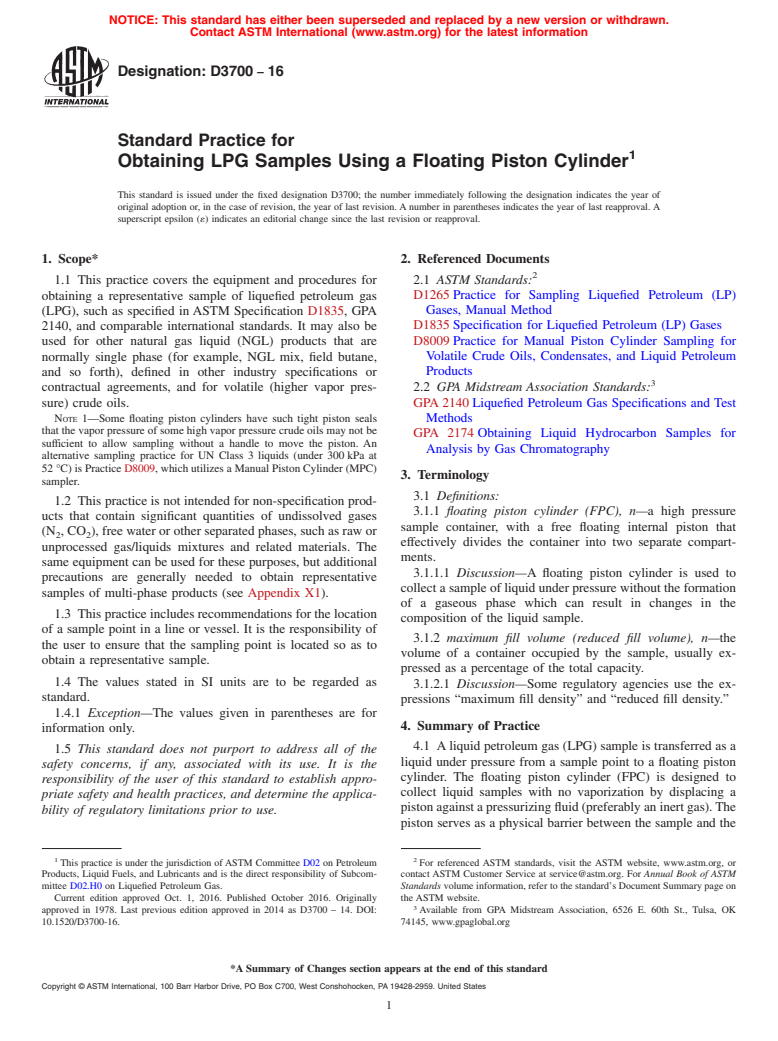
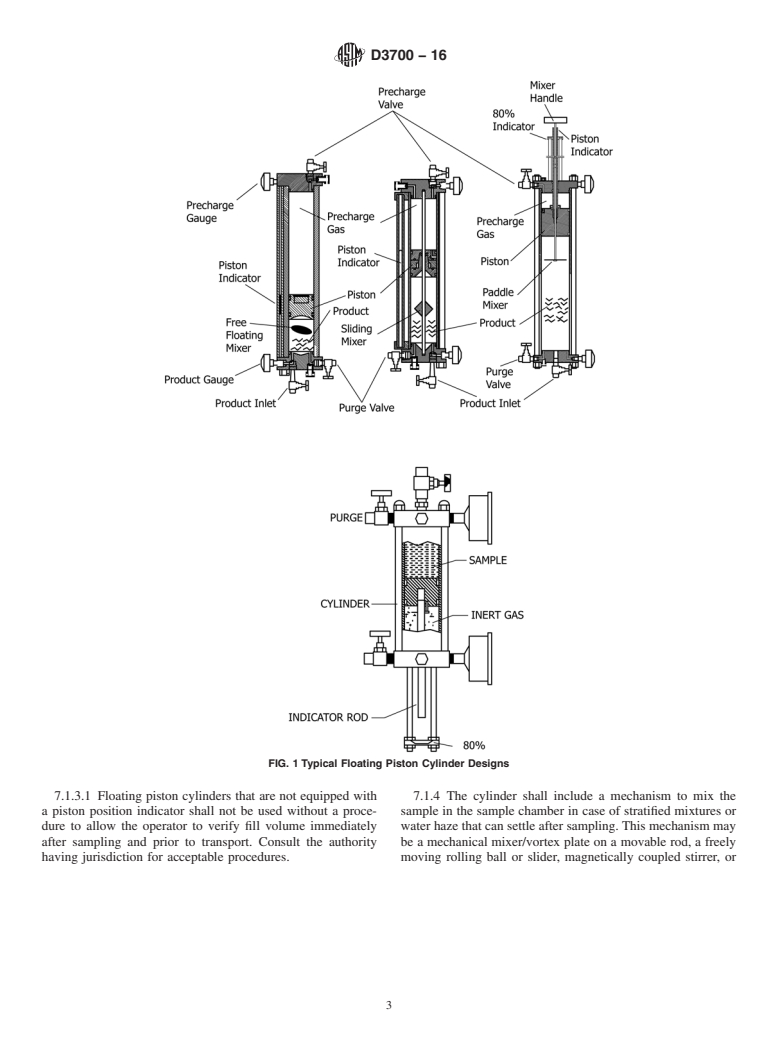
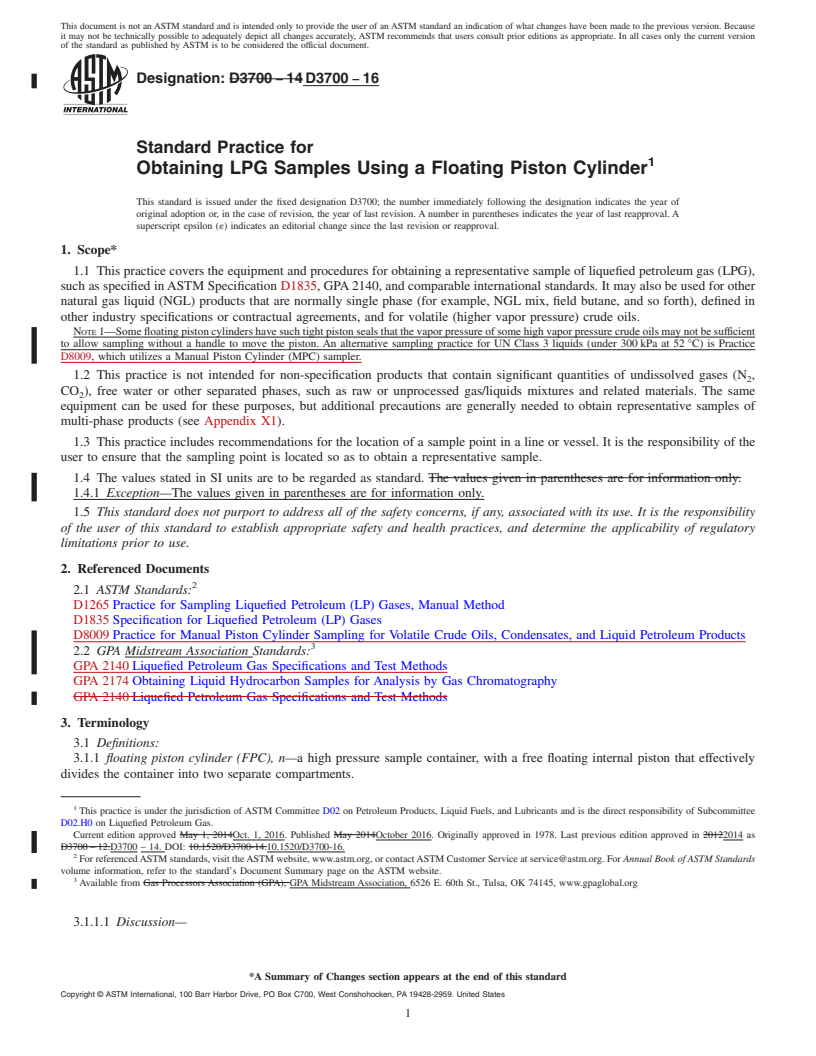
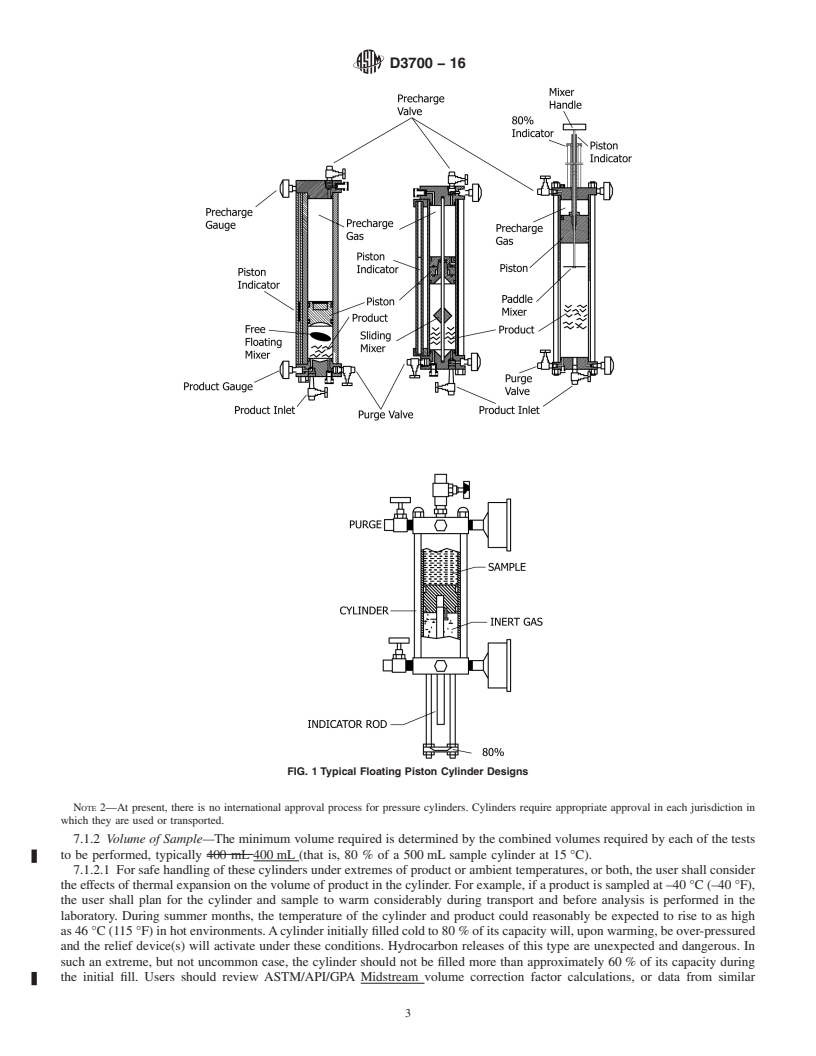
Standards Content (Sample)
NOTICE: This standard has either been superseded and replaced by a new version or withdrawn.
Contact ASTM International (www.astm.org) for the latest information
Designation: D3700 − 16
Standard Practice for
1
Obtaining LPG Samples Using a Floating Piston Cylinder
This standard is issued under the fixed designation D3700; the number immediately following the designation indicates the year of
original adoption or, in the case of revision, the year of last revision. A number in parentheses indicates the year of last reapproval. A
superscript epsilon (´) indicates an editorial change since the last revision or reapproval.
1. Scope* 2. Referenced Documents
2
1.1 This practice covers the equipment and procedures for 2.1 ASTM Standards:
D1265 Practice for Sampling Liquefied Petroleum (LP)
obtaining a representative sample of liquefied petroleum gas
Gases, Manual Method
(LPG), such as specified in ASTM Specification D1835,GPA
D1835 Specification for Liquefied Petroleum (LP) Gases
2140, and comparable international standards. It may also be
D8009 Practice for Manual Piston Cylinder Sampling for
used for other natural gas liquid (NGL) products that are
normally single phase (for example, NGL mix, field butane, Volatile Crude Oils, Condensates, and Liquid Petroleum
Products
and so forth), defined in other industry specifications or
3
contractual agreements, and for volatile (higher vapor pres-
2.2 GPA Midstream Association Standards:
sure) crude oils. GPA 2140 Liquefied Petroleum Gas Specifications and Test
NOTE 1—Some floating piston cylinders have such tight piston seals Methods
that the vapor pressure of some high vapor pressure crude oils may not be
GPA 2174 Obtaining Liquid Hydrocarbon Samples for
sufficient to allow sampling without a handle to move the piston. An
Analysis by Gas Chromatography
alternative sampling practice for UN Class 3 liquids (under 300 kPa at
52 °C) is Practice D8009, which utilizes a Manual Piston Cylinder (MPC)
3. Terminology
sampler.
3.1 Definitions:
1.2 This practice is not intended for non-specification prod-
3.1.1 floating piston cylinder (FPC), n—a high pressure
ucts that contain significant quantities of undissolved gases
sample container, with a free floating internal piston that
(N ,CO ), free water or other separated phases, such as raw or
2 2
effectively divides the container into two separate compart-
unprocessed gas/liquids mixtures and related materials. The
ments.
same equipment can be used for these purposes, but additional
3.1.1.1 Discussion—A floating piston cylinder is used to
precautions are generally needed to obtain representative
collect a sample of liquid under pressure without the formation
samples of multi-phase products (see Appendix X1).
of a gaseous phase which can result in changes in the
1.3 This practice includes recommendations for the location
composition of the liquid sample.
of a sample point in a line or vessel. It is the responsibility of
3.1.2 maximum fill volume (reduced fill volume), n—the
the user to ensure that the sampling point is located so as to
volume of a container occupied by the sample, usually ex-
obtain a representative sample.
pressed as a percentage of the total capacity.
1.4 The values stated in SI units are to be regarded as
3.1.2.1 Discussion—Some regulatory agencies use the ex-
standard.
pressions “maximum fill density” and “reduced fill density.”
1.4.1 Exception—The values given in parentheses are for
4. Summary of Practice
information only.
4.1 Aliquid petroleum gas (LPG) sample is transferred as a
1.5 This standard does not purport to address all of the
liquid under pressure from a sample point to a floating piston
safety concerns, if any, associated with its use. It is the
cylinder. The floating piston cylinder (FPC) is designed to
responsibility of the user of this standard to establish appro-
collect liquid samples with no vaporization by displacing a
priate safety and health practices, and determine the applica-
pistonagainstapressurizingfluid(preferablyaninertgas).The
bility of regulatory limitations prior to use.
piston serves as a physical barrier between the sample and the
1 2
This practice is under the jurisdiction of ASTM Committee D02 on Petroleum For referenced ASTM standards, visit the ASTM website, www.astm.org, or
Products, Liquid Fuels, and Lubricants and is the direct responsibility of Subcom- contact ASTM Customer Service at service@astm.org. For Annual Book of ASTM
mittee D02.H0 on Liquefied Petroleum Gas. Standards volume information, refer to the standard’s Document Summary page on
Current edition approved Oct. 1, 2016. Published October 2016. Originally the ASTM website.
3
approved in 1978. Last previous edition approved in 2014 as D3700 – 14. DOI: Available from GPA Midstream Association, 6526 E. 60th St., Tulsa, OK
10.1520/D3700-16. 74145, www.gpaglobal.org
*A Summary of Changes section appears at the end of this standard
Copyright © ASTM International, 100 Barr Harbor Drive, PO Box C700, West Conshohocken, PA 19428-2959. United
...
This document is not an ASTM standard and is intended only to provide the user of an ASTM standard an indication of what changes have been made to the previous version. Because
it may not be technically possible to adequately depict all changes accurately, ASTM recommends that users consult prior editions as appropriate. In all cases only the current version
of the standard as published by ASTM is to be considered the official document.
Designation: D3700 − 14 D3700 − 16
Standard Practice for
1
Obtaining LPG Samples Using a Floating Piston Cylinder
This standard is issued under the fixed designation D3700; the number immediately following the designation indicates the year of
original adoption or, in the case of revision, the year of last revision. A number in parentheses indicates the year of last reapproval. A
superscript epsilon (´) indicates an editorial change since the last revision or reapproval.
1. Scope*
1.1 This practice covers the equipment and procedures for obtaining a representative sample of liquefied petroleum gas (LPG),
such as specified in ASTM Specification D1835, GPA 2140, and comparable international standards. It may also be used for other
natural gas liquid (NGL) products that are normally single phase (for example, NGL mix, field butane, and so forth), defined in
other industry specifications or contractual agreements, and for volatile (higher vapor pressure) crude oils.
NOTE 1—Some floating piston cylinders have such tight piston seals that the vapor pressure of some high vapor pressure crude oils may not be sufficient
to allow sampling without a handle to move the piston. An alternative sampling practice for UN Class 3 liquids (under 300 kPa at 52 °C) is Practice
D8009, which utilizes a Manual Piston Cylinder (MPC) sampler.
1.2 This practice is not intended for non-specification products that contain significant quantities of undissolved gases (N ,
2
CO ), free water or other separated phases, such as raw or unprocessed gas/liquids mixtures and related materials. The same
2
equipment can be used for these purposes, but additional precautions are generally needed to obtain representative samples of
multi-phase products (see Appendix X1).
1.3 This practice includes recommendations for the location of a sample point in a line or vessel. It is the responsibility of the
user to ensure that the sampling point is located so as to obtain a representative sample.
1.4 The values stated in SI units are to be regarded as standard. The values given in parentheses are for information only.
1.4.1 Exception—The values given in parentheses are for information only.
1.5 This standard does not purport to address all of the safety concerns, if any, associated with its use. It is the responsibility
of the user of this standard to establish appropriate safety and health practices, and determine the applicability of regulatory
limitations prior to use.
2. Referenced Documents
2
2.1 ASTM Standards:
D1265 Practice for Sampling Liquefied Petroleum (LP) Gases, Manual Method
D1835 Specification for Liquefied Petroleum (LP) Gases
D8009 Practice for Manual Piston Cylinder Sampling for Volatile Crude Oils, Condensates, and Liquid Petroleum Products
3
2.2 GPA Midstream Association Standards:
GPA 2140 Liquefied Petroleum Gas Specifications and Test Methods
GPA 2174 Obtaining Liquid Hydrocarbon Samples for Analysis by Gas Chromatography
GPA 2140 Liquefied Petroleum Gas Specifications and Test Methods
3. Terminology
3.1 Definitions:
3.1.1 floating piston cylinder (FPC), n—a high pressure sample container, with a free floating internal piston that effectively
divides the container into two separate compartments.
1
This practice is under the jurisdiction of ASTM Committee D02 on Petroleum Products, Liquid Fuels, and Lubricants and is the direct responsibility of Subcommittee
D02.H0 on Liquefied Petroleum Gas.
Current edition approved May 1, 2014Oct. 1, 2016. Published May 2014October 2016. Originally approved in 1978. Last previous edition approved in 20122014 as
D3700 – 12.D3700 – 14. DOI: 10.1520/D3700-14.10.1520/D3700-16.
2
For referenced ASTM standards, visit the ASTM website, www.astm.org, or contact ASTM Customer Service at service@astm.org. For Annual Book of ASTM Standards
volume information, refer to the standard’s Document Summary page on the ASTM website.
3
Available from Gas Processors Association (GPA), GPA Midstream Association, 6526 E. 60th St., Tulsa, OK 74145, www.gpaglobal.org
3.1.1.1 Discussion—
*A Summary of Changes section appears at the end of this standard
Copyright © ASTM International, 100 Barr Harbor Drive, PO Box C700, West Conshohocken, PA 19428-2959. United States
1
---------------------- Page: 1 ----------------------
D3700 − 16
A floating piston cylinder is used to collect a sample of liquid under pressure without the formation of a gaseous phase which can
result in changes in the composition of the liquid sample.
3.1.2 maximum fill volume (reduced fill volume), n—the volume of a container occupied by the
...
Questions, Comments and Discussion
Ask us and Technical Secretary will try to provide an answer. You can facilitate discussion about the standard in here.