

ASTM C1861-23a
(Specification)Standard Specification for Lathing and Furring Accessories, and Fasteners, for Interior and Exterior Portland Cement-Based Plaster
General Information
- Abstract
ABSTRACT
This specification covers the minimum requirements for lathing and furring accessories and fasteners used as components of interior and exterior portland cement-based plaster assemblies for facilitating lathing and furring installation, cement plaster application, and functionality of the completed stucco cladding assembly. Lathing and furring accessories, and fasteners shall be free of deleterious amounts of rust, oil, or other foreign matter that could cause bond failure or unsightly discoloration; shall include key attachment flanges or solid attachment flanges; and shall be configured to accommodate application of the specified cement plaster thickness. Lathing accessories serving a drainage function shall include a drainage surface and a solid attachment flange. lathing accessories to facilitate drainage include weep screed, designated drainage screed, and perforations; lathing accessories to reinforce corners include internal corner reinforcement and external corner reinforcement; lathing accessories to reduce cracking include expansion joint and control joint; furring accessories include rod hanger, strap hanger, cold-rolled channel furring, and Z-furring.
SCOPE
1.1 This specification contains the minimum requirements for lathing and furring accessories, and fasteners, as components of interior and exterior portland cement-based plaster assemblies, used to facilitate lathing and furring installation (Specifications C1063, C1787), cement plaster application (Specification C926), and functionality of the completed stucco cladding assembly.
1.2 The values stated in inch-pound units are to be regarded as standard. The values given in parentheses are mathematical conversions to SI units that are provided for information only and are not considered standard.
1.3 This standard does not purport to address all of the safety concerns, if any, associated with its use. It is the responsibility of the user of this standard to establish appropriate safety, health, and environmental practices and determine the applicability of regulatory limitations prior to use.
1.4 This international standard was developed in accordance with internationally recognized principles on standardization established in the Decision on Principles for the Development of International Standards, Guides and Recommendations issued by the World Trade Organization Technical Barriers to Trade (TBT) Committee.
- Status
- Published
- Publication Date
- 30-Sep-2023
- Technical Committee
- C11 - Gypsum and Related Building Materials and Systems
Buy Documents
ASTM C1861-23a - Standard Specification for Lathing and Furring Accessories, and Fasteners, for Interior and Exterior Portland Cement-Based Plaster
REDLINE ASTM C1861-23a - Standard Specification for Lathing and Furring Accessories, and Fasteners, for Interior and Exterior Portland Cement-Based Plaster
Overview
ASTM C1861-23a establishes the minimum requirements for lathing and furring accessories, as well as fasteners, used in both interior and exterior portland cement-based plaster (commonly called cement plaster or stucco) assemblies. Developed by ASTM International, this standard ensures that components such as weep screeds, casing beads, corner reinforcements, expansion joints, furring systems, and their related fasteners support proper installation, drainage, and long-term performance of plastered wall systems. Compliance with ASTM C1861-23a is critical for architects, contractors, and manufacturers involved in the design and construction of stucco-clad structures.
Key Topics
- Accessory Types: The standard covers lathing and furring accessories (including weep screeds, drainage screeds, casing beads, internal and external corner reinforcements, expansion joints, control joints, rod hangers, strap hangers, U-Channel furring, and Z-furring).
- Fasteners: Guidance is provided for compatible and corrosion-resistant nails, screws, staples, power actuated fasteners, wire, adhesive, eye screws, and machine bolts.
- Materials Requirements: Specifies acceptable base materials, including galvanized steel, stainless steel, anodized aluminum, zinc, rigid PVC, and CPVC, with sectioned minimum thicknesses. All components must be free from rust, oil, or contaminants.
- Corrosion Resistance: Emphasizes durability, requiring galvanization or equivalent protective finishes for metal parts to prevent premature failure and staining.
- Drainage and Movement: Details proper accessory configurations to ensure effective water drainage away from the building envelope and to reduce plaster cracking from building movement or temperature changes.
- Dimensional Tolerances and Appearance: Sets tolerances for lengths, quality of edges, and absence of damaging burrs or sharp features to ensure safe installation and consistent performance.
Applications
ASTM C1861-23a is widely used in the construction and renovation of residential, commercial, and institutional buildings where portland cement-based plaster, or stucco, is applied as an exterior or interior cladding system. Practical applications include:
- New Construction and Remodeling: Ensures lath and furring systems are correctly specified and installed for robust plaster adhesion and longevity.
- Moisture Control: By requiring properly designed weep screeds and drainage accessories, the standard helps prevent moisture buildup, which can lead to mold, material degradation, or finish failures.
- Crack Mitigation: Expansion and control joints detailed in the standard help manage building movement and thermal expansion, reducing the risk of unsightly or structural cracking in plaster finishes.
- Structural Safety and Aesthetics: Proper selection and installation of accessories contribute to safer, code-compliant envelopes and visually appealing surfaces.
Related Standards
ASTM C1861-23a is closely connected with several other important industry standards, including:
- ASTM C1063: Specification for Installation of Lathing and Furring to Receive Interior and Exterior Portland Cement-Based Plaster.
- ASTM C926: Specification for Application of Portland Cement-Based Plaster.
- ASTM C1787: Specification for Installation of Non-Metallic Plaster Bases (Lath) Used with Portland Cement-Based Plaster.
- ASTM C954 and C1002: Specifications for fasteners used in securing plaster bases to steel and wood framing.
- ASTM F1667: Specification for Nails, Spikes, and Staples.
- AISI S220/S240: North American standards for cold-formed steel framing components.
These related standards provide comprehensive quality and compatibility guidelines, ensuring holistic performance across various components and installation techniques for cement plaster assemblies.
Keywords: ASTM C1861-23a, lathing accessories, furring accessories, fasteners, portland cement plaster, stucco, weep screed, drainage, expansion joint, control joint, casing bead, U-Channel furring, construction standards, moisture management, crack prevention, corrosion resistance.
Relations
- Effective Date
- 01-Oct-2023
- Effective Date
- 15-Nov-2023
- Effective Date
- 01-Nov-2023
- Effective Date
- 01-Mar-2023
- Effective Date
- 01-Mar-2023
- Referred By
ASTM F1667/F1667M-21a - Standard Specification for Driven Fasteners: Nails, Spikes, and Staples - Effective Date
- 01-Oct-2023
- Effective Date
- 01-Oct-2023
- Referred By
ASTM C1780-23a - Standard Practice for Installation Methods for Cement-based Adhered Masonry Veneer - Effective Date
- 01-Oct-2023
- Effective Date
- 01-Oct-2023
Buy Documents
ASTM C1861-23a - Standard Specification for Lathing and Furring Accessories, and Fasteners, for Interior and Exterior Portland Cement-Based Plaster
REDLINE ASTM C1861-23a - Standard Specification for Lathing and Furring Accessories, and Fasteners, for Interior and Exterior Portland Cement-Based Plaster
Get Certified
Connect with accredited certification bodies for this standard

DIBt (Deutsches Institut für Bautechnik)
German Institute for Building Technology.
DIN CERTCO
DIN Group product certification.

Aboma Certification B.V.
Specialized in construction, metal, and transport sectors.
Sponsored listings
Frequently Asked Questions
ASTM C1861-23a is a technical specification published by ASTM International. Its full title is "Standard Specification for Lathing and Furring Accessories, and Fasteners, for Interior and Exterior Portland Cement-Based Plaster". This standard covers: ABSTRACT This specification covers the minimum requirements for lathing and furring accessories and fasteners used as components of interior and exterior portland cement-based plaster assemblies for facilitating lathing and furring installation, cement plaster application, and functionality of the completed stucco cladding assembly. Lathing and furring accessories, and fasteners shall be free of deleterious amounts of rust, oil, or other foreign matter that could cause bond failure or unsightly discoloration; shall include key attachment flanges or solid attachment flanges; and shall be configured to accommodate application of the specified cement plaster thickness. Lathing accessories serving a drainage function shall include a drainage surface and a solid attachment flange. lathing accessories to facilitate drainage include weep screed, designated drainage screed, and perforations; lathing accessories to reinforce corners include internal corner reinforcement and external corner reinforcement; lathing accessories to reduce cracking include expansion joint and control joint; furring accessories include rod hanger, strap hanger, cold-rolled channel furring, and Z-furring. SCOPE 1.1 This specification contains the minimum requirements for lathing and furring accessories, and fasteners, as components of interior and exterior portland cement-based plaster assemblies, used to facilitate lathing and furring installation (Specifications C1063, C1787), cement plaster application (Specification C926), and functionality of the completed stucco cladding assembly. 1.2 The values stated in inch-pound units are to be regarded as standard. The values given in parentheses are mathematical conversions to SI units that are provided for information only and are not considered standard. 1.3 This standard does not purport to address all of the safety concerns, if any, associated with its use. It is the responsibility of the user of this standard to establish appropriate safety, health, and environmental practices and determine the applicability of regulatory limitations prior to use. 1.4 This international standard was developed in accordance with internationally recognized principles on standardization established in the Decision on Principles for the Development of International Standards, Guides and Recommendations issued by the World Trade Organization Technical Barriers to Trade (TBT) Committee.
ABSTRACT This specification covers the minimum requirements for lathing and furring accessories and fasteners used as components of interior and exterior portland cement-based plaster assemblies for facilitating lathing and furring installation, cement plaster application, and functionality of the completed stucco cladding assembly. Lathing and furring accessories, and fasteners shall be free of deleterious amounts of rust, oil, or other foreign matter that could cause bond failure or unsightly discoloration; shall include key attachment flanges or solid attachment flanges; and shall be configured to accommodate application of the specified cement plaster thickness. Lathing accessories serving a drainage function shall include a drainage surface and a solid attachment flange. lathing accessories to facilitate drainage include weep screed, designated drainage screed, and perforations; lathing accessories to reinforce corners include internal corner reinforcement and external corner reinforcement; lathing accessories to reduce cracking include expansion joint and control joint; furring accessories include rod hanger, strap hanger, cold-rolled channel furring, and Z-furring. SCOPE 1.1 This specification contains the minimum requirements for lathing and furring accessories, and fasteners, as components of interior and exterior portland cement-based plaster assemblies, used to facilitate lathing and furring installation (Specifications C1063, C1787), cement plaster application (Specification C926), and functionality of the completed stucco cladding assembly. 1.2 The values stated in inch-pound units are to be regarded as standard. The values given in parentheses are mathematical conversions to SI units that are provided for information only and are not considered standard. 1.3 This standard does not purport to address all of the safety concerns, if any, associated with its use. It is the responsibility of the user of this standard to establish appropriate safety, health, and environmental practices and determine the applicability of regulatory limitations prior to use. 1.4 This international standard was developed in accordance with internationally recognized principles on standardization established in the Decision on Principles for the Development of International Standards, Guides and Recommendations issued by the World Trade Organization Technical Barriers to Trade (TBT) Committee.
ASTM C1861-23a is classified under the following ICS (International Classification for Standards) categories: 91.100.10 - Cement. Gypsum. Lime. Mortar. The ICS classification helps identify the subject area and facilitates finding related standards.
ASTM C1861-23a has the following relationships with other standards: It is inter standard links to ASTM C1861-23, ASTM C926-23a, ASTM A240/A240M-23a, ASTM A240/A240M-23, ASTM C926-23, ASTM F1667/F1667M-21a, ASTM C1063-23, ASTM C1780-23a, ASTM C1787-23. Understanding these relationships helps ensure you are using the most current and applicable version of the standard.
ASTM C1861-23a is available in PDF format for immediate download after purchase. The document can be added to your cart and obtained through the secure checkout process. Digital delivery ensures instant access to the complete standard document.
Standards Content (Sample)
This international standard was developed in accordance with internationally recognized principles on standardization established in the Decision on Principles for the
Development of International Standards, Guides and Recommendations issued by the World Trade Organization Technical Barriers to Trade (TBT) Committee.
Designation: C1861 − 23a
Standard Specification for
Lathing and Furring Accessories, and Fasteners, for Interior
and Exterior Portland Cement-Based Plaster
This standard is issued under the fixed designation C1861; the number immediately following the designation indicates the year of
original adoption or, in the case of revision, the year of last revision. A number in parentheses indicates the year of last reapproval. A
superscript epsilon (´) indicates an editorial change since the last revision or reapproval.
1. Scope* A653/A653M Specification for Steel Sheet, Zinc-Coated
(Galvanized) or Zinc-Iron Alloy-Coated (Galvannealed)
1.1 This specification contains the minimum requirements
by the Hot-Dip Process
for lathing and furring accessories, and fasteners, as compo-
B69 Specification for Rolled Zinc
nents of interior and exterior portland cement-based plaster
B221 Specification for Aluminum and Aluminum-Alloy Ex-
assemblies, used to facilitate lathing and furring installation
truded Bars, Rods, Wire, Profiles, and Tubes
(Specifications C1063, C1787), cement plaster application
C926 Specification for Application of Portland Cement-
(Specification C926), and functionality of the completed stucco
Based Plaster
cladding assembly.
C954 Specification for Steel Drill Screws for the Application
1.2 The values stated in inch-pound units are to be regarded
of Gypsum Panel Products or Metal Plaster Bases to Steel
as standard. The values given in parentheses are mathematical
Studs from 0.033 in. (0.84 mm) to 0.112 in. (2.84 mm) in
conversions to SI units that are provided for information only
Thickness
and are not considered standard.
C1002 Specification for Steel Self-Piercing Tapping Screws
1.3 This standard does not purport to address all of the for Application of Gypsum Panel Products or Metal
safety concerns, if any, associated with its use. It is the
Plaster Bases to Wood Studs or Steel Studs
responsibility of the user of this standard to establish appro- C1063 Specification for Installation of Lathing and Furring
priate safety, health, and environmental practices and deter-
to Receive Interior and Exterior Portland Cement-Based
mine the applicability of regulatory limitations prior to use. Plaster
1.4 This international standard was developed in accor-
C1787 Specification for Installation of Non Metallic Plaster
dance with internationally recognized principles on standard- Bases (Lath) Used with Portland Cement Based Plaster in
ization established in the Decision on Principles for the
Vertical Wall Applications
Development of International Standards, Guides and Recom-
D1784 Classification System and Basis for Specification for
mendations issued by the World Trade Organization Technical Rigid Poly(Vinyl Chloride) (PVC) Compounds and Chlo-
Barriers to Trade (TBT) Committee.
rinated Poly(Vinyl Chloride) (CPVC) Compounds
D4216 Specification for Rigid Poly(Vinyl Chloride) (PVC)
2. Referenced Documents
and Related PVC and Chlorinated Poly(Vinyl Chloride)
2.1 ASTM Standards:
(CPVC) Building Products Compounds
A240/A240M Specification for Chromium and Chromium-
F1667 Specification for Driven Fasteners: Nails, Spikes, and
Nickel Stainless Steel Plate, Sheet, and Strip for Pressure
Staples
Vessels and for General Applications
2.2 AISI Standards:
A580/A580M Specification for Stainless Steel Wire
AISI S220 North American Standard for Cold-Formed Steel
A641/A641M Specification for Zinc–Coated (Galvanized)
Framing—Nonstructural Members
Carbon Steel Wire
AISI S240 North American Standard for Cold-Formed Steel
Structural Framing
This specification is under the jurisdiction of ASTM Committee C11 on
Gypsum and Related Building Materials and Systems and is the direct responsibility
3. Terminology
of Subcommittee C11.02 on Specifications and Test Methods for Accessories and
3.1 Definitions:
Related Products.
Current edition approved Oct. 1, 2023. Published October 2023. Originally
3.1.1 Definitions shall be in accordance with Specification
approved in 2017. Last previous edition approved in 2023 as C1861 – 23. DOI:
C1063.
10.1520/C1861-23A.
For referenced ASTM standards, visit the ASTM website, www.astm.org, or
contact ASTM Customer Service at service@astm.org. For Annual Book of ASTM
Standards volume information, refer to the standard’s Document Summary page on Available from American Iron and Steel (AISI), 25 Massachusetts Avenue, NW,
the ASTM website. Suite 800, Washington, DC 20001, https://www.steel.org.
*A Summary of Changes section appears at the end of this standard
Copyright © ASTM International, 100 Barr Harbor Drive, PO Box C700, West Conshohocken, PA 19428-2959. United States
C1861 − 23a
3.2 Definitions of Terms Specific to This Standard: 4.1.1 Lathing and furring accessories, and fasteners shall be
free of deleterious amounts of rust, oil, or other foreign matter
3.2.1 capture flange, n—the narrow flange element of a
that could cause bond failure or unsightly discoloration.
lathing accessory that projects from a ground and returns onto
the exterior stucco cladding surface to conceal the gap between
4.1.2 Lathing and furring accessories shall include key
the ground and stucco cladding. attachment flanges or solid attachment flanges. Solid attach-
ment flanges shall accommodate self-piercing fasteners with-
3.2.2 cement plaster panel area, n—the surface of a cement
out deforming the attachment flange or shall include optional
plaster area between lathing accessory grounds.
fastener holes used to fasten the lathing accessory.
3.2.3 drainage surface, n—the sloped or non-sloped, perfo-
4.1.3 Lathing and furring accessories shall facilitate lathing
rated or non-perforated surface element of a lathing accessory
and furring installation, cement plaster application, and func-
that facilitates a drainage function, by directing water from
tionality of the completed stucco cladding assembly. Lathing
behind the stucco cladding to the exterior of the stucco
and furring accessories shall be configured to serve one or
cladding.
more functions such as to assist in cement plaster thickness
3.2.4 drip flange, n—the narrow flange element of a lathing
control, to reinforce cement plaster corners, to facilitate
accessory that facilitates a drainage function, projects from a
drainage, to reduce cracking by accommodating movement, to
drainage surface and directs water to the exterior of the stucco
separate cement plaster from dissimilar materials, load bearing
cladding.
members and penetrating elements, and to provide an edge,
end, or termination for a cement plaster panel area.
3.2.5 fastener, n—a nail, screw, staple or power actuated
4.1.4 Lathing accessories shall be configured to accommo-
fastener.
date application of the specified cement plaster thickness. The
3.2.6 flexible pleat, n—the flexible element of a control joint
ground dimension of lathing accessories shall be determined by
lathing accessory that accommodates movement of the cement
the specified thickness of the cement plaster with consideration
plaster cladding assembly caused by shrinkage and thermal
of the installed configuration of the lathing accessory to the lath
variations.
(lathing accessory located under or over the lath).
3.2.7 ground, n—the element of a lathing accessory that
4.1.5 Lathing accessories serving a drainage function shall
provides an edge, end, or termination for a cement plaster panel
include a drainage surface and a solid attachment flange.
area, with a ground dimension to assist in cement plaster
4.2 Materials:
thickness control.
4.2.1 Steel—Specification A653/A653M, with a G60 coat-
3.2.8 key attachment flange, n—the attachment flange ele-
ing.
ment of a lathing accessory that is full of holes or is expanded
4.2.2 Stainless Steel—Specification A240/A240M, Type
sheet metal that provides a means for accurate alignment,
304 or 316.
facilitates complete embedment of the key attachment flange
4.2.3 Zinc Alloy—Specification B69, 99 % pure zinc.
and adjacent lath by cement plaster, and is used to attach the
lathing accessory.
4.2.4 Anodized Aluminum Alloy—Specification B221.
4.2.5 PVC and CPVC Plastic—Specification D1784 or
3.2.9 movement gap, n—the element of an expansion joint
D4216.
lathing accessory that accommodates some degree of move-
ment in the stucco cladding assembly caused by movement of 4.2.6 Lathing accessories shall be corrosion resistant and
fabricated from galvanized (zinc-coated) steel, stainless steel,
the building, the substrate, or its components.
rigid PVC or CPVC plastic, zinc alloy, or anodized aluminum
3.2.10 screed, n—synonymous with ground.
alloy. Lathing accessory base material and minimum thickness
3.2.11 solid attachment flange, n—the solid attachment
shall be as indicated in Table 1.
flange element of a lathing or furring accessory that provides a
4.2.7 Fasteners shall be fabricated from steel or stainless
means for accurate alignment, facilitates drainage where drain-
steel and comply with Specifications C954, C1002, and F1667
age is required by integration of the solid attachment flange
as applicable. Steel fasteners shall have a corrosion resistant
with the water-resistive barrier, and which has no holes except
plating or coating.
for optional fastener holes used to fasten the lathing accessory.
4.2.7.1 Fasteners in contact with preservative-treated or fire
3.3 Illustrations (Fig. 1) are intended to generically depict
retardant-treated wood shall comply with the requirements of
examples of common lathing and furring accessory shapes and the applicable code for corrosion resistance.
fasteners, by depicting their functional elements in relationship
4.2.8 Wire shall be corrosion resistant steel wire, annealed,
to each other, without literally depicting specific manufactured
Specification A641/A641M with a Class I galvanized coating,
products. Variations of lathing and furring accessory shapes
or stainless steel wire, annealed, Specification A580/A580M.
and fasteners illustrated shall be acceptable when the function
4.2.9 Adhesive shall be a materials compatible, exterior,
and performance is equivalent to or exceeds the illustrated
gun-grade, construction adhesive. Expandable foam adhesives
accessory or fastener.
are prohibited.
4.2.10 Clips shall be formed from galvanized steel wire,
4. Materials and Manufacture
Specification A641/A641M or steel sheet, Specification A653/
4.1 General: A653M, depending on use and manufacturer’s requirements.
C1861 − 23a
FIG. 1 Lathing and Furring Accessories, and Fasteners
C1861 − 23a
FIG. 1 Lathing and Furring Accessories, and Fasteners (continued)
C1861 − 23a
FIG. 1 Lathing and Furring Accessories, and Fasteners (continued)
C1861 − 23a
FIG. 1 Lathing and Furring Accessories, and Fasteners (continued)
C1861 − 23a
FIG. 1 Lathing and Furring Accessories, and Fasteners (continued)
C1861 − 23a
TABLE 1 Minimum Thickness of Lathing Accessories
Base Material, in. (mm)
Accessory Steel & Stainless Steel, Steel & Stainless Steel, PVC & CPVC Plastic,
Zinc Alloy, Sheet Aluminum, Extrusion
Sheet Wire Extrusion
Weep Screed and
0.050 (1.27)
Drainage Screed - - - 0.050 (1.27)
0.0207 (0.53)
Casing Bead
0.0172 (0.44) 0.035 (0.89)
Corner Reinforcement 0.0410 (1.04) - - -
Expansion Joint 0.050 (1.27)
- - - 0.018 (0.46) 0.050 (1.27)
Control Joint - - -
4.2.11 Rod hanger and strap hanger shall be mild steel, and 4.4.2 Casing Bead, Solid Flange—A casing bead with a
galvanized, zinc electroplated, or protected with a rust- solid attachment flange.
inhibiting paint.
4.4.3 Casing Bead, Key Flange—A casing bead with an
4.2.12 U-Channel furring shall be cold-formed steel, attachment flange full of holes or of expanded sheet metal.
33 000 psi (228 MPa) yield strength, 0.0538 in. (1.37 mm)
4.5 Lathing Accessories to Reinforce Corners:
minimum bare steel thickness.
4.5.1 Internal Corner Reinforcement—Lathing accessory
4.2.12.1 U-Channel furring protective coating:
used to reinforce internal cement plaster corners, with key
4.2.12.2 U-Channel furring for use in interior applications
attachment flanges of not less than 2 in. (50 mm) length, bent
shall have a protective coating conforming to the requirements
to an interior angle between the flanges greater than 90°.
of AISI S220.
4.5.2 External Corner Reinforcement—Lathing accessory
4.2.12.3 U-Channel furring for use in exterior applications
used to reinforce external cement plaster corners; as a screed to
shall have a protective coating conforming to the requirements
assist in cement plaster thickness control; and to provide an
of AISI S240.
edge, end, or termination for a cement plaster panel area, with
4.3 Lathing Accessories to Facilitate Drainage:
key attachment flanges of not less than 2 ⁄2 in. (63 mm) length,
4.3.1 Weep Screed—Lathing accessory located at the bottom
bent to an interior angle between the flanges less than 90°.
of exterior framed or framed and sheathed walls; used as a
4.6 Lathing Accessories to Reduce Cracking:
screed to assist in cement plaster thickness control; to facilitate
4.6.1 Expansion Joint—Lathing accessory used as a screed
drainage; and to provide an edge, end, or termination for a
to assist in cement plaster thickness control; to reduce cracking
cement plaster panel area. Weep screed shall include a solid
by accommodating movement of the stucco cladding assembly
vertical attachment flange 3 ⁄2 in. (89 mm) long minimum, and
...
This document is not an ASTM standard and is intended only to provide the user of an ASTM standard an indication of what changes have been made to the previous version. Because
it may not be technically possible to adequately depict all changes accurately, ASTM recommends that users consult prior editions as appropriate. In all cases only the current version
of the standard as published by ASTM is to be considered the official document.
Designation: C1861 − 23 C1861 − 23a
Standard Specification for
Lathing and Furring Accessories, and Fasteners, for Interior
and Exterior Portland Cement-Based Plaster
This standard is issued under the fixed designation C1861; the number immediately following the designation indicates the year of
original adoption or, in the case of revision, the year of last revision. A number in parentheses indicates the year of last reapproval. A
superscript epsilon (´) indicates an editorial change since the last revision or reapproval.
1. Scope*
1.1 This specification contains the minimum requirements for lathing and furring accessories, and fasteners, as components of
interior and exterior portland cement-based plaster assemblies, used to facilitate lathing and furring installation (Specifications
C1063, C1787), cement plaster application (Specification C926), and functionality of the completed stucco cladding assembly.
1.2 The values stated in inch-pound units are to be regarded as standard. The values given in parentheses are mathematical
conversions to SI units that are provided for information only and are not considered standard.
1.3 This standard does not purport to address all of the safety concerns, if any, associated with its use. It is the responsibility
of the user of this standard to establish appropriate safety, health, and environmental practices and determine the applicability of
regulatory limitations prior to use.
1.4 This international standard was developed in accordance with internationally recognized principles on standardization
established in the Decision on Principles for the Development of International Standards, Guides and Recommendations issued
by the World Trade Organization Technical Barriers to Trade (TBT) Committee.
2. Referenced Documents
2.1 ASTM Standards:
A240/A240M Specification for Chromium and Chromium-Nickel Stainless Steel Plate, Sheet, and Strip for Pressure Vessels and
for General Applications
A580/A580M Specification for Stainless Steel Wire
A641/A641M Specification for Zinc–Coated (Galvanized) Carbon Steel Wire
A653/A653M Specification for Steel Sheet, Zinc-Coated (Galvanized) or Zinc-Iron Alloy-Coated (Galvannealed) by the
Hot-Dip Process
B69 Specification for Rolled Zinc
B221 Specification for Aluminum and Aluminum-Alloy Extruded Bars, Rods, Wire, Profiles, and Tubes
C926 Specification for Application of Portland Cement-Based Plaster
C954 Specification for Steel Drill Screws for the Application of Gypsum Panel Products or Metal Plaster Bases to Steel Studs
from 0.033 in. (0.84 mm) to 0.112 in. (2.84 mm) in Thickness
C1002 Specification for Steel Self-Piercing Tapping Screws for Application of Gypsum Panel Products or Metal Plaster Bases
to Wood Studs or Steel Studs
C1063 Specification for Installation of Lathing and Furring to Receive Interior and Exterior Portland Cement-Based Plaster
This specification is under the jurisdiction of ASTM Committee C11 on Gypsum and Related Building Materials and Systems and is the direct responsibility of
Subcommittee C11.02 on Specifications and Test Methods for Accessories and Related Products.
Current edition approved March 15, 2023Oct. 1, 2023. Published March 2023October 2023. Originally approved in 2017. Last previous edition approved in 20222023
as C1861 – 22.C1861 – 23. DOI: 10.1520/C1861-23.10.1520/C1861-23A.
For referenced ASTM standards, visit the ASTM website, www.astm.org, or contact ASTM Customer Service at service@astm.org. For Annual Book of ASTM Standards
volume information, refer to the standard’s Document Summary page on the ASTM website.
*A Summary of Changes section appears at the end of this standard
Copyright © ASTM International, 100 Barr Harbor Drive, PO Box C700, West Conshohocken, PA 19428-2959. United States
C1861 − 23a
C1787 Specification for Installation of Non Metallic Plaster Bases (Lath) Used with Portland Cement Based Plaster in Vertical
Wall Applications
D1784 Classification System and Basis for Specification for Rigid Poly(Vinyl Chloride) (PVC) Compounds and Chlorinated
Poly(Vinyl Chloride) (CPVC) Compounds
D4216 Specification for Rigid Poly(Vinyl Chloride) (PVC) and Related PVC and Chlorinated Poly(Vinyl Chloride) (CPVC)
Building Products Compounds
F1667 Specification for Driven Fasteners: Nails, Spikes, and Staples
2.2 AISI Standards:
AISI S220 North American Standard for Cold-Formed Steel Framing—Nonstructural Members
AISI S240 North American Standard for Cold-Formed Steel Structural Framing
3. Terminology
3.1 Definitions:
3.1.1 Definitions shall be in accordance with Specification C1063.
3.2 Definitions of Terms Specific to This Standard:
3.2.1 capture flange, n—the narrow flange element of a lathing accessory that projects from a ground and returns onto the exterior
stucco cladding surface to conceal the gap between the ground and stucco cladding.
3.2.2 cement plaster panel area, n—the surface of a cement plaster area between lathing accessory grounds.
3.2.3 drainage surface, n—the sloped or non-sloped, perforated or non-perforated surface element of a lathing accessory that
facilitates a drainage function, by directing water from behind the stucco cladding to the exterior of the stucco cladding.
3.2.4 drip flange, n—the narrow flange element of a lathing accessory that facilitates a drainage function, projects from a drainage
surface and directs water to the exterior of the stucco cladding.
3.2.5 fastener, n—a nail, screw, staple or power actuated fastener.
3.2.6 flexible pleat, n—the flexible element of a control joint lathing accessory that accommodates movement of the cement plaster
cladding assembly caused by shrinkage and thermal variations.
3.2.7 ground, n—the element of a lathing accessory that provides an edge, end, or termination for a cement plaster panel area, with
a ground dimension to assist in cement plaster thickness control.
3.2.8 key attachment flange, n—the attachment flange element of a lathing accessory that is full of holes or is expanded sheet metal
that provides a means for accurate alignment, facilitates complete embedment of the key attachment flange and adjacent lath by
cement plaster, and is used to attach the lathing accessory.
3.2.9 movement gap, n—the element of an expansion joint lathing accessory that accommodates some degree of movement in the
stucco cladding assembly caused by movement of the building, the substrate, or its components.
3.2.10 screed, n—synonymous with ground.
3.2.11 solid attachment flange, n—the solid attachment flange element of a lathing or furring accessory that provides a means for
accurate alignment, facilitates drainage where drainage is required by integration of the solid attachment flange with the
water-resistive barrier, and which has no holes except for optional fastener holes used to fasten the lathing accessory.
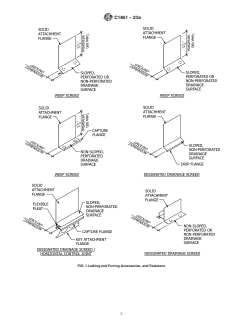
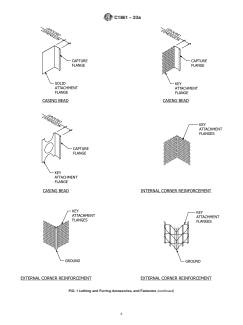
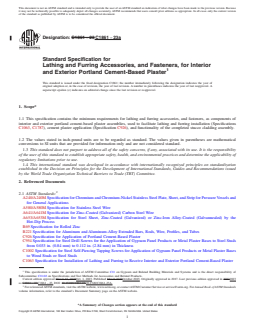
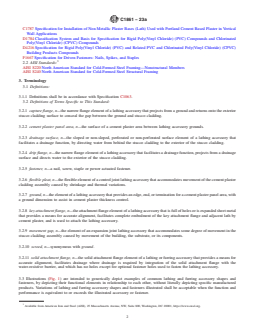
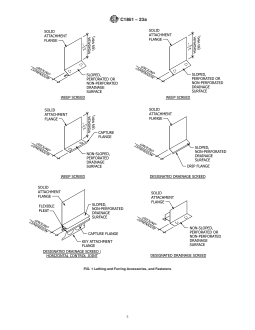
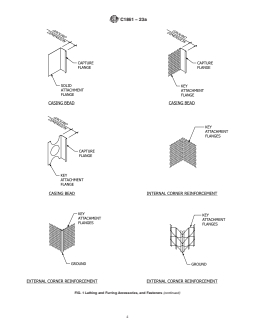
3.3 Illustrations (Fig. 1) are intended to generically depict examples of common lathing and furring accessory shapes and
fasteners, by depicting their functional elements in relationship to each other, without literally depicting specific manufactured
products. Variations of lathing and furring accessory shapes and fasteners illustrated shall be acceptable when the function and
performance is equivalent to or exceeds the illustrated accessory or fastener.
Available from American Iron and Steel (AISI), 25 Massachusetts Avenue, NW, Suite 800, Washington, DC 20001, https://www.steel.org.
C1861 − 23a
FIG. 1 Lathing and Furring Accessories, and Fasteners
C1861 − 23a
FIG. 1 Lathing and Furring Accessories, and Fasteners (continued)
C1861 − 23a
FIG. 1 Lathing and Furring Accessories, and Fasteners (continued)
C1861 − 23a
FIG. 1 Lathing and Furring Accessories, and Fasteners (continued)
C1861 − 23a
FIG. 1 Lathing and Furring Accessories, and Fasteners (continued)
C1861 − 23a
4. Materials and Manufacture
4.1 General:
4.1.1 Lathing and furring accessories, and fasteners shall be free of deleterious amounts of rust, oil, or other foreign matter that
could cause bond failure or unsightly discoloration.
4.1.2 Lathing and furring accessories shall include key attachment flanges or solid attachment flanges. Solid attachment flanges
shall accommodate self-piercing fasteners without deforming the attachment flange or shall include optional fastener holes used
to fasten the lathing accessory.
4.1.3 Lathing and furring accessories shall facilitate lathing and furring installation, cement plaster application, and functionality
of the completed stucco cladding assembly. Lathing and furring accessories shall be configured to serve one or more functions such
as to assist in cement plaster thickness control, to reinforce cement plaster corners, to facilitate drainage, to reduce cracking by
accommodating movement, to separate cement plaster from dissimilar materials, load bearing members and penetrating elements,
and to provide an edge, end, or termination for a cement plaster panel area.
4.1.4 Lathing accessories shall be configured to accommodate application of the specified cement plaster thickness. The ground
dimension of lathing accessories shall be determined by the specified thickness of the cement plaster with consideration of the
installed configuration of the lathing accessory to the lath (lathing accessory located under or over the lath).
4.1.5 Lathing accessories serving a drainage function shall include a drainage surface and a solid attachment flange.
4.2 Materials:
4.2.1 Steel—Specification A653/A653M, with a G60 coating.
4.2.2 Stainless Steel—Specification A240/A240M, Type 304 or 316.
4.2.3 Zinc Alloy—Specification B69, 99 % pure zinc.
4.2.4 Anodized Aluminum Alloy—Specification B221.
4.2.5 PVC and CPVC Plastic—Specification D1784 or D4216.
4.2.6 Lathing accessories shall be corrosion resistant and fabricated from galvanized (zinc-coated) steel, stainless steel, rigid PVC
or CPVC plastic, zinc alloy, or anodized aluminum alloy. Lathing accessory base material and minimum thickness shall be as
indicated in Table 1.
4.2.7 Fasteners shall be fabricated from steel or stainless steel and comply with Specifications C954, C1002, and F1667 as
applicable. Steel fasteners shall have a corrosion resistant plating or coating.
4.2.7.1 Fasteners in contact with preservative-treated or fire retardant-treated wood shall comply with the requirements of the
applicable code for corrosion resistance.
4.2.8 Wire shall be corrosion resistant steel wire, annealed, Specification A641/A641M with a Class I galvanized coating, or
stainless steel wire, annealed, Specification A580/A580M.
TABLE 1 Minimum Thickness of Lathing Accessories
Base Material, in. (mm)
Accessory Steel & Stainless Steel, Steel & Stainless Steel, PVC & CPVC Plastic,
Zinc Alloy, Sheet Aluminum, Extrusion
Sheet Wire Extrusion
Weep Screed and
0.050 (1.27)
Drainage Screed - - - 0.050 (1.27)
0.0207 (0.53)
Casing Bead
0.0172 (0.44) 0.035 (0.89)
Corner Reinforcement 0.0410 (1.04) - - -
Expansion Joint 0.050 (1.27)
- - - 0.018 (0.46) 0.050 (1.27)
Control Joint - - -
C1861 − 23a
4.2.9 Adhesive shall be a materials compatible, exterior, gun-grade, construction adhesive. Expandable foam adhesives are
prohibited.
4.2.10 Clips shall be formed from galvanized steel wire, Specification A641/A641M or steel sheet, Specification A653/A653M,
depending on use and manufacturer’s requirements.
4.2.11 Rod hanger and strap hanger shall be mild steel, and galvanized, zinc electroplated, or protected with a rust-inhibiting paint.
4.2.12 U-Channel furring shall be cold-formed steel, 33 000 psi (228 MPa) yield strength, 0.0538 in. (1.37 mm) minimum bare
steel thickness.
4.2.12.1 U-Channel furring protective coating:
4.2.12.2 U-Channel furring for use in interior applications shall have a protective coating conforming to the requirements of AISI
S220.
4.2.12.3 U-Channel furring for use in exterior applications shall have a protective coating conforming to the requirements of AISI
S240.
4.3 Lathing Accessories to Facilitate Drainage:
4.3.1 Weep Screed—Lathing accessory located at the bottom of exterior framed or framed and sheathed walls; used as a screed
to assist in cement plaster thickness control; to facilitate drainage; and to provide an edge, end, or termination for a cement plaster
panel area. Weep screed shall include a solid vertical attachment flange 3 ⁄2 in. (89 mm) long minimum, and a drainage surface
that is sloped and either perforated or non-perforated, or non-sloped and perforated with a capture flange, or non-sloped and
non-perforated without a capture flange.
4.3.2 Designated Drainage Screed—Lathing accessory located at designated exterior locations in addition to the bottom of exterior
framed, or framed and sheathed walls, such as at floor lines of multi-story buildings, at soffit corners, above wall openings and
projecting elements; used as a screed to assist in cement plaster thickness control; to facilitate drainage; to separate cement plaster
from dissimilar materials, load bearing members and penetrating elements; and to provide an edge, end, or termination for a cement
plaster panel area. Designated drainage screed shall include a solid vertical attachment flange and a drainage surface that is sloped
and non-perforated, or non-sloped and perforated with a capture flange, or non-sloped and non-perforated without a capture flange.
4.3.3 Perforations, where provided on lathing accessory drainage surfaces to facilitate drainage, shall be ¼ in. (6 mm) diameter
minimum or an equivalent non-circular perforation area, at 8 in. (200 mm) on center maximum.
4.4 Lathing Accessories for Casing:
4.4.1 Casing Bead—Lathing accessory used as a screed to assist in cement plaster thickness control; to separate cement plaster
from dissimilar materials, load bearing members and penetrating elements; and to provide an edge, end, or termination for a cement
plaster panel area.
4.4.2 Casing Bead, Solid Flange—A casing bead with a solid attachment flange.
4.4.3 Casing Bead,
...