


ASTM D559/D559M-15(2023)
(Test Method)Standard Test Methods for Wetting and Drying Compacted Soil-Cement Mixtures
Standard Test Methods for Wetting and Drying Compacted Soil-Cement Mixtures
SIGNIFICANCE AND USE
4.1 These test methods are used to determine the resistance of compacted soil-cement specimens to repeated wetting and drying. These test methods were developed to be used in conjunction with Test Methods D560/D560M and criteria given in the Soil-Cement Laboratory Handbook4 to determine the minimum amount of cement required in soil-cement to achieve a degree of hardness adequate to resist field weathering.
Note 1: The quality of the result produced by this standard is dependent on the competence of the personnel performing it, and the suitability of the equipment and facilities used. Agencies that meet the criteria of Practice D3740 are generally considered capable of competent and objective testing/sampling/inspection/etc. Users of this standard are cautioned that compliance with Practice D3740 does not in itself ensure reliable results. Reliable results depend on many factors; Practice D3740 provides a means of evaluating some of those factors.
SCOPE
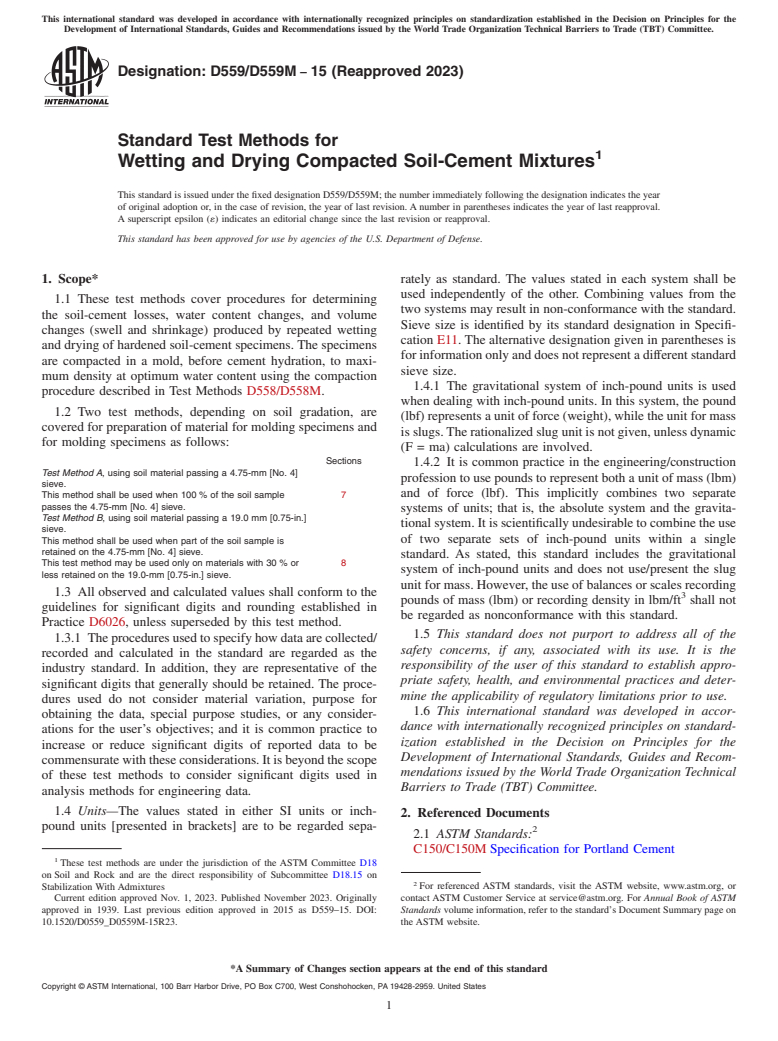
1.1 These test methods cover procedures for determining the soil-cement losses, water content changes, and volume changes (swell and shrinkage) produced by repeated wetting and drying of hardened soil-cement specimens. The specimens are compacted in a mold, before cement hydration, to maximum density at optimum water content using the compaction procedure described in Test Methods D558/D558M.
1.2 Two test methods, depending on soil gradation, are covered for preparation of material for molding specimens and for molding specimens as follows:
Sections
Test Method A, using soil material passing a 4.75-mm [No. 4] sieve.
This method shall be used when 100 % of the soil sample passes the 4.75-mm [No. 4] sieve.
7
Test Method B, using soil material passing a 19.0 mm [0.75-in.] sieve.
This method shall be used when part of the soil sample is retained on the 4.75-mm [No. 4] sieve.
This test method may be used only on materials with 30 % or less retained on the 19.0-mm [0.75-in.] sieve.
8
1.3 All observed and calculated values shall conform to the guidelines for significant digits and rounding established in Practice D6026, unless superseded by this test method.
1.3.1 The procedures used to specify how data are collected/recorded and calculated in the standard are regarded as the industry standard. In addition, they are representative of the significant digits that generally should be retained. The procedures used do not consider material variation, purpose for obtaining the data, special purpose studies, or any considerations for the user’s objectives; and it is common practice to increase or reduce significant digits of reported data to be commensurate with these considerations. It is beyond the scope of these test methods to consider significant digits used in analysis methods for engineering data.
1.4 Units—The values stated in either SI units or inch-pound units [presented in brackets] are to be regarded separately as standard. The values stated in each system shall be used independently of the other. Combining values from the two systems may result in non-conformance with the standard. Sieve size is identified by its standard designation in Specification E11. The alternative designation given in parentheses is for information only and does not represent a different standard sieve size.
1.4.1 The gravitational system of inch-pound units is used when dealing with inch-pound units. In this system, the pound (lbf) represents a unit of force (weight), while the unit for mass is slugs. The rationalized slug unit is not given, unless dynamic (F = ma) calculations are involved.
1.4.2 It is common practice in the engineering/construction profession to use pounds to represent both a unit of mass (lbm) and of force (lbf). This implicitly combines two separate systems of units; that is, the absolute system and the gravitational system. It is scientifically undesirable to combine the use of tw...
General Information
Relations
Standards Content (Sample)
This international standard was developed in accordance with internationally recognized principles on standardization established in the Decision on Principles for the
Development of International Standards, Guides and Recommendations issued by the World Trade Organization Technical Barriers to Trade (TBT) Committee.
Designation: D559/D559M − 15 (Reapproved 2023)
Standard Test Methods for
1
Wetting and Drying Compacted Soil-Cement Mixtures
This standard is issued under the fixed designation D559/D559M; the number immediately following the designation indicates the year
of original adoption or, in the case of revision, the year of last revision. A number in parentheses indicates the year of last reapproval.
A superscript epsilon (´) indicates an editorial change since the last revision or reapproval.
This standard has been approved for use by agencies of the U.S. Department of Defense.
1. Scope* rately as standard. The values stated in each system shall be
used independently of the other. Combining values from the
1.1 These test methods cover procedures for determining
two systems may result in non-conformance with the standard.
the soil-cement losses, water content changes, and volume
Sieve size is identified by its standard designation in Specifi-
changes (swell and shrinkage) produced by repeated wetting
cation E11. The alternative designation given in parentheses is
and drying of hardened soil-cement specimens. The specimens
for information only and does not represent a different standard
are compacted in a mold, before cement hydration, to maxi-
sieve size.
mum density at optimum water content using the compaction
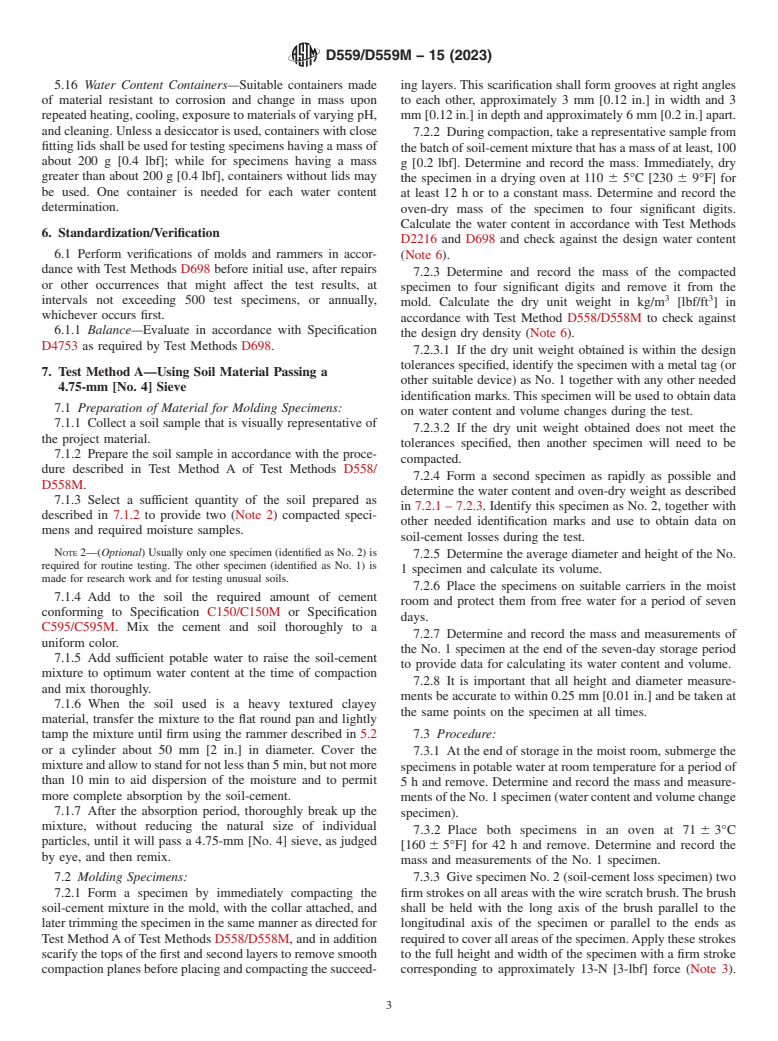
1.4.1 The gravitational system of inch-pound units is used
procedure described in Test Methods D558/D558M.
when dealing with inch-pound units. In this system, the pound
1.2 Two test methods, depending on soil gradation, are
(lbf) represents a unit of force (weight), while the unit for mass
covered for preparation of material for molding specimens and
is slugs. The rationalized slug unit is not given, unless dynamic
for molding specimens as follows:
(F = ma) calculations are involved.
Sections
1.4.2 It is common practice in the engineering/construction
Test Method A, using soil material passing a 4.75-mm [No. 4]
profession to use pounds to represent both a unit of mass (lbm)
sieve.
and of force (lbf). This implicitly combines two separate
This method shall be used when 100 % of the soil sample 7
passes the 4.75-mm [No. 4] sieve.
systems of units; that is, the absolute system and the gravita-
Test Method B, using soil material passing a 19.0 mm [0.75-in.]
tional system. It is scientifically undesirable to combine the use
sieve.
of two separate sets of inch-pound units within a single
This method shall be used when part of the soil sample is
retained on the 4.75-mm [No. 4] sieve.
standard. As stated, this standard includes the gravitational
This test method may be used only on materials with 30 % or 8
system of inch-pound units and does not use/present the slug
less retained on the 19.0-mm [0.75-in.] sieve.
unit for mass. However, the use of balances or scales recording
1.3 All observed and calculated values shall conform to the
3
pounds of mass (lbm) or recording density in lbm/ft shall not
guidelines for significant digits and rounding established in
be regarded as nonconformance with this standard.
Practice D6026, unless superseded by this test method.
1.5 This standard does not purport to address all of the
1.3.1 The procedures used to specify how data are collected/
safety concerns, if any, associated with its use. It is the
recorded and calculated in the standard are regarded as the
responsibility of the user of this standard to establish appro-
industry standard. In addition, they are representative of the
priate safety, health, and environmental practices and deter-
significant digits that generally should be retained. The proce-
mine the applicability of regulatory limitations prior to use.
dures used do not consider material variation, purpose for
1.6 This international standard was developed in accor-
obtaining the data, special purpose studies, or any consider-
dance with internationally recognized principles on standard-
ations for the user’s objectives; and it is common practice to
ization established in the Decision on Principles for the
increase or reduce significant digits of reported data to be
Development of International Standards, Guides and Recom-
commensurate with these considerations. It is beyond the scope
mendations issued by the World Trade Organization Technical
of these test methods to consider significant digits used in
Barriers to Trade (TBT) Committee.
analysis methods for engineering data.
1.4 Units—The values stated in either SI units or inch-
2. Referenced Documents
pound units [presented in brackets] are to be regarded sepa-
2
2.1 ASTM Standards:
C150/C150M Specification for Portland Cement
1
These test methods are under the jurisdiction of the ASTM Committee D18
on So
...
Questions, Comments and Discussion
Ask us and Technical Secretary will try to provide an answer. You can facilitate discussion about the standard in here.