

ASTM C418-20
(Test Method)Standard Test Method for Abrasion Resistance of Concrete by Sandblasting
General Information
- Abstract
SIGNIFICANCE AND USE
4.1 This test method covers the laboratory evaluation of the relative resistance of concrete surfaces to abrasion. This procedure simulates the action of waterborne abrasives and abrasives under traffic on concrete surfaces. It performs a cutting action that tends to abrade more severely the less resistant components of the concrete.
SCOPE
1.1 This test method covers determination of the abrasion resistance characteristics of concrete by subjecting it to the impingement of air-driven silica sand. It is intended for use as a basis for the development of informed judgment.
1.2 The values stated in SI units are to be regarded as the standard. Inch-pound units are shown for information purposes in parentheses.
1.3 The text of this standard refers to notes and footnotes that provide explanatory material. These notes and footnotes (excluding those in tables and figures) shall not be considered as requirements of this standard.
1.4 This standard does not purport to address all of the safety concerns, if any, associated with its use. It is the responsibility of the user of this standard to establish appropriate safety, health, and environmental practices and determine the applicability of regulatory limitations prior to use.
Note 1: Users of this test method are advised that there are known safety hazards associated with the use of silica as a blasting media. Consult the silica manufactures MSDS to insure that the latest recommended health and safety practices are being followed.
Note 2: Other procedures are available for measuring abrasion resistance of concrete surfaces in addition to subjecting it to air driven silica sand. Consideration should be given to other methods of testing as outlined in Test Methods C779/C779M, C944/C944M, and C1138M. The test method most closely representing service conditions should be used.
1.5 This international standard was developed in accordance with internationally recognized principles on standardization established in the Decision on Principles for the Development of International Standards, Guides and Recommendations issued by the World Trade Organization Technical Barriers to Trade (TBT) Committee.
- Status
- Published
- Publication Date
- 31-Mar-2020
- Technical Committee
- C09 - Concrete and Concrete Aggregates
- Drafting Committee
- C09.62 - Abrasion Testing

Overview
ASTM C418-20: Standard Test Method for Abrasion Resistance of Concrete by Sandblasting establishes procedures for evaluating the abrasion resistance of concrete surfaces using air-driven silica sand. Developed by ASTM International, this test method is widely recognized for simulating the effects of waterborne abrasives and traffic on concrete, providing a reliable foundation for assessing material durability in laboratory settings. The standard supports the informed judgement of engineers and professionals in the construction industry by offering reproducible, unit-based test results.
Key Topics
Abrasion Resistance Evaluation: The method determines how well concrete resists surface wear when subjected to sandblasting, reflecting typical service conditions where abrasive materials come into contact with concrete.
Test Apparatus and Procedure:
- Utilizes an injector-type sandblast gun, a controlled supply of air-driven silica sand, and standardized specimen preparation methods.
- Measures are taken to ensure consistency in specimen saturation, exposure duration, and blasting conditions for reproducible results.
Safety and Health Considerations:
- Highlights potential hazards associated with silica sand, recommending adherence to relevant safety practices and consultation of silica manufacturers’ Safety Data Sheets (SDS/MSDS).
- Reminds users to follow all applicable safety, health, and environmental regulations.
Units of Measurement: Stipulates SI units as standard, with inch-pound equivalents for informational purposes.
Limitations and Recommendations:
- Notes the availability of alternative methods for measuring abrasion resistance, encouraging consideration of the test method most appropriate for specific concrete applications and service environments.
Applications
ASTM C418-20 is valuable for a range of stakeholders interested in the durability and longevity of concrete surfaces:
- Construction and Infrastructure: Assessing concrete performance in high-traffic areas, sidewalks, bridge decks, industrial floors, and water-retaining structures exposed to abrasive forces.
- Material Qualification: Comparing the abrasion resistance of different concrete mixes, admixtures, or protective surface treatments in material development and quality control.
- Research and Development: Providing a repeatable method for laboratory studies and validation of new concrete technologies aiming to enhance abrasion resistance.
- Regulatory Compliance and Specification: Assuring that delivered concrete meets specified durability requirements, especially for federally or municipally funded projects that face demanding service conditions.
Related Standards
Several ASTM documents and methods are referenced or related to ASTM C418-20 for comprehensive evaluation of concrete properties:
- ASTM C779/C779M - Test Method for Abrasion Resistance of Horizontal Concrete Surfaces
- ASTM C944/C944M - Test Method for Abrasion Resistance of Concrete or Mortar Surfaces by the Rotating-Cutter Method
- ASTM C1138/C1138M - Test Method for Abrasion Resistance of Concrete (Underwater Method)
- ASTM C778 - Specification for Standard Sand (used as the abrasive in this method)
- ASTM C125 - Terminology Relating to Concrete and Concrete Aggregates
Practical Value
Implementing ASTM C418-20 supports the selection, design, and maintenance of durable concrete surfaces in environments where abrasive wear is a key concern. By providing a standardized approach to abrasion resistance testing, the method helps engineers, contractors, and quality control professionals make data-driven decisions that improve the lifecycle performance and safety of concrete infrastructure. The procedure's focus on reproducibility and alignment with international best practices ensures its ongoing relevance and value in the field of concrete testing and quality assurance.
Relations
- Effective Date
- 01-Apr-2020
- Effective Date
- 15-Dec-2019
- Refers
ASTM C779/C779M-19 - Standard Test Method for Abrasion Resistance of Horizontal Concrete Surfaces - Effective Date
- 01-Oct-2019
- Effective Date
- 01-Oct-2019
- Effective Date
- 01-Jan-2019
- Effective Date
- 01-Oct-2018
- Effective Date
- 01-Jul-2018
- Effective Date
- 01-Jan-2018
- Effective Date
- 15-Dec-2016
- Effective Date
- 15-Dec-2015
- Effective Date
- 01-Jul-2015
- Effective Date
- 01-Feb-2015
- Effective Date
- 01-Aug-2014
- Effective Date
- 15-Dec-2013
- Effective Date
- 01-Aug-2013
Get Certified
Connect with accredited certification bodies for this standard

DIBt (Deutsches Institut für Bautechnik)
German Institute for Building Technology.
DIN CERTCO
DIN Group product certification.

Aboma Certification B.V.
Specialized in construction, metal, and transport sectors.
Sponsored listings
Frequently Asked Questions
ASTM C418-20 is a standard published by ASTM International. Its full title is "Standard Test Method for Abrasion Resistance of Concrete by Sandblasting". This standard covers: SIGNIFICANCE AND USE 4.1 This test method covers the laboratory evaluation of the relative resistance of concrete surfaces to abrasion. This procedure simulates the action of waterborne abrasives and abrasives under traffic on concrete surfaces. It performs a cutting action that tends to abrade more severely the less resistant components of the concrete. SCOPE 1.1 This test method covers determination of the abrasion resistance characteristics of concrete by subjecting it to the impingement of air-driven silica sand. It is intended for use as a basis for the development of informed judgment. 1.2 The values stated in SI units are to be regarded as the standard. Inch-pound units are shown for information purposes in parentheses. 1.3 The text of this standard refers to notes and footnotes that provide explanatory material. These notes and footnotes (excluding those in tables and figures) shall not be considered as requirements of this standard. 1.4 This standard does not purport to address all of the safety concerns, if any, associated with its use. It is the responsibility of the user of this standard to establish appropriate safety, health, and environmental practices and determine the applicability of regulatory limitations prior to use. Note 1: Users of this test method are advised that there are known safety hazards associated with the use of silica as a blasting media. Consult the silica manufactures MSDS to insure that the latest recommended health and safety practices are being followed. Note 2: Other procedures are available for measuring abrasion resistance of concrete surfaces in addition to subjecting it to air driven silica sand. Consideration should be given to other methods of testing as outlined in Test Methods C779/C779M, C944/C944M, and C1138M. The test method most closely representing service conditions should be used. 1.5 This international standard was developed in accordance with internationally recognized principles on standardization established in the Decision on Principles for the Development of International Standards, Guides and Recommendations issued by the World Trade Organization Technical Barriers to Trade (TBT) Committee.
SIGNIFICANCE AND USE 4.1 This test method covers the laboratory evaluation of the relative resistance of concrete surfaces to abrasion. This procedure simulates the action of waterborne abrasives and abrasives under traffic on concrete surfaces. It performs a cutting action that tends to abrade more severely the less resistant components of the concrete. SCOPE 1.1 This test method covers determination of the abrasion resistance characteristics of concrete by subjecting it to the impingement of air-driven silica sand. It is intended for use as a basis for the development of informed judgment. 1.2 The values stated in SI units are to be regarded as the standard. Inch-pound units are shown for information purposes in parentheses. 1.3 The text of this standard refers to notes and footnotes that provide explanatory material. These notes and footnotes (excluding those in tables and figures) shall not be considered as requirements of this standard. 1.4 This standard does not purport to address all of the safety concerns, if any, associated with its use. It is the responsibility of the user of this standard to establish appropriate safety, health, and environmental practices and determine the applicability of regulatory limitations prior to use. Note 1: Users of this test method are advised that there are known safety hazards associated with the use of silica as a blasting media. Consult the silica manufactures MSDS to insure that the latest recommended health and safety practices are being followed. Note 2: Other procedures are available for measuring abrasion resistance of concrete surfaces in addition to subjecting it to air driven silica sand. Consideration should be given to other methods of testing as outlined in Test Methods C779/C779M, C944/C944M, and C1138M. The test method most closely representing service conditions should be used. 1.5 This international standard was developed in accordance with internationally recognized principles on standardization established in the Decision on Principles for the Development of International Standards, Guides and Recommendations issued by the World Trade Organization Technical Barriers to Trade (TBT) Committee.
ASTM C418-20 is classified under the following ICS (International Classification for Standards) categories: 91.100.30 - Concrete and concrete products. The ICS classification helps identify the subject area and facilitates finding related standards.
ASTM C418-20 has the following relationships with other standards: It is inter standard links to ASTM C418-12, ASTM C125-19a, ASTM C779/C779M-19, ASTM C1138M-19, ASTM C125-19, ASTM C125-18b, ASTM C125-18a, ASTM C125-18, ASTM C125-16, ASTM C125-15b, ASTM C125-15a, ASTM C125-15, ASTM C125-14, ASTM C125-13b, ASTM C125-13a. Understanding these relationships helps ensure you are using the most current and applicable version of the standard.
ASTM C418-20 is available in PDF format for immediate download after purchase. The document can be added to your cart and obtained through the secure checkout process. Digital delivery ensures instant access to the complete standard document.
Standards Content (Sample)
This international standard was developed in accordance with internationally recognized principles on standardization established in the Decision on Principles for the
Development of International Standards, Guides and Recommendations issued by the World Trade Organization Technical Barriers to Trade (TBT) Committee.
Designation: C418 − 20
Standard Test Method for
Abrasion Resistance of Concrete by Sandblasting
This standard is issued under the fixed designation C418; the number immediately following the designation indicates the year of
original adoption or, in the case of revision, the year of last revision. A number in parentheses indicates the year of last reapproval. A
superscript epsilon (´) indicates an editorial change since the last revision or reapproval.
This standard has been approved for use by agencies of the U.S. Department of Defense.
1. Scope* 2. Referenced Documents
1.1 This test method covers determination of the abrasion 2.1 ASTM Standards:
resistance characteristics of concrete by subjecting it to the C125 Terminology Relating to Concrete and Concrete Ag-
impingement of air-driven silica sand. It is intended for use as gregates
a basis for the development of informed judgment. C127 Test Method for Relative Density (Specific Gravity)
and Absorption of Coarse Aggregate
1.2 The values stated in SI units are to be regarded as the
C778 Specification for Standard Sand
standard. Inch-pound units are shown for information purposes
C779/C779M Test Method forAbrasion Resistance of Hori-
in parentheses.
zontal Concrete Surfaces
1.3 The text of this standard refers to notes and footnotes
C944/C944M Test Method for Abrasion Resistance of Con-
that provide explanatory material. These notes and footnotes
crete or Mortar Surfaces by the Rotating-Cutter Method
(excluding those in tables and figures) shall not be considered
C1138M Test Method for Abrasion Resistance of Concrete
as requirements of this standard.
(Underwater Method)
1.4 This standard does not purport to address all of the
3. Terminology
safety concerns, if any, associated with its use. It is the
responsibility of the user of this standard to establish appro-
3.1 For definitions of terms used in this standard, refer to
priate safety, health, and environmental practices and deter-
Terminology C125.
mine the applicability of regulatory limitations prior to use.
4. Significance and Use
NOTE 1—Users of this test method are advised that there are known
4.1 This test method covers the laboratory evaluation of the
safety hazards associated with the use of silica as a blasting media.
Consult the silica manufactures MSDS to insure that the latest recom- relative resistance of concrete surfaces to abrasion. This
mended health and safety practices are being followed.
procedure simulates the action of waterborne abrasives and
NOTE 2—Other procedures are available for measuring abrasion resis-
abrasives under traffic on concrete surfaces. It performs a
tance of concrete surfaces in addition to subjecting it to air driven silica
cutting action that tends to abrade more severely the less
sand. Consideration should be given to other methods of testing as
resistant components of the concrete.
outlined in Test Methods C779/C779M, C944/C944M, and C1138M. The
test method most closely representing service conditions should be used.
5. Apparatus
1.5 This international standard was developed in accor-
5.1 Scales—The scale shall have a capacity of 5000 g or
dance with internationally recognized principles on standard-
ization established in the Decision on Principles for the more.Thepermissiblevariationataloadof5000g(11lb)shall
be 6 0.5 g (0.2 oz).
Development of International Standards, Guides and Recom-
mendations issued by the World Trade Organization Technical
5.2 Weights—The permissible variations on weights used in
Barriers to Trade (TBT) Committee.
weighing shall be as prescribed in Table 1. The permissible
variations on new weights shall be one half of the values given
in Table 1.
This test method is under the jurisdiction of ASTM Committee C09 on
Concrete and ConcreteAggregates and is the direct responsibility of Subcommittee
C09.62 on Abrasion Testing. For referenced ASTM standards, visit the ASTM website, www.astm.org, or
Current edition approved April 1, 2020. Published May 2020. Originally contact ASTM Customer Service at service@astm.org. For Annual Book of ASTM
approved in 1958. Last previous edition approved in 2012 as C418 – 12. DOI: Standards volume information, refer to the standard’s Document Summary page on
10.1520/C0418-20. the ASTM website.
*A Summary of Changes section appears at the end of this standard
Copyright © ASTM International, 100 Barr Harbor Drive, PO Box C700, West Conshohocken, PA 19428-2959. United States
C418 − 20
TABLE 1 Permissible Variations on Weights
mm (0.035 to 0.075 in.). The shield shall have an opening
Permissible Variations on 28.70 6 0.25 mm (1.13 6 0.01 in.) in diameter in the center
Weight, g
Weights in Use, g
(See Note 3).
1000 ±0.50
500 ±0.35
NOTE 3—An opening of 28.7 mm (1.13 in.) is equivalent to 6.45 cm (1
300 ±0.30
in. ). The purpose of the opening in the shield is to limit the abraded area
250 ±0.25
to approximately 1 in.
200 ±0.20
5.5 Abrasive—The abrasive shall conform to Specification
C778for20–30sand(predominantlygradedtopassan850-µm
(No. 20) sieve and be retained on a 600-µm (No. 30) sieve).
5.3 Sand Blast Apparatus—The sand blast apparatus shall
consist of an injector-type gun. The gun shall have a high- 6. Preparation of Specimens
velocity air jet fed by a suitably controlled rate of flow for the
6.1 Immerse the specimens in water for 24 h and then
abrasive material. The nozzle shown in Fig. 1 shall consist of
surface dry with a damp cloth to obtain a saturated, surface-dry
cold-rolled bar stock, 40 mm (1.5 in.) long, or hardened tool
condition at the time of test.
steel HRC 48 6 2 as determined by Test Methods E18, drilled
to 6.40 6 0.02 mm (0.250 6 0.001 in.) approximately 700 kPa
7. Calibration of Apparatus
(100 psi) through the center. The walls of the nozzle shall have
a 45° bevel on the inside at the upper end. A compressed air 7.1 Adjust the air pressure to 410 6 1 kPa (59.5 6 1 psi)
supply of approximately 100 psi (690 kPa) shall be available and collect the abrasive for a period of 1 min. Adjust the rate
of flow of abrasive to 600 6 25 g⁄min (See Note 4).
andequippedwithapressure-controldevice.Provisionshallbe
made to collect the spent abrasive
...
This document is not an ASTM standard and is intended only to provide the user of an ASTM standard an indication of what changes have been made to the previous version. Because
it may not be technically possible to adequately depict all changes accurately, ASTM recommends that users consult prior editions as appropriate. In all cases only the current version
of the standard as published by ASTM is to be considered the official document.
Designation: C418 − 12 C418 − 20
Standard Test Method for
Abrasion Resistance of Concrete by Sandblasting
This standard is issued under the fixed designation C418; the number immediately following the designation indicates the year of
original adoption or, in the case of revision, the year of last revision. A number in parentheses indicates the year of last reapproval. A
superscript epsilon (´) indicates an editorial change since the last revision or reapproval.
This standard has been approved for use by agencies of the U.S. Department of Defense.
1. Scope*
1.1 This test method covers determination of the abrasion resistance characteristics of concrete by subjecting it to the
impingement of air-driven silica sand. It is intended for use as a basis for the development of informed judgment.
1.2 The values stated in SI units are to be regarded as the standard. Inch-pound units are shown for information purposes in
parentheses.
1.3 The text of this standard references refers to notes and footnotes which are provided as that provide explanatory material.
These notes and footnotes (excluding those in tables and figures) shall not be considered as requirements of this standard.
1.4 This standard does not purport to address all of the safety concerns, if any, associated with its use. It is the responsibility
of the user of this standard to establish appropriate safety safety, health, and healthenvironmental practices and determine the
applicability of regulatory limitations prior to use.
NOTE 1—Users of this test method are advised that there are known safety hazards associated with the use of silica as a blasting media. Consult the
silica manufactures MSDS to insure that the latest recommended health and safety practices are being followed.
NOTE 2—Other procedures are available for measuring abrasion resistance of concrete surfaces in addition to subjecting it to air driven silica sand.
Consideration should be given to other methods of testing as outlined in ASTM Test Methods C779/C779M, ASTM C944C944/C944M, and ASTM
C1138C1138M. The test method most closely representing service conditions should be used.
1.5 This international standard was developed in accordance with internationally recognized principles on standardization
established in the Decision on Principles for the Development of International Standards, Guides and Recommendations issued
by the World Trade Organization Technical Barriers to Trade (TBT) Committee.
2. Referenced Documents
2.1 ASTM Standards:
C125 Terminology Relating to Concrete and Concrete Aggregates
C127 Test Method for Relative Density (Specific Gravity) and Absorption of Coarse Aggregate
C778 Specification for Standard Sand
C779/C779M Test Method for Abrasion Resistance of Horizontal Concrete Surfaces
C944C944/C944M Test Method for Abrasion Resistance of Concrete or Mortar Surfaces by the Rotating-Cutter Method
C1138C1138M Test Method for Abrasion Resistance of Concrete (Underwater Method)
3. Terminology
3.1 For definitions of terms used in this standard, refer to Terminology C125.
4. Significance and Use
4.1 This test method covers the laboratory evaluation of the relative resistance of concrete surfaces to abrasion. This procedure
simulates the action of waterborne abrasives and abrasives under traffic on concrete surfaces. It performs a cutting action that tends
to abrade more severely the less resistant components of the concrete.
This test method is under the jurisdiction of ASTM Committee C09 on Concrete and Concrete Aggregates and is the direct responsibility of Subcommittee C09.62 on
Abrasion Testing.
Current edition approved Dec. 1, 2012April 1, 2020. Published January 2013May 2020. Originally approved in 1958. Last previous edition approved in 20052012 as
C418 – 05.C418 – 12. DOI: 10.1520/C0418-12.10.1520/C0418-20.
For referenced ASTM standards, visit the ASTM website, www.astm.org, or contact ASTM Customer Service at service@astm.org. For Annual Book of ASTM Standards
volume information, refer to the standard’s Document Summary page on the ASTM website.
*A Summary of Changes section appears at the end of this standard
Copyright © ASTM International, 100 Barr Harbor Drive, PO Box C700, West Conshohocken, PA 19428-2959. United States
C418 − 20
5. Apparatus
5.1 Scales—The scale shall have a capacity of 5000 g or more. The permissible variation at a load of 5000 g (11 lb) shall be
6 0.5 g (0.2 oz).
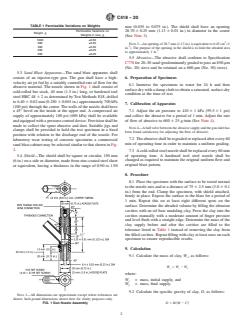
5.2 Weights—The permissible variations on weights used in weighing shall be as prescribed in Table 1. The permissible
variations on new weights shall be one half of the values given in Table 1.
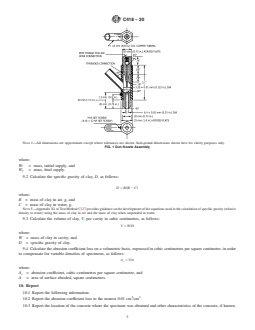
5.3 Sand Blast Apparatus—The sand blast apparatus shall consist of an injector-type gun. The gun shall have a high-velocity
air jet fed by a suitably controlled rate of flow for the abrasive material. The nozzle shown in Fig. 1 shall consist of cold-rolled
bar stock, 40 mm (1.5 in.) long, or hardened tool steel HRC 48 6 2 as determined by Test Methods E18, drilled to 6.40 6 0.02
mm (0.250 6 0.001 in.) approximately 700 kPa (100 psi) through the center. The walls of the nozzle shall have a 45° bevel on
the inside at the upper end. A compressed air supply of approximately 100 psi (690 kPa) shall be available and equipped with a
pressure-control device. Provision shall be made to collect the spent abrasive and dust. Suitable jigs and clamps shall be provided
to hold the test specimen in a fixed position with relation to the discharge end of the nozzle. For laboratory wear testing of concrete
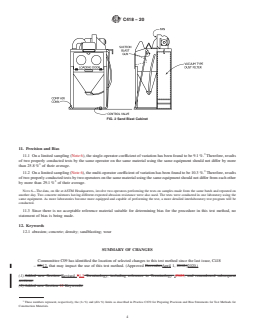
specimens a commercial sand blast cabinet may be selected similar to that shown in Fig. 2.
5.4 Shield—The shield shall be square or circular, 150 mm (6 in.) on a side or diameter, made from zinc-coated steel sheet or
equivalent, having a thickness in the range of 0.90 to 1.90 mm (0.035 to 0.075 in.). The shield shall have an opening 28.70 6 0.25
mm (1.13 6 0.01 in.) in diameter in the center (See Note 3).
2 2
NOTE 3—An opening of 28.7 mm (1.13 in.) is equivalent to 6.45 cm (1 in. ). The purpose of the opening in the shield is to limit the abraded area
to approximately 1 in.
5.5 Abrasive—The abrasive shall conform to Specification C778 for 20–30 sand (predominantly graded to pass an 850-μm (No.
20) sieve and be retained on a 600-μm (No. 30) sieve).
6. Preparation of Specimens
6.1 Immerse the specimens in
...