

ASTM D7906-22
(Practice)Standard Practice for Recovery of Asphalt Binder from Solution Using Toluene and the Rotary Evaporator
General Information
- Abstract
SIGNIFICANCE AND USE
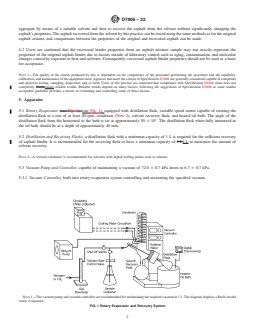
4.1 To determine the characteristics of the asphalt in an asphalt paving mixture, it is necessary to extract the asphalt from the aggregate by means of a suitable solvent and then to recover the asphalt from the solvent without significantly changing the asphalt’s properties. The asphalt recovered from the solvent by this practice can be tested using the same methods as for the original asphalt cement, and comparisons between the properties of the original and recovered asphalt can be made.
4.2 Users are cautioned that the recovered binder properties from an asphalt mixture sample may not exactly represent the properties of the original asphalt binder due to factors outside of laboratory control such as aging, contamination, and molecular changes caused by exposure to heat and solvents. Consequently, recovered asphalt binder properties should not be used as a basis for acceptance.
Note 1: The quality of the results produced by this is dependent on the competence of the personnel performing the procedure and the capability, calibration, and maintenance of the equipment used. Agencies that meet the criteria of Specification D3666 are generally considered capable of competent and objective testing, sampling, inspection, and so forth. Users of this practice are cautioned that compliance with Specification D3666 alone does not completely ensure reliable results. Reliable results depend on many factors; following the suggestions of Specification D3666 or some similar acceptable guideline provides a means of evaluating and controlling some of those factors.
SCOPE
1.1 This practice is intended to be used to recover asphalt from a solvent using the rotary evaporator to ensure that changes in the asphalt properties during the recovery process are minimized.
1.2 Units—The values stated in SI units are to be regarded as standard. No other units of measurement are included in this standard.
1.3 This standard does not purport to address all of the safety concerns, if any, associated with its use. It is the responsibility of the user of this standard to establish appropriate safety, health, and environmental practices and determine the applicability of regulatory limitations prior to use.
1.4 This international standard was developed in accordance with internationally recognized principles on standardization established in the Decision on Principles for the Development of International Standards, Guides and Recommendations issued by the World Trade Organization Technical Barriers to Trade (TBT) Committee.
- Status
- Published
- Publication Date
- 30-Apr-2022
- Technical Committee
- D04 - Road and Paving Materials
- Drafting Committee
- D04.25 - Analysis of Asphalt Mixtures
Buy Documents

ASTM D7906-22 - Standard Practice for Recovery of Asphalt Binder from Solution Using Toluene and the Rotary Evaporator
REDLINE ASTM D7906-22 - Standard Practice for Recovery of Asphalt Binder from Solution Using Toluene and the Rotary Evaporator
Overview
ASTM D7906-22 is a standard practice published by ASTM International that outlines the procedure for the recovery of asphalt binder from a solution using toluene and a rotary evaporator. The method aims to minimize changes in asphalt properties during recovery, ensuring that the recovered binder is suitable for subsequent testing and comparison with the original asphalt cement. This standard is primarily used in laboratories testing bituminous paving mixtures and supports quality assurance in roadway construction and maintenance projects.
Key Topics
- Asphalt Binder Recovery: This practice details the process for extracting asphalt binder from an aggregate using toluene as a solvent, followed by recovery via rotary evaporation.
- Minimizing Property Changes: Emphasizes the importance of preserving the original properties of the asphalt binder during solvent extraction and recovery, to ensure valid test comparisons.
- Equipment Requirements:
- Rotary evaporator with vacuum and temperature control
- Proper sample containers and digital thermometers
- Safety apparatus for handling toxic and flammable solvents
- Laboratory Competence: Highlights that the accuracy and reliability of results depend on the skills of laboratory personnel, proper calibration, and maintenance of equipment.
- Quality Control: References Specification ASTM D3666 as a guideline for laboratory competence but notes this alone does not guarantee reliable outcomes.
Applications
ASTM D7906-22 is vital for laboratories involved in the analysis and quality assessment of asphalt mixtures for road and pavement construction. Key applications include:
- Performance Testing: The recovered asphalt binder can be analyzed using standard test methods to determine physical properties, such as viscosity and penetration, enabling comparison with original binder characteristics.
- Forensic Analysis: Supports investigations into pavement failures or performance issues by providing a method to accurately recover and evaluate asphalt binder from field samples.
- Quality Assurance and Research: Enables agencies and researchers to assess changes in asphalt binder properties resulting from manufacturing, recycling, and field aging processes.
- Recycled Materials: Applicable in testing asphalt mixtures containing recycled asphalt pavement (RAP) or recycled asphalt shingles (RAS), ensuring the recovered binder is suitable for further analysis.
Important Considerations
- The properties of recovered asphalt binder may not perfectly represent the original binder due to inevitable factors such as aging, contamination, and effects of heat and solvents during extraction and recovery.
- Results from recovered binders should not be used as a legal or contractual basis for acceptance but as an informational tool for comparison and quality evaluation.
- Safety protocols must be strictly followed when working with toluene, a toxic and flammable solvent, including adequate ventilation, proper storage, and use of personal protective equipment.
Related Standards
- ASTM D2172/D2172M: Test Methods for Quantitative Extraction of Asphalt Binder from Asphalt Mixtures
- ASTM D92: Test Method for Flash and Fire Points by Cleveland Open Cup Tester
- ASTM D3666: Specification for Minimum Requirements for Agencies Testing and Inspecting Road and Paving Materials
- ASTM E1137/E1137M: Specification for Industrial Platinum Resistance Thermometers
Summary
ASTM D7906-22 provides a standardized approach for the recovery of asphalt binder using toluene and a rotary evaporator. Its proper application ensures minimal alteration of binder properties, supporting accurate assessment of bituminous paving mixtures. Adhering to this practice enhances the reliability of asphalt research, quality assurance programs, and the performance analysis of recycled and conventional asphalt materials used in road construction.
Relations
- Effective Date
- 01-Apr-2017
- Effective Date
- 01-Apr-2017
- Effective Date
- 01-Oct-2016
- Effective Date
- 01-Dec-2013
- Effective Date
- 01-Nov-2012
- Effective Date
- 01-Dec-2011
- Effective Date
- 01-Feb-2011
- Effective Date
- 01-Dec-2009
- Effective Date
- 01-Nov-2008
- Effective Date
- 01-Aug-2007
- Effective Date
- 01-Aug-2007
- Effective Date
- 15-Jan-2007
- Effective Date
- 15-Jan-2007
- Effective Date
- 15-Jan-2007
- Effective Date
- 01-Jun-2006
Buy Documents
ASTM D7906-22 - Standard Practice for Recovery of Asphalt Binder from Solution Using Toluene and the Rotary Evaporator
REDLINE ASTM D7906-22 - Standard Practice for Recovery of Asphalt Binder from Solution Using Toluene and the Rotary Evaporator
Get Certified
Connect with accredited certification bodies for this standard

DIBt (Deutsches Institut für Bautechnik)
German Institute for Building Technology.
DIN CERTCO
DIN Group product certification.
Zavod za gradbeništvo Slovenije (ZAG) - Inšpekcija
ZAG inspection body for construction products, structures, and materials.
Sponsored listings
Frequently Asked Questions
ASTM D7906-22 is a standard published by ASTM International. Its full title is "Standard Practice for Recovery of Asphalt Binder from Solution Using Toluene and the Rotary Evaporator". This standard covers: SIGNIFICANCE AND USE 4.1 To determine the characteristics of the asphalt in an asphalt paving mixture, it is necessary to extract the asphalt from the aggregate by means of a suitable solvent and then to recover the asphalt from the solvent without significantly changing the asphalt’s properties. The asphalt recovered from the solvent by this practice can be tested using the same methods as for the original asphalt cement, and comparisons between the properties of the original and recovered asphalt can be made. 4.2 Users are cautioned that the recovered binder properties from an asphalt mixture sample may not exactly represent the properties of the original asphalt binder due to factors outside of laboratory control such as aging, contamination, and molecular changes caused by exposure to heat and solvents. Consequently, recovered asphalt binder properties should not be used as a basis for acceptance. Note 1: The quality of the results produced by this is dependent on the competence of the personnel performing the procedure and the capability, calibration, and maintenance of the equipment used. Agencies that meet the criteria of Specification D3666 are generally considered capable of competent and objective testing, sampling, inspection, and so forth. Users of this practice are cautioned that compliance with Specification D3666 alone does not completely ensure reliable results. Reliable results depend on many factors; following the suggestions of Specification D3666 or some similar acceptable guideline provides a means of evaluating and controlling some of those factors. SCOPE 1.1 This practice is intended to be used to recover asphalt from a solvent using the rotary evaporator to ensure that changes in the asphalt properties during the recovery process are minimized. 1.2 Units—The values stated in SI units are to be regarded as standard. No other units of measurement are included in this standard. 1.3 This standard does not purport to address all of the safety concerns, if any, associated with its use. It is the responsibility of the user of this standard to establish appropriate safety, health, and environmental practices and determine the applicability of regulatory limitations prior to use. 1.4 This international standard was developed in accordance with internationally recognized principles on standardization established in the Decision on Principles for the Development of International Standards, Guides and Recommendations issued by the World Trade Organization Technical Barriers to Trade (TBT) Committee.
SIGNIFICANCE AND USE 4.1 To determine the characteristics of the asphalt in an asphalt paving mixture, it is necessary to extract the asphalt from the aggregate by means of a suitable solvent and then to recover the asphalt from the solvent without significantly changing the asphalt’s properties. The asphalt recovered from the solvent by this practice can be tested using the same methods as for the original asphalt cement, and comparisons between the properties of the original and recovered asphalt can be made. 4.2 Users are cautioned that the recovered binder properties from an asphalt mixture sample may not exactly represent the properties of the original asphalt binder due to factors outside of laboratory control such as aging, contamination, and molecular changes caused by exposure to heat and solvents. Consequently, recovered asphalt binder properties should not be used as a basis for acceptance. Note 1: The quality of the results produced by this is dependent on the competence of the personnel performing the procedure and the capability, calibration, and maintenance of the equipment used. Agencies that meet the criteria of Specification D3666 are generally considered capable of competent and objective testing, sampling, inspection, and so forth. Users of this practice are cautioned that compliance with Specification D3666 alone does not completely ensure reliable results. Reliable results depend on many factors; following the suggestions of Specification D3666 or some similar acceptable guideline provides a means of evaluating and controlling some of those factors. SCOPE 1.1 This practice is intended to be used to recover asphalt from a solvent using the rotary evaporator to ensure that changes in the asphalt properties during the recovery process are minimized. 1.2 Units—The values stated in SI units are to be regarded as standard. No other units of measurement are included in this standard. 1.3 This standard does not purport to address all of the safety concerns, if any, associated with its use. It is the responsibility of the user of this standard to establish appropriate safety, health, and environmental practices and determine the applicability of regulatory limitations prior to use. 1.4 This international standard was developed in accordance with internationally recognized principles on standardization established in the Decision on Principles for the Development of International Standards, Guides and Recommendations issued by the World Trade Organization Technical Barriers to Trade (TBT) Committee.
ASTM D7906-22 is classified under the following ICS (International Classification for Standards) categories: 91.100.50 - Binders. Sealing materials; 93.080.20 - Road construction materials. The ICS classification helps identify the subject area and facilitates finding related standards.
ASTM D7906-22 has the following relationships with other standards: It is inter standard links to ASTM D2172/D2172M-17e1, ASTM D2172/D2172M-17, ASTM D3666-16, ASTM D3666-13, ASTM D92-12a, ASTM D3666-11, ASTM D2172/D2172M-11, ASTM D3666-09a, ASTM E1137/E1137M-08, ASTM D3666-07a, ASTM D3666-07ae1, ASTM D3666-07, ASTM D3666-07e2, ASTM D3666-07e1, ASTM D3666-06. Understanding these relationships helps ensure you are using the most current and applicable version of the standard.
ASTM D7906-22 is available in PDF format for immediate download after purchase. The document can be added to your cart and obtained through the secure checkout process. Digital delivery ensures instant access to the complete standard document.
Standards Content (Sample)
This international standard was developed in accordance with internationally recognized principles on standardization established in the Decision on Principles for the
Development of International Standards, Guides and Recommendations issued by the World Trade Organization Technical Barriers to Trade (TBT) Committee.
Designation: D7906 − 22
Standard Practice for
Recovery of Asphalt Binder from Solution Using Toluene
and the Rotary Evaporator
This standard is issued under the fixed designation D7906; the number immediately following the designation indicates the year of
original adoption or, in the case of revision, the year of last revision. A number in parentheses indicates the year of last reapproval. A
superscript epsilon (´) indicates an editorial change since the last revision or reapproval.
1. Scope 3. Summary of Practice
3.1 The solution of solvent and asphalt from a prior extrac-
1.1 This practice is intended to be used to recover asphalt
tion is first distilled by partially immersing the rotating
from a solvent using the rotary evaporator to ensure that
distillation flask of the rotary evaporator in a heated oil bath
changes in the asphalt properties during the recovery process
while the solution is subjected to a partial vacuum. During the
are minimized.
final stage of the process, vacuum is increased and nitrogen or
1.2 Units—The values stated in SI units are to be regarded
carbon dioxide gas is introduced to the solution to remove
as standard. No other units of measurement are included in this
remaining toluene and prevent further aging of the asphalt.The
standard.
recovered asphalt can then be tested as required.
1.3 This standard does not purport to address all of the
4. Significance and Use
safety concerns, if any, associated with its use. It is the
responsibility of the user of this standard to establish appro- 4.1 To determine the characteristics of the asphalt in an
asphalt paving mixture, it is necessary to extract the asphalt
priate safety, health, and environmental practices and deter-
mine the applicability of regulatory limitations prior to use. from the aggregate by means of a suitable solvent and then to
recover the asphalt from the solvent without significantly
1.4 This international standard was developed in accor-
changing the asphalt’s properties. The asphalt recovered from
dance with internationally recognized principles on standard-
the solvent by this practice can be tested using the same
ization established in the Decision on Principles for the
methods as for the original asphalt cement, and comparisons
Development of International Standards, Guides and Recom-
between the properties of the original and recovered asphalt
mendations issued by the World Trade Organization Technical
can be made.
Barriers to Trade (TBT) Committee.
4.2 Users are cautioned that the recovered binder properties
2. Referenced Documents
from an asphalt mixture sample may not exactly represent the
properties of the original asphalt binder due to factors outside
2.1 ASTM Standards:
of laboratory control such as aging, contamination, and mo-
D92 Test Method for Flash and Fire Points by Cleveland
lecular changes caused by exposure to heat and solvents.
Open Cup Tester
Consequently, recovered asphalt binder properties should not
D2172/D2172M TestMethodsforQuantitativeExtractionof
be used as a basis for acceptance.
Asphalt Binder from Asphalt Mixtures
NOTE 1—The quality of the results produced by this is dependent on the
D3666 Specification for Minimum Requirements for Agen-
competence of the personnel performing the procedure and the capability,
cies Testing and Inspecting Road and Paving Materials
calibration, and maintenance of the equipment used. Agencies that meet
E1137/E1137M Specification for Industrial Platinum Resis-
the criteria of Specification D3666 are generally considered capable of
tance Thermometers
competent and objective testing, sampling, inspection, and so forth. Users
of this practice are cautioned that compliance with Specification D3666
alone does not completely ensure reliable results. Reliable results depend
on many factors; following the suggestions of Specification D3666 or
This practice is under the jurisdiction of ASTM Committee D04 on Road and
some similar acceptable guideline provides a means of evaluating and
Paving Materials and is the direct responsibility of Subcommittee D04.25 on
controlling some of those factors.
Analysis of Asphalt Mixtures.
Current edition approved May 1, 2022. Published June 2022. Originally
5. Apparatus
approved in 2014. Last previous edition approved in 2014 as D7906 – 14. DOI:
10.1520/D7906-22.
5.1 Rotary Evaporator (see Fig. 1), equipped with distilla-
For referenced ASTM standards, visit the ASTM website, www.astm.org, or
tion flask, variable speed motor capable of rotating the distil-
contact ASTM Customer Service at service@astm.org. For Annual Book of ASTM
lation flask at a rate of at least 40 rpm, condenser (Note 2),
Standards volume information, refer to the standard’s Document Summary page on
the ASTM website. solvent recovery flask, and heated oil bath. The angle of the
Copyright © ASTM International, 100 Barr Harbor Drive, PO Box C700, West Conshohocken, PA 19428-2959. United States
D7906 − 22
NOTE 1—The vacuum pump and vacuum controller are recommended for maintaining the required vacuum in 5.1.The diagram displays a Büchi model
rotary evaporator.
FIG. 1 Rotary Evaporator and Recovery System
distillation flask from the horizontal to the bath is set at 5.6.2 AClassAPt-100 RTD (Specification E1137/E1137M)
approximately 30 6 10°. The distillation flask when fully sensor with a three or four-wire configuration at the connection
immersed in the oil bath should be at a depth of approximately terminal and paired with an appropriate meter capable of
40 mm. displaying the temperature to the nearest 0.1 °C (0.2 °F). The
sensor shall be encased in a stainless steel sheath that has a
5.2 Distillation and Receiving Flasks, a distillation flask
length of at least 150 mm (6 in.) and a minimum immersion
with a minimum capacity of 1 L is required for the sufficient
depth of not more than 40 mm (1.6 in.).
recovery of asphalt binder. It is recommended for the receiving
flask to have a minimum capacity of 1 L to maximize the 5.7 Circulating Chiller, capable of cooling circulating water
amount of solvent recovery. to increase condensation of toluene.
NOTE 2—Avertical condenser is recommended for solvents with higher NOTE 4—Circulating chiller is not required if condensing water is
boiling points such as toluene. normally below 25 °C, as per manufacturer’s recommendation. Colder
circulating water temperatures below 25 °C can increase the rate of
5.3 Vacuum Pump and Controller, capable of maintaining a
condensation of the toluene vapor.
vacuum of 72.0 6 0.7 kPa down to 6.7 6 0.7 kPa.
5.3.1 VacuumController, built into rotary evaporator system
6. Reagents and Materials
controlling and measuring the specified vacuum.
6.1 Purity of Reagents—Reagent-grade chemicals shall be
NOTE3—Alternatively,ahousevacuumsystemandvacuumgaugemay
used in all tests. Unless otherwise indicated, it is intended that
beusediftherotaryevaporatorsystemdoesnotincludevacuumpumpand
all reagents conform to the specifications of the Committee on
controller.
Analytical Reagents of theAmerican Chemical Society, where
5.4 Gas Flow Meter, capable of indicating a gas flow of up
such specifications are available. Other grades may be used
to 1 L/min.
provided it is first ascertained that the reagent is of sufficiently
high purity to permit its use without lessening the accuracy of
5.5 Sample Container, having adequate volume to hold the
the determination.
sample and added solvent.
6.2 Nitrogen Gas or Carbon Dioxide Gas—A pressurized
5.6 Thermometer, capable of measuring the oil bath tem-
tank with pressure-reducing valve or other convenient source.
perature up to 180 °C with an accuracy of 61.5 °C (2.5 °F) at
a depth of 40 6 5 mm. The thermometer shall be one of the
6.3 Oil—The oil for the heated oil bath should be USP
following:
White Oil, Silicone Fluid SWS-
...
This document is not an ASTM standard and is intended only to provide the user of an ASTM standard an indication of what changes have been made to the previous version. Because
it may not be technically possible to adequately depict all changes accurately, ASTM recommends that users consult prior editions as appropriate. In all cases only the current version
of the standard as published by ASTM is to be considered the official document.
Designation: D7906 − 14 D7906 − 22
Standard Practice for
Recovery of Asphalt Binder from Solution Using Toluene
and the Rotary Evaporator
This standard is issued under the fixed designation D7906; the number immediately following the designation indicates the year of
original adoption or, in the case of revision, the year of last revision. A number in parentheses indicates the year of last reapproval. A
superscript epsilon (´) indicates an editorial change since the last revision or reapproval.
1. Scope
1.1 This practice is intended to be used to recover asphalt from a solvent using the rotary evaporator to ensure that changes in the
asphalt properties during the recovery process are minimized.
1.2 Units—The values stated in SI units are to be regarded as standard. No other units of measurement are included in this
standard.
1.3 This standard does not purport to address all of the safety concerns, if any, associated with its use. It is the responsibility
of the user of this standard to establish appropriate safety safety, health, and healthenvironmental practices and determine the
applicability of regulatory limitations prior to use.
1.4 This international standard was developed in accordance with internationally recognized principles on standardization
established in the Decision on Principles for the Development of International Standards, Guides and Recommendations issued
by the World Trade Organization Technical Barriers to Trade (TBT) Committee.
2. Referenced Documents
2.1 ASTM Standards:
D92 Test Method for Flash and Fire Points by Cleveland Open Cup Tester
D2172/D2172M Test Methods for Quantitative Extraction of Asphalt Binder from Asphalt Mixtures
D3666 Specification for Minimum Requirements for Agencies Testing and Inspecting Road and Paving Materials
E1137/E1137M Specification for Industrial Platinum Resistance Thermometers
3. Summary of Practice
3.1 The solution of solvent and asphalt from a prior extraction is first distilled by partially immersing the rotating distillation flask
of the rotary evaporator in a heated oil bath while the solution is subjected to a partial vacuum. During the final stage of the process,
vacuum is increased and nitrogen or carbon dioxide gas is introduced to the solution to remove remaining toluene and prevent
further aging of the asphalt. The recovered asphalt can then be tested as required.
4. Significance and Use
4.1 To determine the characteristics of the asphalt in an asphalt paving mixture, it is necessary to extract the asphalt from the
This practice is under the jurisdiction of ASTM Committee D04 on Road and Paving Materials and is the direct responsibility of Subcommittee D04.25 on Analysis of
BituminousAsphalt Mixtures.
Current edition approved Jan. 1, 2014May 1, 2022. Published February 2014June 2022. Originally approved in 2014. Last previous edition approved in 2014 as
D7906 – 14. DOI: 10.1520/D7906-14.10.1520/D7906-22.
For referenced ASTM standards, visit the ASTM website, www.astm.org, or contact ASTM Customer Service at service@astm.org. For Annual Book of ASTM Standards
volume information, refer to the standard’s Document Summary page on the ASTM website.
Copyright © ASTM International, 100 Barr Harbor Drive, PO Box C700, West Conshohocken, PA 19428-2959. United States
D7906 − 22
aggregate by means of a suitable solvent and then to recover the asphalt from the solvent without significantly changing the
asphalt’s properties. The asphalt recovered from the solvent by this practice can be tested using the same methods as for the original
asphalt cement, and comparisons between the properties of the original and recovered asphalt can be made.
4.2 Users are cautioned that the recovered binder properties from an asphalt mixture sample may not exactly represent the
properties of the original asphalt binder due to factors outside of laboratory control such as aging, contamination, and molecular
changes caused by exposure to heat and solvents. Consequently, recovered asphalt binder properties should not be used as a basis
for acceptance.
NOTE 1—The quality of the results produced by this is dependent on the competence of the personnel performing the procedure and the capability,
calibration, and maintenance of the equipment used. Agencies that meet the criteria of Specification D3666 are generally considered capable of competent
and objective testing, sampling, inspection, and so forth. Users of this practice are cautioned that compliance with Specification D3666 alone does not
completely assureensure reliable results. Reliable results depend on many factors; following the suggestions of Specification D3666 or some similar
acceptable guideline provides a means of evaluating and controlling some of those factors.
5. Apparatus
5.1 Rotary Evaporator (see Fig. 1), (see Fig. 1), equipped with distillation flask, variable speed motor capable of rotating the
distillation flask at a rate of at least 40 rpm, condenser (Note 2), solvent recovery flask, and heated oil bath. The angle of the
distillation flask from the horizontal to the bath is set at approximately 30 6 10°. The distillation flask when fully immersed in
the oil bath should be at a depth of approximately 40 mm.
5.2 Distillation and Receiving Flasks, a distillation flask with a minimum capacity of 1 L is required for the sufficient recovery
of asphalt binder. It is recommended for the receiving flask to have a minimum capacity of 1-L1 L to maximize the amount of
solvent recovery.
NOTE 2—A vertical condenser is recommended for solvents with higher boiling points such as toluene.
5.3 Vacuum Pump and Controller, capable of maintaining a vacuum of 72.0 6 0.7 kPa down to 6.7 6 0.7 kPa.
5.3.1 Vacuum Controller, built into rotary evaporator system controlling and measuring the specified vacuum.
NOTE 1—The vacuum pump and vacuum controller are recommended for maintaining the required vacuum in 5.1. The diagram displays a Büchi model
rotary evaporator.
FIG. 1 Rotary Evaporator and Recovery System
D7906 − 22
NOTE 3—Alternatively, a house vacuum system and vacuum gauge may be used if the rotary evaporator system does not include vacuum pump and
controller.
5.4 Gas Flowmeter, Flow Meter, capable of indicating a gas flow of up to 1 L/min.
5.5 Sample Container, having adequate volume to hold the sample and added solvent.
5.6 Digital Thermometer, capable of measuring the oil bath temperature up to 180°C180 °C with an accuracy of 61°C 61.5 °C
(2.5 °F) at a depth of 40 6 5 mm. The thermometer shall be one of the following:
5.6.1 A digital metal stem thermometer with a thermocouple sensor and a stem length of at least 150 mm (6 in.) paired with an
appropriate meter capable of displaying temperature to the nearest 0.1 °C (0.2 °F). The sensor shall be encased in a stainless steel
sheath that has a length of at least 150 mm (6 in.) and a minimum immersion depth of not more than 40 mm (1.6 in.).
5.6.2 A Class A Pt-100 RTD (Specification E1137/E1137M) sensor with a three or four-wire configuration at the connection
terminal and paired with an appropriate meter capable of displaying the temperature to the nearest 0.1 °C (0.2 °F). The sensor shall
be encased in a stainless steel sheath that has a length of at least 150 mm (6 in.) and a minimum immersion depth of not more
than 40 mm (1.6 in.).
5.7 Circulating Chiller, capable of cooling circulating water to increase condensation of toluene.
NOTE 4—Circulating chiller is not required if condensing water is normally below 25°C,25 °C, as per manufacturer’s recommendation. Colder circulating
water temperatures below 25°C25 °C can increase the rate of condensation of the toluene vapor.
6. Reagents and Materials
6.1 Purity of Reagents—Reagent-grade chemicals shall be used in all tests. Unless otherwise indicated, it is intended that all
reagents conform to the specifications of the Committee on Analytical Reagents of the American Chemical Society, where such
sp
...