

ASTM D6937-16
(Test Method)Standard Test Method for Determining Density of Emulsified Asphalt
General Information
- Abstract
SIGNIFICANCE AND USE
3.1 This test method provides a controlled laboratory test for the determination of quantitative volumes of emulsified asphalt for use in bills of lading, invoicing, and application rates.
SCOPE
1.1 This test method covers the determination of density of emulsified asphalt used in highway construction. This unit is computed by determining the mass of an emulsified asphalt contained in a standard measure of known volume.
1.2 The values stated in SI units are to be regarded as standard. No other units of measurement are included in this standard.
1.3 This test method does not purport to address all of the safety concerns, if any, associated with its use. It is the responsibility of the user of this standard to establish appropriate safety and health practices and determine the applicability of regulatory limitations prior to use.
- Status
- Published
- Publication Date
- 14-Sep-2016
- Technical Committee
- D04 - Road and Paving Materials
- Drafting Committee
- D04.42 - Emulsified Asphalt Test




Overview
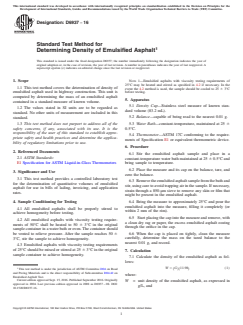
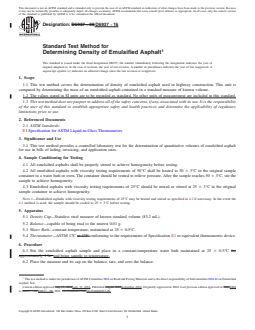
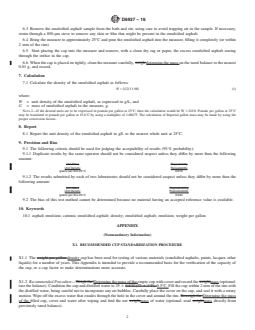
ASTM D6937-16: Standard Test Method for Determining Density of Emulsified Asphalt provides a laboratory procedure for the precise measurement of emulsified asphalt density used primarily in highway construction. This standard, developed by ASTM International, details a controlled way to determine the mass of an asphalt emulsion within a known volume to calculate its density, with results reported strictly in SI units (g/L). Accurate density determination is critical for invoices, bills of lading, and application rate calculations involving emulsified asphalt.
Key Topics
- Density Measurement: The method specifies the use of a stainless steel density cup of standard volume (83.2 mL), a high-precision balance (readable to 0.01 g), and a constant-temperature water bath maintained at 25 ± 0.5°C.
- Sample Preparation: Emulsified asphalt must be thoroughly stirred to ensure homogeneity. Depending on specified viscosity requirements, samples may require controlled heating and cooling before testing.
- Testing Procedure: Steps include taring the balance with the cup and cap, conditioning both the sample and the measure, filling the cup completely with the stirred emulsion, removing excess, capping, and weighing. Density is then calculated by dividing the net mass by the cup volume.
- Precision and Reporting: The standard outlines repeatability and reproducibility limits to ensure results are consistent between operators and laboratories. Results are reported as unit density in grams per liter at 25°C.
- Quality Assurance: An appendix provides guidance for verifying the density cup’s capacity, ensuring accuracy and consistency.
Applications
The primary application of ASTM D6937-16 is within the highway construction industry, where emulsified asphalt is a key material for surface treatments, seal coats, and pavement preservation. Accurate measurement of density enables:
- Correct Billing: Provides verified quantities for invoices and bills of lading, minimizing disputes and ensuring fair transactions.
- Precise Application Rates: Helps contractors and engineers apply the correct amount of emulsion per project specifications, optimizing performance and cost efficiency.
- Quality Control: Supports laboratory and supplier quality management systems by regularly verifying asphalt emulsion properties.
- Contract Compliance: Ensures material properties meet local, state, or national infrastructure standards required for public works.
Related Standards
Consider referencing these related ASTM and industry standards to complement or cross-check procedures:
- ASTM E1 - Specification for ASTM Liquid-in-Glass Thermometers (for temperature measurement during testing)
- ASTM D244 - Standard Test Methods and Practices for Emulsified Asphalts (broader range of emulsion tests)
- AASHTO T 59 - Emulsified Asphalts standards used by transportation departments
- ASTM D6997 - Standard Test Method for Distillation of Emulsified Asphalt
Practical Value
Utilizing ASTM D6937-16 ensures a reliable, repeatable approach to determining the density of emulsified asphalt with standardized equipment and specified conditions. Proper adoption of this test method:
- Supports transparent and consistent construction material transactions
- Contributes to higher-quality roads and infrastructure by standardizing application rates
- Provides laboratories and asphalt producers with a globally recognized protocol
- Enhances stakeholder confidence, from contractors to regulators, through traceable and reproducible results
For more information and latest updates, refer to the official ASTM D6937-16 document and the ASTM International website.
Relations
- Effective Date
- 15-Sep-2016
- Effective Date
- 01-May-2013
- Effective Date
- 01-Nov-2007
- Effective Date
- 01-Nov-2005
- Effective Date
- 01-Nov-2003
- Effective Date
- 10-May-2003
- Effective Date
- 10-Oct-2001
- Effective Date
- 10-Oct-2001
- Effective Date
- 10-Oct-2001
- Effective Date
- 15-Sep-2016
- Effective Date
- 15-Sep-2016
Get Certified
Connect with accredited certification bodies for this standard

Zavod za gradbeništvo Slovenije (ZAG) - Inšpekcija
ZAG inspection body for construction products, structures, and materials.
Sponsored listings
Frequently Asked Questions
ASTM D6937-16 is a standard published by ASTM International. Its full title is "Standard Test Method for Determining Density of Emulsified Asphalt". This standard covers: SIGNIFICANCE AND USE 3.1 This test method provides a controlled laboratory test for the determination of quantitative volumes of emulsified asphalt for use in bills of lading, invoicing, and application rates. SCOPE 1.1 This test method covers the determination of density of emulsified asphalt used in highway construction. This unit is computed by determining the mass of an emulsified asphalt contained in a standard measure of known volume. 1.2 The values stated in SI units are to be regarded as standard. No other units of measurement are included in this standard. 1.3 This test method does not purport to address all of the safety concerns, if any, associated with its use. It is the responsibility of the user of this standard to establish appropriate safety and health practices and determine the applicability of regulatory limitations prior to use.
SIGNIFICANCE AND USE 3.1 This test method provides a controlled laboratory test for the determination of quantitative volumes of emulsified asphalt for use in bills of lading, invoicing, and application rates. SCOPE 1.1 This test method covers the determination of density of emulsified asphalt used in highway construction. This unit is computed by determining the mass of an emulsified asphalt contained in a standard measure of known volume. 1.2 The values stated in SI units are to be regarded as standard. No other units of measurement are included in this standard. 1.3 This test method does not purport to address all of the safety concerns, if any, associated with its use. It is the responsibility of the user of this standard to establish appropriate safety and health practices and determine the applicability of regulatory limitations prior to use.
ASTM D6937-16 is classified under the following ICS (International Classification for Standards) categories: 93.080.20 - Road construction materials. The ICS classification helps identify the subject area and facilitates finding related standards.
ASTM D6937-16 has the following relationships with other standards: It is inter standard links to ASTM D6937-08, ASTM E1-13, ASTM E1-07, ASTM E1-05, ASTM E1-03a, ASTM E1-03, ASTM E1-01, ASTM E1-98e1, ASTM E1-98, ASTM D244-09(2017), ASTM D5505-14(2020). Understanding these relationships helps ensure you are using the most current and applicable version of the standard.
ASTM D6937-16 is available in PDF format for immediate download after purchase. The document can be added to your cart and obtained through the secure checkout process. Digital delivery ensures instant access to the complete standard document.
Standards Content (Sample)
This international standard was developed in accordance with internationally recognized principles on standardization established in the Decision on Principles for the
Development of International Standards, Guides and Recommendations issued by the World Trade Organization Technical Barriers to Trade (TBT) Committee.
Designation:D6937 −16
Standard Test Method for
Determining Density of Emulsified Asphalt
This standard is issued under the fixed designation D6937; the number immediately following the designation indicates the year of
original adoption or, in the case of revision, the year of last revision. A number in parentheses indicates the year of last reapproval. A
superscript epsilon (´) indicates an editorial change since the last revision or reapproval.
NOTE 1—Emulsified asphalts with viscosity testing requirements of
1. Scope
25°C may be heated and stirred as specified in 4.2 if necessary. In the
1.1 This test method covers the determination of density of
event the 4.2 method is used, the sample should be cooled to 25 6 3°C
emulsified asphalt used in highway construction. This unit is before testing.
computed by determining the mass of an emulsified asphalt
5. Apparatus
contained in a standard measure of known volume.
5.1 Density Cup—Stainless steel measure of known stan-
1.2 The values stated in SI units are to be regarded as
dard volume (83.2 mL).
standard. No other units of measurement are included in this
5.2 Balance—capable of being read to the nearest 0.01 g.
standard.
1.3 This test method does not purport to address all of the 5.3 Water Bath—constant-temperature, maintained at 25 6
safety concerns, if any, associated with its use. It is the 0.5°C.
responsibility of the user of this standard to establish appro-
5.4 Thermometer—ASTM 17C conforming to the require-
priate safety and health practices and determine the applica-
ments of Specification E1 or equivalent thermometric device.
bility of regulatory limitations prior to use.
6. Procedure
2. Referenced Documents
6.1 Stir the emulsified asphalt sample and place in a
2.1 ASTM Standards: constant-temperature water bath maintained at 25 6 0.5°C and
E1 Specification for ASTM Liquid-in-Glass Thermometers bring sample to temperature.
6.2 Place the measure and its cap on the balance, tare, and
3. Significance and Use
zero the balance.
3.1 This test method provides a controlled laboratory test
6.3 Removetheemulsifiedasphaltsamplefromthebathand
for the determination of quantitative volumes of emulsified
stir, using care to avoid trapping air in the sample. If necessary,
asphalt for use in bills of lading, invoicing, and application
strain through a 850-µm sieve to remove any skin or film that
rates.
might be present in the emulsified asphalt.
6.4 Bring the measure to approximately 25°C and pour the
4. Sample Conditioning for Testing
emulsified asphalt into the measure, filling it completely (or
4.1 All emulsified asphalts shall be properly stirred to
within 2 mm of the rim).
achieve homogeneity before testing.
6.5 Start placing the cap into the measure and remove, with
4.2 All emulsified asphalts with viscosity testing require-
a clean dry rag or paper, the excess emulsified asphalt oozing
ments of 50°C shall be heated to 50 6 3°C in the original
through the orifice in the cap.
sample container in a water bath or oven. The container should
6.6 When the cap is placed on tightly, clean the measure
be vented to relieve pressure. After the sample reaches 50 6
carefully, determine the mass on the tared balance to the
3°C, stir the sample to achieve homogeneity.
nearest 0.01 g, and record.
4.3 Emulsified asphalts with viscosity testing requirements
of 25°C should be mixed or stirred at 25 6 3°C in the original
7. Calculation
sample container to achieve homogeneity.
7.1 Calculate the density of the emulsified asphalt as fol-
lows:
1 W 5 G 11.98 (1)
~ !~ !
This test method is under the jurisdiction of ASTM Committee D04 on Road
and Paving Materials and is the direct responsibility of Subcommittee D04.42 on
where:
Emulsified Asphalt Test.
Current edition approved Sept. 15, 2016. Published September 2016. Originally
W = unit density of the emulsified asphalt, as expressed in
approved in 2004. Last previous edition approved in 2008 as D6937 – 08. DOI:
g/L, and
10.1520/D6937-16.
Copyright © ASTM International, 100 Barr Harbor Drive, PO Box C700, West Conshohocken, PA 19428-2959. United States
D6937−16
Unit Density Repeatability
G = mass of emulsified a
...
This document is not an ASTM standard and is intended only to provide the user of an ASTM standard an indication of what changes have been made to the previous version. Because
it may not be technically possible to adequately depict all changes accurately, ASTM recommends that users consult prior editions as appropriate. In all cases only the current version
of the standard as published by ASTM is to be considered the official document.
Designation: D6937 − 08 D6937 − 16
Standard Test Method for
Determining Density of Emulsified Asphalt
This standard is issued under the fixed designation D6937; the number immediately following the designation indicates the year of
original adoption or, in the case of revision, the year of last revision. A number in parentheses indicates the year of last reapproval. A
superscript epsilon (´) indicates an editorial change since the last revision or reapproval.
1. Scope
1.1 This test method covers the determination of density of emulsified asphalt used in highway construction. This unit is
computed by determining the mass of an emulsified asphalt contained in a standard measure of known volume.
1.2 The values stated in SI units are to be regarded as standard. No other units of measurement are included in this standard.
1.3 This test method does not purport to address all of the safety concerns, if any, associated with its use. It is the responsibility
of the user of this standard to establish appropriate safety and health practices and determine the applicability of regulatory
limitations prior to use.
2. Referenced Documents
2.1 ASTM Standards:
E1 Specification for ASTM Liquid-in-Glass Thermometers
3. Significance and Use
3.1 This test method provides a controlled laboratory test for the determination of quantitative volumes of emulsified asphalt
for use in bills of lading, invoicing, and application rates.
4. Sample Conditioning for Testing
4.1 All emulsified asphalts shall be properly stirred to achieve homogeneity before testing.
4.2 All emulsified asphalts with viscosity testing requirements of 50°C shall be heated to 50 6 3°C in the original sample
container in a water bath or oven. The container should be vented to relieve pressure. After the sample reaches 50 6 3°C, stir the
sample to achieve homogeneity.
4.3 Emulsified asphalts with viscosity testing requirements of 25°C should be mixed or stirred at 25 6 3°C in the original
sample container to achieve homogeneity.
NOTE 1—Emulsified asphalts with viscosity testing requirements of 25°C may be heated and stirred as specified in 4.2 if necessary. In the event the
4.2 method is used, the sample should be cooled to 25 6 3°C before testing.
5. Apparatus
5.1 Density Cup—Stainless steel measure of known standard volume (83.2 mL).
5.2 Balance—capable of being read to the nearest 0.01 g.
5.3 Water Bath—constant-temperature, maintained at 25 6 0.5°C.
5.4 Thermometer—ASTM 17C or 17F conforming to the requirements of Specification E1 or equivalent thermometric device.
6. Procedure
6.1 Stir the emulsified asphalt sample and place in a constant-temperature water bath maintained at 25 6 0.5°C for
approximately 1 hr. and bring sample to temperature.
6.2 Place the measure and its cap on the balance, tare, and zero the balance.
This test method is under the jurisdiction of ASTM Committee D04 on Road and Paving Materials and is the direct responsibility of Subcommittee D04.42 on Emulsified
Asphalt Test.
Current edition approved July 15, 2008Sept. 15, 2016. Published August 2008September 2016. Originally approved in 2004. Last previous edition approved in 20042008
as D6937 – 04.D6937 – 08. DOI: 10.1520/D6937-08.10.1520/D6937-16.
Copyright © ASTM International, 100 Barr Harbor Drive, PO Box C700, West Conshohocken, PA 19428-2959. United States
D6937 − 16
6.3 Remove the emulsified asphalt sample from the bath and stir, using care to avoid trapping air in the sample. If necessary,
strain through a 850-μm sieve to remove any skin or film that might be present in the emulsified asphalt.
6.4 Bring the measure to approximately 25°C and pour the emulsified asphalt into the measure, filling it completely (or within
2 mm of the rim).
6.5 Start placing the cap into the measure and remove, with a clean dry rag or paper, the excess emulsified asphalt oozing
through the orifice in the cap.
6.6 When the cap is placed on tightly, clean the measure carefully, weigh determine the mass on the tared balance to the nearest
0.01 g, and record.
7. Calculation
7.1 Calculate the density of the emulsified asphalt as follows:
W 5 G 11.98 (1)
~ !~ !
where:
W = unit density of the emulsified asphalt, as expressed in g/L, and
G = mass of emulsified asphalt in the measure, g.
NOTE 2—If the desired units are to be expressed in pounds per gallon at 25°C, then the calculation
...