

ASTM D7090-04(2018)
(Test Method)Standard Test Method for Purity of Isophorone by Capillary Gas Chromatography
General Information
- Abstract
SIGNIFICANCE AND USE
4.1 This test method determines the purity of isophorone, as well as the concentration of various potential impurities, several of which are critical in the application of these solvents.
SCOPE
1.1 This test method covers the determination of the purity of isophorone. This method also determines the impurities of the material in concentration level less than 0.5 mass %, which may include mesityl oxide (MSO), mesityl oxide-isomer, mesitylene, trimethyl cyclohexenone (TMCH), phorone, phorone-isomer, xylitone, and tetralone.
1.2 Water cannot be determined by this test method and shall be measured by other appropriate ASTM procedure. The result is used to normalize the chromatographic data determined by this test method.
1.3 For purposes of determining conformance of an observed or a calculated value using this test method to relevant specifications, test result(s) shall be rounded off “to the nearest unit” in the last right-hand digit used in expressing the specification limit, in accordance with the rounding-off method of Practice E29.
1.4 This standard does not purport to address all of the safety concerns, if any, associated with its use. It is the responsibility of the user of this standard to establish appropriate safety, health, and environmental practices and to determine the applicability of regulatory limitations prior to use.
1.5 This international standard was developed in accordance with internationally recognized principles on standardization established in the Decision on Principles for the Development of International Standards, Guides and Recommendations issued by the World Trade Organization Technical Barriers to Trade (TBT) Committee.
- Status
- Published
- Publication Date
- 31-Oct-2018
- Technical Committee
- D01 - Paint and Related Coatings, Materials, and Applications
- Drafting Committee
- D01.35 - Solvents, Plasticizers, and Chemical Intermediates

Overview
ASTM D7090-04(2018): Standard Test Method for Purity of Isophorone by Capillary Gas Chromatography is an internationally recognized standard that details procedures for determining the purity of isophorone and identifying key impurities at low concentrations. Developed by ASTM International, this standard is essential in quality control and specification compliance across industries utilizing isophorone as a solvent or chemical intermediate. Capillary gas chromatography, equipped with a flame ionization detector, serves as the analytical technique in this method.
Key Topics
- Purity Determination: The standard outlines a method to accurately determine the mass percentage purity of isophorone.
- Impurity Quantification: It enables detection and quantification of impurities down to less than 0.5 mass %, including mesityl oxide (MSO), MSO-isomer, mesitylene, trimethyl cyclohexenone (TMCH), phorone, phorone-isomer, xylitone, and tetralone.
- Chromatographic Technique: Utilizes capillary gas chromatography with temperature programming and flame ionization detection for precise analysis.
- Water Exclusion: Water is not measured using this standard; alternative ASTM procedures such as ASTM D1364 are required for water content, with data used for normalization.
- Reporting & Rounding: Results are to be reported with clearly specified rounding practices, in accordance with ASTM Practice E29.
- Safety & Compliance: The standard advises establishing safe laboratory practices and considering all regulatory requirements before application.
- Calibration & Standardization: Includes comprehensive instructions on preparing calibration mixtures, using internal standards, and determining detector response.
Applications
ASTM D7090-04(2018) is widely adopted for:
- Quality Control in Manufacturing: Ensures the purity of isophorone used as a solvent or chemical intermediate meets industry specifications.
- Specification Compliance: Supports adherence to regulatory and quality requirements by accurately characterizing impurities.
- Research & Development: Facilitates the assessment and validation of isophorone samples in laboratory and pilot-scale environments.
- Procurement & Supply Chains: Assists raw material suppliers and buyers by providing a reliable method for verifying isophorone quality before acceptance or shipment.
- Environmental & Safety Assessments: Allows identification of potentially hazardous impurities, supporting downstream health, safety, and environmental compliance activities.
Related Standards
- ASTM D1364: Test Method for Water in Volatile Solvents (Karl Fischer Reagent Titration Method), used to determine water content in isophorone samples.
- ASTM E29: Practice for Using Significant Digits in Test Data to Determine Conformance with Specifications, dictating rounding of results as applied in D7090.
- ASTM E300: Practice for Sampling Industrial Chemicals, referenced for sample collection procedures.
- International Standards Principles: This method aligns with the World Trade Organization (WTO) Technical Barriers to Trade (TBT) Committee guidelines for internationally recognized standards.
Keywords: ASTM D7090, isophorone purity, capillary gas chromatography, MSO, impurities, solvent analysis, flame ionization detector, chemical standardization, industrial solvents, quality control, ASTM standards.
Relations
- Replaces
ASTM D7090-04(2010) - Standard Test Method for Purity of Isophorone by Capillary Gas Chromatography - Effective Date
- 01-Nov-2018
- Effective Date
- 01-Oct-2008
- Effective Date
- 01-Jun-2007
- Effective Date
- 15-Nov-2006
- Effective Date
- 15-Sep-2006
- Effective Date
- 01-May-2006
- Effective Date
- 01-Dec-2004
- Effective Date
- 10-Dec-2002
- Effective Date
- 10-May-2002
- Effective Date
- 10-Jun-1999
- Effective Date
- 10-May-1999
Get Certified
Connect with accredited certification bodies for this standard

ECOCERT
Organic and sustainability certification.

Eurofins Food Testing Global
Global leader in food, environment, and pharmaceutical product testing.

Intertek Bangladesh
Intertek certification and testing services in Bangladesh.
Sponsored listings
Frequently Asked Questions
ASTM D7090-04(2018) is a standard published by ASTM International. Its full title is "Standard Test Method for Purity of Isophorone by Capillary Gas Chromatography". This standard covers: SIGNIFICANCE AND USE 4.1 This test method determines the purity of isophorone, as well as the concentration of various potential impurities, several of which are critical in the application of these solvents. SCOPE 1.1 This test method covers the determination of the purity of isophorone. This method also determines the impurities of the material in concentration level less than 0.5 mass %, which may include mesityl oxide (MSO), mesityl oxide-isomer, mesitylene, trimethyl cyclohexenone (TMCH), phorone, phorone-isomer, xylitone, and tetralone. 1.2 Water cannot be determined by this test method and shall be measured by other appropriate ASTM procedure. The result is used to normalize the chromatographic data determined by this test method. 1.3 For purposes of determining conformance of an observed or a calculated value using this test method to relevant specifications, test result(s) shall be rounded off “to the nearest unit” in the last right-hand digit used in expressing the specification limit, in accordance with the rounding-off method of Practice E29. 1.4 This standard does not purport to address all of the safety concerns, if any, associated with its use. It is the responsibility of the user of this standard to establish appropriate safety, health, and environmental practices and to determine the applicability of regulatory limitations prior to use. 1.5 This international standard was developed in accordance with internationally recognized principles on standardization established in the Decision on Principles for the Development of International Standards, Guides and Recommendations issued by the World Trade Organization Technical Barriers to Trade (TBT) Committee.
SIGNIFICANCE AND USE 4.1 This test method determines the purity of isophorone, as well as the concentration of various potential impurities, several of which are critical in the application of these solvents. SCOPE 1.1 This test method covers the determination of the purity of isophorone. This method also determines the impurities of the material in concentration level less than 0.5 mass %, which may include mesityl oxide (MSO), mesityl oxide-isomer, mesitylene, trimethyl cyclohexenone (TMCH), phorone, phorone-isomer, xylitone, and tetralone. 1.2 Water cannot be determined by this test method and shall be measured by other appropriate ASTM procedure. The result is used to normalize the chromatographic data determined by this test method. 1.3 For purposes of determining conformance of an observed or a calculated value using this test method to relevant specifications, test result(s) shall be rounded off “to the nearest unit” in the last right-hand digit used in expressing the specification limit, in accordance with the rounding-off method of Practice E29. 1.4 This standard does not purport to address all of the safety concerns, if any, associated with its use. It is the responsibility of the user of this standard to establish appropriate safety, health, and environmental practices and to determine the applicability of regulatory limitations prior to use. 1.5 This international standard was developed in accordance with internationally recognized principles on standardization established in the Decision on Principles for the Development of International Standards, Guides and Recommendations issued by the World Trade Organization Technical Barriers to Trade (TBT) Committee.
ASTM D7090-04(2018) is classified under the following ICS (International Classification for Standards) categories: 71.040.50 - Physicochemical methods of analysis. The ICS classification helps identify the subject area and facilitates finding related standards.
ASTM D7090-04(2018) has the following relationships with other standards: It is inter standard links to ASTM D7090-04(2010), ASTM E29-08, ASTM D1364-02(2007), ASTM E29-06b, ASTM E29-06a, ASTM E29-06, ASTM E29-04, ASTM D1364-02, ASTM E29-02e1, ASTM D1364-95(1999), ASTM E29-93a(1999). Understanding these relationships helps ensure you are using the most current and applicable version of the standard.
ASTM D7090-04(2018) is available in PDF format for immediate download after purchase. The document can be added to your cart and obtained through the secure checkout process. Digital delivery ensures instant access to the complete standard document.
Standards Content (Sample)
This international standard was developed in accordance with internationally recognized principles on standardization established in the Decision on Principles for the
Development of International Standards, Guides and Recommendations issued by the World Trade Organization Technical Barriers to Trade (TBT) Committee.
Designation: D7090 − 04 (Reapproved 2018)
Standard Test Method for
Purity of Isophorone by Capillary Gas Chromatography
This standard is issued under the fixed designation D7090; the number immediately following the designation indicates the year of
original adoption or, in the case of revision, the year of last revision. A number in parentheses indicates the year of last reapproval. A
superscript epsilon (´) indicates an editorial change since the last revision or reapproval.
1. Scope Fischer Reagent Titration Method)
E29 Practice for Using Significant Digits in Test Data to
1.1 This test method covers the determination of the purity
Determine Conformance with Specifications
of isophorone. This method also determines the impurities of
E300 Practice for Sampling Industrial Chemicals
the material in concentration level less than 0.5 mass %, which
may include mesityl oxide (MSO), mesityl oxide-isomer,
3. Summary of Test Method
mesitylene, trimethyl cyclohexenone (TMCH), phorone,
3.1 A representative specimen is introduced into a gas
phorone-isomer, xylitone, and tetralone.
chromatograph with a bonded polyethylene glycol capillary
1.2 Water cannot be determined by this test method and
column using temperature programming and a flame ionization
shall be measured by other appropriate ASTM procedure. The
detector. The concentrations of the sample components are
result is used to normalize the chromatographic data deter-
calculated from the integrated component peaks using internal
mined by this test method.
standardization technique with response factors. Water is
1.3 For purposes of determining conformance of an ob-
measured in accordance with Test Method D1364 and the
served or a calculated value using this test method to relevant
result is used to normalize the values obtained by gas chroma-
specifications, test result(s) shall be rounded off “to the nearest
tography.
unit” in the last right-hand digit used in expressing the
specification limit, in accordance with the rounding-off method
4. Significance and Use
of Practice E29.
4.1 This test method determines the purity of isophorone, as
1.4 This standard does not purport to address all of the
well as the concentration of various potential impurities,
safety concerns, if any, associated with its use. It is the
severalofwhicharecriticalintheapplicationofthesesolvents.
responsibility of the user of this standard to establish appro-
priate safety, health, and environmental practices and to
5. Apparatus
determine the applicability of regulatory limitations prior to
5.1 Chromatograph—Any gas chromatograph utilizing a
use.
capillary column and has the following characteristics (see
1.5 This international standard was developed in accor-
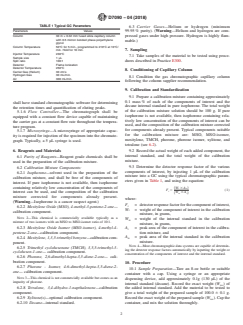
Table 1 for typical GC parameters):
dance with internationally recognized principles on standard-
5.1.1 Detector—A flame ionization detector (FID) capable
ization established in the Decision on Principles for the
of continuous operation at a temperature equivalent to the
Development of International Standards, Guides and Recom-
maximum column temperature employed. The detector shall
mendations issued by the World Trade Organization Technical
havesufficientsensitivitytodetect0.001mass %ofimpurityin
Barriers to Trade (TBT) Committee.
the specimen at a peak height 3 times the noise level.
5.1.2 Column—fused silica capillary column with bonded
2. Referenced Documents
polyethylene (see Table 1 for details).
2.1 ASTM Standards:
5.1.3 Column Temperature Programming—The chromato-
D1364 Test Method for Water in Volatile Solvents (Karl
graph shall be capable of reproducible linear temperature
programming.
5.1.4 Sample Inlet System—The sample inlet system shall
This test method is under the jurisdiction of ASTM Committee D01 on Paint
be capable of split injection, typically at a 100:1 split ratio.
and Related Coatings, Materials, andApplications and is the direct responsibility of
Subcommittee D01.35 on Solvents, Plasticizers, and Chemical Intermediates.
NOTE 1—An autoinjector is recommended. Manual injection with a
Current edition approved Nov. 1, 2018. Published November 2018. Originally
syringe is acceptable, however the observed precision may not apply.
approved in 2004. Last previous edition approved in 2010 as D7090 – 04 (2010).
DOI: 10.1520/D7090-04R18.
5.1.5 Integrator—Means shall be provided for determining
For referenced ASTM standards, visit the ASTM website, www.astm.org, or
the area of the observed chromatographic peaks. This can be
contact ASTM Customer Service at service@astm.org. For Annual Book of ASTM
done by means of an electronic integrator or a computer based
Standards volume information, refer to the standard’s Document Summary page on
the ASTM website. chromatography data system. The integrator/computer system
Copyright © ASTM International, 100 Barr Harbor Drive, PO Box C700, West Conshohocken, PA 19428-2959. United States
D7090 − 04 (2018)
TABLE 1 Typical GC Parameters
6.3 Carrier Gases—Helium or hydrogen (minimum
Parameters Values 99.95 % purity). (Warning—Helium and hydrogen are com-
Column 30m×0.32mmfused silica capillary column pressed gases under high pressure. Hydrogen is highly flam-
with 0.5 micron bonded phase polyethylene
mable.)
glycol
Column Temperature 50°C for 5 min., programmed to 210°C at 10°C/
7. Sampling
min. Hold for 10 min.
Injector Temperature 230°C
7.1 Take samples of the material to be tested using proce-
Sample size 1 µL
Split ratio 100:1 dures described in Practice E300.
Detector Flame Ionization
Detector Temperature 250°C
8. Conditioning of Capillary Column
Carrier Gas (Helium) 30 cm/s
Hydrogen Gas 30 mL/min.
8.1 Condition the gas chromatographic capillary column
Air 300 mL/min.
following the column supplier recommendation.
9. Calibration and Standardization
9.1 Prepare a calibration mixture containing approximately
0.1 mass % of each of the components of interest and the
shall have standard chromatographic software for determining
decane internal standard in pure isophorone. The total weight
the retention times and quantification of eluting peaks.
of the calibration mixture solution should be 100 g. If pure
5.1.6 Flow Controller—The chromatograph shall be
isophorone is not available, then isophorone containing rela-
equipped with a constant flow device capable of maintaining
tively low concentration of the components of interest can be
the carrier gas at a constant flow rate throughout the tempera-
used, and the composition of the calibration mixture corrected
ture program.
for components already present. Typical components suitable
5.1.7 Microsyringe—A microsyringe of appropriate capac-
for the calibration mixture are: MSO, MSO-isomer,
ity is required for injection of the specimen into the chromato-
mesitylene, TMCH, phorone, phorone isomer, xylitone, and
graph. Typically,a5µL syringe is used.
tetralone (see 6.2).
6. Reagents and Materials 9.2 Record the actual weight of each added component, the
internal standard, and the total weight of the calibration
6.1 Purity of Reagents
...