

ASTM F1412-22
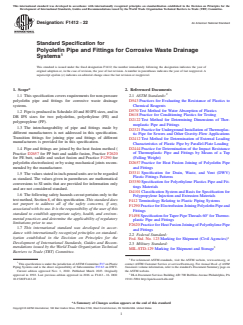
(Specification)Standard Specification for Polyolefin Pipe and Fittings for Corrosive Waste Drainage Systems
General Information
- Abstract
ABSTRACT
This specification covers the requirements for non-pressure polyolefin pipe and fittings for corrosive waste drainage systems. The pipe is produced in Schedule 40 and 80 IPS sizes in two polyolefins (polyethylene and polypropylene) that shall contain suitable stabilizers and antioxidants and may contain pigments and fillers not detrimental to the pipe and fittings. The specimens shall conform to the outside diameter; wall thickness; average waterway diameter; chemical resistance to acetic acid, acetone, methyl alcohol, ammonium hydroxide, nitric acid, and sodium hydroxide; water absorption; system integrity; flattening; and impact resistance requirements. Hydrostatic pressure tests shall be conducted on both the heat-fused and mechanical joints.
SCOPE
1.1 This specification covers requirements for non-pressure polyolefin pipe and fittings for corrosive waste drainage systems.
1.2 Pipe is produced in Schedule 40 and 80 IPS sizes, and in DR IPS sizes for two polyolefins, polyethylene (PE) and polypropylene (PP).
1.3 The interchangeability of pipe and fittings made by different manufacturers is not addressed in this specification. Transition fittings for joining pipe and fittings of different manufacturers is provided for in this specification.
1.4 Pipe and fittings are joined by the heat fusion method ( Practice D2657 for PP butt and saddle fusion, Practice F2620 for PE butt, saddle and socket fusion and Practice F1290 for polyolefin electrofusion) or by using mechanical joints recommended by the manufacturer.
1.5 The values stated in inch-pound units are to be regarded as standard. The values given in parentheses are mathematical conversions to SI units that are provided for information only and are not considered standard.
1.6 The following safety hazards caveat pertains only to the test method, Section 8, of this specification. This standard does not purport to address all of the safety concerns, if any, associated with its use. It is the responsibility of the user of this standard to establish appropriate safety, health, and environmental practices and determine the applicability of regulatory limitations prior to use.
1.7 This international standard was developed in accordance with internationally recognized principles on standardization established in the Decision on Principles for the Development of International Standards, Guides and Recommendations issued by the World Trade Organization Technical Barriers to Trade (TBT) Committee.
- Status
- Published
- Publication Date
- 31-Oct-2022
- Technical Committee
- F17 - Plastic Piping Systems
- Drafting Committee
- F17.63 - DWV
Buy Documents
ASTM F1412-22 - Standard Specification for Polyolefin Pipe and Fittings for Corrosive Waste Drainage Systems
REDLINE ASTM F1412-22 - Standard Specification for Polyolefin Pipe and Fittings for Corrosive Waste Drainage Systems
Overview
ASTM F1412-22 is the internationally recognized standard specification for polyolefin pipe and fittings used in corrosive waste drainage systems. Issued by ASTM International, this specification outlines the requirements for non-pressure piping produced primarily from two types of polyolefins: polyethylene (PE) and polypropylene (PP). Pipes covered under this standard are available in Schedule 40 and 80 Iron Pipe Sizes (IPS) and in Dimension Ratio (DR) IPS for broader application compatibility.
The standard focuses on ensuring chemical resistance, dimensional consistency, and overall system integrity for applications involving the transport of corrosive chemical waste. It is designed to ensure safety, reliability, and compatibility in demanding drainage environments commonly found in laboratories, industrial facilities, and institutional buildings.
Key Topics
Material Requirements
- Polyolefin pipes and fittings must be made from high-quality, stabilized, and antioxidant-rich PE or PP materials.
- Pigments and fillers are permitted if they do not adversely affect performance.
Dimensional Standards
- Pipes and fittings must conform to strict outside diameter, wall thickness, and waterway diameter specifications.
- Both Schedule 40 and Schedule 80 dimensions are included for various application needs.
Chemical Resistance
- Products must withstand exposure to chemicals commonly found in corrosive waste, such as acetic acid, acetone, methyl alcohol, ammonium hydroxide, nitric acid, and sodium hydroxide.
- Rigorous testing is required to ensure the pipe and fittings do not lose tensile strength or gain weight beyond specified thresholds.
Joining Methods
- Two main joining methods: heat fusion (including butt, saddle, socket, and electrofusion techniques) and manufacturer-recommended mechanical joints.
- System integrity is verified by hydrostatic pressure tests on both fused and mechanical joints.
Testing and Quality Assurance
- Pipes and fittings undergo a series of tests including water absorption, flattening, impact resistance, and pullout strength for mechanical joints.
- Marking requirements ensure traceability and identification of key product attributes.
Applications
ASTM F1412-22 is applicable to any non-pressure drainage system requiring resistance to highly corrosive waste streams. Key uses include:
- Laboratory drainage systems
- Safely convey acids, bases, solvents, and other laboratory chemicals.
- Industrial waste disposal
- Effective for manufacturing plants, processing facilities, and chemical handling areas.
- Institutional and healthcare settings
- Designed for reliability in universities, hospitals, pharmaceutical facilities, and research centers.
- Above- and below-ground installations
- Suitable for both underground sewers and above-ground piping where fire-retardant or chemical-resistant materials are required.
Pipes and fittings specified in ASTM F1412-22 support a long service life, minimal maintenance, and reliable performance in environments where metallic systems may rapidly corrode.
Related Standards
The following standards are referenced by or relevant to ASTM F1412-22 and polyolefin corrosive waste disposal systems:
- ASTM D543: Practices for Evaluating the Resistance of Plastics to Chemical Reagents
- ASTM D570: Test Method for Water Absorption of Plastics
- ASTM D2122: Test Method for Determining Dimensions of Thermoplastic Pipe and Fittings
- ASTM D2321: Practice for Underground Installation of Thermoplastic Pipe for Sewers and Other Gravity-Flow Applications
- ASTM D2444: Practice for Determination of the Impact Resistance of Thermoplastic Pipe and Fittings
- ASTM D2657, F2620, F1290: Practices for Heat Fusion Joining of Polyolefin Pipe and Fittings
- ASTM F1498: Specification for Taper Pipe Threads 60° for Thermoplastic Pipe and Fittings
- Uniform Plumbing Code: For plumbing system terminology and definitions
For manufacturers, specifiers, and installers working with corrosive waste pipes and polyolefin piping systems, referencing ASTM F1412-22 ensures compliance with industry best practices and regulatory requirements. This standard helps maintain high levels of safety and durability in demanding chemical drainage applications.
Relations
- Effective Date
- 01-Feb-2024
- Effective Date
- 01-Apr-2020
- Effective Date
- 15-Mar-2020
- Effective Date
- 01-Jan-2019
- Effective Date
- 01-Jan-2019
- Effective Date
- 01-Mar-2018
- Effective Date
- 15-Nov-2017
- Effective Date
- 01-Aug-2017
- Effective Date
- 01-Feb-2017
- Effective Date
- 15-Nov-2016
- Effective Date
- 01-Aug-2016
- Effective Date
- 01-Feb-2016
- Effective Date
- 01-Jun-2015
- Refers
ASTM D2122-15 - Standard Test Method for Determining Dimensions of Thermoplastic Pipe and Fittings - Effective Date
- 15-Mar-2015
- Effective Date
- 01-Aug-2014
Buy Documents
ASTM F1412-22 - Standard Specification for Polyolefin Pipe and Fittings for Corrosive Waste Drainage Systems
REDLINE ASTM F1412-22 - Standard Specification for Polyolefin Pipe and Fittings for Corrosive Waste Drainage Systems
Get Certified
Connect with accredited certification bodies for this standard

Institut za varilstvo d.o.o. (Welding Institute)
Slovenia's leading welding institute since 1952. ISO 3834, EN 1090, pressure equipment certification, NDT personnel, welder qualification. Only IIW Au
Sponsored listings
Frequently Asked Questions
ASTM F1412-22 is a technical specification published by ASTM International. Its full title is "Standard Specification for Polyolefin Pipe and Fittings for Corrosive Waste Drainage Systems". This standard covers: ABSTRACT This specification covers the requirements for non-pressure polyolefin pipe and fittings for corrosive waste drainage systems. The pipe is produced in Schedule 40 and 80 IPS sizes in two polyolefins (polyethylene and polypropylene) that shall contain suitable stabilizers and antioxidants and may contain pigments and fillers not detrimental to the pipe and fittings. The specimens shall conform to the outside diameter; wall thickness; average waterway diameter; chemical resistance to acetic acid, acetone, methyl alcohol, ammonium hydroxide, nitric acid, and sodium hydroxide; water absorption; system integrity; flattening; and impact resistance requirements. Hydrostatic pressure tests shall be conducted on both the heat-fused and mechanical joints. SCOPE 1.1 This specification covers requirements for non-pressure polyolefin pipe and fittings for corrosive waste drainage systems. 1.2 Pipe is produced in Schedule 40 and 80 IPS sizes, and in DR IPS sizes for two polyolefins, polyethylene (PE) and polypropylene (PP). 1.3 The interchangeability of pipe and fittings made by different manufacturers is not addressed in this specification. Transition fittings for joining pipe and fittings of different manufacturers is provided for in this specification. 1.4 Pipe and fittings are joined by the heat fusion method ( Practice D2657 for PP butt and saddle fusion, Practice F2620 for PE butt, saddle and socket fusion and Practice F1290 for polyolefin electrofusion) or by using mechanical joints recommended by the manufacturer. 1.5 The values stated in inch-pound units are to be regarded as standard. The values given in parentheses are mathematical conversions to SI units that are provided for information only and are not considered standard. 1.6 The following safety hazards caveat pertains only to the test method, Section 8, of this specification. This standard does not purport to address all of the safety concerns, if any, associated with its use. It is the responsibility of the user of this standard to establish appropriate safety, health, and environmental practices and determine the applicability of regulatory limitations prior to use. 1.7 This international standard was developed in accordance with internationally recognized principles on standardization established in the Decision on Principles for the Development of International Standards, Guides and Recommendations issued by the World Trade Organization Technical Barriers to Trade (TBT) Committee.
ABSTRACT This specification covers the requirements for non-pressure polyolefin pipe and fittings for corrosive waste drainage systems. The pipe is produced in Schedule 40 and 80 IPS sizes in two polyolefins (polyethylene and polypropylene) that shall contain suitable stabilizers and antioxidants and may contain pigments and fillers not detrimental to the pipe and fittings. The specimens shall conform to the outside diameter; wall thickness; average waterway diameter; chemical resistance to acetic acid, acetone, methyl alcohol, ammonium hydroxide, nitric acid, and sodium hydroxide; water absorption; system integrity; flattening; and impact resistance requirements. Hydrostatic pressure tests shall be conducted on both the heat-fused and mechanical joints. SCOPE 1.1 This specification covers requirements for non-pressure polyolefin pipe and fittings for corrosive waste drainage systems. 1.2 Pipe is produced in Schedule 40 and 80 IPS sizes, and in DR IPS sizes for two polyolefins, polyethylene (PE) and polypropylene (PP). 1.3 The interchangeability of pipe and fittings made by different manufacturers is not addressed in this specification. Transition fittings for joining pipe and fittings of different manufacturers is provided for in this specification. 1.4 Pipe and fittings are joined by the heat fusion method ( Practice D2657 for PP butt and saddle fusion, Practice F2620 for PE butt, saddle and socket fusion and Practice F1290 for polyolefin electrofusion) or by using mechanical joints recommended by the manufacturer. 1.5 The values stated in inch-pound units are to be regarded as standard. The values given in parentheses are mathematical conversions to SI units that are provided for information only and are not considered standard. 1.6 The following safety hazards caveat pertains only to the test method, Section 8, of this specification. This standard does not purport to address all of the safety concerns, if any, associated with its use. It is the responsibility of the user of this standard to establish appropriate safety, health, and environmental practices and determine the applicability of regulatory limitations prior to use. 1.7 This international standard was developed in accordance with internationally recognized principles on standardization established in the Decision on Principles for the Development of International Standards, Guides and Recommendations issued by the World Trade Organization Technical Barriers to Trade (TBT) Committee.
ASTM F1412-22 is classified under the following ICS (International Classification for Standards) categories: 23.040.20 - Plastics pipes. The ICS classification helps identify the subject area and facilitates finding related standards.
ASTM F1412-22 has the following relationships with other standards: It is inter standard links to ASTM D4101-24, ASTM F412-20, ASTM D2321-20, ASTM F1290-19, ASTM F412-19, ASTM D2321-18, ASTM D2444-17, ASTM F412-17a, ASTM F412-17, ASTM F412-16a, ASTM F412-16, ASTM D3311-11(2016), ASTM F412-15, ASTM D2122-15, ASTM D2321-14e1. Understanding these relationships helps ensure you are using the most current and applicable version of the standard.
ASTM F1412-22 is available in PDF format for immediate download after purchase. The document can be added to your cart and obtained through the secure checkout process. Digital delivery ensures instant access to the complete standard document.
Standards Content (Sample)
This international standard was developed in accordance with internationally recognized principles on standardization established in the Decision on Principles for the
Development of International Standards, Guides and Recommendations issued by the World Trade Organization Technical Barriers to Trade (TBT) Committee.
Designation: F1412 − 22 An American National Standard
Standard Specification for
Polyolefin Pipe and Fittings for Corrosive Waste Drainage
Systems
This standard is issued under the fixed designation F1412; the number immediately following the designation indicates the year of
original adoption or, in the case of revision, the year of last revision. A number in parentheses indicates the year of last reapproval. A
superscript epsilon (´) indicates an editorial change since the last revision or reapproval.
1. Scope* 2. Referenced Documents
1.1 This specification covers requirements for non-pressure 2.1 ASTM Standards:
polyolefin pipe and fittings for corrosive waste drainage D543 Practices for Evaluating the Resistance of Plastics to
systems. Chemical Reagents
D570 Test Method for Water Absorption of Plastics
1.2 Pipe is produced in Schedule 40 and 80 IPS sizes, and in
D618 Practice for Conditioning Plastics for Testing
DR IPS sizes for two polyolefins, polyethylene (PE) and
D2122 Test Method for Determining Dimensions of Ther-
polypropylene (PP).
moplastic Pipe and Fittings
1.3 The interchangeability of pipe and fittings made by
D2321 Practice for Underground Installation of Thermoplas-
different manufacturers is not addressed in this specification.
tic Pipe for Sewers and Other Gravity-Flow Applications
Transition fittings for joining pipe and fittings of different
D2412 Test Method for Determination of External Loading
manufacturers is provided for in this specification.
Characteristics of Plastic Pipe by Parallel-Plate Loading
1.4 Pipe and fittings are joined by the heat fusion method ( D2444 Practice for Determination of the Impact Resistance
of Thermoplastic Pipe and Fittings by Means of a Tup
Practice D2657 for PP butt and saddle fusion, Practice F2620
for PE butt, saddle and socket fusion and Practice F1290 for (Falling Weight)
D2657 Practice for Heat Fusion Joining of Polyolefin Pipe
polyolefin electrofusion) or by using mechanical joints recom-
mended by the manufacturer. and Fittings
D3311 Specification for Drain, Waste, and Vent (DWV)
1.5 The values stated in inch-pound units are to be regarded
Plastic Fittings Patterns
as standard. The values given in parentheses are mathematical
D3350 Specification for Polyethylene Plastics Pipe and Fit-
conversions to SI units that are provided for information only
tings Materials
and are not considered standard.
D4101 Classification System and Basis for Specification for
1.6 The following safety hazards caveat pertains only to the
Polypropylene Injection and Extrusion Materials
test method, Section 8, of this specification. This standard does
F412 Terminology Relating to Plastic Piping Systems
not purport to address all of the safety concerns, if any,
F1290 Practice for Electrofusion Joining Polyolefin Pipe and
associated with its use. It is the responsibility of the user of this
Fittings
standard to establish appropriate safety, health, and environ-
F1498 Specification for Taper Pipe Threads 60° for Thermo-
mental practices and determine the applicability of regulatory
plastic Pipe and Fittings
limitations prior to use.
F2620 Practice for Heat Fusion Joining of Polyethylene Pipe
1.7 This international standard was developed in accor-
and Fittings
dance with internationally recognized principles on standard-
2.2 Federal Standard:
ization established in the Decision on Principles for the
Fed. Std. No. 123 Marking for Shipment (Civil Agencies)
Development of International Standards, Guides and Recom-
2.3 Military Standard:
mendations issued by the World Trade Organization Technical
MIL-STD-129 Marking for Shipment and Storage
Barriers to Trade (TBT) Committee.
For referenced ASTM standards, visit the ASTM website, www.astm.org, or
This specification is under the jurisdiction of ASTM Committee F17 on Plastic contact ASTM Customer Service at service@astm.org. For Annual Book of ASTM
Piping Systems and is the direct responsibility of Subcommittee F17.63 on DWV. Standards volume information, refer to the standard’s Document Summary page on
Current edition approved Nov. 1, 2022. Published March 2023. Originally the ASTM website.
approved in 1992. Last previous edition approved in 2016 as F1412 – 16. DOI: DLA Document Services Building 4/D 700 Robbins Avenue Philadelphia, PA
10.1520/F1412-22 19111-5094 http://quicksearch.dla.mil/
*A Summary of Changes section appears at the end of this standard
Copyright © ASTM International, 100 Barr Harbor Drive, PO Box C700, West Conshohocken, PA 19428-2959. United States
F1412 − 22
TABLE 1 Outside Diameters and Tolerances for Polyolefin Pipe
2.4 Other Document:
4 in. (mm)
Uniform Plumbing Code
Nominal Average Out-of-Roundness
Pipe Outside Tolerance (maximum minus
3. Terminology
Size Diameter minimum)
3.1 Definitions:
1 ⁄4 1.660 (42.16) ±0.005 (±0.13) 0.050 (1.27)
A
3.1.1 Definitions and abbreviations used in this specification 1 ⁄2 1.750 (44.45) ±0.010 (±0.25) 0.060 (1.52)
1 ⁄2 1.900 (48.26) ±0.006 (±0.15) 0.060 (1.52)
are in accordance with the definitions and abbreviations given
2 2.375 (60.32) ±0.006 (±0.15) 0.070 (1.78)
in Terminology F412, unless otherwise indicated.
3 3.500 (88.90) ±0.008 (±0.20) 0.080 (2.03)
3.1.2 The plumbing terminology used in this specification is 4 4.500 (114.30) ±0.009 (±0.23) 0.100 (2.54)
6 6.625 (168.28) ±0.011 (±0.28) 0.100 (2.54)
in accordance with the definitions given in Uniform Plumbing
8 8.625 (219.08) ±0.015 (±0.38) 0.150 (3.81)
Code, unless otherwise indicated.
10 10.750 (273.05) ±0.015 (±0.38) 0.150 (3.81)
3.2 Definitions of Terms Specific to This Standard: 12 12.750 (323.85) ±0.015 (±0.38) 0.150 (3.81)
A
3.2.1 toe-in—a small reduction of the outside diameter at
Not an IPS size. Pipe shall be used with compatible fittings designed for this
outside diameter. The wall thickness is the same as 1 ⁄2 in. IPS Schedule 40 shown
the cut end of a length of thermoplastic pipe.
in Table 2.
4. Classification
4.1 General—This specification covers polyolefin pipe
TABLE 2 Wall Thickness and Tolerances for Polyolefin Pipe
made from polyethylene or polypropylene in iron pipe sizes.
Schedules 40 and 80, in. (mm)
4.2 This specification also includes molded fittings and in
NOTE 1— For fittings, the wall thickness is a minimum value, except
that a 10 % variation resulting from core shift is allowable. In such a case,
larger sizes (8 in., 10 in., 12 in.) fabricated fittings.
the average of the two opposite wall thicknesses shall equal or exceed the
value shown in the Schedule 40 table.
5. Materials and Manufacture
Nominal Schedule 40 Schedule 80
5.1 Polyethylene (PE) virgin material for pipe or fittings
Pipe
Minimum Tolerance Minimum Tolerance
shall be from a single compound manufacturer and shall be
Size
made from PE material that meets or exceeds the cell-
1 ⁄4 0.140 (3.56) +0.020 (+0.51) 0.191 (4.85) +0.023 (+0.58)
1 ⁄2 0.145 (3.68) +0.020 (+0.51) 0.200 (5.08) +0.024 (+0.61)
classification requirements of 112110, 213330 or 324430 as
2 0.154 (3.91) +0.020 (+0.51) 0.218 (5.54) +0.026 (+0.66)
defined in Specification D3350.
3 0.216 (5.49) +0.026 (+0.66) 0.300 (7.62) +0.036 (+0.91)
5.1.1 This specification covers PE pipe made from PE
4 0.237 (6.02) +0.028 (+0.71) 0.337 (8.56) +0.040 (+1.02)
6 0.280 (7.11) +0.034 (+0.86) 0.432 (10.97) +0.052 (+1.32)
plastics as defined by hydrostatic design stresses developed on
8 0.322 (8.18) +0.039 (+0.99) 0.500 (12.70) +0.060 (+1.52)
the basis of long-term tests.
10 0.365 (9.27) +0.044 (+1.12) 0.593 (15.06) +0.071 (+1.80)
12 0.406 (10.31) +0.049 (+1.24) 0.687 (17.45) +0.082 (+2.08)
5.2 Polypropylene (PP) virgin material for pipe or fittings
shall meet the requirements for polypropylene Group 01, 02 or
03, as defined in Specification D4101.
TABLE 3 Wall Thickness and Tolerances for Polyolefin Pipe SDR
5.3 The polyolefin material shall contain suitable stabilizers 17 and 26, in. (mm)
and antioxidants and may contain pigments and fillers not
NOTE 1—For fittings, the wall thickness is a minimum value, except
detrimental to pipe and fittings provided the pipe and fittings
that a 10 % variation resulting from core shift is allowable. In such a case,
produced meet the requirements of this specification.
the average of the two opposite wall thicknesses shall equal or exceed the
value shown in the Table 3.
5.3.1 Polyolefin material can be produced in both regular
and flame-retardant compounds for pipe and fittings. Nominal SDR 26 SDR 17
Pipe
Minimum Tolerance Minimum Tolerance
5.4 Rework Material—Clean rework material generated
Size
from the manufacturer’s own pipe or fitting products may be
2 0.091 (2.32) +0.020 (+0.51) 0.140 (2.32) +0.017 (+0.43)
3 0.135 (3.42) +0.020 (+0.51) 0.206 (3.43) +0.025 (+0.63)
used by the same manufacturer, using the same type and grade
4 0.173 (4.40) +0.021 (+0.53) 0.265 (4.40) +0.032 (+.81)
resin, provided that the pipe or fittings produced meet the
6 0.255 (6.47) +0.031 (+0.78) 0.390 (6.47) +0.047 (+1.19)
requirements of this specification.
8 0.332 (8.43) +0.040 (+1.01) 0.507 (8.43) +0.061 (+1.55)
10 0.413 (10.50) +0.050 (+1.26) 0.632 (10.50) +0.076 (+1.93)
12 0.490 (12.46) +0.059 (+1.50) 0.750 (12.46) +0.090 (+2.29)
6. Requirements
6.1 Dimensions and Tolerances—Pipe:
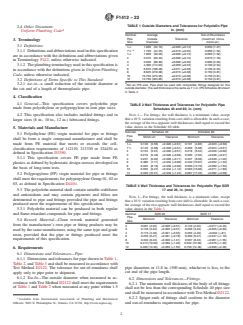
6.1.1 Dimensions and tolerances for pipe shown in Table 1,
Table 2, and Table 3 and shall be measured in accordance with
pipe diameters or 11.8 in. (300 mm), whichever is less, to the
Test Method D2122. The tolerance for out-of-roundness shall
cut end of the pipe length.
apply only to pipe prior to shipment.
6.1.2 Toe-In—The outside diameter when measured in ac-
6.2 Dimensions and Tolerances—Fittings.
cordance with Test Method D2122 shall meet the requirements
6.2.1 The minimum wall thickness of the body of all fittings
of Table 1 and Table 2 when measured at any point within 1.5
shall not be less than the corresponding Schedule 40 pipe size
and shall be measured in accordance with Test Method D2122.
6.2.2 Spigot ends of fittings shall conform to the diameter
Available from International Association of Plumbing and Mechanical
Officials, 5001 E. Philadelphia St., Ontario, CA 91761, http://www.iapmo.org. and out-of-roundness requirements for pipe.
F1412 − 22
NOTE 1—Mechanical joints include transition, compression, threaded,
6.2.3 Socket ends of fittings shall conform to the dimen-
and other mechanical type joints.
sional requirements for size and tolerances as provided on
request by the manufacturer. 6.5.3 Mechanical joints shall incorporate a positive me-
6.2.4 The average minimum diameters of waterways of chanical system for axial restraint in addition to any restraint
fittings excluding adapters shall be as specified in Table 4. provided by friction.
6.2.5 For all fittings having taper pipe threads, threads shall 6.5.4 Mechanical joints shall show no evidence of separa-
conform to Specification F1498 and be gaged in accordance tion at the joint under force P when tested in accordance with
with 8.7. 8.6.1 nor shall they leak or show any other damage when tested
6.2.6 The patterns, dimensions, and laying lengths of in accordance with 8.6.2. Two fittings shall be tested and both
molded fittings, including adaptors, shall meet the require- shall pass.
ments of Specification D3311 or shall be of a proven design
6.6 All stainless steel internal grab rings shall be manufac-
and shall allow a smooth transition of fluid flow from one
tured from corrosion-resistant steel containing not less than
direction to another. Specialty fittings or fittings with laying
16 % chromium and not less than 6 % nickel by weight.
lengths exceeding those shown in D3311 shall not be excluded.
6.7 Sealing Rings—Polyethylene sealing rings shall be of a
For these fittings, laying lengths shall be provided by the
Type 1 (LDPE) compound.
manufacturer.
6.2.7 Cleanouts—All polyolefin fitting cleanouts having
6.8 Flattening—There shall be no evidence of splitting,
female threads shall be supplied with polyolefin plugs to suit.
cracking, or breaking when the pipe is tested in accordance
6.2.8 Cleanouts, cleanout plugs, and caps, as commonly
with 8.8.
used in the manufacturer’s laboratory drainage system, shall
6.9 Impact Resistance—The impact resistance testing shall
have a thread size and depth sufficient to ensure that the
be in accordance with 8.9.
minimum waterway sizes are maintained.
6.2.9 Traps—All traps shall have a minimum water seal of
7. Workmanship, Finish, and Appearance
2 in. (50 mm).
7.1 The manufacture of fittings and pipe shall be in accor-
6.3 Chemical Resistance—Pipe and fitting materials shall be
dance with good commercial practice so as to produce fittings
evaluated in accordance with Test Method D543, Procedures I
meeting the requirements of this specification. Fittings and
and II, using the chemicals listed in 8.3. The weight change
pipe shall be homogeneous throughout and free from visible
shall not exceed 2 % nor shall apparent tensile strength change
cracks, holes, foreign inclusions, or injurious defects. The
by more than 10 %. In cases where there is a change in the
fittings and pipe shall be as uniform as commercially practi-
apparent tensile strength greater than 10 %, a further evaluation
cable in opacity, density, and other physical properties.
shall be made after removal from the chemical, and condition-
ing for 72 h. If after 72 h there is a minimum of 50 % recovery
8. Test Methods
of tensile strength as compared to the unexposed specimen, and
8.1 Conditioning—Condition the test specimens at 73.4 °F
that figure is within 6 10 % of the original tensile strength of
6 3.6 °F (23 °C 6 2 °C) and 50 6 5 % relative humidity for
the unexposed specimen shall be considered acceptable.
not less than 40 h prior to test in accordance with Procedure A
6.4 Water Absorption—Pipe and fitting materials shall not
of Practice D618, for those tests where conditioning is re-
change in weight more than 0.50 % when tested in accordance
quired.
with 8.4.
8.2 Test Conditions—Conduct tests in the standard labora-
6.5 System Integrity:
tory atmosphere of 73.4 °F 6 3.6 °F (23 °C 6 2 °C) and 50 6
6.5.1 Fused joints and pipe associated with them shall
5 % relative humidity, unless otherwise specified in the test
withstand a pressure of 50 psi (0.35 MPa) without leaking
methods or in this specification.
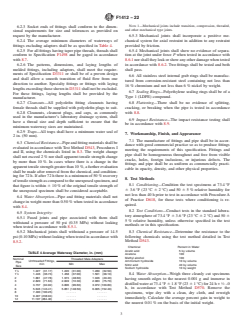
when tested in accordance with 8.5.1.
8.3 Chemical Resistance—Determine the resistance to the
6.5.2 Mechanical joints shall withstand a pressure of 14.5
following chemicals using the test method detailed in Test
psi (0.10 MPa) without leaking when tested in accordance with
Method D543.
8.5.2.
Chemical Percent in Water
Acetic acid 5 by volume
TABLE 4 Average Waterway Diameter, in. (mm)
Acetone 100
Methyl alcohol 100
Nominal Threaded Male Adapters
Unthreaded Fittings,
Ammonium hydroxide 10 by volume
Pipe
Min Max
min
Nitric acid 40 by volume
Size
Sodium hydroxide 10 by weight
1 ⁄4 1.227 (31.17) 1.220 (31.00) 1.280 (32.50)
1 ⁄2 1.446 (36.73) 1.458 (37.00) 1.501 (38.10) 8.4 Water Absorption—Weigh three cleanly cut specimens
2 1.881 (47.78) 1.915 (48.60) 1.946 (49.40)
having smooth edges to the nearest 0.001 g and immerse in
3 2.820 (71.63) 2.849 (72.30) 2.983 (75.70)
distilled water at 73.4 °F 6 1.8 °F (23 6 1 °C) for 24 h + ⁄2 –0
4 3.737 (94.92) 3.806 (96.60) 3.972 (100.80)
6 5.646 (143.41) 5.851 (148.50) 6.005 (152.40) h, in accordance w
...
This document is not an ASTM standard and is intended only to provide the user of an ASTM standard an indication of what changes have been made to the previous version. Because
it may not be technically possible to adequately depict all changes accurately, ASTM recommends that users consult prior editions as appropriate. In all cases only the current version
of the standard as published by ASTM is to be considered the official document.
Designation: F1412 − 16 F1412 − 22 An American National Standard
Standard Specification for
Polyolefin Pipe and Fittings for Corrosive Waste Drainage
Systems
This standard is issued under the fixed designation F1412; the number immediately following the designation indicates the year of
original adoption or, in the case of revision, the year of last revision. A number in parentheses indicates the year of last reapproval. A
superscript epsilon (´) indicates an editorial change since the last revision or reapproval.
1. Scope*
1.1 This specification covers requirements for non-pressure polyolefin pipe and fittings for corrosive waste drainage systems.
1.2 Pipe is produced in Schedule 40 and 80 IPS sizes, and in DR IPS sizes for two polyolefins, polyethylene (PE) and
polypropylene (PP).
1.3 The interchangeability of pipe and fittings made by different manufacturers is not addressed in this specification. Transition
fittings for joining pipe and fittings of different manufacturers is provided for in this specification.
1.4 Pipe and fittings are joined by the heat fusion method ( Practice D2657 for PP butt and saddle fusion, Practice F2620 for PE
butt, saddle and socket fusion and Practice F1290 for polyolefin electrofusion) or by using mechanical joints recommended by the
manufacturer.
1.5 The values stated in inch-pound units are to be regarded as standard. The values given in parentheses are mathematical
conversions to SI units that are provided for information only and are not considered standard.
1.6 The following safety hazards caveat pertains only to the test method, Section 8, of this specification.This standard does not
purport to address all of the safety concerns, if any, associated with its use. It is the responsibility of the user of this standard to
establish appropriate safety and healthsafety, health, and environmental practices and determine the applicability of regulatory
limitations prior to use.
1.7 This international standard was developed in accordance with internationally recognized principles on standardization
established in the Decision on Principles for the Development of International Standards, Guides and Recommendations issued
by the World Trade Organization Technical Barriers to Trade (TBT) Committee.
2. Referenced Documents
2.1 ASTM Standards:
D543 Practices for Evaluating the Resistance of Plastics to Chemical Reagents
D570 Test Method for Water Absorption of Plastics
D618 Practice for Conditioning Plastics for Testing
D1600 Terminology for Abbreviated Terms Relating to Plastics
This specification is under the jurisdiction of ASTM Committee F17 on Plastic Piping Systems and is the direct responsibility of Subcommittee F17.63 on DWV.
Current edition approved Feb. 1, 2016Nov. 1, 2022. Published March 2016March 2023. Originally approved in 1992. Last previous edition approved in 20092016 as
F1412 – 09.F1412 – 16. DOI: 10.1520/F1412-1610.1520/F1412-22
For referenced ASTM standards, visit the ASTM website, www.astm.org, or contact ASTM Customer Service at service@astm.org. For Annual Book of ASTM Standards
volume information, refer to the standard’s Document Summary page on the ASTM website.
*A Summary of Changes section appears at the end of this standard
Copyright © ASTM International, 100 Barr Harbor Drive, PO Box C700, West Conshohocken, PA 19428-2959. United States
F1412 − 22
D2122 Test Method for Determining Dimensions of Thermoplastic Pipe and Fittings
D2321 Practice for Underground Installation of Thermoplastic Pipe for Sewers and Other Gravity-Flow Applications
D2412 Test Method for Determination of External Loading Characteristics of Plastic Pipe by Parallel-Plate Loading
D2444 Practice for Determination of the Impact Resistance of Thermoplastic Pipe and Fittings by Means of a Tup (Falling
Weight)
D2657 Practice for Heat Fusion Joining of Polyolefin Pipe and Fittings
D3311 Specification for Drain, Waste, and Vent (DWV) Plastic Fittings Patterns
D3350 Specification for Polyethylene Plastics Pipe and Fittings Materials
D4101 Classification System and Basis for Specification for Polypropylene Injection and Extrusion Materials
F412 Terminology Relating to Plastic Piping Systems
F1290 Practice for Electrofusion Joining Polyolefin Pipe and Fittings
F1498 Specification for Taper Pipe Threads 60° for Thermoplastic Pipe and Fittings
F2620 Practice for Heat Fusion Joining of Polyethylene Pipe and Fittings
2.2 Federal Standard:
Fed. Std. No. 123 Marking for Shipment (Civil Agencies)
2.3 Military Standard:
MIL-STD-129 Marking for Shipment and Storage
DLA Document Services Building 4/D 700 Robbins Avenue Philadelphia, PA 19111-5094 http://quicksearch.dla.mil/
F1412 − 22
2.4 Other Document:
Uniform Plumbing Code
3. Terminology
3.1 Definitions:
3.1.1 Definitions and abbreviations used in this specification are in accordance with the definitions and abbreviations given in
Terminology F412, and abbreviations are in accordance with Terminology D1600, unless otherwise indicated.
3.1.2 The plumbing terminology used in this specification is in accordance with the definitions given in Uniform Plumbing Code,
unless otherwise indicated.
3.2 Definitions of Terms Specific to This Standard:
3.2.1 toe-in—a small reduction of the outside diameter at the cut end of a length of thermoplastic pipe.
4. Classification
4.1 General—This specification covers polyolefin pipe made from polyethylene or polypropylene in iron pipe sizes.
4.2 This specification also includes molded fittings and in larger sizes (8, 10, (8 in., 10 in., 12 in.) fabricated fittings.
5. Materials and Manufacture
5.1 Polyethylene (PE) virgin material for pipe or fittings shall be from a single compound manufacturer and shall be made from
PE material that meets or exceeds the cell-classification requirements of 112110, 213330 or 324430 as defined in Specification
D3350.
5.1.1 This specification covers PE pipe made from PE plastics as defined by hydrostatic design stresses developed on the basis
of long-term tests.
5.2 Polypropylene (PP) virgin material for pipe or fittings shall meet the requirements for polypropylene Group 01, 02 or 03, as
defined in Specification D4101.
5.3 The polyolefin material shall contain suitable stabilizers and antioxidants and may contain pigments and fillers not detrimental
to pipe and fittings provided the pipe and fittings produced meet the requirements of this specification.
5.3.1 Polyolefin material can be produced in both regular and flame-retardant compounds for pipe and fittings.
5.4 Rework Material—Clean rework material generated from the manufacturer’s own pipe or fitting products may be used by the
same manufacturer, using the same type and grade resin, provided that the pipe or fittings produced meet the requirements of this
specification.
6. Requirements
6.1 Dimensions and Tolerances—Pipe:
6.1.1 Dimensions and tolerances for pipe shown in Table 1, Table 2, and Table 3 and shall be measured in accordance with Test
Method D2122. The tolerance for out-of-roundness shall apply only to pipe prior to shipment.
6.1.2 Toe-In—The outside diameter when measured in accordance with Test Method D2122 shall meet the requirements of Table
1 and Table 2 when measured at any point within 1.5 pipe diameters or 11.8 in. (300 mm), whichever is less, to the cut end of
the pipe length.
6.2 Dimensions and Tolerances—Fittings.
Available from International Association of Plumbing and Mechanical Officials, 5001 E. Philadelphia St., Ontario, CA 91761, http://www.iapmo.org.
F1412 − 22
TABLE 1 Outside Diameters and Tolerances for Polyolefin Pipe
in. (mm)
Nominal Average Out-of-Roundness
Pipe Outside Tolerance (maximum minus
Size Diameter minimum)
1 ⁄4 1.660 (42.16) ±0.005 (±0.13) 0.050 (1.27)
A
1 ⁄2 1.750 (44.45) ±0.010 (±0.25) 0.060 (1.52)
1 ⁄2 1.900 (48.26) ±0.006 (±0.15) 0.060 (1.52)
2 2.375 (60.32) ±0.006 (±0.15) 0.070 (1.78)
3 3.500 (88.90) ±0.008 (±0.20) 0.080 (2.03)
4 4.500 (114.30) ±0.009 (±0.23) 0.100 (2.54)
6 6.625 (168.28) ±0.011 (±0.28) 0.100 (2.54)
8 8.625 (219.08) ±0.015 (±0.38) 0.150 (3.81)
10 10.750 (273.05) ±0.015 (±0.38) 0.150 (3.81)
12 12.750 (323.85) ±0.015 (±0.38) 0.150 (3.81)
A
Not an IPS size. Pipe shall be used with compatible fittings designed for this
outside diameter. The wall thickness is the same as 1 ⁄2 in. IPS Schedule 40 shown
in Table 2.
TABLE 2 Wall Thickness and Tolerances for Polyolefin Pipe
Schedules 40 and 80, in. (mm)
NOTE 1— For fittings, the wall thickness is a minimum value, except
that a 10 % variation resulting from core shift is allowable. In such a case,
the average of the two opposite wall thicknesses shall equal or exceed the
value shown in the Schedule 40 table.
Nominal Schedule 40 Schedule 80
Pipe
Minimum Tolerance Minimum Tolerance
Size
1 ⁄4 0.140 (3.56) +0.020 (+0.51) 0.191 (4.85) +0.023 (+0.58)
1 ⁄2 0.145 (3.68) +0.020 (+0.51) 0.200 (5.08) +0.024 (+0.61)
2 0.154 (3.91) +0.020 (+0.51) 0.218 (5.54) +0.026 (+0.66)
3 0.216 (5.49) +0.026 (+0.66) 0.300 (7.62) +0.036 (+0.91)
4 0.237 (6.02) +0.028 (+0.71) 0.337 (8.56) +0.040 (+1.02)
6 0.280 (7.11) +0.034 (+0.86) 0.432 (10.97) +0.052 (+1.32)
8 0.322 (8.18) +0.039 (+0.99) 0.500 (12.70) +0.060 (+1.52)
10 0.365 (9.27) +0.044 (+1.12) 0.593 (15.06) +0.071 (+1.80)
12 0.406 (10.31) +0.049 (+1.24) 0.687 (17.45) +0.082 (+2.08)
TABLE 3 Wall Thickness and Tolerances for Polyolefin Pipe SDR
17 and 26, in. (mm)
NOTE 1—For fittings, the wall thickness is a minimum value, except
that a 10 % variation resulting from core shift is allowable. In such a case,
the average of the two opposite wall thicknesses shall equal or exceed the
value shown in the Table 3.
Nominal SDR 26 SDR 17
Pipe
Minimum Tolerance Minimum Tolerance
Size
2 0.091 (2.32) +0.020 (+0.51) 0.140 (2.32) +0.017 (+0.43)
3 0.135 (3.42) +0.020 (+0.51) 0.206 (3.43) +0.025 (+0.63)
4 0.173 (4.40) +0.021 (+0.53) 0.265 (4.40) +0.032 (+.81)
6 0.255 (6.47) +0.031 (+0.78) 0.390 (6.47) +0.047 (+1.19)
8 0.332 (8.43) +0.040 (+1.01) 0.507 (8.43) +0.061 (+1.55)
10 0.413 (10.50) +0.050 (+1.26) 0.632 (10.50) +0.076 (+1.93)
12 0.490 (12.46) +0.059 (+1.50) 0.750 (12.46) +0.090 (+2.29)
6.2.1 The minimum wall thickness of the body of all fittings shall not be less than the corresponding Schedule 40 pipe size and
shall be measured in accordance with Test Method D2122.
6.2.2 Spigot ends of fittings shall conform to the diameter and out-of-roundness requirements for pipe.
6.2.3 Socket ends of fittings shall conform to the dimensional requirements for size and tolerances as provided on request by the
manufacturer.
F1412 − 22
6.2.4 The average minimum diameters of waterways of fittings excluding adapters shall be as specified in Table 4.
6.2.5 For all fittings having taper pipe threads, threads shall conform to Specification F1498 and be gaged in accordance with 8.7.
6.2.6 The patterns, dimensions, and laying lengths of molded fittings, including adaptors, shall meet the requirements of
Specification D3311 or shall be of a proven design and shall allow a smooth transition of fluid flow from one direction to another.
Specialty fittings or fittings with laying lengths exceeding those shown in D3311 shall not be excluded. For these fittings, laying
lengths shall be provided by the manufacturer.
6.2.7 Cleanouts—All polyolefin fitting cleanouts having female threads shall be supplied with polyolefin plugs to suit.
6.2.8 Cleanouts, cleanout plugs, and caps, as commonly used in the manufacturer’s laboratory drainage system, shall have a thread
size and depth sufficient to ensure that the minimum waterway sizes are maintained.
6.2.9 Traps—All traps shall have a minimum water seal of 2 in. (50 mm).
6.3 Chemical Resistance—Pipe and fitting materials shall be evaluated in accordance with Test Method D543, Procedures I and
II, using the chemicals listed in 8.3. The weight change shall not exceed 2 % nor shall apparent tensile strength change by more
than 10 %. In cases where there is a change in the apparent tensile strength greater than 10 %, a further evaluation shall be made
after removal from the chemical, and conditioning for 72 h. If after 72 h there is a minimum of 50 % recovery of tensile strength
as compared to the unexposed specimen, and that figure is within 6 10 % of the original tensile strength of the unexposed
specimen shall be considered acceptable.
6.4 Water Absorption—Pipe and fitting materials shall not change in weight more than 0.50 % when tested in accordance with 8.4.
6.5 System Integrity:
6.5.1 Fused joints and pipe associated with them shall withstand a pressure of 50 psi (0.35 MPa) without leaking when tested in
accordance with 8.5.1.
6.5.2 Mechanical joints shall withstand a pressure of 14.5 psi (0.10 MPa) without leaking when tested in accordance with 8.5.2.
NOTE 1—Mechanical joints include transition, compression, threaded, and other mechanical type joints.
6.5.3 Mechanical joints shall incorporate a positive mechanical system for axial restraint in addition to any restraint provided by
friction.
6.5.4 Mechanical joints shall show no evidence of separation at the joint under force P when tested in accordance with 8.6.1 nor
shall they leak or show any other damage when tested in accordance with 8.6.2. Two fittings shall be tested and both shall pass.
6.6 All stainless steel internal grab rings shall be manufactured from corrosion-resistant steel containing not less than 16 %
chromium and not less than 6 % nickel by weight.
TABLE 4 Average Waterway Diameter, in. (mm)
Nominal Threaded Male Adapters
Unthreaded Fittings,
Pipe
Min Max
min
Size
1 ⁄4 1.227 (31.17) 1.220 (31.00) 1.280 (32.50)
1 ⁄2 1.446 (36.73) 1.458 (37.00) 1.501 (38.10)
2 1.881 (47.78) 1.915 (48.60) 1.946 (49.40)
3 2.820 (71.63) 2.849 (72.30) 2.983 (75.70)
4 3.737 (94.92) 3.806 (96.60) 3.972 (100.80)
6 5.646 (143.41) 5.851 (148.50) 6.005 (152.40)
8 7.490 (190.25) . . . . . . . . . . . .
10 9.407 (238.94) . . . . . . . . . . . .
12 11.197 (284.40) . . . . . . . . . . . .
F1412 − 22
6.7 Sealing Rings—Polyethylene sealing rings shall be of a Type 1 (LDPE) compound.
6.8 Flattening—There shall be no evidence of splitting, cracking, or breaking when the pipe is tested in accordance with 8.88.8.
6.9 Impact Resistance—The impact resistance testing shall be in accordance with 8.9.
7. Workmanship, Finish, and Appearance
7.1 The manufacture of fittings and pipe shall be in accordance with good commercial practice so as to produce fittings meeting
the requirements of this specification. Fittings and pipe shall be homogeneous throughout and free from visible cracks, holes,
foreign inclusions, or injurious defects. The fittings and pipe shall be as uniform as commercially practicable in opacity, density,
and other physical properties.
8. Test Methods
8.1 Conditioning—Condition the test specimens at 73.4 6 3.6°F (23 6 2°F)73.4 °F 6 3.6 °F (23 °C 6 2 °C) and 50 6 5 %
relative humidity for not less than 40 h prior to test in accordance with Procedure A of Practice D618, for those tests where
conditioning is required.
8.2 Test Conditions—Conduct tests in the standard laboratory atmosphere of 73.4 6 3.6°F (23 6 2°C)73.4 °F 6 3.6 °F (23 °C 6
2 °C) and 50 6 5 % relative humidity, unless otherwise specified in the test methods or in this specification.
8.3 Chemical Resistance—Determine the resistance to the following chemicals using the test method detailed in Test Method
D543.
Chemical Percent in Water
Acetic acid 5 by volume
Acetone 100
Methyl alcohol 100
Ammonium hydroxide 10 by volume
Nitric acid 40 by volume
Sodi
...