

ASTM D2321-20
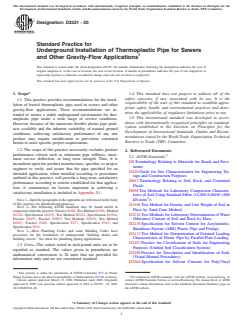
(Practice)Standard Practice for Underground Installation of Thermoplastic Pipe for Sewers and Other Gravity-Flow Applications
General Information
- Abstract
SIGNIFICANCE AND USE
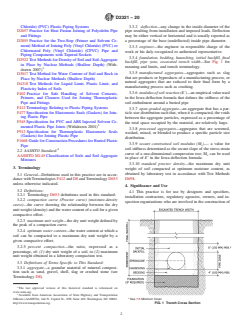
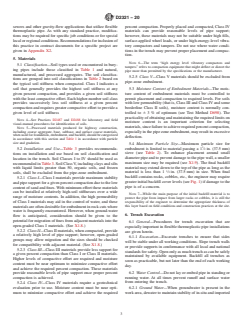
4.1 This practice is for use by designers and specifiers, installation contractors, regulatory agencies, owners, and inspection organizations who are involved in the construction of sewers and other gravity-flow applications that utilize flexible thermoplastic pipe. As with any standard practice, modifications may be required for specific job conditions or for special local or regional conditions. Recommendations for inclusion of this practice in contract documents for a specific project are given in Appendix X2.
SCOPE
1.1 This practice provides recommendations for the installation of buried thermoplastic pipe used in sewers and other gravity-flow applications. These recommendations are intended to ensure a stable underground environment for thermoplastic pipe under a wide range of service conditions. However, because of the numerous flexible plastic pipe products available and the inherent variability of natural ground conditions, achieving satisfactory performance of any one product may require modification to provisions contained herein to meet specific project requirements.
1.2 The scope of this practice necessarily excludes product performance criteria such as minimum pipe stiffness, maximum service deflection, or long term strength. Thus, it is incumbent upon the product manufacturer, specifier, or project engineer to verify and assure that the pipe specified for an intended application, when installed according to procedures outlined in this practice, will provide a long term, satisfactory performance according to criteria established for that application. A commentary on factors important in achieving a satisfactory installation is included in Appendix X1.
Note 1: Specific paragraphs in the appendix are referenced in the body of this practice for informational purposes.
Note 2: The following ASTM standards may be found useful in connection with this practice: Practice D420, Test Method D1556, Method D2216, Specification D2235, Test Method D2412, Specification D2564, Practice D2657, Practice D2855, Test Methods D2922, Test Method D3017, Practice F402, Specification F477, Specification F545, and Specification F913.
Note 3: Most Plumbing Codes and some Building Codes have provisions for the installation of underground “building drains and building sewers.” See them for plumbing piping applications.
1.3 Units—The values stated in inch-pound units are to be regarded as standard. The values given in parentheses are mathematical conversions to SI units that are provided for information only and are not considered standard.
1.4 This standard does not purport to address all of the safety concerns, if any, associated with its use. It is the responsibility of the user of this standard to establish appropriate safety, health, and environmental practices and determine the applicability of regulatory limitations prior to use.
1.5 This international standard was developed in accordance with internationally recognized principles on standardization established in the Decision on Principles for the Development of International Standards, Guides and Recommendations issued by the World Trade Organization Technical Barriers to Trade (TBT) Committee.
- Status
- Published
- Publication Date
- 14-Mar-2020
- Technical Committee
- F17 - Plastic Piping Systems
- Drafting Committee
- F17.62 - Sewer
Buy Documents
ASTM D2321-20 - Standard Practice for Underground Installation of Thermoplastic Pipe for Sewers and Other Gravity-Flow Applications
REDLINE ASTM D2321-20 - Standard Practice for Underground Installation of Thermoplastic Pipe for Sewers and Other Gravity-Flow Applications
Overview
ASTM D2321-20 is a widely recognized standard practice developed by ASTM International for the underground installation of thermoplastic pipe in sewers and other gravity-flow applications. This standard provides essential guidelines and recommendations to ensure the proper and safe installation of flexible thermoplastic pipes in various underground environments. With the growing use of thermoplastic piping systems such as PVC and HDPE for sewerage, drainage, and related infrastructure, adherence to ASTM D2321-20 is crucial for achieving long-term pipe performance and system stability.
Key Topics
- Applicability: ASTM D2321-20 is intended for use by engineers, specifiers, contractors, regulatory bodies, owners, and inspection organizations involved in underground gravity-flow thermoplastic pipe installations. It covers general installation procedures, but job-specific modifications may be required depending on local site or regulatory conditions.
- Soil Classification and Embedment: The standard categorizes soils into Classes I through V based on their support capacity, compaction characteristics, and suitability for use as bedding, haunching, or initial/final backfill. It provides guidance on soil selection and compaction to promote stable installation and reduce pipe deflection.
- Trench Excavation and Backfilling: Safe and effective trenching methods are outlined, including provisions for controlling trench width, water intrusion, and using appropriate bedding and embedment materials. Recommendations for rock removal, trench supports, and minimum cover depths are included to safeguard the pipe against damage during construction and operation.
- Joining Methods: ASTM D2321-20 references commonly used pipe joining techniques, including elastomeric seals (gaskets), solvent cement, and heat fusion, with an emphasis on following manufacturer procedures and protecting joint components from contaminants.
- Compaction Requirements: The document details minimum percent compaction levels for different soil types and the importance of moisture control to achieve required soil stiffness and minimize future settlement or deflection.
- Project Adaptability: While ASTM D2321-20 provides general recommendations, individual projects may require adjustments to account for unique soil conditions, groundwater, or local regulations.
Applications
The ASTM D2321-20 standard is applicable for:
- Municipal sewer systems: Ensuring durable and stable installation of underground thermoplastic pipes in new and rehabilitation projects.
- Stormwater drainage: Providing guidelines for gravity-flow drainage systems where flexible thermoplastic pipes are used.
- Building site utilities: Assisting engineers and contractors in installing underground building drains and sewers with consistent and reliable practices.
- Infrastructure upgrades: Aiding regulatory agencies and project owners in verifying compliance with established installation standards for public works.
- Inspection and quality control: Supporting inspection organizations with criteria to assess installation processes and construction documentation.
Related Standards
To achieve comprehensive compliance and performance, ASTM D2321-20 is often used together with additional industry standards, such as:
- ASTM D420 - Guide for Site Characterization for Engineering Design and Construction Purposes
- ASTM D698 - Standard Test Methods for Laboratory Compaction Characteristics of Soil
- ASTM D1556 and D2922 - Test Methods for Soil Density and Water Content Evaluation
- ASTM D2235, D2564, D2657, D2855 - Product and joining requirements for specific thermoplastic pipe types and fusion/cement joints
- ASTM F477 and F913 - Specifications for elastomeric gaskets and seals in plastic pipe systems
Compliance with ASTM D2321-20 helps reduce the risk of premature pipe failures, infiltration/exfiltration issues, and costly repairs, making it indispensable in modern underground gravity-flow pipe infrastructure projects.
Relations
- Effective Date
- 15-Mar-2020
- Effective Date
- 01-Aug-2020
- Effective Date
- 01-Aug-2020
- Effective Date
- 01-Apr-2020
- Effective Date
- 01-Aug-2019
- Effective Date
- 01-Mar-2019
- Effective Date
- 01-Jan-2019
- Effective Date
- 15-Dec-2018
- Effective Date
- 15-Aug-2018
- Effective Date
- 01-Aug-2018
- Effective Date
- 01-Jul-2018
- Effective Date
- 01-Feb-2018
- Effective Date
- 01-Feb-2018
- Effective Date
- 15-Dec-2017
- Effective Date
- 15-Dec-2017
Buy Documents
ASTM D2321-20 - Standard Practice for Underground Installation of Thermoplastic Pipe for Sewers and Other Gravity-Flow Applications
REDLINE ASTM D2321-20 - Standard Practice for Underground Installation of Thermoplastic Pipe for Sewers and Other Gravity-Flow Applications
Get Certified
Connect with accredited certification bodies for this standard

Institut za varilstvo d.o.o. (Welding Institute)
Slovenia's leading welding institute since 1952. ISO 3834, EN 1090, pressure equipment certification, NDT personnel, welder qualification. Only IIW Au
Sponsored listings
Frequently Asked Questions
ASTM D2321-20 is a standard published by ASTM International. Its full title is "Standard Practice for Underground Installation of Thermoplastic Pipe for Sewers and Other Gravity-Flow Applications". This standard covers: SIGNIFICANCE AND USE 4.1 This practice is for use by designers and specifiers, installation contractors, regulatory agencies, owners, and inspection organizations who are involved in the construction of sewers and other gravity-flow applications that utilize flexible thermoplastic pipe. As with any standard practice, modifications may be required for specific job conditions or for special local or regional conditions. Recommendations for inclusion of this practice in contract documents for a specific project are given in Appendix X2. SCOPE 1.1 This practice provides recommendations for the installation of buried thermoplastic pipe used in sewers and other gravity-flow applications. These recommendations are intended to ensure a stable underground environment for thermoplastic pipe under a wide range of service conditions. However, because of the numerous flexible plastic pipe products available and the inherent variability of natural ground conditions, achieving satisfactory performance of any one product may require modification to provisions contained herein to meet specific project requirements. 1.2 The scope of this practice necessarily excludes product performance criteria such as minimum pipe stiffness, maximum service deflection, or long term strength. Thus, it is incumbent upon the product manufacturer, specifier, or project engineer to verify and assure that the pipe specified for an intended application, when installed according to procedures outlined in this practice, will provide a long term, satisfactory performance according to criteria established for that application. A commentary on factors important in achieving a satisfactory installation is included in Appendix X1. Note 1: Specific paragraphs in the appendix are referenced in the body of this practice for informational purposes. Note 2: The following ASTM standards may be found useful in connection with this practice: Practice D420, Test Method D1556, Method D2216, Specification D2235, Test Method D2412, Specification D2564, Practice D2657, Practice D2855, Test Methods D2922, Test Method D3017, Practice F402, Specification F477, Specification F545, and Specification F913. Note 3: Most Plumbing Codes and some Building Codes have provisions for the installation of underground “building drains and building sewers.” See them for plumbing piping applications. 1.3 Units—The values stated in inch-pound units are to be regarded as standard. The values given in parentheses are mathematical conversions to SI units that are provided for information only and are not considered standard. 1.4 This standard does not purport to address all of the safety concerns, if any, associated with its use. It is the responsibility of the user of this standard to establish appropriate safety, health, and environmental practices and determine the applicability of regulatory limitations prior to use. 1.5 This international standard was developed in accordance with internationally recognized principles on standardization established in the Decision on Principles for the Development of International Standards, Guides and Recommendations issued by the World Trade Organization Technical Barriers to Trade (TBT) Committee.
SIGNIFICANCE AND USE 4.1 This practice is for use by designers and specifiers, installation contractors, regulatory agencies, owners, and inspection organizations who are involved in the construction of sewers and other gravity-flow applications that utilize flexible thermoplastic pipe. As with any standard practice, modifications may be required for specific job conditions or for special local or regional conditions. Recommendations for inclusion of this practice in contract documents for a specific project are given in Appendix X2. SCOPE 1.1 This practice provides recommendations for the installation of buried thermoplastic pipe used in sewers and other gravity-flow applications. These recommendations are intended to ensure a stable underground environment for thermoplastic pipe under a wide range of service conditions. However, because of the numerous flexible plastic pipe products available and the inherent variability of natural ground conditions, achieving satisfactory performance of any one product may require modification to provisions contained herein to meet specific project requirements. 1.2 The scope of this practice necessarily excludes product performance criteria such as minimum pipe stiffness, maximum service deflection, or long term strength. Thus, it is incumbent upon the product manufacturer, specifier, or project engineer to verify and assure that the pipe specified for an intended application, when installed according to procedures outlined in this practice, will provide a long term, satisfactory performance according to criteria established for that application. A commentary on factors important in achieving a satisfactory installation is included in Appendix X1. Note 1: Specific paragraphs in the appendix are referenced in the body of this practice for informational purposes. Note 2: The following ASTM standards may be found useful in connection with this practice: Practice D420, Test Method D1556, Method D2216, Specification D2235, Test Method D2412, Specification D2564, Practice D2657, Practice D2855, Test Methods D2922, Test Method D3017, Practice F402, Specification F477, Specification F545, and Specification F913. Note 3: Most Plumbing Codes and some Building Codes have provisions for the installation of underground “building drains and building sewers.” See them for plumbing piping applications. 1.3 Units—The values stated in inch-pound units are to be regarded as standard. The values given in parentheses are mathematical conversions to SI units that are provided for information only and are not considered standard. 1.4 This standard does not purport to address all of the safety concerns, if any, associated with its use. It is the responsibility of the user of this standard to establish appropriate safety, health, and environmental practices and determine the applicability of regulatory limitations prior to use. 1.5 This international standard was developed in accordance with internationally recognized principles on standardization established in the Decision on Principles for the Development of International Standards, Guides and Recommendations issued by the World Trade Organization Technical Barriers to Trade (TBT) Committee.
ASTM D2321-20 is classified under the following ICS (International Classification for Standards) categories: 23.040.20 - Plastics pipes. The ICS classification helps identify the subject area and facilitates finding related standards.
ASTM D2321-20 has the following relationships with other standards: It is inter standard links to ASTM D2321-18, ASTM D2564-20, ASTM D2855-20, ASTM F412-20, ASTM D8-19, ASTM D2216-19, ASTM F412-19, ASTM D8-18c, ASTM D8-18b, ASTM D2564-12(2018), ASTM D8-18a, ASTM D8-18, ASTM D420-18, ASTM D2487-17e1, ASTM D2487-17. Understanding these relationships helps ensure you are using the most current and applicable version of the standard.
ASTM D2321-20 is available in PDF format for immediate download after purchase. The document can be added to your cart and obtained through the secure checkout process. Digital delivery ensures instant access to the complete standard document.
Standards Content (Sample)
This international standard was developed in accordance with internationally recognized principles on standardization established in the Decision on Principles for the
Development of International Standards, Guides and Recommendations issued by the World Trade Organization Technical Barriers to Trade (TBT) Committee.
Designation: D2321 − 20
Standard Practice for
Underground Installation of Thermoplastic Pipe for Sewers
and Other Gravity-Flow Applications
This standard is issued under the fixed designation D2321; the number immediately following the designation indicates the year of
original adoption or, in the case of revision, the year of last revision. A number in parentheses indicates the year of last reapproval. A
superscript epsilon (´) indicates an editorial change since the last revision or reapproval.
This standard has been approved for use by agencies of the U.S. Department of Defense.
1. Scope* 1.4 This standard does not purport to address all of the
safety concerns, if any, associated with its use. It is the
1.1 This practice provides recommendations for the instal-
responsibility of the user of this standard to establish appro-
lation of buried thermoplastic pipe used in sewers and other
priate safety, health, and environmental practices and deter-
gravity-flow applications. These recommendations are in-
mine the applicability of regulatory limitations prior to use.
tended to ensure a stable underground environment for ther-
1.5 This international standard was developed in accor-
moplastic pipe under a wide range of service conditions.
dance with internationally recognized principles on standard-
However, because of the numerous flexible plastic pipe prod-
ization established in the Decision on Principles for the
ucts available and the inherent variability of natural ground
Development of International Standards, Guides and Recom-
conditions, achieving satisfactory performance of any one
mendations issued by the World Trade Organization Technical
product may require modification to provisions contained
Barriers to Trade (TBT) Committee.
herein to meet specific project requirements.
1.2 The scope of this practice necessarily excludes product
2. Referenced Documents
performance criteria such as minimum pipe stiffness, maxi-
2.1 ASTM Standards:
mum service deflection, or long term strength. Thus, it is
D8 Terminology Relating to Materials for Roads and Pave-
incumbent upon the product manufacturer, specifier, or project
ments
engineer to verify and assure that the pipe specified for an
D420 Guide for Site Characterization for Engineering De-
intended application, when installed according to procedures
sign and Construction Purposes
outlined in this practice, will provide a long term, satisfactory
D653 Terminology Relating to Soil, Rock, and Contained
performance according to criteria established for that applica-
Fluids
tion. A commentary on factors important in achieving a
D698 Test Methods for Laboratory Compaction Character-
satisfactory installation is included in Appendix X1.
istics of Soil Using Standard Effort (12,400 ft-lbf/ft (600
NOTE1—Specificparagraphsintheappendixarereferencedinthebody
kN-m/m ))
of this practice for informational purposes.
D1556 Test Method for Density and Unit Weight of Soil in
NOTE 2—The following ASTM standards may be found useful in
Place by Sand-Cone Method
connectionwiththispractice:PracticeD420,TestMethodD1556,Method
D2216 Test Methods for Laboratory Determination of Water
D2216, Specification D2235, Test Method D2412, Specification D2564,
Practice D2657, Practice D2855, Test Methods D2922, Test Method (Moisture) Content of Soil and Rock by Mass
D3017, Practice F402, Specification F477, Specification F545, and
D2235 Specification for Solvent Cement for Acrylonitrile-
Specification F913.
Butadiene-Styrene (ABS) Plastic Pipe and Fittings
NOTE 3—Most Plumbing Codes and some Building Codes have
D2412 Test Method for Determination of External Loading
provisions for the installation of underground “building drains and
Characteristics of Plastic Pipe by Parallel-Plate Loading
building sewers.” See them for plumbing piping applications.
D2487 Practice for Classification of Soils for Engineering
1.3 Units—The values stated in inch-pound units are to be
Purposes (Unified Soil Classification System)
regarded as standard. The values given in parentheses are
D2488 Practice for Description and Identification of Soils
mathematical conversions to SI units that are provided for
(Visual-Manual Procedures)
information only and are not considered standard.
D2564 Specification for Solvent Cements for Poly(Vinyl
This practice is under the jurisdiction of ASTM Committee F17 on Plastic
Piping Systems and is the direct responsibility of Subcommittee F17.62 on Sewer. For referenced ASTM standards, visit the ASTM website, www.astm.org, or
Current edition approved March 15, 2020. Published April 2020. Originally contact ASTM Customer Service at service@astm.org. For Annual Book of ASTM
approved in 1989. Last previous edition approved in 2018 as D2321 – 18. DOI: Standards volume information, refer to the standard’s Document Summary page on
10.1520/D2321-20. the ASTM website.
*A Summary of Changes section appears at the end of this standard
Copyright © ASTM International, 100 Barr Harbor Drive, PO Box C700, West Conshohocken, PA 19428-2959. United States
D2321 − 20
Chloride) (PVC) Plastic Piping Systems 3.3.2 deflection—any change in the inside diameter of the
D2657 Practice for Heat Fusion Joining of Polyolefin Pipe pipe resulting from installation and imposed loads. Deflection
and Fittings may be either vertical or horizontal and is usually reported as
D2855 Practice for the Two-Step (Primer and Solvent Ce- a percentage of the base (undeflected) inside pipe diameter.
ment) Method of Joining Poly (Vinyl Chloride) (PVC) or
3.3.3 engineer—the engineer in responsible charge of the
Chlorinated Poly (Vinyl Chloride) (CPVC) Pipe and
work or his duly recognized or authorized representative.
Piping Components with Tapered Sockets
3.3.4 foundation, bedding, haunching, initial backfill, final
D2922 Test Methods for Density of Soil and Soil-Aggregate
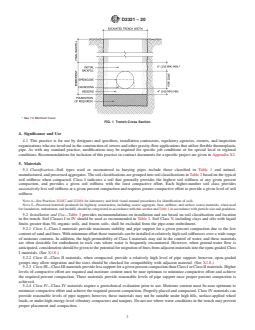
backfill, pipe zone, excavated trench width—See Fig. 1 for
in Place by Nuclear Methods (Shallow Depth) (With-
meaning and limits, and trench terminology.
drawn 2007)
3.3.5 manufactured aggregates—aggregates such as slag
D3017 Test Method for Water Content of Soil and Rock in
that are products or byproducts of a manufacturing process, or
Place by Nuclear Methods (Shallow Depth)
natural aggregates that are reduced to their final form by a
D4318 Test Methods for Liquid Limit, Plastic Limit, and
manufacturing process such as crushing.
Plasticity Index of Soils
3.3.6 modulus of soil reaction (E’)—anempiricalvalueused
F402 Practice for Safe Handling of Solvent Cements,
in the Iowa deflection formula that defines the stiffness of the
Primers, and Cleaners Used for Joining Thermoplastic
soil embedment around a buried pipe
Pipe and Fittings
F412 Terminology Relating to Plastic Piping Systems
3.3.7 open-graded aggregate—an aggregate that has a par-
F477 Specification for Elastomeric Seals (Gaskets) for Join-
ticle size distribution such that, when it is compacted, the voids
ing Plastic Pipe
between the aggregate particles, expressed as a percentage of
F545 Specification for PVC and ABS Injected Solvent Ce-
the total space occupied by the material, are relatively large.
mented Plastic Pipe Joints (Withdrawn 2001)
3.3.8 processed aggregates—aggregates that are screened,
F913 Specification for Thermoplastic Elastomeric Seals
washed, mixed, or blended to produce a specific particle size
(Gaskets) for Joining Plastic Pipe
distribution.
F1668 Guide for Construction Procedures for Buried Plastic
3.3.9 secant constrained soil modulus (M )—- a value for
s
Pipe
4 soil stiffness determined as the secant slope of the stress-strain
2.2 AASHTO Standard:
curve of a one-dimensional compression test; M can be used
s
AASHTO M145 Classification of Soils and Soil Aggregate
in place of E’ in the Iowa deflection formula.
Mixtures
3.3.10 standard proctor density—the maximum dry unit
3. Terminology
weight of soil compacted at optimum moisture content, as
obtained by laboratory test in accordance with Test Methods
3.1 General—Definitions used in this practice are in accor-
D698.
dancewithTerminologiesF412andD8andTerminologyD653
unless otherwise indicated.
4. Significance and Use
3.2 Definitions:
4.1 This practice is for use by designers and specifiers,
3.2.1 Terminology D653 definitions used in this standard:
installation contractors, regulatory agencies, owners, and in-
3.2.2 compaction curve (Proctor curve) (moisture-density
spection organizations who are involved in the construction of
curve)—the curve showing the relationship between the dry
unit weight (density) and the water content of a soil for a given
compactive effort.
3.2.3 maximum unit weight—the dry unit weight defined by
the peak of a compaction curve.
3.2.4 optimum water content—the water content at which a
soil can be compacted to a maximum dry unit weight by a
given compactive effort.
3.2.5 percent compaction—the ratio, expressed as a
percentage, of: (1) dry unit weight of a soil, to (2) maximum
unit weight obtained in a laboratory compaction test.
3.3 Definitions of Terms Specific to This Standard:
3.3.1 aggregate—a granular material of mineral composi-
tion such as sand, gravel, shell, slag or crushed stone (see
Terminology D8).
The last approved version of this historical standard is referenced on
www.astm.org.
Available from American Association of State Highway and Transportation
* See 7.6 Minimum Cover
Officials (AASHTO), 444 N. Capitol St., NW, Suite 249, Washington, DC 20001,
http://www.transportation.org. FIG. 1 Trench Cross Section
D2321 − 20
sewers and other gravity-flow applications that utilize flexible percent compaction. Properly placed and compacted, Class IV
thermoplastic pipe. As with any standard practice, modifica- materials can provide reasonable levels of pipe support;
tions may be required for specific job conditions or for special however, these materials may not be suitable under high fills,
localorregionalconditions.Recommendationsforinclusionof surface-applied wheel loads, or under high-energy-level vibra-
this practice in contract documents for a specific project are tory compactors and tampers. Do not use where water condi-
given in Appendix X2. tions in the trench may prevent proper placement and compac-
tion.
5. Materials
NOTE 6—The term “high energy level vibratory compactors and
5.1 Classification—Soil types used or encountered in bury-
tampers” refers to compaction equipment that might deflect or distort the
ing pipes include those classified in Table 1 and natural,
pipe more than permitted by the specifications or the manufacturer.
manufactured, and processed aggregates. The soil classifica-
5.2.5 Class V—Class V materials should be excluded from
tions are grouped into soil classifications in Table 2 based on
pipe-zone embedment.
the typical soil stiffness when compacted. Class I indicates a
soil that generally provides the highest soil stiffness at any 5.3 Moisture Content of Embedment Materials—The mois-
given percent compaction, and provides a given soil stiffness
ture content of embedment materials must be controlled to
with the least compactive effort. Each higher-number soil class permit placement and compaction to required levels. For soils
provides successively less soil stiffness at a given percent
with low permeability (that is, Class III and Class IVand some
compaction and requires greater compactive effort to provide a borderline Class II soils), moisture content is normally con-
given level of soil stiffness trolled to 6 3 % of optimum (see Test Method D698). The
practicality of obtaining and maintaining the required limits on
NOTE 4—See Practices D2487 and D2488 for laboratory and field
moisture content is an important criterion for selecting
visual-manual procedures for identification of soils.
materials,sincefailuretoachieverequiredpercentcompaction,
NOTE 5—Processed materials produced for highway construction,
including coarse aggregate, base, subbase, and surface coarse materials,
especially in the pipe zone embedment, may result in excessive
whenusedforfoundation,embedment,andbackfill,shouldbecategorized
deflection.
in accordance with this section and Table 1 in accordance with particle
size and gradation.
5.4 Maximum Particle Size—Maximum particle size for
embedment is limited to material passing a 1 ⁄2 in. (37.5 mm)
5.2 Installation and Use—Table 3 provides recommenda-
sieve (see Table 2). To enhance placement around small
tions on installation and use based on soil classification and
diameterpipeandtopreventdamagetothepipewall,asmaller
location in the trench. Soil Classes I to IV should be used as
maximum size may be required (see X1.9). The final backfill
recommendedinTable3.SoilClassV,includingclaysandsilts
material may extend down to the top of the pipe as long as the
with liquid limits greater than 50, organic soils, and frozen
material is less than 1 ⁄2 in. (37.5 mm) in size. When final
soils, shall be excluded from the pipe-zone embedment.
backfill contains rocks, cobbles, etc., the engineer may require
5.2.1 Class I—Class I materials provide maximum stability
greater initial backfill cover levels (see Fig. 1) if damage to the
and pipe support for a given percent compaction due to the low
pipe is of a concern.
content of sand and fines. With minimum effort these materials
can be installed at relatively high-soil stiffnesses over a wide
NOTE 7—While the main purpose of the initial backfill material is to
range of moisture contents. In addition, the high permeability
protect the pipe from impact from larger rocks or cobbles, it is still the
of Class I materials may aid in the control of water, and these
responsibility of the engineer to determine the appropriate thickness of
this layer based on field conditions and construction practices at the site.
materials are often desirable for embedment in rock cuts where
water is frequently encountered. However, when ground-water
6. Trench Excavation
flow is anticipated, consideration should be given to the
potential for migration of fines from adjacent materials into the
6.1 General—Procedures for trench excavation that are
open-graded Class I materials. (See X1.8.)
especially important in flexible thermoplastic pipe installations
5.2.2 Class II—Class II materials, when compacted, provide
are given herein.
a relatively high level of pipe support; however, open-graded
6.1.1 Excavation—Excavate trenches to ensure that sides
groups may allow migration and the sizes should be checked
will be stable under all working conditions. Slope trench walls
for compatibility with adjacent material. (See X1.8.)
or provide supports in conformance with all local and national
5.2.3 Class III—Class III materials provide less support for
standards for safety. Open only as much trench as can be safely
a given percent compaction than Class I or Class II materials.
maintained by available equipment. Backfill all trenches as
Higher levels of compactive effort are required and moisture
soon as practicable, but not later than the end of each working
content must be near optimum to minimize compactive effort
day.
and achieve the required percent compaction. These materials
6.2 Water Control—Do not lay or embed pipe in standing or
provide reasonable levels of pipe support once proper percent
running water. At all times prevent runoff and surface water
compaction is achieved.
from entering the trench.
5.2.4 Class IV—Class IV materials require a geotechnical
evaluation prior to use. Moisture content must be near opti- 6.2.1 Ground Water—When groundwater is present in the
mum to minimize compactive effort and achieve the required work area, dewater to maintain stability of in-situ and imported
D2321 − 20
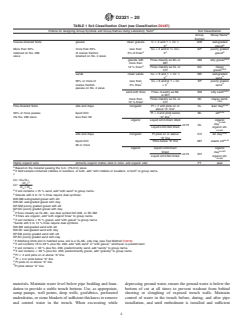
TABLE 1 Soil Classification Chart (see Classification D2487)
A
Criteria for Assigning Group Symbols and Group Names Using Laboratory Tests Soil Classification
B
Group Group Name
Symbol
Coarse-Grained Soils gravels clean gravels C $ 4 and 1 # Cc # GW well-graded
C D
3 gravel
More than 50% more than 50% less than Cu < 4 and/or 1> Cc> GP poorly graded
E C D
retained on No. 200 of coarse fraction 5% of fines 3 gravel
sieve retained on No. 4 sieve
DFG
gravels with Fines classify as ML or GM silty gravel
more than MH
E
12 % fines Fines classify as CL or GC clayey
DFG
CH gravel
sands clean sands Cu $ 6 and 1 # Cc # SW well-graded
C H
3 sand
50% or more of less than Cu < 6 and/or 1 > Cc SP poorly graded
I C H
coarse fraction 5% fines >3 sand
passes on No. 4 sieve
FGH
sand with fines Fines cLassify as ML SM silty sand
or MH
more than Fines classify as CL or SC clayey sand-
I FGH
12 % fines CH
KLM
Fine-Grained Soils silts and clays inorganic PI > 7 and plots on or CL lean clay
J
above “A” line
KLM
50% or more passes liquid limit PI < 4 and plots below ML silt
J
the No. 200 sieve less than 50 “A” line
organic Liquid Limit-Oven dried organic
KLMN
clay
<0.75 OL
Liquid Limit-Not dried organic silt-
KLMO
KLM
silts and clays inorganic PI plots on or above CH fat clay
“A” line
KLM
liquid limit Plots below “A” line MH elastic silt
50 or more
organic Liquid Limit-Oven organic
KLMP
Dried clay
<0.75 OH
Liquid Limit-Not Dried organic silt-
KLMQ
Highly organic soils primarily organic matter, dark in color, and organic odor PT peat
A
Based on the material passing the 3-in. (75-mm) sieve.
B
If field sample contained cobbles or boulders, or both, add “with cobbles or boulders, or both” to group name.
C
Cu5D /D
60 10
sD d
Cc5
D 3D
10 60
D
If soil contains $15 % sand, add “with sand” to group name.
E
Gravels with 5 to 12 % fines require dual symbols:
GW-GM well-graded gravel with silt:
GW-GC well-graded gravel with clay
GP-GM poorly graded gravel with silt
GP-GC poorly graded gravel with clay
F
If fines classify as CL-ML, use dual symbol GC-GM, or SC-SM.
G
If fines are organic, add “with organic fines” to group name.
H
If soil contains $15 % gravel, add “with gravel” to group name.
I
Sands with 5 to 12 % fines require dual symbols:
SW-SM well-graded sand with silt
SW-SC well-graded sand with clay
SP-SM poorly graded sand with silt
SP-SC poorly graded sand with clay
J
If Atterberg limits plot in hatched area, soil is a CL-ML, silty clay (see Test Method D4318).
K
If soil contains 15 to 29 % plus No. 200, add “with sand” or “with gravel,” whichever is predominant.
L
If soil contains $ 30 % plus No. 200, predominantly sand, add “sandy” to group name.
M
If soil contains $ 30 % plus No. 200, predominantly gravel, add “gravelly” to group name.
N
PI $ 4 and plots on or above “A” line.
O
PI < 4 or plots below “A” line.
P
PI plots on or above “A” line.
Q
PI plots below “A” line.
materials. Maintain water level below pipe bedding and foun- depressing ground water, ensure the ground water is below the
dation to provide a stable trench bottom. Use, as appropriate, bottom of cut at all times to prevent washout from behind
sump pumps, well points, deep wells, geofabrics, perforated sheeting or sloughing of exposed trench walls. Maintain
underdrains, or stone blankets of sufficient thickness to remove control of water in the trench before, during, and after pipe
and control water in the trench. When excavating while installation, and until embedment is installed and sufficient
D2321 − 20
TABLE 2 Soil Classes
American Association of
State Highway and
A,B
Soil Group Soil Class
Transportation Officials
C
(AASHTO) Soil Groups
D
Crushed rock, angular :
100% passing 1-1/2in. sieve,
passing #4 sieve,
3/8in. sieve and
#200 sieve
Clean, coarse grained soils:
SW, SP, GW, GP or any soil beginning
Class II A1,A3
with one of these symbols with
E,F
% passing #200 sieve
Coarse grained soils with fines:
GM, GC, SM, SC, or any soil beginning
with one of these symbols, containing > A-2-4, A-2-5, A-2-6, or A-4
12 % passing #200 sieve; Sandy or or A-6 soils with more
Class III
gravelly fine-grained soils: CL, ML, or than 30% retained on
any soil beginning with one of these #200 sieve
symbols, with >/= 30 % retained on
#200 sieve
Fine-grained soils:
A-2-7, or A-4, or A-6 soils
CL, ML, or any soil beginning with one
Class IV with 30% or less retained
of these symbols, with <30 % retained
on #200 sieve
on #200 sieve
Class V
MH, CH, OL, OH, PT Not for use A5, A7
as embedment
A
See Classification D2487, Standard Classification of Soils for Engineering Purposes (Unified Soil Classification System).
B
Limitsmaybeimposedonthesoilgrouptomeetprojectorlocalrequirementsifthespecifiedsoilremainswithinthegroup.Forexample,someprojectapplicationsrequire
a Class I material with minimal fines to address specific structural or hydraulic conditions and the specification may read “Use Class I soil with a maximum of 5 % passing
the #200 sieve.”
C
AASHTO M145, Classification of Soils and Soil Aggregate Mixtures.
D
All particle faces shall be fractured.
E
Materials such as broken coral, shells, and recycled concrete, with # =12 % passing a No. 200 sieve, are considered to be Class II materials. These materials should
only be used when evaluated and approved by the Engineer
F
Uniform fine sands (SP) with more than 50% passing a No. 100 sieve (0.006 in., 0.15 mm) are very sensitive to moisture and should not be used as backfill unless
specificallyallowedinthecontractdocuments.Ifuseofthesematerialsisallowed,compactionandhandlingproceduresshouldfollowtheguidelinesforClassIIImaterials.
backfill has been placed to prevent flotation of the pipe. To considerations, trench width in unsupported, unstable soils will
preclude loss of soil support, employ dewatering methods that
depend on the size and stiffness of the pipe, stiffness of the
minimize removal of fines and the creation of voids in in-situ embedment and in-situ soil, and depth of cover (see X1.10).
materials.
Specially designed equipment may enable the satisfactory
6.2.2 Running Water—Control running water emanating
installation and embedment of pipe in trenches narrower than
from drainage of surface or ground water to preclude under-
specified above. If it is determined that the use of such
mining of the trench bottom or walls, the foundation, or other
equipment provides an installation consistent with the require-
zones of embedment. Provide dams, cutoffs or other barriers
ments of this standard, minimum trench widths may be
periodically along the installation to preclude transport of
reduced, as approved by the engineer.
water along the trench bottom. Backfill all trenches after the
6.4 Support of Trench Walls—When supports such as trench
pipe is installed to prevent disturbance of pipe and embedment.
sheeting, trench jacks, trench shields or boxes are used, ensure
6.2.3 Materials for Water Control—Use suitably graded
that support of the pipe and its embedment is maintained
materials in foundation or bedding layers or as drainage
throughoutinstallation.Ensurethatsheetingissufficientlytight
blankets for transport of running water to sump pits or other
to prevent washing out of the trench wall from behind the
drains. Use well graded materials, along with perforated
sheeting. Provide tight support of trench walls below viaducts,
underdrains,toenhancetransportofrunningwater,asrequired.
existing utilities, or other obstructions that restrict driving of
Select the gradation of the drainage materials to minimize
sheeting.
migration of fines from surrounding materials (see X1.8).
6.4.1 Supports Left in Place—Unless otherwise directed by
6.3 Minimum Trench Width—Where trench walls are stable
the engineer, sheeting driven into or below the pipe zone
or supported, provide a width sufficient, but no greater than
should be left in place to preclude loss of support of foundation
necessary, to ensure working room to properly and safely place
and embedment materials. When top of sheeting is to be cut
and compact haunching and other embedment materials. The
off, make cut 1.5 ft (0.5 m) or more above the crown of the
space between the pipe and trench wall must be wider than the
pipe. Leave rangers, whalers, and braces in place as required to
compaction equipment used in the pipe zone. Minimum width
shall be not less than the greater of either the pipe outside supportcutoffsheetingandthetrenchwallinthevicinityofthe
pipe zone. Timber sheeting to be left in place is considered a
diameter plus 16 in. (400 mm) or the pipe outside diameter
times 1.25, plus 12 in. (300 mm). In addition to safety permanent structural member and should be treated against
D2321 − 20
TABLE 3 Recommendations for Installation and Use of Soils and Aggregates for Foundation and Pipe-Zone Embedment
A B
Soil Class Class I Class II Class III Class IV
General Acceptable and common Where hydraulic gradient exists Do not use where water Difficult to achieve high-soil
Recommendations where no migration check gradation to minimize conditions in trench prevent stiffness. Do not use where
and Restrictions is probable or when migration. Clean groups are suitable proper placement and water
combined with a geotextile for use as a drainage blanket and compaction. conditions in trench
filter media. underdrain (see Table 2). Uniform Not recommended for use prevent proper placement
Suitable for use as a fine sands (SP) with with pipes with stiffness and compaction.
drainage blanket more than 50 % passing a #100 sieve of 9 psi or less Not recommended for
and under drain (0.006 in., 0.15 mm) use with pipes with
where adjacent material is behave like silts and should be stiffness of 9 psi or less
suitably graded or when treated as
used with a geotextile filter fabric Class III soils.
(see X1.8).
Foundation Suitable as foundation and for Suitable as foundation Suitable for replacing over- Suitable for replacing
replacing over-excavated and for replacing excavated over-excavated trench
and unstable trench over-excavated and trench bottom as restricted bottom
bottom as restricted unstable trench bottom above. for depths up to 12 in.
above. as restricted above. Install and compact in (300 mm) as restricted
Install and compact 6 in. (150 mm) maximum above. Use only where
in 12 in. (300 mm) layers uniform longitudinal
maximum layers support of the pipe can be
maintained, as approved
by the engineer.
Install and compact
in 6-in (150 mm) maximum
layers
Pipe Suitable as restricted Suitable as restricted above. Work Suitable as restricted above.Suitable as restricted above.
Embedment above. Work material material under pipe to provide Difficult to place and Difficult to place and
under pipe to provide uniform haunch support. compact in the haunch compact in the
uniform haunch support. zone. haunch zone.
C
Minimum See Note 85 % (SW and SP soils) 90 % 95 %
Recommended For GW and GP soils
E
Percent Compaction, see Note
D
SPD
Relative Compactive low moderate high very high
Effort Required
to Achieve Minimum
Percent Compaction
Compaction vibration vibration impact impact
Methods or impact or impact
Required Moisture none none Maintain near optimum Maintain near optimum
Control to minimize compactive to minimize compactive effort
effort
A
Class V materials are unsuitable as embedment. They may be used as final backfill as permitted by the engineer.
B
Class I materials have higher stiffness than Class II materials, but data on specific soil stiffness values are not available at the current time. Until such data are available
thesoilstiffnessofplaced,uncompactedClassImaterialscanbetakenequivalenttoClassIImaterialscompactedto95 %ofmaximumstandardProctordensity(SPD95),
and the soil stiffness of compacted Class I materials can be taken equivalent to Class II materials compacted to 100% of maximum standard Proctor density (SPD100).
Even if placed uncompacted (that is, dumped), Class I materials should always be worked into the haunch zone to assure complete placement.
C
Suitable compaction typically achieved by dumped placement (that is, uncompacted but worked into haunch zone to ensure complete placement).
D
SPD is standard Proctor density as determined by Test Method D698.
E
Place and compact GW and GP soils with at least two passes of compaction equipment.
biological degradation (for example, attack by insects or other ing supports, place and compact embedment to sufficient
biological forms) as necessary, and against decay if above depths to ensure protection of the pipe.As supports are moved,
ground water. finish placing and compacting embedment.
6.4.3 Removal of Trench Wall Support—If the engineer
NOTE 8—Certain preservative and protective compounds may react
permits the use of sheeting or other trench wall supports below
adversely with some types of thermoplastics, and their use should be
the pipe zone, ensure that pipe and foundation and embedment
avoided
...
This document is not an ASTM standard and is intended only to provide the user of an ASTM standard an indication of what changes have been made to the previous version. Because
it may not be technically possible to adequately depict all changes accurately, ASTM recommends that users consult prior editions as appropriate. In all cases only the current version
of the standard as published by ASTM is to be considered the official document.
Designation: D2321 − 18 D2321 − 20
Standard Practice for
Underground Installation of Thermoplastic Pipe for Sewers
and Other Gravity-Flow Applications
This standard is issued under the fixed designation D2321; the number immediately following the designation indicates the year of
original adoption or, in the case of revision, the year of last revision. A number in parentheses indicates the year of last reapproval. A
superscript epsilon (´) indicates an editorial change since the last revision or reapproval.
This standard has been approved for use by agencies of the U.S. Department of Defense.
1. Scope*
1.1 This practice provides recommendations for the installation of buried thermoplastic pipe used in sewers and other
gravity-flow applications. These recommendations are intended to ensure a stable underground environment for thermoplastic pipe
under a wide range of service conditions. However, because of the numerous flexible plastic pipe products available and the
inherent variability of natural ground conditions, achieving satisfactory performance of any one product may require modification
to provisions contained herein to meet specific project requirements.
1.2 The scope of this practice necessarily excludes product performance criteria such as minimum pipe stiffness, maximum
service deflection, or long term strength. Thus, it is incumbent upon the product manufacturer, specifier, or project engineer to
verify and assure that the pipe specified for an intended application, when installed according to procedures outlined in this
practice, will provide a long term, satisfactory performance according to criteria established for that application. A commentary
on factors important in achieving a satisfactory installation is included in Appendix X1.
NOTE 1—Specific paragraphs in the appendix are referenced in the body of this practice for informational purposes.
NOTE 2—The following ASTM standards may be found useful in connection with this practice: Practice D420, Test Method D1556, Method D2216,
Specification D2235, Test Method D2412, Specification D2564, Practice D2657, Practice D2855, Test Methods D2922, Test Method D3017, Practice
F402, Specification F477, Specification F545, and Specification F913.
NOTE 3—Most Plumbing Codes and some Building Codes have provisions for the installation of underground “building drains and building sewers.”
See them for plumbing piping applications.
1.3 Units—The values stated in inch-pound units are to be regarded as standard. The values given in parentheses are
mathematical conversions to SI units that are provided for information only and are not considered standard.
1.4 This standard does not purport to address all of the safety concerns, if any, associated with its use. It is the responsibility
of the user of this standard to establish appropriate safety, health, and environmental practices and determine the applicability of
regulatory limitations prior to use.
1.5 This international standard was developed in accordance with internationally recognized principles on standardization
established in the Decision on Principles for the Development of International Standards, Guides and Recommendations issued
by the World Trade Organization Technical Barriers to Trade (TBT) Committee.
2. Referenced Documents
2.1 ASTM Standards:
D8 Terminology Relating to Materials for Roads and Pavements
D420 Guide for Site Characterization for Engineering Design and Construction Purposes
D653 Terminology Relating to Soil, Rock, and Contained Fluids
3 3
D698 Test Methods for Laboratory Compaction Characteristics of Soil Using Standard Effort (12,400 ft-lbf/ft (600 kN-m/m ))
D1556 Test Method for Density and Unit Weight of Soil in Place by Sand-Cone Method
D2216 Test Methods for Laboratory Determination of Water (Moisture) Content of Soil and Rock by Mass
D2235 Specification for Solvent Cement for Acrylonitrile-Butadiene-Styrene (ABS) Plastic Pipe and Fittings
D2412 Test Method for Determination of External Loading Characteristics of Plastic Pipe by Parallel-Plate Loading
This practice is under the jurisdiction of ASTM Committee F17 on Plastic Piping Systems and is the direct responsibility of Subcommittee F17.62 on Sewer.
Current edition approved March 1, 2018March 15, 2020. Published April 2018April 2020. Originally approved in 1989. Last previous edition approved in 20142018 as
ɛ1
D2321 – 14D2321 – 18. . DOI: 10.1520/D2321-18.10.1520/D2321-20.
For referenced ASTM standards, visit the ASTM website, www.astm.org, or contact ASTM Customer Service at service@astm.org. For Annual Book of ASTM Standards
volume information, refer to the standard’s Document Summary page on the ASTM website.
*A Summary of Changes section appears at the end of this standard
Copyright © ASTM International, 100 Barr Harbor Drive, PO Box C700, West Conshohocken, PA 19428-2959. United States
D2321 − 20
D2487 Practice for Classification of Soils for Engineering Purposes (Unified Soil Classification System)
D2488 Practice for Description and Identification of Soils (Visual-Manual Procedures)
D2564 Specification for Solvent Cements for Poly(Vinyl Chloride) (PVC) Plastic Piping Systems
D2657 Practice for Heat Fusion Joining of Polyolefin Pipe and Fittings
D2855 Practice for the Two-Step (Primer and Solvent Cement) Method of Joining Poly (Vinyl Chloride) (PVC) or Chlorinated
Poly (Vinyl Chloride) (CPVC) Pipe and Piping Components with Tapered Sockets
D2922 Test Methods for Density of Soil and Soil-Aggregate in Place by Nuclear Methods (Shallow Depth) (Withdrawn 2007)
D3017 Test Method for Water Content of Soil and Rock in Place by Nuclear Methods (Shallow Depth)
D4318 Test Methods for Liquid Limit, Plastic Limit, and Plasticity Index of Soils
F402 Practice for Safe Handling of Solvent Cements, Primers, and Cleaners Used for Joining Thermoplastic Pipe and Fittings
F412 Terminology Relating to Plastic Piping Systems
F477 Specification for Elastomeric Seals (Gaskets) for Joining Plastic Pipe
F545 Specification for PVC and ABS Injected Solvent Cemented Plastic Pipe Joints (Withdrawn 2001)
F913 Specification for Thermoplastic Elastomeric Seals (Gaskets) for Joining Plastic Pipe
F1668 Guide for Construction Procedures for Buried Plastic Pipe
2.2 AASHTO Standard:
AASHTO M145 Classification of Soils and Soil Aggregate Mixtures
3. Terminology
3.1 General—Definitions used in this practice are in accordance with Terminologies F412 and D8 and Terminology D653 unless
otherwise indicated.
3.2 Definitions:
3.2.1 Terminology D653 definitions used in this standard:
3.2.2 compaction curve (Proctor curve) (moisture-density curve)—the curve showing the relationship between the dry unit
weight (density) and the water content of a soil for a given compactive effort.
3.2.3 maximum unit weight—the dry unit weight defined by the peak of a compaction curve.
3.2.4 optimum water content—the water content at which a soil can be compacted to a maximum dry unit weight by a given
compactive effort.
3.2.5 percent compaction—the ratio, expressed as a percentage, of: (1) dry unit weight of a soil, to (2) maximum unit weight
obtained in a laboratory compaction test.
3.3 Definitions of Terms Specific to This Standard:
3.3.1 aggregate—a granular material of mineral composition such as sand, gravel, shell, slag or crushed stone (see Terminology
D8).
3.3.2 deflection—any change in the inside diameter of the pipe resulting from installation and imposed loads. Deflection may
be either vertical or horizontal and is usually reported as a percentage of the base (undeflected) inside pipe diameter.
3.3.3 engineer—the engineer in responsible charge of the work or his duly recognized or authorized representative.
3.3.4 foundation, bedding, haunching, initial backfill, final backfill, pipe zone, excavated trench width—See Fig. 1 for meaning
and limits, and trench terminology.
3.3.5 manufactured aggregates—aggregates such as slag that are products or byproducts of a manufacturing process, or natural
aggregates that are reduced to their final form by a manufacturing process such as crushing.
3.3.6 modulus of soil reaction (E’)—an empirical value used in the Iowa deflection formula that defines the stiffness of the soil
embedment around a buried pipe
3.3.7 open-graded aggregate—an aggregate that has a particle size distribution such that, when it is compacted, the voids
between the aggregate particles, expressed as a percentage of the total space occupied by the material, are relatively large.
3.3.8 processed aggregates—aggregates that are screened, washed, mixed, or blended to produce a specific particle size
distribution.
3.3.9 secant constrained soil modulus (M )—- a value for soil stiffness determined as the secant slope of the stress-strain curve
s
of a one-dimensional compression test; M can be used in place of E’ in the Iowa deflection formula.
s
3.3.10 standard proctor density—the maximum dry unit weight of soil compacted at optimum moisture content, as obtained by
laboratory test in accordance with Test Methods D698.
The last approved version of this historical standard is referenced on www.astm.org.
Available from American Association of State Highway and Transportation Officials (AASHTO), 444 N. Capitol St., NW, Suite 249, Washington, DC 20001,
http://www.transportation.org.
D2321 − 20
* See 7.6 Minimum Cover
FIG. 1 Trench Cross Section
4. Significance and Use
4.1 This practice is for use by designers and specifiers, installation contractors, regulatory agencies, owners, and inspection
organizations who are involved in the construction of sewers and other gravity-flow applications that utilize flexible thermoplastic
pipe. As with any standard practice, modifications may be required for specific job conditions or for special local or regional
conditions. Recommendations for inclusion of this practice in contract documents for a specific project are given in Appendix X2.
5. Materials
5.1 Classification—Soil types used or encountered in burying pipes include those classified in Table 1 and natural,
manufactured, and processed aggregates. The soil classifications are grouped into soil classifications in Table 2 based on the typical
soil stiffness when compacted. Class I indicates a soil that generally provides the highest soil stiffness at any given percent
compaction, and provides a given soil stiffness with the least compactive effort. Each higher-number soil class provides
successively less soil stiffness at a given percent compaction and requires greater compactive effort to provide a given level of soil
stiffness
NOTE 4—See Practices D2487 and D2488 for laboratory and field visual-manual procedures for identification of soils.
NOTE 5—Processed materials produced for highway construction, including coarse aggregate, base, subbase, and surface coarse materials, when used
for foundation, embedment, and backfill, should be categorized in accordance with this section and Table 1 in accordance with particle size and gradation.
5.2 Installation and Use—Table 3 provides recommendations on installation and use based on soil classification and location
in the trench. Soil Classes I to IV should be used as recommended in Table 3. Soil Class V, including clays and silts with liquid
limits greater than 50, organic soils, and frozen soils, shall be excluded from the pipe-zone embedment.
5.2.1 Class I—Class I materials provide maximum stability and pipe support for a given percent compaction due to the low
content of sand and fines. With minimum effort these materials can be installed at relatively high-soil stiffnesses over a wide range
of moisture contents. In addition, the high permeability of Class I materials may aid in the control of water, and these materials
are often desirable for embedment in rock cuts where water is frequently encountered. However, when ground-water flow is
anticipated, consideration should be given to the potential for migration of fines from adjacent materials into the open-graded Class
I materials. (See X1.8.)
5.2.2 Class II—Class II materials, when compacted, provide a relatively high level of pipe support; however, open-graded
groups may allow migration and the sizes should be checked for compatibility with adjacent material. (See X1.8.)
5.2.3 Class III—Class III materials provide less support for a given percent compaction than Class I or Class II materials. Higher
levels of compactive effort are required and moisture content must be near optimum to minimize compactive effort and achieve
the required percent compaction. These materials provide reasonable levels of pipe support once proper percent compaction is
achieved.
5.2.4 Class IV—Class IV materials require a geotechnical evaluation prior to use. Moisture content must be near optimum to
minimize compactive effort and achieve the required percent compaction. Properly placed and compacted, Class IV materials can
provide reasonable levels of pipe support; however, these materials may not be suitable under high fills, surface-applied wheel
loads, or under high-energy-level vibratory compactors and tampers. Do not use where water conditions in the trench may prevent
proper placement and compaction.
D2321 − 20
TABLE 1 Soil Classification Chart (see Classification D2487)
A
Criteria for Assigning Group Symbols and Group Names Using Laboratory Tests Soil Classification
B
Group Group Name
Symbol
Coarse-Grained Soils gravels clean gravels C $ 4 and 1 # Cc # GW well-graded
C D
3 gravel
More than 50% more than 50% less than Cu < 4 and/or 1> Cc> GP poorly graded
E C D
retained on No. 200 of coarse fraction 5% of fines 3 gravel
sieve retained on No. 4 sieve
DFG
gravels with Fines classify as ML or GM silty gravel
more than MH
E
12 % fines Fines classify as CL or GC clayey
DFG
CH gravel
sands clean sands Cu $ 6 and 1 # Cc # SW well-graded
C H
3 sand
50% or more of less than Cu < 6 and/or 1 > Cc SP poorly graded
I C H
coarse fraction 5% fines > 3 sand
passes on No. 4 sieve
FGH
sand with fines Fines cLassify as ML SM silty sand
or MH
more than Fines classify as CL or SC clayey sand-
I FGH
12 % fines CH
KLM
Fine-Grained Soils silts and clays inorganic PI > 7 and plots on or CL lean clay
J
above “A” line
KLM
50% or more passes liquid limit PI < 4 and plots below ML silt
J
the No. 200 sieve less than 50 “A” line
organic Liquid Limit-Oven dried organic
KLMN
clay
<0.75 OL
Liquid Limit-Not dried organic silt-
KLMO
KLM
silts and clays inorganic PI plots on or above CH fat clay
“A” line
KLM
liquid limit Plots below “A” line MH elastic silt
50 or more
organic Liquid Limit-Oven organic
KLMP
Dried clay
<0.75 OH
Liquid Limit-Not Dried organic silt-
KLMQ
Highly organic soils primarily organic matter, dark in color, and organic odor PT peat
A
Based on the material passing the 3-in. (75-mm) sieve.
B
If field sample contained cobbles or boulders, or both, add “with cobbles or boulders, or both” to group name.
C
Cu5D /D
60 10
sD d
Cc5
D 3D
10 60
D
If soil contains $15 % sand, add “with sand” to group name.
E
Gravels with 5 to 12 % fines require dual symbols:
GW-GM well-graded gravel with silt:
GW-GC well-graded gravel with clay
GP-GM poorly graded gravel with silt
GP-GC poorly graded gravel with clay
F
If fines classify as CL-ML, use dual symbol GC-GM, or SC-SM.
G
If fines are organic, add “with organic fines” to group name.
H
If soil contains $15 % gravel, add “with gravel” to group name.
I
Sands with 5 to 12 % fines require dual symbols:
SW-SM well-graded sand with silt
SW-SC well-graded sand with clay
SP-SM poorly graded sand with silt
SP-SC poorly graded sand with clay
J
If Atterberg limits plot in hatched area, soil is a CL-ML, silty clay (see Test Method D4318).
K
If soil contains 15 to 29 % plus No. 200, add “with sand” or “with gravel,” whichever is predominant.
L
If soil contains $ 30 % plus No. 200, predominantly sand, add “sandy” to group name.
M
If soil contains $ 30 % plus No. 200, predominantly gravel, add “gravelly” to group name.
N
PI $ 4 and plots on or above “A” line.
O
PI < 4 or plots below “A” line.
P
PI plots on or above “A” line.
Q
PI plots below “A” line.
NOTE 6—The term “high energy level vibratory compactors and tampers” refers to compaction equipment that might deflect or distort the pipe more
than permitted by the specifications or the manufacturer.
5.2.5 Class V—Class V materials should be excluded from pipe-zone embedment.
5.3 Moisture Content of Embedment Materials—The moisture content of embedment materials must be controlled to permit
placement and compaction to required levels. For soils with low permeability (that is, Class III and Class IV and some borderline
D2321 − 20
TABLE 2 Soil Classes
American Association of
State Highway and
A,B
Soil Group Soil Class
Transportation Officials
C
(AASHTO) Soil Groups
D
Crushed rock, angular :
100% passing 1-1/2in. sieve,
passing #4 sieve,
3/8in. sieve and
#200 sieve
Clean, coarse grained soils:
SW, SP, GW, GP or any soil beginning
Class II A1,A3
with one of these symbols with
E,F
% passing #200 sieve
Coarse grained soils with fines:
GM, GC, SM, SC, or any soil beginning
with one of these symbols, containing > A-2-4, A-2-5, A-2-6, or A-4
12 % passing #200 sieve; Sandy or or A-6 soils with more
Class III
gravelly fine-grained soils: CL, ML, or than 30% retained on
any soil beginning with one of these #200 sieve
symbols, with >/= 30 % retained on
#200 sieve
Fine-grained soils:
A-2-7, or A-4, or A-6 soils
CL, ML, or any soil beginning with one
Class IV with 30% or less retained
of these symbols, with <30 % retained
on #200 sieve
on #200 sieve
Class V
MH, CH, OL, OH, PT Not for use A5, A7
as embedment
A
See Classification D2487, Standard Classification of Soils for Engineering Purposes (Unified Soil Classification System).
B
Limits may be imposed on the soil group to meet project or local requirements if the specified soil remains within the group. For example, some project applications require
a Class I material with minimal fines to address specific structural or hydraulic conditions and the specification may read “Use Class I soil with a maximum of 5%5 % passing
the #200 sieve.”
C
AASHTO M145, Classification of Soils and Soil Aggregate Mixtures.
D
All particle faces shall be fractured.
E
Materials such as broken coral, shells, and recycled concrete, with # =12% =12 % passing a No. 200 sieve, are considered to be Class II materials. These materials
should only be used when evaluated and approved by the Engineer
F
Uniform fine sands (SP) with more than 50% passing a No. 100 sieve (0.006 in., 0.15 mm) are very sensitive to moisture and should not be used as backfill unless
specifically allowed in the contract documents. If use of these materials is allowed, compaction and handling procedures should follow the guidelines for Class III materials.
Class II soils), moisture content is normally controlled to 6 3 % of optimum (see Test Method D698). The practicality of obtaining
and maintaining the required limits on moisture content is an important criterion for selecting materials, since failure to achieve
required percent compaction, especially in the pipe zone embedment, may result in excessive deflection.
5.4 Maximum Particle Size—Maximum particle size for embedment is limited to material passing a 1 ⁄2-in. (37.5-mm) in.
(37.5 mm) sieve (see Table 2). To enhance placement around small diameter pipe and to prevent damage to the pipe wall, a smaller
maximum size may be required (see X1.9). The final backfill material may extend down to the top of the pipe as long as the
material is less than 1 ⁄2 in. (37.5 mm) in size. When final backfill contains rocks, cobbles, etc., the engineer may require greater
initial backfill cover levels (see Fig. 1). ) if damage to the pipe is of a concern.
NOTE 7—While the main purpose of the initial backfill material is to protect the pipe from impact from larger rocks or cobbles, it is still the
responsibility of the engineer to determine the appropriate thickness of this layer based on field conditions and construction practices at the site.
6. Trench Excavation
6.1 General—Procedures for trench excavation that are especially important in flexible thermoplastic pipe installations are
given herein.
6.1.1 Excavation—Excavate trenches to ensure that sides will be stable under all working conditions. Slope trench walls or
provide supports in conformance with all local and national standards for safety. Open only as much trench as can be safely
maintained by available equipment. Backfill all trenches as soon as practicable, but not later than the end of each working day.
6.2 Water Control—Do not lay or embed pipe in standing or running water. At all times prevent runoff and surface water from
entering the trench.
6.2.1 Ground Water—When groundwater is present in the work area, dewater to maintain stability of in-situ and imported
materials. Maintain water level below pipe bedding and foundation to provide a stable trench bottom. Use, as appropriate, sump
pumps, well points, deep wells, geofabrics, perforated underdrains, or stone blankets of sufficient thickness to remove and control
water in the trench. When excavating while depressing ground water, ensure the ground water is below the bottom of cut at all
times to prevent washout from behind sheeting or sloughing of exposed trench walls. Maintain control of water in the trench
before, during, and after pipe installation, and until embedment is installed and sufficient backfill has been placed to prevent
flotation of the pipe. To preclude loss of soil support, employ dewatering methods that minimize removal of fines and the creation
of voids in in-situ materials.
D2321 − 20
TABLE 3 Recommendations for Installation and Use of Soils and Aggregates for Foundation and Pipe-Zone Embedment
A B
Soil Class Class I Class II Class III Class IV
General Acceptable and common Where hydraulic gradient exists Do not use where water Difficult to achieve high-soil
Recommendations where no migration check gradation to minimize conditions in trench prevent stiffness. Do not use where
and Restrictions is probable or when migration. Clean groups are suitable proper placement and water
combined with a geotextile for use as a drainage blanket and compaction. conditions in trench
filter media. underdrain (see Table 2). Uniform Not recommended for use prevent proper placement
Suitable for use as a fine sands (SP) with with pipes with stiffness and compaction.
drainage blanket more than 50 % passing a #100 sieve of 9 psi or less Not recommended for
and under drain (0.006 in., 0.15 mm) use with pipes with
where adjacent material is behave like silts and should be stiffness of 9 psi or less
suitably graded or when treated as
used with a geotextile filter fabric Class III soils.
(see X1.8).
Foundation Suitable as foundation and for Suitable as foundation Suitable for replacing over- Suitable for replacing
replacing over-excavated and for replacing excavated over-excavated trench
and unstable trench over-excavated and trench bottom as restricted bottom
bottom as restricted unstable trench bottom above. for depths up to 12 in.
above. as restricted above. Install and compact in (300 mm) as restricted
Install and compact 6 in. (150 mm) maximum above. Use only where
in 12 in. (300 mm) layers uniform longitudinal
maximum layers support of the pipe can be
maintained, as approved
by the engineer.
Install and compact
in 6-in (150 mm) maximum
layers
Pipe Suitable as restricted Suitable as restricted above. Work Suitable as restricted above. Suitable as restricted above.
Embedment above. Work material material under pipe to provide Difficult to place and Difficult to place and
under pipe to provide uniform haunch support. compact in the haunch compact in the
uniform haunch support. zone. haunch zone.
C
Minimum See Note 85 % (SW and SP soils) 90 % 95 %
Recommended For GW and GP soils
E
Percent Compaction, see Note
D
SPD
Relative Compactive low moderate high very high
Effort Required
to Achieve Minimum
Percent Compaction
Compaction vibration vibration impact impact
Methods or impact or impact
Required Moisture none none Maintain near optimum Maintain near optimum
Control to minimize compactive to minimize compactive effort
effort
A
Class V materials are unsuitable as embedment. They may be used as final backfill as permitted by the engineer.
B
Class I materials have higher stiffness than Class II materials, but data on specific soil stiffness values are not available at the current time. Until such data are available
the soil stiffness of placed, uncompacted Class I materials can be taken equivalent to Class II materials compacted to 95%95 % of maximum standard Proctor density
(SPD95), and the soil stiffness of compacted Class I materials can be taken equivalent to Class II materials compacted to 100% of maximum standard Proctor density
(SPD100). Even if placed uncompacted (that is, dumped), Class I materials should always be worked into the haunch zone to assure complete placement.
C
Suitable compaction typically achieved by dumped placement (that is, uncompacted but worked into haunch zone to ensure complete placement).
D
SPD is standard Proctor density as determined by Test Method D698.
E
Place and compact GW and GP soils with at least two passes of compaction equipment.
6.2.2 Running Water—Control running water emanating from drainage of surface or ground water to preclude undermining of
the trench bottom or walls, the foundation, or other zones of embedment. Provide dams, cutoffs or other barriers periodically along
the installation to preclude transport of water along the trench bottom. Backfill all trenches after the pipe is installed to prevent
disturbance of pipe and embedment.
6.2.3 Materials for Water Control—Use suitably graded materials in foundation or bedding layers or as drainage blankets for
transport of running water to sump pits or other drains. Use well graded materials, along with perforated underdrains, to enhance
transport of running water, as required. Select the gradation of the drainage materials to minimize migration of fines from
surrounding materials (see X1.8).
6.3 Minimum Trench Width—Where trench walls are stable or supported, provide a width sufficient, but no greater than
necessary, to ensure working room to properly and safely place and compact haunching and other embedment materials. The space
between the pipe and trench wall must be wider than the compaction equipment used in the pipe zone. Minimum width shall be
not less than the greater of either the pipe outside diameter plus 16 in. (400 mm) or the pipe outside diameter times 1.25, plus 12
D2321 − 20
in. (300 mm). In addition to safety considerations, trench width in unsupported, unstable soils will depend on the size and stiffness
of the pipe, stiffness of the embedment and in-situ soil, and depth of cover (see X1.10). Specially designed equipment may enable
the satisfactory installation and embedment of pipe in trenches narrower than specified above. If it is determined that the use of
such equipment provides an installation consistent with the requirements of this standard, minimum trench widths may be reduced,
as approved by the engineer.
6.4 Support of Trench Walls—When supports such as trench sheeting, trench jacks, trench shields or boxes are used, ensure that
support of the pipe and its embedment is maintained throughout installation. Ensure that sheeting is sufficiently tight to prevent
washing out of the trench wall from behind the sheeting. Provide tight support of trench walls below viaducts, existing utilities,
or other obstructions that restrict driving of sheeting.
6.4.1 Supports Left in Place—Unless otherwise directed by the engineer, sheeting driven into or below the pipe zone should be
left in place to preclude loss of support of foundation and embedment materials. When top of sheeting is to be cut off, make cut
1.5 ft (0.5 m) or more above the crown of the pipe. Leave rangers, whalers, and braces in place as required to support cutoff
sheeting and the trench wall in the vicinity of the pipe zone. Timber sheeting to be left in place is considered a permanent structural
member and should be treated against biological degradation (for example, attack by insects or other biological forms) as
necessary, and against decay if above ground water.
NOTE 8—Certain preservative and protective compounds may react adversely with some types of thermoplastics, and their use should be avoided in
proximity of the pipe material.
6.4.2 Movable Trench Wall Supports—Do not disturb the installed pipe and its embedment when using movable trench boxes
and shields. Movable supports should not be used below the top of the pipe zone unless approved methods are used for maintaining
the integrity of embedment material. Before moving supports, place and compact
...