


ASTM B694-19
(Specification)Standard Specification for Copper, Copper-Alloy, Copper-Clad Bronze (CCB), Copper-Clad Stainless Steel (CCS), and Copper-Clad Alloy Steel (CAS) Sheet and Strip for Electrical Cable Shielding
Standard Specification for Copper, Copper-Alloy, Copper-Clad Bronze (CCB), Copper-Clad Stainless Steel (CCS), and Copper-Clad Alloy Steel (CAS) Sheet and Strip for Electrical Cable Shielding
ABSTRACT
This specification establishes the requirements for sheets and strips of various thicknesses produced from copper (Copper UNS No. C1000), copper-iron alloy (Copper Alloy UNS No. C19400), copper-zinc alloy that is commercial bronze (Copper Alloy UNS No. C22000), copper-zinc alloy that is red brass (Copper Alloy UNS No. C23000), copper-zinc-iron-cobalt alloy (Copper Alloy UNS No. C66400), copper-zinc-iron alloy (Copper Alloy UNS No. C66410), copper-zinc-iron-tin alloy (Copper Alloy UNS No. C66430), cupro-20% nickel (Copper Alloy UNS No. C71000), copper-clad bronze, copper-clad stainless steel, and copper-clad alloy steel. These materials are intended for use as electrostatic or electromagnetic shielding for insulated power, control, instrumentation, and communication cables. Cladding metals may be bonded to the specified base metal by any method that will produce products that will conform to the properties and characteristics prescribed herein. Materials shall be furnished specific to individual metals in the following tempers: H00 (cold-rolled, 1/8 hard), H01 (cold-rolled, ¼ hard), H02 (cold-rolled, ½ hard); O61 (annealed), O81 (annealed, ¼ hard), O50 (light annealed), O61 (annealed, soft), OS035, and OS015. Specimens shall be sampled and prepared, then tested accordingly to examine their conformance to dimensional (mass, thickness, width, straightness, and cladding ratio), mechanical (tensile strength, and Rockwell hardness), electrical (mass resistivity, and conductivity), chemical composition, and grain size requirements.
SCOPE
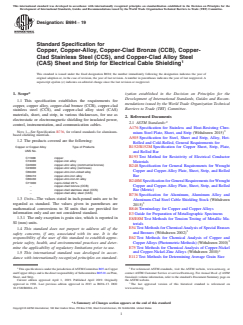
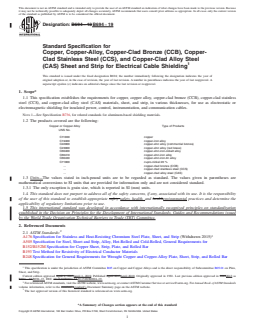
1.1 This specification establishes the requirements for copper, copper alloy, copper-clad bronze (CCB), copper-clad stainless steel (CCS), and copper-clad alloy steel (CAS) materials, sheet, and strip, in various thicknesses, for use as electrostatic or electromagnetic shielding for insulated power, control, instrumentation, and communication cables.
Note 1: See Specification B736, for related standards for aluminum-based shielding materials.
1.2 The products covered are the following:
Copper or Copper Alloy UNS No.
Type of Products
C11000
copper
C19400
copper-iron alloy
C22000
copper-zinc alloy (commercial bronze)
C23000
copper-zinc alloy (red brass)
C66400
copper-zinc-iron-cobalt alloy
C66410
copper-zinc-iron alloy
C66430
copper-zinc-iron-tin alloy
C71000
cupro-nickel 20 %
...
copper-clad bronze (CCB)
...
copper-clad stainless steel (CCS)
...
copper-clad alloy steel (CAS)
1.3 Units—The values stated in inch-pound units are to be regarded as standard. The values given in parentheses are mathematical conversions to SI units that are provided for information only and are not considered standard.
1.3.1 The only exception is grain size, which is reported in SI (mm) units.
1.4 This standard does not purport to address all of the safety concerns, if any, associated with its use. It is the responsibility of the user of this standard to establish appropriate safety, health, and environmental practices and determine the applicability of regulatory limitations prior to use.
1.5 This international standard was developed in accordance with internationally recognized principles on standardization established in the Decision on Principles for the Development of International Standards, Guides and Recommendations issued by the World Trade Organization Technical Barriers to Trade (TBT) Committee.
General Information
- Status
- Published
- Publication Date
- 31-Mar-2019
- Technical Committee
- B05 - Copper and Copper Alloys
- Drafting Committee
- B05.01 - Plate, Sheet, and Strip
Relations
- Effective Date
- 01-Apr-2019
- Effective Date
- 01-Jan-2024
- Effective Date
- 01-Oct-2019
- Effective Date
- 01-Aug-2019
- Effective Date
- 01-Jan-2019
- Effective Date
- 15-Jul-2016
- Effective Date
- 01-Apr-2016
- Effective Date
- 01-Feb-2015
- Effective Date
- 01-Apr-2014
- Effective Date
- 01-Jun-2013
- Effective Date
- 15-Jan-2013
- Effective Date
- 15-Nov-2012
- Effective Date
- 01-May-2012
- Effective Date
- 01-Apr-2012
- Effective Date
- 01-Apr-2012
Overview
ASTM B694-19 is the authoritative specification for copper, copper-alloy, copper-clad bronze (CCB), copper-clad stainless steel (CCS), and copper-clad alloy steel (CAS) sheet and strip materials used in electrical cable shielding. Published by ASTM International, this standard sets strict requirements for chemical composition, mechanical properties, electrical performance, and dimensional tolerances for materials designed to provide reliable electrostatic and electromagnetic shielding in insulated power, control, instrumentation, and communication cables.
The standard covers a range of alloys, including copper (UNS C11000), copper-iron, copper-zinc variants such as commercial bronze (C22000) and red brass (C23000), cupro-nickel (C71000), and various copper-zinc-iron(-cobalt/tin) alloys. Materials may also feature copper cladding bonded to base metals like stainless steel or alloy steel, providing tailored performance for diverse cable shielding requirements.
Key Topics
Material Types and Alloy Designations
- Includes solid copper, specific copper alloys, and layered or clad combinations (CCB, CCS, CAS).
- Recognizes multiple UNS numbers for standardized identification.
Intended Use
- Designed specifically for cable shielding applications needing electromagnetic or electrostatic interference protection.
Physical and Mechanical Requirements
- Specifies tensile strength, Rockwell hardness, and electrical conductivity levels to support durability and electrical function.
- Prescribes various hardness (temper) options, such as cold-rolled and annealed states, to meet different fabrication and performance needs.
Dimensional and Quality Criteria
- Details tight tolerances for thickness, width, straightness, and cladding ratios, ensuring material consistency and optimal performance in cable production.
- Emphasizes uniformity, clean surface finish, and avoidance of internal or cladding defects.
Testing and Certification
- Requires precise sampling and testing for dimensional, mechanical, electrical, and chemical properties.
- Offers guidance for ordering, including specifying alloy, temper, dimensions, and necessity for test reports or certifications.
Applications
The primary application for materials conforming to ASTM B694-19 is in the manufacture of cable shielding for electrical, control, instrumentation, and communication cables. These materials are vital for:
Protection Against Electromagnetic Interference (EMI):
- Cable shields mitigate EMI, ensuring signal integrity in complex electronic or power systems.
Electrostatic Discharge Protection:
- The specified sheets and strips help prevent damage from static charges in sensitive wiring.
Physical Durability and Corrosion Resistance:
- Clad and alloyed constructions bolster resistance against mechanical stresses, environmental corrosion, and physical attacks (e.g., rodents underground).
Typical industries and environments relying on ASTM B694-19 compliant materials include:
- Power distribution and transmission
- Telecommunications infrastructure
- Industrial and instrumentation control systems
- Data centers and server facilities
- Military and aerospace cabling
Materials may be supplied in various configurations (coils, spools, strips), and can be applied to cables via helical, longitudinal, overlapped, or welded/soldered wraps, allowing cable manufacturers flexibility in design.
Related Standards
When working with ASTM B694-19, consider the following related standards for compatibility and comprehensive coverage:
- ASTM B152/B152M: Copper Sheet, Strip, Plate, and Rolled Bar Specification
- ASTM B248/B248M: General requirements for wrought copper and copper-alloy plate, sheet, strip, and rolled bar
- ASTM B193: Test Method for Resistivity of Electrical Conductor Materials
- ASTM B736: (Withdrawn) – For aluminum-based cable shielding materials
- ASTM B846: Copper and Copper Alloys Terminology
- ISO 3110/2: Determination of aluminum for chemical analysis
- ASTM A176 and A505: Reference for stainless and alloy steel core compositions for clad materials
For cable shielding solutions outside the copper and copper-alloy spectrum, especially for aluminum-based materials, see the now-withdrawn ASTM B736 or equivalent international standards.
Keywords: cable shielding, copper alloy, copper-clad steel, CCB, CCS, CAS, EMI protection, cable wrap, ASTM B694-19, UNS C11000, electrical conductivity, mechanical properties, dimensional tolerances
Buy Documents
ASTM B694-19 - Standard Specification for Copper, Copper-Alloy, Copper-Clad Bronze (CCB), Copper-Clad Stainless Steel (CCS), and Copper-Clad Alloy Steel (CAS) Sheet and Strip for Electrical Cable Shielding
REDLINE ASTM B694-19 - Standard Specification for Copper, Copper-Alloy, Copper-Clad Bronze (CCB), Copper-Clad Stainless Steel (CCS), and Copper-Clad Alloy Steel (CAS) Sheet and Strip for Electrical Cable Shielding
Get Certified
Connect with accredited certification bodies for this standard

Element Materials Technology
Materials testing and product certification.

Inštitut za kovinske materiale in tehnologije
Institute of Metals and Technology. Materials testing, metallurgical analysis, NDT.
Sponsored listings
Frequently Asked Questions
ASTM B694-19 is a technical specification published by ASTM International. Its full title is "Standard Specification for Copper, Copper-Alloy, Copper-Clad Bronze (CCB), Copper-Clad Stainless Steel (CCS), and Copper-Clad Alloy Steel (CAS) Sheet and Strip for Electrical Cable Shielding". This standard covers: ABSTRACT This specification establishes the requirements for sheets and strips of various thicknesses produced from copper (Copper UNS No. C1000), copper-iron alloy (Copper Alloy UNS No. C19400), copper-zinc alloy that is commercial bronze (Copper Alloy UNS No. C22000), copper-zinc alloy that is red brass (Copper Alloy UNS No. C23000), copper-zinc-iron-cobalt alloy (Copper Alloy UNS No. C66400), copper-zinc-iron alloy (Copper Alloy UNS No. C66410), copper-zinc-iron-tin alloy (Copper Alloy UNS No. C66430), cupro-20% nickel (Copper Alloy UNS No. C71000), copper-clad bronze, copper-clad stainless steel, and copper-clad alloy steel. These materials are intended for use as electrostatic or electromagnetic shielding for insulated power, control, instrumentation, and communication cables. Cladding metals may be bonded to the specified base metal by any method that will produce products that will conform to the properties and characteristics prescribed herein. Materials shall be furnished specific to individual metals in the following tempers: H00 (cold-rolled, 1/8 hard), H01 (cold-rolled, ¼ hard), H02 (cold-rolled, ½ hard); O61 (annealed), O81 (annealed, ¼ hard), O50 (light annealed), O61 (annealed, soft), OS035, and OS015. Specimens shall be sampled and prepared, then tested accordingly to examine their conformance to dimensional (mass, thickness, width, straightness, and cladding ratio), mechanical (tensile strength, and Rockwell hardness), electrical (mass resistivity, and conductivity), chemical composition, and grain size requirements. SCOPE 1.1 This specification establishes the requirements for copper, copper alloy, copper-clad bronze (CCB), copper-clad stainless steel (CCS), and copper-clad alloy steel (CAS) materials, sheet, and strip, in various thicknesses, for use as electrostatic or electromagnetic shielding for insulated power, control, instrumentation, and communication cables. Note 1: See Specification B736, for related standards for aluminum-based shielding materials. 1.2 The products covered are the following: Copper or Copper Alloy UNS No. Type of Products C11000 copper C19400 copper-iron alloy C22000 copper-zinc alloy (commercial bronze) C23000 copper-zinc alloy (red brass) C66400 copper-zinc-iron-cobalt alloy C66410 copper-zinc-iron alloy C66430 copper-zinc-iron-tin alloy C71000 cupro-nickel 20 % ... copper-clad bronze (CCB) ... copper-clad stainless steel (CCS) ... copper-clad alloy steel (CAS) 1.3 Units—The values stated in inch-pound units are to be regarded as standard. The values given in parentheses are mathematical conversions to SI units that are provided for information only and are not considered standard. 1.3.1 The only exception is grain size, which is reported in SI (mm) units. 1.4 This standard does not purport to address all of the safety concerns, if any, associated with its use. It is the responsibility of the user of this standard to establish appropriate safety, health, and environmental practices and determine the applicability of regulatory limitations prior to use. 1.5 This international standard was developed in accordance with internationally recognized principles on standardization established in the Decision on Principles for the Development of International Standards, Guides and Recommendations issued by the World Trade Organization Technical Barriers to Trade (TBT) Committee.
ABSTRACT This specification establishes the requirements for sheets and strips of various thicknesses produced from copper (Copper UNS No. C1000), copper-iron alloy (Copper Alloy UNS No. C19400), copper-zinc alloy that is commercial bronze (Copper Alloy UNS No. C22000), copper-zinc alloy that is red brass (Copper Alloy UNS No. C23000), copper-zinc-iron-cobalt alloy (Copper Alloy UNS No. C66400), copper-zinc-iron alloy (Copper Alloy UNS No. C66410), copper-zinc-iron-tin alloy (Copper Alloy UNS No. C66430), cupro-20% nickel (Copper Alloy UNS No. C71000), copper-clad bronze, copper-clad stainless steel, and copper-clad alloy steel. These materials are intended for use as electrostatic or electromagnetic shielding for insulated power, control, instrumentation, and communication cables. Cladding metals may be bonded to the specified base metal by any method that will produce products that will conform to the properties and characteristics prescribed herein. Materials shall be furnished specific to individual metals in the following tempers: H00 (cold-rolled, 1/8 hard), H01 (cold-rolled, ¼ hard), H02 (cold-rolled, ½ hard); O61 (annealed), O81 (annealed, ¼ hard), O50 (light annealed), O61 (annealed, soft), OS035, and OS015. Specimens shall be sampled and prepared, then tested accordingly to examine their conformance to dimensional (mass, thickness, width, straightness, and cladding ratio), mechanical (tensile strength, and Rockwell hardness), electrical (mass resistivity, and conductivity), chemical composition, and grain size requirements. SCOPE 1.1 This specification establishes the requirements for copper, copper alloy, copper-clad bronze (CCB), copper-clad stainless steel (CCS), and copper-clad alloy steel (CAS) materials, sheet, and strip, in various thicknesses, for use as electrostatic or electromagnetic shielding for insulated power, control, instrumentation, and communication cables. Note 1: See Specification B736, for related standards for aluminum-based shielding materials. 1.2 The products covered are the following: Copper or Copper Alloy UNS No. Type of Products C11000 copper C19400 copper-iron alloy C22000 copper-zinc alloy (commercial bronze) C23000 copper-zinc alloy (red brass) C66400 copper-zinc-iron-cobalt alloy C66410 copper-zinc-iron alloy C66430 copper-zinc-iron-tin alloy C71000 cupro-nickel 20 % ... copper-clad bronze (CCB) ... copper-clad stainless steel (CCS) ... copper-clad alloy steel (CAS) 1.3 Units—The values stated in inch-pound units are to be regarded as standard. The values given in parentheses are mathematical conversions to SI units that are provided for information only and are not considered standard. 1.3.1 The only exception is grain size, which is reported in SI (mm) units. 1.4 This standard does not purport to address all of the safety concerns, if any, associated with its use. It is the responsibility of the user of this standard to establish appropriate safety, health, and environmental practices and determine the applicability of regulatory limitations prior to use. 1.5 This international standard was developed in accordance with internationally recognized principles on standardization established in the Decision on Principles for the Development of International Standards, Guides and Recommendations issued by the World Trade Organization Technical Barriers to Trade (TBT) Committee.
ASTM B694-19 is classified under the following ICS (International Classification for Standards) categories: 77.150.30 - Copper products. The ICS classification helps identify the subject area and facilitates finding related standards.
ASTM B694-19 has the following relationships with other standards: It is inter standard links to ASTM B694-13, ASTM E8/E8M-24, ASTM B152/B152M-19, ASTM B846-19a, ASTM B846-19, ASTM E8/E8M-16, ASTM B193-16, ASTM E8/E8M-15, ASTM B193-02(2014), ASTM E8/E8M-13, ASTM B152/B152M-13, ASTM E112-12, ASTM A505-12, ASTM B248M-12, ASTM B248-12. Understanding these relationships helps ensure you are using the most current and applicable version of the standard.
ASTM B694-19 is available in PDF format for immediate download after purchase. The document can be added to your cart and obtained through the secure checkout process. Digital delivery ensures instant access to the complete standard document.
Standards Content (Sample)
This international standard was developed in accordance with internationally recognized principles on standardization established in the Decision on Principles for the
Development of International Standards, Guides and Recommendations issued by the World Trade Organization Technical Barriers to Trade (TBT) Committee.
Designation:B694 −19
Standard Specification for
Copper, Copper-Alloy, Copper-Clad Bronze (CCB), Copper-
Clad Stainless Steel (CCS), and Copper-Clad Alloy Steel
(CAS) Sheet and Strip for Electrical Cable Shielding
This standard is issued under the fixed designation B694; the number immediately following the designation indicates the year of
original adoption or, in the case of revision, the year of last revision. A number in parentheses indicates the year of last reapproval. A
superscript epsilon (´) indicates an editorial change since the last revision or reapproval.
1. Scope* ization established in the Decision on Principles for the
Development of International Standards, Guides and Recom-
1.1 This specification establishes the requirements for
mendations issued by the World Trade Organization Technical
copper, copper alloy, copper-clad bronze (CCB), copper-clad
Barriers to Trade (TBT) Committee.
stainless steel (CCS), and copper-clad alloy steel (CAS)
materials, sheet, and strip, in various thicknesses, for use as
2. Referenced Documents
electrostatic or electromagnetic shielding for insulated power,
2.1 ASTM Standards:
control, instrumentation, and communication cables.
A176 Specification for Stainless and Heat-Resisting Chro-
NOTE 1—See Specification B736, for related standards for aluminum- 3
mium Steel Plate, Sheet, and Strip (Withdrawn 2015)
based shielding materials.
A505 Specification for Steel, Sheet and Strip, Alloy, Hot-
1.2 The products covered are the following:
Rolled and Cold-Rolled, General Requirements for
Copper or Copper Alloy Type of Products B152/B152M Specification for Copper Sheet, Strip, Plate,
UNS No.
and Rolled Bar
B193 Test Method for Resistivity of Electrical Conductor
C11000 copper
C19400 copper-iron alloy
Materials
C22000 copper-zinc alloy (commercial bronze)
B248 Specification for General Requirements for Wrought
C23000 copper-zinc alloy (red brass)
Copper and Copper-Alloy Plate, Sheet, Strip, and Rolled
C66400 copper-zinc-iron-cobalt alloy
C66410 copper-zinc-iron alloy
Bar
C66430 copper-zinc-iron-tin alloy
B248M SpecificationforGeneralRequirementsforWrought
C71000 cupro-nickel 20 %
Copper and Copper-Alloy Plate, Sheet, Strip, and Rolled
... copper-clad bronze (CCB)
... copper-clad stainless steel (CCS)
Bar (Metric)
... copper-clad alloy steel (CAS)
B736 Specification for Aluminum, Aluminum Alloy and
1.3 Units—The values stated in inch-pound units are to be
Aluminum-Clad Steel Cable Shielding Stock (Withdrawn
regarded as standard. The values given in parentheses are
2015)
mathematical conversions to SI units that are provided for
B846 Terminology for Copper and Copper Alloys
information only and are not considered standard.
E3 Guide for Preparation of Metallographic Specimens
1.3.1 The only exception is grain size, which is reported in
E8/E8M Test Methods for Tension Testing of Metallic Ma-
SI (mm) units.
terials
E54 Test Methods for ChemicalAnalysis of Special Brasses
1.4 This standard does not purport to address all of the
and Bronzes (Withdrawn 2002)
safety concerns, if any, associated with its use. It is the
E62 Test Methods for Chemical Analysis of Copper and
responsibility of the user of this standard to establish appro-
CopperAlloys (Photometric Methods) (Withdrawn 2010)
priate safety, health, and environmental practices and deter-
E75 Test Methods for Chemical Analysis of Copper-Nickel
mine the applicability of regulatory limitations prior to use.
and Copper-Nickel-Zinc Alloys (Withdrawn 2010)
1.5 This international standard was developed in accor-
E112 Test Methods for Determining Average Grain Size
dance with internationally recognized principles on standard-
1 2
ThisspecificationisunderthejurisdictionofASTMCommitteeB05onCopper For referenced ASTM standards, visit the ASTM website, www.astm.org, or
andCopperAlloysandisthedirectresponsibilityofSubcommitteeB05.01onPlate, contact ASTM Customer Service at service@astm.org. For Annual Book of ASTM
Sheet, and Strip. Standards volume information, refer to the standard’s Document Summary page on
Current edition approved April 1, 2019. Published April 2019. Originally the ASTM website.
approved in 1981. Last previous edition approved in 2013 as B694–13. DOI: The last approved version of this historical standard is referenced on
10.1520/B0694–19. www.astm.org.
*A Summary of Changes section appears at the end of this standard
Copyright © ASTM International, 100 Barr Harbor Drive, PO Box C700, West Conshohocken, PA 19428-2959. United States
B694−19
E255 Practice for Sampling Copper and Copper Alloys for 5.1.4 Dimensions: thickness and width (Section 12),
the Determination of Chemical Composition 5.1.5 How furnished: coils, traverse wound on reels or
E478 Test Methods for ChemicalAnalysis of CopperAlloys spools,
5.1.6 Quantity—total weight of each item,
3. General Requirements
5.1.7 Name of material: cable shielding or cable wrap, and
5.1.8 Type of product: (or abbreviation, in the case of clad
3.1 The following sections of Specification B248 or B248M
materials) as listed in 1.2.
constitute a part of this specification:
3.1.1 Terminology;
5.2 The following options are available but may not be
3.1.2 Materials and Manufacture;
included unless specified at the time of placing of the order
3.1.3 Workmanship, Finish, and Appearance;
when required:
3.1.4 Sampling—except for chemical analysis;
5.2.1 Electrical resistivity test;
3.1.5 Number of Tests and Retests;
5.2.2 Coil dimension: inner or outer coil diameter
3.1.6 Specimen Preparation;
limitation, or both;
3.1.7 Test Methods—except for chemical analysis;
5.2.3 Weight of coils: coil weights or coil size limitations;
3.1.8 Significance of Numerical Limits;
5.2.4 Cladding ratio (see 7.6.4);
3.1.9 Inspection;
5.2.5 Certification;
3.1.10 Rejection and Rehearing;
5.2.6 Mill Test Report; and
3.1.11 Certification;
5.2.7 Special tests or exceptions.
3.1.12 Test Report;
6. Materials and Manufacture
3.1.13 Packaging and Package Marking; and
3.1.14 Supplementary Requirements.
6.1 Materials:
6.1.1 The material of manufacture shall be a form (cast bar,
3.2 In addition, when a section with a title identical to that
cake,slab,etc.)ofthespecifiedcopperalloyUNSNo.[orother
referenced in 3.1 above, appears in this specification, it
designation] of such purity and soundness as to be suitable for
contains additional requirements which supplement those ap-
processing into the products prescribed herein.
pearing in Specification B248 or B248M.
6.2 Manufacture:
4. Terminology
6.2.1 The product shall be manufactured by such hot
4.1 For definitions of terms related to copper and copper
working, cold working, and annealing processes as to produce
alloys, refer to Terminology B846.
a uniform wrought structure in the finished product.
6.2.2 Cladding metals as appropriate may be bonded to the
5. Ordering Information
specified base metal by any method that will produce a clad
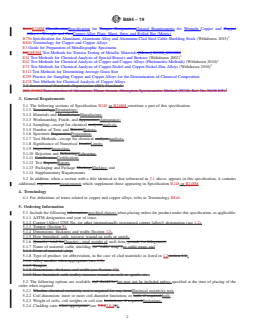
5.1 Include the following specified choices when placing material that will conform to this specification.
orders for product under this specification, as applicable:
7. Chemical Composition
5.1.1 ASTM designation and year of issue,
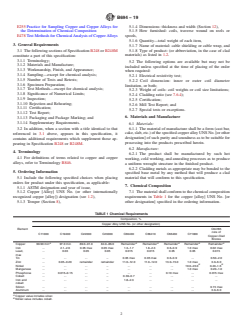
5.1.2 Copper [Alloy] UNS No. (or other internationally 7.1 The material shall conform to the chemical composition
recognized copper [alloy]) designation (see 1.2), requirements in Table 1 for the copper [alloy] UNS No. [or
5.1.3 Temper (Section 8), other designation] specified in the ordering information.
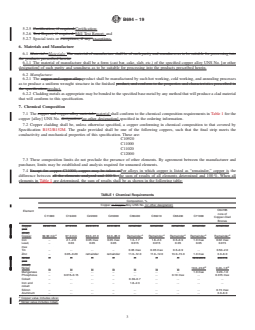
TABLE 1 Chemical Requirements
Composition, %
Copper Alloy UNS No. (or other designation)
C64785
Element
core of
C11000 C19400 C22000 C23000 C66400 C66410 C66430 C71000
Copper-Clad
Bronze
A A A A A A
Copper 99.90 min 97.0 min 89.0–91.0 84.0–86.0 Remainder Remainder Remainder Remainder Remainder
Iron . 2.1–2.6 0.05 max 0.05 max 1.3–1.7 1.8–2.3 0.6–0.9 1.0 max 0.02 max
Lead, . 0.03 0.05 0.05 0.015 0.015 0.05 0.05 0.015
max
Tin . . . . 0.05 max 0.05 max 0.6–0.9 . 0.50–2.0
Zinc . 0.05–0.20 remainder remainder 11.0–12.0 11.0–12.0 13.0–15.0 1.0 max 3.0–6.0
B B
Nickel . . . . . . . 19.0–23.0 0.40–1.6
Manganese . . . . . . . 1.0 max 0.20–1.0
Phosphorus . 0.015–0.15 . . . . 0.10 max . 0.015 max
Cobalt . . . . 0.30–0.7 . . . .
Iron and . . . . 1.8–2.3 . . . .
cobalt
Silicon . . . . . . . . 0.15 max
Aluminum . . . . . . . . 3.0–6.0
A
Copper value includes silver.
B
Nickel value includes cobalt.
B694−19
7.2 Copper cladding shall be, unless otherwise specified, a 9. Grain Size for Annealed Tempers
copper conforming in chemical composition to that covered by
9.1 There are no minimum or maximum grain size require-
SpecificationB152/B152M.Thegradeprovidedshallbeoneof
ments for product in annealed tempers O50, O60, O61, and
the following coppers, such that the final strip meets the
O81; however, the metal shall be fully recrystallized.
conductivity and mechanical properties of this specification.
9.2 For copper alloy UNS No. C71000 in annealed tempers
These are:
OS015 and OS035, acceptance or rejection based upon grain
C10920
size shall depend only on the average grain size of a test
C11000
specimen taken from each of two sample portions, and each
C11020
specimen shall be within the limits prescribed in Table 2 when
C12000
determined in accordance with Test Methods E112.
7.3 These composition limits do not preclude the presence
ofotherelements.Byagreementbetweenthemanufacturerand
10. Physical Property Requirements
purchaser, limits may be established and analysis required for
unnamed elements. 10.1 Electrical Conductivity Requirement:
7.4 For alloys in which copper is listed as “remainder,”
10.2 The annealed product furnished shall conform to the
copper is the difference between the sum of results of all
electrical conductivity requirement prescribed in Table 3 and
elements determined and 100 %. When all elements in Table 1
Table 4.
are determined, the sum of results shall be as shown in the
10.3 The electrical resistivity of the material shall be deter-
following table:
mined in accordance with Test Method B193; the conductivity
Copper Alloy UNS No. Copper Plus Named Elements, % min
shallbecalculatedinaccordancewithExplanatoryNotes3and
C19400 99.8
C22000 99.8 4 of Test Method B193.
C23000 99.8
C66400 99.5
11. Mechanical Property Requirements
C66410 99.5
C66430 99.5
11.1 Tensile Strength Requirements:
C64785 99.5
C71000 99.5
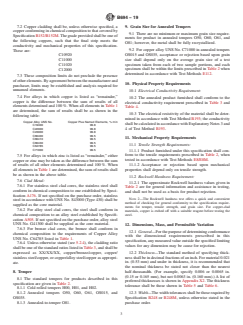
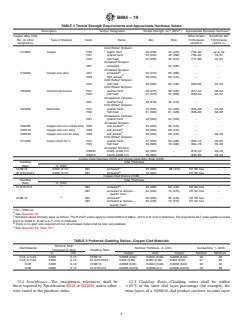
11.1.1 Product furnished under this specification shall con-
form to the tensile requirements prescribed in Table 2, when
7.5 For alloys in which zinc is listed as “remainder,” either
tested in accordance with Test Methods E8/E8M.
copper or zinc may be taken as the difference between the sum
of results of all other elements determined and 100 %. When
11.1.2 Acceptance or rejection based upon mechanical
all elements in Table 1 are determined, the sum of results shall properties shall depend only on tensile strength.
be as shown in the above table.
11.2 Rockwell Hardness Requirement:
7.6 Clad Metal:
11.2.1 The approximate Rockwell hardness values given in
7.6.1 For stainless steel clad cores, the stainless steel shall
Table 2 are for general information and assistance in testing,
conform in chemical composition to one established by Speci-
and shall not be used as a basis for product rejection.
fication A176. If not specified on the purchase order, stainless
NOTE 2—The Rockwell hardness test offers a quick and convenient
steel in accordance with UNS No. S43000 (Type 430) shall be
method of checking for general conformity to the specification require-
supplied as the core material.
ments for temper, tensile strength, and grain size. For copper-clad
7.6.2 For alloy steel clad cores, the steel shall conform in
materials, copper is etched off with a suitable reagent before testing the
chemical composition to an alloy steel established by Specifi-
steel.
cation A505. If not specified on the purchase order, alloy steel
UNS No. G41300 shall be supplied as the core material.
12. Dimensions, Mass, and Permissible Variation
7.6.3 For bronze clad cores, the bronze shall conform in
12.1 General—Forthepurposeofdeterminingconformance
chemical composition to the requirements of Copper Alloy
with the dimensional requirements prescribed in this
UNS No. C64785 listed in Table 1.
specification,anymeasuredvalueoutsidethespecifiedlimiting
7.6.4 Unless otherwise stated (see 5.2.4), the cladding ratio
values for any dimension may be cause for rejection.
shall be one of the standard ratios listed in Table 3, and shall be
expressed as XX/XX/XX, copper/bronze/copper, copper/ 12.2 Thickness—The standard method of specifying thick-
nessshallbeindecimalfractionsofaninch.Formaterial0.021
stainless steel/copper, or copper/alloy steel/copper as appropri-
ate. in. (0.53 mm) and under in thickness, it is recommended that
the nominal thickness be stated not closer than the nearest
half-thousandth. (For example, specify 0.006 or 0.0065 in.
8. Temper
(0.15 or 0.165 mm), but not 0.0063 in. (0.160 mm).) A list of
8.1 The standard tempers for products described in this
preferred thicknesses is shown in Appendix X2. The thickness
specification are given in Table 2.
tolerance shall be those shown in Table 5 and Table 6.
8.1.1 Cold rolled tempers H00, H01, and H02.
8.1.2 Annealed tempers O50, O60, O61, OS015, and 12.3 Width—Thewidthtolerancesshallbethoserequiredby
OS035.
Specification B248 or B248M, unless otherwise stated in the
8.1.3 Annealed-to-temper O81. purchase order.
B694−19
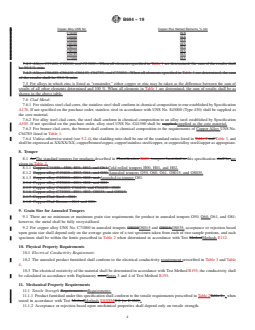
TABLE 2 Tensile Strength Requirements and Approximate Hardness Values
A B C
Description Temper Designation Tensile Strength, ksi (MPa ) Approximate Rockwell Hardness
Copper Alloy UNS Other Scales Superficial 30T
No. (or other Type of Material Code Name Min Max Thicknesses Thicknesses
designation) >0.020 in. >0.012 in.
Cold Rolled Tempers:
C11000 Copper H00 eighth hard 32 (220) 40 (275) F54–82 up to 49
H01 quarter hard 34 (235) 42 (290) F60–84 18–51
H02 half hard 37 (255) 46 (315) F77–89 43–57
Annealed-Tempers:
O61 annealed . 34 (235) . .
Annealed-Tempers:
D
C19400 Copper-iron alloy O61 annealed 45 (310) 55 (380) . .
D
O50 light anneal 50 (345) 60 (415) . .
Cold Rolled Tempers:
H02 half hard 53 (365) 63 (435) B49–69 52–63
Cold Rolled Tempers:
C22000 Commercial bronze H01 quarter hard 40 (275) 50 (345) B27–52 38–53
H02 half hard 47 (325) 57 (395) B50–63 52–61
Annealed-to-Tempers:
O81 quarter hard 39 (270) 46 (315) . .
Cold Rolled Tempers:
C23000 Red brass H01 quarter hard 44 (305) 54 (370) B33–58 45–60
H02 half hard 51 (350) 61 (420) B56–68 58–66
Annealed-to-Tempers:
O81 quarter hard 44 (305) 54 (370) . .
Annealed-Tempers:
D
C66400 Copper-zinc-iron-cobalt alloy O60 soft anneal 53 (365) 60 (415) . .
D
C66410 Copper-zinc-iron alloy O60 soft anneal 53 (365) 60 (415) . .
D
C66430 Copper-zinc-iron-tin alloy O60 soft anneal 59 (405) 69 (475) . 59–69
Cold Rolled Tempers:
C71000 Cupro-nickel 20 % H01 quarter hard 47 (325) 63 (435) B45–72 46–65
H02 half hard
...
This document is not an ASTM standard and is intended only to provide the user of an ASTM standard an indication of what changes have been made to the previous version. Because
it may not be technically possible to adequately depict all changes accurately, ASTM recommends that users consult prior editions as appropriate. In all cases only the current version
of the standard as published by ASTM is to be considered the official document.
Designation: B694 − 13 B694 − 19
Standard Specification for
Copper, Copper-Alloy, Copper-Clad Bronze (CCB), Copper-
Clad Stainless Steel (CCS), and Copper-Clad Alloy Steel
(CAS) Sheet and Strip for Electrical Cable Shielding
This standard is issued under the fixed designation B694; the number immediately following the designation indicates the year of
original adoption or, in the case of revision, the year of last revision. A number in parentheses indicates the year of last reapproval. A
superscript epsilon (´) indicates an editorial change since the last revision or reapproval.
1. Scope*
1.1 This specification establishes the requirements for copper, copper alloy, copper-clad bronze (CCB), copper-clad stainless
steel (CCS), and copper-clad alloy steel (CAS) materials, sheet, and strip, in various thicknesses, for use as electrostatic or
electromagnetic shielding for insulated power, control, instrumentation, and communication cables.
NOTE 1—See Specification B736, for related standards for aluminum-based shielding materials.
1.2 The products covered are the following:
Copper or Copper Alloy Type of Products
UNS No.
C11000 copper
C19400 copper-iron alloy
C22000 copper-zinc alloy (commercial bronze)
C23000 copper-zinc alloy (red brass)
C66400 copper-zinc-iron-cobalt alloy
C66410 copper-zinc-iron alloy
C66430 copper-zinc-iron-tin alloy
C71000 cupro-nickel 20 %
... copper-clad bronze (CCB)
... copper-clad stainless steel (CCS)
... copper-clad alloy steel (CAS)
1.3 Units—The values stated in inch-pound units are to be regarded as standard. The values given in parentheses are
mathematical conversions to SI units that are provided for information only and are not considered standard.
1.3.1 The only exception is grain size, which is reported in SI (mm) units.
1.4 This standard does not purport to address all of the safety concerns, if any, associated with its use. It is the responsibility
of the user of this standard to establish appropriate safety safety, health, and healthenvironmental practices and determine the
applicability of regulatory limitations prior to use.
1.5 This international standard was developed in accordance with internationally recognized principles on standardization
established in the Decision on Principles for the Development of International Standards, Guides and Recommendations issued
by the World Trade Organization Technical Barriers to Trade (TBT) Committee.
2. Referenced Documents
2.1 ASTM Standards:
A176 Specification for Stainless and Heat-Resisting Chromium Steel Plate, Sheet, and Strip (Withdrawn 2015)
A505 Specification for Steel, Sheet and Strip, Alloy, Hot-Rolled and Cold-Rolled, General Requirements for
B152/B152M Specification for Copper Sheet, Strip, Plate, and Rolled Bar
B193 Test Method for Resistivity of Electrical Conductor Materials
B248 Specification for General Requirements for Wrought Copper and Copper-Alloy Plate, Sheet, Strip, and Rolled Bar
This specification is under the jurisdiction of ASTM Committee B05 on Copper and Copper Alloys and is the direct responsibility of Subcommittee B05.01 on Plate,
Sheet, and Strip.
Current edition approved April 1, 2013April 1, 2019. Published April 2013April 2019. Originally approved in 1981. Last previous edition approved in 20102013 as
B694 – 10.B694–13. DOI: 10.1520/B0694-13.10.1520/B0694–19.
For referenced ASTM standards, visit the ASTM website, www.astm.org, or contact ASTM Customer Service at service@astm.org. For Annual Book of ASTM Standards
volume information, refer to the standard’sstandard’s Document Summary page on the ASTM website.
The last approved version of this historical standard is referenced on www.astm.org.
*A Summary of Changes section appears at the end of this standard
Copyright © ASTM International, 100 Barr Harbor Drive, PO Box C700, West Conshohocken, PA 19428-2959. United States
B694 − 19
B601B248M ClassificationSpecification for Temper DesignationsGeneral Requirements for Wrought Copper and Copper
Alloys—Wrought and CastCopper-Alloy Plate, Sheet, Strip, and Rolled Bar (Metric)
B736 Specification for Aluminum, Aluminum Alloy and Aluminum-Clad Steel Cable Shielding Stock (Withdrawn 2015)
B846 Terminology for Copper and Copper Alloys
E3 Guide for Preparation of Metallographic Specimens
E8E8/E8M Test Methods for Tension Testing of Metallic Materials [Metric] E0008_E0008M
E54 Test Methods for Chemical Analysis of Special Brasses and Bronzes (Withdrawn 2002)
E62 Test Methods for Chemical Analysis of Copper and Copper Alloys (Photometric Methods) (Withdrawn 2010)
E75 Test Methods for Chemical Analysis of Copper-Nickel and Copper-Nickel-Zinc Alloys (Withdrawn 2010)
E112 Test Methods for Determining Average Grain Size
E255 Practice for Sampling Copper and Copper Alloys for the Determination of Chemical Composition
E478 Test Methods for Chemical Analysis of Copper Alloys
2.2 International Standards Organization (ISO) Standards:
ISO 3110/2 Determination of Aluminum; Flame Atomic Absorption Spectrometric Method (TC/26 Ref. No. N698 E/F)
3. General Requirements
3.1 The following sections of Specification B248 or B248M constitute a part of this specification:
3.1.1 Terminology,Terminology;
3.1.2 Materials and Manufacture,Manufacture;
3.1.3 Workmanship, Finish, and Appearance,Appearance;
3.1.4 Sampling—except for chemical analysis,analysis;
3.1.5 Number of Tests and Retests,Retests;
3.1.6 Specimen Preparation,Preparation;
3.1.7 Test Methods—except for chemical analysis,analysis;
3.1.8 Significance of Numerical Limits,Limits;
3.1.9 Inspection,Inspection;
3.1.10 Rejection and Rehearing,Rehearing;
3.1.11 Certification,Certification;
3.1.12 Test Reports,Report;
3.1.13 Packaging and Package Marking,Marking; and
3.1.14 Supplementary Requirements.
3.2 In addition, when a section with a title identical to that referenced in 3.1 above, appears in this specification, it contains
additional requirements,requirements which supplement those appearing in Specification B248 or B248M.
4. Terminology
4.1 For definitions of terms related to copper and copper alloys, refer to Terminology B846.
5. Ordering Information
5.1 Include the following information specified choices when placing orders for product under this specification, as applicable:
5.1.1 ASTM designation and year of issue,
5.1.2 Copper [Alloy] UNS No. (or other internationally recognized copper [alloy]) designation (see 1.2),
5.1.3 Temper (Section 8),
5.1.4 Dimensions: thickness and width (Section 12),
5.1.5 How furnished: coils, traverse wound on reels or spools,
5.1.6 Quantity: total forQuantity—total weight of each item, pounds (or kilograms),
5.1.7 Name of material: cable shielding (or “cable wrap”),or cable wrap, and
5.1.4 Form of material: strip,
5.1.8 Type of product: (or abbreviation, in the case of clad materials) as listed in 1.2section 1.2,.
5.1.6 Alloy number when appropriate (see 1.2),
5.1.7 Temper,
5.1.8 Dimensions: thickness and width (see Section 12),
5.1.9 How furnished: coils (rolls), traverse wound on reels or spools, etc.,
5.2 The following options are available and should be but may not be included unless specified at the time of placing of the
order when required:
5.2.1 Whether electrical resistivity test is required for any item,Electrical resistivity test;
5.2.2 Coil dimension: inner or outer coil diameter limitation, or both, if required,both;
5.2.3 Weight of coils: coil weights or coil size limitations, if required,limitations;
5.2.4 Cladding ratio when appropriate (see 7.5.47.6.4),);
B694 − 19
5.2.5 Certification, if required,Certification;
5.2.6 Test Report, if required, Mill Test Report; and
5.2.7 Special tests or exceptions, if any. exceptions.
6. Materials and Manufacture
6.1 Material—Materials: The material of manufacture shall be of such purity and soundness as to be suitable for processing into
the products prescribed herein.
6.1.1 The material of manufacture shall be a form (cast bar, cake, slab, etc.) of the specified copper alloy UNS No. [or other
designation] of such purity and soundness as to be suitable for processing into the products prescribed herein.
6.2 Manufacture:
6.2.1 The copper and copper alloy product shall be manufactured by such hot working, cold working, and annealing processes
as to produce a uniform wrought structure in the finished product, and conform to the properties and characteristics prescribed in
the specification.product.
6.2.2 Cladding metals as appropriate may be bonded to the specified base metal by any method that will produce a clad material
that will conform to this specification.
7. Chemical Composition
7.1 The copper and copper-alloy materials material shall conform to the chemical composition requirements in Table 1 for the
copper [alloy] UNS No. designation [or other designation] specified in the ordering information.
7.2 Copper cladding shall be, unless otherwise specified, a copper conforming in chemical composition to that covered by
Specification B152/B152M. The grade provided shall be one of the following coppers, such that the final strip meets the
conductivity and mechanical properties of this specification. These are:
C10920
C11000
C11020
C12000
7.3 These composition limits do not preclude the presence of other elements. By agreement between the manufacturer and
purchaser, limits may be established and analysis required for unnamed elements.
7.4 Except for copper C11000, copper may be taken asFor alloys in which copper is listed as “remainder,” copper is the
difference between all the elements analyzed and 100 %. the sum of results of all elements determined and 100 %. When all
elements in Table 1 are determined, the sum of results shall be as shown in the following table:
TABLE 1 Chemical Requirements
Composition, %
Copper or Copper Alloy UNS No. (or other designation)
C64785
Element
core of
C11000 C19400 C22000 C23000 C66400 C66410 C66430 C71000
Copper-Clad
Bronze
Copper 99.90 min 97.0 min 89.0–91.0 84.0–86.0 remainder remainder remainder remainder remainder
(incl
silver)
A A A A A A
Copper 99.90 min 97.0 min 89.0–91.0 84.0–86.0 Remainder Remainder Remainder Remainder Remainder
Iron . 2.1–2.6 0.05 max 0.05 max 1.3–1.7 1.8–2.3 0.6–0.9 1.0 max 0.02 max
Lead, . 0.03 0.05 0.05 0.015 0.015 0.05 0.05 0.015
max
Tin . . . . 0.05 max 0.05 max 0.6–0.9 . 0.50–2.0
Zinc . 0.05–0.20 remainder remainder 11.0–12.0 11.0–12.0 13.0–15.0 1.0 max 3.0–6.0
Nickel . . . . . . . 19.0–23.0 0.4–1.6
(incl
cobalt)
B B
Nickel . . . . . . . 19.0–23.0 0.40–1.6
Manganese . . . . . . . 1.0 max 0.20–1.0
Phosphorus . 0.015–0.15 . . . . 0.10 max . 0.015 max
Cobalt . . . . 0.30–0.7 . . . .
Iron and . . . . 1.8–2.3 . . . .
cobalt
Silicon . . . . . . . . 0.15 max
Aluminum . . . . . . . . 3.0–6.0
A
Copper value includes silver.
B
Nickel value includes cobalt.
B694 − 19
Copper Alloy UNS No. Copper Plus Named Elements, % min
C19400 99.8
C22000 99.8
C23000 99.8
C66400 99.5
C66410 99.5
C66430 99.5
C64785 99.5
C71000 99.5
7.4.1 Alloys C19400, C22000, and C23000—When all elements specified in Table 1 are determined, the sum of the results shall
be 99.8 % min.
7.4.2 Alloys C66400, C66410, C66430, C64785, and C71000—When all elements specified in Table 1 are determined, the sum
of the results shall be 99.5 % min.
7.5 For alloys in which zinc is listed as “remainder,” either copper or zinc may be taken as the difference between the sum of
results of all other elements determined and 100 %. When all elements in Table 1 are determined, the sum of results shall be as
shown in the above table.
7.6 Clad Metal:
7.6.1 For stainless steel clad cores, the stainless steel shall conform in chemical composition to one established by Specification
A176. If not specified on the purchase order, stainless steel in accordance with UNS No. S43000 (Type 430) shall be supplied as
the core material.
7.6.2 For alloy steel clad cores, the steel shall conform in chemical composition to an alloy steel established by Specification
A505. If not specified on the purchase order, alloy steel UNS No. G41300 shall be supplied.supplied as the core material.
7.6.3 For bronze clad cores, the bronze shall conform in chemical composition to the requirements of Copper Alloy UNS No.
C64785 listed in Table 1.
7.6.4 Unless otherwise stated (see 5.2.4), the cladding ratio shall be one of the standard ratios listed in Table 2 and Table 3, and
shall be expressed as XX/XX/XX, copper/bronze/copper, copper/stainless steel/copper, or copper/alloy steel/copper as appropriate.
8. Temper
8.1 As The standard tempers for products described in Classification B601, tempers furnished to this specification shall be:are
given in Table 2.
8.1.1 Copper C11000—H00, H01, H02, and O61.Cold rolled tempers H00, H01, and H02.
8.1.2 Copper alloy C19400—H02, O61, and O50.Annealed tempers O50, O60, O61, OS015, and OS035.
8.1.3 Copper alloy C22000—H01, H02, and Annealed-to-temper O81.
8.1.4 Copper alloy C23000—H01, H02, and O81.
8.1.5 Copper alloy C66400, C66410, and C66430—O60.
8.1.6 Copper alloy C71000—H01, H02, OS035, and OS015.
8.1.7 Copper-Clad Steel—O61.
8.1.8 Copper-Clad Bronze—O61 and O81.
9. Grain Size for Annealed Tempers
9.1 There are no minimum or maximum grain size requirements for product in annealed tempers O50, O60, O61, and O81;
however, the metal shall be fully recrystallized.
9.2 For copper alloy UNS No. C71000 in annealed tempers OS035OS015 and OS015,OS035, acceptance or rejection based
upon grain size shall depend only on the average grain size of a test specimen taken from each of two sample portions, and each
specimen shall be within the limits prescribed in Table 2 when determined in accordance with Test MethodMethods E112.
10. Physical Property Requirements
10.1 Electrical Conductivity Requirement:
10.2 The annealed product furnished shall conform to the electrical conductivity requirement prescribed in Table 3 and Table
4.
10.3 The electrical resistivity of the material shall be determined in accordance with Test Method B193; the conductivity shall
be calculated in accordance with Explanatory notesNotes 3 and 4 of Test Method B193.
11. Mechanical Property Requirements
11.1 Tensile Strength Requirements : Requirements:
11.1.1 Product furnished under this specification shall conform to the tensile requirements prescribed in Table 2Table 2, , when
tested in accordance with Test MethodMethods E8/E8ME 8 [or E 8M].
11.1.2 Acceptance or rejection based upon mechanical properties shall depend only on tensile strength.
B694 − 19
TABLE 2 Tensile Strength Requirements and Approximate Hardness Values for Shielding Materials in Commonly Ordered Tempers
A B
Tensile Strength, ksi (Mpa(MPa
C
Description Temper Designation Approximate Rockwell Hardness
)
Copper or Copper Other Scales Superficial 30T
Alloy UNS No. (or Type of Material Code Name Min Max Thicknesses Thicknesses
other designation) >0.020 in. >0.012 in.
Cold-Rolled Tempers:
Cold Rolled Tempers:
C11000 Copper H00 eighth hard 32 (220) 40 (275) F54–82 up to 49
H01 quarter hard 34 (235) 42 (290) F60–84 18–51
H02 half hard 37 (255) 46 (315) F77–89 43–57
Annealed Tempers:
Annealed-Tempers:
O61 annealed . 34 (235) . .
Annealed Tempers:
Annealed-Tempers:
D
C19400 Copper-iron alloy O61 annealed 45 (310) 55 (380) . .
D
O50 light annealed 50 (345) 60 (415) . .
D
O50 light anneal 50 (345) 60 (415) . .
Cold-Rolled Tempers:
Cold Rolled Tempers:
H02 half hard 53 (365) 63 (435) B49–69 52–63
Cold-Rolled Tempers:
Cold Rolled Tempers:
C22000 Commercial bronze H01 quarter hard 40 (275) 50 (345) B27–52 38–53
H02 half hard 47 (325) 57 (395) B50–63 52–61
Annealed Tempers:
Annealed-to-Tempers:
O81 quarter hard 39 (270) 46 (315) . .
Cold-Rolled Tempers:
Cold Rolled Tempers:
C23000 Red brass H01 quarter hard 44 (305) 54 (375) B33–58 45–60
C23000 Red brass H01 quarter hard 44 (305) 54 (370) B33–58 45–60
H02 half hard 51 (350) 61 (420) B56–68 58–66
Annealed Tempers:
Annealed-to-Tempers:
O81 quarter hard 44 (305) 54 (375) . .
O81 quarter hard 44 (305) 54 (370) . .
Annealed Tempers:
Annealed-Tempers:
D
C66400 Copper-zinc-iron-cobalt alloy O60 soft anneal 53 (365) 60 (415) . .
D
C66410 Copper-zinc-iron alloy O60 soft anneal 53 (365) 60 (415) . .
D
C66430 Copper-zinc-iron-tin alloy O60 soft anneal 59 (405) 69 (475) . 59–69
Cold-Rolled Tempers:
Cold Rolled Tempers:
C71000 Cupro-nickel 20 % H01 quarter hard 47 (325) 63 (435) B45–72 46–65
H02 half hard 56 (385) 70 (485) B64–78 59–69
Annealed Tempers:
OS035 0.025–0.050 mm 52 (355) . B18–35 28–40
OS035 0.025–0.050 mm 52 (360) . B18–35 28–40
OS015 0.010–0.020 mm 53 (365) . B35–88 40–58
Copper-Clad Stainless (CCS) and Copper-Clad Alloy Steel (CAS)
Cladding Total Thickness
Ratio in. (mm) Annealed Tempers
in. (mm)
D
16/68/16 0.005 (0.13) O61 annealed 55 (380) 68 (470) 15T 89 max .
D
33.3/33.3/33.3 0.006 (0.15) O61 annealed 44 (305) 15T 89 max .
Copper-Clad Bronze (CCB)
Cladding Total Thickness
Ratio in. (mm) Annealed Temper
...
Questions, Comments and Discussion
Ask us and Technical Secretary will try to provide an answer. You can facilitate discussion about the standard in here.
Loading comments...