


ASTM D4966-12(2016)
(Test Method)Standard Test Method for Abrasion Resistance of Textile Fabrics (Martindale Abrasion Tester Method)
Standard Test Method for Abrasion Resistance of Textile Fabrics (Martindale Abrasion Tester Method)
SIGNIFICANCE AND USE
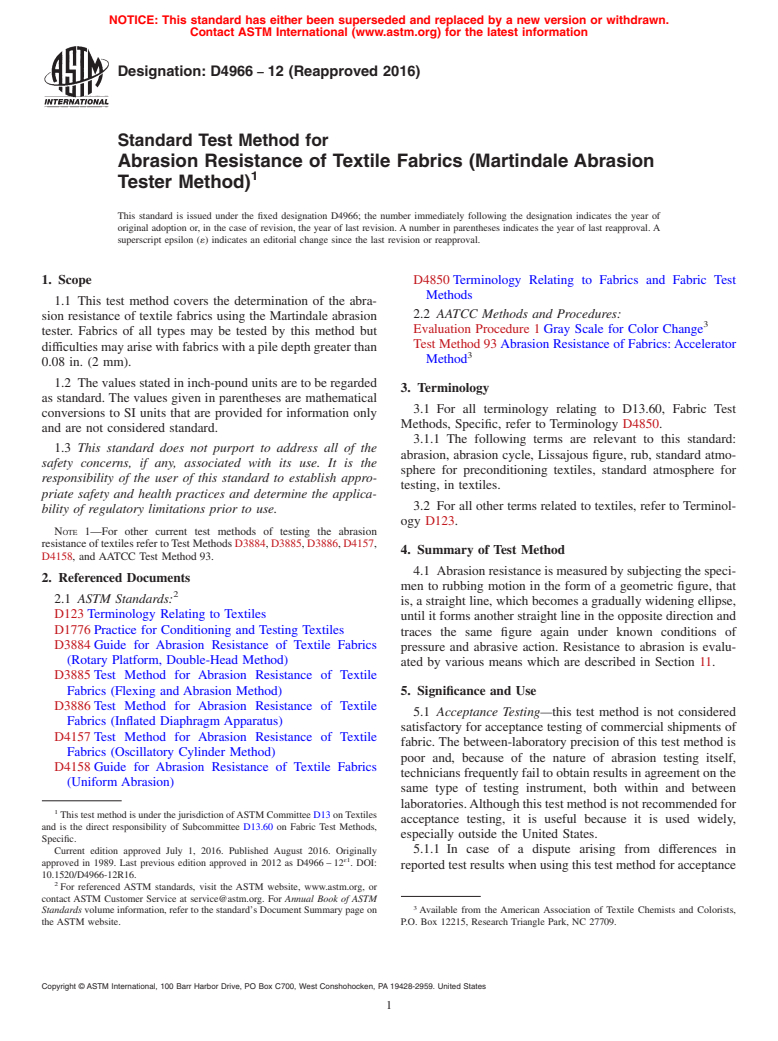
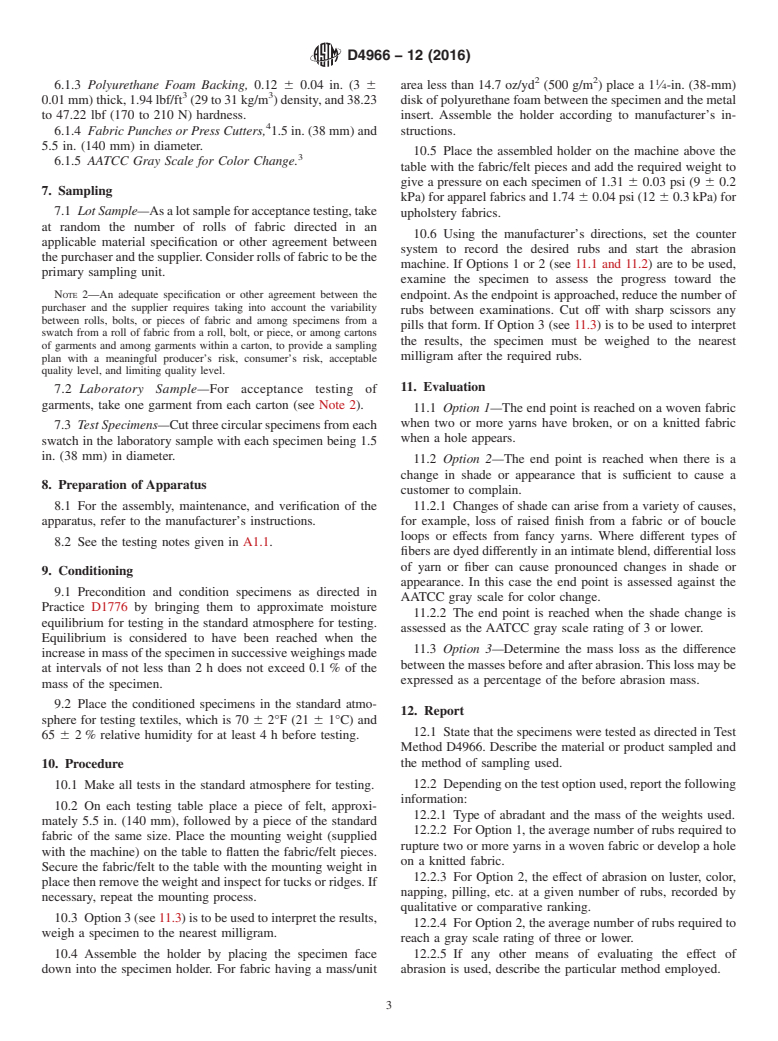
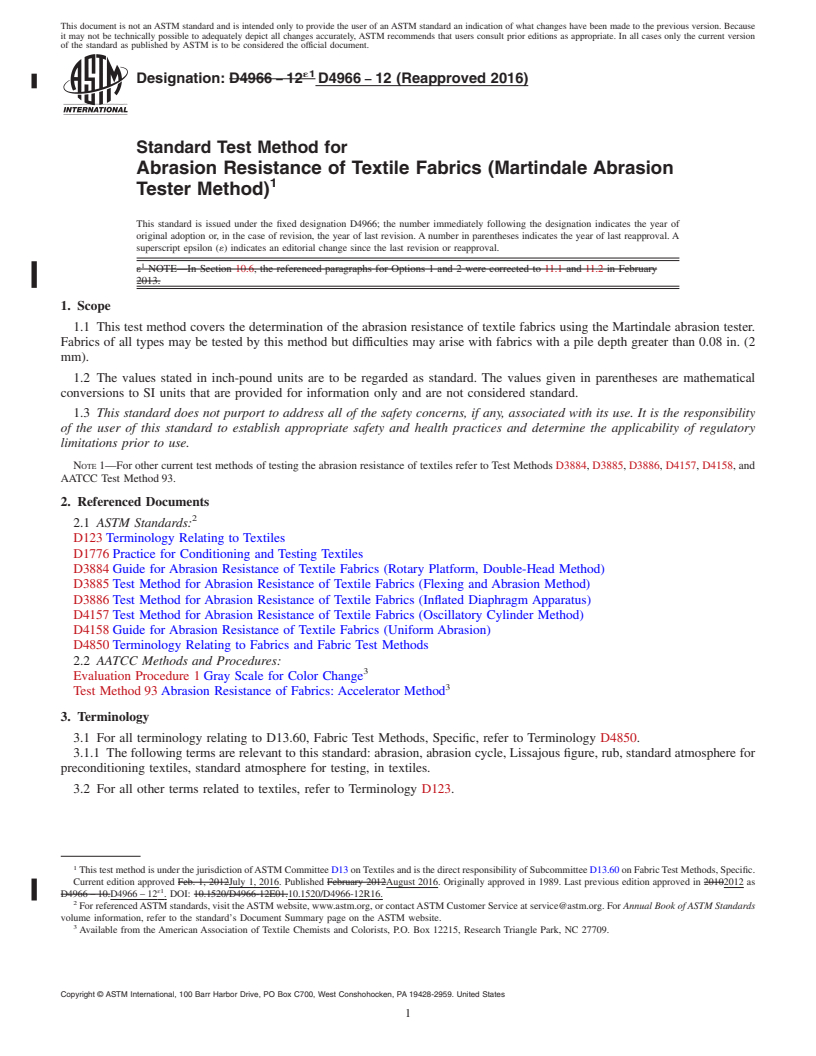
5.1 Acceptance Testing—this test method is not considered satisfactory for acceptance testing of commercial shipments of fabric. The between-laboratory precision of this test method is poor and, because of the nature of abrasion testing itself, technicians frequently fail to obtain results in agreement on the same type of testing instrument, both within and between laboratories. Although this test method is not recommended for acceptance testing, it is useful because it is used widely, especially outside the United States.
5.1.1 In case of a dispute arising from differences in reported test results when using this test method for acceptance testing of commercial shipments, the purchaser and the supplier should conduct comparative tests to determine if there is a statistical bias between their laboratories. Competent statistical assistance is recommended for the investigation of bias. As a minimum, the two parties should take a group of test specimens that are as homogeneous as possible and that are from a lot of material of the type in question. The test specimens then should be assigned randomly in equal numbers to each laboratory for testing. The average results from the two laboratories should be compared using Students t-test for unpaired data and an acceptable probability level chosen by the two parties before the testing is begun. If a bias is found, either its cause must be found and corrected or the purchaser and the supplier must agree to interpret future test results in light of the known bias.
5.2 The resistance to abrasion also is affected greatly by the conditions of the tests, such as the nature of abradant; variable action of the abradant over the area of specimen abraded, the tension on the specimen, the pressure between the specimen and abradant, and the dimensional changes in the specimen.
5.3 Abrasion tests are all subject to variation due to changes in the abradant during specific tests. The abradant must be changed accordingly at freque...
SCOPE
1.1 This test method covers the determination of the abrasion resistance of textile fabrics using the Martindale abrasion tester. Fabrics of all types may be tested by this method but difficulties may arise with fabrics with a pile depth greater than 0.08 in. (2 mm).
1.2 The values stated in inch-pound units are to be regarded as standard. The values given in parentheses are mathematical conversions to SI units that are provided for information only and are not considered standard.
1.3 This standard does not purport to address all of the safety concerns, if any, associated with its use. It is the responsibility of the user of this standard to establish appropriate safety and health practices and determine the applicability of regulatory limitations prior to use.
Note 1: For other current test methods of testing the abrasion resistance of textiles refer to Test Methods D3884, D3885, D3886, D4157, D4158, and AATCC Test Method 93.
General Information
Buy Standard
Standards Content (Sample)
NOTICE: This standard has either been superseded and replaced by a new version or withdrawn.
Contact ASTM International (www.astm.org) for the latest information
Designation:D4966 −12 (Reapproved 2016)
Standard Test Method for
Abrasion Resistance of Textile Fabrics (Martindale Abrasion
Tester Method)
This standard is issued under the fixed designation D4966; the number immediately following the designation indicates the year of
original adoption or, in the case of revision, the year of last revision. A number in parentheses indicates the year of last reapproval. A
superscript epsilon (´) indicates an editorial change since the last revision or reapproval.
1. Scope D4850 Terminology Relating to Fabrics and Fabric Test
Methods
1.1 This test method covers the determination of the abra-
2.2 AATCC Methods and Procedures:
sion resistance of textile fabrics using the Martindale abrasion
Evaluation Procedure 1 Gray Scale for Color Change
tester. Fabrics of all types may be tested by this method but
Test Method 93 Abrasion Resistance of Fabrics:Accelerator
difficulties may arise with fabrics with a pile depth greater than
Method
0.08 in. (2 mm).
1.2 The values stated in inch-pound units are to be regarded
3. Terminology
as standard. The values given in parentheses are mathematical
3.1 For all terminology relating to D13.60, Fabric Test
conversions to SI units that are provided for information only
Methods, Specific, refer to Terminology D4850.
and are not considered standard.
3.1.1 The following terms are relevant to this standard:
1.3 This standard does not purport to address all of the
abrasion, abrasion cycle, Lissajous figure, rub, standard atmo-
safety concerns, if any, associated with its use. It is the
sphere for preconditioning textiles, standard atmosphere for
responsibility of the user of this standard to establish appro-
testing, in textiles.
priate safety and health practices and determine the applica-
3.2 For all other terms related to textiles, refer to Terminol-
bility of regulatory limitations prior to use.
ogy D123.
NOTE 1—For other current test methods of testing the abrasion
resistanceoftextilesrefertoTestMethodsD3884,D3885,D3886,D4157,
4. Summary of Test Method
D4158, and AATCC Test Method 93.
4.1 Abrasion resistance is measured by subjecting the speci-
2. Referenced Documents
men to rubbing motion in the form of a geometric figure, that
2.1 ASTM Standards:
is, a straight line, which becomes a gradually widening ellipse,
D123 Terminology Relating to Textiles
until it forms another straight line in the opposite direction and
D1776 Practice for Conditioning and Testing Textiles
traces the same figure again under known conditions of
D3884 Guide for Abrasion Resistance of Textile Fabrics
pressure and abrasive action. Resistance to abrasion is evalu-
(Rotary Platform, Double-Head Method)
ated by various means which are described in Section 11.
D3885 Test Method for Abrasion Resistance of Textile
Fabrics (Flexing and Abrasion Method) 5. Significance and Use
D3886 Test Method for Abrasion Resistance of Textile
5.1 Acceptance Testing—this test method is not considered
Fabrics (Inflated Diaphragm Apparatus)
satisfactory for acceptance testing of commercial shipments of
D4157 Test Method for Abrasion Resistance of Textile
fabric. The between-laboratory precision of this test method is
Fabrics (Oscillatory Cylinder Method)
poor and, because of the nature of abrasion testing itself,
D4158 Guide for Abrasion Resistance of Textile Fabrics
technicians frequently fail to obtain results in agreement on the
(Uniform Abrasion)
same type of testing instrument, both within and between
laboratories.Although this test method is not recommended for
This test method is under the jurisdiction ofASTM Committee D13 on Textiles
acceptance testing, it is useful because it is used widely,
and is the direct responsibility of Subcommittee D13.60 on Fabric Test Methods,
especially outside the United States.
Specific.
Current edition approved July 1, 2016. Published August 2016. Originally 5.1.1 In case of a dispute arising from differences in
ɛ1
approved in 1989. Last previous edition approved in 2012 as D4966 – 12 . DOI:
reported test results when using this test method for acceptance
10.1520/D4966-12R16.
For referenced ASTM standards, visit the ASTM website, www.astm.org, or
contact ASTM Customer Service at service@astm.org. For Annual Book of ASTM
Standards volume information, refer to the standard’s Document Summary page on Available from the American Association of Textile Chemists and Colorists,
the ASTM website. P.O. Box 12215, Research Triangle Park, NC 27709.
Copyright © ASTM International, 100 Barr Harbor Drive, PO Box C700, West Conshohocken, PA 19428-2959. United States
D4966−12 (2016)
one of several factors contributing to wear performance or
durability as experienced in the actual use of the material.
While “abrasion resistance” (often stated in terms of the
number of cycles on a specified machine, using a specified
technique to produce a specified degree or amount of abrasion)
and “durability” (defined as the ability to withstand deteriora-
tion or wearing out in use, including the effects of abrasion)
frequently are related, the relationship varies with different end
uses, and different factors may be necessary in any calculation
of predicted durability from specific abrasion data.
5.4.1 Laboratory tests may be reliable as an indication of
relative end-use performance in cases where the difference in
abrasion resistance of various materials is large, but they
should not be relied upon where differences in laboratory test
findings are small. In general, they should not be relied upon
for prediction of actual wear-life in specific-end uses unless
there are data showing the specific relationship between
laboratory abrasion tests and actual wear in the intended
FIG. 1 Martindale Abrasion Tester
end-use.
5.5 These general observations apply to all types of fabrics,
including woven, nonwoven, and knit apparel fabrics, house-
testing of commercial shipments, the purchaser and the sup-
hold fabrics, industrial fabrics, and floor coverings. It is not
plier should conduct comparative tests to determine if there is
surprising, therefore, to find that there are many different types
a statistical bias between their laboratories. Competent statis-
of abrasion testing machines, abradants, testing conditions,
tical assistance is recommended for the investigation of bias.
testing procedures, methods of evaluation of abrasion
As a minimum, the two parties should take a group of test
resistance, and interpretation of results.
specimens that are as homogeneous as possible and that are
5.6 All the test methods and instruments so far developed
from a lot of material of the type in question. The test
forabrasionresistancemayshowahighdegreeofvariabilityin
specimens then should be assigned randomly in equal numbers
results obtained by different operators and in different labora-
to each laboratory for testing.The average results from the two
tories; however, they represent the methods now most widely
laboratories should be compared using Students t-test for
in use.
unpaireddataandanacceptableprobabilitylevelchosenbythe
two parties before the testing is begun. If a bias is found, either
5.7 Since there is a definite need for measuring the relative
its cause must be found and corrected or the purchaser and the
resistance to abrasion, standardized test methods are desirable
supplier must agree to interpret future test results in light of the
and useful and may clarify the problem and lessen the
known bias.
confusion.
5.2 The resistance to abrasion also is affected greatly by the
6. Apparatus and Materials
conditions of the tests, such as the nature of abradant; variable
action of the abradant over the area of specimen abraded, the
6.1 Martindale Abrasion Tester, (Fig. 1) with the following
tension on the specimen, the pressure between the specimen
replaceable items:
and abradant, and the dimensional changes in the specimen.
6.1.1 Standard Abradant Fabric, a plain weave, crossbred,
worsted wool fabric described in the finished state as in Table
5.3 Abrasion tests are all subject to variation due to changes
1.
in the abradant during specific tests. The abradant must be
6.1.2 Standard Felt, of mass 22 6 1.5 oz/yd (750 6 50
changed accordingly at frequent intervals or checked periodi-
g/m ) and 0.12 6 0.01 in. (3 6 0.3 mm) thick.
cally against a standard. With disposable abradants, the abrad-
ant is used only once or changed after limited use. With
permanent abradants that use hardened metal or equivalent
surfaces, it is assumed that the abradant will not change
appreciably in a specific series of tests, but obviously similar
Apparatus and accessories are commercially available.
abradantsusedindifferentlaboratorieswillnotlikelychangeat
the same rate due to differences in usage. Permanent abradants
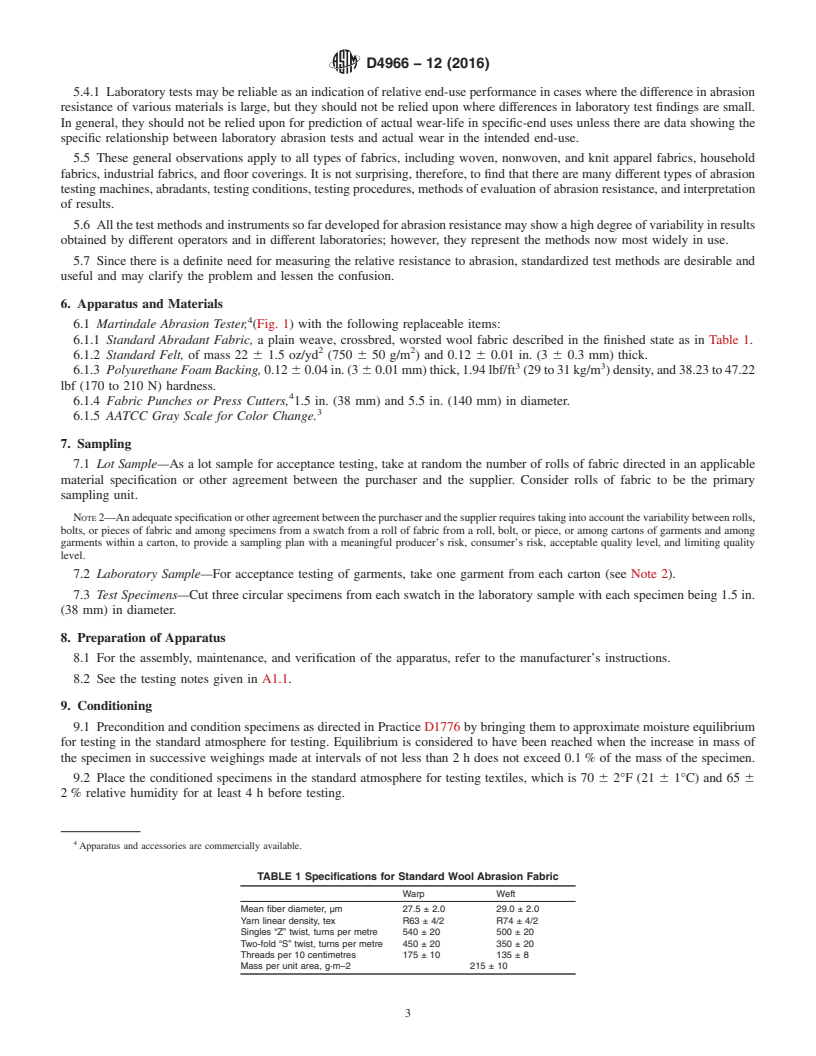
TABLE 1 Specifications for Standard Wool Abrasion Fabric
also may change due to pick up of finishing or other material
Warp Weft
from test fabrics and must accordingly be cleaned at frequent
Mean fiber diameter, µm 27.5 ± 2.0 29.0 ± 2.0
intervals. The measurement of the relative amount of abrasion
Yarn linear density, tex R63 ± 4/2 R74 ± 4/2
also may be affected by the method of evaluati
...
This document is not an ASTM standard and is intended only to provide the user of an ASTM standard an indication of what changes have been made to the previous version. Because
it may not be technically possible to adequately depict all changes accurately, ASTM recommends that users consult prior editions as appropriate. In all cases only the current version
of the standard as published by ASTM is to be considered the official document.
´1
Designation: D4966 − 12 D4966 − 12 (Reapproved 2016)
Standard Test Method for
Abrasion Resistance of Textile Fabrics (Martindale Abrasion
Tester Method)
This standard is issued under the fixed designation D4966; the number immediately following the designation indicates the year of
original adoption or, in the case of revision, the year of last revision. A number in parentheses indicates the year of last reapproval. A
superscript epsilon (´) indicates an editorial change since the last revision or reapproval.
ε NOTE—In Section 10.6, the referenced paragraphs for Options 1 and 2 were corrected to 11.1 and 11.2 in February
2013.
1. Scope
1.1 This test method covers the determination of the abrasion resistance of textile fabrics using the Martindale abrasion tester.
Fabrics of all types may be tested by this method but difficulties may arise with fabrics with a pile depth greater than 0.08 in. (2
mm).
1.2 The values stated in inch-pound units are to be regarded as standard. The values given in parentheses are mathematical
conversions to SI units that are provided for information only and are not considered standard.
1.3 This standard does not purport to address all of the safety concerns, if any, associated with its use. It is the responsibility
of the user of this standard to establish appropriate safety and health practices and determine the applicability of regulatory
limitations prior to use.
NOTE 1—For other current test methods of testing the abrasion resistance of textiles refer to Test Methods D3884, D3885, D3886, D4157, D4158, and
AATCC Test Method 93.
2. Referenced Documents
2.1 ASTM Standards:
D123 Terminology Relating to Textiles
D1776 Practice for Conditioning and Testing Textiles
D3884 Guide for Abrasion Resistance of Textile Fabrics (Rotary Platform, Double-Head Method)
D3885 Test Method for Abrasion Resistance of Textile Fabrics (Flexing and Abrasion Method)
D3886 Test Method for Abrasion Resistance of Textile Fabrics (Inflated Diaphragm Apparatus)
D4157 Test Method for Abrasion Resistance of Textile Fabrics (Oscillatory Cylinder Method)
D4158 Guide for Abrasion Resistance of Textile Fabrics (Uniform Abrasion)
D4850 Terminology Relating to Fabrics and Fabric Test Methods
2.2 AATCC Methods and Procedures:
Evaluation Procedure 1 Gray Scale for Color Change
Test Method 93 Abrasion Resistance of Fabrics: Accelerator Method
3. Terminology
3.1 For all terminology relating to D13.60, Fabric Test Methods, Specific, refer to Terminology D4850.
3.1.1 The following terms are relevant to this standard: abrasion, abrasion cycle, Lissajous figure, rub, standard atmosphere for
preconditioning textiles, standard atmosphere for testing, in textiles.
3.2 For all other terms related to textiles, refer to Terminology D123.
This test method is under the jurisdiction of ASTM Committee D13 on Textiles and is the direct responsibility of Subcommittee D13.60 on Fabric Test Methods, Specific.
Current edition approved Feb. 1, 2012July 1, 2016. Published February 2012August 2016. Originally approved in 1989. Last previous edition approved in 20102012 as
ɛ1
D4966 – 10.D4966 – 12 . DOI: 10.1520/D4966-12E01.10.1520/D4966-12R16.
For referenced ASTM standards, visit the ASTM website, www.astm.org, or contact ASTM Customer Service at service@astm.org. For Annual Book of ASTM Standards
volume information, refer to the standard’s Document Summary page on the ASTM website.
Available from the American Association of Textile Chemists and Colorists, P.O. Box 12215, Research Triangle Park, NC 27709.
Copyright © ASTM International, 100 Barr Harbor Drive, PO Box C700, West Conshohocken, PA 19428-2959. United States
D4966 − 12 (2016)
4. Summary of Test Method
4.1 Abrasion resistance is measured by subjecting the specimen to rubbing motion in the form of a geometric figure, that is, a
straight line, which becomes a gradually widening ellipse, until it forms another straight line in the opposite direction and traces
the same figure again under known conditions of pressure and abrasive action. Resistance to abrasion is evaluated by various means
which are described in Section 11.
5. Significance and Use
5.1 Acceptance Testing—this test method is not considered satisfactory for acceptance testing of commercial shipments of
fabric. The between-laboratory precision of this test method is poor and, because of the nature of abrasion testing itself, technicians
frequently fail to obtain results in agreement on the same type of testing instrument, both within and between laboratories.
Although this test method is not recommended for acceptance testing, it is useful because it is used widely, especially outside the
United States.
5.1.1 In case of a dispute arising from differences in reported test results when using this test method for acceptance testing of
commercial shipments, the purchaser and the supplier should conduct comparative tests to determine if there is a statistical bias
between their laboratories. Competent statistical assistance is recommended for the investigation of bias. As a minimum, the two
parties should take a group of test specimens that are as homogeneous as possible and that are from a lot of material of the type
in question. The test specimens then should be assigned randomly in equal numbers to each laboratory for testing. The average
results from the two laboratories should be compared using Students t-test for unpaired data and an acceptable probability level
chosen by the two parties before the testing is begun. If a bias is found, either its cause must be found and corrected or the purchaser
and the supplier must agree to interpret future test results in light of the known bias.
5.2 The resistance to abrasion also is affected greatly by the conditions of the tests, such as the nature of abradant; variable
action of the abradant over the area of specimen abraded, the tension on the specimen, the pressure between the specimen and
abradant, and the dimensional changes in the specimen.
5.3 Abrasion tests are all subject to variation due to changes in the abradant during specific tests. The abradant must be changed
accordingly at frequent intervals or checked periodically against a standard. With disposable abradants, the abradant is used only
once or changed after limited use. With permanent abradants that use hardened metal or equivalent surfaces, it is assumed that the
abradant will not change appreciably in a specific series of tests, but obviously similar abradants used in different laboratories will
not likely change at the same rate due to differences in usage. Permanent abradants also may change due to pick up of finishing
or other material from test fabrics and must accordingly be cleaned at frequent intervals. The measurement of the relative amount
of abrasion also may be affected by the method of evaluation and may be influenced by the judgment of the operator.
5.4 The resistance of textile materials to abrasion as measured on a testing machine in the laboratory is generally only one of
several factors contributing to wear performance or durability as experienced in the actual use of the material. While “abrasion
resistance” (often stated in terms of the number of cycles on a specified machine, using a specified technique to produce a specified
degree or amount of abrasion) and “durability” (defined as the ability to withstand deterioration or wearing out in use, including
the effects of abrasion) frequently are related, the relationship varies with different end uses, and different factors may be necessary
in any calculation of predicted durability from specific abrasion data.
FIG. 1 Martindale Abrasion Tester
D4966 − 12 (2016)
5.4.1 Laboratory tests may be reliable as an indication of relative end-use performance in cases where the difference in abrasion
resistance of various materials is large, but they should not be relied upon where differences in laboratory test findings are small.
In general, they should not be relied upon for prediction of actual wear-life in specific-end uses unless there are data showing the
specific relationship between laboratory abrasion tests and actual wear in the intended end-use.
5.5 These general observations apply to all types of fabrics, including woven, nonwoven, and knit apparel fabrics, household
fabrics, industrial fabrics, and floor coverings. It is not surprising, therefore, to find that there are many different types of abrasion
testing machines, abradants, testing conditions, testing procedures, methods of evaluation of abrasion resistance, and interpretation
of results.
5.6 All the test methods and instruments so far developed for abrasion resistance may show a high degree of variability in results
obtained by different operators and in different laboratories; however, they represent the methods now most widely in use.
5.7 Since there is a definite need for measuring the relative resistance to abrasion, standardized test methods are desirable and
useful and may clarify the problem and lessen the confusion.
6. Apparatus and Materials
6.1 Martindale Abrasion Tester, (Fig. 1) with the following replaceable items:
6.1.1 Standard
...
Questions, Comments and Discussion
Ask us and Technical Secretary will try to provide an answer. You can facilitate discussion about the standard in here.