

ASTM D4957-18
(Test Method)Standard Test Method for Apparent Viscosity of Asphalt Emulsion Residues and Non-Newtonian Asphalts by Vacuum Capillary Viscometer
General Information
- Abstract
SIGNIFICANCE AND USE
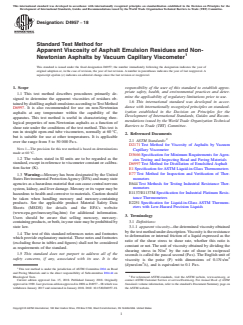
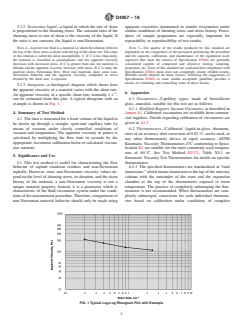
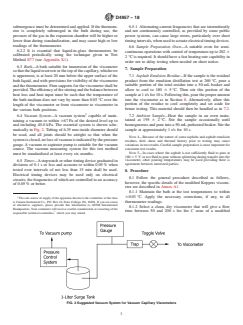
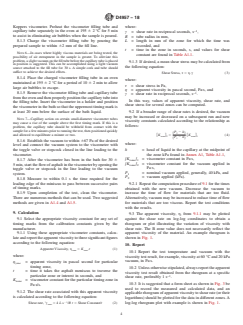
5.1 This test method is useful for characterizing the flow behavior of asphalt emulsion residues and non-Newtonian asphalts. However, since non-Newtonian viscosity values depend on the level of shearing stress, its duration, and the shear history of the material, a non-Newtonian viscosity is not a unique material property. Instead, it is a parameter which is characteristic of the fluid-viscometer system under the conditions of the measurement procedure. Therefore, comparisons of non-Newtonian material behavior should only be made using apparent viscosities determined in similar viscometers under similar conditions of shearing stress and stress history. Procedures of sample preparation are especially important for repeatability or reproducibility of test results.
Note 3: The quality of the results produced by this standard are dependent on the competence of the personnel performing the procedure and the capacity, calibration, and maintenance of the equipment used. Agencies that meet the criteria of Specification D3666 are generally considered capable of competent and objective testing, sampling, inspection, etc. Users of this standard are cautioned that compliance with Specification D3666 alone does not completely ensure reliable results. Reliable results depend on many factors; following the suggestions of Specification D3666 or some similar acceptable guideline provides a means of evaluating and controlling some of those factors.
SCOPE
1.1 This test method describes procedures primarily designed to determine the apparent viscosities of residues obtained by distilling asphalt emulsions according to Test Method D6997. It is also recommended for use on non-Newtonian asphalts at any temperature within the capability of the apparatus. This test method is useful in characterizing rheological properties of non-Newtonian asphalts as a function of shear rate under the conditions of the test method. This test is run in straight open-end tube viscometers, normally at 60 °C, but is suitable for use at other temperatures. It is applicable over the range from 5 to 50 000 Pa·s.
Note 1: The precision for this test method is based on determinations made at 60 °C.
1.2 The values stated in SI units are to be regarded as the standard, except in reference to viscometer constant or calibration factor (K).
1.3 Warning— Mercury has been designated by the United States Environmental Protection Agency (EPA) and many state agencies as a hazardous material that can cause central nervous system, kidney, and liver damage. Mercury or its vapor may be hazardous to health and corrosive to materials. Caution should be taken when handling mercury and mercury-containing products. See the applicable product Material Safety Data Sheets (MSDS) for details and the EPA’s website (www.epa.gov/mercury/faq.htm) for additional information. Users should be aware that selling mercury, mercury-containing products, or both, in your state may be prohibited by state law.
1.4 The text of this standard references notes and footnotes which provide explanatory material. These notes and footnotes (excluding those in tables and figures) shall not be considered as requirements of the standard.
1.5 This standard does not purport to address all of the safety concerns, if any, associated with its use. It is the responsibility of the user of this standard to establish appropriate safety, health, and environmental practices and determine the applicability of regulatory limitations prior to use.
1.6 This international standard was developed in accordance with internationally recognized principles on standardization established in the Decision on Principles for the Development of International Standards, Guides and Recommendations issued by the World Trade Organization Technical Barriers to Trade (TBT) Committee.
- Status
- Published
- Publication Date
- 14-Jan-2018
- Technical Committee
- D04 - Road and Paving Materials
- Drafting Committee
- D04.44 - Rheological Tests
Overview
ASTM D4957-18 provides a standardized test method for determining the apparent viscosity of asphalt emulsion residues and non-Newtonian asphalts using a vacuum capillary viscometer. Developed by ASTM International, this standard plays a significant role in characterizing the flow behavior and rheological properties of these materials. The procedure is applicable to residues obtained by distilling asphalt emulsions, as well as non-Newtonian asphalts, over a broad viscosity range (5 to 50,000 Pa·s), typically performed at 60°C but suitable for other temperatures within the apparatus’s capability.
Measuring apparent viscosity yields important data for quality control, product development, and compliance within the road construction and materials industry. This method is widely adopted due to its relevance to material performance and repeatability, provided that standardized procedures are carefully followed.
Key Topics
- Apparent Viscosity Measurement: Explains the process for determining the resistance to flow (apparent viscosity) of asphalt residues using vacuum capillary viscometers.
- Application to Non-Newtonian Asphalts: Addresses the unique considerations when measuring non-Newtonian fluids, where viscosity varies with shear rate and the history of applied stress.
- Test Method Precision: Outlines the importance of using the same viscometers and similar conditions when comparing results, ensuring reliability and reproducibility.
- Sample Preparation: Emphasizes careful sample preparation to achieve consistent, accurate results, including techniques for handling, heating, and homogenization.
- Equipment and Calibration: Stresses the necessity of properly maintained and calibrated equipment, including viscometers, thermometers, and vacuum systems.
- Safety Considerations: Highlights health and environmental cautions, particularly regarding the handling and potential hazards of mercury used in some thermometers.
Applications
- Quality Control in Road Construction: The standard enables testing agencies, material suppliers, and contractors to assess whether asphalt emulsions and non-Newtonian asphalts meet performance specifications essential for paving and road maintenance.
- Rheological Characterization: By understanding how materials behave under different shear rates and temperature conditions, engineers can predict performance characteristics such as workability and durability.
- Comparative Analysis: This method can be used for comparing different products or batches, provided tests are conducted under equivalent conditions to ensure meaningful comparisons.
- Research & Development: Laboratories use the method to develop new asphalt formulations, ensuring that materials exhibit suitable viscosity profiles for intended applications.
- Regulatory Compliance: The test supports compliance with industry regulations and contract requirements by providing traceable, standardized measurement procedures.
Related Standards
- ASTM D2171 - Test Method for Viscosity of Asphalts by Vacuum Capillary Viscometer: Offers closely related procedures for viscosity measurement.
- ASTM D3666 - Specification for Minimum Requirements for Agencies Testing and Inspecting Road and Paving Materials: Covers competence and quality assurance for laboratories performing these tests.
- ASTM D6997 - Test Method for Distillation of Emulsified Asphalt: Specifies how to obtain the residue for viscosity testing as per ASTM D4957-18.
- ASTM E1, E77, E644, E1137/E1137M, E2251 - Standards for thermometric devices and procedures required for proper temperature measurement and calibration during testing.
By following ASTM D4957-18, laboratories and professionals in the asphalt and paving industries ensure reliable, consistent viscosity data, enabling better material performance, quality assurance, and regulatory compliance. Using standardized test methods helps enhance the durability and service life of pavements and related infrastructure.
Keywords: Asphalt viscosity test, non-Newtonian asphalts, asphalt emulsion residue, vacuum capillary viscometer, ASTM D4957-18, road paving materials, rheological properties, viscosity measurement, quality control, sample preparation, laboratory testing.
Relations
- Effective Date
- 15-Jan-2018
- Effective Date
- 01-Nov-2019
- Effective Date
- 01-Oct-2016
- Effective Date
- 01-May-2014
- Effective Date
- 01-Dec-2013
- Effective Date
- 01-May-2013
- Effective Date
- 01-Dec-2011
- Effective Date
- 01-May-2011
- Effective Date
- 01-May-2011
- Effective Date
- 01-Nov-2010
- Effective Date
- 01-Dec-2009
- Effective Date
- 01-Nov-2009
- Effective Date
- 01-Nov-2008
- Effective Date
- 01-May-2008
- Effective Date
- 01-Dec-2007
Get Certified
Connect with accredited certification bodies for this standard

DIBt (Deutsches Institut für Bautechnik)
German Institute for Building Technology.
DIN CERTCO
DIN Group product certification.
Zavod za gradbeništvo Slovenije (ZAG) - Inšpekcija
ZAG inspection body for construction products, structures, and materials.
Sponsored listings
Frequently Asked Questions
ASTM D4957-18 is a standard published by ASTM International. Its full title is "Standard Test Method for Apparent Viscosity of Asphalt Emulsion Residues and Non-Newtonian Asphalts by Vacuum Capillary Viscometer". This standard covers: SIGNIFICANCE AND USE 5.1 This test method is useful for characterizing the flow behavior of asphalt emulsion residues and non-Newtonian asphalts. However, since non-Newtonian viscosity values depend on the level of shearing stress, its duration, and the shear history of the material, a non-Newtonian viscosity is not a unique material property. Instead, it is a parameter which is characteristic of the fluid-viscometer system under the conditions of the measurement procedure. Therefore, comparisons of non-Newtonian material behavior should only be made using apparent viscosities determined in similar viscometers under similar conditions of shearing stress and stress history. Procedures of sample preparation are especially important for repeatability or reproducibility of test results. Note 3: The quality of the results produced by this standard are dependent on the competence of the personnel performing the procedure and the capacity, calibration, and maintenance of the equipment used. Agencies that meet the criteria of Specification D3666 are generally considered capable of competent and objective testing, sampling, inspection, etc. Users of this standard are cautioned that compliance with Specification D3666 alone does not completely ensure reliable results. Reliable results depend on many factors; following the suggestions of Specification D3666 or some similar acceptable guideline provides a means of evaluating and controlling some of those factors. SCOPE 1.1 This test method describes procedures primarily designed to determine the apparent viscosities of residues obtained by distilling asphalt emulsions according to Test Method D6997. It is also recommended for use on non-Newtonian asphalts at any temperature within the capability of the apparatus. This test method is useful in characterizing rheological properties of non-Newtonian asphalts as a function of shear rate under the conditions of the test method. This test is run in straight open-end tube viscometers, normally at 60 °C, but is suitable for use at other temperatures. It is applicable over the range from 5 to 50 000 Pa·s. Note 1: The precision for this test method is based on determinations made at 60 °C. 1.2 The values stated in SI units are to be regarded as the standard, except in reference to viscometer constant or calibration factor (K). 1.3 Warning— Mercury has been designated by the United States Environmental Protection Agency (EPA) and many state agencies as a hazardous material that can cause central nervous system, kidney, and liver damage. Mercury or its vapor may be hazardous to health and corrosive to materials. Caution should be taken when handling mercury and mercury-containing products. See the applicable product Material Safety Data Sheets (MSDS) for details and the EPA’s website (www.epa.gov/mercury/faq.htm) for additional information. Users should be aware that selling mercury, mercury-containing products, or both, in your state may be prohibited by state law. 1.4 The text of this standard references notes and footnotes which provide explanatory material. These notes and footnotes (excluding those in tables and figures) shall not be considered as requirements of the standard. 1.5 This standard does not purport to address all of the safety concerns, if any, associated with its use. It is the responsibility of the user of this standard to establish appropriate safety, health, and environmental practices and determine the applicability of regulatory limitations prior to use. 1.6 This international standard was developed in accordance with internationally recognized principles on standardization established in the Decision on Principles for the Development of International Standards, Guides and Recommendations issued by the World Trade Organization Technical Barriers to Trade (TBT) Committee.
SIGNIFICANCE AND USE 5.1 This test method is useful for characterizing the flow behavior of asphalt emulsion residues and non-Newtonian asphalts. However, since non-Newtonian viscosity values depend on the level of shearing stress, its duration, and the shear history of the material, a non-Newtonian viscosity is not a unique material property. Instead, it is a parameter which is characteristic of the fluid-viscometer system under the conditions of the measurement procedure. Therefore, comparisons of non-Newtonian material behavior should only be made using apparent viscosities determined in similar viscometers under similar conditions of shearing stress and stress history. Procedures of sample preparation are especially important for repeatability or reproducibility of test results. Note 3: The quality of the results produced by this standard are dependent on the competence of the personnel performing the procedure and the capacity, calibration, and maintenance of the equipment used. Agencies that meet the criteria of Specification D3666 are generally considered capable of competent and objective testing, sampling, inspection, etc. Users of this standard are cautioned that compliance with Specification D3666 alone does not completely ensure reliable results. Reliable results depend on many factors; following the suggestions of Specification D3666 or some similar acceptable guideline provides a means of evaluating and controlling some of those factors. SCOPE 1.1 This test method describes procedures primarily designed to determine the apparent viscosities of residues obtained by distilling asphalt emulsions according to Test Method D6997. It is also recommended for use on non-Newtonian asphalts at any temperature within the capability of the apparatus. This test method is useful in characterizing rheological properties of non-Newtonian asphalts as a function of shear rate under the conditions of the test method. This test is run in straight open-end tube viscometers, normally at 60 °C, but is suitable for use at other temperatures. It is applicable over the range from 5 to 50 000 Pa·s. Note 1: The precision for this test method is based on determinations made at 60 °C. 1.2 The values stated in SI units are to be regarded as the standard, except in reference to viscometer constant or calibration factor (K). 1.3 Warning— Mercury has been designated by the United States Environmental Protection Agency (EPA) and many state agencies as a hazardous material that can cause central nervous system, kidney, and liver damage. Mercury or its vapor may be hazardous to health and corrosive to materials. Caution should be taken when handling mercury and mercury-containing products. See the applicable product Material Safety Data Sheets (MSDS) for details and the EPA’s website (www.epa.gov/mercury/faq.htm) for additional information. Users should be aware that selling mercury, mercury-containing products, or both, in your state may be prohibited by state law. 1.4 The text of this standard references notes and footnotes which provide explanatory material. These notes and footnotes (excluding those in tables and figures) shall not be considered as requirements of the standard. 1.5 This standard does not purport to address all of the safety concerns, if any, associated with its use. It is the responsibility of the user of this standard to establish appropriate safety, health, and environmental practices and determine the applicability of regulatory limitations prior to use. 1.6 This international standard was developed in accordance with internationally recognized principles on standardization established in the Decision on Principles for the Development of International Standards, Guides and Recommendations issued by the World Trade Organization Technical Barriers to Trade (TBT) Committee.
ASTM D4957-18 is classified under the following ICS (International Classification for Standards) categories: 91.100.50 - Binders. Sealing materials; 93.080.20 - Road construction materials. The ICS classification helps identify the subject area and facilitates finding related standards.
ASTM D4957-18 has the following relationships with other standards: It is inter standard links to ASTM D4957-08, ASTM E644-11(2019), ASTM D3666-16, ASTM E77-14, ASTM D3666-13, ASTM E1-13, ASTM D3666-11, ASTM E644-11, ASTM E2251-11, ASTM E2251-10, ASTM D3666-09a, ASTM E644-09, ASTM E1137/E1137M-08, ASTM E644-08, ASTM E77-07. Understanding these relationships helps ensure you are using the most current and applicable version of the standard.
ASTM D4957-18 is available in PDF format for immediate download after purchase. The document can be added to your cart and obtained through the secure checkout process. Digital delivery ensures instant access to the complete standard document.
Standards Content (Sample)
This international standard was developed in accordance with internationally recognized principles on standardization established in the Decision on Principles for the
Development of International Standards, Guides and Recommendations issued by the World Trade Organization Technical Barriers to Trade (TBT) Committee.
Designation: D4957 − 18
Standard Test Method for
Apparent Viscosity of Asphalt Emulsion Residues and Non-
Newtonian Asphalts by Vacuum Capillary Viscometer
This standard is issued under the fixed designation D4957; the number immediately following the designation indicates the year of
original adoption or, in the case of revision, the year of last revision.Anumber in parentheses indicates the year of last reapproval.A
superscript epsilon (´) indicates an editorial change since the last revision or reapproval.
1. Scope responsibility of the user of this standard to establish appro-
priate safety, health, and environmental practices and deter-
1.1 This test method describes procedures primarily de-
mine the applicability of regulatory limitations prior to use.
signed to determine the apparent viscosities of residues ob-
1.6 This international standard was developed in accor-
tainedbydistillingasphaltemulsionsaccordingtoTestMethod
dance with internationally recognized principles on standard-
D6997. It is also recommended for use on non-Newtonian
ization established in the Decision on Principles for the
asphalts at any temperature within the capability of the
Development of International Standards, Guides and Recom-
apparatus. This test method is useful in characterizing rheo-
mendations issued by the World Trade Organization Technical
logical properties of non-Newtonian asphalts as a function of
Barriers to Trade (TBT) Committee.
shear rate under the conditions of the test method. This test is
run in straight open-end tube viscometers, normally at 60°C,
2. Referenced Documents
but is suitable for use at other temperatures. It is applicable
2.1 ASTM Standards:
over the range from 5 to 50 000 Pa·s.
D2171Test Method for Viscosity of Asphalts by Vacuum
NOTE 1—The precision for this test method is based on determinations
Capillary Viscometer
made at 60°C.
D3666Specification for Minimum Requirements for Agen-
1.2 The values stated in SI units are to be regarded as the
cies Testing and Inspecting Road and Paving Materials
standard,exceptinreferencetoviscometerconstantorcalibra-
D6997Test Method for Distillation of Emulsified Asphalt
tion factor (K).
E1Specification for ASTM Liquid-in-Glass Thermometers
E77Test Method for Inspection and Verification of Ther-
1.3 Warning—Mercury has been designated by the United
mometers
StatesEnvironmentalProtectionAgency(EPA)andmanystate
E644Test Methods for Testing Industrial Resistance Ther-
agenciesasahazardousmaterialthatcancausecentralnervous
mometers
system,kidney,andliverdamage.Mercuryoritsvapormaybe
E1137/E1137MSpecification for Industrial Platinum Resis-
hazardous to health and corrosive to materials. Caution should
tance Thermometers
be taken when handling mercury and mercury-containing
E2251Specification for Liquid-in-Glass ASTM Thermom-
products. See the applicable product Material Safety Data
eters with Low-Hazard Precision Liquids
Sheets (MSDS) for details and the EPA’s website
(www.epa.gov/mercury/faq.htm) for additional information.
3. Terminology
Users should be aware that selling mercury, mercury-
3.1 Definitions:
containingproducts,orboth,inyourstatemaybeprohibitedby
3.1.1 apparent viscosity—the determined viscosity obtained
state law.
bythetestmethodunderdescription.Viscosityistheresistance
1.4 The text of this standard references notes and footnotes
to deformation or internal friction of a liquid expressed as the
whichprovideexplanatorymaterial.Thesenotesandfootnotes
ratio of the shear stress to shear rate, whether this ratio is
(excluding those in tables and figures) shall not be considered
constant or not. The unit of viscosity obtained by dividing the
as requirements of the standard.
shearing stress in N/m by the rate of shear in reciprocal
1.5 This standard does not purport to address all of the
seconds is called the pascal second (Pa·s). The English unit of
safety concerns, if any, associated with its use. It is the
viscosity is the poise (P) with dimensions of 0.1N·s/m
(dynes/cm /s), and is equivalent to 0.1 Pa·s.
This test method is under the jurisdiction of ASTM Committee D04 on Road
and Paving Materials and is the direct responsibility of Subcommittee D04.44 on
Rheological Tests. For referenced ASTM standards, visit the ASTM website, www.astm.org, or
Current edition approved Jan. 15, 2018. Published January 2018. Originally contact ASTM Customer Service at service@astm.org. For Annual Book of ASTM
approvedin1989.Lastpreviouseditionapprovedin2008asD4957–08whichwas Standards volume information, refer to the standard’s Document Summary page on
withdrawn January 2017 and reinstated in January 2018. DOI: 10.1520/D4957-18. the ASTM website.
Copyright © ASTM International, 100 Barr Harbor Drive, PO Box C700, West Conshohocken, PA 19428-2959. United States
D4957 − 18
3.1.2 Newtonian liquid—a liquid in which the rate of shear apparent viscosities determined in similar viscometers under
is proportional to the shearing stress. The constant ratio of the similar conditions of shearing stress and stress history. Proce-
shearing stress to rate of shear is the viscosity of the liquid. If dures of sample preparation are especially important for
the ratio is not constant, the liquid is non-Newtonian. repeatability or reproducibility of test results.
NOTE 2—Apower law fluid is a material in which the relation between NOTE 3—The quality of the results produced by this standard are
thelogoftheshearstressislinearwiththelogoftheshearrate.Theslope dependent on the competence of the personnel performing the procedure
of this relation is called the shear susceptibility, C.If C is less than unity, and the capacity, calibration, and maintenance of the equipment used.
the material is classified as pseudoplastic and the apparent viscosity Agencies that meet the criteria of Specification D3666 are generally
decreases with increased stress. If C is greater than one, the material is considered capable of competent and objective testing, sampling,
dilatant and the apparent viscosity increases with stress. If C is unity the inspection, etc. Users of this standard are cautioned that compliance with
material shows Newtonian flow. Most real materials show some non- Specification D3666 alone does not completely ensure reliable results.
Newtonian behavior and the apparent viscosity, computed as stress Reliable results depend on many factors; following the suggestions of
divided by the shear rate, is reported. Specification D3666 or some similar acceptable guideline provides a
means of evaluating and controlling some of those factors.
3.1.3 rheogram—a rheological diagram which shows how
the apparent viscosity of a material varies with the shear rate.
−1 6. Apparatus
An apparent viscosity at a specific shear rate, normally 1 s ,
6.1 Viscometers—Capillary types, made of borosilicate
can be estimated from this plot. A typical rheogram with an
example is shown in Fig. 1. glass, annealed, suitable for this test are as follows:
6.1.1 Modified Koppers Vacuum Viscometer, as described in
4. Summary of Test Method
AnnexA1.Calibratedviscometersareavailablefromcommer-
cial suppliers. Details regarding calibration of viscometers are
4.1 The time is measured for a fixed volume of the liquid to
given in A1.3.
be drawn up through a straight, open-end capillary tube by
means of vacuum, under closely controlled conditions of
6.2 Thermometers—Calibrated liquid-in-glass thermom-
vacuum and temperature. The apparent viscosity in poises is
eters of an accuracy after correction of 0.02°C can be used, or
calculated by multiplying the flow time in seconds by the
any other thermometric device of equal accuracy. ASTM
appropriateviscometercalibrationfactororcalculatedviscom-
Kinematic Viscosity Thermometers 47C conforming to Speci-
eter constant.
fication E1 are suitable for the most commonly used tempera-
ture of 60°C. See Test Method D2171, Table X5.1 on
5. Significance and Use
Kinematic Viscosity Test Thermometers for details on specific
5.1 This test method is useful for characterizing the flow thermometers.
behavior of asphalt emulsion residues and non-Newtonian 6.2.1 The specified thermometers are standardized at “total
asphalts. However, since non-Newtonian viscosity values de- immersion,”whichmeansimmersiontothetopofthemercury
pend on the level of shearing stress, its duration, and the shear column with the remainder of the stem and the expansion
history of the material, a non-Newtonian viscosity is not a chamber at the top of the thermometer exposed to room
unique material property. Instead, it is a parameter which is temperature. The practice of completely submerging the ther-
characteristic of the fluid-viscometer system under the condi- mometer is not recommended. When thermometers are com-
tionsofthemeasurementprocedure.Therefore,comparisonsof pletely submerged, corrections for each individual thermom-
non-Newtonian material behavior should only be made using eter based on calibration under conditions of complete
FIG. 1 Typical Log-Log Rheogram Plot with Example
D4957 − 18
submergence must be determined and applied. If the thermom- 6.5.1 Alternating-current frequencies that are intermittently
eter is completely submerged in the bath during use, the and not continuously controlled, as provided by some public
pressure of the gas in the expansion chamber will be higher or power systems, can cause large errors, particularly over short
lower than during standardization, and may cause high or low timingintervals,whenusedtoactuateelectricaltimingdevices.
readings of the thermometer.
6.6 Sample Preparation Oven—A suitable oven for semi-
6.2.2 It is essential that liquid-in-glass thermometers be
continuousoperationswithcontroloftemperatureupto202 6
calibrated periodically using the technique given in Test
2°C is required. It should have a fast heating rate capability in
Method E77 (see Appendix X1).
order not to delay testing when needed on short notice.
6.3 Bath—A bath suitable for immersion of the viscometer
7. Sample Preparation
sothattheliquidreservoirorthetopofthecapillary,whichever
7.1 Asphalt Emulsion Residue—If the sample is the residual
is uppermost, is at least 20 mm below the upper surface of the
product from the emulsion distillation test at 260°C, pour a
bath liquid, and with provisions for visibility of the viscometer
suitable portion of the total residue into a 50-mL beaker and
andthethermometer.Firmsupportsfortheviscometershallbe
allow to cool to 180 6 5°C. Then stir this portion of the
provided.Theefficiencyofthestirringandthebalancebetween
sampleat1r/sfor10s.Followingthis,pourtheproperamount
heat loss and heat input must be such that the temperature of
the bath medium does not vary by more than 0.03°C over the into the viscometer as in Section 8. Alternatively, allow this
portion of the residue to cool completely and set aside for
length of the viscometer or from viscometer to viscometer in
the various bath positions. future testing. This material should then be handled as in 7.2.
7.2 Ambient Sample—Heat the sample in an oven main-
6.4 Vacuum System—A vacuum system capable of main-
taining a vacuum to within 667Pa of the desired level up to tained at 195 6 2°C. Stir the sample occasionally until
homogeneousandpourintoa50-mLpreheatedbeaker.Stirthe
and including 40.0 kPa. The essential system is shown sche-
sample at approximately 1 r/s for 10 s.
matically in Fig. 2. Tubing of 6.35 mm inside diameter should
be used, and all joints should be airtight so that when the
NOTE 4—Because of the nature of some asphalts and asphalt emulsion
systemisclosed,nolossofvacuumisindicatedbythepressure
residues, their shear and thermal history prior to testing may cause
gauge.Avacuum or aspirator pump is suitable for the vacuum variations in test results. Careful sample preparation is most important for
consistent test results.
source. The vacuum measuring system for this test method
NOTE 5—In cases where the asphalt is not sufficiently fluid to pour at
must be standardized at least every six months.
180 65°Cortoofluidtopourwithoutsplatteringduringtransferintothe
6.5 Timer—Astopwatchorothertimingdevicegraduatedin viscometer, other pouring temperatures may be used providing there is
agreement between interested parties.
divisions of 0.1 s or less and accurate to within 0.05% when
tested over intervals of not less than 15 min shall be used.
8. Procedure
Electrical timing devices may be used only on electrical
8.1 Follow the general procedure described as follows,
circuits, the frequencies of which are controlled to an accuracy
however, the specific details of the modified Koppers viscom-
of 0.05% or better.
eter are described in Annex A1.
8.1.1 Maintain the bath at the test temperatures to within
60.03°C. Apply the necessary corrections, if any, to all
The sole source of supply of the apparatus known to the committee at this time
is Cannon Instrument Co., P.O. Box 16, State College, PA, 16801. If you are aware thermometer readings.
of alternative suppliers, please provide this information to ASTM International
8.1.2 Select a clean, dry viscometer that will give a flow
Headquarters.Your comments will receive careful consideration at a meeting of the
time between 50 and 200 s for the C zone of a modified
responsible technical committee, which you may attend.
FIG. 2 Suggested Vacuum System for Vacuum Capillary Viscometers
D4957 − 18
Koppers viscometer. Preheat the viscometer filling tube and where:
−1
capillary tube separately in the oven at 195 6 2°C for 5 min
γ = shear rate in reciprocal seconds, s ,
to assist in eliminating air bubbles when the sample is poured.
R = tube radius in mm,
8.1.3 Charge the viscometer filling tube by pouring the L = length in mm of the zone for which the time was
prepared sample to within 62 mm of the fill line.
recorded, and
t = time in the zone in seconds, s, and values for shear
NOTE 6—In cases where highly viscous materials are being tested, the
constant are found in Table A1.1.
possibility of air entrapment in the sample is greater. To alleviate this
problem,aslightvacuumonthefilltubebeforethecapillarytubeisplaced
9.1.3 If desired, a mean shear stress may be calculated from
in position is
...