

ASTM D4727/D4727M-22
(Specification)Standard Specification for Corrugated and Solid Fiberboard Sheet Stock (Container Grade) and Cut Shapes
General Information
- Abstract
ABSTRACT
This specification covers corrugated and solid fiberboard sheet stock (container grade) and cut shapes intended for use mainly in the fabrication of boxes and interior details (for example, pads, sleeves, liners, partitions, and die-cut sheets). Covered in this specification are three classes (domestic and domestic/fire retardant, weather resistant and weather resistant/fire retardant, and water and water-vapor resistant and water and water-vapor resistant/fire retardant) of corrugated fiberboard and two classes (domestic and domestic/fire retardant, and weather resistant and weather resistant/fire retardant) of solid fiberboard, with a variety of grades reflecting the varied performance levels of the fiberboards. Corrugated fiberboards shall be manufactured with two, three, or four facings for single-, double-, or triple-wall varieties, respectively, with each facing separated by and securely adhered to the corrugating medium of any suitable fiber. Solid fiberboards, on the other hand, shall be manufactured from plies securely and continuously laminated together. The facings of corrugated fiberboards and plies of solid fiberboards shall conform to the requirements specified. Tests for thickness, basis weight, puncture resistance, ply separation, bursting strength, flame spread, specific optical density, and edge crush shall be performed and shall conform to the requirements specified.
SCOPE
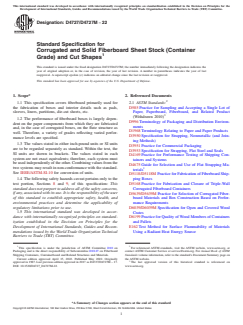
1.1 This specification covers fiberboard primarily used for the fabrication of boxes and interior details such as pads, sleeves, liners, partitions, die-cut sheets, etc.
1.2 The performance of fiberboard boxes is largely dependent on the paper components from which they are fabricated and, in the case of corrugated boxes, on the flute structure as well. Therefore, a variety of grades reflecting varied performance levels are specified.
1.3 The values stated in either inch-pound units or SI units are to be regarded separately as standard. Within the text, the SI units are shown in brackets. The values stated in each system are not exact equivalents; therefore, each system must be used independently of the other. Combining values from the two systems may result in non-conformance with the standard. See IEEE/ASTM-SI-10 for conversion of units.
1.4 The following safety hazards caveat pertains only to the test portion, Sections 8 and 9, of this specification: This standard does not purport to address all of the safety concerns, if any, associated with its use. It is the responsibility of the user of this standard to establish appropriate safety, health, and environmental practices and determine the applicability of regulatory limitations prior to use.
1.5 This international standard was developed in accordance with internationally recognized principles on standardization established in the Decision on Principles for the Development of International Standards, Guides and Recommendations issued by the World Trade Organization Technical Barriers to Trade (TBT) Committee.
- Status
- Published
- Publication Date
- 14-Apr-2022
- Technical Committee
- D10 - Packaging
Buy Documents
ASTM D4727/D4727M-22 - Standard Specification for Corrugated and Solid Fiberboard Sheet Stock (Container Grade) and Cut Shapes
REDLINE ASTM D4727/D4727M-22 - Standard Specification for Corrugated and Solid Fiberboard Sheet Stock (Container Grade) and Cut Shapes
Overview
ASTM D4727/D4727M-22 is the standard specification developed by ASTM International to cover the requirements for corrugated and solid fiberboard sheet stock (container grade) and cut shapes. These materials are mainly used in the fabrication of boxes and a variety of interior packaging details such as pads, sleeves, liners, partitions, and die-cut sheets. The standard outlines a comprehensive classification system, quality criteria for material grades, and detailed requirements for performance and construction.
The standard supports industry needs by establishing common expectations for the production and quality of fiberboard materials, which are critical for the consistent performance of shipping containers in transit and storage environments. It is widely used in packaging, logistics, and supply chain operations to ensure safe, durable, and efficient packaging solutions.
Key Topics
Material Classification: The document details three classes for corrugated fiberboard (domestic and domestic/fire retardant, weather resistant and weather resistant/fire retardant, and water and water-vapor resistant and water and water-vapor resistant/fire retardant) and two classes for solid fiberboard (domestic and domestic/fire retardant, weather resistant and weather resistant/fire retardant).
Manufacturing Requirements: Corrugated fiberboards are manufactured with two, three, or four facings for single-, double-, or triple-wall types, with each facing securely adhered to a corrugated medium. Solid fiberboards are produced by continuous lamination of plies.
Performance Grades: The standard includes various grades to reflect different performance levels - such as burst strength, edge crush, and puncture resistance - to meet diverse application requirements.
Testing Procedures: Key tests prescribed include thickness measurement, basis weight, puncture resistance, ply separation, bursting strength, flame spread, specific optical density, and edge crush. Both ASTM and TAPPI methods are referenced for test procedures.
Dimensional and Construction Tolerances: Size tolerances are set for sheets, pads, and cut shapes to ensure precision in final products.
Adhesives and Treatments: Materials specified for weather resistance or fire retardancy must use treated paperboard components and suitable adhesives to maintain strength and safety performance.
Applications
ASTM D4727/D4727M-22 is integral to packaging applications requiring the fabrication of corrugated and solid fiberboard boxes and packaging components. Typical uses include:
- Shipping Containers: Ensures corrugated and solid fiberboards meet strict quality criteria for fabricating durable shipping boxes for a variety of goods.
- Interior Packaging: Pads, dividers, and liners produced from compliant fiberboard protect contents within outer boxes.
- Custom Packaging Solutions: Cut shapes and die-cut sheets are used for specialized packaging needs in manufacturing, logistics, and e-commerce sectors.
- Regulated and Hazardous Goods: Classes and grades that specify fire retardant and water or vapor resistance are particularly beneficial for packaging hazardous materials or products with strict transport or storage regulations.
- Government and Defense: Approved for use by U.S. Department of Defense agencies and referenced in government procurement.
Related Standards
Several key standards and test methods are referenced or associated with ASTM D4727/D4727M-22:
- ASTM D996 and D1968: Terminology for packaging, fiberboard, and paper products.
- ASTM D5118/D5118M: Practice for fabrication of fiberboard shipping boxes.
- ASTM D3951: Standard for commercial packaging practices.
- TAPPI T 810, T 811: Test methods for bursting strength and edge crush of fiberboard.
- ASTM E162, E662: Tests for flame spread and specific optical density.
- ISO 535: Water absorption characteristics for paper and board.
By following ASTM D4727/D4727M-22, manufacturers, supply chain professionals, and procurement officers ensure that corrugated and solid fiberboard packaging materials consistently meet performance, safety, and regulatory guidelines, supporting efficient and reliable packaging operations across industries.
Relations
- Effective Date
- 01-Dec-2023
- Refers
ASTM D4169-23e1 - Standard Practice for Performance Testing of Shipping Containers and Systems - Effective Date
- 01-Dec-2023
- Effective Date
- 01-Oct-2023
- Effective Date
- 01-Jul-2023
- Effective Date
- 01-Dec-2018
- Effective Date
- 01-Oct-2018
- Effective Date
- 01-May-2018
- Effective Date
- 01-Mar-2018
- Effective Date
- 01-Sep-2017
- Effective Date
- 01-Jul-2017
- Effective Date
- 01-Feb-2017
- Effective Date
- 15-Mar-2016
- Effective Date
- 15-Dec-2015
- Effective Date
- 01-Dec-2015
- Effective Date
- 01-Nov-2015
Buy Documents
ASTM D4727/D4727M-22 - Standard Specification for Corrugated and Solid Fiberboard Sheet Stock (Container Grade) and Cut Shapes
REDLINE ASTM D4727/D4727M-22 - Standard Specification for Corrugated and Solid Fiberboard Sheet Stock (Container Grade) and Cut Shapes
Get Certified
Connect with accredited certification bodies for this standard

BRCGS (Brand Reputation Compliance Global Standards)
Global food safety and quality standards owner.
Sponsored listings
Frequently Asked Questions
ASTM D4727/D4727M-22 is a technical specification published by ASTM International. Its full title is "Standard Specification for Corrugated and Solid Fiberboard Sheet Stock (Container Grade) and Cut Shapes". This standard covers: ABSTRACT This specification covers corrugated and solid fiberboard sheet stock (container grade) and cut shapes intended for use mainly in the fabrication of boxes and interior details (for example, pads, sleeves, liners, partitions, and die-cut sheets). Covered in this specification are three classes (domestic and domestic/fire retardant, weather resistant and weather resistant/fire retardant, and water and water-vapor resistant and water and water-vapor resistant/fire retardant) of corrugated fiberboard and two classes (domestic and domestic/fire retardant, and weather resistant and weather resistant/fire retardant) of solid fiberboard, with a variety of grades reflecting the varied performance levels of the fiberboards. Corrugated fiberboards shall be manufactured with two, three, or four facings for single-, double-, or triple-wall varieties, respectively, with each facing separated by and securely adhered to the corrugating medium of any suitable fiber. Solid fiberboards, on the other hand, shall be manufactured from plies securely and continuously laminated together. The facings of corrugated fiberboards and plies of solid fiberboards shall conform to the requirements specified. Tests for thickness, basis weight, puncture resistance, ply separation, bursting strength, flame spread, specific optical density, and edge crush shall be performed and shall conform to the requirements specified. SCOPE 1.1 This specification covers fiberboard primarily used for the fabrication of boxes and interior details such as pads, sleeves, liners, partitions, die-cut sheets, etc. 1.2 The performance of fiberboard boxes is largely dependent on the paper components from which they are fabricated and, in the case of corrugated boxes, on the flute structure as well. Therefore, a variety of grades reflecting varied performance levels are specified. 1.3 The values stated in either inch-pound units or SI units are to be regarded separately as standard. Within the text, the SI units are shown in brackets. The values stated in each system are not exact equivalents; therefore, each system must be used independently of the other. Combining values from the two systems may result in non-conformance with the standard. See IEEE/ASTM-SI-10 for conversion of units. 1.4 The following safety hazards caveat pertains only to the test portion, Sections 8 and 9, of this specification: This standard does not purport to address all of the safety concerns, if any, associated with its use. It is the responsibility of the user of this standard to establish appropriate safety, health, and environmental practices and determine the applicability of regulatory limitations prior to use. 1.5 This international standard was developed in accordance with internationally recognized principles on standardization established in the Decision on Principles for the Development of International Standards, Guides and Recommendations issued by the World Trade Organization Technical Barriers to Trade (TBT) Committee.
ABSTRACT This specification covers corrugated and solid fiberboard sheet stock (container grade) and cut shapes intended for use mainly in the fabrication of boxes and interior details (for example, pads, sleeves, liners, partitions, and die-cut sheets). Covered in this specification are three classes (domestic and domestic/fire retardant, weather resistant and weather resistant/fire retardant, and water and water-vapor resistant and water and water-vapor resistant/fire retardant) of corrugated fiberboard and two classes (domestic and domestic/fire retardant, and weather resistant and weather resistant/fire retardant) of solid fiberboard, with a variety of grades reflecting the varied performance levels of the fiberboards. Corrugated fiberboards shall be manufactured with two, three, or four facings for single-, double-, or triple-wall varieties, respectively, with each facing separated by and securely adhered to the corrugating medium of any suitable fiber. Solid fiberboards, on the other hand, shall be manufactured from plies securely and continuously laminated together. The facings of corrugated fiberboards and plies of solid fiberboards shall conform to the requirements specified. Tests for thickness, basis weight, puncture resistance, ply separation, bursting strength, flame spread, specific optical density, and edge crush shall be performed and shall conform to the requirements specified. SCOPE 1.1 This specification covers fiberboard primarily used for the fabrication of boxes and interior details such as pads, sleeves, liners, partitions, die-cut sheets, etc. 1.2 The performance of fiberboard boxes is largely dependent on the paper components from which they are fabricated and, in the case of corrugated boxes, on the flute structure as well. Therefore, a variety of grades reflecting varied performance levels are specified. 1.3 The values stated in either inch-pound units or SI units are to be regarded separately as standard. Within the text, the SI units are shown in brackets. The values stated in each system are not exact equivalents; therefore, each system must be used independently of the other. Combining values from the two systems may result in non-conformance with the standard. See IEEE/ASTM-SI-10 for conversion of units. 1.4 The following safety hazards caveat pertains only to the test portion, Sections 8 and 9, of this specification: This standard does not purport to address all of the safety concerns, if any, associated with its use. It is the responsibility of the user of this standard to establish appropriate safety, health, and environmental practices and determine the applicability of regulatory limitations prior to use. 1.5 This international standard was developed in accordance with internationally recognized principles on standardization established in the Decision on Principles for the Development of International Standards, Guides and Recommendations issued by the World Trade Organization Technical Barriers to Trade (TBT) Committee.
ASTM D4727/D4727M-22 is classified under the following ICS (International Classification for Standards) categories: 55.040 - Packaging materials and accessories. The ICS classification helps identify the subject area and facilitates finding related standards.
ASTM D4727/D4727M-22 has the following relationships with other standards: It is inter standard links to ASTM D4169-23, ASTM D4169-23e1, ASTM D3951-18(2023), ASTM D3950-23, ASTM E662-18, ASTM D6199-18a, ASTM D3951-18, ASTM D6199-18, ASTM D3950-17, ASTM E662-17a, ASTM E662-17, ASTM D3950-16, ASTM E162-15b, ASTM D3951-15, ASTM E662-15a. Understanding these relationships helps ensure you are using the most current and applicable version of the standard.
ASTM D4727/D4727M-22 is available in PDF format for immediate download after purchase. The document can be added to your cart and obtained through the secure checkout process. Digital delivery ensures instant access to the complete standard document.
Standards Content (Sample)
This international standard was developed in accordance with internationally recognized principles on standardization established in the Decision on Principles for the
Development of International Standards, Guides and Recommendations issued by the World Trade Organization Technical Barriers to Trade (TBT) Committee.
Designation: D4727/D4727M −22
Standard Specification for
Corrugated and Solid Fiberboard Sheet Stock (Container
Grade) and Cut Shapes
This standard is issued under the fixed designation D4727/D4727M; the number immediately following the designation indicates the
year of original adoption or, in the case of revision, the year of last revision. A number in parentheses indicates the year of last
reapproval. A superscript epsilon (´) indicates an editorial change since the last revision or reapproval.
This standard has been approved for use by agencies of the U.S. Department of Defense.
1. Scope* 2. Referenced Documents
1.1 This specification covers fiberboard primarily used for 2.1 ASTM Standards:
the fabrication of boxes and interior details such as pads, D585Practice for Sampling and Accepting a Single Lot of
sleeves, liners, partitions, die-cut sheets, etc. Paper, Paperboard, Fiberboard, and Related Product
(Withdrawn 2010)
1.2 The performance of fiberboard boxes is largely depen-
D996Terminology of Packaging and Distribution Environ-
dent on the paper components from which they are fabricated
ments
and, in the case of corrugated boxes, on the flute structure as
D1968Terminology Relating to Paper and Paper Products
well. Therefore, a variety of grades reflecting varied perfor-
D3950Specification for Strapping, Nonmetallic (and Join-
mance levels are specified.
ing Methods)
1.3 The values stated in either inch-pound units or SI units
D3951Practice for Commercial Packaging
are to be regarded separately as standard. Within the text, the
D3953Specification for Strapping, Flat Steel and Seals
SI units are shown in brackets. The values stated in each
D4169Practice for Performance Testing of Shipping Con-
system are not exact equivalents; therefore, each system must
tainers and Systems
beusedindependentlyoftheother.Combiningvaluesfromthe
D4675Guide for Selection and Use of Flat Strapping Ma-
two systems may result in non-conformance with the standard.
terials
See IEEE/ASTM-SI-10 for conversion of units.
D5118/D5118MPracticeforFabricationofFiberboardShip-
1.4 The following safety hazards caveat pertains only to the
ping Boxes
test portion, Sections 8 and 9, of this specification: This D5168Practice for Fabrication and Closure of Triple-Wall
standard does not purport to address all of the safety concerns,
Corrugated Fiberboard Containers
if any, associated with its use. It is the responsibility of the user D5639/D5639MPractice for Selection of Corrugated Fiber-
of this standard to establish appropriate safety, health, and
board Materials and Box Construction Based on Perfor-
environmental practices and determine the applicability of mance Requirements
regulatory limitations prior to use.
D6039/D6039MSpecification for Open and Covered Wood
1.5 This international standard was developed in accor- Crates
dance with internationally recognized principles on standard-
D6199PracticeforQualityofWoodMembersofContainers
ization established in the Decision on Principles for the and Pallets
Development of International Standards, Guides and Recom-
E162Test Method for Surface Flammability of Materials
mendations issued by the World Trade Organization Technical Using a Radiant Heat Energy Source
Barriers to Trade (TBT) Committee.
1 2
This specification is under the jurisdiction of ASTM Committee D10 on For referenced ASTM standards, visit the ASTM website, www.astm.org, or
Packaging and is the direct responsibility of Subcommittee D10.27 on Fiberboard contact ASTM Customer Service at service@astm.org. For Annual Book of ASTM
Shipping Containers, Containerboard and Related Structures and Materials. Standards volume information, refer to the standard’s Document Summary page on
Current edition approved April 15, 2022. Published May 2022. Originally the ASTM website.
approved in 1987. Last previous edition approved in 2017 as D4727/D4727M–17. The last approved version of this historical standard is referenced on
DOI: 10.1520/D4727_D4727M-22. www.astm.org.
*A Summary of Changes section appears at the end of this standard
Copyright © ASTM International, 100 Barr Harbor Drive, PO Box C700, West Conshohocken, PA 19428-2959. United States
D4727/D4727M − 22
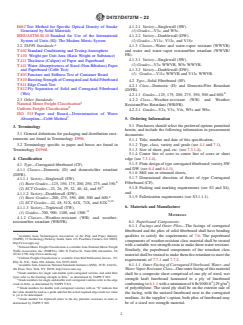
E662Test Method for Specific Optical Density of Smoke 4.1.2.1 Variety—Singlewall (SW).
Generated by Solid Materials (1) Grades—V3c, and W5c.
IEEE/ASTM-SI-10Standard for Use of the International 4.1.2.2 Variety—Doublewall (DW).
System of Units (SI): The Modern Metric System (1) Grades—V11c, V13c, and V15c
4.1.3 Classes—Water and water-vapor resistant (WWVR)
2.2 TAPPI Standards:
and water and water-vapor resistant/fire retardant (WWVR/
T402Standard Conditioning and Testing Atmosphere
FR).
T410 Weight per Unit Area (Basis Weight or Substance)
4.1.3.1 Variety—Singlewall (SW).
T411Thickness (Caliper) of Paper and Paperboard
(1) Grades—V3c WWVR, W5c WWVR.
T441WaterAbsorptiveness of Sized (Non-Bibulous) Paper
4.1.3.2 Variety—Doublewall (DW).
and Paperboard (Cobb Test)
(1) Grades—V11c WWVR and V13c WWVR.
T803Puncture and Stiffness Test of Container Board
T810BurstingStrengthofCorrugatedandSolidFiberboard
4.2 Type—Solid Fiberboard (SF).
T811Edge Crush Test
4.2.1 Class—Domestic (D) and Domestic/Fire Retardant
T812Ply Separation of Solid and Corrugated Fiberboard
(D/FR).
(Wet)
4.2.1.1 Grades—125, 175, 200, 275, 350, 500 and 600.
2.3 Other Standards: 4.2.2 Class—Weather-resistant (WR) and Weather
National Motor Freight Classification
Resistant/Fire Retardant (WR/FR).
Uniform Freight Classification 4.2.2.1 Grades—V2s, V3s, V4s, W5s and W6s.
ISO 535 Paper and Board—Determination of Water
Absorption—Cobb Method
5. Ordering Information
5.1 Purchasers should select the preferred options permitted
3. Terminology
herein, and include the following information in procurement
3.1 General definitions for packaging and distribution envi-
documents:
ronments are found in Terminology D996.
5.1.1 Title, number and date of this specification,
5.1.2 Type, class, variety and grade (see 4.1 and 7.1),
3.2 Terminology specific to paper and boxes are found in
Terminology D1968. 5.1.3 Size of sheet, pad, etc. (see 7.3.1.4),
5.1.4 Center line of score to center line of score or sheet
4. Classification
edge (see 7.3.1.4),
5.1.5 Flutedesignoftypecorrugatedfiberboard;varietySW
4.1 Type—Corrugated fiberboard (CF).
and DW (see 6.4 and 6.4.1),
4.1.1 Classes—Domestic (D) and domestic/fire retardant
5.1.6 Mill run or trimmed sheets,
(D/FR).
5.1.7 Dimensional direction of flutes of type Corrugated
4.1.1.1 Variety—Singlewall (SW).
Fiberboard (CF),
(1) Burst Grades—125,150,175,200,250,275,and350.
5.1.8 Packing and marking requirements (see S3 and S4),
(2) ECT Grades—23, 26, 29, 32, 40, 44, and 55
and
4.1.1.2 Variety—Doublewall (DW).
5.1.9 Palletization requirements (see S3.1.1.1).
(1) Burst Grades—200, 275, 350, 400, 500 and 600.
9,10
(2) ECT Grades—42, 48, 51X, 61X, 71X, and 82X.
6. Materials and Manufacture
4.1.1.3 Variety—Triplewall (TW).
(1) Grades—700, 900, 1100, and 1300.
MATERIALS
4.1.2 Classes—Weather-resistant (WR) and weather-
6.1 Paperboard Components:
resistant/fire retardant (WR/FR).
6.1.1 Facings and Outer Plies—The facings of corrugated
fiberboard and the plies of solid fiberboard shall have bending
Available from Technological Association of the Pulp and Paper Industry
qualities to satisfy the requirements of 7.6. The paperboard
(TAPPI), 15 Technology Parkway South, Suite 115, Peachtree Corners, GA30092,
components of weather-resistant class material shall be treated
http://www.tappi.org.
withasuitablewetstrengthresintomakethemwaterresistant.
National Motor Freight Classification is available from National Motor Freight
TrafficAssociation, Inc. (NMFTA), 1001 N. Fairfax St., Suite 600,Alexandria, VA Similarly, the paperboard components of fire retardant class
22314-1798, http://www.nmfta.org.
materialshallbetreatedtomakethemfireretardanttomeetthe
Uniform Freight Classification is available from Rail Publication Service, 151
requirements of 7.7.1 and 7.7.2.
Ellis St. N.E., Suite 260, Atlanta, GA 30335–6021.
7 6.1.1.1 Outer Facing of Corrugated Fiberboard, Water- and
Available fromAmerican National Standards Institute (ANSI), 25 W. 43rd St.,
4th Floor, New York, NY 10036, http://www.ansi.org.
Water Vapor Resistant Class—Oneouterfacingofthismaterial
Grade numbers for single and double wall corrugated varieties and solid fiber
shall be a composite sheet comprised of one ply of sized, wet
types refer to the bursting strength in lb/in. as determined by TAPPI T 810.
9 strength kraft linerboard laminated to a ply of linerboard
Gradenumbersforsingleanddoublewallcorrugatedvarietiesrefertotheedge
2 2
conformingto6.1.1withaminimumof6lb/1000ft [29g/m ]
crush in lb/in. as determined by TAPPI T 811.
Grade numbers for double wall corrugated varieties with an “X” indicate that
of polyethylene. The sized ply shall be on the exterior side of
thevalueshouldbeusedasaguideandthattheactualrequirededgecrushtestvalue
the facing, with the unsized linerboard next to the corrugated
is yet to be determined.
medium.At the supplier’s option, both plies of linerboard may
Grade number for triplewall refers to the dry puncture resistance in units as
determined by TAPPI T 803. be of a sized wet strength material.
D4727/D4727M − 22
6.1.1.2 Facing and Outer Plies Pertaining to Hazardous 6.5.1.1 Grades 125 and 175—The fiberboard shall consist
Materials Packaging—The facings of corrugated fiberboard of not less than two plies of components.
and the plies of solid fiberboard shall have water resistance
6.5.2 Grades 200 through 600—Thefiberboardshallconsist
qualities to satisfy the following requirement from ISO 535:
of not less than three plies of components.
(1) Water resistance of the outer surface shall be such that
6.6 Scored Sheets—The scorelines on scored sheets shall
the increase in mass, as determined in a test carried out over a
show no visual continuous surface break greater than specified
periodof30minbytheCobbtestmethodofdeterminingwater
2 in 7.6 when tested as specified in 9.3.
absorption, is not greater than 155 g/m .
6.1.2 Corrugated Medium—
6.7 Pads and Cut Shapes—Pads and cut shapes shall be
(1)The corrugating medium of corrugated fiberboard shall
made in accordance with specified dimensions or drawings.
be made from any suitable fibers.
6.7.1 Pads and cut shapes may be single sheets, or may be
(2)The corrugating medium components of Weather Re-
made by laminating two or more sheets of specified types and
sistantclassesandtheWaterandWaterVaporResistantclasses
classes of material to the specified thickness.
shallbetreatedwithasuitablewetstrengthresintomakethem
water resistant.
7. Physical Requirements
6.2 Adhesives:
7.1 Corrugated Fiberboard:
6.2.1 Domestic (D) and Domestic/Fire Retardant (D/FR)
7.1.1 Domestic and Domestic/Fire Retardant Classes, All
Classes—The adhesive used in the construction of the
Varieties:
domestic/fireretardantclassoffiberboardshouldbethatwhich
7.1.1.1 Facings—The facings shall conform to the require-
is commercially used by the industry, and shall enable the end
ments in Table 1 when tested as specified in 9.1.2.
item to meet the strength requirements specified herein.
7.1.1.2 Corrugating Medium—The corrugating medium for
6.2.2 Weather-Resistant (WR) and Weather-Resistant/Fire
the domestic/fire retardant classes of corrugated fiberboard
Retardant (WR/FR) Classes—The adhesive used in the con-
2 2
shall weigh not less than 26 lb/1000 ft [127 g/m ], or as
struction of Weather-Resistant classes of fiberboard shall be
specified, when tested in accordance with 9.1.2.
water-resistant to the extent that the end item will meet the
7.1.1.3 End Item—Domestic and domestic/fire retardant
requirements of this specification (see 7.4).
classes of corrugated fiberboard, constructed as specified in
6.2.3 Water and Water Vapor-Resistant (WWVR) and Water
6.4, shall conform to the requirements in Table 1 for bursting
and Water Vapor-Resistant/Fire Retardant (WWVR/FR)
strength or puncture resistance or edge crush (as specified)
Classes—The adhesive used in the construction of Water and
when tested as specified in 9.1.3, 9.1.5, or 9.1.8. (See compli-
Water Vapor-Resistant classes of fiberboard shall be water-
ance statement following Table 1 for Burst and Edge Crush.)
resistant to the extent that the end item will meet the require-
mentsofthisspecification(see7.4).Paragraph7.4alsoapplies
7.1.2 Weather-Resistant and Weather-Resistant/Fire Retar-
to the polyethylene linerboard bonds in the laminated facings.
dant Classes—The components and end items conform to the
applicable basis weight and bursting strengths specified in
6.3 Triplewall and Triplewall/Fire Retardant Corrugated
Table 2 when tested as specified in 9.1.2, 9.1.5 and 9.2. The
Fiberboard Classes—Triplewallcorrugatedfiberboard,domes-
corrugating medium for the Weather-Resistant classes and
tic and domestic/fire retardant classes, non-weather-resistant
Weather-Resistant/Fire Retardant classes of corrugated fiber-
and weather-resistant in both regular and fire-retardant classes
2 2
boardshallweighnotlessthan30lb/1000ft (146g/m ),oras
shall conform to the requirements of Practice D5168.
specified, when tested in accordance with 9.1.2.
CONSTRUCTION
7.1.3 Water and Water Vapor-Resistant, and Water and
Water Vapor-Resistant/Fire Retardant Classes:
6.4 Corrugated Fiberboard—Corrugatedfiberboardshallbe
7.1.3.1 Components—The components shall conform to the
made with two, three, or four facings for single, doublewall or
applicable requirements as specified in Table 2 and 6.1.1.1,
triplewall, respectively. Each facing shall be separated by and
when tested as specified in 9.1.2. The corrugating medium for
securely adhered to the corrugated medium.
the Water and Water Vapor-Resistant, and Water and Water
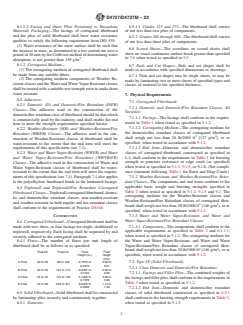
6.4.1 Flutes—The number of flutes per unit length of
Vapor-Resistant/Fire Retardant classes of corrugated fiber-
fiberboard shall be as follows or as specified:
2 2
boardshallweighnotlessthan30lb/1000ft (146g/m ),oras
Flutes/ft Flutes/m Flute Flute
Height (in.) Height specified, when tested in accordance with 9.1.2.
(mm)
A-Flute 30 to 39 98 to 128 0.1575 to 4.00 to 7.2 Type SF (Solid Fiberboard):
0.2210 5.61
7.2.1 Class Domestic and Domestic/Fire Retardant:
B-Flute 45 to 53 147 to 174 0.0787 to 2.00 to
0.1102 2.80 7.2.1.1 Facings and Filler Plies—The combined weights of
C-Flute 35 to 45 115 to 148 0.1300 to 3.30 to
the facings and filler plies shall conform to the requirements in
0.1575 4.00
Table 3 when tested as specified in 9.1.2.
E-Flute 70 to 98 229 to 321 0.0445 to 1.13 to
0.0550 1.40
7.2.1.2 End Item—Domestic and domestic/fire retardant
6.5 Solid Fiberboard—Solid fiberboard shall be constructed classes of solid fiberboard constructed as specified in 6.5.1
by laminating plies securely and continuously together.
shall conform to the bursting strength requirements in Table 3,
6.5.1 Domestic: when tested as specified in 9.1.5.
D4727/D4727M − 22
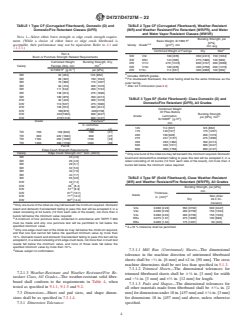
TABLE 1 Type CF (Corrugated Fiberboard), Domestic (D) and TABLE 2 Type CF (Corrugated Fiberboard), Weather-Resistant
Domestic/Fire Retardant Classes (D/FR) (WR) and Weather Resistant/Fire Retardant (WR/FR), and Water
and Water Vapor Resistant Classes (WWVR)
NOTE 1—Select either burst strength or edge crush strength require-
Bursting Strength, psi
ment. (While a choice of either burst or edge crush fiberboard is
Basis Weight, lb/1000 ft
[kPa],
A,B
acceptable, their performance may not be equivalent. Refer to 4.1 and [g/m ], min
Variety Grade
min avg
7.1.1.3.)
C
Combined Weight of Facings Dry Wet
Part A
SW V3c 180 [878] 350 [2413] 150 [1034]
Burst or Puncture Strength Related Requirements
SW W5c 124 [605] 275 [1896] 100 [689]
Combined Weight Bursting Strength, Dry,
DW V11c 270 [1318] 600 [4137] 300 [2068]
A
Facings Only, min min
Variety
DW V13c 180 [878] 400 [2758] 200 [1379]
2 2
lb/1000 ft [g ⁄m ] psi [kPa] DW V15c 114 [557] 300 [2068] 100 [689]
A
SW 52 [254] 125 [862]
Includes WWVR grades.
B
SW 66 [322] 150 [1034]
For doublewall fiberboard, the inner facing shall be the same thickness as the
SW 75 [366] 175 [1207]
outer facing.
C
SW 84 [410] 200 [1379] After 24 h immersion (see 9.2).
SW 111 [542] 250 [1724]
SW 138 [674] 275 [1896]
SW 180 [879] 350 [2413]
TABLE 3 Type SF (Solid Fiberboard): Class Domestic (D) and
DW 92 [449] 200 [1379]
Domestic/Fire Retardant (D/FR), All Grades
DW 110 [537] 275 [1896]
DW 126 [615] 350 [2413]
Combined Weight
DW 180[879] 400[2758]
Of Plies Before
Bursting Strength,
DW 222[1084] 500 [3447]
Grade Lamination,
A
psi [kPa], min
DW 270[1318] 600 [4137] 2 2
lb/1000ft [g ⁄m ],
B
Grade Puncture
min
in.·oz/inches
125 114 [557] 125 [862]
of tear (J)
175 149 [727] 175 [1207]
TW 700 168 [820] 700 [21]
200 190 [928] 200 [1379]
TW 900 222 [1084] 900 [27]
275 237 [1157] 275 [1896]
TW 1100 264 [1289] 1100 [33]
350 283 [1382] 350 [2413]
TW 1300 360 [1758] 1300 [39]
500 330 [1611] 500 [3447]
Part B
600 360 [1758] 600 [4137]
Edge Crush Strength Requirements
C
A
Variety Edge Crush Strength min lb/in. [kN/m]
Only one burst of the initial six may fall beneath the minimum required. Domestic
SW 23 [4.0]
board and domestic/fire retardant failing to pass this test will be accepted if, in a
SW 26 [4.6]
retest consisting of 24 bursts (12 from each side of the board), not more than 4
SW 29 [5.1]
bursts fall below the minimum value required.
SW 32 [5.6]
SW 40 [7.0]
SW 44 [7.7]
TABLE 4 Type SF (Solid Fiberboard), Class Weather-Resistant
SW 55 [9.6]
DW 42 [7.4] (WR) and Weather Resistant/Fire Retardant (WR/FR), All Grades
D
DW 48 [8.4]
Bursting Strength, psi [kPa],
D
DW 51 [8.9]
min
D
DW 61 [10.7]
Thickness,
D Grade
A Wet (After
DW 71 [12.4]
in. [mm]
D
Dry 24-h Im-
DW 82 [14.4]
mersion)
A
Only one burst of the initial six may fall beneath the minimum required. Domestic
V2s 0.090 [2.29] 550 [3792] 500 [3447]
board and domestic fire/retardant failing to pass this test will be accepted if, in a
V3s 0.090 [2.29] 400 [2758] 150 [1034]
retest consisting of 24 bursts (12 from each side of the board), not more than 4
V4s 0.080 [2.03] 400 [2758] 150 [1034]
bursts fall below the minimum value required.
B
W5s 0.075 [1.91] 275 [1896] 100 [689]
A minimum of four puncture tests, conducted in accordance with TAPPI T 803
W6s 0.060 [1.52] 175 [1207] 50 [345]
must be made and only one puncture test will be permitted to fall below the
A
specified minimum value.
A ±10 % tolerance shall be permitted.
C
Only one edge crush test of the initial six may fall below the minimum required,
and that one test cannot fall below the specified minimum value by more than
10 %. Domestic board and domestic fire/retardant failing to pass this test will be
acceptedif,inaretestconsistingof24edgecrushtests,notmorethan4crushtest
results fall below the minimum value, and none of those tests fall below the
specified minimum value by more than 10 %.
D
7.3.1.1 Mill Run (Untrimmed) Sheets—The dimensional
Values subject to confirmation.
tolerance in the machine direction of untrimmed fiberboard
sheets shall
...
This document is not an ASTM standard and is intended only to provide the user of an ASTM standard an indication of what changes have been made to the previous version. Because
it may not be technically possible to adequately depict all changes accurately, ASTM recommends that users consult prior editions as appropriate. In all cases only the current version
of the standard as published by ASTM is to be considered the official document.
Designation: D4727/D4727M − 17 D4727/D4727M − 22
Standard Specification for
Corrugated and Solid Fiberboard Sheet Stock (Container
Grade) and Cut Shapes
This standard is issued under the fixed designation D4727/D4727M; the number immediately following the designation indicates the
year of original adoption or, in the case of revision, the year of last revision. A number in parentheses indicates the year of last
reapproval. A superscript epsilon (´) indicates an editorial change since the last revision or reapproval.
This standard has been approved for use by agencies of the U.S. Department of Defense.
1. Scope*
1.1 This specification covers fiberboard primarily used for the fabrication of boxes and interior details such as pads, sleeves, liners,
partitions, die-cut sheets, etc.
1.2 The performance of fiberboard boxes is largely dependent on the paper components from which they are fabricated and, in
the case of corrugated boxes, on the flute structure as well. Therefore, a variety of grades reflecting varied performance levels are
specified.
1.3 The values stated in either inch-pound units or SI units are to be regarded separately as standard. Within the text, the SI units
are shown in brackets. The values stated in each system are not exact equivalents; therefore, each system must be used
independently of the other. Combining values from the two systems may result in non-conformance with the standard. See
IEEE/ASTM-SI-10 for conversion of units.
1.4 The following safety hazards caveat pertains only to the test portion, Sections 8 and 9, of this specification: This standard
does not purport to address all of the safety concerns, if any, associated with its use. It is the responsibility of the user of this
standard to establish appropriate safety safety, health, and healthenvironmental practices and determine the applicability of
regulatory limitations prior to use.
1.5 This international standard was developed in accordance with internationally recognized principles on standardization
established in the Decision on Principles for the Development of International Standards, Guides and Recommendations issued
by the World Trade Organization Technical Barriers to Trade (TBT) Committee.
2. Referenced Documents
2.1 ASTM Standards:
D585 Practice for Sampling and Accepting a Single Lot of Paper, Paperboard, Fiberboard, and Related Product (Withdrawn
2010)
D996 Terminology of Packaging and Distribution Environments
D1968 Terminology Relating to Paper and Paper Products
D3950 Specification for Strapping, Nonmetallic (and Joining Methods)
This specification is under the jurisdiction of ASTM Committee D10 on Packaging and is the direct responsibility of Subcommittee D10.27 on Fiberboard Shipping
Containers, Containerboard and Related Structures and Materials.
Current edition approved April 1, 2017April 15, 2022. Published June 2017May 2022. Originally approved in 1987. Last previous edition approved in 20152017 as
ɛ1
D4727/D4727M – 15D4727/D4727M – 17. . DOI: 10.1520/D4727_D4727M-17.10.1520/D4727_D4727M-22.
For referenced ASTM standards, visit the ASTM website, www.astm.org, or contact ASTM Customer Service at service@astm.org. For Annual Book of ASTM Standards
volume information, refer to the standard’s Document Summary page on the ASTM website.
The last approved version of this historical standard is referenced on www.astm.org.
*A Summary of Changes section appears at the end of this standard
Copyright © ASTM International, 100 Barr Harbor Drive, PO Box C700, West Conshohocken, PA 19428-2959. United States
D4727/D4727M − 22
D3951 Practice for Commercial Packaging
D3953 Specification for Strapping, Flat Steel and Seals
D4169 Practice for Performance Testing of Shipping Containers and Systems
D4675 Guide for Selection and Use of Flat Strapping Materials
D5118/D5118M Practice for Fabrication of Fiberboard Shipping Boxes
D5168 Practice for Fabrication and Closure of Triple-Wall Corrugated Fiberboard Containers
D5639/D5639M Practice for Selection of Corrugated Fiberboard Materials and Box Construction Based on Performance
Requirements
D6039/D6039M Specification for Open and Covered Wood Crates
D6199 Practice for Quality of Wood Members of Containers and Pallets
E162 Test Method for Surface Flammability of Materials Using a Radiant Heat Energy Source
E662 Test Method for Specific Optical Density of Smoke Generated by Solid Materials
IEEE/ASTM-SI-10 Standard for Use of the International System of Units (SI): The Modern Metric System
2.2 TAPPI Standards:
T 402 Standard Conditioning and Testing Atmosphere
T 410 Weight per Unit Area (Basis Weight or Substance)
T 411 Thickness (Caliper) of Paper and Paperboard
T 441 Water Absorptiveness of Sized (Non-Bibulous) Paper and Paperboard (Cobb Test)
T 803 Puncture and Stiffness Test of Container Board
T 810 Bursting Strength of Corrugated and Solid Fiberboard
T 811 Edge Crush Test
T 812 Ply Separation of Solid and Corrugated Fiberboard (Wet)
2.3 Other Standards:
National Motor Freight Classification
Uniform Freight Classification
ISO 535 Paper and Board—Determination of Water Absorption—Cobb Method
3. Terminology
3.1 General definitions for packaging and distribution environments are found in Terminology D996.
3.2 Terminology specific to paper and boxes are found in Terminology D1968.
4. Classification
4.1 Type—Corrugated fiberboard (CF).
4.1.1 Classes—Domestic (D) and domestic/fire retardant (D/FR).
4.1.1.1 Variety—Singlewall (SW).
(1) Burst Grades—125, 150, 175, 200, 250, 275, and 350.
(2) ECT Grades—23, 26, 29, 32, 40, 44, and 55
4.1.1.2 Variety—Doublewall (DW).
(1) Burst Grades—200, 275, 350, 400, 500 and 600.
9,10
(2) ECT Grades—42, 48, 51X, 61X, 71X, and 82X.
4.1.1.3 Variety—Triplewall (TW).
Available from Technological Association of the Pulp and Paper Industry (TAPPI), 15 Technology Parkway South, Suite 115, Peachtree Corners, GA 30092,
http://www.tappi.org.
National Motor Freight Classification is available from National Motor Freight Traffic Association, Inc. (NMFTA), 1001 N. Fairfax St., Suite 600, Alexandria, VA
22314-1798, http://www.nmfta.org.
Uniform Freight Classification is available from Rail Publication Service, 151 Ellis St. N.E., Suite 260, Atlanta, GA 30335–6021.
Available from American National Standards Institute (ANSI), 25 W. 43rd St., 4th Floor, New York, NY 10036, http://www.ansi.org.
Grade numbers for single and double wall corrugated varieties and solid fiber types refer to the bursting strength in lb/in. as determined by TAPPI T 810.
Grade numbers for single and double wall corrugated varieties refer to the edge crush in lb/in. as determined by TAPPI T 811.
Grade numbers for double wall corrugated varieties with an “X” indicate that the value should be used as a guide and that the actual required edge crush test value is
yet to be determined.
D4727/D4727M − 22
(1) Grades—700, 900, 1100, and 1300.
4.1.2 Classes—Weather-resistant (WR) and weather-resistant/fire retardant (WR/FR).
4.1.2.1 Variety—Singlewall (SW).
(1) Grades—V3c, and W5c.
4.1.2.2 Variety—Doublewall (DW).
(1) Grades—V11c, V13c, and V15c
4.1.3 Classes—Water and water-vapor resistant (WWVR) and water and water-vapor resistant/fire retardant (WWVR/FR).
4.1.3.1 Variety—Singlewall (SW).
(1) Grades—V3c WWVR, W5c WWVR.
4.1.3.2 Variety—Doublewall (DW).
(1) Grades—V11c WWVR and V13c WWVR.
4.2 Type—Solid Fiberboard (SF).
4.2.1 Class—Domestic (D) and Domestic/Fire Retardant (D/FR).
4.2.1.1 Grades—125, 175, 200, 275, 350, 500 and 600.
4.2.2 Class—Weather-resistant (WR) and Weather Resistant/Fire Retardant (WR/FR).
4.2.2.1 Grades—V2s, V3s, V4s, W5s and W6s.
5. Ordering Information
5.1 Purchasers should select the preferred options permitted herein, and include the following information in procurement
documents:
5.1.1 Title, number and date of this specification,
5.1.2 Type, class, variety and grade (see 4.1 and 7.1),
5.1.3 Size of sheet, pad, etc. (see 7.3.1.4),
5.1.4 Center line of score to center line of score or sheet edge (see 7.3.1.4),
5.1.5 Flute design of type corrugated fiberboard; variety SW and DW (see 6.4 and 6.4.1),
5.1.6 Mill run or trimmed sheets,
5.1.7 Dimensional direction of flutes of type Corrugated Fiberboard (CF),
5.1.8 Packing and marking requirements (see S3 and S4), and
5.1.9 Palletization requirements (see S3.1.1.1).
6. Materials and Manufacture
MATERIALS
6.1 Paperboard Components:
Grade number for triplewall refers to the dry puncture resistance in units as determined by TAPPI T 803.
D4727/D4727M − 22
6.1.1 Facings and Outer Plies—The facings of corrugated fiberboard and the plies of solid fiberboard shall have bending qualities
to satisfy the requirements of 7.6. The paperboard components of weather-resistant class material shall be treated with a suitable
wet strength resin to make them water resistant. Similarly, the paperboard components of fire retardant class material shall be
treated to make them fire retardant to meet the requirements of 7.7.1 and 7.7.2.
6.1.1.1 Outer Facing of Corrugated Fiberboard, Water- and Water Vapor Resistant Class—One outer facing of this material shall
be a composite sheet comprised of one ply of sized, wet strength kraft linerboard laminated to a ply of linerboard conforming to
2 2
6.1.1 with a minimum of 6 lb/1000 ft [29 g/m ] of polyethylene. The sized ply shall be on the exterior side of the facing, with
the unsized linerboard next to the corrugated medium. At the supplier’s option, both plies of linerboard may be of a sized wet
strength material.
6.1.1.2 Facing and Outer Plies Pertaining to Hazardous Materials Packaging—The facings of corrugated fiberboard and the plies
of solid fiberboard shall have water resistance qualities to satisfy the following requirement from ISO 535:
(1) Water resistance of the outer surface shall be such that the increase in mass, as determined in a test carried out over a period
of 30 min by the Cobb test method of determining water absorption, is not greater than 155 g/m .
6.1.2 Corrugated Medium—
(1) The corrugating medium of corrugated fiberboard shall be made from any suitable fibers.
(2) The corrugating medium components of Weather Resistant classes and the Water and Water Vapor Resistant classes shall
be treated with a suitable wet strength resin to make them water resistant.
6.2 Adhesives:
6.2.1 Domestic (D) and Domestic/Fire Retardant (D/FR) Classes—The adhesive used in the construction of the domestic/fire
retardant class of fiberboard should be that which is commercially used by the industry, and shall enable the end item to meet the
strength requirements specified herein.
6.2.2 Weather-Resistant (WR) and Weather-Resistant/Fire Retardant (WR/FR) Classes—The adhesive used in the construction of
Weather-Resistant classes of fiberboard shall be water-resistant to the extent that the end item will meet the requirements of this
specification (see 7.4).
6.2.3 Water and Water Vapor-Resistant (WWVR) and Water and Water Vapor-Resistant/Fire Retardant (WWVR/FR) Classes—The
adhesive used in the construction of Water and Water Vapor-Resistant classes of fiberboard shall be water-resistant to the extent
that the end item will meet the requirements of this specification (see 7.4). Paragraph 7.4 also applies to the polyethylene linerboard
bonds in the laminated facings.
6.3 Triplewall and Triplewall/Fire Retardant Corrugated Fiberboard Classes—Triplewall corrugated fiberboard, domestic and
domestic/fire retardant classes, non-weather-resistant and weather-resistant in both regular and fire-retardant classes shall conform
to the requirements of Practice D5168.
CONSTRUCTION
6.4 Corrugated Fiberboard—Corrugated fiberboard shall be made with two, three, or four facings for single, doublewall or
triplewall, respectively. Each facing shall be separated by and securely adhered to the corrugated medium.
6.4.1 Flutes—The number of flutes per unit length of fiberboard shall be as follows or as specified:
Flutes/ft Flutes/m Flute Flute
Height (in.) Height
(mm)
A-Flute 30 to 39 98 to 128 0.1575 to 4.00 to
0.2210 5.61
B-Flute 45 to 53 147 to 174 0.0787 to 2.00 to
0.1102 2.80
C-Flute 35 to 45 115 to 148 0.1300 to 3.30 to
0.1575 4.00
E-Flute 70 to 98 229 to 321 0.0445 to 1.13 to
0.0550 1.40
D4727/D4727M − 22
6.5 Solid Fiberboard—Solid fiberboard shall be constructed by laminating plies securely and continuously together.
6.5.1 Domestic:
6.5.1.1 Grades 125 and 175—The fiberboard shall consist of not less than two plies of components.
6.5.2 Grades 200 through 600—The fiberboard shall consist of not less than three plies of components.
6.6 Scored Sheets—The scorelines on scored sheets shall show no visual continuous surface break greater than specified in 7.6
when tested as specified in 9.3.
6.7 Pads and Cut Shapes—Pads and cut shapes shall be made in accordance with specified dimensions or drawings.
6.7.1 Pads and cut shapes may be single sheets, or may be made by laminating two or more sheets of specified types and classes
of material to the specified thickness.
7. Physical Requirements
7.1 Corrugated Fiberboard:
7.1.1 Domestic and Domestic/Fire Retardant Classes, All Varieties:
7.1.1.1 Facings—The facings shall conform to the requirements in Table 1 when tested as specified in 9.1.2.
7.1.1.2 Corrugating Medium—The corrugating medium for the domestic/fire retardant classes of corrugated fiberboard shall
2 2
weigh not less than 26 lb/1000 ft [127 g/m ], or as specified, when tested in accordance with 9.1.2.
7.1.1.3 End Item—Domestic and domestic/fire retardant classes of corrugated fiberboard, constructed as specified in 6.4, shall
conform to the requirements in Table 1 for bursting strength or puncture resistance or edge crush (as specified) when tested as
specified in 9.1.3, 9.1.5, or 9.1.8. (See compliance statement following Table 1 for Burst and Edge Crush.)
7.1.2 Weather-Resistant and Weather-Resistant/Fire Retardant Classes—The components and end items conform to the applicable
basis weight and bursting strengths specified in Table 2 when tested as specified in 9.1.2, 9.1.5 and 9.2. The corrugating medium
for the Weather-Resistant classes and Weather-Resistant/Fire Retardant classes of corrugated fiberboard shall weigh not less than
2 2
30 lb/1000 ft (146 g/m ), or as specified, when tested in accordance with 9.1.2.
7.1.3 Water and Water Vapor-Resistant, and Water and Water Vapor-Resistant/Fire Retardant Classes:
7.1.3.1 Components—The components shall conform to the applicable requirements as specified in Table 2 and 6.1.1.1, when
tested as specified in 9.1.2. The corrugating medium for the Water and Water Vapor-Resistant, and Water and Water
2 2
Vapor-Resistant/Fire Retardant classes of corrugated fiberboard shall weigh not less than 30 lb/1000 ft (146 g/m ), or as specified,
when tested in accordance with 9.1.2.
7.2 Type SF (Solid Fiberboard):
7.2.1 Class Domestic and Domestic/Fire Retardant:
7.2.1.1 Facings and Filler Plies—The combined weights of the facings and filler plies shall conform to the requirements in Table
3 when tested as specified in 9.1.2.
7.2.1.2 End Item—Domestic and domestic/fire retardant classes of solid fiberboard constructed as specified in 6.5.1 shall conform
to the bursting strength requirements in Table 3, when tested as specified in 9.1.5.
7.2.1.3 Weather-Resistant and Weather Resistant/Fire Retardant Class, All Grades—The weather-resistant solid fiberboard shall
conform to the requirements in Table 4, when tested as specified in 9.1.1, 9.1.5 and 9.2.
D4727/D4727M − 22
TABLE 1 Type CF (Corrugated Fiberboard), Domestic (D) and
Domestic/Fire Retardant Classes (D/FR)
NOTE 1—Select either burst strength or edge crush strength require-
ment. (While a choice of either burst or edge crush fiberboard is
acceptable, their performance may not be equivalent. Refer to 4.1 and
7.1.1.3.)
Part A
Burst or Puncture Strength Related Requirements
Combined Weight Bursting Strength, Dry,
A
Facings Only, min min
Variety
2 2
lb/1000 ft [g ⁄m ] psi [kPa]
SW 52 [254] 125 [862]
SW 66 [322] 150 [1034]
SW 75 [366] 175 [1207]
SW 84 [410] 200 [1379]
SW 111 [542] 250 [1724]
SW 138 [674] 275 [1896]
SW 180 [879] 350 [2413]
DW 92 [449] 200 [1379]
DW 110 [537] 275 [1896]
DW 126 [615] 350 [2413]
DW 180[879] 400[2758]
DW 222[1084] 500 [3447]
DW 270[1318] 600 [4137]
B
Grade Puncture
in.·oz/inches
of tear (J)
TW 700 168 [820] 700 [21]
TW 900 222 [1084] 900 [27]
TW 1100 264 [1289] 1100 [33]
TW 1300 360 [1758] 1300 [39]
Part B
Edge Crush Strength Requirements
C
Variety Edge Crush Strength min lb/in. [kN/m]
SW 23 [4.0]
SW 26 [4.6]
SW 29 [5.1]
SW 32 [5.6]
SW 40 [7.0]
SW 44 [7.7]
SW 55 [9.6]
DW 42 [7.4]
D
DW 48 [8.4]
D
DW 51 [8.9]
D
DW 61 [10.7]
D
DW 71 [12.4]
D
DW 82 [14.4]
A
Only one burst of the initial six may fall beneath the minimum required. Domestic
board and domestic fire/retardant failing to pass this test will be accepted if, in a
retest consisting of 24 bursts (12 from each side of the board), not more than 4
bursts fall below the minimum value required.
B
A minimum of four puncture tests, conducted in accordance with TAPPI T 803
must be made and only one puncture test will be permitted to fall below the
specified minimum value.
C
Only one edge crush test of the initial six may fall below the minimum required,
and that one test cannot fall below the specified minimum value by more than
10 %. Domestic board and domestic fire/retardant failing to pass this test will be
accepted if, in a retest consisting of 24 edge crush tests, not more than 4 crush test
results fall below the minimum value, and none of those tests fall below the
specified minimum value by more than 10 %.
D
Values subject to confirmation.
7.3 Dimensions—Sheet and pad sizes, and shape dimensions shall be as specified in 7.3.1.4.
7.3.1 Dimension Tolerance:
7.3.1.1 Mill Run (Untrimmed) Sheets—The dimensional tolerance in the machine direction of untrimmed fiberboard sheets shall
be − ⁄4 in. [6 mm] and +2 in. [50 mm]. The cross machine dimensions shall be not less than specified in 5.1.3.
D4727/D4727M − 22
TABLE 2 Type CF (Corrugated Fiberboard), Weather-Resistant
(WR) and Weather Resistant/Fire Retardant (WR/FR), and Water
and Water Vapor Resistant Classes (WWVR)
Bursting Strength, psi
Basis Weight, lb/1000 ft
[kPa],
A,B
[g/m ], min
Variety Grade
min avg
C
Combined Weight of Facings Dry Wet
SW V3c 180 [878] 350 [2413] 150 [1034]
SW W5c 124 [605] 275 [1896] 100 [689]
DW V11c 270 [1318] 600 [4137] 300 [2068]
DW V13c 180 [878] 400 [2758] 200 [1379]
DW V15c 114 [557] 300 [2068] 100 [689]
A
Includes WWVR grades.
B
For doublewall fiberboard, the inner facing shall be the same thickness as the
outer facing.
C
After 24 h immersion (see 9.2).
TABLE 3 Type SF (Solid Fiberboard): Class Domestic (D) and
Domestic/Fire Retardant (D/FR), All Grades
Combined Weight
Of Plies Before
Bursting Strength,
Grade Lamination,
A
psi [kPa], min
2 2
lb/1000ft [g ⁄m ],
min
125 114 [557] 125 [862]
175 149 [727] 175 [1207]
200 190 [928] 200 [1379]
275 237 [1157] 275 [1896]
350 283 [1382] 350 [2413]
500 330 [1611] 500 [3447]
600 360 [1758] 600 [4137]
A
Only one burst of the initial six may fall beneath the minimum required. Domestic
board and domestic/fire retardant failing to pass this test will be accepted if, in a
retest
...