

ASTM D8436-23
(Specification)Standard Specification for Fluoropolymer-based Materials for Use for Encapsulation of Downhole Cable
General Information
- Abstract
SCOPE
1.1 This specification covers thermoplastic fluoropolymer-based materials, intended for use as an encapsulation material for downhole cables used during well completion by the petroleum and natural gas industries.
1.1.1 The fluoropolymer-based materials to be used for this purpose shall be virgin materials and shall be permitted to contain up to 25 %, by weight, of reprocessed material (regrind) of the same fluoropolymer generic material type. When reprocessed material is included, it shall be thoroughly mixed with virgin material.
1.2 The fluoropolymers covered by this specification include but are not limited to the following: ethylene tetrafluoroethylene (ETFE), polyethylene chlorotetrafluoroethylene (ECTFE), fluorinated ethylene propylene (FEP), polyvinylidene fluoride (PVDF), copolymers of PVDF, polychlorotrifluoroethylene (PCTFE), polytetrafluoroethylene (PTFE), and perfluoroalkoxy alkane (PFA).
1.3 This specification establishes common temperature ratings for the encapsulation materials and also describes requirements for alternative temperature ratings.
1.4 The applications for the encapsulation materials covered by this specification are all associated with downhole cables used during well completion. Such applications include, but are not limited to, the following: control lines (CL), tubing encased conductors (TEC), tubing encased fiber cables (TEF), and tubing encased power cables (TEPC). Other downhole cable products such as surface-controlled sub-surface safety valves (SCSSV or SSSV) and chemical injection lines/chemical injection tubes (CIL/CIT) are also covered by this specification.
1.5 The values stated in SI units are to be regarded as standard. The values given in parentheses after SI units are provided for information only and are not considered standard.
1.6 This standard does not purport to address all of the safety concerns, if any, associated with its use. It is the responsibility of the user of this standard to establish appropriate safety, health, and environmental practices and determine the applicability of regulatory limitations prior to use.
1.7 This international standard was developed in accordance with internationally recognized principles on standardization established in the Decision on Principles for the Development of International Standards, Guides and Recommendations issued by the World Trade Organization Technical Barriers to Trade (TBT) Committee.
- Status
- Published
- Publication Date
- 31-Jul-2023
- Technical Committee
- D09 - Electrical and Electronic Insulating Materials
- Drafting Committee
- D09.07 - Electrical Insulating Materials
Buy Documents
ASTM D8436-23 - Standard Specification for Fluoropolymer-based Materials for Use for Encapsulation of Downhole Cable
REDLINE ASTM D8436-23 - Standard Specification for Fluoropolymer-based Materials for Use for Encapsulation of Downhole Cable
Overview
ASTM D8436-23 is the standard specification for thermoplastic fluoropolymer-based materials used for encapsulating downhole cables, primarily within the petroleum and natural gas industries during well completion operations. This specification defines the requirements for the quality and performance of fluoropolymer encapsulation materials, ensuring dependable protection and longevity of downhole cables subject to harsh underground environments. Complying with ASTM D8436-23 ensures materials are fit for service, especially in applications where resistance to chemicals, high temperatures, and mechanical stress is crucial.
Key Topics
- Material Scope: The standard covers a variety of fluoropolymers including ETFE, ECTFE, FEP, PVDF, PCTFE, PTFE, PFA, and their copolymers. These can be used as virgin materials or blended with up to 25% reprocessed materials of the same type, provided thorough mixing.
- Physical and Chemical Performance: Encapsulation materials must meet stringent requirements for melting point, tensile strength and elongation, flammability, oxygen index, and retention of these properties after exposure to chemicals (diesel, aromatic fuels, sulfuric acid), weathering, and thermal aging.
- Testing and Conditioning: The standard outlines test methodologies for property verification, referencing established ASTM and UL procedures to ensure accurate assessment of material suitability.
- Encapsulation Functionality: Beyond insulation, these materials must facilitate the proper alignment, orientation, and protection of internal cable components, contributing both to cable durability during installation and in-service performance.
Applications
ASTM D8436-23 is applied to a range of downhole cable types and related products used in oil and gas well completion, providing essential protection against the extreme conditions encountered underground. Key applications include:
- Control Lines (CL): Used for hydraulic or electrohydraulic operation of downhole equipment such as surface-controlled subsurface safety valves (SCSSV).
- Tubing Encased Conductors (TEC): Armored cables used to transmit power or signals between the surface and downhole tools.
- Tubing Encased Fiber Cables (TEF): Encased fiber optic cables for high-integrity communication.
- Tubing Encased Power Cables (TEPC): Encapsulated power delivery cables for downhole applications.
- Chemical Injection Lines/Tubes (CIL/CIT): Armored polymer-encapsulated tubes allowing precise delivery of chemical reagents.
- Surface-Controlled Sub-Surface Safety Valves (SCSSV or SSSV): Systems requiring protected hydraulic lines and flatpacks.
The strict requirements for chemical resistance, mechanical durability, and thermal stability make the encapsulation materials specified in ASTM D8436-23 well-suited for high-stakes, long-term operations in demanding oilfield environments.
Related Standards
ASTM D8436-23 references and aligns with several other standards important for the evaluation and use of fluoropolymer encapsulation materials:
- ASTM D543: Evaluating the resistance of plastics to chemical reagents.
- ASTM D638, D1708: Test methods for tensile properties of plastics.
- ASTM D2863: Minimum oxygen concentration for combustion (oxygen index).
- ASTM D3418, D4591: Methods for determining melting points and other thermal properties.
- ASTM D7801: Weathering and light exposure of plastics.
- UL 94, UL 1581, UL 2556, UL 746B: Flammability testing, wire and cable testing, and long-term polymer property evaluations.
By adhering to ASTM D8436-23 and these related standards, manufacturers and users can ensure the reliability and safety of encapsulated downhole cables in critical petroleum and natural gas industry applications.
Keywords: downhole cable encapsulation, fluoropolymer materials, well completion, oil and gas cable protection, ASTM D8436-23, thermoplastic fluoropolymers, chemical resistance, thermal durability, cable insulation standards.
Relations
- Effective Date
- 01-Mar-2024
- Effective Date
- 01-Feb-2024
- Effective Date
- 01-Jan-2024
- Effective Date
- 15-Dec-2023
- Effective Date
- 01-Nov-2023
- Effective Date
- 01-Oct-2023
- Effective Date
- 29-Sep-2023
- Effective Date
- 01-Jan-2020
- Effective Date
- 01-Dec-2019
- Effective Date
- 01-Oct-2019
- Effective Date
- 01-Aug-2019
- Effective Date
- 15-Apr-2019
- Effective Date
- 01-Feb-2019
- Effective Date
- 01-Feb-2019
- Effective Date
- 15-Jan-2019
Buy Documents
ASTM D8436-23 - Standard Specification for Fluoropolymer-based Materials for Use for Encapsulation of Downhole Cable
REDLINE ASTM D8436-23 - Standard Specification for Fluoropolymer-based Materials for Use for Encapsulation of Downhole Cable
Get Certified
Connect with accredited certification bodies for this standard

DIN CERTCO
DIN Group product certification.

Smithers Quality Assessments
US management systems and product certification.
Sponsored listings
Frequently Asked Questions
ASTM D8436-23 is a technical specification published by ASTM International. Its full title is "Standard Specification for Fluoropolymer-based Materials for Use for Encapsulation of Downhole Cable". This standard covers: SCOPE 1.1 This specification covers thermoplastic fluoropolymer-based materials, intended for use as an encapsulation material for downhole cables used during well completion by the petroleum and natural gas industries. 1.1.1 The fluoropolymer-based materials to be used for this purpose shall be virgin materials and shall be permitted to contain up to 25 %, by weight, of reprocessed material (regrind) of the same fluoropolymer generic material type. When reprocessed material is included, it shall be thoroughly mixed with virgin material. 1.2 The fluoropolymers covered by this specification include but are not limited to the following: ethylene tetrafluoroethylene (ETFE), polyethylene chlorotetrafluoroethylene (ECTFE), fluorinated ethylene propylene (FEP), polyvinylidene fluoride (PVDF), copolymers of PVDF, polychlorotrifluoroethylene (PCTFE), polytetrafluoroethylene (PTFE), and perfluoroalkoxy alkane (PFA). 1.3 This specification establishes common temperature ratings for the encapsulation materials and also describes requirements for alternative temperature ratings. 1.4 The applications for the encapsulation materials covered by this specification are all associated with downhole cables used during well completion. Such applications include, but are not limited to, the following: control lines (CL), tubing encased conductors (TEC), tubing encased fiber cables (TEF), and tubing encased power cables (TEPC). Other downhole cable products such as surface-controlled sub-surface safety valves (SCSSV or SSSV) and chemical injection lines/chemical injection tubes (CIL/CIT) are also covered by this specification. 1.5 The values stated in SI units are to be regarded as standard. The values given in parentheses after SI units are provided for information only and are not considered standard. 1.6 This standard does not purport to address all of the safety concerns, if any, associated with its use. It is the responsibility of the user of this standard to establish appropriate safety, health, and environmental practices and determine the applicability of regulatory limitations prior to use. 1.7 This international standard was developed in accordance with internationally recognized principles on standardization established in the Decision on Principles for the Development of International Standards, Guides and Recommendations issued by the World Trade Organization Technical Barriers to Trade (TBT) Committee.
SCOPE 1.1 This specification covers thermoplastic fluoropolymer-based materials, intended for use as an encapsulation material for downhole cables used during well completion by the petroleum and natural gas industries. 1.1.1 The fluoropolymer-based materials to be used for this purpose shall be virgin materials and shall be permitted to contain up to 25 %, by weight, of reprocessed material (regrind) of the same fluoropolymer generic material type. When reprocessed material is included, it shall be thoroughly mixed with virgin material. 1.2 The fluoropolymers covered by this specification include but are not limited to the following: ethylene tetrafluoroethylene (ETFE), polyethylene chlorotetrafluoroethylene (ECTFE), fluorinated ethylene propylene (FEP), polyvinylidene fluoride (PVDF), copolymers of PVDF, polychlorotrifluoroethylene (PCTFE), polytetrafluoroethylene (PTFE), and perfluoroalkoxy alkane (PFA). 1.3 This specification establishes common temperature ratings for the encapsulation materials and also describes requirements for alternative temperature ratings. 1.4 The applications for the encapsulation materials covered by this specification are all associated with downhole cables used during well completion. Such applications include, but are not limited to, the following: control lines (CL), tubing encased conductors (TEC), tubing encased fiber cables (TEF), and tubing encased power cables (TEPC). Other downhole cable products such as surface-controlled sub-surface safety valves (SCSSV or SSSV) and chemical injection lines/chemical injection tubes (CIL/CIT) are also covered by this specification. 1.5 The values stated in SI units are to be regarded as standard. The values given in parentheses after SI units are provided for information only and are not considered standard. 1.6 This standard does not purport to address all of the safety concerns, if any, associated with its use. It is the responsibility of the user of this standard to establish appropriate safety, health, and environmental practices and determine the applicability of regulatory limitations prior to use. 1.7 This international standard was developed in accordance with internationally recognized principles on standardization established in the Decision on Principles for the Development of International Standards, Guides and Recommendations issued by the World Trade Organization Technical Barriers to Trade (TBT) Committee.
ASTM D8436-23 is classified under the following ICS (International Classification for Standards) categories: 83.080.20 - Thermoplastic materials. The ICS classification helps identify the subject area and facilitates finding related standards.
ASTM D8436-23 has the following relationships with other standards: It is inter standard links to ASTM D1711-24, ASTM D883-24, ASTM E176-24, ASTM D975-23a, ASTM D883-23, ASTM D2863-23, ASTM D2863-95, ASTM D883-20, ASTM D3801-19a, ASTM D2863-19, ASTM D883-19c, ASTM D883-19a, ASTM D975-19, ASTM D883-19, ASTM D3801-19. Understanding these relationships helps ensure you are using the most current and applicable version of the standard.
ASTM D8436-23 is available in PDF format for immediate download after purchase. The document can be added to your cart and obtained through the secure checkout process. Digital delivery ensures instant access to the complete standard document.
Standards Content (Sample)
This international standard was developed in accordance with internationally recognized principles on standardization established in the Decision on Principles for the
Development of International Standards, Guides and Recommendations issued by the World Trade Organization Technical Barriers to Trade (TBT) Committee.
Designation: D8436 − 23
Standard Specification for
Fluoropolymer-based Materials for Use for Encapsulation of
Downhole Cable
This standard is issued under the fixed designation D8436; the number immediately following the designation indicates the year of
original adoption or, in the case of revision, the year of last revision. A number in parentheses indicates the year of last reapproval. A
superscript epsilon (´) indicates an editorial change since the last revision or reapproval.
1. Scope 1.6 This standard does not purport to address all of the
safety concerns, if any, associated with its use. It is the
1.1 This specification covers thermoplastic fluoropolymer-
responsibility of the user of this standard to establish appro-
based materials, intended for use as an encapsulation material
priate safety, health, and environmental practices and deter-
for downhole cables used during well completion by the
mine the applicability of regulatory limitations prior to use.
petroleum and natural gas industries.
1.7 This international standard was developed in accor-
1.1.1 The fluoropolymer-based materials to be used for this
dance with internationally recognized principles on standard-
purpose shall be virgin materials and shall be permitted to
ization established in the Decision on Principles for the
contain up to 25 %, by weight, of reprocessed material (re-
Development of International Standards, Guides and Recom-
grind) of the same fluoropolymer generic material type. When
mendations issued by the World Trade Organization Technical
reprocessed material is included, it shall be thoroughly mixed
Barriers to Trade (TBT) Committee.
with virgin material.
1.2 The fluoropolymers covered by this specification in-
2. Referenced Documents
clude but are not limited to the following: ethylene tetrafluo- 2
2.1 ASTM Standards:
roethylene (ETFE), polyethylene chlorotetrafluoroethylene
D543 Practices for Evaluating the Resistance of Plastics to
(ECTFE), fluorinated ethylene propylene (FEP), polyvi-
Chemical Reagents
nylidene fluoride (PVDF), copolymers of PVDF, polychloro-
D618 Practice for Conditioning Plastics for Testing
trifluoroethylene (PCTFE), polytetrafluoroethylene (PTFE),
D638 Test Method for Tensile Properties of Plastics
and perfluoroalkoxy alkane (PFA).
D883 Terminology Relating to Plastics
1.3 This specification establishes common temperature rat- D975 Specification for Diesel Fuel
ings for the encapsulation materials and also describes require-
D1708 Test Method for Tensile Properties of Plastics by Use
ments for alternative temperature ratings.
of Microtensile Specimens
D1711 Terminology Relating to Electrical Insulation
1.4 The applications for the encapsulation materials covered
D2633 Test Methods for Thermoplastic Insulations and
by this specification are all associated with downhole cables
Jackets for Wire and Cable
used during well completion. Such applications include, but are
D2863 Test Method for Measuring the Minimum Oxygen
not limited to, the following: control lines (CL), tubing encased
Concentration to Support Candle-Like Combustion of
conductors (TEC), tubing encased fiber cables (TEF), and
Plastics (Oxygen Index)
tubing encased power cables (TEPC). Other downhole cable
D3418 Test Method for Transition Temperatures and Enthal-
products such as surface-controlled sub-surface safety valves
pies of Fusion and Crystallization of Polymers by Differ-
(SCSSV or SSSV) and chemical injection lines/chemical
ential Scanning Calorimetry
injection tubes (CIL/CIT) are also covered by this specifica-
D3801 Test Method for Measuring the Comparative Burning
tion.
Characteristics of Solid Plastics in a Vertical Position
1.5 The values stated in SI units are to be regarded as
D4591 Test Method for Determining Temperatures and
standard. The values given in parentheses after SI units are
Heats of Transitions of Fluoropolymers by Differential
provided for information only and are not considered standard.
Scanning Calorimetry
D6751 Specification for Biodiesel Fuel Blendstock (B100)
for Middle Distillate Fuels
This specification is under the jurisdiction of ASTM Committee D09 on
Electrical and Electronic Insulating Materials and is the direct responsibility of
Subcommittee D09.07 on Electrical Insulating Materials. For referenced ASTM standards, visit the ASTM website, www.astm.org, or
Current edition approved Aug. 1, 2023. Published September 2023. Originally contact ASTM Customer Service at service@astm.org. For Annual Book of ASTM
approved in 2022. Last previous edition approved in 2022 as D8436 – 22. DOI: Standards volume information, refer to the standard’s Document Summary page on
10.1520/D8436-23. the ASTM website.
Copyright © ASTM International, 100 Barr Harbor Drive, PO Box C700, West Conshohocken, PA 19428-2959. United States
D8436 − 23
D7869 Practice for Xenon Arc Exposure Test with Enhanced Fig. 1 provides an illustration of the use of the materials
Light and Water Exposure for Transportation Coatings covered by this specification.
E176 Terminology of Fire Standards
4.1.2 The fluoropolymer-based materials to be used for this
purpose shall be virgin materials and shall be permitted to
2.2 UL Standards:
contain up to 25 % by weight of reprocessed material (regrind)
UL 94 Standard for Tests for Flammability of Plastic Mate-
of the same fluoropolymer type. When reprocessed material is
rials for Parts in Devices and Appliances
included, it shall be thoroughly mixed with virgin material.
UL 746B Standard for Polymeric Materials—Long Term
4.1.3 The source of the reprocessed fluoropolymer-based
Property Evaluations
material shall be either postindustrial recycled material or
UL 1581 Reference Standard for Electrical Wires, Cables,
post-consumer recycled material.
and Flexible Cords
UL 2556 Standard Wire and Cable Test Methods
4.2 Downhole cables are cables used during the process of
injecting chemicals into a well stream in order to assist in the
3. Terminology
production of oil or gas. This is accomplished using a system
of pumps, flat-packs, and valves.
3.1 Definitions—For definitions of terms used in this speci-
fication associated with electrical and electronic insulating
4.3 Cables installed in oil or gas wells are exposed to severe
materials, refer to Terminology D1711. For definitions of terms
mechanical and chemical conditions. Cable damage during
used in this specification associated with plastic materials, refer
run-in and subsequent completion processes such as hydraulic
to Terminology D883. For definitions of terms used in this
fracturing can lead to premature cable failures.
specification associated with fire issues, refer to Terminology
4.4 Encapsulation is the provision of a protective insulative
E176.
layer that surrounds and protects the internal components of a
3.2 Definitions of Terms Specific to This Standard:
downhole cable. In addition, encapsulation provides additional
3.2.1 encapsulation material—protective insulation layer
functions, which can include, but are not limited to, alignment
used to encapsulate and protect the internal components of a
and orientation of components, so as to facilitate fastening to
downhole cable.
the production casing. Encapsulation can also potentially
3.2.1.1 Discussion—The encapsulation material layer also
improve management of the production casing as well as
provides additional functions, such as component alignment
installation, and, when needed, future recovery.
and orientation, which serves to facilitate fastening to the
4.5 Production casing is a large diameter pipe assembled
production casing and to improve installation and manage-
and inserted into a recently drilled section of a borehole.
ment. The encapsulation material layer also aids, when needed,
for future recovery of the downhole cable.
4.6 Flatpacks are assemblies of small diameter metal tubes
and other components held together by an encapsulation
3.2.2 internal components—components residing within
tubes contained inside the downhole cable enclosure; they are material layer. Components of the assemblies include, but are
not limited to, various types of cables, as described in Annex
often cables providing power or communication functions.
A1. The various components of a flatpack are normally
3.2.3 oxygen index (OI)—the minimum concentration of
oriented in a parallel fashion, and the encapsulation material is
oxygen, expressed as volume percent, in a mixture of oxygen
applied to the outer layer, typically a rectangular cable.
and nitrogen that will just support flaming combustion of a
material initially at 23 °C 6 2 °C under the conditions of this
4.7 The specific applications of the encapsulation materials
test method. (Test Method D2863)
covered by this specification are described in Annex A1.
3.2.4 reprocessed material—scrap or waste plastic material
4.8 This is a specification for electrical insulating materials
obtained following a manufacturing process.
intended for specific applications as encapsulation materials.
3.2.4.1 Discussion—Reprocessed material can be post-
Processing of any material into a product, including those
industrial recycled material (PIR) or post-consumer recycled
covered by this specification, is likely to have a significant
material (PCR), obtained directly from scrap produced during
effect on performance. Thus, additional requirements above
the manufacturing process or sourced from a plastics recycling
those outlined in this specification will be potentially needed
facility.
for individual applications.
4. Significance and Use
5. Properties of Encapsulation Materials
4.1 The materials covered by this specification are
5.1 The encapsulation material shall consist of a
fluoropolymer-based materials intended to be used as encap-
fluoropolymer-based material.
sulation materials for downhole cables.
5.2 The fluoropolymer-based material shall comply with
4.1.1 The fluoropolymer encapsulation materials in this
encapsulation material property requirements in Section 7.
specification are intended to be used for the encapsulants but
Tests shall be performed with the encapsulation material as
not for the wires or cables contained within the encapsulants.
shown below:
5.2.1 Test the unaged encapsulation material for melting
point, tensile strength at break, tensile elongation at break, and
Available from Underwriters Laboratories (UL), UL Headquarters, 333 Pfing-
sten Road, Northbrook, IL, 60062, http://www.ul.com. flammability (7.1).
D8436 − 23
FIG. 1 Example of Application of Encapsulation Materials Covered by this Specification
5.2.2 Test the encapsulation material for retention of tensile D1708 is that it has been shown that the use of Type I and Type
properties and weight gain after aging in a diesel fuel, namely II tensile bars as described in Practice D638 is inappropriate for
B20 diesel fuel (7.2). those materials as Practice D638 test bars give inaccurate
5.2.3 Test the encapsulation material for retention of tensile results due to slippage and deformation.
properties and weight gain after aging in an aromatic fuel blend
6.4 If no specific information is available for a particular
comprised of Fuel C (7.3).
fluoropolymer material, Practice D638 shall be used.
5.2.4 Test the encapsulation material for retention of tensile
properties after aging in an acid, namely 90 % sulfuric acid
7. Specification Property Requirements
(7.4).
7.1 Unaged Encapsulation Material—Property require-
5.2.5 Test the encapsulation material for retention of tensile
ments of the unaged encapsulation material are shown in Table
properties and for no visible changes after weathering with a
1. The tests shall be performed on test specimens annealed in
xenon arc (7.5).
accordance with 5.3, followed by conditioning in accordance
5.2.6 Test the encapsulation material after heat exposure for
with 5.5. Tensile properties shall be determined in accordance
establishing a temperature rating (7.6).
with Section 6. The encapsulation material shall meet all the
5.3 Prior to conducting any of the tests required in this
requirements described in Table 1.
specification, the test specimens shall be annealed. The stan-
7.1.1 Test Method D4591 is a test method for assessing
dard annealing conditions to be used is a temperature of 90 °C
melting points of fluoropolymers by differential scanning
6 2 °C (194 °F 6 3.6 °F) for a period of 2 h unless noted
calorimetry. However, Test Method D4591 states that, in
otherwise.
general, Test Method D3418 shall be use
...
This document is not an ASTM standard and is intended only to provide the user of an ASTM standard an indication of what changes have been made to the previous version. Because
it may not be technically possible to adequately depict all changes accurately, ASTM recommends that users consult prior editions as appropriate. In all cases only the current version
of the standard as published by ASTM is to be considered the official document.
Designation: D8436 − 22 D8436 − 23
Standard Specification for
Fluoropolymer-based Materials for Use for Encapsulation of
Downhole Cable
This standard is issued under the fixed designation D8436; the number immediately following the designation indicates the year of
original adoption or, in the case of revision, the year of last revision. A number in parentheses indicates the year of last reapproval. A
superscript epsilon (´) indicates an editorial change since the last revision or reapproval.
1. Scope
1.1 This specification covers thermoplastic fluoropolymer-based materials, intended for use as an encapsulation material for
downhole cables used during well completion by the petroleum and natural gas industries.
1.1.1 The fluoropolymer-based materials to be used for this purpose shall be virgin materials and shall be permitted to contain up
to 25 %, by weight, of reprocessed material (regrind) of the same fluoropolymer generic material type. When reprocessed material
is included, it shall be thoroughly mixed with virgin material.
1.2 The fluoropolymers covered by this specification include but are not limited to the following: ethylene tetrafluoroethylene
(ETFE), polyethylene chlorotetrafluoroethylene (ECTFE), fluorinated ethylene propylene (FEP), polyvinylidene fluoride (PVDF),
copolymers of PVDF, polychlorotrifluoroethylene (PCTFE), polytetrafluoroethylene (PTFE), and perfluoroalkoxy alkane (PFA).
1.3 This specification establishes common temperature ratings for the encapsulation materials and also describes requirements for
alternative temperature ratings.
1.4 The applications for the encapsulation materials covered by this specification are all associated with downhole cables used
during well completion. Such applications include, but are not limited to, the following: control lines (CL), tubing encased
conductors (TEC), tubing encased fiber cables (TEF), and tubing encased power cables (TEPC). Other downhole cable products
such as surface-controlled sub-surface safety valves (SCSSV or SSSV) and chemical injection lines/chemical injection tubes
(CIL/CIT) are also covered by this specification.
1.5 The values stated in SI units are to be regarded as standard. The values given in parentheses after SI units are provided for
information only and are not considered standard.
1.6 This standard does not purport to address all of the safety concerns, if any, associated with its use. It is the responsibility
of the user of this standard to establish appropriate safety, health, and environmental practices and determine the applicability of
regulatory limitations prior to use.
1.7 This international standard was developed in accordance with internationally recognized principles on standardization
established in the Decision on Principles for the Development of International Standards, Guides and Recommendations issued
by the World Trade Organization Technical Barriers to Trade (TBT) Committee.
This specification is under the jurisdiction of ASTM Committee D09 on Electrical and Electronic Insulating Materials and is the direct responsibility of Subcommittee
D09.07 on Electrical Insulating Materials.
Current edition approved Jan. 1, 2022Aug. 1, 2023. Published February 2022September 2023. Originally approved in 2022. Last previous edition approved in 2022 as
D8436 – 22. DOI: 10.1520/D8436-22.10.1520/D8436-23.
Copyright © ASTM International, 100 Barr Harbor Drive, PO Box C700, West Conshohocken, PA 19428-2959. United States
D8436 − 23
2. Referenced Documents
2.1 ASTM Standards:
D543 Practices for Evaluating the Resistance of Plastics to Chemical Reagents
D618 Practice for Conditioning Plastics for Testing
D638 Test Method for Tensile Properties of Plastics
D883 Terminology Relating to Plastics
D975 Specification for Diesel Fuel
D1708 Test Method for Tensile Properties of Plastics by Use of Microtensile Specimens
D1711 Terminology Relating to Electrical Insulation
D2633 Test Methods for Thermoplastic Insulations and Jackets for Wire and Cable
D2863 Test Method for Measuring the Minimum Oxygen Concentration to Support Candle-Like Combustion of Plastics
(Oxygen Index)
D3418 Test Method for Transition Temperatures and Enthalpies of Fusion and Crystallization of Polymers by Differential
Scanning Calorimetry
D3801 Test Method for Measuring the Comparative Burning Characteristics of Solid Plastics in a Vertical Position
D4591 Test Method for Determining Temperatures and Heats of Transitions of Fluoropolymers by Differential Scanning
Calorimetry
D6751 Specification for Biodiesel Fuel Blendstock (B100) for Middle Distillate Fuels
D7869 Practice for Xenon Arc Exposure Test with Enhanced Light and Water Exposure for Transportation Coatings
E176 Terminology of Fire Standards
2.2 UL Standards:
UL 94 Standard for Tests for Flammability of Plastic Materials for Parts in Devices and Appliances
UL 746B Standard for Polymeric Materials—Long Term Property Evaluations
UL 1581 Reference Standard for Electrical Wires, Cables, and Flexible Cords
UL 2556 Standard Wire and Cable Test Methods
3. Terminology
3.1 Definitions—For definitions of terms used in this specification associated with electrical and electronic insulating materials,
refer to Terminology D1711. For definitions of terms used in this specification associated with plastic materials, refer to
Terminology D883. For definitions of terms used in this specification associated with fire issues, refer to Terminology E176.
3.2 Definitions of Terms Specific to This Standard:
3.2.1 encapsulation material—protective insulation layer used to encapsulate and protect the internal components of a downhole
cable.
3.2.1.1 Discussion—
The encapsulation material layer also provides additional functions, such as component alignment and orientation, which serves
to facilitate fastening to the production casing and to improve installation and management. The encapsulation material layer also
aids, when needed, for future recovery of the downhole cable.
3.2.2 internal components—components residing within tubes contained inside the downhole cable enclosure; they are often
cables providing power or communication functions.
3.2.3 oxygen index (OI)—the minimum concentration of oxygen, expressed as volume percent, in a mixture of oxygen and
nitrogen that will just support flaming combustion of a material initially at 23 °C 6 2 °C under the conditions of this test method.
(Test Method D2863)
3.2.4 reprocessed material—scrap or waste plastic material obtained following a manufacturing process.
3.2.4.1 Discussion—
Reprocessed material can be post-industrial recycled material (PIR) or post-consumer recycled material (PCR), obtained directly
from scrap produced during the manufacturing process or sourced from a plastics recycling facility.
For referenced ASTM standards, visit the ASTM website, www.astm.org, or contact ASTM Customer Service at service@astm.org. For Annual Book of ASTM Standards
volume information, refer to the standard’s Document Summary page on the ASTM website.
Available from Underwriters Laboratories (UL), UL Headquarters, 333 Pfingsten Road, Northbrook, IL, 60062, http://www.ul.com.
D8436 − 23
4. Significance and Use
4.1 The materials covered by this specification are fluoropolymer-based materials intended to be used as encapsulation materials
for downhole cables.
4.1.1 The fluoropolymer encapsulation materials in this specification are intended to be used for the encapsulants but not for the
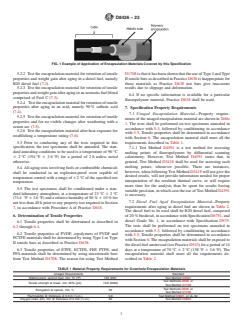
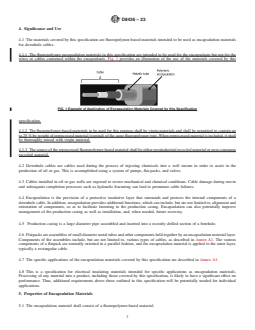
wires or cables contained within the encapsulants. Fig. 1 provides an illustration of the use of the materials covered by this
FIG. 1 Example of Application of Encapsulation Materials Covered by this Specification
specification.
4.1.2 The fluoropolymer-based materials to be used for this purpose shall be virgin materials and shall be permitted to contain up
to 25 % by weight of reprocessed material (regrind) of the same fluoropolymer type. When reprocessed material is included, it shall
be thoroughly mixed with virgin material.
4.1.3 The source of the reprocessed fluoropolymer-based material shall be either postindustrial recycled material or post-consumer
recycled material.
4.2 Downhole cables are cables used during the process of injecting chemicals into a well stream in order to assist in the
production of oil or gas. This is accomplished using a system of pumps, flat-packs, and valves.
4.3 Cables installed in oil or gas wells are exposed to severe mechanical and chemical conditions. Cable damage during run-in
and subsequent completion processes such as hydraulic fracturing can lead to premature cable failures.
4.4 Encapsulation is the provision of a protective insulative layer that surrounds and protects the internal components of a
downhole cable. In addition, encapsulation provides additional functions, which can include, but are not limited to, alignment and
orientation of components, so as to facilitate fastening to the production casing. Encapsulation can also potentially improve
management of the production casing as well as installation, and, when needed, future recovery.
4.5 Production casing is a large diameter pipe assembled and inserted into a recently drilled section of a borehole.
4.6 Flatpacks are assemblies of small diameter metal tubes and other components held together by an encapsulation material layer.
Components of the assemblies include, but are not limited to, various types of cables, as described in Annex A1. The various
components of a flatpack are normally oriented in a parallel fashion, and the encapsulation material is applied to the outer layer,
typically a rectangular cable.
4.7 The specific applications of the encapsulation materials covered by this specification are described in Annex A1.
4.8 This is a specification for electrical insulating materials intended for specific applications as encapsulation materials.
Processing of any material into a product, including those covered by this specification, is likely to have a significant effect on
performance. Thus, additional requirements above those outlined in this specification will be potentially needed for individual
applications.
5. Properties of Encapsulation Materials
5.1 The encapsulation material shall consist of a fluoropolymer-based material.
D8436 − 23
5.2 The fluoropolymer-based material shall comply with encapsulation material property requirements in Section 7. Tests shall be
performed with the encapsulation material as shown below:
5.2.1 Test the unaged encapsulation material for melting point, tensile strength at break, tensile elongation at break, and
flammability (7.1).
5.2.2 Test the encapsulation material for retention of tensile properties and weight gain after aging in a diesel fuel, namely B20
diesel fuel (7.2).
5.2.3 Test the encapsulation material for retention of tensile properties and weight gain after aging in an aromatic fuel blend
comprised of Fuel C (7.3).
5.2.4 Test the encapsulation material for retention of tensile properties after aging in an acid, namely 90 % sulfuric acid (7.4).
5.2.5 Test the encapsulation material for retention of tensile properties and for no visible changes after weathering with a xenon
arc (7.5).
5.2.6 Test the encapsulation material after heat exposure for establishing a temperature rating (7.6).
5.3 Prior to conducting any of the tests required in this specification, the test specimens shall be annealed. The standard annealing
conditions to be used is a temperature of 90 °C 6 2 °C (194 °F 6 3.6 °F) for a period of 2 h unless noted otherwise.
5.4 All aging tests involving fuels or combustible chemicals shall be conducted in an explosion-proof oven capable of temperature
control with a range of 62 °C of the specified test temperature.
5.5 The test specimens shall be conditioned under a standard laboratory atmosphere, at a temperature of 23 °C 6 2 °C (73.4 °F
6 3.6 °F) and a relative humidity of 50 % 6 10 % for not less than 40 h prior to any property test required in Section 7, in
accordance with Procedure A of Practice D618.
6. Determination of Tensile Properties
6.1 Tensile properties shall be determined as described in 6.2 through 6.4.
6.2 Tensile properties of PVDF, copolymers of PVDF and PCTFE materials shall be determined by using Type I or Type II tensile
bars as described in Practice D638.
6.3 Tensile properties of ETFE, ECTFE, FEP, PTFE, and PFA materials shall be determined by using microte
...