


ASTM D6722-19
(Test Method)Standard Test Method for Total Mercury in Coal and Coal Combustion Residues by Direct Combustion Analysis
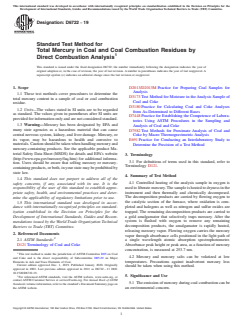
Standard Test Method for Total Mercury in Coal and Coal Combustion Residues by Direct Combustion Analysis
SIGNIFICANCE AND USE
5.1 The emission of mercury during coal combustion can be an environmental concern.
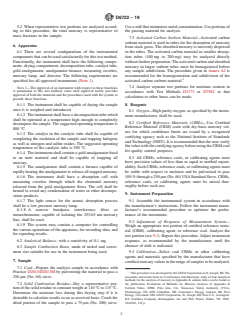
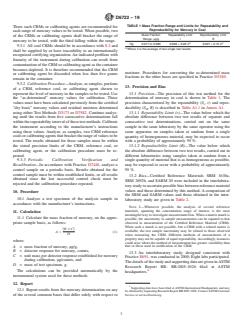
5.2 When representative test portions are analyzed according to this procedure, the total mercury is representative of mass fractions in the sample.
SCOPE
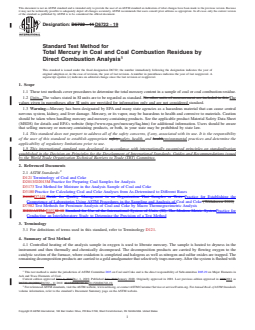
1.1 These test methods cover procedures to determine the total mercury content in a sample of coal or coal combustion residue.
1.2 Units—The values stated in SI units are to be regarded as standard. The values given in parentheses after SI units are provided for information only and are not considered standard.
1.3 Warning—Mercury has been designated by EPA and many state agencies as a hazardous material that can cause central nervous system, kidney, and liver damage. Mercury, or its vapor, may be hazardous to health and corrosive to materials. Caution should be taken when handling mercury and mercury-containing products. See the applicable product Material Safety Data Sheet (MSDS) for details and EPA’s website (http://www.epa.gov/mercury/faq.htm) for additional information. Users should be aware that selling mercury or mercury-containing products, or both, in your state may be prohibited by state law.
1.4 This standard does not purport to address all of the safety concerns, if any, associated with its use. It is the responsibility of the user of this standard to establish appropriate safety, health, and environmental practices and determine the applicability of regulatory limitations prior to use.
1.5 This international standard was developed in accordance with internationally recognized principles on standardization established in the Decision on Principles for the Development of International Standards, Guides and Recommendations issued by the World Trade Organization Technical Barriers to Trade (TBT) Committee.
General Information
- Status
- Published
- Publication Date
- 30-Nov-2019
- Technical Committee
- D05 - Coal and Coke
- Drafting Committee
- D05.29 - Major Elements in Ash and Trace Elements of Coal
Relations
- Effective Date
- 01-Dec-2019
- Effective Date
- 01-Apr-2024
- Effective Date
- 01-Mar-2024
- Effective Date
- 01-Dec-2023
- Effective Date
- 01-Dec-2023
- Effective Date
- 01-Mar-2016
- Effective Date
- 01-Sep-2015
- Effective Date
- 01-Jan-2015
- Effective Date
- 01-May-2013
- Effective Date
- 01-Apr-2012
- Effective Date
- 01-Nov-2011
- Effective Date
- 01-Apr-2011
- Effective Date
- 01-Jun-2010
- Effective Date
- 01-Jun-2010
- Effective Date
- 01-Nov-2009
Overview
ASTM D6722-19 is the Standard Test Method for Total Mercury in Coal and Coal Combustion Residues by Direct Combustion Analysis. Published by ASTM International, this standard provides established procedures for the determination of total mercury content in samples of coal and coal combustion residues. Because mercury emissions are a recognized environmental concern, especially during coal combustion, accurate assessment of mercury concentrations is critical for environmental monitoring, regulatory compliance, and research.
This method involves direct combustion analysis, where mercury is released from the sample and quantified using an atomic absorption spectrophotometer. It supports the use of the International System of Units (SI) and includes guidelines for laboratory safety due to the hazardous nature of mercury.
Key Topics
Mercury Emissions and Environmental Impact
- Monitoring mercury in coal and combustion residues helps in managing air quality and addressing environmental regulations.
- Mercury exposure poses risks to human health, affecting the central nervous system, kidney, and liver.
Test Method Procedure
- Samples are combusted in oxygen, enabling the release and capture of mercury.
- Mercury vapor is trapped, thermally released, and quantified using single-wavelength atomic absorption spectrophotometry, typically at 253.7 nm.
- Quality control is emphasized through calibration with Certified Reference Materials (CRMs).
Sample Preparation
- Coal samples are finely pulverized to ensure homogeneity.
- Combustion residues are dried, crushed, and sieved for analysis.
- Activated carbon sorbents (used in mercury emission control) require homogenization before testing.
Instrumentation and Calibration
- Instruments must include drying, decomposition, catalytic oxidation, and amalgamation compartments.
- Calibration with reference materials ensures measurement precision and accuracy.
Precision and Quality Assurance
- Guidelines include statistical limits for repeatability and reproducibility across laboratories.
- Instrument response and accuracy are maintained with periodic calibration and control sample analysis.
Applications
Regulatory Compliance
- Essential for power plants, environmental laboratories, and regulatory agencies needing mercury emission data for permits or reporting.
Environmental Monitoring
- Supports assessment and mitigation of mercury released during coal utilization.
Research and Quality Assurance
- Used in academic and industrial research to study mercury cycling in coal systems and combustion by-products.
- Ensures that coal products and combustion residues meet environmental and health safety standards.
Industrial Use
- Valuable for coal-fired power generation, waste management, and companies involved in coal quality analysis.
Certified Reference Materials (CRMs)
- Use of CRMs enhances the reliability and comparability of measurement data between laboratories.
Related Standards
- ASTM D121 - Terminology of Coal and Coke
- ASTM D2013/D2013M - Practice for Preparing Coal Samples for Analysis
- ASTM D3173 - Test Method for Moisture in the Analysis Sample of Coal and Coke
- ASTM D3180 - Practice for Calculating Coal and Coke Analyses from As-Determined to Different Bases
- ASTM D7448/D4621 - Quality Management in Organizations That Sample or Test Coal and Coke
- ASTM D7582 - Test Methods for Proximate Analysis of Coal and Coke by Macro Thermogravimetric Analysis
- IEEE/ASTM E691 - Standard for Conducting an Interlaboratory Study to Determine the Precision of a Test Method
Practical Value
Adopting ASTM D6722-19 ensures consistent, accurate determination of total mercury in coal and combustion residues, supporting environmental responsibility and compliance with international regulations. Its application enhances data reliability across the coal and energy sectors while addressing health and ecological concerns linked to mercury emissions. For anyone engaged in coal quality control, environmental analytics, or regulatory monitoring, this standard is a critical tool for effective, safe, and accurate mercury analysis.
Buy Documents
ASTM D6722-19 - Standard Test Method for Total Mercury in Coal and Coal Combustion Residues by Direct Combustion Analysis
REDLINE ASTM D6722-19 - Standard Test Method for Total Mercury in Coal and Coal Combustion Residues by Direct Combustion Analysis
Get Certified
Connect with accredited certification bodies for this standard

ECOCERT
Organic and sustainability certification.

Eurofins Food Testing Global
Global leader in food, environment, and pharmaceutical product testing.

Intertek Bangladesh
Intertek certification and testing services in Bangladesh.
Sponsored listings
Frequently Asked Questions
ASTM D6722-19 is a standard published by ASTM International. Its full title is "Standard Test Method for Total Mercury in Coal and Coal Combustion Residues by Direct Combustion Analysis". This standard covers: SIGNIFICANCE AND USE 5.1 The emission of mercury during coal combustion can be an environmental concern. 5.2 When representative test portions are analyzed according to this procedure, the total mercury is representative of mass fractions in the sample. SCOPE 1.1 These test methods cover procedures to determine the total mercury content in a sample of coal or coal combustion residue. 1.2 Units—The values stated in SI units are to be regarded as standard. The values given in parentheses after SI units are provided for information only and are not considered standard. 1.3 Warning—Mercury has been designated by EPA and many state agencies as a hazardous material that can cause central nervous system, kidney, and liver damage. Mercury, or its vapor, may be hazardous to health and corrosive to materials. Caution should be taken when handling mercury and mercury-containing products. See the applicable product Material Safety Data Sheet (MSDS) for details and EPA’s website (http://www.epa.gov/mercury/faq.htm) for additional information. Users should be aware that selling mercury or mercury-containing products, or both, in your state may be prohibited by state law. 1.4 This standard does not purport to address all of the safety concerns, if any, associated with its use. It is the responsibility of the user of this standard to establish appropriate safety, health, and environmental practices and determine the applicability of regulatory limitations prior to use. 1.5 This international standard was developed in accordance with internationally recognized principles on standardization established in the Decision on Principles for the Development of International Standards, Guides and Recommendations issued by the World Trade Organization Technical Barriers to Trade (TBT) Committee.
SIGNIFICANCE AND USE 5.1 The emission of mercury during coal combustion can be an environmental concern. 5.2 When representative test portions are analyzed according to this procedure, the total mercury is representative of mass fractions in the sample. SCOPE 1.1 These test methods cover procedures to determine the total mercury content in a sample of coal or coal combustion residue. 1.2 Units—The values stated in SI units are to be regarded as standard. The values given in parentheses after SI units are provided for information only and are not considered standard. 1.3 Warning—Mercury has been designated by EPA and many state agencies as a hazardous material that can cause central nervous system, kidney, and liver damage. Mercury, or its vapor, may be hazardous to health and corrosive to materials. Caution should be taken when handling mercury and mercury-containing products. See the applicable product Material Safety Data Sheet (MSDS) for details and EPA’s website (http://www.epa.gov/mercury/faq.htm) for additional information. Users should be aware that selling mercury or mercury-containing products, or both, in your state may be prohibited by state law. 1.4 This standard does not purport to address all of the safety concerns, if any, associated with its use. It is the responsibility of the user of this standard to establish appropriate safety, health, and environmental practices and determine the applicability of regulatory limitations prior to use. 1.5 This international standard was developed in accordance with internationally recognized principles on standardization established in the Decision on Principles for the Development of International Standards, Guides and Recommendations issued by the World Trade Organization Technical Barriers to Trade (TBT) Committee.
ASTM D6722-19 is classified under the following ICS (International Classification for Standards) categories: 71.060.10 - Chemical elements. The ICS classification helps identify the subject area and facilitates finding related standards.
ASTM D6722-19 has the following relationships with other standards: It is inter standard links to ASTM D6722-11, ASTM D7582-24, ASTM D121-15(2024), ASTM D3180-15(2023), ASTM D7582-15(2023), ASTM D7448-16, ASTM D121-15, ASTM D3180-15, ASTM E691-13, ASTM D3180-12, ASTM E691-11, ASTM D3173-11, ASTM D7582-10, ASTM D7582-10e1, ASTM D7582-09. Understanding these relationships helps ensure you are using the most current and applicable version of the standard.
ASTM D6722-19 is available in PDF format for immediate download after purchase. The document can be added to your cart and obtained through the secure checkout process. Digital delivery ensures instant access to the complete standard document.
Standards Content (Sample)
This international standard was developed in accordance with internationally recognized principles on standardization established in the Decision on Principles for the
Development of International Standards, Guides and Recommendations issued by the World Trade Organization Technical Barriers to Trade (TBT) Committee.
Designation: D6722 − 19
Standard Test Method for
Total Mercury in Coal and Coal Combustion Residues by
Direct Combustion Analysis
This standard is issued under the fixed designation D6722; the number immediately following the designation indicates the year of
original adoption or, in the case of revision, the year of last revision. A number in parentheses indicates the year of last reapproval. A
superscript epsilon (´) indicates an editorial change since the last revision or reapproval.
1. Scope D2013/D2013M Practice for Preparing Coal Samples for
Analysis
1.1 These test methods cover procedures to determine the
D3173 Test Method for Moisture in the Analysis Sample of
total mercury content in a sample of coal or coal combustion
Coal and Coke
residue.
D3180 Practice for Calculating Coal and Coke Analyses
1.2 Units—The values stated in SI units are to be regarded
from As-Determined to Different Bases
as standard. The values given in parentheses after SI units are
D7448 Practice for Establishing the Competence of Labora-
provided for information only and are not considered standard.
tories Using ASTM Procedures in the Sampling and
1.3 Warning—Mercury has been designated by EPA and
Analysis of Coal and Coke
many state agencies as a hazardous material that can cause
D7582 Test Methods for Proximate Analysis of Coal and
central nervous system, kidney, and liver damage. Mercury, or
Coke by Macro Thermogravimetric Analysis
its vapor, may be hazardous to health and corrosive to
E691 Practice for Conducting an Interlaboratory Study to
materials.Cautionshouldbetakenwhenhandlingmercuryand
Determine the Precision of a Test Method
mercury-containing products. See the applicable product Ma-
terial Safety Data Sheet (MSDS) for details and EPA’s website
3. Terminology
(http://www.epa.gov/mercury/faq.htm) for additional informa-
3.1 For definitions of terms used in this standard, refer to
tion. Users should be aware that selling mercury or mercury-
Terminology D121.
containingproducts,orboth,inyourstatemaybeprohibitedby
state law.
4. Summary of Test Method
1.4 This standard does not purport to address all of the
4.1 Controlled heating of the analysis sample in oxygen is
safety concerns, if any, associated with its use. It is the
usedtoliberatemercury.Thesampleisheatedtodrynessinthe
responsibility of the user of this standard to establish appro-
instrument and then thermally and chemically decomposed.
priate safety, health, and environmental practices and deter-
The decomposition products are carried by flowing oxygen to
mine the applicability of regulatory limitations prior to use.
the catalytic section of the furnace, where oxidation is com-
1.5 This international standard was developed in accor-
pleted and halogens as well as nitrogen and sulfur oxides are
dance with internationally recognized principles on standard-
trapped. The remaining decomposition products are carried to
ization established in the Decision on Principles for the
a gold amalgamator that selectively traps mercury. After the
Development of International Standards, Guides and Recom-
system is flushed with oxygen to remove any remaining
mendations issued by the World Trade Organization Technical
decomposition products, the amalgamator is rapidly heated,
Barriers to Trade (TBT) Committee.
releasing mercury vapor. Flowing oxygen carries the mercury
2. Referenced Documents
vapor through absorbance cells positioned in the light path of
2.1 ASTM Standards:
a single wavelength atomic absorption spectrophotometer.
D121 Terminology of Coal and Coke
Absorbance peak height or peak area, as a function of mercury
concentration, is measured at 253.7 nm.
This test method is under the jurisdiction of ASTM Committee D05 on Coal
4.2 Mercury and mercury salts can be volatized at low
and Coke and is the direct responsibility of Subcommittee D05.29 on Major
Elements in Ash and Trace Elements of Coal. temperatures. Precautions against inadvertent mercury loss
Current edition approved Dec. 1, 2019. Published January 2020. Originally
should be taken when using this method.
approved in 2001. Last previous edition approved in 2011 as D6722 – 11 DOI:
10.1520/D6722-19.
5. Significance and Use
For referenced ASTM standards, visit the ASTM website, www.astm.org, or
contact ASTM Customer Service at service@astm.org. For Annual Book of ASTM
5.1 The emission of mercury during coal combustion can be
Standards volume information, refer to the standard’s Document Summary page on
the ASTM website. an environmental concern.
Copyright © ASTM International, 100 Barr Harbor Drive, PO Box C700, West Conshohocken, PA 19428-2959. United States
D6722 − 19
5.2 When representative test portions are analyzed accord- Useamillthatminimizesmetalcontamination.Useportionsof
ing to this procedure, the total mercury is representative of the passing material for analysis.
mass fractions in the sample.
7.3 Activated Carbon Sorbent Material—Activated carbon
sorbent material is used in tubes for the absorption of mercury
6. Apparatus
from stack gases. The absorbed mercury is unevenly dispersed
6.1 There are several configurations of the instrumental
in the tubes. The activated carbon material in smaller absorp-
components that can be used satisfactorily for this test method. tion tubes (100 mg to 200 mg) may be analyzed directly
Functionally, the instrument shall have the following compo-
without further preparation.The activated carbon and absorbed
nents: drying compartment, decomposition tube, catalyst tube, mercury in larger sorbent tubes must be homogenized before
gold amalgamator, amalgamator furnace, measuring cuvettes,
any sample subdivision. The procedure given in Annex A2 is
mercury lamp, and detector. The following requirements are recommended for the homogenization and subdivision of the
specified for all approved instruments (Note 1).
activated carbon sorbent material.
7.4 Analyze separate test portions for moisture content in
NOTE 1—The approval of an instrument with respect to these functions
is paramount to this test method, since such approval tacitly provides
accordance with Test Methods D3173 or D7582 so that
approval of both the materials and the procedures used with the system to
calculation to other bases can be made.
provide these functions.
8. Reagents
6.1.1 The instrument shall be capable of drying the sample
once it is weighed and introduced.
8.1 Oxygen—High purity oxygen, as specified by the instru-
6.1.2 Theinstrumentshallhaveadecompositiontubewhich
ment manufacturer, shall be used.
shall be operated at a temperature high enough to completely
8.2 Certified Reference Materials (CRMs)—Use Certified
decompose the sample.The suggested operating temperature is
Reference Material (CRM) coals with dry-basis mercury val-
800 °C.
ues for which confidence limits are issued by a recognized
6.1.3 The catalyst in the catalytic tube shall be capable of
certifying agency such as the National Institute of Standards
completing the oxidation of the sample and trapping halogens
andTechnology (NIST). It is recommended that the user verify
as well as nitrogen and sulfur oxides. The suggested operating
thevaluewiththecertifyingagencybeforeusingtheCRMcoal
temperature of the catalytic tube is 550 °C.
for quality control purposes.
6.1.4 Theinstrumentshallcontainagoldamalgamatorfixed
8.3 All CRMs, reference coals, or calibrating agents must
to an inert material and shall be capable of trapping all
mercury. have precision values of less than or equal to method repeat-
ability. Such CRMs, reference coals, or calibrating agents must
6.1.5 The amalgamator shall contain a furnace capable of
rapidly heating the amalgamator to release all trapped mercury. be stable with respect to moisture and be pulverized to pass
100 %througha250µm(No.60)USAStandardSieve.CRMs,
6.1.6 The instrument shall have a absorption cell with
measuring cuvettes through which the elemental mercury reference coals, or calibrating agents must be mixed thor-
oughly before each use.
released from the gold amalgamator flows. The cell shall be
heated to avoid any condensation of water or other decompo-
9. Instrument Preparation
sition products.
6.1.7 The light source for the atomic absorption process 9.1 Assemble the instrumental system in accordance with
shall be a low pressure mercury lamp.
the manufacturer’s instructions. Follow the instrument manu-
6.1.8 A narrow bandpass interference filter or facturer’s recommended procedure to optimize the perfor-
monochromator, capable of isolating the 253.65 nm mercury
mance of the instrument.
line, shall be used.
9.2 Adjustment of Response of Measurement System—
6.1.9 The system may contain a computer for controlling
Weigh an appropriate test portion of certified reference mate-
the various operations of the apparatus, for recording data, and
rial (CRM), calibrating agent, or reference coal. Analyze the
for reporting results.
test portion (see 9.1). Repeat this procedure.Adjust instrument
6.2 Analytical Balance, with a sensitivity of 0.1 mg. response, as recommended by the manufacturer, until the
absence of drift is indicated.
6.3 Sample Combustion Boats, made of nickel and conve-
nient size suitable for use in the instrument being used. 9.3 Calibration—Select coal CRMs or other calibrating
agents and materials specified by the manufacturer that have
7. Sample
certifiedmercuryvaluesintherangeofsamplestobeanalyzed.
7.1 Coal—Prepare the analysis sample in accordance with
Practice D2013/D2013M by pulverizing the material to pass a
ThisprocedurewasdevelopedbytheLECOCorporationinSt.Joseph,MI.The
procedure and results from an 11-laboratory interlaboratory study of four analytical
250 µm (No. 60) sieve.
methods for the analysis of mercury in Appendix K sorbent tubes can be found in
7.2 Solid Combustion Residue—Dry a representative por-
the publication: Evaluation of Methods for Mercury Analysis of Appendix K
Sorbent Tubes, EPRI, Palo Alto, CA, Tennessee Valley Authority (TVA),
tionofthesolidresiduetoconstantweightat110 °Cto115 °C.
Chattanooga, TN, AEP, Columbus, OH, Consumer’s Energy, Jackson, MI, First
Determine the moisture loss during this drying step if it is
Energy, Cleveland, OH, LECO Corporation, St. Joseph, MI, Eon U.S., Lexington,
desirable to calculate results to an as-received basis. Crush the
KY, Southern Company, Birmingham, AL and TXU Power, Dallas, TX: 2007,
dried portion of the sample to pass a 75 µm (No. 200) sieve. 1014565, 110 p.
D6722 − 19
TABLE 1 Mass Fraction Range and Limits for Repeatability and
Three such CRMs or calibrating agents are recommended for
Reproducibility for Mercury in Coal
each range of mercury values to be tested. When possible, two
Mass Fraction Repeatability Limit Reproducibility Limit
of the CRMs or calibrating agents shall bracket the range of
Range, µg/g r R
mercury to be tested, with the third falling within the range.
A A
Hg
...
This document is not an ASTM standard and is intended only to provide the user of an ASTM standard an indication of what changes have been made to the previous version. Because
it may not be technically possible to adequately depict all changes accurately, ASTM recommends that users consult prior editions as appropriate. In all cases only the current version
of the standard as published by ASTM is to be considered the official document.
Designation: D6722 − 11 D6722 − 19
Standard Test Method for
Total Mercury in Coal and Coal Combustion Residues by
Direct Combustion Analysis
This standard is issued under the fixed designation D6722; the number immediately following the designation indicates the year of
original adoption or, in the case of revision, the year of last revision. A number in parentheses indicates the year of last reapproval. A
superscript epsilon (´) indicates an editorial change since the last revision or reapproval.
1. Scope
1.1 These test methods cover procedures to determine the total mercury content in a sample of coal or coal combustion residue.
1.2 Units—The values stated in SI units are to be regarded as standard. No other units of measurement are included in this The
values given in parentheses after SI units are provided for information only and are not considered standard.
1.3 Warning—Mercury has been designated by EPA and many state agencies as a hazardous material that can cause central
nervous system, kidney, and liver damage. Mercury, or its vapor, may be hazardous to health and corrosive to materials. Caution
should be taken when handling mercury and mercury-containing products. See the applicable product Material Safety Data Sheet
(MSDS) for details and EPA’s website (http://www.epa.gov/mercury/faq.htm) for additional information. Users should be aware
that selling mercury or mercury-containing products, or both, in your state may be prohibited by state law.
1.4 This standard does not purport to address all of the safety concerns, if any, associated with its use. It is the responsibility
of the user of this standard to establish appropriate safety safety, health, and healthenvironmental practices and determine the
applicability of regulatory limitations prior to use.
1.5 This international standard was developed in accordance with internationally recognized principles on standardization
established in the Decision on Principles for the Development of International Standards, Guides and Recommendations issued
by the World Trade Organization Technical Barriers to Trade (TBT) Committee.
2. Referenced Documents
2.1 ASTM Standards:
D121 Terminology of Coal and Coke
D2013/D2013M Practice for Preparing Coal Samples for Analysis
D3173 Test Method for Moisture in the Analysis Sample of Coal and Coke
D3180 Practice for Calculating Coal and Coke Analyses from As-Determined to Different Bases
D4621D7448 Guide for Quality Management in an Organization That Samples or Tests Practice for Establishing the
Competence of Laboratories Using ASTM Procedures in the Sampling and Analysis of Coal and Coke (Withdrawn 2010)
D7582 Test Methods for Proximate Analysis of Coal and Coke by Macro Thermogravimetric Analysis
IEEE/ASTM E691SI 10 Standard for Use of the International System of Units (SI): The Modern Metric SystemPractice for
Conducting an Interlaboratory Study to Determine the Precision of a Test Method
3. Terminology
3.1 For definitions of terms used in this standard, refer to Terminology D121.
4. Summary of Test Method
4.1 Controlled heating of the analysis sample in oxygen is used to liberate mercury. The sample is heated to dryness in the
instrument and then thermally and chemically decomposed. The decomposition products are carried by flowing oxygen to the
catalytic section of the furnace, where oxidation is completed and halogens as well as nitrogen and sulfur oxides are trapped. The
remaining decomposition products are carried to a gold amalgamator that selectively traps mercury. After the system is flushed with
This test method is under the jurisdiction of ASTM Committee D05 on Coal and Coke and is the direct responsibility of Subcommittee D05.29 on Major Elements in
Ash and Trace Elements of Coal.
Current edition approved June 1, 2011Dec. 1, 2019. Published June 2011January 2020. Originally approved in 2001. Last previous edition approved in 20062011 as
D6722–01(2006).D6722 – 11 DOI: 10.1520/D6722-11.10.1520/D6722-19.
For referenced ASTM standards, visit the ASTM website, www.astm.org, or contact ASTM Customer Service at service@astm.org. For Annual Book of ASTM Standards
volume information, refer to the standard’s Document Summary page on the ASTM website.
Copyright © ASTM International, 100 Barr Harbor Drive, PO Box C700, West Conshohocken, PA 19428-2959. United States
D6722 − 19
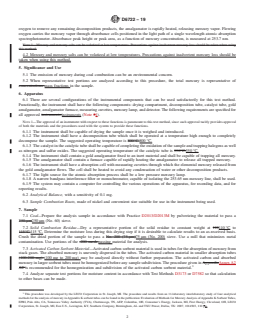
oxygen to remove any remaining decomposition products, the amalgamator is rapidly heated, releasing mercury vapor. Flowing
oxygen carries the mercury vapor through absorbance cells positioned in the light path of a single wavelength atomic absorption
spectrophotometer. Absorbance peak height or peak area, as a function of mercury concentration, is measured at 253.7 nm.
NOTE 1—Mercury and mercury salts can be volatized at low temperatures. Precautions against inadvertent mercury loss should be taken when using
this method.
4.2 Mercury and mercury salts can be volatized at low temperatures. Precautions against inadvertent mercury loss should be
taken when using this method.
5. Significance and Use
5.1 The emission of mercury during coal combustion can be an environmental concern.
5.2 When representative test portions are analyzed according to this procedure, the total mercury is representative of
concentrations mass fractions in the sample.
6. Apparatus
6.1 There are several configurations of the instrumental components that can be used satisfactorily for this test method.
Functionally, the instrument shall have the following components: drying compartment, decomposition tube, catalyst tube, gold
amalgamator, amalgamator furnace, measuring cuvettes, mercury lamp, and detector. The following requirements are specified for
all approved instruments.instruments (Note 21).
NOTE 1—The approval of an instrument with respect to these functions is paramount to this test method, since such approval tacitly provides approval
of both the materials and the procedures used with the system to provide these functions.
6.1.1 The instrument shall be capable of drying the sample once it is weighed and introduced.
6.1.2 The instrument shall have a decomposition tube which shall be operated at a temperature high enough to completely
decompose the sample. The suggested operating temperature is 800°C.800 °C.
6.1.3 The catalyst in the catalytic tube shall be capable of completing the oxidation of the sample and trapping halogens as well
as nitrogen and sulfur oxides. The suggested operating temperature of the catalytic tube is 550°C.550 °C.
6.1.4 The instrument shall contain a gold amalgamator fixed to an inert material and shall be capable of trapping all mercury.
6.1.5 The amalgamator shall contain a furnace capable of rapidly heating the amalgamator to release all trapped mercury.
6.1.6 The instrument shall have a absorption cell with measuring cuvettes through which the elemental mercury released from
the gold amalgamator flows. The cell shall be heated to avoid any condensation of water or other decomposition products.
6.1.7 The light source for the atomic absorption process shall be a low pressure mercury lamp.
6.1.8 A narrow bandpass interference filter or monochromator, capable of isolating the 253.65 nm mercury line, shall be used.
6.1.9 The system may contain a computer for controlling the various operations of the apparatus, for recording data, and for
reporting results.
6.2 Analytical Balance, with a sensitivity of 0.1 mg.
6.3 Sample Combustion Boats, made of nickel and convenient size suitable for use in the instrument being used.
7. Sample
7.1 Coal—Prepare the analysis sample in accordance with Practice D2013/D2013M by pulverizing the material to pass a
250-μm250 μm (No. 60) sieve.
7.2 Solid Combustion Residue—Dry a representative portion of the solid residue to constant weight at 110110 °C to
115°C.115 °C. Determine the moisture loss during this drying step if it is desirable to calculate results to an as-received basis.
Crush the dried portion of the sample to pass a No. 200 (75-μm)75 μm (No. 200) sieve. Use a mill that minimizes metal
contamination. Use portions of the -200 mesh passing material for analysis.
7.3 Activated Carbon Sorbent Material—Activated carbon sorbent material is used in tubes for the absorption of mercury from
stack gases. The absorbed mercury is unevenly dispersed in the tubes. The activated carbon material in smaller absorption tubes
(100-200 mg) (100 mg to 200 mg) may be analyzed directly without further preparation. The activated carbon and absorbed
mercury in larger sorbent tubes must be homogenized before any sample subdivision. The procedure given in AppendixAnnex A2
A2 is recommended for the homogenization and subdivision of the activated carbon sorbent material.
7.4 Analyze separate test portions for moisture content in accordance with Test Methods D3173 or D7582 so that calculation
to other bases can be made.
This procedure was developed by the LECO Corporation in St. Joseph, MI. The procedure and results from an 11-laboratory interlaboratory study of four analytical
methods for the analysis of mercury in Appendix K sorbent tubes can be found in the publication: Evaluation of Methods for Mercury Analysis of Appendix K Sorbent Tubes,
EPRI, Palo Alto, CA, Tennessee Valley Authority (TVA), Chattanooga, TN, AEP, Columbus, OH, Consumer’s Energy, Jackson, MI, First Energy, Cleveland, OH, LECO
Corporation, St. Joseph, MI, Eon U.S., Lexington, KY, Southern Company, Birmingham, AL and TXU Power, Dallas, TX: 2007, 1014565, 110 pp.
D6722 − 19
8. Reagents
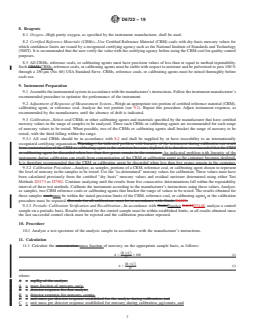
8.1 Oxygen—High purity oxygen, as specified by the instrument manufacturer, shall be used.
8.2 Certified Reference Materials (CRMs)—Use Certified Reference Material (CRM) coals with dry-basis mercury values for
which confidence limits are issued by a recognized certifying agency such as the National Institute of Standards and Technology
(NIST). It is recommended that the user verify the value with the certifying agency before using the CRM coal for quality control
purposes.
8.3 All CRMs, reference coals, or calibrating agents must have precision values of less than or equal to method repeatability.
Such CRMS,CRMs, reference coals, or calibrating agents must be stable with respect to moisture and be pulverized to pass 100 %
through a 250 μm (No. 60) USA Standard Sieve. CRMs, reference coals, or calibrating agents must be mixed thoroughly before
each use.
9. Instrument Preparation
9.1 Assemble the instrumental system in accordance with the manufacturer’s instructions. Follow the instrument manufacturer’s
recommended procedure to optimize the performance of the instrument.
9.2 Adjustment of Response of Measurement System—Weigh an appropriate test portion of certified reference material (CRM),
calibrating agent, or reference coal. Analyze the test portion (see 9.1). Repeat this procedure. Adjust instrument response, as
recommended by the manufacturer, until the absence of drift is indicated.
9.3 Calibration—Select coal CRMs or other calibrating agents and materials specified by the manufacturer that have certified
mercury values in the range of samples to be analyzed. Three such CRMs or calibrating agents are recommended for each range
of mercury values to be tested. When possible, two of the CRMs or calibrating agents shall bracket the range of mercury to be
tested, with the third falling within the range.
9.3.1 All coal CRMs should be in accordance with 8.2 and shall be supplied by or have traceability to an internationally
recognized certifying organization.Warning—An indicated problem with linearity of the instrument during calibration can result
from contamination of the CRM or calibrating agent as the container becomes depleted. It is therefore recommended that the CRM
or calibrating agent be discarded when less than five grams remain in the container. An indicated problem with linearity of the
instrument during calibration can result from contamination of the CRM or calibrating agent as the container becomes depleted.
It
...
Questions, Comments and Discussion
Ask us and Technical Secretary will try to provide an answer. You can facilitate discussion about the standard in here.
Loading comments...