


ASTM C1563-08(2017)
(Test Method)Standard Test Method for Gaskets for Use in Connection with Hub and Spigot Cast Iron Soil Pipe and Fittings for Sanitary Drain, Waste, Vent, and Storm Piping Applications
Standard Test Method for Gaskets for Use in Connection with Hub and Spigot Cast Iron Soil Pipe and Fittings for Sanitary Drain, Waste, Vent, and Storm Piping Applications
ABSTRACT
This specification covers the standard material criteria and test method for compression gaskets used in joining hub and spigot cast iron soil pipe and fittings for sanitary drain, waste, vent, and storm piping applications. The gaskets shall be made of a compound containing a thermoset elastomer and shall consist of one or more sealing ring(s) that compress to provide an airtight and watertight seal. Compression gaskets shall have an integral flange to prevent the gasket from rolling into the hub during installation and shall be designed to permit expansion, contraction, and deflection of assembled piping. The gaskets shall be restrained and subjected to hydrostatic pressure and the joint assembly performance shall be evaluated using the restrained hydrostatic joint testing apparatus wherein a water pressure gauge is used to ensure the accuracy of the test pressures.
SCOPE
1.1 Several different types of compression gaskets are available for use in connection with hub and spigot cast iron soil pipe and fittings. The purpose of this test method is to establish material criteria and test procedures for compression gaskets used in joining hub and spigot cast iron soil pipe and fittings for sanitary drain, waste, vent, and storm drain piping applications in accordance with the general needs of producers, distributors, and users.
1.2 The values stated in inch-pound units are to be regarded as standard. The values given in parentheses are mathematical conversions to SI units that are provided for information only and are not considered standard.
1.3 This standard does not purport to address all of the safety concerns, if any, associated with its use. It is the responsibility of the user of this standard to establish appropriate safety, health, and environmental practices and determine the applicability of regulatory limitations prior to use.
1.4 This international standard was developed in accordance with internationally recognized principles on standardization established in the Decision on Principles for the Development of International Standards, Guides and Recommendations issued by the World Trade Organization Technical Barriers to Trade (TBT) Committee.
General Information
Buy Standard


Standards Content (Sample)
NOTICE: This standard has either been superseded and replaced by a new version or withdrawn.
Contact ASTM International (www.astm.org) for the latest information
Designation: C1563 − 08 (Reapproved 2017)
Standard Test Method for
Gaskets for Use in Connection with Hub and Spigot Cast
Iron Soil Pipe and Fittings for Sanitary Drain, Waste, Vent,
and Storm Piping Applications
This standard is issued under the fixed designation C1563; the number immediately following the designation indicates the year of
original adoption or, in the case of revision, the year of last revision. A number in parentheses indicates the year of last reapproval. A
superscript epsilon (´) indicates an editorial change since the last revision or reapproval.
1. Scope 3. Terminology
1.1 Several different types of compression gaskets are 3.1 Definitions:
available for use in connection with hub and spigot cast iron 3.1.1 For definitions of terms in this test method, see
soil pipe and fittings. The purpose of this test method is to Terminology A644.
establish material criteria and test procedures for compression 3.1.2 adhesive lubricant, n—liquid emulsion chemically
gaskets used in joining hub and spigot cast iron soil pipe and cured polychloroprene.
fittings for sanitary drain, waste, vent, and storm drain piping
3.1.3 manufacturer, n—the entity that molds the compres-
applicationsinaccordancewiththegeneralneedsofproducers,
sion gaskets covered by this standard.
distributors, and users.
4. Summary of Test Method
1.2 The values stated in inch-pound units are to be regarded
as standard. The values given in parentheses are mathematical 4.1 Restrained Hydrostatic Joint Test—In the restrained
conversions to SI units that are provided for information only hydrostatic joint test, two test pieces are prepared such that
and are not considered standard. inside diameter of the hub and the outside diameter of the
spigot conform to the maximum and minimum (respectively)
1.3 This standard does not purport to address all of the
dimensions permitted by Specification A74. The compression
safety concerns, if any, associated with its use. It is the
gasket to be tested is used to join the test pieces as detailed in
responsibility of the user of this standard to establish appro-
Fig. 1. This assembly is then restrained and subjected to
priate safety, health, and environmental practices and deter-
hydrostaticpressure,andtheperformanceofthejointassembly
mine the applicability of regulatory limitations prior to use.
is evaluated.
1.4 This international standard was developed in accor-
dance with internationally recognized principles on standard-
5. Physical Properties, Material, and Marking
ization established in the Decision on Principles for the
5.1 Physical Properties—The gaskets governed by this test
Development of International Standards, Guides and Recom-
method are of a compression type and are designed to fit the
mendations issued by the World Trade Organization Technical
annular space between the spigot (plain) end of one pipe or
Barriers to Trade (TBT) Committee.
fitting and the receptive hub of another, as shown in Fig. 2.
2. Referenced Documents
5.1.1 Each compression gasket shall consist of one or more
sealing ring(s) that compress to provide an airtight and
2.1 ASTM Standards:
watertight seal. Compression gaskets shall have an integral
A74 Specification for Cast Iron Soil Pipe and Fittings
flange to prevent the gasket from rolling into the hub during
A644 Terminology Relating to Iron Castings
installation.
C564 Specification for Rubber Gaskets for Cast Iron Soil
5.1.2 Each compression gasket shall be designed to permit
Pipe and Fittings
expansion, contraction, and deflection of assembled piping
common to sanitary drain, waste, vent, and storm piping
This test method is under the jurisdiction of ASTM Committee A04 on Iron
applications.
Castings and is the direct responsibility of Subcommittee A04.75 on Gaskets and
Coupling for Plumbing and Sewer Piping.
5.2 Material—Compression gaskets governed by this test
Current edition approved Oct. 1, 2017. Published October 2017. Originally
method shall be made of a compound containing a thermoset
approved in 2004. Last previous edition approved in 2013 as C1563 – 08 (2013).
elastomer that complies with all of the requirements of
DOI: 10.1520/C1563-08R17.
For referenced ASTM standards, visit the ASTM website, www.astm.org, or Specification C564.
contact ASTM Customer Service at service@astm.org. For Annual Book of ASTM
5.3 Marking—Compression gaskets governed by this test
Standards volume information, refer to the standard’s Document Summary page on
the ASTM website. method shall be marked with raised letters so as to be visible
Copyright © ASTM International, 100 Barr Harbor Drive, PO Box C700, West Conshohocken, PA 19428-2959. United States
C1563 − 08 (2017)
FIG. 1 Restrained Hydrostatic Joint Test Apparatus (Typical)
after installation (see Fig. 3). Each compression gasket shall be 6.1.1 Water Pressure Gauge—To ensure the accuracy of the
plainly marked with pipe size and class, “ASTM C564,” test pressures, the test apparatus shall utilize a water pressure
“ASTM C1563,” country of origin, year of manufacture, and gauge graduated in increments no greater than 1 psi (7 kPa),
manufacturer’s name or registered trademark that readily
and with a maximum gauge pressure no greater than 30 psi
identifies the manufacturer after installation. The manufacturer (207 kPa). Locate the water pressure gauge within 6 in.
shall also be permitted to include mold number and cavity
vertically of the joint being tested.
number or other unique markings for use in quality control
procedures.
7. Hazards
5.3.1 Pipe Class—“XH” shall identify gaskets for use in
7.1 This test method is for use in evaluating only those
joining extra heavy cast iron soil pipe and fittings. “SV” shall
compression gaskets complying with Specification C564 and
identifygasketsforuseinjoiningserv
...
This document is not an ASTM standard and is intended only to provide the user of an ASTM standard an indication of what changes have been made to the previous version. Because
it may not be technically possible to adequately depict all changes accurately, ASTM recommends that users consult prior editions as appropriate. In all cases only the current version
of the standard as published by ASTM is to be considered the official document.
Designation: C1563 − 08 (Reapproved 2013) C1563 − 08 (Reapproved 2017)
Standard Test Method for
Gaskets for Use in Connection with Hub and Spigot Cast
Iron Soil Pipe and Fittings for Sanitary Drain, Waste, Vent,
and Storm Piping Applications
This standard is issued under the fixed designation C1563; the number immediately following the designation indicates the year of
original adoption or, in the case of revision, the year of last revision. A number in parentheses indicates the year of last reapproval. A
superscript epsilon (´) indicates an editorial change since the last revision or reapproval.
1. Scope
1.1 Several different types of compression gaskets are available for use in connection with hub and spigot cast iron soil pipe
and fittings. The purpose of this test method is to establish material criteria and test procedures for compression gaskets used in
joining hub and spigot cast iron soil pipe and fittings for sanitary drain, waste, vent, and storm drain piping applications in
accordance with the general needs of producers, distributors, and users.
1.2 The values stated in inch-pound units are to be regarded as standard. The values given in parentheses are mathematical
conversions to SI units that are provided for information only and are not considered standard.
1.3 This standard does not purport to address all of the safety concerns, if any, associated with its use. It is the responsibility
of the user of this standard to establish appropriate safety safety, health, and healthenvironmental practices and determine the
applicability of regulatory limitations prior to use.
1.4 This international standard was developed in accordance with internationally recognized principles on standardization
established in the Decision on Principles for the Development of International Standards, Guides and Recommendations issued
by the World Trade Organization Technical Barriers to Trade (TBT) Committee.
2. Referenced Documents
2.1 ASTM Standards:
A74 Specification for Cast Iron Soil Pipe and Fittings
A644 Terminology Relating to Iron Castings
C564 Specification for Rubber Gaskets for Cast Iron Soil Pipe and Fittings
A644 Terminology Relating to Iron Castings
3. Terminology
3.1 Definitions:
3.1.1 For definitions of terms in this test method, see Terminology A644.
3.1.2 adhesive lubricant, n—liquid emulsion chemically cured polychloroprene.
3.1.3 manufacturer, n—the entity that molds the compression gaskets covered by this standard.
4. Summary of Test Method
4.1 Restrained Hydrostatic Joint Test—In the Restrained Hydrostatic Joint Test,restrained hydrostatic joint test, two test pieces
are prepared such that inside diameter of the hub and the outside diameter of the spigot conform to the maximum and minimum
(respectively) dimensions permitted by Specification A74. The compression gasket to be tested is used to join the test pieces as
detailed in Fig. 1. This assembly is then restrained and subjected to hydrostatic pressure, and the performance of the joint assembly
is evaluated.
This test method is under the jurisdiction of ASTM Committee A04 on Iron Castings and is the direct responsibility of Subcommittee A04.75 on Gaskets and Coupling
for Plumbing and Sewer Piping.
Current edition approved May 1, 2013Oct. 1, 2017. Published May 2013October 2017. Originally approved in 2004. Last previous edition approved in 20082013 as
C1563 – 08.C1563 – 08 (2013). DOI: 10.1520/C1563-08R13.10.1520/C1563-08R17.
For referenced ASTM standards, visit the ASTM website, www.astm.org, or contact ASTM Customer Service at service@astm.org. For Annual Book of ASTM Standards
volume information, refer to the standard’s Document Summary page on the ASTM website.
Copyright © ASTM International, 100 Barr Harbor Drive, PO Box C700, West Conshohocken, PA 19428-2959. United States
C1563 − 08 (2017)
FIG. 1 Restrained Hydrostatic Joint Test Apparatus (Typical)
5. Physical Properties, Material, and Marking
5.1 Physical Properties—The gaskets governed by this test method are of a compression type and are designed to fit the annular
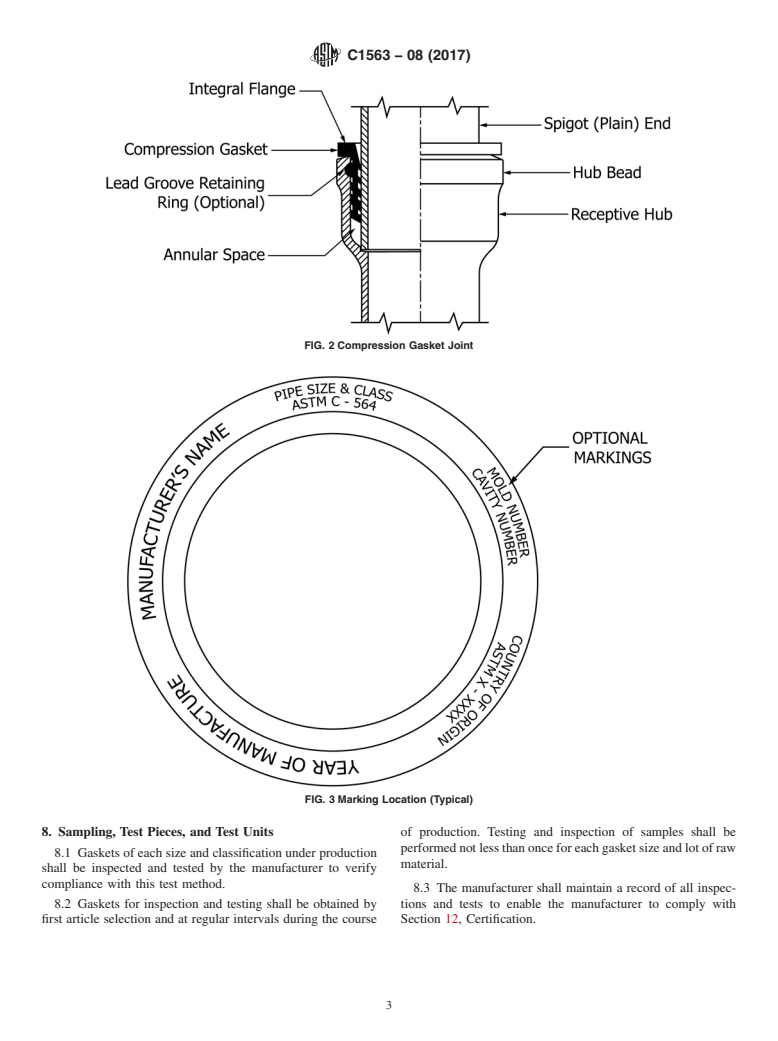
space between the spigot (plain) end of one pipe or fitting and the receptive hub of another, as shown in Fig. 2.
5.1.1 Each compression gasket shall consist of one or more sealing ring(s) that compress to provide an airtight and watertight
seal. Compression gaskets shall have an integral flange to prevent the gasket from rolling into the hub during installation.
5.1.2 Each compression gasket shall be designed to permit expansion, contraction, and deflection of assembled piping common
to sanitary drain, waste, vent, and storm piping applications.
5.2 Material—Compression gaskets governed by this test method shall be made of a compound containing a thermoset
elastomer that complies with all of the requirements of Specification C564.
5.3 Marking—Compression gaskets governed by this test method shall be marked with raised letters so as to be visible after
installation (see Fig. 3). Each compression gasket shall be plainly marked with pipe size and class, “ASTM C564,” “ASTM
C1563,” country of origin, year of manufacture, and manufacturer’s name or registered trademark that readily identifies the
manufacturer after installation. The manufacturer shall also be permitted to include mold number and cavity number or other
unique markings for use in quality control procedures.
5.3.1 Pipe Class—“XH” shall identify gaskets for use in joining extra heavy cast iron soil pipe and fittings. “SV” shall identify
gaskets for use in joining service cast iron soil pipe and fittings.
C1563 − 08 (2017)
FIG. 2 Compression Gasket Joint
FIG. 3 Marking Location (Typical)
6. Apparatus
6.1 Restrained Hydrostatic Joint Testing Apparatus—Assemble apparatus as detailed in Fig. 1.
6.1.1 Water Pressure Gauge—To ens
...
Questions, Comments and Discussion
Ask us and Technical Secretary will try to provide an answer. You can facilitate discussion about the standard in here.