

ASTM C1216/C1216M-23
(Test Method)Standard Test Method for Adhesion and Cohesion of One-Part Elastomeric Solvent Release Sealants
General Information
- Abstract
SIGNIFICANCE AND USE
4.1 The failure of a building sealant in a joint that experiences movement is manifested by cohesive failure in the sealant or adhesive failure between the sealant and substrate, or both. This test method evaluates the performance of one-part elastomeric solvent release sealants in joints subjected to movement and temperature aging.
SCOPE
1.1 This test method is a laboratory procedure that determines the adhesion and cohesion performance of one-part elastomeric, solvent release sealants at high and low temperatures by the extension and compression of test specimens.
1.2 Units—The values stated in either SI units or inch-pound units are to be regarded separately as standard. The values stated in each system are not necessarily exact equivalents; therefore, to ensure conformance with the standard, each system shall be used independently of the other, and values from the two systems shall not be combined.
1.3 The subcommittee with jurisdiction is not aware of any similar ISO standard.
1.4 This standard does not purport to address all of the safety concerns, if any, associated with its use. It is the responsibility of the user of this standard to establish appropriate safety, health, and environmental practices and determine the applicability of regulatory limitations prior to use. For a specific precautionary statement, see Note 2.
1.5 This international standard was developed in accordance with internationally recognized principles on standardization established in the Decision on Principles for the Development of International Standards, Guides and Recommendations issued by the World Trade Organization Technical Barriers to Trade (TBT) Committee.
- Status
- Published
- Publication Date
- 31-Dec-2022
- Technical Committee
- C24 - Building Seals and Sealants
- Drafting Committee
- C24.30 - Adhesion
Overview
ASTM C1216/C1216M-23 is the Standard Test Method for Adhesion and Cohesion of One-Part Elastomeric Solvent Release Sealants. Developed and published by ASTM International, this test method provides a comprehensive laboratory procedure for evaluating the adhesion and cohesion performance of one-part elastomeric solvent release sealants under conditions that simulate real-world stresses, including joint movement and temperature changes. This standard is especially relevant for building and construction professionals concerned with sealant durability and the prevention of joint failures.
Key Topics
- Adhesion and Cohesion Testing: The standard focuses on identifying adhesive failures (loss of bond between sealant and substrate) and cohesive failures (failure within the sealant material itself).
- Thermal Aging and Movement: Sealants are tested under high and low temperatures and are subjected to extension and compression cycles to mimic real-world joint movement and temperature aging.
- Substrate Compatibility: Performance is assessed using standard substrates such as Portland cement mortar, float glass, and aluminum alloy, with provisions for testing other substrates upon request.
- Controlled Laboratory Conditions: The test requires the use of specific apparatus, such as extension-compression machines, ovens, and freezers, to standardize specimen preparation, curing, and testing processes.
- Result Reporting: Cohesive and adhesive failures are measured and reported in square centimeters or square inches for transparency and repeatability.
Applications
ASTM C1216/C1216M-23 is widely applicable across the construction and manufacturing industries for:
- Quality Control of Sealants: Manufacturers use this method to ensure that their one-part elastomeric solvent release sealants meet expected performance standards before entering the market.
- On-site Assessment: Construction professionals and building inspectors apply this test method to select sealants that are reliable for joints expected to experience movement and temperature variations.
- Product Comparison: The standard enables objective comparisons across different sealant products regarding their resistance to adhesive and cohesive failure.
- Research and Development: Laboratories utilize this test to develop and refine sealant formulations for improved performance under environmental and mechanical stresses.
Related Standards
Several other standards are referenced within ASTM C1216/C1216M-23 to support consistent testing and terminology, including:
- ASTM C33: Specification for Concrete Aggregates
- ASTM C150: Specification for Portland Cement
- ASTM C109/C109M: Test Method for Compressive Strength of Hydraulic Cement Mortars
- ASTM C717: Terminology of Building Seals and Sealants
- Aluminum Association DAF-45: Designation System for Aluminum Finishes
Practical Value
By following ASTM C1216/C1216M-23, organizations can:
- Reduce Sealant Failures: Proactively test and select products with superior adhesion and cohesion properties, reducing maintenance costs and the risk of joint leaks or failures.
- Ensure Regulatory Compliance: Meet internationally recognized principles for construction material testing, vital for specifications in both public and private sector projects.
- Support Product Development: Gain actionable data to innovate and improve elastomeric sealant formulations specifically for demanding building applications.
For professionals in building design, construction, and material manufacturing, ASTM C1216/C1216M-23 serves as a trusted benchmark for evaluating the durability and effectiveness of one-part elastomeric solvent release sealants in real-world conditions.
Relations
- Effective Date
- 15-Dec-2023
- Effective Date
- 01-Mar-2019
- Effective Date
- 01-Mar-2018
- Effective Date
- 01-Nov-2017
- Effective Date
- 01-Jan-2017
- Effective Date
- 15-Nov-2016
- Effective Date
- 01-Sep-2016
- Effective Date
- 01-May-2014
- Effective Date
- 01-Feb-2014
- Effective Date
- 01-Nov-2013
- Effective Date
- 15-Dec-2012
- Effective Date
- 01-Dec-2012
- Effective Date
- 01-May-2012
- Effective Date
- 15-Jan-2012
- Effective Date
- 01-Oct-2011
Get Certified
Connect with accredited certification bodies for this standard

DIN CERTCO
DIN Group product certification.

Smithers Quality Assessments
US management systems and product certification.
Sponsored listings
Frequently Asked Questions
ASTM C1216/C1216M-23 is a standard published by ASTM International. Its full title is "Standard Test Method for Adhesion and Cohesion of One-Part Elastomeric Solvent Release Sealants". This standard covers: SIGNIFICANCE AND USE 4.1 The failure of a building sealant in a joint that experiences movement is manifested by cohesive failure in the sealant or adhesive failure between the sealant and substrate, or both. This test method evaluates the performance of one-part elastomeric solvent release sealants in joints subjected to movement and temperature aging. SCOPE 1.1 This test method is a laboratory procedure that determines the adhesion and cohesion performance of one-part elastomeric, solvent release sealants at high and low temperatures by the extension and compression of test specimens. 1.2 Units—The values stated in either SI units or inch-pound units are to be regarded separately as standard. The values stated in each system are not necessarily exact equivalents; therefore, to ensure conformance with the standard, each system shall be used independently of the other, and values from the two systems shall not be combined. 1.3 The subcommittee with jurisdiction is not aware of any similar ISO standard. 1.4 This standard does not purport to address all of the safety concerns, if any, associated with its use. It is the responsibility of the user of this standard to establish appropriate safety, health, and environmental practices and determine the applicability of regulatory limitations prior to use. For a specific precautionary statement, see Note 2. 1.5 This international standard was developed in accordance with internationally recognized principles on standardization established in the Decision on Principles for the Development of International Standards, Guides and Recommendations issued by the World Trade Organization Technical Barriers to Trade (TBT) Committee.
SIGNIFICANCE AND USE 4.1 The failure of a building sealant in a joint that experiences movement is manifested by cohesive failure in the sealant or adhesive failure between the sealant and substrate, or both. This test method evaluates the performance of one-part elastomeric solvent release sealants in joints subjected to movement and temperature aging. SCOPE 1.1 This test method is a laboratory procedure that determines the adhesion and cohesion performance of one-part elastomeric, solvent release sealants at high and low temperatures by the extension and compression of test specimens. 1.2 Units—The values stated in either SI units or inch-pound units are to be regarded separately as standard. The values stated in each system are not necessarily exact equivalents; therefore, to ensure conformance with the standard, each system shall be used independently of the other, and values from the two systems shall not be combined. 1.3 The subcommittee with jurisdiction is not aware of any similar ISO standard. 1.4 This standard does not purport to address all of the safety concerns, if any, associated with its use. It is the responsibility of the user of this standard to establish appropriate safety, health, and environmental practices and determine the applicability of regulatory limitations prior to use. For a specific precautionary statement, see Note 2. 1.5 This international standard was developed in accordance with internationally recognized principles on standardization established in the Decision on Principles for the Development of International Standards, Guides and Recommendations issued by the World Trade Organization Technical Barriers to Trade (TBT) Committee.
ASTM C1216/C1216M-23 is classified under the following ICS (International Classification for Standards) categories: 83.140.50 - Seals. The ICS classification helps identify the subject area and facilitates finding related standards.
ASTM C1216/C1216M-23 has the following relationships with other standards: It is inter standard links to ASTM C109/C109M-23, ASTM C717-19, ASTM C717-18, ASTM C717-17a, ASTM C717-17, ASTM C717-16a, ASTM C717-16, ASTM C717-14a, ASTM C717-14, ASTM C717-13, ASTM C109/C109M-12, ASTM C717-12b, ASTM C717-12a, ASTM C717-12, ASTM C109/C109M-11a. Understanding these relationships helps ensure you are using the most current and applicable version of the standard.
ASTM C1216/C1216M-23 is available in PDF format for immediate download after purchase. The document can be added to your cart and obtained through the secure checkout process. Digital delivery ensures instant access to the complete standard document.
Standards Content (Sample)
This international standard was developed in accordance with internationally recognized principles on standardization established in the Decision on Principles for the
Development of International Standards, Guides and Recommendations issued by the World Trade Organization Technical Barriers to Trade (TBT) Committee.
Designation: C1216/C1216M − 23
Standard Test Method for
Adhesion and Cohesion of One-Part Elastomeric Solvent
Release Sealants
This standard is issued under the fixed designation C1216/C1216M; the number immediately following the designation indicates the
year of original adoption or, in the case of revision, the year of last revision. A number in parentheses indicates the year of last
reapproval. A superscript epsilon (´) indicates an editorial change since the last revision or reapproval.
1. Scope Hydraulic Cement Mortars (Using 2-in. or [50 mm] Cube
Specimens)
1.1 This test method is a laboratory procedure that deter-
C150Specification for Portland Cement
mines the adhesion and cohesion performance of one-part
C717Terminology of Building Seals and Sealants
elastomeric, solvent release sealants at high and low tempera-
tures by the extension and compression of test specimens. 2.2 Aluminum Association Standard:
DAF-45Designation System for Aluminum Finishes
1.2 Units—The values stated in either SI units or inch-
pound units are to be regarded separately as standard. The
3. Terminology
values stated in each system are not necessarily exact equiva-
lents; therefore, to ensure conformance with the standard, each 3.1 Definitions—Refer to Terminology C717 for definitions
system shall be used independently of the other, and values of the following terms used in this test method: adhesive
from the two systems shall not be combined. failure, bond breaker, cohesive failure, elastomeric, joint,
primer, sealant, solvent release sealant, substrate, and standard
1.3 The subcommittee with jurisdiction is not aware of any
conditions.
similar ISO standard.
1.4 This standard does not purport to address all of the
4. Significance and Use
safety concerns, if any, associated with its use. It is the
4.1 The failure of a building sealant in a joint that experi-
responsibility of the user of this standard to establish appro-
ences movement is manifested by cohesive failure in the
priate safety, health, and environmental practices and deter-
sealantoradhesivefailurebetweenthesealantandsubstrate,or
mine the applicability of regulatory limitations prior to use.
both. This test method evaluates the performance of one-part
For a specific precautionary statement, see Note 2.
elastomeric solvent release sealants in joints subjected to
1.5 This international standard was developed in accor-
movement and temperature aging.
dance with internationally recognized principles on standard-
ization established in the Decision on Principles for the
5. Apparatus
Development of International Standards, Guides and Recom-
mendations issued by the World Trade Organization Technical
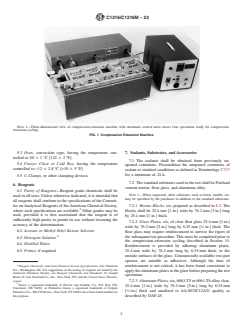
5.1 Extension-Compression Machine, as shown in Fig. 1,
Barriers to Trade (TBT) Committee.
designed to extend the test specimens automatically at a
constant rate of 3.20 mm [ ⁄8 in.]/h from a joint width of 11.2
7 9
2. Referenced Documents
mm [ ⁄16 in.] to 14.29 mm [ ⁄16 in.] at−12 6 2.8°C [+10 6
5°F].
2.1 ASTM Standards:
C33Specification for Concrete Aggregates
5.2 Oven, forced-draft type, having the temperature con-
C109/C109MTest Method for Compressive Strength of trolled to 70 6 1°C [158 6 2°F].
1 3
ThistestmethodisunderthejurisdictionofASTMCommitteeC24onBuilding Available from Aluminum Association, 900 19th St. NW, Washington, DC
Seals and Sealants and is the direct responsibility of Subcommittee C24.30 on 20006.
Adhesion. Series 520 Sealant Compound Tester, manufactured by Applied Test Systems,
Current edition approved Jan. 1, 2023. Published January 2023. Originally Inc.,348NewCastleRd.,Butler,PA16001,andadurabilitytestermanufacturedby
approved in 1992. Last previous edition approved in 2013 as C1216/C1216M–13 Ambard, Inc., 269-11 Sist Ave., New Hyde Park, NY 11040, have been found
which was withdrawn in January 2022 and reinstated in January 2023. DOI: suitable for this purpose.
10.1520/C1216_C1216M-23. The sole source of supply of the apparatus known to the committee at this time
For referenced ASTM standards, visit the ASTM website, www.astm.org, or is Applied Test Systems and Ambard. If you are aware of alternative suppliers,
contact ASTM Customer Service at service@astm.org. For Annual Book of ASTM please provide this information to ASTM International Headquarters. Your com-
Standards volume information, refer to the standard’s Document Summary page on ments will receive careful consideration at a meeting of the responsible technical
the ASTM website. committee, which you may attend.
Copyright © ASTM International, 100 Barr Harbor Drive, PO Box C700, West Conshohocken, PA 19428-2959. United States
C1216/C1216M − 23
NOTE 1—Three-dimensional view of compression-extension machine with automatic control units shows four specimens ready for compression-
extension cycling.
FIG. 1 Compression Extension Machine
5.3 Oven, convection type, having the temperature con- 7. Sealants, Substrates, and Accessories
trolled to 50 6 1°C [122 6 2°F].
7.1 The sealants shall be obtained from previously un-
5.4 Freezer Chest or Cold Box, having the temperature
opened containers. Precondition the unopened containers of
controlled to−12 6 2.8°C [+10 6 5°F].
sealant at standard conditions as defined in Terminology C717
for a minimum of 24 h.
5.5 C-Clamps, or other clamping devices.
7.2 ThestandardsubstratesusedinthetestshallbePortland
6. Reagents
cement mortar, float glass, and aluminum alloy.
6.1 Purity of Reagents—Reagent grade chemicals shall be
NOTE 1—When requested, other substrates such as brick, marble, etc.
used in all tests. Unless otherwise indicated, it is intended that
may be specified by the purchaser in addition to the standard substrates.
all reagents shall conform to the specifications of the Commit-
tee onAnalytical Reagents of theAmerican Chemical Society,
7.2.1 Mortar Blocks, six, prepared as described in 8.2. The
where such specifications are available. Other grades may be
blocks shall be 25.4mm [1in.] wide by 76.2mm [3in.] long
used, provided it is first ascertained that the reagent is of
by 25.4mm [1in.] thick.
sufficiently high purity to permit its use without lessening the
7.2.2 Glass Plates, six, of clear float glass 25.4mm [1in.]
accuracy of the determination.
wide by 76.2mm [3in.] long by 6.35mm [ ⁄4in.] thick. The
6.2 Acetone or Methyl Ethyl Ketone Solvents.
float glass may require reinforcement to survive the rigors of
the subsequent test procedure.This must be completed prior to
6.3 Detergent Solution.
the compression-extension cycling described in Section 10.
6.4 Distilled Water.
Reinforcement is provided by adhering aluminum plates,
6.5 Primer, if required.
25.4mm wide by 76.2mm long by 6.35mm thick, to the
outside surfaces of the glass. Commercially available two-part
epoxies are suitable as adhesives. Although the time of
Reagent Chemicals, American Chemical Society Specifications,Am. Chemical reinforcement is not critical, it has been found convenient to
Soc., Washington, DC. For suggestions on the testing of reagents not listed by the
applythealuminumplatestotheglassbeforepreparingthetest
American Chemical Society, see Reagent Chemicals and Standards, by Joseph
specimens.
Rosin, D. Van Nostrand Co., Inc., New York, NY, and the United States Pharma-
copeia.
7.2.3 Aluminum Plates,six,6063-T5or6061-T6alloyclear,
Dawn, a registered trademark of Proctor and Gamble, Co., P.O. Box 599,
25.4mm [1in.] wide by 76.2mm [3in.] long by 6.35mm
Cincinnati, OH 54201, or Palmolive Green, a registered trademark of Colgate
[ ⁄4in.] thick and anodized to AA-M32C12A31 quality as
PalmoliveCo.,300-TParkAve.,NewYork,NY10022,havebeenfoundsuitablefor
this purpose. described by DAF-45.
C1216/C1216M − 23
7.3 Rigid Spacer Bars, nine, 12.7 mm [ ⁄2 in.] by 12.7 mm
by 50.8 mm [2 in.]; 18 bars 12.7 mm by 12.7 mm by 25.4 mm
9 1
[1 in.]; 18 bars 14.29 mm [ ⁄16 in.] by 6.35
...