


ASTM D25-12(2017)
(Specification)Standard Specification for Round Timber Piles
Standard Specification for Round Timber Piles
ABSTRACT
This specification deals with the standards for unused round timber piles to be used either treated or untreated. This specification, however, does not cover preused piles unless the piles have the quality and design stresses equal to or greater than those prescribed herein. The piles shall be made of sound wood, free of decay, insect attacks, marine borer attack, and Limnoria damage. The piles shall also be cut above the ground swell and have a tapered tip.
SCOPE
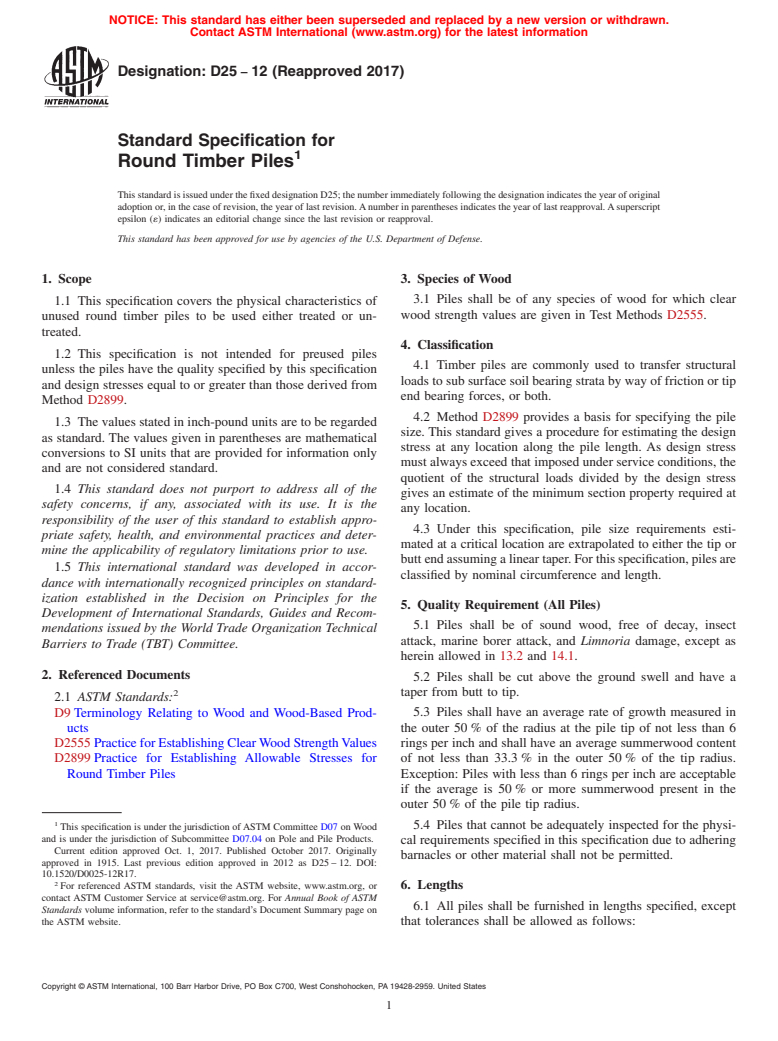
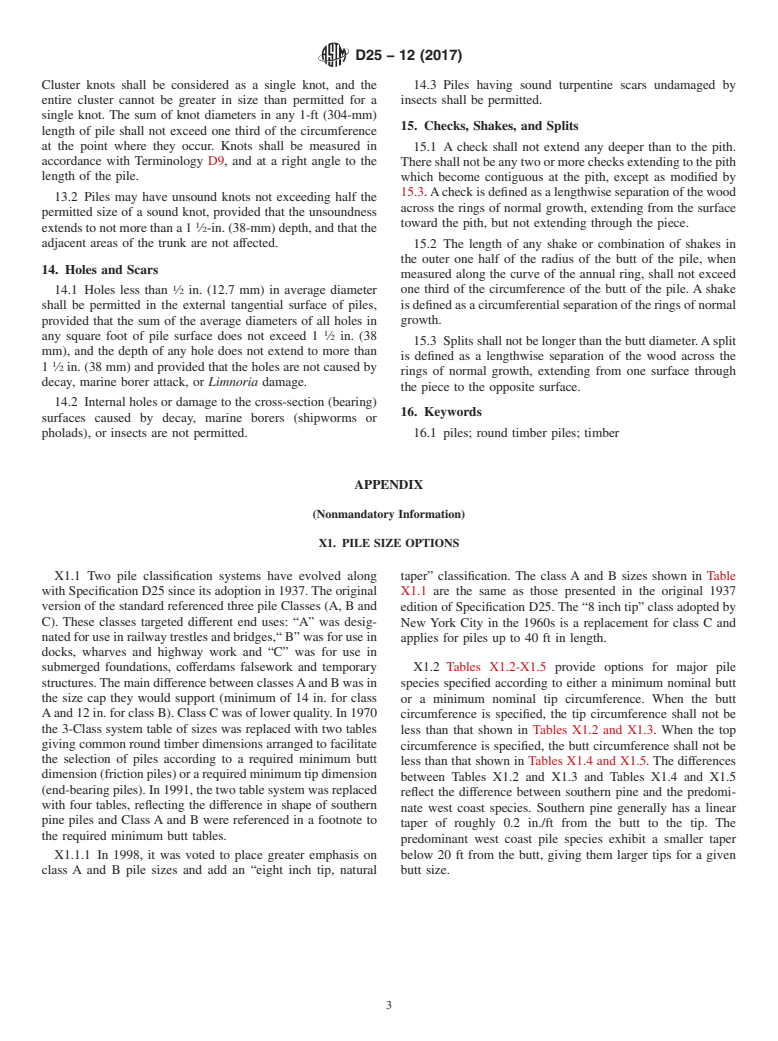
1.1 This specification covers the physical characteristics of unused round timber piles to be used either treated or untreated.
1.2 This specification is not intended for preused piles unless the piles have the quality specified by this specification and design stresses equal to or greater than those derived from Method D2899.
1.3 The values stated in inch-pound units are to be regarded as standard. The values given in parentheses are mathematical conversions to SI units that are provided for information only and are not considered standard.
1.4 This standard does not purport to address all of the safety concerns, if any, associated with its use. It is the responsibility of the user of this standard to establish appropriate safety, health, and environmental practices and determine the applicability of regulatory limitations prior to use.
1.5 This international standard was developed in accordance with internationally recognized principles on standardization established in the Decision on Principles for the Development of International Standards, Guides and Recommendations issued by the World Trade Organization Technical Barriers to Trade (TBT) Committee.
General Information
Buy Standard
Standards Content (Sample)
NOTICE: This standard has either been superseded and replaced by a new version or withdrawn.
Contact ASTM International (www.astm.org) for the latest information
Designation:D25 −12 (Reapproved 2017)
Standard Specification for
Round Timber Piles
ThisstandardisissuedunderthefixeddesignationD25;thenumberimmediatelyfollowingthedesignationindicatestheyearoforiginal
adoption or, in the case of revision, the year of last revision.Anumber in parentheses indicates the year of last reapproval.Asuperscript
epsilon (´) indicates an editorial change since the last revision or reapproval.
This standard has been approved for use by agencies of the U.S. Department of Defense.
1. Scope 3. Species of Wood
3.1 Piles shall be of any species of wood for which clear
1.1 This specification covers the physical characteristics of
wood strength values are given in Test Methods D2555.
unused round timber piles to be used either treated or un-
treated.
4. Classification
1.2 This specification is not intended for preused piles
4.1 Timber piles are commonly used to transfer structural
unless the piles have the quality specified by this specification
loads to sub surface soil bearing strata by way of friction or tip
and design stresses equal to or greater than those derived from
end bearing forces, or both.
Method D2899.
4.2 Method D2899 provides a basis for specifying the pile
1.3 The values stated in inch-pound units are to be regarded
size. This standard gives a procedure for estimating the design
as standard. The values given in parentheses are mathematical
stress at any location along the pile length. As design stress
conversions to SI units that are provided for information only
must always exceed that imposed under service conditions, the
and are not considered standard.
quotient of the structural loads divided by the design stress
1.4 This standard does not purport to address all of the
gives an estimate of the minimum section property required at
safety concerns, if any, associated with its use. It is the
any location.
responsibility of the user of this standard to establish appro-
4.3 Under this specification, pile size requirements esti-
priate safety, health, and environmental practices and deter-
mated at a critical location are extrapolated to either the tip or
mine the applicability of regulatory limitations prior to use.
buttendassumingalineartaper.Forthisspecification,pilesare
1.5 This international standard was developed in accor-
classified by nominal circumference and length.
dance with internationally recognized principles on standard-
ization established in the Decision on Principles for the
5. Quality Requirement (All Piles)
Development of International Standards, Guides and Recom-
5.1 Piles shall be of sound wood, free of decay, insect
mendations issued by the World Trade Organization Technical
attack, marine borer attack, and Limnoria damage, except as
Barriers to Trade (TBT) Committee.
herein allowed in 13.2 and 14.1.
2. Referenced Documents
5.2 Piles shall be cut above the ground swell and have a
2 taper from butt to tip.
2.1 ASTM Standards:
5.3 Piles shall have an average rate of growth measured in
D9 Terminology Relating to Wood and Wood-Based Prod-
ucts the outer 50 % of the radius at the pile tip of not less than 6
D2555 PracticeforEstablishingClearWoodStrengthValues rings per inch and shall have an average summerwood content
D2899 Practice for Establishing Allowable Stresses for of not less than 33.3 % in the outer 50 % of the tip radius.
Round Timber Piles Exception: Piles with less than 6 rings per inch are acceptable
if the average is 50 % or more summerwood present in the
outer 50 % of the pile tip radius.
This specification is under the jurisdiction ofASTM Committee D07 on Wood 5.4 Piles that cannot be adequately inspected for the physi-
and is under the jurisdiction of Subcommittee D07.04 on Pole and Pile Products.
cal requirements specified in this specification due to adhering
Current edition approved Oct. 1, 2017. Published October 2017. Originally
barnacles or other material shall not be permitted.
approved in 1915. Last previous edition approved in 2012 as D25 – 12. DOI:
10.1520/D0025-12R17.
For referenced ASTM standards, visit the ASTM website, www.astm.org, or 6. Lengths
contact ASTM Customer Service at service@astm.org. For Annual Book of ASTM
6.1 All piles shall be furnished in lengths specified, except
Standards volume information, refer to the standard’s Document Summary page on
the ASTM website. that tolerances shall be allowed as follows:
Copyright © ASTM International, 100 Barr Harbor Drive, PO Box C700, West Conshohocken, PA 19428-2959. United States
D25−12 (2017)
6.1.1 Piles 40 ft (12.2 m) and shorter—plus 1 ft (0.3 m), 9.2 All knots and limbs shall be cut flush with the surface of
minus 6 in. (152 mm). the pile, except that knots may be hand-trimmed flush with the
6.1.2 Piles41ft(12.5m)orlonger—plus2ft(0.6m),minus surface of the swell surrounding the knot.
6 in. (152 mm).
10. Peeling (Shaving)
7. Sizes
10.1 Piles are classified according to the extent of bark
7.1 Pile sizes are specified according to nominal circumfer- removal as clean-peeled, rough-peeled, or unpeeled.
10.1.1 Clean-peeled piles require the removal of all outer
ence 3 ft from the butt or at the tip. Tables are provided in
Appendix X1.1 to facilitate the selection of pile dimensions. bark. In addition, at least 80 % of the inner bark, well-
distributed over the surface of the pile, shall be removed. Piles
7.2 The out-of-round ratio (maximum to minimum diam-
for preservative treatment shall have no strip of inner bark
eter) at the butt or the tip shall not exceed 1.2.
larger than 1 by 6 in. (25 by 152 mm).
7.3 All circumference measurements shall be taken under
10.1.2 Rough-peeled piles require the complete removal of
the bark.
all outer bark.
10.1.3 Unpeeled piles require no bark removal.
7.4 Circumference at the butt shall not exceed circumfer-
ence 3 ft (0.9 m) from the butt by more than 8 in. (203 mm).
11. Straightness
7.5 Circumferences given in Tables X1.2-X1.5 are mini-
11.1 Astraight line from the center of the butt to the center
mum values. No more than 10 % of piles in any shipment shall
of the tip shall lie entirely within the body of the pile.
havetipcircumferenceslessthanthetabulatedvalues.Ofthose
that are below tabulated values, none shall vary from tabulated
11.2 Piles shall be free from short crooks that deviate more
values by more than 2 in. (51 mm).
than 2 ⁄2 in. (64 mm) from straightness in any 5-ft (1.5-m)
length (see Fig. 1).
8. Sapwood
12. Twist of Grain
8.1 Wood piles for preservative treatment shall have suffi-
cient sapwood to meet minimum penetration requirements. 12.1 Spiral grain shall not exceed 180 deg of twist when
measured over any 20-ft (6.1-m) section of the pile.
9. Cutting and Trimming
13. Knots
9.1 Butts and tips of piles shall be sawed square with the
axis of the piles and shall not be out of square by more than ⁄10 13.1 Sound knots shall be no larger than one sixth the
in./in. (100 mm/m) of diameter. circumference of the pile located where the knot occurs.
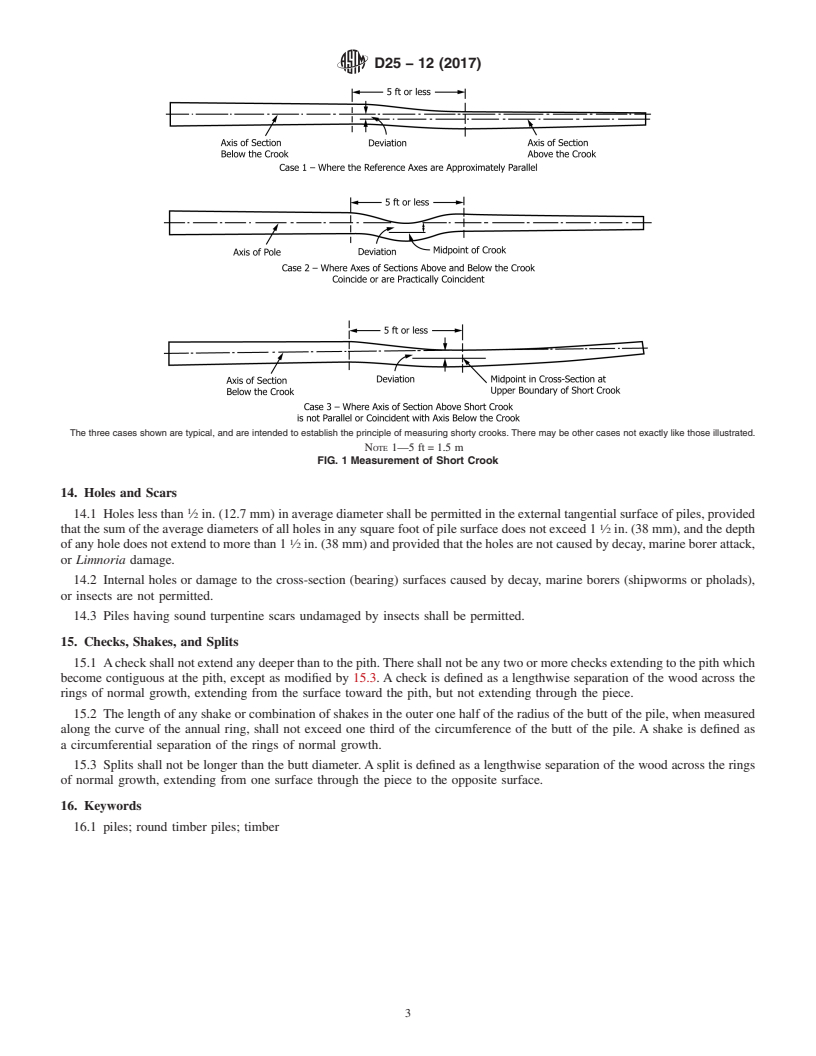
The three cases shown are typical, and are intended to establish the principle of measuring shorty crooks. There may be other cases not exactly like those illustrated.
NOTE 1—5 ft = 1.5 m
FIG. 1Measurement of Short Crook
D25−12 (2017)
Cluster knots shall be considered as a single knot, and the 14.3 Piles having sound turpentine scars undamaged by
entire cluster cannot be greater in size than permitted for a insects shall be permitted.
single knot. The sum of knot diameters in any 1-ft (304-mm)
15. Checks, Shakes, and Splits
length of pile shall not exceed one third of the circumference
at the point where they occur. Knots shall be measured in
15.1 A check shall not extend any deeper than to the pith.
accordance with Terminology D9, and at a right angle to the Thereshallnotbeanytwoormorechecksextendingtothepith
length of the pile.
which become contiguous at the pith, except as modified by
15.3.Acheck is defined as a lengthwise separation of the wood
13.2 Piles may have unsound knots not exceeding half the
across the rings of normal growth, extending from the surface
permitted size of a sound knot, provided that the unsoundness
toward the pith, but not extending through the piece.
extends to not more than a 1 ⁄2-in. (38-mm) depth, and that the
adjacent areas of the trunk are not affected.
15.2 The length of any shake or combination of shakes in
the outer one half of the radius of the butt of the pile, when
14. Holes and Scars
measured along the curve of the annual ring, shall not exceed
14.1 Holes less than ⁄2 in. (12.7 mm) in average diameter one third of the circumference of the butt of the pile. A shake
isdefinedasacircumferentialseparationoftheringsofnormal
shall be permitted in the external tangential surface of piles,
provided that the sum of the average diameters of all holes in growth.
any square foot of pile surface does not exceed 1 ⁄2 in. (38
15.3 Splits shall not be longer than the butt diameter.Asplit
mm), and the depth of any hole does not extend to more than
is defined as a lengthwise separation of the wood across the
1 ⁄2 in. (38 mm) and provided that the holes are not caused by
rings of normal growth, extending from one surface through
decay, marine borer attack, or Limnoria damage.
the piece to the opposite surface.
14.2 Internal holes or damage to the cross-section (bearing)
16. Keywords
surfaces caused by decay, marine borers (shipworms or
pholads), or insects are not permitted. 16.1 piles; round timber piles; timber
APPENDIX
(Nonmandatory Information)
X1. PILE SIZE OPTIONS
X1.1 Two pile classification systems have evolved along taper” classification. The class A and B sizes shown in Table
with Specification D25 since its adoption in 1937.The original
X1.1 are the same as those presented in the original 1937
version of the standard referenced three pile Classes (A, B and edition of Specification D25. The “8 inch tip” class adopted by
C). These classes targeted different end uses: “A” was desig-
New York City in the 1960s is a replacement for class C and
nated for use in railway trestles and bridges,“ B” was for use in
applies for piles up to 40 ft in length.
docks, wharves and highway work and “C” was for use in
submerged foundations, cofferdams falsework and temporary X1.2 Tables X1.2-X1.5 provide options for major pile
structures.ThemaindifferencebetweenclassesAandBwasin species specified according to either a minimum nominal butt
the size cap they would support (minimum of 14 in. for class or a minimum nominal tip circumference. When the butt
Aand 12 in. for class B). Class C was of lower quality. In 1970
circumference is specified, the tip circumference shall not be
the 3-Class system table of sizes was replaced with two tables
less than that shown in Tables X1.2 and X1.3. When the top
giving common round timber dimensions arranged to facilitate
circumference is specified, the butt circumference shall not be
the selection of piles according to a required minimum butt
less than that shown in Tables X1.4 and X1.5. The differences
dimension(frictionpiles)orarequiredminimumtipdimension
between Tables X1.2 and X1.3 and Tables X1.4 and X1.5
(end-bearing piles). In 1991, the two table system was replaced
reflect the difference between southern pine and the predomi-
with four tables, reflecting the difference in shape of southern
nate west coast species. Southern pine generally has a linear
pine piles and Class A and B were referenced in a footnote to
taper of roughly 0.2 in./ft from the butt to the tip. The
the required minimum butt tables.
predominant west coast pile species exhibit a smaller taper
X1.1.1 In 1998, it was voted to place greater emphasis on below 20 ft from the butt, giving them larger tips for a given
class A and B pile sizes and add an “eight inch tip, natural butt size.
D25−12 (2017)
TABLE X1.1 Specified Minimum Butt and Tip Sizes for Class A
and Class B Piles
Pile Circumference (in.)
Diameter (in.) given in brackets
A
Length (ft) Class A Class B
8in.
3 ft from butt min 3 ft from butt min
tip
min max tip min max tip
Douglas Fir, Southern Pine
Under 40 25 25
57 28 38 [8] [8]
40-54, incl. [18] [9] [12]
55-74, incl. 44 57 25 63 [7]
[14] [20] [8] [20]
75-90, incl. 22 41 19
63 [7] [13] [6]
Over 90 [20] 19 16
[6] [6]
Oak
Under 30 28 38 57 22
[9] [12] [18] [7]
30-40, incl. 44 57 19
[14] [18] 25 41 63 [6]
Over 40 [8] [13] [20] 16
[5]
A
For Class B piles a minimum circumference of 34 in. (864 mm) or a diameter of
11 in. (279 mm) at a point 3 ft (1 m) from the butt may be specified for lengths of
25 ft (7.6 m) and under.
D25−12 (2017)
TABLE X1.2 Specified Butt Circumferences with Corresponding Minimum Tip Circumferences for Coast Douglas Fir Piles and Other
A,B
Species, Except Southern Yellow Pine
[Approximate Diameters in Brackets]
Required Minimum 22 25 28 31 35 38 41 44 47 50 57
Circumference, in. [7] [8] [9] [10] [11] [12] [13] [14] [15] [16] [18]
3 ft from Butts
Length (ft) Minimum Tip Circumferences, in.
20 16.0 16.0 16.0 18.0 22.0 25.0 28.0 . . . .
[5.1] [5.1] [5.1] [5.7] [7.0] [8.0] [8.9]
25 16.0 16.0 16.0 16.5 20.5 23.5 26.5 29.5 . . .
[5.1] [5.1] [5.1] [5.3] [6.5] [7.5] [8.4] [9.4]
30 16.0 16.0 16.0 16.0 19.0 22.0 25.0 28.0 . . .
[5.1] [5.1] [5.1] [5.1] [6.0] [7.0] [8.0] [8.9]
35 . . . 16.0 17.5 20.5 23.5 26.5 29.5 . .
[5.1] [5.6] [6.5] [7.5] [8.4] [9.4]
40 . . . 16.0 16.0 19.0 22.0 25.0 28.0 . .
[5.1] [5.1] [6.0] [7.0] [8.0] [8.9]
45 . . . . 16.0 17.5 20.5 23.5 26.5 29.5 .
[5.1] [5.6] [6.5] [7.5] [8.4] [9.4]
50 . . . . 16.0 16.0 19.0 22.0 25.0 28.0 .
[5.1] [5.1] [6.0] [7.0] [8.0] [8.9]
55 . . . . . 16.0 17.5 20.5 23.5 26.5 33.5
[5.1] [5.6] [6.5] [7.5] [8.4] [10.7]
60 . . . . . 16.0 16.0 19.0 22.0 25.0 32.0
[5.1] [5.1] [6.0] [7.0] [8.0] [10.2]
65 . . . . . 16.0 16.0 17.5 20.5 23.5 30.5
[5.1] [5.1] [5.6] [6.5] [7.5] [9.7]
70 . . . . . 16.0 16.0 16.0 19.0 22.0 29.0
[5.1] [5.1] [5.1] [6.0] [7.0] [9.2]
75 . . . . . . 16.0 16.0 17.5 20.5 27.5
[5.1] [5.1] [5.6] [6.5] [8.8]
80 . . . . . . 16.0 16.0 16.0 19.0 26.0
[5.1] [5.1] [5.1] [6.0] [8.3]
85 . . . . . . 16.0 16.0 16.0 17.5 24.5
[5.1] [5.1] [5.1] [5.6] [7.8]
90 . . . . . . 16.0 16.0 16.0 16.0 23.0
[5.1] [5.1] [5.1] [5.1] [7.3]
95 . . . . . . 16.0 16.0 16.0 16.0 21.5
[5.1] [5.1] [5.1] [5.1] [6.8]
100 . . . . . . 16.0 16.0 16.0 16.0 20.0
[5.1] [5.1] [5.1] [5.1] [6.4]
105 . . . . . . . . . 16.0 18.5
[5.1] [5.9]
110 . . . . . . . . . 16.0 17.0
[5.1] [5.4]
115 . . . . . . . . . . 16.0
[5.1]
120 . . . .
...
This document is not an ASTM standard and is intended only to provide the user of an ASTM standard an indication of what changes have been made to the previous version. Because
it may not be technically possible to adequately depict all changes accurately, ASTM recommends that users consult prior editions as appropriate. In all cases only the current version
of the standard as published by ASTM is to be considered the official document.
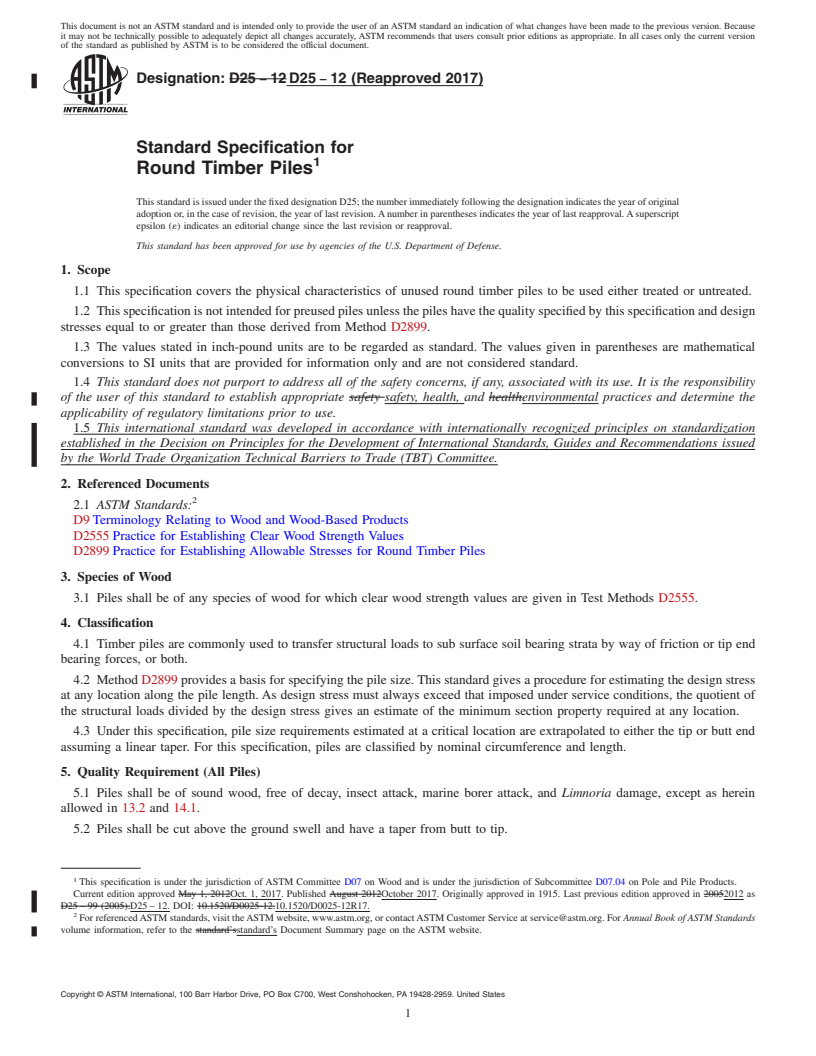
Designation: D25 − 12 D25 − 12 (Reapproved 2017)
Standard Specification for
Round Timber Piles
This standard is issued under the fixed designation D25; the number immediately following the designation indicates the year of original
adoption or, in the case of revision, the year of last revision. A number in parentheses indicates the year of last reapproval. A superscript
epsilon (´) indicates an editorial change since the last revision or reapproval.
This standard has been approved for use by agencies of the U.S. Department of Defense.
1. Scope
1.1 This specification covers the physical characteristics of unused round timber piles to be used either treated or untreated.
1.2 This specification is not intended for preused piles unless the piles have the quality specified by this specification and design
stresses equal to or greater than those derived from Method D2899.
1.3 The values stated in inch-pound units are to be regarded as standard. The values given in parentheses are mathematical
conversions to SI units that are provided for information only and are not considered standard.
1.4 This standard does not purport to address all of the safety concerns, if any, associated with its use. It is the responsibility
of the user of this standard to establish appropriate safety safety, health, and healthenvironmental practices and determine the
applicability of regulatory limitations prior to use.
1.5 This international standard was developed in accordance with internationally recognized principles on standardization
established in the Decision on Principles for the Development of International Standards, Guides and Recommendations issued
by the World Trade Organization Technical Barriers to Trade (TBT) Committee.
2. Referenced Documents
2.1 ASTM Standards:
D9 Terminology Relating to Wood and Wood-Based Products
D2555 Practice for Establishing Clear Wood Strength Values
D2899 Practice for Establishing Allowable Stresses for Round Timber Piles
3. Species of Wood
3.1 Piles shall be of any species of wood for which clear wood strength values are given in Test Methods D2555.
4. Classification
4.1 Timber piles are commonly used to transfer structural loads to sub surface soil bearing strata by way of friction or tip end
bearing forces, or both.
4.2 Method D2899 provides a basis for specifying the pile size. This standard gives a procedure for estimating the design stress
at any location along the pile length. As design stress must always exceed that imposed under service conditions, the quotient of
the structural loads divided by the design stress gives an estimate of the minimum section property required at any location.
4.3 Under this specification, pile size requirements estimated at a critical location are extrapolated to either the tip or butt end
assuming a linear taper. For this specification, piles are classified by nominal circumference and length.
5. Quality Requirement (All Piles)
5.1 Piles shall be of sound wood, free of decay, insect attack, marine borer attack, and Limnoria damage, except as herein
allowed in 13.2 and 14.1.
5.2 Piles shall be cut above the ground swell and have a taper from butt to tip.
This specification is under the jurisdiction of ASTM Committee D07 on Wood and is under the jurisdiction of Subcommittee D07.04 on Pole and Pile Products.
Current edition approved May 1, 2012Oct. 1, 2017. Published August 2012October 2017. Originally approved in 1915. Last previous edition approved in 20052012 as
D25 – 99 (2005).D25 – 12. DOI: 10.1520/D0025-12.10.1520/D0025-12R17.
For referenced ASTM standards, visit the ASTM website, www.astm.org, or contact ASTM Customer Service at service@astm.org. For Annual Book of ASTM Standards
volume information, refer to the standard’sstandard’s Document Summary page on the ASTM website.
Copyright © ASTM International, 100 Barr Harbor Drive, PO Box C700, West Conshohocken, PA 19428-2959. United States
D25 − 12 (2017)
5.3 Piles shall have an average rate of growth measured in the outer 50 % of the radius at the pile tip of not less than 6 rings
per inch and shall have an average summerwood content of not less than 33.3 % in the outer 50 % of the tip radius. Exception:
Piles with less than 6 rings per inch are acceptable if the average is 50 % or more summerwood present in the outer 50 % of the
pile tip radius.
5.4 Piles that cannot be adequately inspected for the physical requirements specified in this specification due to adhering
barnacles or other material shall not be permitted.
6. Lengths
6.1 All piles shall be furnished in lengths specified, except that tolerances shall be allowed as follows:
6.1.1 Piles 40 ft (12.2 m) and shorter—plus 1 ft (0.3 m), minus 6 in. (152 mm).
6.1.2 Piles 41 ft (12.5 m) or longer—plus 2 ft (0.6 m), minus 6 in. (152 mm).
7. Sizes
7.1 Pile sizes are specified according to nominal circumference 3 ft from the butt or at the tip. Tables are provided in Appendix
X1.1 to facilitate the selection of pile dimensions.
7.2 The out-of-round ratio (maximum to minimum diameter) at the butt or the tip shall not exceed 1.2.
7.3 All circumference measurements shall be taken under the bark.
7.4 Circumference at the butt shall not exceed circumference 3 ft (0.9 m) from the butt by more than 8 in. (203 mm).
7.5 Circumferences given in Tables X1.2-X1.5 are minimum values. No more than 10 % of piles in any shipment shall have
tip circumferences less than the tabulated values. Of those that are below tabulated values, none shall vary from tabulated values
by more than 2 in. (51 mm).
8. Sapwood
8.1 Wood piles for preservative treatment shall have sufficient sapwood to meet minimum penetration requirements.
9. Cutting and Trimming
9.1 Butts and tips of piles shall be sawed square with the axis of the piles and shall not be out of square by more than ⁄10 in./in.
(100 mm/m) of diameter.
9.2 All knots and limbs shall be cut flush with the surface of the pile, except that knots may be hand-trimmed flush with the
surface of the swell surrounding the knot.
10. Peeling (Shaving)
10.1 Piles are classified according to the extent of bark removal as clean-peeled, rough-peeled, or unpeeled.
10.1.1 Clean-peeled piles require the removal of all outer bark. In addition, at least 80 % of the inner bark, well-distributed over
the surface of the pile, shall be removed. Piles for preservative treatment shall have no strip of inner bark larger than 1 by 6 in.
(25 by 152 mm).
10.1.2 Rough-peeled piles require the complete removal of all outer bark.
10.1.3 Unpeeled piles require no bark removal.
11. Straightness
11.1 A straight line from the center of the butt to the center of the tip shall lie entirely within the body of the pile.
11.2 Piles shall be free from short crooks that deviate more than 2 ⁄2 in. (64 mm) from straightness in any 5-ft (1.5-m) length
(see Fig. 1).
12. Twist of Grain
12.1 Spiral grain shall not exceed 180 deg of twist when measured over any 20-ft (6.1-m) section of the pile.
13. Knots
13.1 Sound knots shall be no larger than one sixth the circumference of the pile located where the knot occurs. Cluster knots
shall be considered as a single knot, and the entire cluster cannot be greater in size than permitted for a single knot. The sum of
knot diameters in any 1-ft (304-mm) length of pile shall not exceed one third of the circumference at the point where they occur.
Knots shall be measured in accordance with Terminology D9, and at a right angle to the length of the pile.
13.2 Piles may have unsound knots not exceeding half the permitted size of a sound knot, provided that the unsoundness extends
to not more than a 1 ⁄2-in. (38-mm) depth, and that the adjacent areas of the trunk are not affected.
D25 − 12 (2017)
The three cases shown are typical, and are intended to establish the principle of measuring shorty crooks. There may be other cases not exactly like those illustrated.
NOTE 1—5 ft = 1.5 m
FIG. 1 Measurement of Short Crook
14. Holes and Scars
14.1 Holes less than ⁄2 in. (12.7 mm) in average diameter shall be permitted in the external tangential surface of piles, provided
that the sum of the average diameters of all holes in any square foot of pile surface does not exceed 1 ⁄2 in. (38 mm), and the depth
of any hole does not extend to more than 1 ⁄2 in. (38 mm) and provided that the holes are not caused by decay, marine borer attack,
or Limnoria damage.
14.2 Internal holes or damage to the cross-section (bearing) surfaces caused by decay, marine borers (shipworms or pholads),
or insects are not permitted.
14.3 Piles having sound turpentine scars undamaged by insects shall be permitted.
15. Checks, Shakes, and Splits
15.1 A check shall not extend any deeper than to the pith. There shall not be any two or more checks extending to the pith which
become contiguous at the pith, except as modified by 15.3. A check is defined as a lengthwise separation of the wood across the
rings of normal growth, extending from the surface toward the pith, but not extending through the piece.
15.2 The length of any shake or combination of shakes in the outer one half of the radius of the butt of the pile, when measured
along the curve of the annual ring, shall not exceed one third of the circumference of the butt of the pile. A shake is defined as
a circumferential separation of the rings of normal growth.
15.3 Splits shall not be longer than the butt diameter. A split is defined as a lengthwise separation of the wood across the rings
of normal growth, extending from one surface through the piece to the opposite surface.
16. Keywords
16.1 piles; round timber piles; timber
D25 − 12 (2017)
APPENDIX
(Nonmandatory Information)
X1. PILE SIZE OPTIONS
X1.1 Two pile classification systems have evolved along with Specification D25 since its adoption in 1937. The original version
of the standard referenced three pile Classes (A, B and C). These classes targeted different end uses: “A” was designated for use
in railway trestles and bridges,“ B” was for use in docks, wharves and highway work and “C” was for use in submerged
foundations, cofferdams falsework and temporary structures. The main difference between classes A and B was in the size cap they
would support (minimum of 14 in. for class A and 12 in. for class B). Class C was of lower quality. In 1970 the 3-Class system
table of sizes was replaced with two tables giving common round timber dimensions arranged to facilitate the selection of piles
according to a required minimum butt dimension (friction piles) or a required minimum tip dimension (end-bearing piles). In 1991,
the two table system was replaced with four tables, reflecting the difference in shape of southern pine piles and Class A and B were
referenced in a footnote to the required minimum butt tables.
X1.1.1 In 1998, it was voted to place greater emphasis on class A and B pile sizes and add an “eight inch tip, natural taper”
classification. The class A and B sizes shown in Table X1.1 are the same as those presented in the original 1937 edition of
Specification D25. The “8 inch tip” class adopted by New York City in the 1960s is a replacement for class C and applies for piles
up to 40 ft in length.
X1.2 Tables X1.2-X1.5 provide options for major pile species specified according to either a minimum nominal butt or a minimum
nominal tip circumference. When the butt circumference is specified, the tip circumference shall not be less than that shown in
Tables X1.2 and X1.3. When the top circumference is specified, the butt circumference shall not be less than that shown in Tables
X1.4 and X1.5. The differences between Tables X1.2 and X1.3 and Tables X1.4 and X1.5 reflect the difference between southern
pine and the predominate west coast species. Southern pine generally has a linear taper of roughly 0.2 in./ft from the butt to the
tip. The predominant west coast pile species exhibit a smaller taper below 20 ft from the butt, giving them larger tips for a given
butt size.
TABLE X1.1 Specified Minimum Butt and Tip Sizes for Class A
and Class B Piles
Pile Circumference (in.)
Diameter (in.) given in brackets
A
Length (ft) Class A Class B
8 in.
3 ft from butt min 3 ft from butt min
tip
min max tip min max tip
Douglas Fir, Southern Pine
Under 40 25 25
57 28 38 [8] [8]
40-54, incl. [18] [9] [12]
55-74, incl. 44 57 25 63 [7]
[14] [20] [8] [20]
75-90, incl. 22 41 19
63 [7] [13] [6]
Over 90 [20] 19 16
[6] [6]
Oak
Under 30 28 38 57 22
[9] [12] [18] [7]
30-40, incl. 44 57 19
[14] [18] 25 41 63 [6]
Over 40 [8] [13] [20] 16
[5]
A
For Class B piles a minimum circumference of 34 in. (864 mm) or a diameter of
11 in. (279 mm) at a point 3 ft (1 m) from the butt may be specified for lengths of
25 ft (7.6 m) and under.
D25 − 12 (2017)
TABLE X1.2 Specified Butt Circumferences with Corresponding Minimum Tip Circumferences for Coast Douglas Fir Piles and Other
A,B
Species, Except Southern Yellow Pine
[Approximate Diameters in Brackets]
Required Minimum 22 25 28 31 35 38 41 44 47 50 57
Circumference, in. [7] [8] [9] [10] [11] [12] [13] [14] [15] [16] [18]
3 ft from Butts
Length (ft) Minimum Tip Circumferences, in.
20 16.0 16.0 16.0 18.0 22.0 25.0 28.0 . . . .
[5.1] [5.1] [5.1] [5.7] [7.0] [8.0] [8.9]
25 16.0 16.0 16.0 16.5 20.5 23.5 26.5 29.5 . . .
[5.1] [5.1] [5.1] [5.3] [6.5] [7.5] [8.4] [9.4]
30 16.0 16.0 16.0 16.0 19.0 22.0 25.0 28.0 . . .
[5.1] [5.1] [5.1] [5.1] [6.0] [7.0] [8.0] [8.9]
35 . . . 16.0 17.5 20.5 23.5 26.5 29.5 . .
[5.1] [5.6] [6.5] [7.5] [8.4] [9.4]
40 . . . 16.0 16.0 19.0 22.0 25.0 28.0 . .
[5.1] [5.1] [6.0] [7.0] [8.0] [8.9]
45 . . . . 16.0 17.5 20.5 23.5 26.5 29.5 .
[5.1] [5.6] [6.5] [7.5] [8.4] [9.4]
50 . . . . 16.0 16.0 19.0 22.0 25.0 28.0 .
[5.1] [5.1] [6.0] [7.0] [8.0] [8.9]
55 . . . . . 16.0 17.5 20.5 23.5 26.5 33.5
[5.1] [5.6] [6.5] [7.5] [8.4] [10.7]
60 . . . . . 16.0 16.0 19.0 22.0 25.0 32.0
[5.1] [5.1] [6.0] [7.0] [8.0] [10.2]
65 . . . . . 16.0 16.0 17.5 20.5 23.5 30.5
[5.1] [5.1] [5.6] [6.5] [7.5] [9.7]
70 . . . . . 16.0 16.0 16.0 19.0 22.0 29.0
[5.1] [5.1] [5.1] [6.0] [7.0] [9.2]
75 . . . . . . 16.0 16.0 17.5 20.5 27.5
[5.1] [5.1] [5.6] [6.5] [8.8]
80 . . . . . . 16.0 16.0 16.0 19.0 26.0
[5.1] [5.1] [5.1] [6.0] [8.3]
85 . . . . . . 16.0 16.0 16.0 17.5 24.5
[5.1] [5.1] [5.1] [
...
Questions, Comments and Discussion
Ask us and Technical Secretary will try to provide an answer. You can facilitate discussion about the standard in here.