

ASTM F725-03(2018)
(Practice)Standard Practice for Drafting Impact Test Requirements In Thermoplastic Pipe And Fittings Standards
General Information
- Abstract
SIGNIFICANCE AND USE
5.1 This practice is used for drafting impact test specification requirements, and it presupposes no special familiarity with statistical methods. It provides for specification values that will pass acceptable lots with a high degree of certainty. The impact test requirement is intended to discriminate between acceptable materials and manufacturing methods and those which are not; it is not a simulated service test.
SCOPE
1.1 This practice describes a procedure for setting up impact test requirements on the basis of test data obtained by Test Method D2444.
1.2 This practice is applicable to thermoplastic pipe and fittings.
1.3 The values stated in inch-pound units are to be regarded as standard. The values given in parentheses are mathematical conversions to SI units that are provided for information only and are not considered standard.
1.4 This standard does not purport to address all of the safety concerns, if any, associated with its use. It is the responsibility of the user of this standard to establish appropriate safety, health, and environmental practices and determine the applicability of regulatory limitations prior to use.
1.5 This international standard was developed in accordance with internationally recognized principles on standardization established in the Decision on Principles for the Development of International Standards, Guides and Recommendations issued by the World Trade Organization Technical Barriers to Trade (TBT) Committee.
- Status
- Published
- Publication Date
- 31-Jul-2018
- Technical Committee
- F17 - Plastic Piping Systems
- Drafting Committee
- F17.40 - Test Methods

Overview
ASTM F725-03(2018) is the Standard Practice for Drafting Impact Test Requirements in Thermoplastic Pipe and Fittings Standards. Issued by ASTM International, this document outlines a systematic approach for developing impact test specifications for thermoplastic pipes and fittings. The standard is intended to ensure reliable assessment of material and manufacturing quality, allowing the differentiation between acceptable and unacceptable products. The procedures described do not simulate service conditions but are critical for evaluating fundamental material performance.
Key Topics
Purpose and Significance
- Enables drafting of impact test requirements based on empirical data.
- Does not require advanced statistical expertise.
- Ensures specification values that reliably identify acceptable lots while minimizing the risk of accepting substandard products.
Applicability
- Specifically tailored to thermoplastic pipe and fittings.
- Impact test requirements are derived from data obtained using ASTM D2444, the standard test method for determining impact resistance with a tup (falling weight).
Procedures
- Emphasizes the use of binomial probability equations and operating characteristic (OC) curves to set minimum pass criteria.
- Provides suggested formats for sample sizes and acceptance levels, minimizing both test costs and error rates.
Test Conditions
- Recommends room-temperature testing for practicality and consistency.
- Outlines the preferred use of the B-tup and V-block holder for representative sampling.
Statistical Approach
- Employs a straightforward method to relate test performance to product quality, using clear pass/fail criteria.
- Highlights the use of probability graph paper to interpret test data without requiring deep statistical knowledge.
Applications
Standards Development
- Serves as a foundational reference for technical committees and industry professionals developing requirements for thermoplastic pipe and fitting impact tests.
- Supports the creation of clear, statistically justified criteria that ensure only quality materials and manufacturing methods are qualified.
Quality Assurance
- Assists manufacturers in designing and implementing robust impact testing protocols.
- Helps end-users and regulators establish consistent product acceptance standards across applications such as water distribution, gas piping, and industrial piping systems.
Optimization of Testing
- Offers methodologies for minimizing testing costs and effort, particularly when multiple product sizes and specifications need assessment.
- Provides guidance on preliminary testing to identify critical sizes and stress points, reducing redundant or unnecessary tests.
Risk Management
- Enhances confidence in product conformance through statistically sound acceptance/rejection guidelines.
- Aids in minimizing defects reaching the market, thereby reducing the risk of failures in the field.
Related Standards
ASTM D2444 - Standard Test Method for Determination of the Impact Resistance of Thermoplastic Pipe and Fittings by Means of a Tup (Falling Weight)
- Directly referenced for obtaining impact test data required by ASTM F725.
International Guidelines
- The standard aligns with the Decision on Principles for the Development of International Standards by the World Trade Organization’s TBT Committee, ensuring global applicability and relevance.
Other Plastic Pipe Testing Standards
- ASTM F17 Committee standards for plastic piping systems provide complementary procedures and definitions relevant to impact testing and product conformance.
Keywords: impact test, thermoplastic pipe, pipe fittings, ASTM F725, impact resistance, material specification, plastic tubing, quality assurance, standardization, binomial test, OC curve, ASTM D2444, plastic piping systems.
Relations
- Effective Date
- 01-Aug-2018
- Effective Date
- 15-Nov-2017
- Effective Date
- 01-Aug-2010
- Effective Date
- 01-May-2005
- Effective Date
- 10-Apr-1999
- Effective Date
- 01-Aug-2018
Get Certified
Connect with accredited certification bodies for this standard

Institut za varilstvo d.o.o. (Welding Institute)
Slovenia's leading welding institute since 1952. ISO 3834, EN 1090, pressure equipment certification, NDT personnel, welder qualification. Only IIW Au
Sponsored listings
Frequently Asked Questions
ASTM F725-03(2018) is a standard published by ASTM International. Its full title is "Standard Practice for Drafting Impact Test Requirements In Thermoplastic Pipe And Fittings Standards". This standard covers: SIGNIFICANCE AND USE 5.1 This practice is used for drafting impact test specification requirements, and it presupposes no special familiarity with statistical methods. It provides for specification values that will pass acceptable lots with a high degree of certainty. The impact test requirement is intended to discriminate between acceptable materials and manufacturing methods and those which are not; it is not a simulated service test. SCOPE 1.1 This practice describes a procedure for setting up impact test requirements on the basis of test data obtained by Test Method D2444. 1.2 This practice is applicable to thermoplastic pipe and fittings. 1.3 The values stated in inch-pound units are to be regarded as standard. The values given in parentheses are mathematical conversions to SI units that are provided for information only and are not considered standard. 1.4 This standard does not purport to address all of the safety concerns, if any, associated with its use. It is the responsibility of the user of this standard to establish appropriate safety, health, and environmental practices and determine the applicability of regulatory limitations prior to use. 1.5 This international standard was developed in accordance with internationally recognized principles on standardization established in the Decision on Principles for the Development of International Standards, Guides and Recommendations issued by the World Trade Organization Technical Barriers to Trade (TBT) Committee.
SIGNIFICANCE AND USE 5.1 This practice is used for drafting impact test specification requirements, and it presupposes no special familiarity with statistical methods. It provides for specification values that will pass acceptable lots with a high degree of certainty. The impact test requirement is intended to discriminate between acceptable materials and manufacturing methods and those which are not; it is not a simulated service test. SCOPE 1.1 This practice describes a procedure for setting up impact test requirements on the basis of test data obtained by Test Method D2444. 1.2 This practice is applicable to thermoplastic pipe and fittings. 1.3 The values stated in inch-pound units are to be regarded as standard. The values given in parentheses are mathematical conversions to SI units that are provided for information only and are not considered standard. 1.4 This standard does not purport to address all of the safety concerns, if any, associated with its use. It is the responsibility of the user of this standard to establish appropriate safety, health, and environmental practices and determine the applicability of regulatory limitations prior to use. 1.5 This international standard was developed in accordance with internationally recognized principles on standardization established in the Decision on Principles for the Development of International Standards, Guides and Recommendations issued by the World Trade Organization Technical Barriers to Trade (TBT) Committee.
ASTM F725-03(2018) is classified under the following ICS (International Classification for Standards) categories: 23.040.20 - Plastics pipes; 23.040.45 - Plastics fittings. The ICS classification helps identify the subject area and facilitates finding related standards.
ASTM F725-03(2018) has the following relationships with other standards: It is inter standard links to ASTM F725-03(2013), ASTM D2444-17, ASTM D2444-99(2010), ASTM D2444-99(2005), ASTM D2444-99, ASTM D2444-21. Understanding these relationships helps ensure you are using the most current and applicable version of the standard.
ASTM F725-03(2018) is available in PDF format for immediate download after purchase. The document can be added to your cart and obtained through the secure checkout process. Digital delivery ensures instant access to the complete standard document.
Standards Content (Sample)
This international standard was developed in accordance with internationally recognized principles on standardization established in the Decision on Principles for the
Development of International Standards, Guides and Recommendations issued by the World Trade Organization Technical Barriers to Trade (TBT) Committee.
Designation: F725 − 03 (Reapproved 2018)
Standard Practice for
Drafting Impact Test Requirements In Thermoplastic Pipe
And Fittings Standards
ThisstandardisissuedunderthefixeddesignationF725;thenumberimmediatelyfollowingthedesignationindicatestheyearoforiginal
adoptionor,inthecaseofrevision,theyearoflastrevision.Anumberinparenthesesindicatestheyearoflastreapproval.Asuperscript
epsilon (´) indicates an editorial change since the last revision or reapproval.
1. Scope tested, given p, the chance that a single specimen chosen at
random will pass. It is expressed as follows:
1.1 Thispracticedescribesaprocedureforsettingupimpact
test requirements on the basis of test data obtained by Test n!
r n2r
P 5 p 1 2 p (1)
~ !
r n
Method D2444. r! n 2 r !
~ !
NOTE 1—The factorial of zero is one.
1.2 This practice is applicable to thermoplastic pipe and
fittings. 3.1.2 binomial test—a test that has only two possible results
(for example, pass or fail, heads or tails, true or false).
1.3 The values stated in inch-pound units are to be regarded
as standard. The values given in parentheses are mathematical 3.1.3 mean strength—theaveragestrengthofthetotalpopu-
conversions to SI units that are provided for information only lation (see Note 2).
and are not considered standard.
3.1.4 OC curve (operating characteristic curve)— a graph
1.4 This standard does not purport to address all of the
that illustrates the chance of success or failure when a given
safety concerns, if any, associated with its use. It is the
specification format is employed, given any quality level from
responsibility of the user of this standard to establish appro-
0to1(0to100%passinginthelotfromwhichtestspecimens
priate safety, health, and environmental practices and deter-
are selected).
mine the applicability of regulatory limitations prior to use.
3.1.5 probability graph paper—commercially available
1.5 This international standard was developed in accor-
graph paper that provides straight-line plots when the distribu-
dance with internationally recognized principles on standard-
tion of attributes is normal. For a discussion on the use of
ization established in the Decision on Principles for the
proability graph paper, see Test Method D2444 Appendix X2.
Development of International Standards, Guides and Recom-
3.1.6 specification format—the rules set forth by the test
mendations issued by the World Trade Organization Technical
requirement, including the number of specimens to be tested
Barriers to Trade (TBT) Committee.
and the minimum acceptable number of passes.
2. Referenced Documents
3.1.7 standard deviation—a statistical term that relates to
2.1 ASTM Standards:
the size of the expected variation in test results.
D2444Practice for Determination of the Impact Resistance
NOTE 2—The terms “mean,” “normal distribution,” and “standard
of Thermoplastic Pipe and Fittings by Means of a Tup
deviation” are dealt with in elementary statistics textbooks.
(Falling Weight)
4. Summary of Practice
3. Terminology
3.1 Definitions of Terms Specific to This Standard: 4.1 Round-robin tests of representative pipe and fittings
specimens are performed to identify the energy levels at which
3.1.1 binomial probability equation—the equation that de-
fines the chance for exactly r specimens to pass, when n are 90% or more of the specimens in acceptable lots will pass.A
preferred test format is listed. The B-tup and the V-block
holder, and room-temperature conditioning and tests are pre-
This practice is under the jurisdiction of ASTM Committee F17 on Plastic
ferred choices.
Piping Systems and is the direct responsibility of Subcommittee F17.40 on Test
Methods.
Current edition approved Aug. 1, 2018. Published August 2018. Originally
5. Significance and Use
approvedin1981.Lastpreviouseditionapprovedin2013asF725–03(2013).DOI:
10.1520/F0725-03R18.
5.1 This practice is used for drafting impact test specifica-
For referenced ASTM standards, visit the ASTM website, www.astm.org, or
tion requirements, and it presupposes no special familiarity
contact ASTM Customer Service at service@astm.org. For Annual Book of ASTM
with statistical methods. It provides for specification values
Standards volume information, refer to the standard’s Document Summary page on
the ASTM website. that will pass acceptable lots with a high degree of certainty.
Copyright © ASTM International, 100 Barr Harbor Drive, PO Box C700, West Conshohocken, PA 19428-2959. United States
F725 − 03 (2018)
The impact test requirement is intended to discriminate be-
tween acceptable materials and manufacturing methods and
those which are not; it is not a simulated service test.
6. Procedure
6.1 Test thermoplastic pipe or fittings specimens in accor-
dance with Test Method D2444, and plot the test results on
probability graph paper.
6.2 It will be clear, from the probability paper plot, that the
energy level where 98% or 99% of all specimens would pass
willbelow.Ontheonehand,whenthetestformatrequiresthat
five of five, or six of six, or nine or ten of ten tested shall pass,
or the lot rejected, then the specified energy levels must
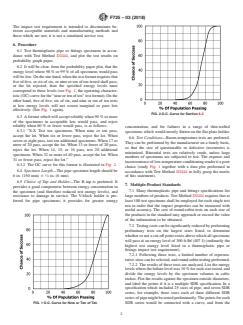
correspond to these levels (see Fig. 1, the operating character-
istic(OC)curveforthe“nineortenoften”testformat).Onthe
other hand, five of five, six of six, and nine or ten of ten tests
at low energy levels will not screen marginal or poor lots
effectively. (See Fig. 1 again).
FIG. 2 O.C. Curve for Section 6.3
6.3 Aformat which will accept reliably when 90% or more
of the specimens in acceptable lots would pass, and reject
reliably when 60% or fewer would pass, is as follows:
concentration, and for failures in a range of thin-walled
6.3.1 “X.X Test ten specimens. When nine or ten pass,
specimens which would merely flatten on the flat-plate holder.
accept the lot. When six or fewer pass, reject the lot. When
6.6 Test Conditions—Room-temperature tests are preferred.
seven or eight pass, test ten additional specimens. When 17 or
They can be performed by the manufacturer on a timely basis,
more of 20 pass, accept the lot. When 13 or fewer of 20 pass,
so that the size of questionable or defective inventories is
reject the lot. When 14, 15, or 16 pass, test 20 additional
minimized. Binomial tests are relatively crude, unless large
specimens. When 32 or more of 40 pass, accept the lot. When
numbers of specimens are subjected to test. The expense and
31 or fewer pass, reject the lot.”
inconvenienceoflow-temperatureconditioningrenderitapoor
6.3.2 The OC curve for this format is illustrated in Fig. 2.
choice (study Fig. 1 together with a data plot performed in
6.4 Specimen Length—The pipe specimen length should be
accordance with Test Method D2444 to fully grasp the merits
6 in. (150 mm) 6 ⁄4 in. (6 mm).
of this statement).
6.5 Choice of Tup and Holder—The B tup is preferred. It
7. Multiple-Product Standards
provides a good compromise between energy concentration in
7.1 Many thermoplastic pipe and fittings specifications list
the specimen (and therefore reduced test energy levels), and
resistance to damage in service. The V-block holder is pre- large numbers of products.Test Method D2444 requires that at
least 100 test specimens shall be employed for each single test
ferred for pipe specimens; it provides for greater energy
run in order that the impact properties can be measured with
useful accuracy. The cost of round-robin tests on each size of
the products in the standard may approach or exceed the value
of the information to
...