


ASTM D4274-23
(Test Method)Standard Test Methods for Testing Polyurethane Raw Materials: Determination of Hydroxyl Numbers of Polyols
Standard Test Methods for Testing Polyurethane Raw Materials: Determination of Hydroxyl Numbers of Polyols
SIGNIFICANCE AND USE
5.1 These test methods are suitable for research and as quality control and specification tests. It is necessary to know the hydroxyl contents of polyols in order to formulate polyurethane systems.
SCOPE
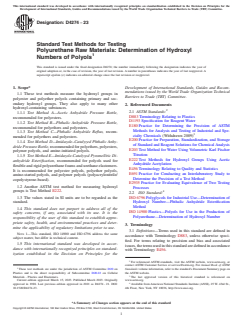
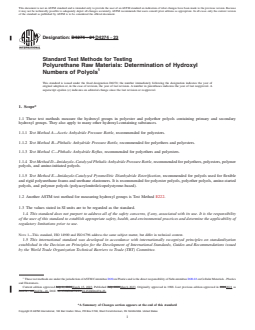
1.1 These test methods measure the hydroxyl groups in polyester and polyether polyols containing primary and secondary hydroxyl groups. They also apply to many other hydroxyl-containing substances.
1.1.1 Test Method A—Acetic Anhydride Pressure Bottle, recommended for polyesters.
1.1.2 Test Method B—Phthalic Anhydride Pressure Bottle, recommended for polyethers and polyesters.
1.1.3 Test Method C—Phthalic Anhydride Reflux, recommended for polyethers and polyesters.
1.1.4 Test Method D—Imidazole–Catalyzed Phthalic Anhydride Pressure Bottle, recommended for polyethers, polyesters, polymer polyols, and amine-initiated polyols.
1.1.5 Test Method E—Imidazole-Catalyzed Pyromellitic Dianhydride Esterification, recommended for polyols used for flexible and rigid polyurethane foams and urethane elastomers. It is recommended for polyester polyols, polyether polyols, amine-started polyols, and polymer polyols (polyacrylonitrile/copolystyrene-based).
1.2 Another ASTM test method for measuring hydroxyl groups is Test Method E222.
1.3 The values stated in SI units are to be regarded as the standard.
1.4 This standard does not purport to address all of the safety concerns, if any, associated with its use. It is the responsibility of the user of this standard to establish appropriate safety, health, and environmental practices and determine the applicability of regulatory limitations prior to use.
Note 1: This standard, ISO 14900 and ISO 6796 address the same subject matter, but differ in technical content.
1.5 This international standard was developed in accordance with internationally recognized principles on standardization established in the Decision on Principles for the Development of International Standards, Guides and Recommendations issued by the World Trade Organization Technical Barriers to Trade (TBT) Committee.
General Information
- Status
- Published
- Publication Date
- 14-Mar-2023
- Technical Committee
- D20 - Plastics
- Drafting Committee
- D20.22 - Cellular Materials - Plastics and Elastomers
Relations
- Effective Date
- 01-Feb-2024
- Effective Date
- 01-Jan-2024
- Effective Date
- 01-Nov-2023
- Effective Date
- 01-Apr-2022
- Effective Date
- 01-Jan-2020
- Effective Date
- 01-Aug-2019
- Effective Date
- 15-Apr-2019
- Effective Date
- 01-Feb-2019
- Effective Date
- 01-Dec-2018
- Effective Date
- 01-Nov-2018
- Effective Date
- 01-Oct-2017
- Refers
ASTM E2935-17 - Standard Practice for Conducting Equivalence Testing in Laboratory Applications - Effective Date
- 01-Oct-2017
- Effective Date
- 01-Oct-2017
- Effective Date
- 15-Aug-2017
- Refers
ASTM E2935-16 - Standard Practice for Conducting Equivalence Testing in Laboratory Applications - Effective Date
- 15-Nov-2016
Overview
ASTM D4274-23: Standard Test Methods for Testing Polyurethane Raw Materials: Determination of Hydroxyl Numbers of Polyols specifies a series of laboratory procedures for accurately determining the hydroxyl number in polyester polyols, polyether polyols, and other hydroxyl-containing substances. The hydroxyl number is a key metric for assessing the quality and suitability of polyols in polyurethane formulations, critical for rigorous research, product development, quality control, and material specification in the polyurethane industry.
Key Topics
- Hydroxyl Number Determination: Identifies and quantifies hydroxyl groups in polyols, which is essential for controlled polyurethane chemistry and optimal product characteristics.
- Test Methods: Includes five established methods, each tailored to particular polyol types or polyurethane systems:
- Method A – Acetic Anhydride Pressure Bottle (best for polyesters)
- Method B – Phthalic Anhydride Pressure Bottle (for both polyethers and polyesters)
- Method C – Phthalic Anhydride Reflux (for polyethers and polyesters)
- Method D – Imidazole-Catalyzed Phthalic Anhydride Pressure Bottle (for polyethers, polyesters, polymer polyols, amine-initiated polyols)
- Method E – Imidazole-Catalyzed Pyromellitic Dianhydride Esterification (for flexible and rigid polyurethane foams and urethane elastomers, including polyester, polyether, and amine-started polyols)
- Sample Handling and Preparation: Stresses the importance of representative sampling and controlling sample moisture to ensure test accuracy.
- Safety Considerations: Addresses the need for appropriate safety measures when handling reagents like pyridine, acetic anhydride, and other chemicals used in the test methods.
Applications
- Polyurethane Production: Enables accurate formulation of flexible and rigid foams, elastomers, and coatings by determining the hydroxyl content of raw materials.
- Quality Control: Ensures batch-to-batch consistency and compliance with specification requirements for polyol suppliers and polyurethane manufacturers.
- Research & Development: Assists in new product development by providing reliable data on the functional group content of experimental polyols or blends.
- Material Specification Compliance: Serves as a reference method for verifying the suitability and quality of polyols in contract specifications and regulatory submissions.
Related Standards
- ASTM E222: Alternate ASTM method for determination of hydroxyl number using acetic anhydride acetylation.
- ISO 14900: International standard for determination of hydroxyl number in polyols intended for polyurethane production.
- ISO 6796: Specifies the phthalic anhydride esterification method for determining hydroxyl numbers in polyglycols.
- ASTM D883: Provides terminology relating to plastics.
- ASTM D1193: Specifies standards for reagent water.
- ASTM E203: Test method for water determination by Karl Fischer titration.
- ASTM E691: Practice for conducting interlaboratory studies, useful for method precision analysis.
- ASTM E456 & E180: Pertinent to quality and statistical analysis in laboratory procedures.
Practical Value
- Ensures Reproducibility: By providing detailed and standardized methods, ASTM D4274-23 minimizes inter-laboratory differences and maximizes reproducibility of results.
- Adaptability: Covers a wide range of polyol chemistries and end-use requirements, offering flexibility in method selection based on sample characteristics and intended polyurethane application.
- Global Relevance: Developed in line with international standardization principles, making it suitable for global suppliers and multinational manufacturers.
Utilizing ASTM D4274-23 supports suppliers and manufacturers in delivering high-performance polyurethane products by maintaining strict control over polyol quality through reliable hydroxyl number analysis.
Buy Documents
ASTM D4274-23 - Standard Test Methods for Testing Polyurethane Raw Materials: Determination of Hydroxyl Numbers of Polyols
REDLINE ASTM D4274-23 - Standard Test Methods for Testing Polyurethane Raw Materials: Determination of Hydroxyl Numbers of Polyols
Get Certified
Connect with accredited certification bodies for this standard

Smithers Quality Assessments
US management systems and product certification.

DIN CERTCO
DIN Group product certification.
Sponsored listings
Frequently Asked Questions
ASTM D4274-23 is a standard published by ASTM International. Its full title is "Standard Test Methods for Testing Polyurethane Raw Materials: Determination of Hydroxyl Numbers of Polyols". This standard covers: SIGNIFICANCE AND USE 5.1 These test methods are suitable for research and as quality control and specification tests. It is necessary to know the hydroxyl contents of polyols in order to formulate polyurethane systems. SCOPE 1.1 These test methods measure the hydroxyl groups in polyester and polyether polyols containing primary and secondary hydroxyl groups. They also apply to many other hydroxyl-containing substances. 1.1.1 Test Method A—Acetic Anhydride Pressure Bottle, recommended for polyesters. 1.1.2 Test Method B—Phthalic Anhydride Pressure Bottle, recommended for polyethers and polyesters. 1.1.3 Test Method C—Phthalic Anhydride Reflux, recommended for polyethers and polyesters. 1.1.4 Test Method D—Imidazole–Catalyzed Phthalic Anhydride Pressure Bottle, recommended for polyethers, polyesters, polymer polyols, and amine-initiated polyols. 1.1.5 Test Method E—Imidazole-Catalyzed Pyromellitic Dianhydride Esterification, recommended for polyols used for flexible and rigid polyurethane foams and urethane elastomers. It is recommended for polyester polyols, polyether polyols, amine-started polyols, and polymer polyols (polyacrylonitrile/copolystyrene-based). 1.2 Another ASTM test method for measuring hydroxyl groups is Test Method E222. 1.3 The values stated in SI units are to be regarded as the standard. 1.4 This standard does not purport to address all of the safety concerns, if any, associated with its use. It is the responsibility of the user of this standard to establish appropriate safety, health, and environmental practices and determine the applicability of regulatory limitations prior to use. Note 1: This standard, ISO 14900 and ISO 6796 address the same subject matter, but differ in technical content. 1.5 This international standard was developed in accordance with internationally recognized principles on standardization established in the Decision on Principles for the Development of International Standards, Guides and Recommendations issued by the World Trade Organization Technical Barriers to Trade (TBT) Committee.
SIGNIFICANCE AND USE 5.1 These test methods are suitable for research and as quality control and specification tests. It is necessary to know the hydroxyl contents of polyols in order to formulate polyurethane systems. SCOPE 1.1 These test methods measure the hydroxyl groups in polyester and polyether polyols containing primary and secondary hydroxyl groups. They also apply to many other hydroxyl-containing substances. 1.1.1 Test Method A—Acetic Anhydride Pressure Bottle, recommended for polyesters. 1.1.2 Test Method B—Phthalic Anhydride Pressure Bottle, recommended for polyethers and polyesters. 1.1.3 Test Method C—Phthalic Anhydride Reflux, recommended for polyethers and polyesters. 1.1.4 Test Method D—Imidazole–Catalyzed Phthalic Anhydride Pressure Bottle, recommended for polyethers, polyesters, polymer polyols, and amine-initiated polyols. 1.1.5 Test Method E—Imidazole-Catalyzed Pyromellitic Dianhydride Esterification, recommended for polyols used for flexible and rigid polyurethane foams and urethane elastomers. It is recommended for polyester polyols, polyether polyols, amine-started polyols, and polymer polyols (polyacrylonitrile/copolystyrene-based). 1.2 Another ASTM test method for measuring hydroxyl groups is Test Method E222. 1.3 The values stated in SI units are to be regarded as the standard. 1.4 This standard does not purport to address all of the safety concerns, if any, associated with its use. It is the responsibility of the user of this standard to establish appropriate safety, health, and environmental practices and determine the applicability of regulatory limitations prior to use. Note 1: This standard, ISO 14900 and ISO 6796 address the same subject matter, but differ in technical content. 1.5 This international standard was developed in accordance with internationally recognized principles on standardization established in the Decision on Principles for the Development of International Standards, Guides and Recommendations issued by the World Trade Organization Technical Barriers to Trade (TBT) Committee.
ASTM D4274-23 is classified under the following ICS (International Classification for Standards) categories: 83.080.20 - Thermoplastic materials. The ICS classification helps identify the subject area and facilitates finding related standards.
ASTM D4274-23 has the following relationships with other standards: It is inter standard links to ASTM D883-24, ASTM E203-24, ASTM D883-23, ASTM E456-13a(2022)e1, ASTM D883-20, ASTM D883-19c, ASTM D883-19a, ASTM D883-19, ASTM D883-18a, ASTM D883-18, ASTM E456-13A(2017)e1, ASTM E2935-17, ASTM E456-13A(2017)e3, ASTM D883-17, ASTM E2935-16. Understanding these relationships helps ensure you are using the most current and applicable version of the standard.
ASTM D4274-23 is available in PDF format for immediate download after purchase. The document can be added to your cart and obtained through the secure checkout process. Digital delivery ensures instant access to the complete standard document.
Standards Content (Sample)
This international standard was developed in accordance with internationally recognized principles on standardization established in the Decision on Principles for the
Development of International Standards, Guides and Recommendations issued by the World Trade Organization Technical Barriers to Trade (TBT) Committee.
Designation: D4274 − 23
Standard Test Methods for Testing
Polyurethane Raw Materials: Determination of Hydroxyl
Numbers of Polyols
This standard is issued under the fixed designation D4274; the number immediately following the designation indicates the year of
original adoption or, in the case of revision, the year of last revision. A number in parentheses indicates the year of last reapproval. A
superscript epsilon (´) indicates an editorial change since the last revision or reapproval.
1. Scope* Development of International Standards, Guides and Recom-
mendations issued by the World Trade Organization Technical
1.1 These test methods measure the hydroxyl groups in
Barriers to Trade (TBT) Committee.
polyester and polyether polyols containing primary and sec-
ondary hydroxyl groups. They also apply to many other
2. Referenced Documents
hydroxyl-containing substances.
2.1 ASTM Standards:
1.1.1 Test Method A—Acetic Anhydride Pressure Bottle,
D883 Terminology Relating to Plastics
recommended for polyesters.
D1193 Specification for Reagent Water
1.1.2 Test Method B—Phthalic Anhydride Pressure Bottle,
E180 Practice for Determining the Precision of ASTM
recommended for polyethers and polyesters.
Methods for Analysis and Testing of Industrial and Spe-
1.1.3 Test Method C—Phthalic Anhydride Reflux, recom-
cialty Chemicals (Withdrawn 2009)
mended for polyethers and polyesters.
E200 Practice for Preparation, Standardization, and Storage
1.1.4 Test Method D—Imidazole–Catalyzed Phthalic Anhy-
of Standard and Reagent Solutions for Chemical Analysis
dride Pressure Bottle, recommended for polyethers, polyesters,
E203 Test Method for Water Using Volumetric Karl Fischer
polymer polyols, and amine-initiated polyols.
Titration
1.1.5 Test Method E—Imidazole-Catalyzed Pyromellitic Di-
E222 Test Methods for Hydroxyl Groups Using Acetic
anhydride Esterification, recommended for polyols used for
Anhydride Acetylation
flexible and rigid polyurethane foams and urethane elastomers.
E456 Terminology Relating to Quality and Statistics
It is recommended for polyester polyols, polyether polyols,
E691 Practice for Conducting an Interlaboratory Study to
amine-started polyols, and polymer polyols (polyacrylonitrile/
Determine the Precision of a Test Method
copolystyrene-based).
E2935 Practice for Evaluating Equivalence of Two Testing
1.2 Another ASTM test method for measuring hydroxyl
Processes
groups is Test Method E222. 4
2.2 ISO Standard:
1.3 The values stated in SI units are to be regarded as the ISO 6796 Polyglycols for Industrial Use—Determination of
standard. Hydroxyl Number—Phthalic Anhydride Esterification
Method
1.4 This standard does not purport to address all of the
ISO 14900 Plastics—Polyols for Use in the Production of
safety concerns, if any, associated with its use. It is the
Polyurethane—Determination of Hydroxyl Number
responsibility of the user of this standard to establish appro-
priate safety, health, and environmental practices and deter-
3. Terminology
mine the applicability of regulatory limitations prior to use.
3.1 Definitions—Terms used in this standard are defined in
NOTE 1—This standard, ISO 14900 and ISO 6796 address the same
accordance with Terminology D883, unless otherwise speci-
subject matter, but differ in technical content.
fied. For terms relating to precision and bias and associated
1.5 This international standard was developed in accor-
issues, the terms used in this standard are defined in accordance
dance with internationally recognized principles on standard-
with Terminology E456.
ization established in the Decision on Principles for the
For referenced ASTM standards, visit the ASTM website, www.astm.org, or
contact ASTM Customer Service at service@astm.org. For Annual Book of ASTM
These test methods are under the jurisdiction of ASTM Committee D20 on Standards volume information, refer to the standard’s Document Summary page on
Plastics and is the direct responsibility of Subcommittee D20.22 on Cellular the ASTM website.
Materials - Plastics and Elastomers. The last approved version of this historical standard is referenced on
Current edition approved March 15, 2023. Published March 2023. Originally www.astm.org.
approved in 1988. Last previous edition approved in 2021 as D4274 - 21. DOI: Available from American National Standards Institute (ANSI), 25 W. 43rd St.,
10.1520/D4274-23. 4th Floor, New York, NY 10036, http://www.ansi.org.
*A Summary of Changes section appears at the end of this standard
Copyright © ASTM International, 100 Barr Harbor Drive, PO Box C700, West Conshohocken, PA 19428-2959. United States
D4274 − 23
3.2 Definitions of Terms Specific to This Standard—There 6.1 Purity of Reagents—Use reagent-grade chemicals in all
are no terms in these test methods that require new or other tests. Unless otherwise indicated, all reagents must conform to
than dictionary definitions. the specifications of the Committee on Analytical Reagents of
the American Chemical Society, where such specifications are
available. Other grades are allowed, provided they are pure
4. Summary of Test Methods
enough to be used without lowering accuracy.
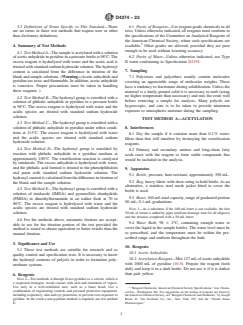
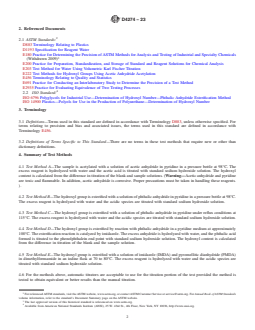
4.1 Test Method A—The sample is acetylated with a solution
6.2 Purity of Water—Unless otherwise indicated, use Type
of acetic anhydride in pyridine in a pressure bottle at 98°C. The
II water conforming to Specification D1193.
excess reagent is hydrolyzed with water and the acetic acid is
titrated with standard sodium hydroxide solution. The hydroxyl
7. Sampling
content is calculated from the difference in titration of the
blank and sample solutions. (Warning—Acetic anhydride and
7.1 Polyesters and polyethers usually contain molecules
pyridine are toxic and flammable. In addition, acetic anhydride
covering an appreciable range of molecular weights. These
is corrosive. Proper precautions must be taken in handling
have a tendency to fractionate during solidification. Unless the
these reagents. ).
material is a finely-ground solid it is necessary to melt (using
no higher temperature than necessary) and mix the resin well
4.2 Test Method B—The hydroxyl group is esterified with a
before removing a sample for analysis. Many polyols are
solution of phthalic anhydride in pyridine in a pressure bottle
hygroscopic, and care is to be taken to provide minimum
at 98°C. The excess reagent is hydrolyzed with water and the
exposure to atmospheric moisture during the sampling.
acidic species are titrated with standard sodium hydroxide
solution.
TEST METHOD A—ACETYLATION
4.3 Test Method C—The hydroxyl group is esterified with a
8. Interferences
solution of phthalic anhydride in pyridine under reflux condi-
tions at 115°C. The excess reagent is hydrolyzed with water
8.1 Dry the sample if it contains more than 0.2 % water.
and the acidic species are titrated with standard sodium
More than that will interfere by destroying the esterification
hydroxide solution.
reagents.
4.4 Test Method D—The hydroxyl group is esterified by
8.2 Primary and secondary amines and long-chain fatty
reaction with phthalic anhydride in a pyridine medium at
acids react with the reagent to form stable compounds that
approximately 100°C. The esterification reaction is catalyzed
would be included in the analysis.
by imidazole. The excess anhydride is hydrolyzed with water,
and the phthalic acid formed is titrated to the phenolphthalein
9. Apparatus
end point with standard sodium hydroxide solution. The
9.1 Bottle, pressure, heat-resistant, approximately 350 mL.
hydroxyl content is calculated from the difference in titration of
9.2 Bag, heavy fabric with draw string to hold bottle. As an
the blank and the sample solution.
alternative, a stainless steel mesh jacket fitted to cover the
4.5 Test Method E—The hydroxyl group is esterified with a
bottle is used.
solution of imidazole (IMDA) and pyromellitic dianhydride
9.3 Buret, 100-mL total capacity, range of graduated portion
(PMDA) in dimethylformamide in an iodine flask at 70 to
50 mL, 0.1-mL graduations.
80°C. The excess reagent is hydrolyzed with water and the
acidic species are titrated with standard sodium hydroxide
NOTE 3—As a substitute, if the 100-mL buret is not available, the first
solution.
50 mL of titrant is added by pipet (uniform drainage time for all aliquots)
and the titration completed with a 50-mL buret.
4.6 For the methods above, automatic titrators are accept-
9.4 Water Bath, 98 6 2°C, containing enough water to
able to use for the titration portion of the test provided the
cover the liquid in the sample bottles. The water level must be
method is tested to obtain equivalent or better results than the
as prescribed, and the temperature must be within the pre-
manual titration.
scribed range and uniform throughout the bath.
5. Significance and Use
10. Reagents
5.1 These test methods are suitable for research and as
10.1 Acetic Anhydride.
quality control and specification tests. It is necessary to know
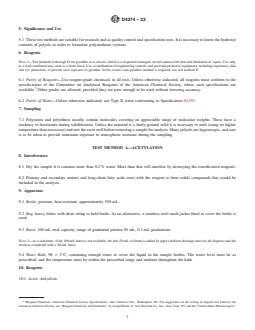
10.2 Acetylation Reagent—Mix 127 mL of acetic anhydride
the hydroxyl contents of polyols in order to formulate poly-
with 1000 mL of pyridine (10.5). Prepare the reagent fresh
urethane systems.
daily and keep it in a dark bottle. Do not use it if it is darker
than pale yellow.
6. Reagents
NOTE 2—Test methods A through D use pyridine as a solvent, which is
a suspected teratogen. Avoid contact with skin and inhalation of vapors.
Use only in a well-ventilated area, such as a fume hood. Use a
“Reagent Chemicals, American Chemical Society Specifications,” Am. Chemi-
combination of engineering controls and personal protective equipment,
cal Soc., Washington, DC. For suggestions on the testing of reagents not listed by
including respiratory, skin and eye protection, to prevent over-exposure to
the American Chemical Society, see “Reagent Chemicals and Standards,” by Joseph
pyridine. In the event a non-pyridine method is required, use test method Rosin, D. Van Nostrand Co., Inc., New York, NY, and the “United States
E. Pharmacopeia.”
D4274 − 23
10.3 Hydrochloric Acid, Standard (0.5 N)—Prepare and 11.5 Carefully rinse any liquid on the stopper into the bottle
standardize in accordance with Sections 20 to 24 of Practice and rinse the walls of the flask with 20 to 30 mL of water. Add
E200. Determine and record the temperature at which the clean crushed ice to each of the bottles until about half full.
standardization was performed. The concentration of the solu-
11.6 Add 1 mL of the phenolphthalein indicator solution
tion shall be corrected to the temperature at which the
and titrate immediately with the 0.5 N NaOH solution to the
determination is performed as described in 10.6. The factor for
first faint pink end point that persists for 15 s. The solution is
the thermal expansion of this solution is 0.00014. This solution
to be swirled during the titration, with vigorous swirling as the
is required only if a correction is to be applied for the presence
end point is reached. Record the volume of titrant to 0.02 mL
of strong base in the sample being analyzed.
(Note 4). Record the temperature of the NaOH solution.
10.4 Phenolphthalein Indicator Solution—Dissolve 1 g of
NOTE 4—If the volume of 0.5 N NaOH solution required for the sample
phenolphthalein in 100 mL of pyridine.
is less than 80 % of that required for the blank, the sample was too large
10.5 Pyridine, containing from 0.30 to 0.45 % water. Deter-
and the analysis must be repeated with a smaller sample.
mine the water content of the pyridine using Test Method
11.7 Acidity or Alkalinity Correction—If the sample con-
E203. Add the required amount of water. The volume of water
tains significant acidity or alkalinity, correct the result as
to add, mL per litre of pyridine is calculated as follows:
follows. Weigh into a 400-mL Erlenmeyer flask the same
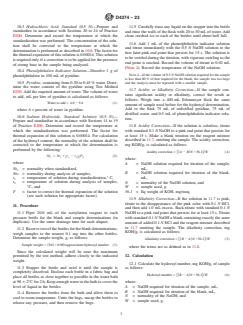
Water to add 5 4.0 2 9A (1)
amount of sample used before for the hydroxyl determination.
Add to the flask 75 mL of redistilled pyridine, 75 mL of
where A = percent of water in pyridine.
distilled water, and 0.5 mL of phenolphthalein indicator solu-
10.6 Sodium Hydroxide, Standard Solution (0.5 N)—
tion.
Prepare and standardize in accordance with Sections 14 to 19
11.8 Acidity Correction—If the solution is colorless, titrate
of Practice E200. Determine and record the temperature at
which the standardization was performed. The factor for with standard 0.1 N NaOH to a pink end point that persists for
at least 15 s. Make a blank titration on the reagent mixture
thermal expansion of this solution is 0.00014. For calculation
of the hydroxyl content, the normality of the solution shall be described in 11.7, omitting the sample. The acidity correction,
corrected to the temperature at which the determination is mg KOH/g, is calculated as follows:
performed by the following:
Acidity correction 5 A 2 B N × 56.1 /W (4)
@~ ! #
Nt 5 Nt 1 t 2 t F (2)
~ !~ !
2 1 1 2
where:
where:
A = NaOH solution required for titration of the sample,
mL,
Nt = normality when standardized,
Nt = normality during analysis of samples, B = NaOH solution required for titration of the blank,
t = temperature of solution during standardization,° C,
mL,
t = temperature of solution during analysis of samples, N = normality of the NaOH solution, and
°C, and W = sample used, g.
F = factor to correct for thermal expansion of the solution 56.1 = Eq weight of KOH, mg/meq
(see each solution for appropriate factor).
11.9 Alkalinity Correction—If the solution in 11.7 is pink,
titrate to the disappearance of the pink color with 0.1 N HCl,
11. Procedure
and then add 1.0 mL excess. Back-titrate with standard 0.1 N
11.1 Pipet 20.0 mL of the acetylation reagent to each
NaOH to a pink end point that persists for at least 15 s. Titrate
pressure bottle for the blank and sample determinations (in
with standard 0.1 N NaOH a blank containing exactly the same
duplicate). Use the same drainage time for each aliquot.
amount of added 0.1 N HCl and the reagent mixture described
in 11.7 omitting the sample. The alkalinity correction, mg
11.2 Reserve two of the bottles for the blank determinations;
KOH/g, is calculated as follows:
weigh samples to the nearest 0.1 mg into the other bottles.
Determine the sample weight, g, as follows:
Alkalinity correction 5 @~B 2 A!N × 56.1#/W (5)
Sample weight 5 561 × 0.98 /approximate hydroxyl number (3)
~ !
where the terms are as defined as in 11.8.
Since the calculated weight will be near the maximum
12. Calculation
permitted by the test method, adhere closely to the indicated
weight.
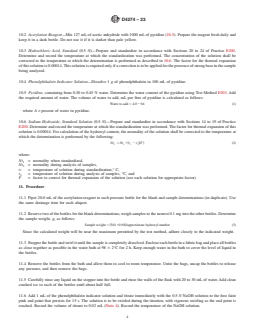
12.1 Calculate the hydroxyl number, mg KOH/g, of sample
11.3 Stopper the bottle and swirl it until the sample is
as follows:
completely dissolved. Enclose each bottle in a fabric bag and
Hydroxyl number 5 B 2 A N × 56.1 /W (6)
@~ ! #
place all bottles as close together as possible in the water bath
where:
at 98 6 2°C for 2 h. Keep enough water in the bath to cover the
level of liquid in the bottles.
A = NaOH required for titration of the sample, mL,
B = NaOH required for titration of the blank, mL,
11.4 Remove the bottles from the bath and allow them to
N = normality of the NaOH, and
cool to room temperature. Untie the bags, uncap the bottles to
W = sample used, g.
release any pressure, and then remove the bags.
D4274 − 23
12.2 If the sample contains free acidity or alkalinity as the following procedure, exactly 25 mL of this reagent must
measured in 11.7 – 11.9, the result in 12.1 must be corrected as consume between 95 and 100 mL of 0.500 N sodium hydrox-
follows: ide.
Hydroxyl number corrected 5 hydroxyl number1acidity correction, or
~ !
17.3 Phenolphthalein Indicator Solution (10 g/L)—Prepare
(7) a solution of 1 g of phenolphthalein in 100 mL of pyridine.
Hydroxyl number corrected 5 hydroxyl number 2 alkalinity correction
~ ! 17.4 Potassium Acid Phthalate—Use material that is trace-
(8) able to the National Institute of Standards and Technology.
17.5 Sodium Hydroxide, Standard Solution (0.5 N)— Pre-
13. Report
pare a 0.5 N solution of sodium hydroxide (NaOH) and
13.1 Report the corrected hydroxyl number to the nearest
standardize as follows:
0.1.
17.5.1 Crush (do not grind) about 10 g of potassium acid
phthalate (KHC H O ) to approximately 100 mesh and dry it
8 4 4
14. Precision and Bias
for 1 to 2 h at 100°C. Place in a glass-stoppered container and
14.1 Precision—Attempts to develop a precision and bias
cool in a desiccator. Accurately weigh 4 to 5 g of the dried
statement for this test method have not been successful. For
potassium acid phthalate and transfer it to a 500-mL flask that
this reason, data on precision and bias cannot be given. Contact
has been swept free of carbon dioxide. Add 200 mL of water
the Chairman, Subcommittee D20.22, ASTM, 100 Barr Harbor
that is free of carbon dioxide, stopper the flask, and swirl it
Drive, West Conshohocken, PA 19428–2959 to participate in
gently until the sample is dissolved. Add phenolphthalein
the development of precision and bias data.
indicator and titrate to a pink end point with the 0.5 N NaOH
solution using a 50-mL buret.
14.2 It is estimated that duplicate results by the same analyst
17.5.2 Calculate the normality of the NaOH as follows:
are to be considered suspect if they differ by more than 1 unit
(where the measured hydroxyl number <120) or by more than
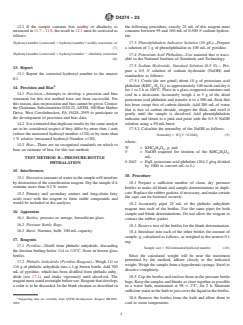
Normality 5 W/ V × 0.2042 (9)
~ !
1 % relative (measured hydroxyl Number >120).
where:
14.3 Bias—There are no recognized standards on which to
W = KHC H O , g, and
8 4 4
base an estimate of bias for this test method.
V = NaOH required for titration of the KHC H O ,
8 4 4
mL.
TEST METHOD B—PRESSURE-BOTTLE
0.2042 = Eq/L potassium acid phthalate (204.2 g/eq divided
PHTHALATION
by 1000 to convert mL to L).
15. Interferences
18. Procedure
15.1 Excessive amounts of water in the sample will interfere
by destruction of the esterification reagent. Dry the sample if it
18.1 Prepare a sufficient number of clean, dry pressure
contains more than 0.2 % water.
bottles to make all blank and sample determinations in dupli-
cate. Replace the rubber gaskets, if necessary, and make certain
15.2 Primary and secondary amines and long-chain fatty
the caps can be fastened securely.
acids react with the reagent to form stable compounds and
would be included in the analysis.
18.2 Accurately pipet 25 mL of the phthalic anhydride
reagent into each of the bottles. Use the same pipet for both
16. Apparatus
sample and blank determinations. Do not allow the reagent to
16.1 Bottles, pressure or storage, borosilicate glass.
contact the rubber gasket.
16.2 Pressure Bottle Bags.
18.3 Reserve two of the bottles for the blank determination.
16.3 Buret, Normax, bulb, 100-mL capacity.
18.4 Introduce into each of the other bottles the amount of
sample, g, calculated as follows, as weighed to the nearest 0.1
17. Reagents
mg:
17.1 Pyridine—Distill from phthalic anhydride, discarding
Sample size 5 561/estimated hydroxyl number (10)
the fraction boiling below 114 to 115°C. Store in brown glass
bottles. Since the calculated weight will be near the maximum
permitted by the method, adhere closely to the indicated
17.2 Phthalic Anhydride (Pyridine Reagent)—Weigh 111 to
weight. Weigh the sample from a hypodermic syringe. Swirl to
116 g of phthalic anhydride into a 1-qt brown bottle. Add 700
dissolve completely.
mL of pyridine, which has been distilled from phthalic anhy-
dride (see 17.1), and shake vigorously until dissolved. The
18.5 Cap the bottles and enclose them in the pressure bottle
reagent must stand overnight before use. Reagent that develops bags. Keep the samples and blanks as close together as possible
a color is to be discarded. In the blank titration as described in
in a water bath, maintained at 98 6 2°C, for 2 h. Maintain
sufficient water in the bath to just cover the liquid in the bottles.
18.6 Remove the bottles from the bath and allow them to
Supporting data are available from ASTM Headquarters. Request RR:D20-
1089. cool to room temperature.
D4274 − 23
18.7 When the bottles have cooled, open the bags, uncap TEST METHOD C—REFLUX PHTHALATION
them carefully to release any pressure, and then remove the
22. Interferences
bags.
22.1 Excessive amounts of water in the sample will interfere
18.8 To each bottle, add 50 mL of redistilled pyridine, 10
by destruction of the esterification reagents. If the water
mL of distilled water, and 0.5 mL of the phenolphthalein
content of the sample exceeds 0.2 %, it is recommended that
indicator solution, and titrate with standard 0.5 N NaOH
the sample be dried.
solution to a pink end point that persists for at least 15 s. It is
essential that the net titration (blank minus sample) be between 22.2 Primary and secondary amines and higher fatty acids
18 and 22 mL. If it is not, repeat the determination, adjusting react with the reagent to form stable compounds and would be
the sample size accordingly. included in the analysis.
18.9 Acidity or Alkalinity Correction—If the sample con-
23. Apparatus
tains significant acidity or alkalinity, the result must be
23.1 Soil Digestion Flasks, 250-mL capacity, with standard-
corrected as follows.
taper 24/40 joints and 24-in. air condensers.
18.9.1 Weigh into a 400-mL Erlenmeyer flask an amount of
23.2 Oil Bath, maintained at 115 6 2°C.
sample equal to that taken previously for the hydroxyl deter-
mination. Add to the flask 75 mL of redistilled pyridine, 75 mL
23.3 Buret, Normax, bulb, 100-mL capacity.
of distilled water, and 0.5 mL of phenolphthalein indicator
24. Reagents
solution.
24.1 Pyridine—See 17.1.
18.10 Acidity Correction—If the solution is colorless, titrate
with standard 0.1 N NaOH solution to a pink end point that
24.2 Phthalic Anhydride (Pyridine Reagent)—See 17.2.
persists for at least 15 s. Make a blank titration on the reagent
24.3 Phenolphthalein (10 g/L)—See 17.3.
mixture described in 18.9.1, omitting the sample. The acidity
24.4 Potassium Acid Phthalate—See 17.4.
correction, mg KOH/g, is calculated as follows:
24.5 Sodium Hydroxide, Standard Solution (0.5 N)—See
Acidity correction 5 A 2 B N × 56.1 /W (11)
@~ ! #
17.5.
where:
25. Procedure
A = NaOH solution required for titration of the sample,
mL,
25.1 Weigh into the flasks, by means of a hypodermic
B = NaOH solution required for titration of the blank,
syringe or other suitable equipment, the amount of sample, g,
mL,
calculated as follows, and weigh to the nearest 0.1 mg. No
N = normality of the NaOH solution, and
material must be allowed to touch the neck of the flask:
W = sample used, g.
Sample size 5 561/estimated hydroxyl number (13)
56.1 = Eq weight of KOH, mg/meq.
Since the calculated weight will be near the maximum
18.11 Alkalinity Correction—If the soluti
...
This document is not an ASTM standard and is intended only to provide the user of an ASTM standard an indication of what changes have been made to the previous version. Because
it may not be technically possible to adequately depict all changes accurately, ASTM recommends that users consult prior editions as appropriate. In all cases only the current version
of the standard as published by ASTM is to be considered the official document.
Designation: D4274 − 21 D4274 − 23
Standard Test Methods for Testing
Polyurethane Raw Materials: Determination of Hydroxyl
Numbers of Polyols
This standard is issued under the fixed designation D4274; the number immediately following the designation indicates the year of
original adoption or, in the case of revision, the year of last revision. A number in parentheses indicates the year of last reapproval. A
superscript epsilon (´) indicates an editorial change since the last revision or reapproval.
1. Scope*
1.1 These test methods measure the hydroxyl groups in polyester and polyether polyols containing primary and secondary
hydroxyl groups. They also apply to many other hydroxyl-containing substances.
1.1.1 Test Method A—Acetic Anhydride Pressure Bottle, recommended for polyesters.
1.1.2 Test Method B—Phthalic Anhydride Pressure Bottle, recommended for polyethers and polyesters.
1.1.3 Test Method C—Phthalic Anhydride Reflux, recommended for polyethers and polyesters.
1.1.4 Test Method D—Imidazole–Catalyzed Phthalic Anhydride Pressure Bottle, recommended for polyethers, polyesters, polymer
polyols, and amine-initiated polyols.
1.1.5 Test Method E—Imidazole-Catalyzed Pyromellitic Dianhydride Esterification, recommended for polyols used for flexible
and rigid polyurethane foams and urethane elastomers. It is recommended for polyester polyols, polyether polyols, amine-started
polyols, and polymer polyols (polyacrylonitrile/copolystyrene-based).
1.2 Another ASTM test method for measuring hydroxyl groups is Test Method E222.
1.3 The values stated in SI units are to be regarded as the standard.
1.4 This standard does not purport to address all of the safety concerns, if any, associated with its use. It is the responsibility
of the user of this standard to establish appropriate safety, health, and environmental practices and determine the applicability of
regulatory limitations prior to use.
NOTE 1—This standard, ISO 14900 and ISO 6796 address the same subject matter, but differ in technical content.
1.5 This international standard was developed in accordance with internationally recognized principles on standardization
established in the Decision on Principles for the Development of International Standards, Guides and Recommendations issued
by the World Trade Organization Technical Barriers to Trade (TBT) Committee.
These test methods are under the jurisdiction of ASTM Committee D20 on Plastics and is the direct responsibility of Subcommittee D20.22 on Cellular Materials - Plastics
and Elastomers.
Current edition approved July 1, 2021March 15, 2023. Published July 2021March 2023. Originally approved in 1988. Last previous edition approved in 20162021 as
D4274 - 16.D4274 - 21. DOI: 10.1520/D4274-21.10.1520/D4274-23.
*A Summary of Changes section appears at the end of this standard
Copyright © ASTM International, 100 Barr Harbor Drive, PO Box C700, West Conshohocken, PA 19428-2959. United States
D4274 − 23
2. Referenced Documents
2.1 ASTM Standards:
D883 Terminology Relating to Plastics
D1193 Specification for Reagent Water
E180 Practice for Determining the Precision of ASTM Methods for Analysis and Testing of Industrial and Specialty Chemicals
(Withdrawn 2009)
E200 Practice for Preparation, Standardization, and Storage of Standard and Reagent Solutions for Chemical Analysis
E203 Test Method for Water Using Volumetric Karl Fischer Titration
E222 Test Methods for Hydroxyl Groups Using Acetic Anhydride Acetylation
E456 Terminology Relating to Quality and Statistics
E691 Practice for Conducting an Interlaboratory Study to Determine the Precision of a Test Method
E2935 Practice for Evaluating Equivalence of Two Testing Processes
2.2 ISO Standard:
ISO 6796 Polyglycols for Industrial Use—Determination of Hydroxyl Number—Phthalic Anhydride Esterification Method
ISO 14900 Plastics—Polyols for Use in the Production of Polyurethane—Determination of Hydroxyl Number
3. Terminology
3.1 Definitions—Terms used in this standard are defined in accordance with Terminology D883, unless otherwise specified. For
terms relating to precision and bias and associated issues, the terms used in this standard are defined in accordance with
Terminology E456.
3.2 Definitions of Terms Specific to This Standard—There are no terms in these test methods that require new or other than
dictionary definitions.
4. Summary of Test Methods
4.1 Test Method A—The sample is acetylated with a solution of acetic anhydride in pyridine in a pressure bottle at 98°C. The
excess reagent is hydrolyzed with water and the acetic acid is titrated with standard sodium hydroxide solution. The hydroxyl
content is calculated from the difference in titration of the blank and sample solutions. (Warning—Acetic anhydride and pyridine
are toxic and flammable. In addition, acetic anhydride is corrosive. Proper precautions must be taken in handling these reagents.
).
4.2 Test Method B—The hydroxyl group is esterified with a solution of phthalic anhydride in pyridine in a pressure bottle at 98°C.
The excess reagent is hydrolyzed with water and the acidic species are titrated with standard sodium hydroxide solution.
4.3 Test Method C—The hydroxyl group is esterified with a solution of phthalic anhydride in pyridine under reflux conditions at
115°C. The excess reagent is hydrolyzed with water and the acidic species are titrated with standard sodium hydroxide solution.
4.4 Test Method D—The hydroxyl group is esterified by reaction with phthalic anhydride in a pyridine medium at approximately
100°C. The esterification reaction is catalyzed by imidazole. The excess anhydride is hydrolyzed with water, and the phthalic acid
formed is titrated to the phenolphthalein end point with standard sodium hydroxide solution. The hydroxyl content is calculated
from the difference in titration of the blank and the sample solution.
4.5 Test Method E—The hydroxyl group is esterified with a solution of imidazole (IMDA) and pyromellitic dianhydride (PMDA)
in dimethylformamide in an iodine flask at 70 to 80°C. The excess reagent is hydrolyzed with water and the acidic species are
titrated with standard sodium hydroxide solution.
4.6 For the methods above, automatic titrators are acceptable to use for the titration portion of the test provided the method is
tested to obtain equivalent or better results than the manual titration.
For referenced ASTM standards, visit the ASTM website, www.astm.org, or contact ASTM Customer Service at service@astm.org. For Annual Book of ASTM Standards
volume information, refer to the standard’s Document Summary page on the ASTM website.
The last approved version of this historical standard is referenced on www.astm.org.
Available from American National Standards Institute (ANSI), 25 W. 43rd St., 4th Floor, New York, NY 10036, http://www.ansi.org.
D4274 − 23
5. Significance and Use
5.1 These test methods are suitable for research and as quality control and specification tests. It is necessary to know the hydroxyl
contents of polyols in order to formulate polyurethane systems.
6. Reagents
NOTE 2—Test methods A through D use pyridine as a solvent, which is a suspected teratogen. Avoid contact with skin and inhalation of vapors. Use only
in a well-ventilated area, such as a fume hood. Use a combination of engineering controls and personal protective equipment, including respiratory, skin
and eye protection, to prevent over-exposure to pyridine. In the event a non-pyridine method is required, use test method E.
6.1 Purity of Reagents—Use reagent-grade chemicals in all tests. Unless otherwise indicated, all reagents must conform to the
specifications of the Committee on Analytical Reagents of the American Chemical Society, where such specifications are
available. Other grades are allowed, provided they are pure enough to be used without lowering accuracy.
6.2 Purity of Water—Unless otherwise indicated, use Type II water conforming to Specification D1193.
7. Sampling
7.1 Polyesters and polyethers usually contain molecules covering an appreciable range of molecular weights. These have a
tendency to fractionate during solidification. Unless the material is a finely-ground solid it is necessary to melt (using no higher
temperature than necessary) and mix the resin well before removing a sample for analysis. Many polyols are hygroscopic, and care
is to be taken to provide minimum exposure to atmospheric moisture during the sampling.
TEST METHOD A—ACETYLATION
8. Interferences
8.1 Dry the sample if it contains more than 0.2 % water. More than that will interfere by destroying the esterification reagents.
8.2 Primary and secondary amines and long-chain fatty acids react with the reagent to form stable compounds that would be
included in the analysis.
9. Apparatus
9.1 Bottle, pressure, heat-resistant, approximately 350 mL.
9.2 Bag, heavy fabric with draw string to hold bottle. As an alternative, a stainless steel mesh jacket fitted to cover the bottle is
used.
9.3 Buret, 100-mL total capacity, range of graduated portion 50 mL, 0.1-mL graduations.
NOTE 3—As a substitute, if the 100-mL buret is not available, the first 50 mL of titrant is added by pipet (uniform drainage time for all aliquots) and the
titration completed with a 50-mL buret.
9.4 Water Bath, 98 6 2°C, containing enough water to cover the liquid in the sample bottles. The water level must be as
prescribed, and the temperature must be within the prescribed range and uniform throughout the bath.
10. Reagents
10.1 Acetic Anhydride.
“Reagent Chemicals, American Chemical Society Specifications,” Am. Chemical Soc., Washington, DC. For suggestions on the testing of reagents not listed by the
American Chemical Society, see “Reagent Chemicals and Standards,” by Joseph Rosin, D. Van Nostrand Co., Inc., New York, NY, and the “United States Pharmacopeia.”
D4274 − 23
10.2 Acetylation Reagent—Mix 127 mL of acetic anhydride with 1000 mL of pyridine (10.5). Prepare the reagent fresh daily and
keep it in a dark bottle. Do not use it if it is darker than pale yellow.
10.3 Hydrochloric Acid, Standard (0.5 N)—Prepare and standardize in accordance with Sections 20 to 24 of Practice E200.
Determine and record the temperature at which the standardization was performed. The concentration of the solution shall be
corrected to the temperature at which the determination is performed as described in 10.6. The factor for the thermal expansion
of this solution is 0.00014. This solution is required only if a correction is to be applied for the presence of strong base in the sample
being analyzed.
10.4 Phenolphthalein Indicator Solution—Dissolve 1 g of phenolphthalein in 100 mL of pyridine.
10.5 Pyridine, containing from 0.30 to 0.45 % water. Determine the water content of the pyridine using Test Method E203. Add
the required amount of water. The volume of water to add, mL per litre of pyridine is calculated as follows:
Water to add 5 4.0 2 9A (1)
where A = percent of water in pyridine.
10.6 Sodium Hydroxide, Standard Solution (0.5 N)—Prepare and standardize in accordance with Sections 14 to 19 of Practice
E200. Determine and record the temperature at which the standardization was performed. The factor for thermal expansion of this
solution is 0.00014. For calculation of the hydroxyl content, the normality of the solution shall be corrected to the temperature at
which the determination is performed by the following:
Nt 5 Nt 1 t 2 t F (2)
~ !~ !
2 1 1 2
where:
Nt = normality when standardized,
Nt = normality during analysis of samples,
t = temperature of solution during standardization,° C,
t = temperature of solution during analysis of samples, °C, and
F = factor to correct for thermal expansion of the solution (see each solution for appropriate factor).
11. Procedure
11.1 Pipet 20.0 mL of the acetylation reagent to each pressure bottle for the blank and sample determinations (in duplicate). Use
the same drainage time for each aliquot.
11.2 Reserve two of the bottles for the blank determinations; weigh samples to the nearest 0.1 mg into the other bottles. Determine
the sample weight, g, as follows:
Sample weight 5 ~561 ×0.98!/approximate hydroxyl number (3)
Since the calculated weight will be near the maximum permitted by the test method, adhere closely to the indicated weight.
11.3 Stopper the bottle and swirl it until the sample is completely dissolved. Enclose each bottle in a fabric bag and place all bottles
as close together as possible in the water bath at 98 6 2°C for 2 h. Keep enough water in the bath to cover the level of liquid in
the bottles.
11.4 Remove the bottles from the bath and allow them to cool to room temperature. Untie the bags, uncap the bottles to release
any pressure, and then remove the bags.
11.5 Carefully rinse any liquid on the stopper into the bottle and rinse the walls of the flask with 20 to 30 mL of water. Add clean
crushed ice to each of the bottles until about half full.
11.6 Add 1 mL of the phenolphthalein indicator solution and titrate immediately with the 0.5 N NaOH solution to the first faint
pink end point that persists for 15 s. The solution is to be swirled during the titration, with vigorous swirling as the end point is
reached. Record the volume of titrant to 0.02 mL (Note 4). Record the temperature of the NaOH solution.
D4274 − 23
NOTE 4—If the volume of 0.5 N NaOH solution required for the sample is less than 80 % of that required for the blank, the sample was too large and
the analysis must be repeated with a smaller sample.
11.7 Acidity or Alkalinity Correction—If the sample contains significant acidity or alkalinity, correct the result as follows. Weigh
into a 400-mL Erlenmeyer flask the same amount of sample used before for the hydroxyl determination. Add to the flask 75 mL
of redistilled pyridine, 75 mL of distilled water, and 0.5 mL of phenolphthalein indicator solution.
11.8 Acidity Correction—If the solution is colorless, titrate with standard 0.1 N NaOH to a pink end point that persists for at least
15 s. Make a blank titration on the reagent mixture described in 11.7, omitting the sample. The acidity correction, mg KOH/g, is
calculated as follows:
Acidity correction 5 @~A 2 B!N ×56.1#/W (4)
where:
A = NaOH solution required for titration of the sample, mL,
B = NaOH solution required for titration of the blank, mL,
N = normality of the NaOH solution, and
W = sample used, g.
56.1 = Eq weight of KOH, mg/meq
11.9 Alkalinity Correction—If the solution in 11.7 is pink, titrate to the disappearance of the pink color with 0.1 N HCl, and then
add 1.0 mL excess. Back-titrate with standard 0.1 N NaOH to a pink end point that persists for at least 15 s. Titrate with standard
0.1 N NaOH a blank containing exactly the same amount of added 0.1 N HCl and the reagent mixture described in 11.7 omitting
the sample. The alkalinity correction, mg KOH/g, is calculated as follows:
Alkalinity correction 5 @~B 2 A!N ×56.1#/W (5)
where the terms are as defined as in 11.8.
12. Calculation
12.1 Calculate the hydroxyl number, mg KOH/g, of sample as follows:
Hydroxyl number 5 B 2 A N ×56.1 /W (6)
@~ ! #
where:
A = NaOH required for titration of the sample, mL,
B = NaOH required for titration of the blank, mL,
N = normality of the NaOH, and
W = sample used, g.
12.2 If the sample contains free acidity or alkalinity as measured in 11.7 – 11.9, the result in 12.1 must be corrected as follows:
Hydroxyl number ~corrected!5 hydroxyl number1acidity correction, or (7)
Hydroxyl number corrected 5 hydroxyl number 2 alkalinity correction (8)
~ !
13. Report
13.1 Report the corrected hydroxyl number to the nearest 0.1.
14. Precision and Bias
14.1 Precision—Attempts to develop a precision and bias statement for this test method have not been successful. For this reason,
data on precision and bias cannot be given. Contact the Chairman, Subcommittee D20.22, ASTM, 100 Barr Harbor Drive, West
Conshohocken, PA 19428–2959 to participate in the development of precision and bias data.
Supporting data are available from ASTM Headquarters. Request RR:D20-1089.
D4274 − 23
14.2 It is estimated that duplicate results by the same analyst are to be considered suspect if they differ by more than 1 unit (where
the measured hydroxyl number <120) or by more than 1 % relative (measured hydroxyl Number >120).
14.3 Bias—There are no recognized standards on which to base an estimate of bias for this test method.
TEST METHOD B—PRESSURE-BOTTLE PHTHALATION
15. Interferences
15.1 Excessive amounts of water in the sample will interfere by destruction of the esterification reagent. Dry the sample if it
contains more than 0.2 % water.
15.2 Primary and secondary amines and long-chain fatty acids react with the reagent to form stable compounds and would be
included in the analysis.
16. Apparatus
16.1 Bottles, pressure or storage, borosilicate glass.
16.2 Pressure Bottle Bags.
16.3 Buret, Normax, bulb, 100-mL capacity.
17. Reagents
17.1 Pyridine—Distill from phthalic anhydride, discarding the fraction boiling below 114 to 115°C. Store in brown glass bottles.
17.2 Phthalic Anhydride (Pyridine Reagent)—Weigh 111 to 116 g of phthalic anhydride into a 1-qt brown bottle. Add 700 mL of
pyridine, which has been distilled from phthalic anhydride (see 17.1), and shake vigorously until dissolved. The reagent must stand
overnight before use. Reagent that develops a color is to be discarded. In the blank titration as described in the following procedure,
exactly 25 mL of this reagent must consume between 95 and 100 mL of 0.500 N sodium hydroxide.
17.3 Phenolphthalein Indicator Solution (10 g/L)—Prepare a solution of 1 g of phenolphthalein in 100 mL of pyridine.
17.4 Potassium Acid Phthalate—Use material that is traceable to the National Institute of Standards and Technology.
17.5 Sodium Hydroxide, Standard Solution (0.5 N)— Prepare a 0.5 N solution of sodium hydroxide (NaOH) and standardize as
follows:
17.5.1 Crush (do not grind) about 10 g of potassium acid phthalate (KHC H O ) to approximately 100 mesh and dry it for 1 to
8 4 4
2 h at 100°C. Place in a glass-stoppered container and cool in a desiccator. Accurately weigh 4 to 5 g of the dried potassium acid
phthalate and transfer it to a 500-mL flask that has been swept free of carbon dioxide. Add 200 mL of water that is free of carbon
dioxide, stopper the flask, and swirl it gently until the sample is dissolved. Add phenolphthalein indicator and titrate to a pink end
point with the 0.5 N NaOH solution using a 50-mL buret.
17.5.2 Calculate the normality of the NaOH as follows:
Normality 5 W/~V ×0.2042! (9)
where:
W = KHC H O , g, and
8 4 4
V = NaOH required for titration of the KHC H O , mL.
8 4 4
0.2042 = Eq/L potassium acid phthalate (204.2 g/eq divided by 1000 to convert mL to L).
D4274 − 23
18. Procedure
18.1 Prepare a sufficient number of clean, dry pressure bottles to make all blank and sample determinations in duplicate. Replace
the rubber gaskets, if necessary, and make certain the caps can be fastened securely.
18.2 Accurately pipet 25 mL of the phthalic anhydride reagent into each of the bottles. Use the same pipet for both sample and
blank determinations. Do not allow the reagent to contact the rubber gasket.
18.3 Reserve two of the bottles for the blank determination.
18.4 Introduce into each of the other bottles the amount of sample, g, calculated as follows, as weighed to the nearest 0.1 mg:
Sample size 5 561/estimated hydroxyl number (10)
Since the calculated weight will be near the maximum permitted by the method, adhere closely to the indicated weight. Weigh
the sample from a hypodermic syringe. Swirl to dissolve completely.
18.5 Cap the bottles and enclose them in the pressure bottle bags. Keep the samples and blanks as close together as possible in
a water bath, maintained at 98 6 2°C, for 2 h. Maintain sufficient water in the bath to just cover the liquid in the bottles.
18.6 Remove the bottles from the bath and allow them to cool to room temperature.
18.7 When the bottles have cooled, open the bags, uncap them carefully to release any pressure, and then remove the bags.
18.8 To each bottle, add 50 mL of redistilled pyridine pyridine, 10 mL of distilled water, and 0.5 mL of the phenolphthalein
indicator solution, and titrate with standard 0.5 N NaOH solution to a pink end point that persists for at least 15 s. It is essential
that the net titration (blank minus sample) be between 18 and 22 mL. If it is not, repeat the determination, adjusting the sample
size accordingly.
18.9 Acidity or Alkalinity Correction—If the sample contains significant acidity or alkalinity, the result must be corrected as
follows.
18.9.1 Weigh into a 400-mL Erlenmeyer flask an amount of sample equal to that taken previously for the hydroxyl determination.
Add to the flask 75 mL of redistilled pyridine, 75 mL of distilled water, and 0.5 mL of phenolphthalein indicator solution.
18.10 Acidity Correction—If the solution is colorless, titrate with standard 0.1 N NaOH solution to a pink end point that persists
for at least 15 s. Make a blank titration on the reagent mixture described in 18.9.1, omitting the sample. The acidity correction,
mg KOH/g, is calculated as follows:
Acidity correction 5 @~A 2 B!N ×56.1#/W (11)
where:
A = NaOH solution required for titration of the sample, mL,
B = NaOH solution required for titration of the blank, mL,
N = normality of the NaOH solution, and
W = sample used, g.
56.1 = Eq weight of KOH, mg/meq.
18.11 Alkalinity Correction—If the solution in 18.9.1 is pink, titrate to the disappearance of the pink color with 0.1 N HCl, and
then add 1.0 mL in excess. Back titrate with standard 0.1 N NaOH solution to a pink end point that persists for at least 15 s. Titrate
with 0.1-N NaOH solution a blank containing exactly the same amount of added 0.1 N HCl and the reagent mixture described in
18.9.1, omitting the sample. The alkalinity correction, mg KOH/g, is calculated as follows:
Alkalinity correction 5 @~B 2 A!N ×56.1#/W (12)
where the terms are as defined as in 18.10.
D4274 − 23
19. Calculation
19.1 See Section 12.
20. Report
20.1 See Section 13.
21. Precision and Bias
21.1 See Section 14.
TEST METHOD C—REFLUX PHTHALATION
22. Interferences
22.1 Excessive amounts of water in the sample will interfere by destruction of the esterification reagents. If the water content of
the sample exceeds 0.2 %, it is recommended that the sample be dried.
22.2 Primary and secondary amines and higher fatty acids react with the reagent to form stable compounds and would be included
in the analysis.
23. Apparatus
23.1 Soil Digestion Flasks, 250-mL capacity, with standard-taper 24/40 joints and 24-in. air condensers.
23.2 Oil Bath, maintained at 115 6 2°C.
23.3 Buret, Normax, bulb, 100-mL capacity.
24. Reagents
24.1 Pyridine—See 17.1.
24.2 Phthalic Anhydride
...
Questions, Comments and Discussion
Ask us and Technical Secretary will try to provide an answer. You can facilitate discussion about the standard in here.
Loading comments...