


ASTM D7899-19
(Test Method)Standard Test Method for Measuring the Merit of Dispersancy of In-Service Engine Oils with Blotter Spot Method
Standard Test Method for Measuring the Merit of Dispersancy of In-Service Engine Oils with Blotter Spot Method
SIGNIFICANCE AND USE
5.1 Dispersancy is the property that allows oil to suspend and carry away pollutants of diverse sources such as soot from combustion, metallic particles from wear, corrosion of mechanical parts, and insoluble products resulting from the aging of the oil.
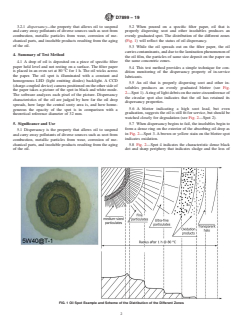
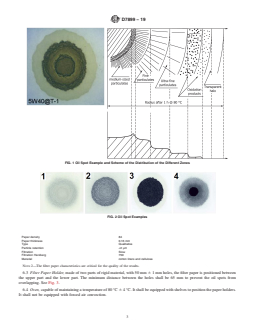
5.2 When poured on a specific filter paper, oil that is properly dispersing soot and other insolubles produces an evenly graduated spot. The distribution of the different zones (Fig. 1) will reflect the status of oil dispersancy.
FIG. 1 Oil Spot Example and Scheme of the Distribution of the Different Zones
5.3 While the oil spreads out on the filter paper, the oil carries contaminants, and due to the lamination phenomenon of the oil film, the particles of same size deposit on the paper on the same concentric zones.
5.4 This test method provides a simple technique for condition monitoring of the dispersancy property of in-service lubricants.
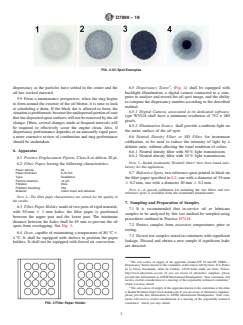
5.5 An oil that is properly dispersing soot and other insolubles produces an evenly graduated blotter (see Fig. 2—Spot 1). A ring of light debris on the outer circumference of the circular spot also indicates that the oil has retained its dispersancy properties.
FIG. 2 Oil Spot Examples
5.6 A blotter indicating a high soot load, but even graduation, suggests the oil is still fit for service, but should be watched closely for degradation (see Fig. 2—Spot 2).
5.7 When dispersancy begins to fail, the insolubles begin to form a dense ring on the exterior of the absorbing oil drop as in Fig. 2—Spot 3. A brown or yellow stain on the blotter spot indicates oxidation.
5.8 Fig. 2—Spot 4 indicates the characteristic dense black dot and sharp periphery that indicates sludge and the loss of dispersancy as the particles have settled in the center and the oil has wicked outward.
5.9 From a maintenance perspective, when the ring begins to form around the exterior of the oil blotter, it is time to look at scheduling a drain. If the black dot is allowed to form, the si...
SCOPE
1.1 This test method covers a procedure for determination of the merit of dispersancy of diesel crankcase engine oils as well as other types of engine oils where pollutants of diverse sources such as soot from combustion, metallic particles from wear, corrosion of mechanical parts, and insoluble products resulting from the oxidation of the oil may contaminate the lubricant.
1.2 The values stated in SI units are to be regarded as standard. No other units of measurement are included in this standard.
1.3 This standard does not purport to address all of the safety concerns, if any, associated with its use. It is the responsibility of the user of this standard to establish appropriate safety, health, and environmental practices and determine the applicability of regulatory limitations prior to use.
Note 1: It is not the intent of this test method to establish or recommend normal, cautionary, warning, or alert limits for any machinery. Such limits should be established in conjunction with advice and guidance from the machinery manufacturer and maintenance group.
1.4 This international standard was developed in accordance with internationally recognized principles on standardization established in the Decision on Principles for the Development of International Standards, Guides and Recommendations issued by the World Trade Organization Technical Barriers to Trade (TBT) Committee.
General Information
- Status
- Published
- Publication Date
- 30-Nov-2019
- Technical Committee
- D02 - Petroleum Products, Liquid Fuels, and Lubricants
- Drafting Committee
- D02.96.02 - Chemistry for the Evaluation of In-Service Lubricants
Relations
- Effective Date
- 01-Dec-2019
- Effective Date
- 01-Dec-2007
Overview
ASTM D7899-19 is the Standard Test Method for Measuring the Merit of Dispersancy of In-Service Engine Oils with the Blotter Spot Method. Developed by ASTM International, this test method provides a practical and effective approach for evaluating the dispersancy properties of diesel crankcase engine oils and other in-service engine lubricants. Dispersancy is a crucial oil characteristic, enabling lubricants to suspend and transport contaminants like soot, wear metals, and oxidation products, thereby supporting engine cleanliness and optimal performance.
This method uses a straightforward procedure involving the application of oil samples onto filter paper, followed by a visual and software-based assessment of spot characteristics, to determine whether engine oil continues to maintain its dispersing power after use in an engine.
Key Topics
Dispersancy in Engine Oils
Dispersancy describes the oil's ability to keep contaminants such as soot, metallic debris, and oxidation residues finely suspended, preventing deposit formation and enabling their removal during oil changes. Higher dispersancy translates to cleaner engine components and increased lubricant lifespan.Blotter Spot Method
The test is performed by depositing a standardized drop of in-service oil on specified filter paper, followed by controlled drying and digital imaging. The resulting spot’s pattern and distribution zones are analyzed to assess dispersancy effectiveness. Even graduation of the spot and specific border characteristics indicate good dispersancy, while uneven patterns or dense central spots signify dispersancy loss.Condition Monitoring
This method is extensively used for condition monitoring of lubricants in vehicles, heavy-duty and industrial applications. It helps maintenance teams track oil health, foresee the need for oil changes or further engine inspection, and avoid unnecessary downtime.Assessment Outcomes
- Good dispersancy: Even, graduated spot with light debris ring.
- Alert phase: Dense ring on the spot periphery signals a drop in dispersancy.
- Critical phase: Dense black dot at the center and sharp spot edges indicate sludge and significant dispersancy loss.
Applications
ASTM D7899-19 is widely adopted across multiple industries to:
- Monitor In-Service Engine Oil Quality:
Determine whether engine lubricant is still capable of suspending contaminants or if it is time for replacement. - Predict Maintenance Needs:
Early detection of dispersancy loss helps schedule timely oil drains or deeper engine inspections, reducing risk of equipment failure. - Support Predictive and Preventive Maintenance Programs:
Integrate with oil analysis to provide actionable data on lubrication and contamination status. - Optimize Service Intervals:
Tailor oil change intervals to actual lubricant condition rather than fixed schedules, improving operational efficiency and reducing costs. - Industrial and On-Highway Applications:
Applicable to various types of reciprocating or rotary engines in trucks, buses, marine, rail, power generation, and off-road equipment.
Related Standards
- ASTM D7418: Practice for Set-Up and Operation of Fourier Transform Infrared (FT-IR) Spectrometers for In-Service Oil Condition Monitoring
- Other ASTM Lubricant Standards: Use alongside standards covering oil oxidation, viscosity changes, and contaminant analysis for comprehensive oil condition monitoring programs.
- OEM and Maintenance Guidelines: Results from ASTM D7899-19 support recommendations and limits set by engine manufacturers and maintenance professionals for safe and efficient operation.
Keywords: ASTM D7899-19, dispersancy, in-service engine oil, blotter spot method, oil analysis, condition monitoring, diesel engine oils, lubricant degradation, preventive maintenance, oil condition, ASTM standards.
Buy Documents
ASTM D7899-19 - Standard Test Method for Measuring the Merit of Dispersancy of In-Service Engine Oils with Blotter Spot Method
REDLINE ASTM D7899-19 - Standard Test Method for Measuring the Merit of Dispersancy of In-Service Engine Oils with Blotter Spot Method
Get Certified
Connect with accredited certification bodies for this standard

ABS Quality Evaluations Inc.
American Bureau of Shipping quality certification.

Element Materials Technology
Materials testing and product certification.

ABS Group Brazil
ABS Group certification services in Brazil.
Sponsored listings
Frequently Asked Questions
ASTM D7899-19 is a standard published by ASTM International. Its full title is "Standard Test Method for Measuring the Merit of Dispersancy of In-Service Engine Oils with Blotter Spot Method". This standard covers: SIGNIFICANCE AND USE 5.1 Dispersancy is the property that allows oil to suspend and carry away pollutants of diverse sources such as soot from combustion, metallic particles from wear, corrosion of mechanical parts, and insoluble products resulting from the aging of the oil. 5.2 When poured on a specific filter paper, oil that is properly dispersing soot and other insolubles produces an evenly graduated spot. The distribution of the different zones (Fig. 1) will reflect the status of oil dispersancy. FIG. 1 Oil Spot Example and Scheme of the Distribution of the Different Zones 5.3 While the oil spreads out on the filter paper, the oil carries contaminants, and due to the lamination phenomenon of the oil film, the particles of same size deposit on the paper on the same concentric zones. 5.4 This test method provides a simple technique for condition monitoring of the dispersancy property of in-service lubricants. 5.5 An oil that is properly dispersing soot and other insolubles produces an evenly graduated blotter (see Fig. 2—Spot 1). A ring of light debris on the outer circumference of the circular spot also indicates that the oil has retained its dispersancy properties. FIG. 2 Oil Spot Examples 5.6 A blotter indicating a high soot load, but even graduation, suggests the oil is still fit for service, but should be watched closely for degradation (see Fig. 2—Spot 2). 5.7 When dispersancy begins to fail, the insolubles begin to form a dense ring on the exterior of the absorbing oil drop as in Fig. 2—Spot 3. A brown or yellow stain on the blotter spot indicates oxidation. 5.8 Fig. 2—Spot 4 indicates the characteristic dense black dot and sharp periphery that indicates sludge and the loss of dispersancy as the particles have settled in the center and the oil has wicked outward. 5.9 From a maintenance perspective, when the ring begins to form around the exterior of the oil blotter, it is time to look at scheduling a drain. If the black dot is allowed to form, the si... SCOPE 1.1 This test method covers a procedure for determination of the merit of dispersancy of diesel crankcase engine oils as well as other types of engine oils where pollutants of diverse sources such as soot from combustion, metallic particles from wear, corrosion of mechanical parts, and insoluble products resulting from the oxidation of the oil may contaminate the lubricant. 1.2 The values stated in SI units are to be regarded as standard. No other units of measurement are included in this standard. 1.3 This standard does not purport to address all of the safety concerns, if any, associated with its use. It is the responsibility of the user of this standard to establish appropriate safety, health, and environmental practices and determine the applicability of regulatory limitations prior to use. Note 1: It is not the intent of this test method to establish or recommend normal, cautionary, warning, or alert limits for any machinery. Such limits should be established in conjunction with advice and guidance from the machinery manufacturer and maintenance group. 1.4 This international standard was developed in accordance with internationally recognized principles on standardization established in the Decision on Principles for the Development of International Standards, Guides and Recommendations issued by the World Trade Organization Technical Barriers to Trade (TBT) Committee.
SIGNIFICANCE AND USE 5.1 Dispersancy is the property that allows oil to suspend and carry away pollutants of diverse sources such as soot from combustion, metallic particles from wear, corrosion of mechanical parts, and insoluble products resulting from the aging of the oil. 5.2 When poured on a specific filter paper, oil that is properly dispersing soot and other insolubles produces an evenly graduated spot. The distribution of the different zones (Fig. 1) will reflect the status of oil dispersancy. FIG. 1 Oil Spot Example and Scheme of the Distribution of the Different Zones 5.3 While the oil spreads out on the filter paper, the oil carries contaminants, and due to the lamination phenomenon of the oil film, the particles of same size deposit on the paper on the same concentric zones. 5.4 This test method provides a simple technique for condition monitoring of the dispersancy property of in-service lubricants. 5.5 An oil that is properly dispersing soot and other insolubles produces an evenly graduated blotter (see Fig. 2—Spot 1). A ring of light debris on the outer circumference of the circular spot also indicates that the oil has retained its dispersancy properties. FIG. 2 Oil Spot Examples 5.6 A blotter indicating a high soot load, but even graduation, suggests the oil is still fit for service, but should be watched closely for degradation (see Fig. 2—Spot 2). 5.7 When dispersancy begins to fail, the insolubles begin to form a dense ring on the exterior of the absorbing oil drop as in Fig. 2—Spot 3. A brown or yellow stain on the blotter spot indicates oxidation. 5.8 Fig. 2—Spot 4 indicates the characteristic dense black dot and sharp periphery that indicates sludge and the loss of dispersancy as the particles have settled in the center and the oil has wicked outward. 5.9 From a maintenance perspective, when the ring begins to form around the exterior of the oil blotter, it is time to look at scheduling a drain. If the black dot is allowed to form, the si... SCOPE 1.1 This test method covers a procedure for determination of the merit of dispersancy of diesel crankcase engine oils as well as other types of engine oils where pollutants of diverse sources such as soot from combustion, metallic particles from wear, corrosion of mechanical parts, and insoluble products resulting from the oxidation of the oil may contaminate the lubricant. 1.2 The values stated in SI units are to be regarded as standard. No other units of measurement are included in this standard. 1.3 This standard does not purport to address all of the safety concerns, if any, associated with its use. It is the responsibility of the user of this standard to establish appropriate safety, health, and environmental practices and determine the applicability of regulatory limitations prior to use. Note 1: It is not the intent of this test method to establish or recommend normal, cautionary, warning, or alert limits for any machinery. Such limits should be established in conjunction with advice and guidance from the machinery manufacturer and maintenance group. 1.4 This international standard was developed in accordance with internationally recognized principles on standardization established in the Decision on Principles for the Development of International Standards, Guides and Recommendations issued by the World Trade Organization Technical Barriers to Trade (TBT) Committee.
ASTM D7899-19 is classified under the following ICS (International Classification for Standards) categories: 75.100 - Lubricants, industrial oils and related products. The ICS classification helps identify the subject area and facilitates finding related standards.
ASTM D7899-19 has the following relationships with other standards: It is inter standard links to ASTM D7899-13, ASTM D7418-07. Understanding these relationships helps ensure you are using the most current and applicable version of the standard.
ASTM D7899-19 is available in PDF format for immediate download after purchase. The document can be added to your cart and obtained through the secure checkout process. Digital delivery ensures instant access to the complete standard document.
Standards Content (Sample)
This international standard was developed in accordance with internationally recognized principles on standardization established in the Decision on Principles for the
Development of International Standards, Guides and Recommendations issued by the World Trade Organization Technical Barriers to Trade (TBT) Committee.
Designation: D7899 − 19
Standard Test Method for
Measuring the Merit of Dispersancy of In-Service Engine
Oils with Blotter Spot Method
This standard is issued under the fixed designation D7899; the number immediately following the designation indicates the year of
original adoption or, in the case of revision, the year of last revision.Anumber in parentheses indicates the year of last reapproval.A
superscript epsilon (´) indicates an editorial change since the last revision or reapproval.
1. Scope* 3. Terminology
1.1 This test method covers a procedure for determination 3.1 Definitions:
of the merit of dispersancy of diesel crankcase engine oils as
3.1.1 diesel crankcase engine oils, n—an engine oil used in
well as other types of engine oils where pollutants of diverse
the crankcase of the internal combustion diesel engine.
sources such as soot from combustion, metallic particles from
3.1.1.1 Discussion—It may contain additives to enhance
wear, corrosion of mechanical parts, and insoluble products
certain properties. Inhibition of engine rusting, deposit
resulting from the oxidation of the oil may contaminate the
formation, valve train wear, oil oxidation, and foaming are
lubricant.
examples.
1.2 The values stated in SI units are to be regarded as
3.1.2 diesel engine, n—a reciprocating or rotary engine in
standard. No other units of measurement are included in this
whichignitionofthemainfuelcharge,asitisintroducedtothe
standard.
combustionchamber,shallbebytheheatofcompressionofthe
1.3 This standard does not purport to address all of the
charge of combustion air, during regular operation of the
safety concerns, if any, associated with its use. It is the
engine from idle speeds up to full speed, regardless of whether
responsibility of the user of this standard to establish appro-
miscellaneous methods to augment such heat of compression
priate safety, health, and environmental practices and deter-
are used to facilitate starting of the engine under normal
mine the applicability of regulatory limitations prior to use.
conditionsorunderlowambienttemperatureconditionsorlow
intake air temperature conditions.
NOTE 1—It is not the intent of this test method to establish or
recommendnormal,cautionary,warning,oralertlimitsforanymachinery. 3.1.2.1 Discussion—Engines that are designed to operate
Suchlimitsshouldbeestablishedinconjunctionwithadviceandguidance
withacontinuouslyhotspotorbulborotherdevicetofacilitate
from the machinery manufacturer and maintenance group.
ignition or combustion, or both, of low cetane fuels, or any
1.4 This international standard was developed in accor-
fuels slow to ignite or to burn, or both, shall be considered to
dance with internationally recognized principles on standard-
be diesel engines for purposes of this test method.
ization established in the Decision on Principles for the
3.1.3 engine oil, n—aliquidthatreducesfrictionorwear,or
Development of International Standards, Guides and Recom-
both, between the moving parts within an engine; removes
mendations issued by the World Trade Organization Technical
heat, particularly from the underside of pistons; and serves as
Barriers to Trade (TBT) Committee.
a combustion gas sealant for piston rings.
3.1.3.1 Discussion—It may contain additives to enhance
2. Referenced Documents
certain properties. Inhibition of engine rusting, deposit
2.1 ASTM Standards:
formation, valve train wear, oil oxidation, and foaming are
D7418Practice for Set-Up and Operation of Fourier Trans-
examples.
form Infrared (FT-IR) Spectrometers for In-Service Oil
Condition Monitoring 3.1.4 oxidation, n—ofengineoil,thereactionoftheoilwith
an electron acceptor, generally oxygen, which can produce
deleterious acidic or resinous materials often manifested as
This test method is under the jurisdiction of ASTM Committee D02 on
sludge formation, varnish formation, viscosity increase, or
Petroleum Products, Liquid Fuels, and Lubricants and is the direct responsibility of
corrosion, or a combination thereof.
SubcommitteeD02.96.02onChemistryfortheEvaluationofIn-ServiceLubricants.
Current edition approved Dec. 1, 2019. Published January 2020. Originally
3.1.5 sludge, n—in internal combustion engines, a deposit,
approved in 2013. Last previous edition approved in 2013 as D7899–13. DOI:
principally composed of insoluble resins and oxidation prod-
10.1520/D7899-19.
For referenced ASTM standards, visit the ASTM website, www.astm.org, or uctsfromfuelcombustionandthelubricantthatdoesnotdrain
contact ASTM Customer Service at service@astm.org. For Annual Book of ASTM
from engine parts but can be removed by wiping with a cloth.
Standards volume information, refer to the standard’s Document Summary page on
the ASTM website. 3.2 Definitions of Terms Specific to This Standard:
*A Summary of Changes section appears at the end of this standard
Copyright © ASTM International, 100 Barr Harbor Drive, PO Box C700, West Conshohocken, PA 19428-2959. United States
D7899 − 19
3.2.1 dispersancy—the property that allows oil to suspend 5.2 When poured on a specific filter paper, oil that is
and carry away pollutants of diverse sources such as soot from properly dispersing soot and other insolubles produces an
combustion, metallic particles from wear, corrosion of me- evenly graduated spot. The distribution of the different zones
chanical parts, and insoluble products resulting from the aging (Fig. 1) will reflect the status of oil dispersancy.
of the oil.
5.3 While the oil spreads out on the filter paper, the oil
carriescontaminants,andduetothelaminationphenomenonof
4. Summary of Test Method
the oil film, the particles of same size deposit on the paper on
the same concentric zones.
4.1 A drop of oil is deposited on a piece of specific filter
paper held level and not resting on a surface. The filter paper
5.4 This test method provides a simple technique for con-
is placed in an oven set at 80°C for 1 h. The oil wicks across
dition monitoring of the dispersancy property of in-service
the paper. The oil spot is illuminated with a constant and
lubricants.
homogenous LED (light emitting diodes) backlight. A CCD
5.5 An oil that is properly dispersing soot and other in-
(charge-coupleddevice)camerapositionedontheothersideof
solubles produces an evenly graduated blotter (see Fig.
the paper takes a picture of the spot in black and white mode.
2—Spot1).Aringoflightdebrisontheoutercircumferenceof
The software analyzes each pixel of the picture. Dispersancy
the circular spot also indicates that the oil has retained its
characteristics of the oil are judged by how far the oil drop
dispersancy properties.
spreads, how large the central sooty area is, and how homo-
5.6 A blotter indicating a high soot load, but even
geneous the opacity of the spot is in comparison with a
graduation, suggests the oil is still fit for service, but should be
theoretical reference diameter of 32 mm.
watched closely for degradation (see Fig. 2—Spot 2).
5. Significance and Use
5.7 When dispersancy begins to fail, the insolubles begin to
form a dense ring on the exterior of the absorbing oil drop as
5.1 Dispersancy is the property that allows oil to suspend
in Fig. 2—Spot 3.Abrown or yellow stain on the blotter spot
and carry away pollutants of diverse sources such as soot from
indicates oxidation.
combustion, metallic particles from wear, corrosion of me-
chanical parts, and insoluble products resulting from the aging 5.8 Fig. 2—Spot 4 indicates the characteristic dense black
of the oil. dot and sharp periphery that indicates sludge and the loss of
FIG. 1 Oil Spot Example and Scheme of the Distribution of the Different Zones
D7899 − 19
FIG. 2 Oil Spot Examples
dispersancy as the particles have settled in the center and the 6.5 Dispersancy Tester,(Fig. 4) shall be equipped with
oil has wicked outward. backlight illumination, a digital camera connected to a com-
puter to analyze and record the oil spot image, and the ability
5.9 From a maintenance perspective, when the ring begins
to compute the dispersancy number according to the described
to form around the exterior of the oil blotter, it is time to look
method.
at scheduling a drain. If the black dot is allowed to form, the
6.5.1 Digital Camera, associated to its dedicated software,
situationisproblematicbecausetheundispersedportionofsoot
type WVGA shall have a minimum resolution of 752 × 480
thathasdepositeduponsurfaceswillnotberemovedbytheoil
pixels.
change. Often, several changes made at frequent intervals will
6.5.2 Illumination Source, shall provide a uniform light on
be required to effectively scour the engine clean. Also, if
the entire surface of the oil spot.
dispersancy performance degrades at an unusually rapid pace,
a more extensive review of combustion and ring performance 6.6 Neutral Density Filter or ND Filter, for instrument
should be undertaken. calibration, to be used to reduce the intensity of light by a
definite ratio, without affecting the tonal rendition of colors.
6. Apparatus 6.6.1 Neutral density filter with 50% light transmission.
6.6.2 Neutral density filter with 10% light transmission.
6.1 Positive Displacement Pipette, ClassAto deliver 20 µl.
NOTE 3—Kodak (trademark) Wratten2 filters have been found satis-
6.2 Filter Paper, having the following characteristics:
factory for this application.
Paper density 84
6.7 Reference Spots, two reference spots printed in black on
Paper thickness 0.16 mm
Type Qualitative
the filter paper specified in 6.2, one with a diameter of 35mm
Particle retention <2 µm
6 0.2mm, one with a diameter 20mm 6 0.2mm.
Filtration Slow
Filtration Herzberg 750
NOTE 4—A special calibration kit including the two filters and two
Material cotton liners and cellulose
reference spots is available from the instrument manufacturer.
NOTE 2—The filter paper characteristics are critical for the quality of
the results.
7. Sampling and Preparation of Samples
6.3 Filter Paper Holder,madeoftwopartsofrigidmaterial,
7.1 It is recommended that in-service oil or lubricant
with 50mm 6 1 mm holes, the filter paper is positioned
samples to be analyzed by this test method be sampled using
between the upper part and the lower part. The minimum
procedures outlined in Practice D7418.
distance between the holes shall be 65 mm to prevent the oil
7.2 Protect samples from excessive temperatures prior to
spots from overlapping. See Fig. 3.
testing.
6.4 Oven, capable of maintaining a temperature of 80°C 6
7.3 Do not test samples stored in containers with significant
4°C. It shall be equipped with shelves to position the paper
leakage. Discard and obtain a new sample if significant leaks
holders. It shall not be equipped with forced air convection.
are detected.
The sole source of supply of the apparatus (model DT 10 and DT 100DL—
DispersancyTester)knowntothecommitteeatthistimeisADSystems,P.A.Portes
de la Suisse Normande, Allée de Cin
...
This document is not an ASTM standard and is intended only to provide the user of an ASTM standard an indication of what changes have been made to the previous version. Because
it may not be technically possible to adequately depict all changes accurately, ASTM recommends that users consult prior editions as appropriate. In all cases only the current version
of the standard as published by ASTM is to be considered the official document.
Designation: D7899 − 13 D7899 − 19
Standard Test Method for
Measuring the Merit of Dispersancy of In-Service Engine
Oils with Blotter Spot Method
This standard is issued under the fixed designation D7899; the number immediately following the designation indicates the year of
original adoption or, in the case of revision, the year of last revision. A number in parentheses indicates the year of last reapproval. A
superscript epsilon (´) indicates an editorial change since the last revision or reapproval.
1. Scope Scope*
1.1 This test method covers a procedure for determination of the merit of dispersancy of diesel crankcase engine oils as well
as other types of engine oils where pollutants of diverse sources such as soot from combustion, metallic particles from wear,
corrosion of mechanical parts, and insoluble products resulting from the oxidation of the oil may contaminate the lubricant.
1.2 The values stated in SI units are to be regarded as standard. No other units of measurement are included in this standard.
1.3 This standard does not purport to address all of the safety concerns, if any, associated with its use. It is the responsibility
of the user of this standard to establish appropriate safety safety, health, and healthenvironmental practices and determine the
applicability of regulatory limitations prior to use.
NOTE 1—It is not the intent of this test method to establish or recommend normal, cautionary, warning, or alert limits for any machinery. Such limits
should be established in conjunction with advice and guidance from the machinery manufacturer and maintenance group.
1.4 This international standard was developed in accordance with internationally recognized principles on standardization
established in the Decision on Principles for the Development of International Standards, Guides and Recommendations issued
by the World Trade Organization Technical Barriers to Trade (TBT) Committee.
2. Referenced Documents
2.1 ASTM Standards:
D7418 Practice for Set-Up and Operation of Fourier Transform Infrared (FT-IR) Spectrometers for In-Service Oil Condition
Monitoring
3. Terminology
3.1 Definitions:
3.1.1 diesel crankcase engine oils, n—an engine oil used in the crankcase of the internal combustion diesel engine.
3.1.1.1 Discussion—
It may contain additives to enhance certain properties. Inhibition of engine rusting, deposit formation, valve train wear, oil
oxidation, and foaming are examples.
3.1.2 diesel engine, n—a reciprocating or rotary engine in which ignition of the main fuel charge, as it is introduced to the
combustion chamber, shall be by the heat of compression of the charge of combustion air, during regular operation of the engine
from idle speeds up to full speed, regardless of whether miscellaneous methods to augment such heat of compression are used to
facilitate starting of the engine under normal conditions or under low ambient temperature conditions or low intake air temperature
conditions.
3.1.2.1 Discussion—
This test method is under the jurisdiction of ASTM Committee D02 on Petroleum Products, Liquid Fuels, and Lubricants and is the direct responsibility of Subcommittee
D02.96.02 on Chemistry for the Evaluation of In-Service Lubricants.
Current edition approved Dec. 1, 2013Dec. 1, 2019. Published January 2014January 2020. Originally approved in 2013. Last previous edition approved in 2013 as
D7899 – 13. DOI: 10.1520/D7899-13.10.1520/D7899-19.
For referenced ASTM standards, visit the ASTM website, www.astm.org, or contact ASTM Customer Service at service@astm.org. For Annual Book of ASTM Standards
volume information, refer to the standard’s Document Summary page on the ASTM website.
*A Summary of Changes section appears at the end of this standard
Copyright © ASTM International, 100 Barr Harbor Drive, PO Box C700, West Conshohocken, PA 19428-2959. United States
D7899 − 19
Engines that are designed to operate with a continuously hot spot or bulb or other device to facilitate ignition or combustion, or
both, of low cetane fuels, or any fuels slow to ignite or to burn, or both, shall be considered to be diesel engines for purposes of
this test method.
3.1.3 engine oil, n—a liquid that reduces friction or wear, or both, between the moving parts within an engine; removes heat,
particularly from the underside of pistons; and serves as a combustion gas sealant for piston rings.
3.1.3.1 Discussion—
It may contain additives to enhance certain properties. Inhibition of engine rusting, deposit formation, valve train wear, oil
oxidation, and foaming are examples.
3.1.4 oxidation, n—of engine oil, the reaction of the oil with an electron acceptor, generally oxygen, which can produce
deleterious acidic or resinous materials often manifested as sludge formation, varnish formation, viscosity increase, or corrosion,
or a combination thereof.
3.1.5 sludge, n—in internal combustion engines, a deposit, principally composed of insoluble resins and oxidation products
from fuel combustion and the lubricant that does not drain from engine parts but can be removed by wiping with a cloth.
3.2 Definitions of Terms Specific to This Standard:
3.2.1 dispersancy—the property that allows oil to suspend and carry away pollutants of diverse sources such as soot from
combustion, metallic particles from wear, corrosion of mechanical parts, and insoluble products resulting from the aging of the oil.
4. Summary of Test Method
4.1 A drop of oil is deposited on a piece of specific filter paper held level and not resting on a surface. The filter paper is placed
in an oven set at 80 °C for 1 h. The oil wicks across the paper. The oil spot is illuminated with a constant and homogenous LED
(light emitting diodes) backlight. A CCD (charge-coupled device) camera positioned on the other side of the paper takes a picture
of the spot in black and white mode. The software analyzes each pixel of the picture. Dispersancy characteristics of the oil are
judged by how far the oil drop spreads, how large the central sooty area is, and how homogeneous the opacity of the spot is in
comparison with a theoretical reference diameter of 32 mm.
5. Significance and Use
5.1 Dispersancy is the property that allows oil to suspend and carry away pollutants of diverse sources such as soot from
combustion, metallic particles from wear, corrosion of mechanical parts, and insoluble products resulting from the aging of the oil.
5.2 When poured on a specific filter paper, oil that is properly dispersing soot and other insolubles produces an evenly graduated
spot. The distribution of the different zones (Fig. 1) will reflect the status of oil dispersancy.
5.3 While the oil spreads out on the filter paper, the oil carries contaminants, and due to the lamination phenomenon of the oil
film, the particles of same size deposit on the paper on the same concentric zones.
5.4 This test method provides a simple technique for condition monitoring of the dispersancy property of in-service lubricants.
5.5 An oil that is properly dispersing soot and other insolubles produces an evenly graduated blotter (see Fig. 2—Spot 1). A
ring of light debris on the outer circumference of the circular spot also indicates that the oil has retained its dispersancy properties.
5.6 A blotter indicating a high soot load, but even graduation, suggests the oil is still fit for service, but should be watched
closely for degradation (see Fig. 2—Spot 2).
5.7 When dispersancy begins to fail, the insolubles begin to form a dense ring on the exterior of the absorbing oil drop as in
Fig. 2—Spot 3. A brown or yellow stain on the blotter spot indicates oxidation.
5.8 Fig. 2—Spot 4 indicates the characteristic dense black dot and sharp periphery that indicates sludge and the loss of
dispersancy as the particles have settled in the center and the oil has wicked outward.
5.9 From a maintenance perspective, when the ring begins to form around the exterior of the oil blotter, it is time to look at
scheduling a drain. If the black dot is allowed to form, the situation is problematic because the undispersed portion of soot that
has deposited upon surfaces will not be removed by the oil change. Often, several changes made at frequent intervals will be
required to effectively scour the engine clean. Also, if dispersancy performance degrades at an unusually rapid pace, a more
extensive review of combustion and ring performance should be undertaken.
6. Apparatus
6.1 Positive Displacement Pipette, Class A to deliver 20 μl.
6.2 Filter Paper, having the following characteristics:
D7899 − 19
FIG. 1 Oil Spot Example and Scheme of the Distribution of the Different Zones
FIG. 2 Oil Spot Examples
Paper density 84
Paper thickness 0.16 mm
Type Qualitative
Particle retention <2 μm
Filtration Slow
Filtration Herzberg 750
Material cotton liners and cellulose
NOTE 2—The filter paper characteristics are critical for the quality of the results.
6.3 Filter Paper Holder, made of two parts of rigid material, with 50 mm 6 1 mm holes, the filter paper is positioned between
the upper part and the lower part. The minimum distance between the holes shall be 65 mm to prevent the oil spots from
overlapping. See Fig. 3.
6.4 Oven, capable of maintaining a temperature of 80 °C 6 4 °C. It shall be equipped with shelves to position the paper holders.
It shall not be equipped with forced air convection.
D7899 − 19
FIG. 3 Filter Paper Holder
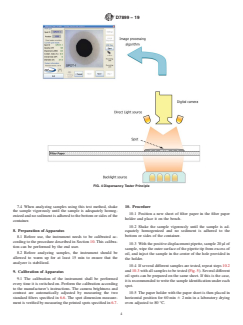
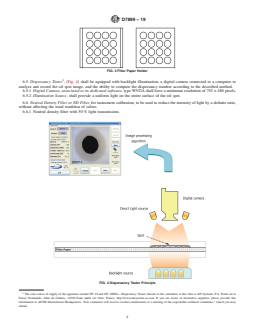
6.5 Dispersancy Tester , (Fig. 4) shall be equipped with backlight illumination, a digital camera connected to a computer to
analyze and record the oil spot image, and the ability to compute the dispersancy number according to the described method.
6.5.1 Digital Camera, associated to its dedicated software, type WVGA shall have a minimum resolution of 752 × 480 pixels.
6.5.2 Illumination Source, shall provide a uniform light on the entire surface of the oil spot.
6.6 Neutral Density Filter or ND Filter, for instrument calibration, to be used to reduce the intensity of light by a definite ratio,
without affecting the tonal rendition of colors.
6.6.1 Neutral density filter with 50 % light transmission.
FIG. 4 Dispersancy Tester Principle
The sole source of supply of the apparatus (model DT 10 and DT 100DL—Dispersancy Tester) known to the committee at this time is AD Systems, P.A. Portes de la
Suisse Normande, Allée de Cindais, 14320 Saint andré sur Orne, France, http://www.adsystems-sa.com. If you are aware of alternative suppliers, please provide this
information to ASTM International Headquarters. Your comments will receive careful consideration at a meeting of the responsible technical committee, which you may
attend.
D7899 − 19
6.6.2 Neutral density filter with 10 % light transmission.
NOTE 3—Kodak (trademark) Wratten2 filters have been found satisfactory for this application.
6.7 Reference Spots, two reference spots printed in black on the filter paper specified in 6.2, one with a diameter of 35 mm 6
0.2 mm, one with a diameter 20 mm 6 0.2 mm.
NOTE 4—A special calibration kit including the two filters and two reference spots is available from the instrument manufacturer.
7. Sampling and Preparation o
...
Questions, Comments and Discussion
Ask us and Technical Secretary will try to provide an answer. You can facilitate discussion about the standard in here.
Loading comments...