

ASTM D6222/D6222M-16(2023)
(Specification)Standard Specification for Atactic Polypropylene (APP) Modified Bituminous Sheet Materials Using Polyester Reinforcements
General Information
- Abstract
ABSTRACT
This specification covers prefabricated modified bituminous sheet materials with polyester fabric reinforcement, with or without granules, that use atactic polypropylene (APP) as the primary modifier and are intended for use in the fabrication of multiple ply roofing and waterproofing membranes. This specification is not intended for (1) issues regarding the suitability of specific roof constructions or application techniques and (2) in-place roof system design criteria such as fire resistance, field strength, impact/puncture resistance, material compatibility, uplift resistance, the need for field applied coatings, and others. Type I and II modified bituminous sheet materials reinforced with polyester fabric, with granule surfacing (Grade G) and smooth surfacing (Grade S) are covered by this specification The APP modified bituminous coating shall be permitted to be compounded with a mineral stabilizer. To prevent sticking in the roll, the reverse side and any selvage shall be permitted to be covered with a fine mineral surfacing or any other surfacing that will not interfere with adhesion or bonding of the lap. The sheet shall conform to the minimum physical properties prescribed for: peak load, elongation, ultimate elongation, tear strength, low temperature flexibility, dimensional stability, compound stability, granule embedment, water absorption, moisture content, and low temperature unrolling. The finished product shall conform to the requirements prescribed for net mass and dimensions such as width of roll, area of roll, selvage width, thickness, and bottom side coating thickness. The specified ultimate elongation, high temperature stability, and low temperature unrolling test methods shall be used.
SCOPE
1.1 This specification covers prefabricated modified bituminous sheet materials reinforced with polyester fabric, with or without granules, that use atactic polypropylene (APP) as the primary modifier and are intended for use in the fabrication of multiple ply roofing and waterproofing membranes.
Note 1: Many modified bituminous sheets are currently marketed with polyester mat reinforced with glass yarns to improve processing in the manufacture of the finished modified bitumen product and to reduce distortions that may be introduced during production. These glass yarns are typically a small percentage of the reinforcement and do not contribute to the physical properties of the finished product so much as to make these products be classified by Specification D6223/D6223M.
1.2 This specification is intended as a material specification only. Issues regarding the suitability of specific roof constructions or application techniques are beyond the scope of this specification.
1.3 The specified tests and property limits used to characterize the sheet materials covered by this specification are intended to establish minimum properties. In-place roof system design criteria such as fire resistance, field strength, impact/puncture resistance, material compatibility, uplift resistance, the need for field applied coatings, and others, are factors beyond the scope of this material specification.
1.4 The values stated in either SI units or inch-pound units are to be regarded separately as standard. The values stated in each system may not be exact equivalents; therefore, each system shall be used independently of the other. Combining values from the two systems may result in non-conformance with the standard.
1.5 The following precautionary statement pertains only to the test method portion, Section 9, of this specification: This standard does not purport to address all of the safety concerns, if any, associated with its use. It is the responsibility of the user of this standard to establish appropriate safety, health, and environmental practices and determine the applicability of regulatory limitations prior to use.
1.6 This international standard was developed in accordance with international...
- Status
- Published
- Publication Date
- 31-Jan-2023
- Technical Committee
- D08 - Roofing and Waterproofing
- Drafting Committee
- D08.04 - Felts, Fabrics and Bituminous Sheet Materials


Overview
ASTM D6222/D6222M-16(2023) is the internationally recognized standard specification for Atactic Polypropylene (APP) modified bituminous sheet materials using polyester reinforcements. Developed by ASTM International, this standard details the requirements for prefabricated roofing and waterproofing membranes primarily used in multiple-ply systems. The specification covers products reinforced with polyester fabric, with the option of granular or smooth surfaces, and using APP as the main modifier for enhanced performance properties in exterior applications.
This standard is intended as a material specification, ensuring that sheet materials meet strict minimum physical, mechanical, and dimensional criteria for quality and consistency. It is not intended to assess installation techniques or overall roof system design factors such as fire resistance, impact resistance, or compatibility with other materials.
Key Topics
Material Composition
- Atactic Polypropylene (APP) is the primary modifier, enhancing flexibility and weather resistance.
- Polyester fabric provides reinforcement for added strength and durability.
- Options for smooth (Grade S) or mineral granule (Grade G) surfacing, with granule surfacing primarily for weather exposure.
Physical Properties
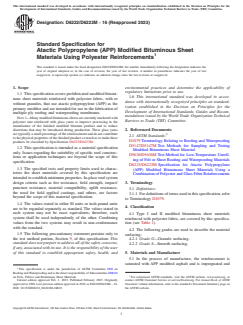
The standard requires compliance with minimum properties such as:- Peak load and elongation (before and after heat conditioning)
- Ultimate elongation
- Tear strength
- Flexibility at low temperatures
- Dimensional and compound stability
- Water absorption and moisture content
- Proper adhesion and granule embedment (where applicable)
Product Dimensions
- Roll width, length, selvage width, thickness, and mass are controlled within prescribed tolerances to ensure uniform application and integration with other roofing components.
Surface Protection
- Reverse side and selvage may be treated with fine mineral surfacing or equivalent to prevent sticking during storage and handling, without negatively impacting adhesion during application.
Inspection and Packaging
- Inspection protocols, packaging, labeling, and marking requirements are specified for product verification and traceability.
Applications
Multiple Ply Roofing Systems
- Used as key components in multi-layered roofing assemblies, providing robust waterproofing for commercial, industrial, and institutional buildings.
Waterproofing Membranes
- Suitable for applications requiring enhanced strength and water resistance, including foundations, terraces, parking decks, and other critical waterproofing structures.
Replacement and Retrofits
- Well-suited for both new installations and replacement projects, where upgraded physical properties and improved longevity are required.
Areas of Variable Climate
- The physical requirements ensure suitable performance across a wide temperature range, supporting use in diverse environmental conditions.
Related Standards
ASTM D1079: Terminology Relating to Roofing and Waterproofing
Provides standard definitions for industry terms referenced throughout ASTM D6222/D6222M.ASTM D5147/D5147M: Test Methods for Sampling and Testing Modified Bituminous Sheet Material
Establishes the approved methods for determining physical properties such as elongation, strength, and stability.ASTM D5636/D5636M: Test Method for Low-Temperature Unrolling of Roofing and Waterproofing Materials
Specifies procedures to evaluate flexibility and handling at low application temperatures.ASTM D6223/D6223M: Specification for APP Modified Bituminous Sheet Materials Using a Combination of Polyester and Glass Fiber Reinforcements
Related standard for materials with different reinforcement configurations.
Practical Value
Adhering to ASTM D6222/D6222M-16(2023) ensures that APP modified bituminous sheet materials with polyester reinforcement deliver the durability, dimensional stability, and waterproofing performance needed for demanding roofing and waterproofing applications. By meeting these rigorous requirements, manufacturers, contractors, and building owners can be confident in both the consistency and long-term reliability of the installed membrane systems, leading to safer, longer-lasting building envelopes.
Keywords: APP modified bitumen, polyester reinforcement, waterproofing membranes, roofing sheets, ASTM D6222, roofing standards, bituminous sheet material, roofing membrane specification.
Relations
- Effective Date
- 01-May-2020
- Effective Date
- 15-Dec-2018
- Effective Date
- 15-Dec-2018
- Effective Date
- 01-Jul-2018
- Effective Date
- 01-Feb-2016
- Effective Date
- 01-Jan-2014
- Effective Date
- 01-Mar-2013
- Effective Date
- 01-Mar-2013
- Effective Date
- 01-May-2011
- Effective Date
- 01-Jan-2011
- Effective Date
- 01-Jan-2011
- Effective Date
- 01-Sep-2010
- Effective Date
- 15-Nov-2009
- Effective Date
- 01-Jul-2009
- Effective Date
- 01-Feb-2008
Get Certified
Connect with accredited certification bodies for this standard

DIBt (Deutsches Institut für Bautechnik)
German Institute for Building Technology.
DIN CERTCO
DIN Group product certification.

Aboma Certification B.V.
Specialized in construction, metal, and transport sectors.
Sponsored listings
Frequently Asked Questions
ASTM D6222/D6222M-16(2023) is a technical specification published by ASTM International. Its full title is "Standard Specification for Atactic Polypropylene (APP) Modified Bituminous Sheet Materials Using Polyester Reinforcements". This standard covers: ABSTRACT This specification covers prefabricated modified bituminous sheet materials with polyester fabric reinforcement, with or without granules, that use atactic polypropylene (APP) as the primary modifier and are intended for use in the fabrication of multiple ply roofing and waterproofing membranes. This specification is not intended for (1) issues regarding the suitability of specific roof constructions or application techniques and (2) in-place roof system design criteria such as fire resistance, field strength, impact/puncture resistance, material compatibility, uplift resistance, the need for field applied coatings, and others. Type I and II modified bituminous sheet materials reinforced with polyester fabric, with granule surfacing (Grade G) and smooth surfacing (Grade S) are covered by this specification The APP modified bituminous coating shall be permitted to be compounded with a mineral stabilizer. To prevent sticking in the roll, the reverse side and any selvage shall be permitted to be covered with a fine mineral surfacing or any other surfacing that will not interfere with adhesion or bonding of the lap. The sheet shall conform to the minimum physical properties prescribed for: peak load, elongation, ultimate elongation, tear strength, low temperature flexibility, dimensional stability, compound stability, granule embedment, water absorption, moisture content, and low temperature unrolling. The finished product shall conform to the requirements prescribed for net mass and dimensions such as width of roll, area of roll, selvage width, thickness, and bottom side coating thickness. The specified ultimate elongation, high temperature stability, and low temperature unrolling test methods shall be used. SCOPE 1.1 This specification covers prefabricated modified bituminous sheet materials reinforced with polyester fabric, with or without granules, that use atactic polypropylene (APP) as the primary modifier and are intended for use in the fabrication of multiple ply roofing and waterproofing membranes. Note 1: Many modified bituminous sheets are currently marketed with polyester mat reinforced with glass yarns to improve processing in the manufacture of the finished modified bitumen product and to reduce distortions that may be introduced during production. These glass yarns are typically a small percentage of the reinforcement and do not contribute to the physical properties of the finished product so much as to make these products be classified by Specification D6223/D6223M. 1.2 This specification is intended as a material specification only. Issues regarding the suitability of specific roof constructions or application techniques are beyond the scope of this specification. 1.3 The specified tests and property limits used to characterize the sheet materials covered by this specification are intended to establish minimum properties. In-place roof system design criteria such as fire resistance, field strength, impact/puncture resistance, material compatibility, uplift resistance, the need for field applied coatings, and others, are factors beyond the scope of this material specification. 1.4 The values stated in either SI units or inch-pound units are to be regarded separately as standard. The values stated in each system may not be exact equivalents; therefore, each system shall be used independently of the other. Combining values from the two systems may result in non-conformance with the standard. 1.5 The following precautionary statement pertains only to the test method portion, Section 9, of this specification: This standard does not purport to address all of the safety concerns, if any, associated with its use. It is the responsibility of the user of this standard to establish appropriate safety, health, and environmental practices and determine the applicability of regulatory limitations prior to use. 1.6 This international standard was developed in accordance with international...
ABSTRACT This specification covers prefabricated modified bituminous sheet materials with polyester fabric reinforcement, with or without granules, that use atactic polypropylene (APP) as the primary modifier and are intended for use in the fabrication of multiple ply roofing and waterproofing membranes. This specification is not intended for (1) issues regarding the suitability of specific roof constructions or application techniques and (2) in-place roof system design criteria such as fire resistance, field strength, impact/puncture resistance, material compatibility, uplift resistance, the need for field applied coatings, and others. Type I and II modified bituminous sheet materials reinforced with polyester fabric, with granule surfacing (Grade G) and smooth surfacing (Grade S) are covered by this specification The APP modified bituminous coating shall be permitted to be compounded with a mineral stabilizer. To prevent sticking in the roll, the reverse side and any selvage shall be permitted to be covered with a fine mineral surfacing or any other surfacing that will not interfere with adhesion or bonding of the lap. The sheet shall conform to the minimum physical properties prescribed for: peak load, elongation, ultimate elongation, tear strength, low temperature flexibility, dimensional stability, compound stability, granule embedment, water absorption, moisture content, and low temperature unrolling. The finished product shall conform to the requirements prescribed for net mass and dimensions such as width of roll, area of roll, selvage width, thickness, and bottom side coating thickness. The specified ultimate elongation, high temperature stability, and low temperature unrolling test methods shall be used. SCOPE 1.1 This specification covers prefabricated modified bituminous sheet materials reinforced with polyester fabric, with or without granules, that use atactic polypropylene (APP) as the primary modifier and are intended for use in the fabrication of multiple ply roofing and waterproofing membranes. Note 1: Many modified bituminous sheets are currently marketed with polyester mat reinforced with glass yarns to improve processing in the manufacture of the finished modified bitumen product and to reduce distortions that may be introduced during production. These glass yarns are typically a small percentage of the reinforcement and do not contribute to the physical properties of the finished product so much as to make these products be classified by Specification D6223/D6223M. 1.2 This specification is intended as a material specification only. Issues regarding the suitability of specific roof constructions or application techniques are beyond the scope of this specification. 1.3 The specified tests and property limits used to characterize the sheet materials covered by this specification are intended to establish minimum properties. In-place roof system design criteria such as fire resistance, field strength, impact/puncture resistance, material compatibility, uplift resistance, the need for field applied coatings, and others, are factors beyond the scope of this material specification. 1.4 The values stated in either SI units or inch-pound units are to be regarded separately as standard. The values stated in each system may not be exact equivalents; therefore, each system shall be used independently of the other. Combining values from the two systems may result in non-conformance with the standard. 1.5 The following precautionary statement pertains only to the test method portion, Section 9, of this specification: This standard does not purport to address all of the safety concerns, if any, associated with its use. It is the responsibility of the user of this standard to establish appropriate safety, health, and environmental practices and determine the applicability of regulatory limitations prior to use. 1.6 This international standard was developed in accordance with international...
ASTM D6222/D6222M-16(2023) is classified under the following ICS (International Classification for Standards) categories: 91.100.50 - Binders. Sealing materials. The ICS classification helps identify the subject area and facilitates finding related standards.
ASTM D6222/D6222M-16(2023) has the following relationships with other standards: It is inter standard links to ASTM D1079-20, ASTM D1079-18, ASTM D1079-18e1, ASTM D5147/D5147M-18, ASTM D1079-16, ASTM D5147/D5147M-14, ASTM D1079-13e1, ASTM D1079-13, ASTM D5147/D5147M-11a, ASTM D5636/D5636M-94(2011)e1, ASTM D5147/D5147M-11, ASTM D1079-10, ASTM D6223/D6223M-02(2009)e1, ASTM D1079-09, ASTM D1079-08a. Understanding these relationships helps ensure you are using the most current and applicable version of the standard.
ASTM D6222/D6222M-16(2023) is available in PDF format for immediate download after purchase. The document can be added to your cart and obtained through the secure checkout process. Digital delivery ensures instant access to the complete standard document.
Standards Content (Sample)
This international standard was developed in accordance with internationally recognized principles on standardization established in the Decision on Principles for the
Development of International Standards, Guides and Recommendations issued by the World Trade Organization Technical Barriers to Trade (TBT) Committee.
Designation: D6222/D6222M − 16 (Reapproved 2023)
Standard Specification for
Atactic Polypropylene (APP) Modified Bituminous Sheet
Materials Using Polyester Reinforcements
This standard is issued under the fixed designation D6222/D6222M; the number immediately following the designation indicates the
year of original adoption or, in the case of revision, the year of last revision. A number in parentheses indicates the year of last
reapproval. A superscript epsilon (´) indicates an editorial change since the last revision or reapproval.
1. Scope environmental practices and determine the applicability of
regulatory limitations prior to use.
1.1 This specification covers prefabricated modified bitumi-
1.6 This international standard was developed in accor-
nous sheet materials reinforced with polyester fabric, with or
dance with internationally recognized principles on standard-
without granules, that use atactic polypropylene (APP) as the
ization established in the Decision on Principles for the
primary modifier and are intended for use in the fabrication of
Development of International Standards, Guides and Recom-
multiple ply roofing and waterproofing membranes.
mendations issued by the World Trade Organization Technical
NOTE 1—Many modified bituminous sheets are currently marketed with
Barriers to Trade (TBT) Committee.
polyester mat reinforced with glass yarns to improve processing in the
manufacture of the finished modified bitumen product and to reduce
distortions that may be introduced during production. These glass yarns 2. Referenced Documents
are typically a small percentage of the reinforcement and do not contribute
2.1 ASTM Standards:
to the physical properties of the finished product so much as to make these
D1079 Terminology Relating to Roofing and Waterproofing
products be classified by Specification D6223/D6223M.
D5147/D5147M Test Methods for Sampling and Testing
1.2 This specification is intended as a material specification
Modified Bituminous Sheet Material
only. Issues regarding the suitability of specific roof construc-
D5636/D5636M Test Method for Low-Temperature Unroll-
tions or application techniques are beyond the scope of this
ing of Felt or Sheet Roofing and Waterproofing Materials
specification.
D6223/D6223M Specification for Atactic Polypropylene
1.3 The specified tests and property limits used to charac-
(APP) Modified Bituminous Sheet Materials Using a
terize the sheet materials covered by this specification are
Combination of Polyester and Glass Fiber Reinforcements
intended to establish minimum properties. In-place roof system
design criteria such as fire resistance, field strength, impact/ 3. Terminology
puncture resistance, material compatibility, uplift resistance,
3.1 Definitions:
the need for field applied coatings, and others, are factors
3.1.1 For definitions of terms used in this specification, refer
beyond the scope of this material specification.
to Terminology D1079.
1.4 The values stated in either SI units or inch-pound units
4. Classification
are to be regarded separately as standard. The values stated in
each system may not be exact equivalents; therefore, each
4.1 Type I and II modified bituminous sheet materials
system shall be used independently of the other. Combining
reinforced with polyester fabric, are covered by this specifica-
values from the two systems may result in non-conformance
tion (see Table 1).
with the standard.
4.2 The following grades are used to describe the material
1.5 The following precautionary statement pertains only to
surfacing:
the test method portion, Section 9, of this specification: This
4.2.1 Grade G—Granule surfacing.
standard does not purport to address all of the safety concerns,
4.2.2 Grade S—Smooth surfacing.
if any, associated with its use. It is the responsibility of the user
of this standard to establish appropriate safety, health, and 5. Materials and Manufacture
5.1 In the process of manufacture, the reinforcement is
saturated with APP modified asphalt and is impregnated and
This specification is under the jurisdiction of ASTM Committee D08 on
Roofing and Waterproofing and is the direct responsibility of Subcommittee D08.04
on Felts, Fabrics and Bituminous Sheet Materials. For referenced ASTM standards, visit the ASTM website, www.astm.org, or
Current edition approved Feb. 1, 2023. Published February 2023. Originally contact ASTM Customer Service at service@astm.org. For Annual Book of ASTM
approved in 1998. Last previous edition approved in 2016 as D6222/D6222M – 16. Standards volume information, refer to the standard’s Document Summary page on
DOI: 10.1520/D6222_D6222M-16R23. the ASTM website.
Copyright © ASTM International, 100 Barr Harbor Drive, PO Box C700, West Conshohocken, PA 19428-2959. United States
D6222/D6222M − 16 (2023)
TABLE 1 Physical Properties of APP Modified Bituminous Sheet
7. Dimensions, Mass, and Permissible Variations
A
Materials Using Polyester Reinforcements
7.1 The finished product shall conform to the following
Property Type I Type II
dimensions and variations:
Peak load at 23 °C ± 2 °C [73.4 °F ± 3.6 °F]
7.1.1 The width of the roll shall be as agreed upon between
MD and XMD, before and after heat
conditioning, min, kN/m [lbf/in.] 8.8 [50] 14 [80]
the purchaser and the supplier and shall not vary more than
1 %.
Elongation at 23 °C ± 2 °C [73.4 °F ± 3.6 °F]
7.1.2 The area of the roll shall be no less than as agreed
MD and XMD, before and after heat
conditioning, at peak load,
upon between the purchaser and the supplier.
min, % 23 40
7.1.3 The selvage width shall be within 6 mm [ ⁄4 in.] of the
Peak load at –18 °C ± 2 °C [0 °F ± 3.6 °F] nominal selvage width and shall be not less than 76 mm [3 in.]
MD and XMD, min, kN/m [lbf/in.] 10.5 [60] 15.8 [90]
in width from the edge of the sheet.
Elongation at –18 °C ± 2 °C [0 °F ± 3.6 °F]
7.2 The mass and thickness of the finished product shall be
MD and XMD, at peak load,
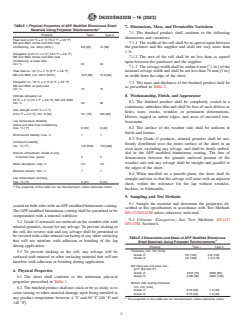
as prescribed in Table 2.
min, % 10 15
8. Workmanship, Finish, and Appearance
Ultimate elongation at
23 °C ± 2 °C [73.4 °F ± 3.6 °F], MD and XMD,
8.1 The finished product shall be completely coated in a
min, % 30 50
continuous, unbroken film and shall be free of such defects as
Tear strength at 23 °C ± 2 °C
holes, tears, cracks, wrinkles or permanent deformations,
[73.4 °F ± 3
...