


ASTM B398/B398M-15(2021)
(Specification)Standard Specification for Aluminum-Alloy 6201-T81 and 6201-T83 Wire for Electrical Purposes
Standard Specification for Aluminum-Alloy 6201-T81 and 6201-T83 Wire for Electrical Purposes
ABSTRACT
This specification covers aluminum-alloy 6201-T81 round wire which are solution heat-treated, cold worked, and artificially aged for electrical purposes. The material shall conform to the chemical composition requirements. Tensile properties such as tensile strength and elongation and bending properties shall be determined via a tension test and bending test, respectively. The electrical resistivity and density of the wires shall be measured as well.
SCOPE
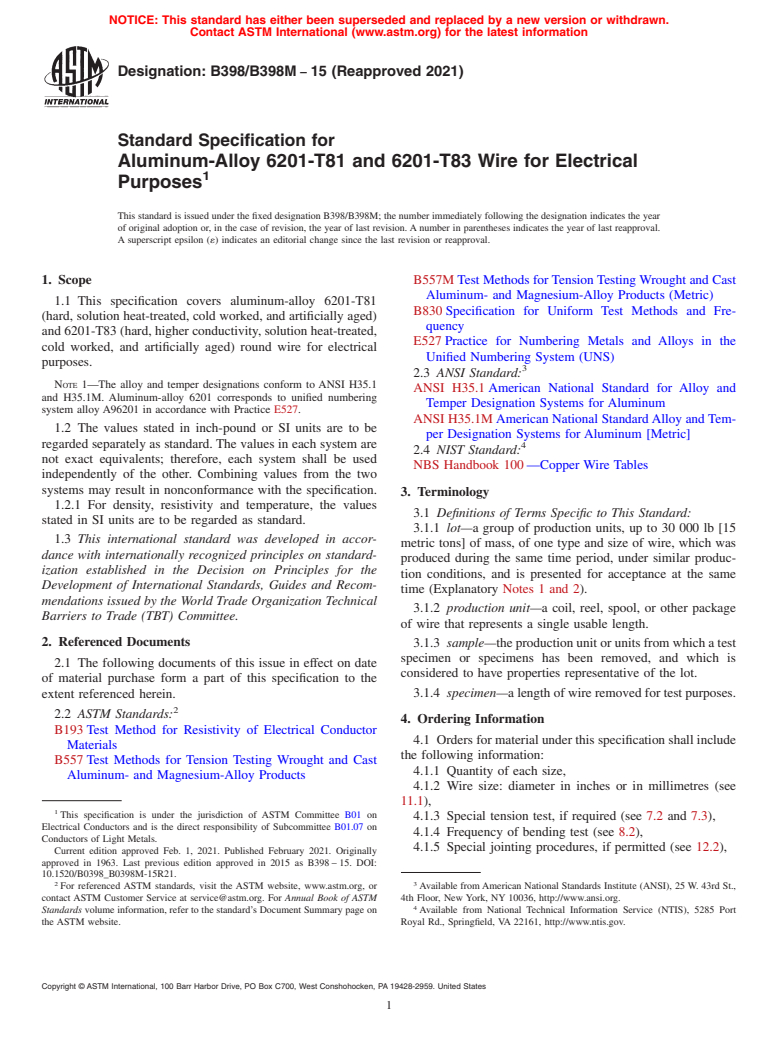
1.1 This specification covers aluminum-alloy 6201-T81 (hard, solution heat-treated, cold worked, and artificially aged) and 6201-T83 (hard, higher conductivity, solution heat-treated, cold worked, and artificially aged) round wire for electrical purposes.
Note 1: The alloy and temper designations conform to ANSI H35.1 and H35.1M. Aluminum-alloy 6201 corresponds to unified numbering system alloy A96201 in accordance with Practice E527.
1.2 The values stated in inch-pound or SI units are to be regarded separately as standard. The values in each system are not exact equivalents; therefore, each system shall be used independently of the other. Combining values from the two systems may result in nonconformance with the specification.
1.2.1 For density, resistivity and temperature, the values stated in SI units are to be regarded as standard.
1.3 This international standard was developed in accordance with internationally recognized principles on standardization established in the Decision on Principles for the Development of International Standards, Guides and Recommendations issued by the World Trade Organization Technical Barriers to Trade (TBT) Committee.
General Information
Buy Standard
Standards Content (Sample)
NOTICE: This standard has either been superseded and replaced by a new version or withdrawn.
Contact ASTM International (www.astm.org) for the latest information
Designation: B398/B398M −15 (Reapproved 2021)
Standard Specification for
Aluminum-Alloy 6201-T81 and 6201-T83 Wire for Electrical
Purposes
This standard is issued under the fixed designation B398/B398M; the number immediately following the designation indicates the year
of original adoption or, in the case of revision, the year of last revision. A number in parentheses indicates the year of last reapproval.
A superscript epsilon (´) indicates an editorial change since the last revision or reapproval.
1. Scope B557M Test Methods for Tension Testing Wrought and Cast
Aluminum- and Magnesium-Alloy Products (Metric)
1.1 This specification covers aluminum-alloy 6201-T81
B830 Specification for Uniform Test Methods and Fre-
(hard, solution heat-treated, cold worked, and artificially aged)
quency
and 6201-T83 (hard, higher conductivity, solution heat-treated,
E527 Practice for Numbering Metals and Alloys in the
cold worked, and artificially aged) round wire for electrical
Unified Numbering System (UNS)
purposes.
2.3 ANSI Standard:
NOTE 1—The alloy and temper designations conform to ANSI H35.1
ANSI H35.1 American National Standard for Alloy and
and H35.1M. Aluminum-alloy 6201 corresponds to unified numbering
Temper Designation Systems for Aluminum
system alloy A96201 in accordance with Practice E527.
ANSI H35.1M American National StandardAlloy and Tem-
1.2 The values stated in inch-pound or SI units are to be
per Designation Systems for Aluminum [Metric]
regarded separately as standard. The values in each system are 4
2.4 NIST Standard:
not exact equivalents; therefore, each system shall be used
NBS Handbook 100 —Copper Wire Tables
independently of the other. Combining values from the two
systems may result in nonconformance with the specification.
3. Terminology
1.2.1 For density, resistivity and temperature, the values
3.1 Definitions of Terms Specific to This Standard:
stated in SI units are to be regarded as standard.
3.1.1 lot—a group of production units, up to 30 000 lb [15
1.3 This international standard was developed in accor-
metric tons] of mass, of one type and size of wire, which was
dance with internationally recognized principles on standard-
produced during the same time period, under similar produc-
ization established in the Decision on Principles for the
tion conditions, and is presented for acceptance at the same
Development of International Standards, Guides and Recom-
time (Explanatory Notes 1 and 2).
mendations issued by the World Trade Organization Technical
3.1.2 production unit—a coil, reel, spool, or other package
Barriers to Trade (TBT) Committee.
of wire that represents a single usable length.
2. Referenced Documents 3.1.3 sample—the production unit or units from which a test
specimen or specimens has been removed, and which is
2.1 The following documents of this issue in effect on date
considered to have properties representative of the lot.
of material purchase form a part of this specification to the
extent referenced herein. 3.1.4 specimen—a length of wire removed for test purposes.
2.2 ASTM Standards:
4. Ordering Information
B193 Test Method for Resistivity of Electrical Conductor
4.1 Orders for material under this specification shall include
Materials
the following information:
B557 Test Methods for Tension Testing Wrought and Cast
4.1.1 Quantity of each size,
Aluminum- and Magnesium-Alloy Products
4.1.2 Wire size: diameter in inches or in millimetres (see
11.1),
This specification is under the jurisdiction of ASTM Committee B01 on
4.1.3 Special tension test, if required (see 7.2 and 7.3),
Electrical Conductors and is the direct responsibility of Subcommittee B01.07 on
4.1.4 Frequency of bending test (see 8.2),
Conductors of Light Metals.
4.1.5 Special jointing procedures, if permitted (see 12.2),
Current edition approved Feb. 1, 2021. Published February 2021. Originally
approved in 1963. Last previous edition approved in 2015 as B398 – 15. DOI:
10.1520/B0398_B0398M-15R21.
2 3
For referenced ASTM standards, visit the ASTM website, www.astm.org, or Available from American National Standards Institute (ANSI), 25 W. 43rd St.,
contact ASTM Customer Service at service@astm.org. For Annual Book of ASTM 4th Floor, New York, NY 10036, http://www.ansi.org.
Standards volume information, refer to the standard’s Document Summary page on Available from National Technical Information Service (NTIS), 5285 Port
the ASTM website. Royal Rd., Springfield, VA 22161, http://www.ntis.gov.
Copyright © ASTM International, 100 Barr Harbor Drive, PO Box C700, West Conshohocken, PA 19428-2959. United States
B398/B398M − 15 (2021)
TABLE 2 Tensile Requirements (6201-T81)
4.1.6 Place of inspection (see 15.2),
4.1.7 Package size and type (see 16.1), and Tensile Strength, min Elongation in 10
Diameter,
Average Individual in. [250 mm] for
4.1.8 Special package marking, if required (see 16.4).
in. [mm]
for a lot Tests Individual Tests,
Over Through ksi (MPa) ksi (MPa) min, %
5. Material and Manufacture 0.1280 [3.25] 0.1878 [4.75] 46 (315) 44 (305) 3.0
0.0610 [1.50] 0.1280 [3.25] 48 (330) 46 (315) 3.0
5.1 The aluminum alloy used shall be of such quality that
wire produced from it can comply with the requirements as to
chemical composition, tensile and elongation properties, bend-
TABLE 3 Tensile Requirements (6201-T83)
ing properties, and electrical resistivity prescribed in this
Tensile Strength, min
Elongation in 10
Diameter,
specification. Average Individual in. [250 mm] for
in. [mm]
for a lot Tests Individual Tests,
Over Through ksi (MPa) ksi (MPa) min, %
6. Chemical Composition
0.0610 [1.50] 0.1878 [4.75] 36 (250) 34 (235) 3.5
6.1 The wire shall be made from aluminum alloy 6201 as
designated in ANSI H35.1 and H35.1M. The material shall
A
TABLE 4 Equivalent Resistivity Values at 20°C [68°F]
conform to the chemical composition prescribed in Table 1.
A
Resistivity Constants
Volume Conductivity
Material Volume
% IACS
7. Tensile Properties
Ω·cmil/ft [Ω·mm /m]
Copper 100 10.371 [0.017241]
7.1 The heat-treated, drawn, and artificially aged wire when
Aluminum 61.0 17.002 [0.028265]
sampledinaccordancewithSection14ofthisspecificationand
57.5 18.036 [0.029984]
53.5 19.385 [0.032227]
tested in accordance with Test Methods B557 and B557M for
52.5 19.755 [0.032841]
6201-T81 shall conform to the tensile requirements prescribed
A
The equivalent resistivity values for 100 % IACS (soft copper) were each
in Table 2 and for 6201-T83 to the tensile requirements of
computed from the fundamental IEC value [ ⁄58Ω·mm m] using conversion factors
Table 3 (Explanatory Note 3).
each accurate to at least seven significant figures. Corresponding values for other
conductivities (aluminum) were derived from these by multiplying by the reciprocal
7.2 When requested by the purchaser, tension tests shall be
of the conductivity ratios accurate to at least seven significant figures.
madeonspecimensofheat-treated,drawn,andartificiallyaged
wirecontainingjointsmadeinthewireafterheattreatmentand
prior to final drawing. Such tests shall show not less than 90 %
8. Bending Properties
of the minimum strength specified in Table 2 (for 6201-T81) or
8.1 The wire shall be free of brittleness as evidenced by its
Table 3 (for 6201-T83) for individual test.
ability to be coiled or looped around its own diameter either
7.3 When requested by the purchaser, tension tests shall be
with or without a mandrel. No fracture shall occur. Slight
madeonspecimensofheat-treated,drawn,andartificiallyaged
surface checks shall not constitute cause for rejection.
wire containing joints made in the finished wire or during the
8.2 Any coil or reel may be tested in accordance with 8.1,
final drawing as permitted in 12.2. Such tests shall show the
but the frequency of production sampling and testing shall be
tensile strength to be not less than 42 ksi (290 MPa) (for
by agreement between the manufacturer and the purchaser.
6201-T81) or 32 ksi (220 MPa) (for 6201-T83) for cold-
pressure welds and for electric-butt, cold-upset welds and not
9. Resistivity
less than 15 ksi (100 MPa) for electric-butt welds. Electric-butt
9.1 Electrical resistivity, determined on samples selected in
welds in addition shall show a minimum elongation of 6 % in
accordance with Section 14 of this specification and tested in
10 in. [250 mm].
accordance with Test Method B193, shall not exceed 0.032841
Ω·mm /m at 20°C [68°F] (for 6201-T81) and shall not exceed
0.029984Ω·mm /m at 20°C [68°F] (for 6201-T83) (Explana-
A
tory Note 2 and Table 4).
TABLE 1 Chemical Requirements
Element Composition, %
10. Density
Copper, max 0.10
Iron, max 0.50
10.1 For the purpose of calculating mass, mass per unit
Silicon 0.50–0.9
length, mass cross sections, etc., the density of aluminum-alloy
Manganese, max 0.03
3 3
6201 shall be taken as 2690 kg/m (0.097 lb/in. ) at 20°C.
Magnesium 0.6–0.9
Zinc, max 0.10
Chromium, max 0.03
11. Diameter and Permissible Variations
Boron, max 0.06
11.1 The diameter of the wire shall be expressed in decimal
Other elements, each, max 0.03
Other elements, total, max 0.10
fractions of an inch using four places of decimals or in
Aluminum remainder
millimetres using two places of decimals.
A
Analysis shall regularly be made only for the elements specified in this table. If,
however, the presence of other elements is suspected or indicated in amounts 11.2 Ten percent, but not less than five coils or spools (or all
greater than the specified limits, further analysis shall be made to determine that
if the lot is less than five) from any lot of wire shall be gaged
these elements are not present in amounts in excess of the specified limits for
at three places. If the material is in coil form, one gaging shall
other elements.
be made near each end and one near the middle.
B398/B398M − 15 (2021)
11.3 The permissible variations in diameter are as follows: 14.2.3 Conformance Criteria—To be considered in
conformance, the lot average test results shall meet the
Permissible Variations of Mean
Diameter from Specified
“average for a lot” requirements of Tables 1 and 2, and the test
Specified Diameter, in. [mm]
Diameter,
results of each specimen shall meet the “individual tests”
plus and minus
requirements of Tables 2 and 4 unless otherwise s
...
This document is not an ASTM standard and is intended only to provide the user of an ASTM standard an indication of what changes have been made to the previous version. Because
it may not be technically possible to adequately depict all changes accurately, ASTM recommends that users consult prior editions as appropriate. In all cases only the current version
of the standard as published by ASTM is to be considered the official document.
Designation: B398/B398M − 15 B398/B398M − 15 (Reapproved 2021)
Standard Specification for
Aluminum-Alloy 6201-T81 and 6201-T83 Wire for Electrical
Purposes
This standard is issued under the fixed designation B398/B398M; the number immediately following the designation indicates the year
of original adoption or, in the case of revision, the year of last revision. A number in parentheses indicates the year of last reapproval.
A superscript epsilon (´) indicates an editorial change since the last revision or reapproval.
1. Scope
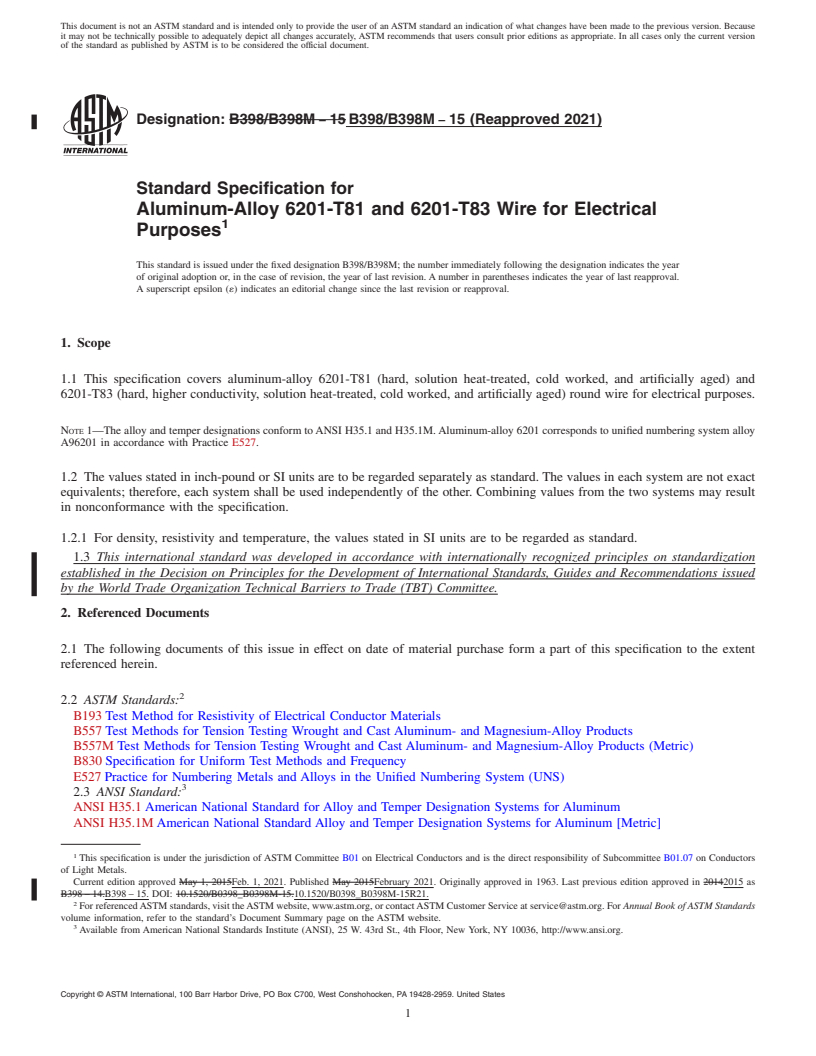
1.1 This specification covers aluminum-alloy 6201-T81 (hard, solution heat-treated, cold worked, and artificially aged) and
6201-T83 (hard, higher conductivity, solution heat-treated, cold worked, and artificially aged) round wire for electrical purposes.
NOTE 1—The alloy and temper designations conform to ANSI H35.1 and H35.1M. Aluminum-alloy 6201 corresponds to unified numbering system alloy
A96201 in accordance with Practice E527.
1.2 The values stated in inch-pound or SI units are to be regarded separately as standard. The values in each system are not exact
equivalents; therefore, each system shall be used independently of the other. Combining values from the two systems may result
in nonconformance with the specification.
1.2.1 For density, resistivity and temperature, the values stated in SI units are to be regarded as standard.
1.3 This international standard was developed in accordance with internationally recognized principles on standardization
established in the Decision on Principles for the Development of International Standards, Guides and Recommendations issued
by the World Trade Organization Technical Barriers to Trade (TBT) Committee.
2. Referenced Documents
2.1 The following documents of this issue in effect on date of material purchase form a part of this specification to the extent
referenced herein.
2.2 ASTM Standards:
B193 Test Method for Resistivity of Electrical Conductor Materials
B557 Test Methods for Tension Testing Wrought and Cast Aluminum- and Magnesium-Alloy Products
B557M Test Methods for Tension Testing Wrought and Cast Aluminum- and Magnesium-Alloy Products (Metric)
B830 Specification for Uniform Test Methods and Frequency
E527 Practice for Numbering Metals and Alloys in the Unified Numbering System (UNS)
2.3 ANSI Standard:
ANSI H35.1 American National Standard for Alloy and Temper Designation Systems for Aluminum
ANSI H35.1M American National Standard Alloy and Temper Designation Systems for Aluminum [Metric]
This specification is under the jurisdiction of ASTM Committee B01 on Electrical Conductors and is the direct responsibility of Subcommittee B01.07 on Conductors
of Light Metals.
Current edition approved May 1, 2015Feb. 1, 2021. Published May 2015February 2021. Originally approved in 1963. Last previous edition approved in 20142015 as
B398 – 14.B398 – 15. DOI: 10.1520/B0398_B0398M-15.10.1520/B0398_B0398M-15R21.
For referenced ASTM standards, visit the ASTM website, www.astm.org, or contact ASTM Customer Service at service@astm.org. For Annual Book of ASTM Standards
volume information, refer to the standard’s Document Summary page on the ASTM website.
Available from American National Standards Institute (ANSI), 25 W. 43rd St., 4th Floor, New York, NY 10036, http://www.ansi.org.
Copyright © ASTM International, 100 Barr Harbor Drive, PO Box C700, West Conshohocken, PA 19428-2959. United States
B398/B398M − 15 (2021)
2.4 NIST Standard:
NBS Handbook 100 —Copper Wire Tables
3. Terminology
3.1 Definitions of Terms Specific to This Standard:
3.1.1 lot—Aa group of production units, up to 30 000 lb [15 metric tons] of mass, of one type and size of wire, which was produced
during the same time period, under similar production conditions, and is presented for acceptance at the same time (Explanatory
Notes 1 and 2).
3.1.2 production unit—Aa coil, reel, spool, or other package of wire that represents a single usable length.
3.1.3 sample—Thethe production unit or units from which a test specimen or specimens has been removed, and which is
considered to have properties representative of the lot.
3.1.4 specimen—Aa length of wire removed for test purposes.
4. Ordering Information
4.1 Orders for material under this specification shall include the following information:
4.1.1 Quantity of each size,
4.1.2 Wire size: diameter in inches or in millimetres (see 11.1),
4.1.3 Special tension test, if required (see 7.2 and 7.3),
4.1.4 Frequency of bending test (see 8.2),
4.1.5 Special jointing procedures, if permitted (see 12.2),
4.1.6 Place of inspection (see 15.2),
4.1.7 Package size and type (see 16.1), and
4.1.8 Special package marking, if required (see 16.4).
5. Material and Manufacture
5.1 The aluminum alloy used shall be of such quality that wire produced from it can comply with the requirements as to chemical
composition, tensile and elongation properties, bending properties, and electrical resistivity prescribed in this specification.
6. Chemical Composition
6.1 The wire shall be made from aluminum alloy 6201 as designated in ANSI H35.1 and H35.1M. The material shall conform to
the chemical composition prescribed in Table 1.
7. Tensile Properties
7.1 The heat-treated, drawn, and artificially aged wire when sampled in accordance with Section 14 of this specification and tested
in accordance with Test Methods B557 and B557M for 6201-T81 shall conform to the tensile requirements prescribed in Table
2 and for 6201-T83 to the tensile requirements of Table 3 (Explanatory Note 3).
7.2 When requested by the purchaser, tension tests shall be made on specimens of heat-treated, drawn, and artificially aged wire
Available from National Technical Information Service (NTIS), 5285 Port Royal Rd., Springfield, VA 22161, http://www.ntis.gov.
B398/B398M − 15 (2021)
A
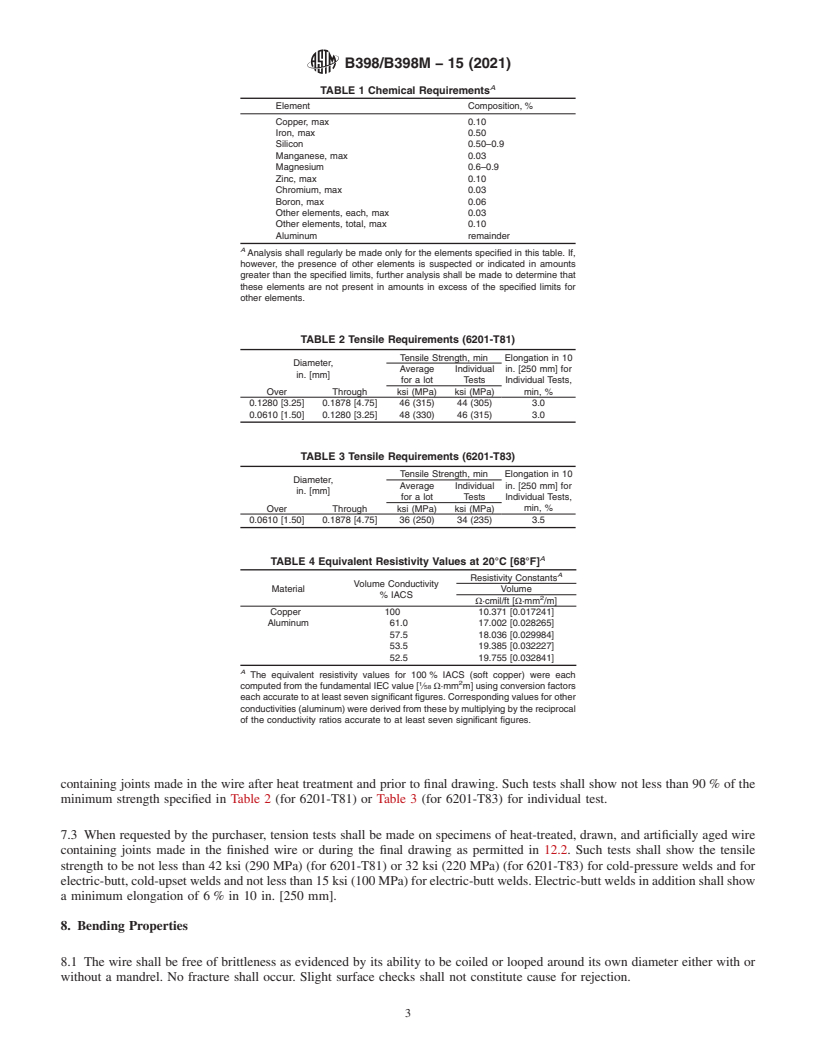
TABLE 1 Chemical Requirements
Element Composition, %
Copper, max 0.10
Iron, max 0.50
Silicon 0.50–0.9
Manganese, max 0.03
Magnesium 0.6–0.9
Zinc, max 0.10
Chromium, max 0.03
Boron, max 0.06
Other elements, each, max 0.03
Other elements, total, max 0.10
Aluminum remainder
A
Analysis shall regularly be made only for the elements specified in this table. If,
however, the presence of other elements is suspected or indicated in amounts
greater than the specified limits, further analysis shall be made to determine that
these elements are not present in amounts in excess of the specified limits for
other elements.
TABLE 2 Tensile Requirements (6201-T81)
Tensile Strength, min Elongation in 10
Diameter,
Average Individual in. [250 mm] for
in. [mm]
for a lot Tests Individual Tests,
min, %
Over Through ksi (MPa) ksi (MPa)
0.1280 [3.25] 0.1878 [4.75] 46 (315) 44 (305) 3.0
0.0610 [1.50] 0.1280 [3.25] 48 (330) 46 (315) 3.0
TABLE 3 Tensile Requirements (6201-T83)
Tensile Strength, min Elongation in 10
Diameter,
Average Individual in. [250 mm] for
in. [mm]
for a lot Tests Individual Tests,
Over Through ksi (MPa) ksi (MPa) min, %
0.0610 [1.50] 0.1878 [4.75] 36 (250) 34 (235) 3.5
A
TABLE 4 Equivalent Resistivity Values at 20°C [68°F]
A
Resistivity Constants
Volume Conductivity
Material Volume
% IACS
Ω·cmil/ft [Ω·mm /m]
Copper 100 10.371 [0.017241]
Aluminum 61.0 17.002 [0.028265]
57.5 18.036 [0.029984]
53.5 19.385 [0.032227]
52.5 19.755 [0.032841]
A
The equivalent resistivity values for 100 % IACS (soft copper) were each
computed from the fundamental IEC value [ ⁄58 Ω·mm m] using conversion factors
each accurate to at least seven significant figures. Corresponding values for other
conductivities (aluminum) were derived from these by multiplying by the reciprocal
of the conductivity ratios accurate to at least seven significant figures.
containing joints made in the wire after heat treatment and prior to final drawing. Such tests shall show not less than 90 % of the
minimum strength specified in Table 2 (for 6201-T81) or Table 3 (for 6201-T83) for individual test.
7.3 When requested by the purchaser, tension tests shall be made on specimens of heat-treated, drawn, and artificially aged wire
containing joints made in the finished wire or during the final drawing as permitted in 12.2. Such tests shall show the tensile
strength to be not less than 42 ksi (290 MPa) (for 6201-T81) or 32 ksi (220 MPa) (for 6201-T83) for cold-pressure welds and for
electric-butt, cold-upset welds and not less than 15 ksi (100 MPa) for electric-butt welds. Electric-butt welds in addition shall show
a minimum elongation of 6 % in 10 in. [250 mm].
8. Bending Properties
8.1 The wire shall be free of brittleness as evidenced by its ability to be coiled or looped around its own diameter either with or
without a mandrel. No fracture shall occur. Slight surface checks shall not constitute cause for rejection.
B398/B398M − 15 (2021)
8.2 Any coil or reel may be tested in accordance with 8.1, but the frequency of production sampling and testing shall be by
agreement between the manufacturer and the purchaser.
9. Resistivity
9.1 Electrical resistivity, determined on samples selected in accordance with Section 14 of this specification and tested in
accordance with Test Method B193, shall not exceed 0.032841 Ω·mm /m at 20°C [68°F] (for 6201-T81) and shall not exceed
0.029984 Ω·mm /m at 20°C [68°F] (for 6201-T83) (Explanatory Note 2 and Table 4).
10. Density
10.1 For the purpose of calculating mass, mass per unit length, mass cross sections, etc., the density of aluminum-alloy 6201 shall
3 3
be taken as 2690 kg/m (0.097 lb/in. ) at 20°C.
11. Diameter and Permissible Variations
11.1 The diameter of the wire shall be expressed in decimal fractions of an inch using four places of decimals or in millimetres
using two places of decimals.
11.2 Ten percent, but not less than five coils or spools (or all if the lot is less than five) from any lot of wire shall be gaged at
three places. If the material is in coil form, one gaging shall be made near each end and one near the middle.
11.3 The permissible variations in diameter are as follows:
Permissible Variations of Mean
Diameter from Specified
Specified Diameter, in. [mm]
Diameter,
plus and minus
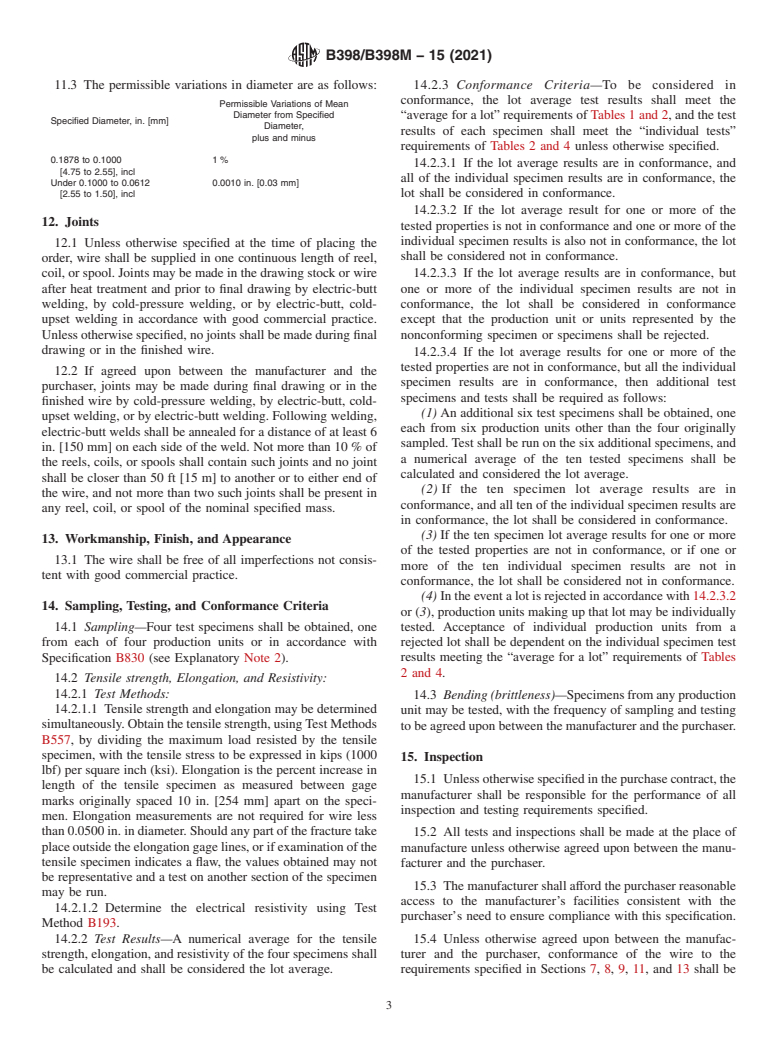
0.1878 to 0.1000 1 %
[4.75 to 2.55], incl
Under 0.1000 to 0.0612 0.0010 in. [0.03 mm]
[2.55 to 1.50], incl
12. Joints
12.1 Unless otherwise specified at the time of placing the ord
...
Questions, Comments and Discussion
Ask us and Technical Secretary will try to provide an answer. You can facilitate discussion about the standard in here.