


ASTM D3749-19
(Test Method)Standard Test Method for Residual Vinyl Chloride Monomer in Poly(Vinyl Chloride) Resins by Gas Chromatographic Headspace Technique
Standard Test Method for Residual Vinyl Chloride Monomer in Poly(Vinyl Chloride) Resins by Gas Chromatographic Headspace Technique
SIGNIFICANCE AND USE
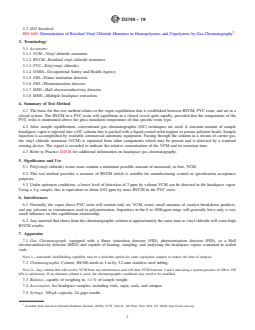
5.1 Poly(vinyl chloride) resins must contain a minimum possible amount of unreacted, or free, VCM.
5.2 This test method provides a measure of RVCM which is suitable for manufacturing control or specification acceptance purposes.
5.3 Under optimum conditions, a lower level of detection of 2 ppm by volume VCM can be detected in the headspace vapor. Using a 4-g sample, this is equivalent to about 0.02 ppm by mass RVCM in the PVC resin.
SCOPE
1.1 This test method is suitable for determining the residual vinyl chloride monomer (RVCM) content of poly(vinyl chloride) (PVC) homopolymer and copolymer resins. The range for this test, based on interlaboratory evaluation, is from 0.1 to 400 ppm RVCM.
1.2 This test method can be adapted to determinations of RVCM in a PVC copolymer resin if the Henry's Law constant at 90°C for that copolymer is known.
1.3 This test method cannot be used for polymer in fused forms, such as cubes or sheets. Refer to Test Method D4443 for these materials.
1.4 This test method is proposed as an alternative to EPA Method 107 for determination of vinyl chloride monomers in dry-resin samples.
1.5 The values stated SI units are to be regarded as the standard.
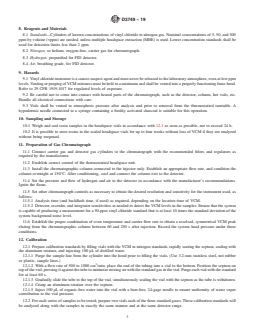
1.6 This standard does not purport to address all of the safety concerns, if any, associated with its use. It is the responsibility of the user of this standard to establish appropriate safety, health, and environmental practices and determine the applicability of regulatory limitations prior to use.
1.7 This international standard was developed in accordance with internationally recognized principles on standardization established in the Decision on Principles for the Development of International Standards, Guides and Recommendations issued by the World Trade Organization Technical Barriers to Trade (TBT) Committee.
General Information
- Status
- Published
- Publication Date
- 31-Mar-2019
- Technical Committee
- D20 - Plastics
- Drafting Committee
- D20.70 - Analytical Methods
Relations
- Effective Date
- 01-Apr-2019
- Effective Date
- 01-Apr-2019
- Effective Date
- 01-Nov-2013
- Effective Date
- 01-May-2013
- Effective Date
- 15-Dec-2012
- Effective Date
- 01-Oct-2012
- Effective Date
- 01-Nov-2011
- Effective Date
- 01-Oct-2008
- Effective Date
- 01-Nov-2007
- Effective Date
- 01-Sep-2007
- Effective Date
- 01-Nov-2005
- Effective Date
- 01-Jan-2001
- Effective Date
- 01-Jan-2001
- Effective Date
- 10-May-1999
- Effective Date
- 10-Oct-1995
Overview
ASTM D3749-19 is the Standard Test Method developed by ASTM International for determining residual vinyl chloride monomer (RVCM) in poly(vinyl chloride) (PVC) resins using the gas chromatographic headspace technique. This method plays a critical role in evaluating the safety and quality of PVC homopolymer and copolymer resins, particularly by quantifying unreacted vinyl chloride monomer-a potential health hazard if present in excess. The standard is primarily intended for industrial manufacturing control and specification acceptance, ensuring PVC resin materials meet regulatory and performance requirements.
Key Topics
Scope and Suitability
- Measures RVCM content in PVC homopolymer and copolymer resins within a range of 0.1 to 400 ppm.
- Applicable to dry-resin samples but not suitable for fused polymer forms such as cubes or sheets.
- May be adapted for use with copolymers when the Henry's Law constant at 90°C is available.
Analytical Technique
- Utilizes gas chromatographic headspace analysis, where a vapor equilibrium is established between RVCM and the resin in a closed system.
- Measurement is achieved by sampling the headspace gas, injecting it into a gas chromatograph, and detecting vinyl chloride using appropriate detectors (e.g., FID, PID, or HED).
Detection Limits and Precision
- Under optimal conditions, the method can detect RVCM at levels as low as 2 ppm by volume (equating to approximately 0.02 ppm by mass with a 4-gram sample).
- Interlaboratory studies support the method’s repeatability and reliability for standardization and specification purposes.
Safety and Regulatory Considerations
- RVCM is a known carcinogen; the method includes safety guidelines to prevent laboratory exposure.
- Results support compliance with occupational and environmental regulations governing vinyl chloride content.
Applications
The ASTM D3749-19 standard is widely used in the plastics manufacturing industry where PVC resins are produced and processed. Its main applications include:
- Quality Control: Ensures that residual vinyl chloride monomer levels are minimized in bulk resin production, supporting process optimization and consistent product quality.
- Regulatory Compliance: Provides a reliable method for verification of RVCM levels, assisting manufacturers in meeting workplace, public health, and environmental safety regulations.
- Specification Acceptance: Enables suppliers and consumers to assess and accept resin lots based on precise RVCM content measured per an internationally recognized procedure.
- Alternative to EPA Methods: Offers an industry-accepted alternative to EPA Method 107 for dry resin analysis, facilitating regulatory reporting and compliance.
Related Standards
The ASTM D3749-19 test method refers to and is complemented by several related standards and practices, including:
- ASTM D4443: Test method for determining residual vinyl chloride monomer in vinyl chloride homo- and co-polymers by headspace gas chromatography, particularly in ppb range.
- ASTM D4526: Practice for determination of volatiles in polymers by static headspace gas chromatography.
- ISO 6401: International standard addressing the determination of residual vinyl chloride monomer in homopolymers and copolymers by gas chromatography.
- EPA Method 107: Federal method for determination of vinyl chloride in resin and environmental samples.
These standards work together to ensure robust, consistent, and reliable measurement of RVCM, supporting safe use and regulatory adherence in PVC resin manufacturing.
Keywords: ASTM D3749-19, residual vinyl chloride monomer, RVCM, poly(vinyl chloride) resin, PVC, gas chromatography, headspace analysis, vinyl chloride detection, quality control, regulatory compliance.
Buy Documents

ASTM D3749-19 - Standard Test Method for Residual Vinyl Chloride Monomer in Poly(Vinyl Chloride) Resins by Gas Chromatographic Headspace Technique
REDLINE ASTM D3749-19 - Standard Test Method for Residual Vinyl Chloride Monomer in Poly(Vinyl Chloride) Resins by Gas Chromatographic Headspace Technique
Get Certified
Connect with accredited certification bodies for this standard

Smithers Quality Assessments
US management systems and product certification.

DIN CERTCO
DIN Group product certification.
Sponsored listings
Frequently Asked Questions
ASTM D3749-19 is a standard published by ASTM International. Its full title is "Standard Test Method for Residual Vinyl Chloride Monomer in Poly(Vinyl Chloride) Resins by Gas Chromatographic Headspace Technique". This standard covers: SIGNIFICANCE AND USE 5.1 Poly(vinyl chloride) resins must contain a minimum possible amount of unreacted, or free, VCM. 5.2 This test method provides a measure of RVCM which is suitable for manufacturing control or specification acceptance purposes. 5.3 Under optimum conditions, a lower level of detection of 2 ppm by volume VCM can be detected in the headspace vapor. Using a 4-g sample, this is equivalent to about 0.02 ppm by mass RVCM in the PVC resin. SCOPE 1.1 This test method is suitable for determining the residual vinyl chloride monomer (RVCM) content of poly(vinyl chloride) (PVC) homopolymer and copolymer resins. The range for this test, based on interlaboratory evaluation, is from 0.1 to 400 ppm RVCM. 1.2 This test method can be adapted to determinations of RVCM in a PVC copolymer resin if the Henry's Law constant at 90°C for that copolymer is known. 1.3 This test method cannot be used for polymer in fused forms, such as cubes or sheets. Refer to Test Method D4443 for these materials. 1.4 This test method is proposed as an alternative to EPA Method 107 for determination of vinyl chloride monomers in dry-resin samples. 1.5 The values stated SI units are to be regarded as the standard. 1.6 This standard does not purport to address all of the safety concerns, if any, associated with its use. It is the responsibility of the user of this standard to establish appropriate safety, health, and environmental practices and determine the applicability of regulatory limitations prior to use. 1.7 This international standard was developed in accordance with internationally recognized principles on standardization established in the Decision on Principles for the Development of International Standards, Guides and Recommendations issued by the World Trade Organization Technical Barriers to Trade (TBT) Committee.
SIGNIFICANCE AND USE 5.1 Poly(vinyl chloride) resins must contain a minimum possible amount of unreacted, or free, VCM. 5.2 This test method provides a measure of RVCM which is suitable for manufacturing control or specification acceptance purposes. 5.3 Under optimum conditions, a lower level of detection of 2 ppm by volume VCM can be detected in the headspace vapor. Using a 4-g sample, this is equivalent to about 0.02 ppm by mass RVCM in the PVC resin. SCOPE 1.1 This test method is suitable for determining the residual vinyl chloride monomer (RVCM) content of poly(vinyl chloride) (PVC) homopolymer and copolymer resins. The range for this test, based on interlaboratory evaluation, is from 0.1 to 400 ppm RVCM. 1.2 This test method can be adapted to determinations of RVCM in a PVC copolymer resin if the Henry's Law constant at 90°C for that copolymer is known. 1.3 This test method cannot be used for polymer in fused forms, such as cubes or sheets. Refer to Test Method D4443 for these materials. 1.4 This test method is proposed as an alternative to EPA Method 107 for determination of vinyl chloride monomers in dry-resin samples. 1.5 The values stated SI units are to be regarded as the standard. 1.6 This standard does not purport to address all of the safety concerns, if any, associated with its use. It is the responsibility of the user of this standard to establish appropriate safety, health, and environmental practices and determine the applicability of regulatory limitations prior to use. 1.7 This international standard was developed in accordance with internationally recognized principles on standardization established in the Decision on Principles for the Development of International Standards, Guides and Recommendations issued by the World Trade Organization Technical Barriers to Trade (TBT) Committee.
ASTM D3749-19 is classified under the following ICS (International Classification for Standards) categories: 83.080.20 - Thermoplastic materials. The ICS classification helps identify the subject area and facilitates finding related standards.
ASTM D3749-19 has the following relationships with other standards: It is inter standard links to ASTM D3749-13, ASTM D4443-19, ASTM D4443-13, ASTM E691-13, ASTM D4526-12, ASTM D4443-12, ASTM E691-11, ASTM E691-08, ASTM D4443-07, ASTM D4526-96(2007), ASTM E691-05, ASTM D4526-96(2001)e1, ASTM D4526-96, ASTM E691-99, ASTM D4443-95(2002). Understanding these relationships helps ensure you are using the most current and applicable version of the standard.
ASTM D3749-19 is available in PDF format for immediate download after purchase. The document can be added to your cart and obtained through the secure checkout process. Digital delivery ensures instant access to the complete standard document.
Standards Content (Sample)
This international standard was developed in accordance with internationally recognized principles on standardization established in the Decision on Principles for the
Development of International Standards, Guides and Recommendations issued by the World Trade Organization Technical Barriers to Trade (TBT) Committee.
Designation: D3749 − 19
Standard Test Method for
Residual Vinyl Chloride Monomer in Poly(Vinyl Chloride)
Resins by Gas Chromatographic Headspace Technique
This standard is issued under the fixed designation D3749; the number immediately following the designation indicates the year of
original adoption or, in the case of revision, the year of last revision.Anumber in parentheses indicates the year of last reapproval.A
superscript epsilon (´) indicates an editorial change since the last revision or reapproval.
1. Scope* D4443Test Method for Determining Residual Vinyl Chlo-
ride Monomer Content in PPB Range in Vinyl Chloride
1.1 This test method is suitable for determining the residual
Homo- and Co-Polymers by Headspace Gas Chromatog-
vinyl chloride monomer (RVCM) content of poly(vinyl chlo-
raphy
ride)(PVC)homopolymerandcopolymerresins.Therangefor
D4526Practice for Determination of Volatiles in Polymers
thistest,basedoninterlaboratoryevaluation,isfrom0.1to400
by Static Headspace Gas Chromatography
ppm RVCM.
E691Practice for Conducting an Interlaboratory Study to
1.2 This test method can be adapted to determinations of
Determine the Precision of a Test Method
RVCM in a PVC copolymer resin if the Henry’s Law constant
2.2 Federal Standards:
at 90°C for that copolymer is known.
EnvironmentalProtectionAgencyMethod107 Determina-
1.3 This test method cannot be used for polymer in fused
tion ofVinyl Chloride Content of In-ProcessWaste-Water
forms,suchascubesorsheets.RefertoTestMethodD4443for
Samples, andVinyl Chloride Content of Poly(Vinyl Chlo-
these materials.
ride) Resin, Slurry, Wet Cake, and Latex Samples
29CFR 1919.1017 Vinyl Chloride for Regulated Levels of
1.4 This test method is proposed as an alternative to EPA
Method107 for determination of vinyl chloride monomers in Exposure
dry-resin samples.
2.3 ISO Standard:
1.5 The values stated SI units are to be regarded as the ISO6401Determination of Residual Vinyl Chloride Mono-
mer in Homopolymers and Copolymers by Gas Chroma-
standard.
tography
1.6 This standard does not purport to address all of the
safety concerns, if any, associated with its use. It is the
3. Terminology
responsibility of the user of this standard to establish appro-
priate safety, health, and environmental practices and deter-
3.1 Acronyms:
mine the applicability of regulatory limitations prior to use.
3.1.1 VCM—Vinyl chloride monomer.
1.7 This international standard was developed in accor-
3.1.2 RVCM—Residual vinyl chloride monomer.
dance with internationally recognized principles on standard-
ization established in the Decision on Principles for the
3.1.3 PVC—Poly(vinyl chloride).
Development of International Standards, Guides and Recom-
3.1.4 OSHA—Occupational Safety and Health Agency.
mendations issued by the World Trade Organization Technical
3.1.5 FID—Flame ionization detector.
Barriers to Trade (TBT) Committee.
3.1.6 PID—Photoionization detector.
2. Referenced Documents
3.1.7 HED—Hall electroconductivity detector.
2.1 ASTM Standards:
3.1.8 MHE—Multiple headspace extraction.
ThistestmethodisunderthejurisdictionofASTMCommitteeD20onPlastics
and is the direct responsibility of Subcommittee D20.70 on Analytical Methods. Available from United States Environmental Protection Agency (EPA), Ariel
Current edition approved April 1, 2019. Published May 2019. Originally Rios Bldg., 1200 Pennsylvania Ave., NW, Washington, DC 20460, http://
approved in 1978. Last previous edition approved in 2013 as D3749-13. DOI: www.epa.gov.
10.1520/D3749-19. AvailablefromU.S.GovernmentPrintingOfficeSuperintendentofDocuments,
For referenced ASTM standards, visit the ASTM website, www.astm.org, or 732 N. Capitol St., NW, Mail Stop: SDE, Washington, DC 20401, http://
contact ASTM Customer Service at service@astm.org. For Annual Book of ASTM www.access.gpo.gov.
Standards volume information, refer to the standard’s Document Summary page on Available fromAmerican National Standards Institute (ANSI), 25 W. 43rd St.,
the ASTM website. 4th Floor, New York, NY 10036, http://www.ansi.org.
*A Summary of Changes section appears at the end of this standard
Copyright © ASTM International, 100 Barr Harbor Drive, PO Box C700, West Conshohocken, PA 19428-2959. United States
D3749 − 19
graphic conditions may need to be modified.
4. Summary of Test Method
7.3 Balance, capable of weighing to 61% of sample
4.1 The basis for this test method relates to the vapor
weight.
equilibriumthatisestablishedbetweenRVCM,PVCresin,and
air in a closed system. The RVCM in a PVC resin will
7.4 Accessories, for headspace samples, including vials,
equilibrate in a closed vessel quite rapidly, provided that the
septa, seals, and crimper.
temperature of the PVC resin is maintained above the glass
7.5 Syringe, 100-µL capacity, 24-gage needle.
transition temperature of that specific resin type.
4.2 After sample equilibration, conventional gas chromato-
8. Reagents and Materials
graphic (GC) techniques are used. A constant amount of
8.1 Standards—Cylinders of known concentrations of vinyl
sample headspace vapor is injected into a GC column that is
chloride in nitrogen gas. Nominal concentrations of 5, 50, and
packed with a liquid-coated solid support or porous polymer
500 ppm by volume (vppm) are needed, unless multiple
beads.Sampleinjectionisaccomplishedbyavailablecommer-
headspace extraction (MHE) is used. Lower concentration
cial automatic equipment. Passing through the column in a
standards shall be used for detection limits less than 2 ppm.
stream of carrier gas, the vinyl chloride monomer (VCM) is
separated from other components which may be present and is 8.2 Nitrogen, or helium, oxygen-free, carrier gas for chro-
detectedbyastandardsensingdevice.Thesignalisrecordedto matograph.
indicatetherelativeconcentrationoftheVCManditsretention
8.3 Hydrogen, prepurified for FID detector.
time.
8.4 Air, breathing grade, for FID detector.
4.3 Refer to Practice D4526 for additional information on
headspace gas chromatography.
9. Hazards
5. Significance and Use
9.1 Vinyl chloride monomer is a cancer-suspect agent and
must never be released to the laboratory atmosphere, even at
5.1 Poly(vinyl chloride) resins must contain a minimum
low ppm levels. Venting or purging of VCM mixtures must be
possible amount of unreacted, or free, VCM.
held to a minimum and shall be vented into a properly
5.2 ThistestmethodprovidesameasureofRVCMwhichis
functioning fume hood. Refer to 29 CFR 1919.1017 for
suitable for manufacturing control or specification acceptance
regulated levels of exposure.
purposes.
9.2 Be careful not to come into contact with heated parts of
5.3 Underoptimumconditions,alowerlevelofdetectionof
thechromatograph,suchasthedetector,column,hotvials,etc.
2ppmbyvolumeVCMcanbedetectedintheheadspacevapor.
Handle all electrical connections with care.
Using a 4-g sample, this is equivalent to about 0.02 ppm by
9.3 Vials shall be vented to atmospheric pressure after
mass RVCM in the PVC resin.
analysis and prior to removal from the thermostatted turntable.
6. Interferences A hypodermic needle connected to a syringe containing a
freshly activated charcoal is suitable for this operation.
6.1 Normally, the vapor above PVC resin will contain only
air, VCM, water, small amounts of catalyst breakdown
10. Sampling and Storage
products, and any solvents or comonomers used in polymer-
ization. Impurities in the 0 to 1000-ppm range will generally
10.1 Weigh and seal resin samples in the headspace vials in
have only a very small influence on this equilibrium relation-
accordance with 12.1 as soon as possible, not to exceed 24 h.
ship.
10.2 It is possible to store resins in the sealed headspace
6.2 Any material that elutes from the chromatographic
vials for up to four weeks without loss of VCM if they are
column at approximately the same time as vinyl chloride will
analyzed without being reopened.
cause high RVCM results.
11. Preparation of Gas Chromatograph
7. Apparatus
11.1 Connect carrier gas
...
This document is not an ASTM standard and is intended only to provide the user of an ASTM standard an indication of what changes have been made to the previous version. Because
it may not be technically possible to adequately depict all changes accurately, ASTM recommends that users consult prior editions as appropriate. In all cases only the current version
of the standard as published by ASTM is to be considered the official document.
Designation: D3749 − 13 D3749 − 19
Standard Test Method for
Residual Vinyl Chloride Monomer in Poly(Vinyl Chloride)
Resins by Gas Chromatographic Headspace Technique
This standard is issued under the fixed designation D3749; the number immediately following the designation indicates the year of
original adoption or, in the case of revision, the year of last revision. A number in parentheses indicates the year of last reapproval. A
superscript epsilon (´) indicates an editorial change since the last revision or reapproval.
1. Scope*
1.1 This test method is suitable for determining the residual vinyl chloride monomer (RVCM) content of poly(vinyl chloride)
(PVC) homopolymer and copolymer resins for uses other than food contact. resins. The range for this test, based on interlaboratory
evaluation, is from 0.1 to 400 ppm RVCM.
1.2 This test method can be adapted to determinations of RVCM in a PVC copolymer resin if the Henry’s Law constant at 90°C
for that copolymer is known.
1.3 This test method cannot be used for polymer in fused forms, such as cubes or sheets. Refer to Test Method D4443 or Test
Method D3680for these materials.
1.4 This test method is proposed as an alternative to EPA Method 107 for determination of vinyl chloride monomers in dry-resin
samples.
1.5 The values stated SI units are to be regarded as the standard.
1.6 This standard does not purport to address all of the safety concerns, if any, associated with its use. It is the responsibility
of the user of this standard to establish appropriate safety safety, health, and healthenvironmental practices and determine the
applicability of regulatory limitations prior to use.
NOTE 1—This standard and ISO 6401 address the same subject matter, but differ in technical content.
1.7 This international standard was developed in accordance with internationally recognized principles on standardization
established in the Decision on Principles for the Development of International Standards, Guides and Recommendations issued
by the World Trade Organization Technical Barriers to Trade (TBT) Committee.
2. Referenced Documents
2.1 ASTM Standards:
D3680 Test Method for Residual Vinyl Chloride Monomer Content of Poly(Vinyl Chloride) Resins, Compounds, and
Copolymers by Solution Injection Technique (Withdrawn 2005)
D4443 Test Method for Determining Residual Vinyl Chloride Monomer Content in PPB Range in Vinyl Chloride Homo- and
Co-Polymers by Headspace Gas Chromatography
D4526 Practice for Determination of Volatiles in Polymers by Static Headspace Gas Chromatography
E691 Practice for Conducting an Interlaboratory Study to Determine the Precision of a Test Method
2.2 Federal Standards:
Environmental Protection Agency Method 107 Determination of Vinyl Chloride Content of In-Process Waste-Water Samples,
and Vinyl Chloride Content of Poly(Vinyl Chloride) Resin, Slurry, Wet Cake, and Latex Samples
29 CFR 1919.1017 Vinyl Chloride for Regulated Levels of Exposure
This test method is under the jurisdiction of ASTM Committee D20 on Plastics and is the direct responsibility of Subcommittee D20.70 on Analytical Methods.
Current edition approved Nov. 1, 2013April 1, 2019. Published November 2013May 2019. Originally approved in 1978. Last previous edition approved in 20122013 as
D3749 - 12.D3749 - 13. DOI: 10.1520/D3749-13.10.1520/D3749-19.
For referenced ASTM standards, visit the ASTM website, www.astm.org, or contact ASTM Customer Service at service@astm.org. For Annual Book of ASTM Standards
volume information, refer to the standard’s Document Summary page on the ASTM website.
Available from United States Environmental Protection Agency (EPA), Ariel Rios Bldg., 1200 Pennsylvania Ave., NW, Washington, DC 20460, http://www.epa.gov.
Available from U.S. Government Printing Office Superintendent of Documents, 732 N. Capitol St., NW, Mail Stop: SDE, Washington, DC 20401, http://
www.access.gpo.gov.
*A Summary of Changes section appears at the end of this standard
Copyright © ASTM International, 100 Barr Harbor Drive, PO Box C700, West Conshohocken, PA 19428-2959. United States
D3749 − 19
2.3 ISO Standard:
ISO 6401 Determination of Residual Vinyl Chloride Monomer in Homopolymers and Copolymers by Gas Chromatography
3. Terminology
3.1 Acronyms:
3.1.1 VCM—Vinyl chloride monomer.
3.1.2 RVCM—Residual vinyl chloride monomer.
3.1.3 PVC—Poly(vinyl chloride).
3.1.4 OSHA—Occupational Safety and Health Agency.
3.1.5 FID—Flame ionization detector.
3.1.6 PID—Photoionization detector.
3.1.7 HED—Hall electroconductivity detector.
3.1.8 MHE—Multiple headspace extraction.
4. Summary of Test Method
4.1 The basis for this test method relates to the vapor equilibrium that is established between RVCM, PVC resin, and air in a
closed system. The RVCM in a PVC resin will equilibrate in a closed vessel quite rapidly, provided that the temperature of the
PVC resin is maintained above the glass transition temperature of that specific resin type.
4.2 After sample equilibration, conventional gas chromatographic (GC) techniques are used. A constant amount of sample
headspace vapor is injected into a GC column that is packed with a liquid-coated solid support or porous polymer beads. Sample
injection is accomplished by available commercial automatic equipment. Passing through the column in a stream of carrier gas,
the vinyl chloride monomer (VCM) is separated from other components which may be present and is detected by a standard
sensing device. The signal is recorded to indicate the relative concentration of the VCM and its retention time.
4.3 Refer to Practice D4526 for additional information on headspace gas chromatography.
5. Significance and Use
5.1 Poly(vinyl chloride) resins must contain a minimum possible amount of unreacted, or free, VCM.
5.2 This test method provides a measure of RVCM which is suitable for manufacturing control or specification acceptance
purposes.
5.3 Under optimum conditions, a lower level of detection of 2 ppm by volume VCM can be detected in the headspace vapor.
Using a 4-g sample, this is equivalent to about 0.02 ppm by mass RVCM in the PVC resin.
6. Interferences
6.1 Normally, the vapor above PVC resin will contain only air, VCM, water, small amounts of catalyst breakdown products,
and any solvents or comonomers used in polymerization. Impurities in the 0 to 1000-ppm range will generally have only a very
small influence on this equilibrium relationship.
6.2 Any material that elutes from the chromatographic column at approximately the same time as vinyl chloride will cause high
RVCM results.
7. Apparatus
7.1 Gas Chromatograph, equipped with a flame ionization detector (FID), photoionization detector (PID), or a Hall
electroconductivity detector (HED) and capable of heating, sampling, and analyzing the headspace vapors contained in sealed
vials.
NOTE 1—Automatic backflushing capability may be a desirable option for some copolymer samples to reduce the time of analysis.
7.2 Chromatographic Column, 80/100-mesh in 1-m by 3.2-mm stainless steel tubing.
NOTE 2—Any column that will resolve VCM from any interferences and will elute VCM between 1 and 4 min using a system pressure of 100 to 150
kPa is satisfactory. If an alternate column is used, the chromatographic conditions may need to be modified.
7.3 Balance, capable of weighing to 61 % of sample weight.
7.4 Accessories, for headspace samples, including vials, septa, seals, and crimper.
7.5 Syringe, 100-μL capacity, 24-gage needle.
Available from American National Standards Institute (ANSI), 25 W. 43rd St., 4th Floor, New York, NY 10036, http://www.ansi.org.
D3749 − 19
8. Reagents and Materials
8.1 Standards—Cylinders of known concentrations of vinyl chloride in nitrogen gas. Nominal concentrations of 5, 50, and 500
ppm by volume (vppm) are needed, unless multiple headspace extraction (MHE) is used. Lower concentration standards shall be
used for detection limits less than 2 ppm.
8.2 Nitrogen, or helium, oxygen-free, carrier gas for chromatograph.
8.3 Hydrogen, prepurified for FID detector.
8.4 Air, breathing grade, for FID detector.
9. Hazards
9.1 Vinyl chloride monomer is a cancer-suspect agent and must never be released to the laboratory atmosphere, even at low ppm
levels. Venting or purging of VCM mixtures must be held to a minimum and shall be vented into a properly functioning fume hood.
Refer to 29 CFR 1919.1017 for regulated levels of exposure.
9.2 Be careful not to come into contact with heated parts of the chromatograph, su
...
Questions, Comments and Discussion
Ask us and Technical Secretary will try to provide an answer. You can facilitate discussion about the standard in here.
Loading comments...