

ASTM D5465-16(2020)
(Practice)Standard Practices for Determining Microbial Colony Counts from Waters Analyzed by Plating Methods
General Information
- Abstract
SIGNIFICANCE AND USE
4.1 Numerous ASTM test methods and practices (for example: Test Methods D5259 and D5392, and Practices D6974 and E2563) report colony counts as their measured parameter.
4.2 These practices provide a uniform set of counting, calculating, and reporting procedures for ASTM test methods in microbiology.
Section
A—Counting Colonies on Membrane Filters
6
B—Counting Colonies on Pour Plates
7
C—Counting Colonies on Spread Plates
8
4.3 The counting rules provide a best attainable estimate of microorganisms in the sample, since the samples cannot be held and reanalyzed at a later date.
SCOPE
1.1 These practices cover recommended procedures for counting colonies and reporting colony-forming units (CFU) on membrane filters (MF) and standard pour and spread plates.
1.2 The values stated in SI units are to be regarded as standard. No other units of measurement are included in this standard.
1.3 This standard does not purport to address all of the safety concerns, if any, associated with its use. It is the responsibility of the user of this standard to establish appropriate safety, health, and environmental practices and determine the applicability of regulatory limitations prior to use.
1.4 This international standard was developed in accordance with internationally recognized principles on standardization established in the Decision on Principles for the Development of International Standards, Guides and Recommendations issued by the World Trade Organization Technical Barriers to Trade (TBT) Committee.
- Status
- Published
- Publication Date
- 30-Jun-2020
- Technical Committee
- D19 - Water
- Drafting Committee
- D19.24 - Water Microbiology
Overview
ASTM D5465-16(2020), "Standard Practices for Determining Microbial Colony Counts from Waters Analyzed by Plating Methods," is a critical standard for laboratories and water quality professionals engaged in microbiological analysis. Developed by ASTM International, this standard outlines consistent procedures for counting microbial colonies and reporting colony-forming units (CFU) in water samples. The document addresses membrane filter, pour plate, and spread plate methods, enabling accurate enumeration of bacteria, fungi, and algae in compliance with globally recognized quality standards. By following these practices, laboratories ensure consistency, reliability, and clear data reporting in water microbiology testing.
Key Topics
Counting Procedures
The standard provides detailed steps for counting colonies using three popular plating methods:- Membrane filter (MF) technique
- Pour plate method
- Spread plate method
Calculation and Reporting
- Outlines how to calculate CFUs per milliliter (mL) or per 100 mL, depending on the sample type.
- Specifies rounding rules and use of significant figures to ensure scientific accuracy and prevent over-precision.
Acceptable Counting Ranges
- Establishes guidelines for valid counting ranges based on plate type (e.g., 20-60 colonies for membrane filters, 30-300 colonies for pour plates).
- Provides procedures for handling results outside these ranges, such as "too numerous to count" (TNTC) or very low counts.
Verification Practices
- Emphasizes the importance of verifying colony identity, especially for potable water samples or quality control purposes.
Safety and Best Practices
- Reinforces the need for laboratory safety, quality procedures, and compliance with regulatory limitations.
Applications
ASTM D5465-16(2020) is widely applicable across industries that monitor water microbiological quality. Key applications include:
Drinking Water Testing
Supports utilities and laboratories in reliably quantifying microbial contamination, ensuring compliance with public health standards.Environmental Monitoring
Used in river, lake, and groundwater quality assessments to enumerate bacteria and other microorganisms, guiding water resource management.Industrial Water Systems
Applied in testing cooling towers, process water, and metalworking fluids to detect and control microbial growth, helping to maintain operational integrity and product quality.Research and Quality Assurance
Provides a standardized framework for academic, governmental, and industrial research involving waterborne microorganisms, enhancing comparability and credibility of reported data.
Related Standards
ASTM D5465-16(2020) is often used alongside or referenced by other key standards in water microbiology, including:
- ASTM D5259: Test Method for Isolation and Enumeration of Enterococci from Water by Membrane Filter Procedure
- ASTM D5392: Test Method for Isolation and Enumeration of Escherichia coli in Water
- ASTM D6974: Practice for Enumeration of Viable Bacteria and Fungi in Liquid Fuels
- ASTM E2563: Practice for Enumeration of Non-Tuberculosis Mycobacteria in Aqueous Metalworking Fluids by Plate Count
- APHA 9215: Heterotrophic Plate Count
- ASTM Terminologies D1129, D6161: Definitions related to water and filtration processes
By integrating ASTM D5465-16(2020) into laboratory protocols, organizations establish confidence in the accuracy and reproducibility of microbial colony counts, which is essential for regulatory compliance, public health, and reliable scientific research.
Relations
- Effective Date
- 01-Jul-2020
- Effective Date
- 01-Apr-2024
- Effective Date
- 01-Apr-2024
- Effective Date
- 01-Oct-2023
- Effective Date
- 01-May-2020
- Effective Date
- 01-May-2020
- Effective Date
- 01-Jul-2019
- Effective Date
- 01-Apr-2019
- Effective Date
- 01-Apr-2019
- Effective Date
- 01-Oct-2018
- Effective Date
- 15-Aug-2014
- Effective Date
- 01-Aug-2014
- Effective Date
- 01-Jul-2013
- Effective Date
- 01-May-2013
- Effective Date
- 01-May-2013
Frequently Asked Questions
ASTM D5465-16(2020) is a standard published by ASTM International. Its full title is "Standard Practices for Determining Microbial Colony Counts from Waters Analyzed by Plating Methods". This standard covers: SIGNIFICANCE AND USE 4.1 Numerous ASTM test methods and practices (for example: Test Methods D5259 and D5392, and Practices D6974 and E2563) report colony counts as their measured parameter. 4.2 These practices provide a uniform set of counting, calculating, and reporting procedures for ASTM test methods in microbiology. Section A—Counting Colonies on Membrane Filters 6 B—Counting Colonies on Pour Plates 7 C—Counting Colonies on Spread Plates 8 4.3 The counting rules provide a best attainable estimate of microorganisms in the sample, since the samples cannot be held and reanalyzed at a later date. SCOPE 1.1 These practices cover recommended procedures for counting colonies and reporting colony-forming units (CFU) on membrane filters (MF) and standard pour and spread plates. 1.2 The values stated in SI units are to be regarded as standard. No other units of measurement are included in this standard. 1.3 This standard does not purport to address all of the safety concerns, if any, associated with its use. It is the responsibility of the user of this standard to establish appropriate safety, health, and environmental practices and determine the applicability of regulatory limitations prior to use. 1.4 This international standard was developed in accordance with internationally recognized principles on standardization established in the Decision on Principles for the Development of International Standards, Guides and Recommendations issued by the World Trade Organization Technical Barriers to Trade (TBT) Committee.
SIGNIFICANCE AND USE 4.1 Numerous ASTM test methods and practices (for example: Test Methods D5259 and D5392, and Practices D6974 and E2563) report colony counts as their measured parameter. 4.2 These practices provide a uniform set of counting, calculating, and reporting procedures for ASTM test methods in microbiology. Section A—Counting Colonies on Membrane Filters 6 B—Counting Colonies on Pour Plates 7 C—Counting Colonies on Spread Plates 8 4.3 The counting rules provide a best attainable estimate of microorganisms in the sample, since the samples cannot be held and reanalyzed at a later date. SCOPE 1.1 These practices cover recommended procedures for counting colonies and reporting colony-forming units (CFU) on membrane filters (MF) and standard pour and spread plates. 1.2 The values stated in SI units are to be regarded as standard. No other units of measurement are included in this standard. 1.3 This standard does not purport to address all of the safety concerns, if any, associated with its use. It is the responsibility of the user of this standard to establish appropriate safety, health, and environmental practices and determine the applicability of regulatory limitations prior to use. 1.4 This international standard was developed in accordance with internationally recognized principles on standardization established in the Decision on Principles for the Development of International Standards, Guides and Recommendations issued by the World Trade Organization Technical Barriers to Trade (TBT) Committee.
ASTM D5465-16(2020) is classified under the following ICS (International Classification for Standards) categories: 07.100.20 - Microbiology of water. The ICS classification helps identify the subject area and facilitates finding related standards.
ASTM D5465-16(2020) has the following relationships with other standards: It is inter standard links to ASTM D5465-16, ASTM D5259-24, ASTM D5392-24, ASTM E2563-23, ASTM D1129-13(2020)e2, ASTM D6974-20, ASTM D6161-19, ASTM D5392-19, ASTM D5259-19, ASTM E2563-18, ASTM D5392-14, ASTM D5259-14, ASTM E2563-13, ASTM D6974-09(2013), ASTM D6974-09(2013)e2. Understanding these relationships helps ensure you are using the most current and applicable version of the standard.
ASTM D5465-16(2020) is available in PDF format for immediate download after purchase. The document can be added to your cart and obtained through the secure checkout process. Digital delivery ensures instant access to the complete standard document.
Standards Content (Sample)
This international standard was developed in accordance with internationally recognized principles on standardization established in the Decision on Principles for the
Development of International Standards, Guides and Recommendations issued by the World Trade Organization Technical Barriers to Trade (TBT) Committee.
Designation: D5465 − 16 (Reapproved 2020)
Standard Practices for
Determining Microbial Colony Counts from Waters Analyzed
by Plating Methods
This standard is issued under the fixed designation D5465; the number immediately following the designation indicates the year of
original adoption or, in the case of revision, the year of last revision.Anumber in parentheses indicates the year of last reapproval.A
superscript epsilon (´) indicates an editorial change since the last revision or reapproval.
1. Scope E2563PracticeforEnumerationofNon-Tuberculosis Myco-
bacteria inAqueous Metalworking Fluids by Plate Count
1.1 These practices cover recommended procedures for
Method
counting colonies and reporting colony-forming units (CFU)
2.2 Other Standards:
onmembranefilters(MF)andstandardpourandspreadplates.
APHA 9215Heterotrophic Plate Count
1.2 The values stated in SI units are to be regarded as
standard. No other units of measurement are included in this
3. Terminology
standard.
3.1 Definitions:
1.3 This standard does not purport to address all of the
3.1.1 For definitions of terms used in this standard, refer to
safety concerns, if any, associated with its use. It is the
Terminologies D1129 and D6161.
responsibility of the user of this standard to establish appro-
3.2 Definitions of Terms Specific to This Standard:
priate safety, health, and environmental practices and deter-
3.2.1 colony forming unit (CFU), n—in microbiology, a
mine the applicability of regulatory limitations prior to use.
visiblemassofcells(algae,bacteria,orfungi)originatingfrom
1.4 This international standard was developed in accor-
eitheranindividualcellorclusterofcellsthathavebeenplaced
dance with internationally recognized principles on standard-
onto or dispersed into a solid or semi-solid nutrient medium
ization established in the Decision on Principles for the
and subsequently incubated under prescribed conditions.
Development of International Standards, Guides and Recom-
3.2.1.1 Discussion—Prescribed growth conditions can
mendations issued by the World Trade Organization Technical
include,butarenotlimitedto:growthmediumpHandnutrient
Barriers to Trade (TBT) Committee.
composition, incubation temperature, incubation environment
(forexample:gasmixture,pressureandrelativehumidity),and
2. Referenced Documents
incubation interval. Any given set of growth conditions will
2.1 ASTM Standards:
select for the culture recovery of a fraction of a sample’s
D1129Terminology Relating to Water
microbiome and against the culture recovery of the balance of
D5259Test Method for Isolation and Enumeration of En-
that microbiome.
terococci from Water by the Membrane Filter Procedure
3.2.1.2 Discussion—Recognizing that all culture test meth-
D5392Test Method for Isolation and Enumeration of Es-
ods are selective, CFU data invariably underestimate the
cherichia coli inWater by theTwo-Step Membrane Filter
population densities of viable microbes in samples tested by
Procedure
those methods. Moreover, incomplete disaggregation of
D6161TerminologyUsedforMicrofiltration,Ultrafiltration,
masses of microbial cells during sample preparation contrib-
Nanofiltration,andReverseOsmosisMembraneProcesses
utes to decreasing the ratio of CFU to total viable microbes in
D6974Practice for Enumeration of Viable Bacteria and
the sample.
Fungi in Liquid Fuels—Filtration and Culture Procedures
3.2.1.3 Discussion—Colonies normally become visible to
the naked eye only after approximately 1 billion cells have
amassed.Assuming that the colony derived from a single cell,
it requires approximately 30 generations for a single cell to
proliferate to a mass of 1 billion cells. Consequently, the time
These practices are under the jurisdiction ofASTM Committee D19 on Water
and are the direct responsibility of Subcommittee D19.24 on Water Microbiology.
lapse between inoculation and detection of a CFU is directly
CurrenteditionapprovedJuly1,2020.PublishedJuly2020.Originallyapproved
dependent on the generation time(s) of taxa present in sample.
in 1993. Last previous edition approved in 2016 as D6465–16. DOI: 10.1520/
Moreover, because colony diameter increases as the cells
D5465-16R20.
For referenced ASTM standards, visit the ASTM website, www.astm.org, or
contact ASTM Customer Service at service@astm.org. For Annual Book of ASTM
Standards volume information, refer to the standard’s Document Summary page on Available from American Public Health Association (APHA), 800 I St., NW,
the ASTM website. Washington, DC 20001, http://www.apha.org.
Copyright © ASTM International, 100 Barr Harbor Drive, PO Box C700, West Conshohocken, PA 19428-2959. United States
D5465 − 16 (2020)
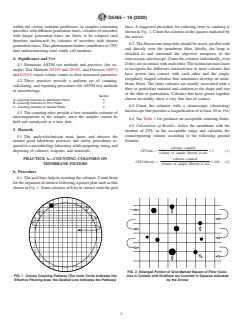
within the colony continue proliferate, in samples containing lines. A suggested procedure for reducing error in counting is
microbes with different generation times, colonies of microbes showninFig.2.Countthecoloniesinthesquaresindicatedby
with longer generation times are likely to be eclipsed (and
the arrows.
therefore undetected) by colonies of microbes with shorter
6.2 Thefluorescentlamptubeshouldbenearlyparallelwith
generationtimes.ThisphenomenonfurthercontributestoCFU
and directly over the membrane filter. Ideally, the lamp is
data underestimating total viable cell numbers.
attached to and surrounds the objective nosepiece of the
4. Significance and Use
stereoscopicmicroscope.Countthecoloniesindividually,even
iftheyareincontactwitheachother.Thetechnicianmustlearn
4.1 Numerous ASTM test methods and practices (for ex-
to recognize the difference between two or more colonies that
ample: Test Methods D5259 and D5392, and Practices D6974
have grown into contact with each other and the single,
and E2563) report colony counts as their measured parameter.
irregularly shaped colonies that sometimes develop on mem-
4.2 These practices provide a uniform set of counting,
brane filters. The latter colonies are usually associated with a
calculating, and reporting procedures for ASTM test methods
fiber or particulate material and conform to the shape and size
in microbiology.
of the fiber or particulates. Colonies that have grown together
Section
almost invariably show a very fine line of contact.
A—Counting Colonies on Membrane Filters 6
B—Counting Colonies on Pour Plates 7
6.3 Count the colonies with a stereoscopic (dissecting)
C—Counting Colonies on Spread Plates 8
microscope that provides a magnification of at least 10 to 15×.
4.3 The counting rules provide a best attainable estimate of
microorganisms in the sample, since the samples cannot be
6.4 See Table 1 for guidance on acceptable counting limits.
held and reanalyzed at a later date.
6.5 Calculation of Results—Select the membrane with the
5. Hazards
number of CFU in the acceptable range and calculate the
count/reporting volume according to the following general
5.1 The analyst/technician must know and observe the
normal good laboratory practices and safety procedures re- formula:
quiredinamicrobiologylaboratorywhilepreparing,using,and
colonies counted
CFU/mL 5 31 (1)
disposing of cultures, reagents, and materials.
volume of sample filtered in mL
colonies counted
PRACTICE A—COUNTING COLONIES ON
CFU/100 mL 5 3100 (2)
MEMBRANE FILTERS volume of sample filtered in mL
6. Procedure
6.1 Thegridlineshelpincountingthecolonies.Countthem
fortheorganismofinterestfollowingapresetplansuchasthat
showninFig.1.Somecolonieswillbeincontactwiththegrid
FIG. 2 Enlarged Portion of Grid-Marked Square of Filter (Colo-
FIG. 1 Colony Counting Pathway (The Inner Circle Indicates the nies in Contact with Gridlines are Counted in Squares Indicated
Effective Filtering Area; the Dashed Line Indicates the Pathway) by the Arrow)
D5465 − 16 (2020)
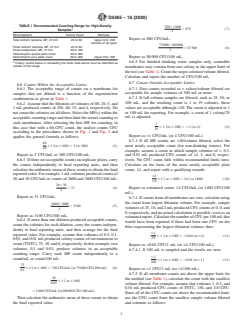
TABLE 1 Recommended Counting Range for High-Density
A
5875 (7)
Samples
Microorganism Colony Count Remarks
Report as 880 CFU/mL.
Total coliform bacteria, MF, 47 mm 20 to 60 Upper limit, 200
colonies of all types
Fecal coliform bacteria, MF, 47 mm 20 to 60
587500 (8)
Fecal streptococci, MF, 47 mm 20 to 100
Heterotrophic spread plate count 20 to 200
Heterotrophic pour plate count 30 to 300 Upper limit, 300 Report as 88000 CFU/100 mL.
A
6.6.5 For finished drinking water samples only, countable
Colony counts below or exceeding the limits cited above must be identified as
outside of this range.
membranes may contain from one colony to the upper limit of
thetest(seeTable1).Countthetargetcolonies/volumefiltered.
Calculate and report the number of CFU/100 mL.
6.7 Counts Outside Acceptable Limits:
6.6 Counts Within the Acceptable Limits:
6.7.1 Zero counts recorded as < values/volume filtered are
6.6.1 The acceptable range of counts on a membrane for
acceptable for sample volumes of 100 mL or more.
samples that are diluted is a function of the organism/test
6.7.2 If full-volume samples are filtered, such as 25, 50, or
combination as given in Table 1.
100 mL, and the resulting count is 1 to 19 colonies, these
6.6.2 Assume that the filtration of volumes of 80, 20, 5, and
values are acceptable although <20. The count is adjusted to 1
1 mL produced counts of 250, 60, 15, and 4, respectively. Do
or 100 mL for reporting. For example, a count of 1 colony/25
notcountthecoloniesonallfilters.SelecttheMF(s)withinthe
mL is adjusted:
acceptablecountingrangeandthenlimittheactualcountingto
such membranes. After selecting the best MF for counting, in
31 or 3100 5,1 or4 (9)
~ ! ~ !
this case that with a 60-CFU count, the analyst counts CFU
according to the procedures shown in Fig. 1 and Fig. 2 and
Report as <1 CFU/mL (or 4 CFU/100 mL).
applies the general formula as follows:
6.7.3 If all MF counts are <20/volume fi
...