


ASTM C1607-12(2016)
(Test Method)Standard Test Method for Determination of “Microwave Safe for Reheating” for Ceramicware
Standard Test Method for Determination of “Microwave Safe for Reheating” for Ceramicware
SIGNIFICANCE AND USE
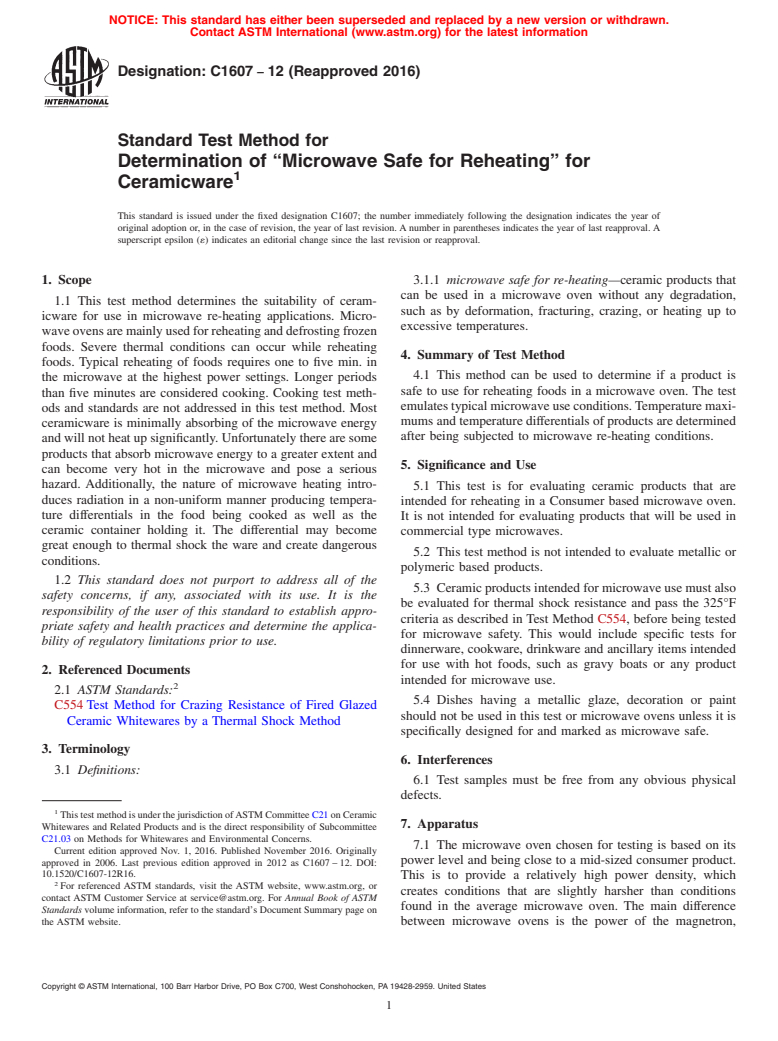
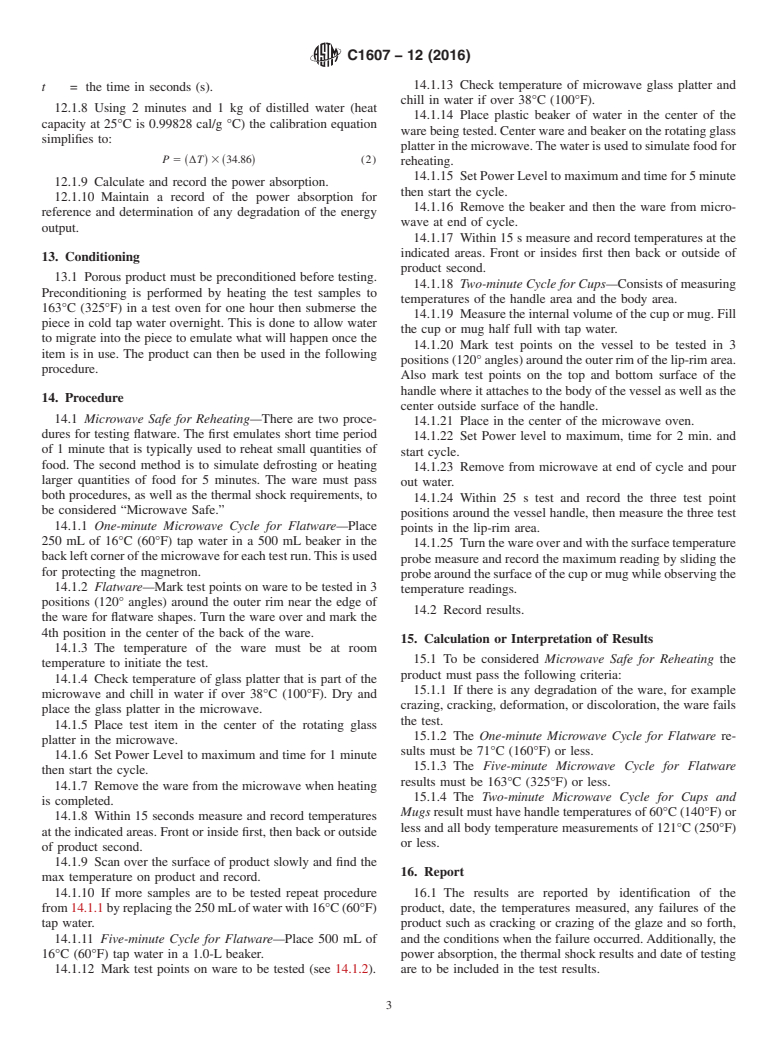
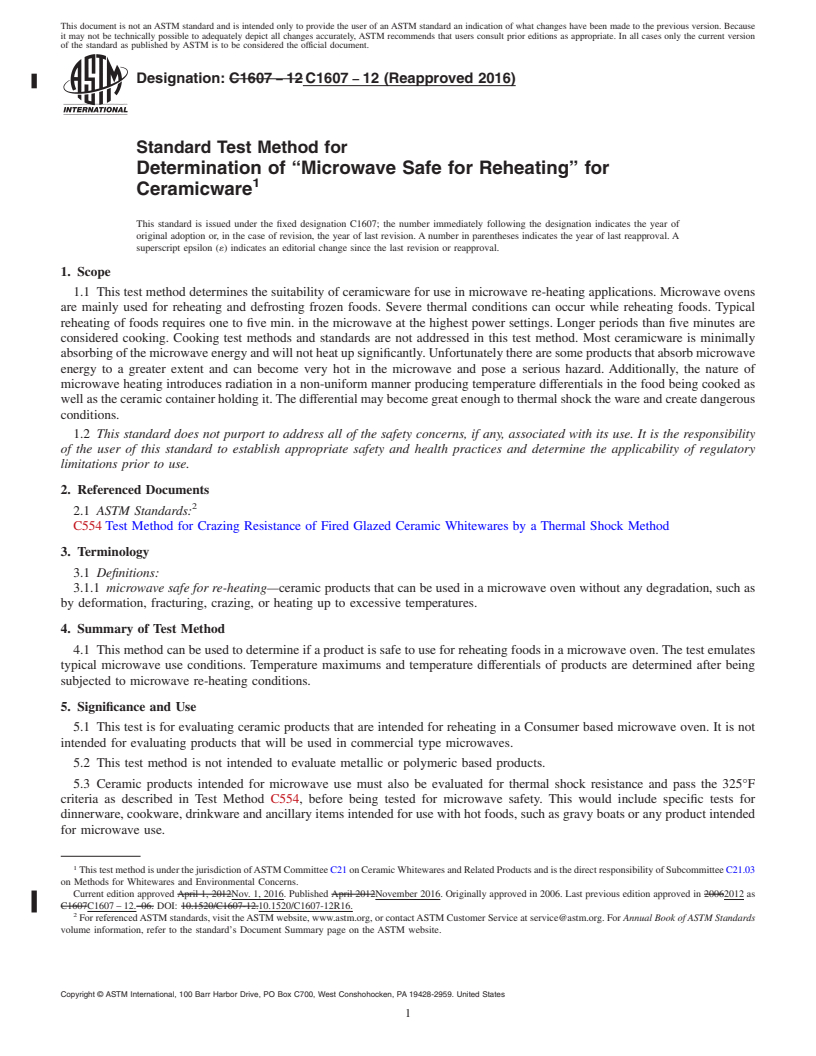
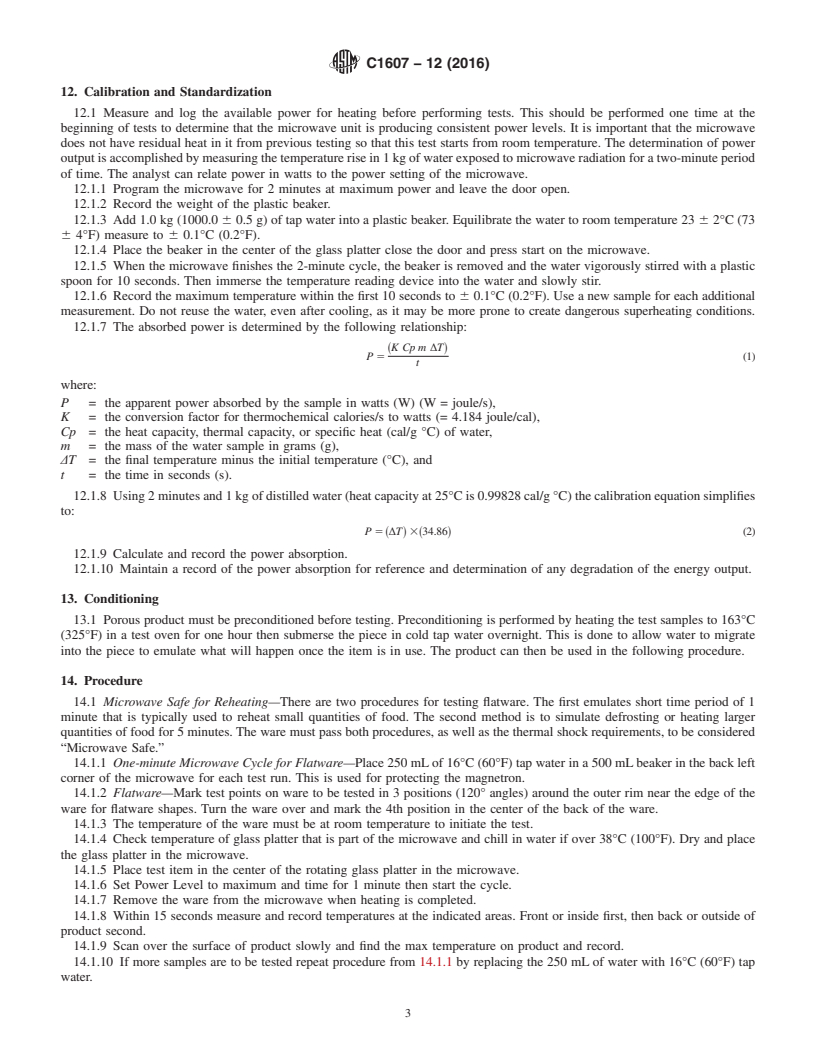
5.1 This test is for evaluating ceramic products that are intended for reheating in a Consumer based microwave oven. It is not intended for evaluating products that will be used in commercial type microwaves.
5.2 This test method is not intended to evaluate metallic or polymeric based products.
5.3 Ceramic products intended for microwave use must also be evaluated for thermal shock resistance and pass the 325°F criteria as described in Test Method C554, before being tested for microwave safety. This would include specific tests for dinnerware, cookware, drinkware and ancillary items intended for use with hot foods, such as gravy boats or any product intended for microwave use.
5.4 Dishes having a metallic glaze, decoration or paint should not be used in this test or microwave ovens unless it is specifically designed for and marked as microwave safe.
SCOPE
1.1 This test method determines the suitability of ceramicware for use in microwave re-heating applications. Microwave ovens are mainly used for reheating and defrosting frozen foods. Severe thermal conditions can occur while reheating foods. Typical reheating of foods requires one to five min. in the microwave at the highest power settings. Longer periods than five minutes are considered cooking. Cooking test methods and standards are not addressed in this test method. Most ceramicware is minimally absorbing of the microwave energy and will not heat up significantly. Unfortunately there are some products that absorb microwave energy to a greater extent and can become very hot in the microwave and pose a serious hazard. Additionally, the nature of microwave heating introduces radiation in a non-uniform manner producing temperature differentials in the food being cooked as well as the ceramic container holding it. The differential may become great enough to thermal shock the ware and create dangerous conditions.
1.2 This standard does not purport to address all of the safety concerns, if any, associated with its use. It is the responsibility of the user of this standard to establish appropriate safety and health practices and determine the applicability of regulatory limitations prior to use.
General Information
Buy Standard
Standards Content (Sample)
NOTICE: This standard has either been superseded and replaced by a new version or withdrawn.
Contact ASTM International (www.astm.org) for the latest information
Designation: C1607 − 12 (Reapproved 2016)
Standard Test Method for
Determination of “Microwave Safe for Reheating” for
Ceramicware
This standard is issued under the fixed designation C1607; the number immediately following the designation indicates the year of
original adoption or, in the case of revision, the year of last revision. A number in parentheses indicates the year of last reapproval. A
superscript epsilon (´) indicates an editorial change since the last revision or reapproval.
1. Scope 3.1.1 microwave safe for re-heating—ceramic products that
can be used in a microwave oven without any degradation,
1.1 This test method determines the suitability of ceram-
such as by deformation, fracturing, crazing, or heating up to
icware for use in microwave re-heating applications. Micro-
excessive temperatures.
waveovensaremainlyusedforreheatinganddefrostingfrozen
foods. Severe thermal conditions can occur while reheating
4. Summary of Test Method
foods. Typical reheating of foods requires one to five min. in
4.1 This method can be used to determine if a product is
the microwave at the highest power settings. Longer periods
safe to use for reheating foods in a microwave oven. The test
than five minutes are considered cooking. Cooking test meth-
emulates typical microwave use conditions.Temperature maxi-
ods and standards are not addressed in this test method. Most
mums and temperature differentials of products are determined
ceramicware is minimally absorbing of the microwave energy
after being subjected to microwave re-heating conditions.
and will not heat up significantly. Unfortunately there are some
products that absorb microwave energy to a greater extent and
5. Significance and Use
can become very hot in the microwave and pose a serious
hazard. Additionally, the nature of microwave heating intro-
5.1 This test is for evaluating ceramic products that are
duces radiation in a non-uniform manner producing tempera-
intended for reheating in a Consumer based microwave oven.
ture differentials in the food being cooked as well as the
It is not intended for evaluating products that will be used in
ceramic container holding it. The differential may become
commercial type microwaves.
great enough to thermal shock the ware and create dangerous
5.2 This test method is not intended to evaluate metallic or
conditions.
polymeric based products.
1.2 This standard does not purport to address all of the
5.3 Ceramic products intended for microwave use must also
safety concerns, if any, associated with its use. It is the
be evaluated for thermal shock resistance and pass the 325°F
responsibility of the user of this standard to establish appro-
criteria as described in Test Method C554, before being tested
priate safety and health practices and determine the applica-
for microwave safety. This would include specific tests for
bility of regulatory limitations prior to use.
dinnerware, cookware, drinkware and ancillary items intended
for use with hot foods, such as gravy boats or any product
2. Referenced Documents
intended for microwave use.
2.1 ASTM Standards:
5.4 Dishes having a metallic glaze, decoration or paint
C554 Test Method for Crazing Resistance of Fired Glazed
should not be used in this test or microwave ovens unless it is
Ceramic Whitewares by a Thermal Shock Method
specifically designed for and marked as microwave safe.
3. Terminology
6. Interferences
3.1 Definitions:
6.1 Test samples must be free from any obvious physical
defects.
This test method is under the jurisdiction ofASTM Committee C21 on Ceramic
7. Apparatus
Whitewares and Related Products and is the direct responsibility of Subcommittee
C21.03 on Methods for Whitewares and Environmental Concerns.
7.1 The microwave oven chosen for testing is based on its
Current edition approved Nov. 1, 2016. Published November 2016. Originally
power level and being close to a mid-sized consumer product.
approved in 2006. Last previous edition approved in 2012 as C1607 – 12. DOI:
10.1520/C1607-12R16.
This is to provide a relatively high power density, which
For referenced ASTM standards, visit the ASTM website, www.astm.org, or
creates conditions that are slightly harsher than conditions
contact ASTM Customer Service at service@astm.org. For Annual Book of ASTM
found in the average microwave oven. The main difference
Standards volume information, refer to the standard’s Document Summary page on
the ASTM website. between microwave ovens is the power of the magnetron,
Copyright © ASTM International, 100 Barr Harbor Drive, PO Box C700, West Conshohocken, PA 19428-2959. United States
C1607 − 12 (2016)
which generates the microwaves. Midsize and large ovens are possibility that the product attained temperatures that will
typically rated at 900 to 1300 watts and compact ovens have quickly burn through insulated oven mitts.
about 600 to 800 watts of output.
10. Sampling, Test Specimens, and Test Units
7.1.1 Greater wattage for a given space heats food more
quickly. The microwave oven chosen for this method is based
10.1 Representative sample(s) of the process generating the
on having the greatest power output per volume. This provides
products should be used. Check ware before testing for any
worse case conditions for microwaves available in the midsize
physical damage resulting from shipping or handling that
range while allowing for a greater range of sample sizes.
would not represent the process.
Microwaves with greater power outputs of 1400 and 1600
watts that were once available are no longer in production.
11. Preparation of Apparatus
7.1.2 Microwave Oven, (1350 Watts) with an internal oven
11.1 Only microwave models fulfilling the description in
3 3
cavity volume of approximately 0.045 M (1.58 ft ) dimen-
7.1 of this method should be used for testing. It is critical to
7 1
sions of 228 by 418 by 470 mm (9 by 16 ⁄16 by 18 ⁄2 in.) and
have the same power level of emitted microwaves in the same
rotating glass platter.
volume of space to achieve correlation between test sites.
7.2 Fast Reading Contact Surface Thermocouple Probe, or
suitable surface temperature reading device. 12. Calibration and Standardization
7.3 Scale, capable of reading 1200 6 0.5 g. 12.1 Measure and log the available power for heating before
performing tests. This should be performed one time at the
8. Reagents and Materials
beginning of tests to determine that the microwave unit is
8.1 Tap Water. producing consistent power levels. It is important that the
microwave does not have residual heat in it from previous
8.2 Plastic Beakers, 1 L, 500 mL; Graduate cylinder 250
testing so that this test starts from room temperature. The
mL.
determination of power output is accomplished by measuring
8.3 Eye Protection.
the temperature rise in 1 kg of water exposed to microwave
radiation for a two-minute period of time. The analyst can
8.4 Insulated Gloves or Oven Mitts, preferably waterproof.
relate power in watts to the power setting of the microwave.
8.5 Permanent Marker.
12.1.1 Program the microwave for 2 minutes at maximum
8.6 Boiling Stones.
power and leave the door open.
12.1.2 Record the weight of the plastic beaker.
9. Hazards
12.1.3 Add 1.0 kg (1000.0 6 0.5 g) of tap water into a
9.1 Thermal shock is possible during the testing of the
plastic beaker. Equilibrate the water to room temperature 23 6
product. Care should be taken while handling ware and be
2°C (73 6 4°F) measure to 6 0.1°C (0.2°F).
prepared for unexpected failure of the ware.
12.1.4 Place the beaker in the center of the glass platter
close the door and press start on the microwave.
9.2 Whenever heating water in a microwave there is the
12.1.5 When the microwave finishes the 2-minute cycle, the
possibility of super heating the water. Do not use distilled
beaker is removed and the water vigorously stirred with a
water, as it is more likely to superheat than tap water. If the
plastic spoon for 10 seconds. Then immerse the temperature
water is super heated it is possible that it will spontaneously
reading device into the water and slowly stir.
erupt splashing boiling hot water, which could potentially
12.1.6 Record the maximum temperature within the first 10
cause burns and injury. Always use boiling stones in the water
seconds to 6 0.1°C (0.2°F). Use a new sample for each
container when boiling water.
additional measurement.
...
This document is not an ASTM standard and is intended only to provide the user of an ASTM standard an indication of what changes have been made to the previous version. Because
it may not be technically possible to adequately depict all changes accurately, ASTM recommends that users consult prior editions as appropriate. In all cases only the current version
of the standard as published by ASTM is to be considered the official document.
Designation: C1607 − 12 C1607 − 12 (Reapproved 2016)
Standard Test Method for
Determination of “Microwave Safe for Reheating” for
Ceramicware
This standard is issued under the fixed designation C1607; the number immediately following the designation indicates the year of
original adoption or, in the case of revision, the year of last revision. A number in parentheses indicates the year of last reapproval. A
superscript epsilon (´) indicates an editorial change since the last revision or reapproval.
1. Scope
1.1 This test method determines the suitability of ceramicware for use in microwave re-heating applications. Microwave ovens
are mainly used for reheating and defrosting frozen foods. Severe thermal conditions can occur while reheating foods. Typical
reheating of foods requires one to five min. in the microwave at the highest power settings. Longer periods than five minutes are
considered cooking. Cooking test methods and standards are not addressed in this test method. Most ceramicware is minimally
absorbing of the microwave energy and will not heat up significantly. Unfortunately there are some products that absorb microwave
energy to a greater extent and can become very hot in the microwave and pose a serious hazard. Additionally, the nature of
microwave heating introduces radiation in a non-uniform manner producing temperature differentials in the food being cooked as
well as the ceramic container holding it. The differential may become great enough to thermal shock the ware and create dangerous
conditions.
1.2 This standard does not purport to address all of the safety concerns, if any, associated with its use. It is the responsibility
of the user of this standard to establish appropriate safety and health practices and determine the applicability of regulatory
limitations prior to use.
2. Referenced Documents
2.1 ASTM Standards:
C554 Test Method for Crazing Resistance of Fired Glazed Ceramic Whitewares by a Thermal Shock Method
3. Terminology
3.1 Definitions:
3.1.1 microwave safe for re-heating—ceramic products that can be used in a microwave oven without any degradation, such as
by deformation, fracturing, crazing, or heating up to excessive temperatures.
4. Summary of Test Method
4.1 This method can be used to determine if a product is safe to use for reheating foods in a microwave oven. The test emulates
typical microwave use conditions. Temperature maximums and temperature differentials of products are determined after being
subjected to microwave re-heating conditions.
5. Significance and Use
5.1 This test is for evaluating ceramic products that are intended for reheating in a Consumer based microwave oven. It is not
intended for evaluating products that will be used in commercial type microwaves.
5.2 This test method is not intended to evaluate metallic or polymeric based products.
5.3 Ceramic products intended for microwave use must also be evaluated for thermal shock resistance and pass the 325°F
criteria as described in Test Method C554, before being tested for microwave safety. This would include specific tests for
dinnerware, cookware, drinkware and ancillary items intended for use with hot foods, such as gravy boats or any product intended
for microwave use.
This test method is under the jurisdiction of ASTM Committee C21 on Ceramic Whitewares and Related Products and is the direct responsibility of Subcommittee C21.03
on Methods for Whitewares and Environmental Concerns.
Current edition approved April 1, 2012Nov. 1, 2016. Published April 2012November 2016. Originally approved in 2006. Last previous edition approved in 20062012 as
C1607C1607 – 12.–06. DOI: 10.1520/C1607-12.10.1520/C1607-12R16.
For referenced ASTM standards, visit the ASTM website, www.astm.org, or contact ASTM Customer Service at service@astm.org. For Annual Book of ASTM Standards
volume information, refer to the standard’s Document Summary page on the ASTM website.
Copyright © ASTM International, 100 Barr Harbor Drive, PO Box C700, West Conshohocken, PA 19428-2959. United States
C1607 − 12 (2016)
5.4 Dishes having a metallic glaze, decoration or paint should not be used in this test or microwave ovens unless it is specifically
designed for and marked as microwave safe.
6. Interferences
6.1 Test samples must be free from any obvious physical defects.
7. Apparatus
7.1 The microwave oven chosen for testing is based on its power level and being close to a mid-sized consumer product. This
is to provide a relatively high power density, which creates conditions that are slightly harsher than conditions found in the average
microwave oven. The main difference between microwave ovens is the power of the magnetron, which generates the microwaves.
Midsize and large ovens are typically rated at 900 to 1300 watts and compact ovens have about 600 to 800 watts of output.
7.1.1 Greater wattage for a given space heats food more quickly. The microwave oven chosen for this method is based on having
the greatest power output per volume. This provides worse case conditions for microwaves available in the midsize range while
allowing for a greater range of sample sizes. Microwaves with greater power outputs of 1400 and 1600 watts that were once
available are no longer in production.
3 3
7.1.2 Microwave Oven, (1350 Watts) with an internal oven cavity volume of approximately 0.045 M (1.58 ft ) dimensions of
7 1
228 by 418 by 470 mm (9 by 16 ⁄16 by 18 ⁄2 in.) and rotating glass platter.
7.2 Fast Reading Contact Surface Thermocouple Probe, or suitable surface temperature reading device.
7.3 Scale, capable of reading 1200 6 0.5 g.
8. Reagents and Materials
8.1 Tap Water.
8.2 Plastic Beakers, 1 L, 500 mL; Graduate cylinder 250 mL.
8.3 Eye Protection.
8.4 Insulated Gloves or Oven Mitts, preferably waterproof.
8.5 Permanent Marker.
8.6 Boiling Stones.
9. Hazards
9.1 Thermal shock is possible during the testing of the product. Care should be taken while handling ware and be prepared for
unexpected failure of the ware.
9.2 Whenever heating water in a microwave there is the possibility of super heating the water. Do not use distilled water, as
it is more likely to superheat than tap water. If the water is super heated it is possible that it will spontaneously erupt splashing
boiling hot water, which could potentially cause burns and injury. Always use boiling stones in the water container when boiling
water.
9.3 People with Pacemakers or any other life sustaining devices should not perform this test and should also not be in the area
when the test is performed.
9.4 While performing the test maintain a distance of at least 20 in. from the microwave oven when it is heating. This will reduce
any possible leakage of radiation 100 times. The more distance from the microwave the greater the reduction in any exposure.
9.5 Do not operate an oven that is damaged or suspected of being physically damaged.
9.6 If there is any damage to the door, hinges or door seals have the oven repaired and tested for microwave leakage.
9.7 Look for holes created by electrical arcing inside the oven and on the door and door frame.
9.8 Wear oven mitts or insulated gloves when handling hot samples. Always test the piece before handling as there is the
possibility that the product attained temperatures that will quickly burn through insulated oven mitts.
10. Sampling, Test Specimens, and Test Units
10.1 Representative sample(s) of the process generating the products should be used. Check ware before testing for any physical
damage resulting from shipping or handling that would not represent the process.
11. Preparation of Apparatus
11.1 Only microwave models fulfilling the description in 7.1 of this method should be used for testing. It is critical to have the
same power level of emitted microwaves in the same volume of space to achieve correlation between test sites.
C1607 − 12 (2016)
12. Calibration and Standardization
12.1 Measure and log the available power for heating before performing tests. This should be performed one time at the
beginning of tests to determine that the microwave unit is producing consistent power levels. It is important that the microwave
does not have residual heat in it from previous testin
...
Questions, Comments and Discussion
Ask us and Technical Secretary will try to provide an answer. You can facilitate discussion about the standard in here.