


ASTM F3249-24
(Specification)Standard Specification for Treestands, Climbing Sticks, and Tripod or Tower Stands
Standard Specification for Treestands, Climbing Sticks, and Tripod or Tower Stands
ABSTRACT
This specification establishes the requirements for treestands, climbing sticks, and tripod/tower stands that are used for hunting, photographing, or general observation. It covers ladder treestands; non-climbing, fixed position or hang-on treestands; climbing sticks (continuous); climbing sticks (sectional); and tripods or tower stands. It also applies to three types of climbing treestand: climbing treestand (hand climber), Type I; climbing treestand (sit/stand), Type II; and climbing treestand (sit/stand), Type III.
SCOPE
1.1 This specification covers requirements for treestands, climbing sticks, and tripod/tower stands that are used for hunting, photographing, or general observation. Furthermore, this specification establishes minimum warning and package labeling, instructional content, safety device requirements, and physical testing parameters. This is a performance based specification and is not intended to restrict design.
1.2 Partial utilization of this specification is prohibited. Any statement of compliance with this specification shall be a certification that the product tested meets all of the requirements of the specification in its entirety. A product that fails to meet any one of the requirements of this specification is considered to have failed this specification and shall not be sold with any indication that it meets parts of the specification.
1.3 The values stated in inch-pound units are to be regarded as standard. No other units of measurement are included in this standard.
1.4 This standard does not purport to address all of the safety concerns, if any, associated with its use. It is the responsibility of the user of this standard to establish appropriate safety, health, and environmental practices and determine the applicability of regulatory limitations prior to use.
1.5 This international standard was developed in accordance with internationally recognized principles on standardization established in the Decision on Principles for the Development of International Standards, Guides and Recommendations issued by the World Trade Organization Technical Barriers to Trade (TBT) Committee.
General Information
- Status
- Published
- Publication Date
- 31-Jan-2024
- Technical Committee
- F08 - Sports Equipment, Playing Surfaces, and Facilities
- Drafting Committee
- F08.18 - Treestands
Relations
- Replaces
ASTM F3249-20 - Standard Specification for Treestands, Climbing Sticks, and Tripod or Tower Stands - Effective Date
- 01-Feb-2024
- Effective Date
- 01-Feb-2024
- Effective Date
- 01-Feb-2024
- Effective Date
- 01-Feb-2024
- Effective Date
- 01-Feb-2024
Overview
ASTM F3249-24: Standard Specification for Treestands, Climbing Sticks, and Tripod or Tower Stands specifies requirements for products commonly used in hunting, outdoor observation, and wildlife photography. This international ASTM standard covers ladder treestands, fixed position (hang-on) treestands, climbing sticks (continuous and sectional), tripod and tower stands, and three types of climbing treestands. Its aim is to ensure safety, reliability, and clear user instructions for these elevated outdoor platforms.
Key Topics
- Product Scope:
ASTM F3249-24 applies to a comprehensive range of portable and elevated platforms for outdoor use, including:- Ladder treestands
- Fixed position/hang-on treestands
- Continuous and sectional climbing sticks
- Tripods and tower stands
- Climbing treestands: hand climber (Type I), sit/stand (Types II & III)
- Safety Requirements:
- Mandatory provision of a fall arrest system compliant with ASTM F2337 for ladder, fixed position, and climbing treestands
- Requirements for auxiliary safety devices like stabilizers for ladders and interconnection devices for climbing treestands
- Labeling and Warnings:
Each product must include:- Permanent, weather-resistant warning labels and date codes
- Information on load capacity and manufacturer contact
- Clear warnings regarding the use of fall arrest systems and the necessity of reading the instructions before use
- User Instructions:
- Every unit must include comprehensive printed and digital instructions (following ASTM F2123), with visual aids for setup and safety
- Performance Testing:
- Products must undergo repetitive load and static load testing to verify structural safety, corner/side stability, and seat reliability
- Failure criteria include any structural defects or deformations
Applications
ASTM F3249-24 is essential for manufacturers, retailers, and users of treestands and outdoor climbing aids, particularly in the following contexts:
- Hunting: Ensures that treestands and climbing sticks used by hunters meet rigorous safety and performance standards, reducing the risk of falls and injuries.
- Wildlife Photography and Observation: Provides peace of mind for bird watchers and photographers requiring stable, secure elevated platforms.
- Recreation and Outdoor Industry: Guides product development and quality assurance for companies producing outdoor access and observation equipment.
- Regulatory Compliance: Enables manufacturers and importers to demonstrate conformity to international standards, aiding in global market acceptance and legal defensibility.
This standard prohibits partial compliance claims, ensuring that every certified product has passed all requirements, supporting user safety and consumer confidence.
Related Standards
The following related ASTM standards are referenced within ASTM F3249-24:
- ASTM F2123: Practice for Treestand Instructions
Outlines requirements for instructional documentation accompanying treestands. - ASTM F2337: Test Method for Treestand Fall Arrest System
Specifies performance criteria for fall arrest harnesses. - ASTM F2128: Test Method for Treestand Repetitive Loading Capability
Describes procedures for verifying structural durability under repeated use. - ASTM F2275: Practice for Treestand Manufacturer Quality Assurance Program
Establishes quality processes for consistent production standards.
Adopting ASTM F3249-24 as part of safety management systems helps organizations in the outdoor recreation and hunting industry deliver reliable, clearly labeled, and tested products that meet user safety expectations.
Keywords: treestands, climbing sticks, tripod stands, tower stands, hunting safety, outdoor observation, fall arrest system, ASTM F3249-24, warning labels, product testing, user instructions, outdoor access equipment.
Buy Documents


ASTM F3249-24 - Standard Specification for Treestands, Climbing Sticks, and Tripod or Tower Stands
REDLINE ASTM F3249-24 - Standard Specification for Treestands, Climbing Sticks, and Tripod or Tower Stands
Frequently Asked Questions
ASTM F3249-24 is a technical specification published by ASTM International. Its full title is "Standard Specification for Treestands, Climbing Sticks, and Tripod or Tower Stands". This standard covers: ABSTRACT This specification establishes the requirements for treestands, climbing sticks, and tripod/tower stands that are used for hunting, photographing, or general observation. It covers ladder treestands; non-climbing, fixed position or hang-on treestands; climbing sticks (continuous); climbing sticks (sectional); and tripods or tower stands. It also applies to three types of climbing treestand: climbing treestand (hand climber), Type I; climbing treestand (sit/stand), Type II; and climbing treestand (sit/stand), Type III. SCOPE 1.1 This specification covers requirements for treestands, climbing sticks, and tripod/tower stands that are used for hunting, photographing, or general observation. Furthermore, this specification establishes minimum warning and package labeling, instructional content, safety device requirements, and physical testing parameters. This is a performance based specification and is not intended to restrict design. 1.2 Partial utilization of this specification is prohibited. Any statement of compliance with this specification shall be a certification that the product tested meets all of the requirements of the specification in its entirety. A product that fails to meet any one of the requirements of this specification is considered to have failed this specification and shall not be sold with any indication that it meets parts of the specification. 1.3 The values stated in inch-pound units are to be regarded as standard. No other units of measurement are included in this standard. 1.4 This standard does not purport to address all of the safety concerns, if any, associated with its use. It is the responsibility of the user of this standard to establish appropriate safety, health, and environmental practices and determine the applicability of regulatory limitations prior to use. 1.5 This international standard was developed in accordance with internationally recognized principles on standardization established in the Decision on Principles for the Development of International Standards, Guides and Recommendations issued by the World Trade Organization Technical Barriers to Trade (TBT) Committee.
ABSTRACT This specification establishes the requirements for treestands, climbing sticks, and tripod/tower stands that are used for hunting, photographing, or general observation. It covers ladder treestands; non-climbing, fixed position or hang-on treestands; climbing sticks (continuous); climbing sticks (sectional); and tripods or tower stands. It also applies to three types of climbing treestand: climbing treestand (hand climber), Type I; climbing treestand (sit/stand), Type II; and climbing treestand (sit/stand), Type III. SCOPE 1.1 This specification covers requirements for treestands, climbing sticks, and tripod/tower stands that are used for hunting, photographing, or general observation. Furthermore, this specification establishes minimum warning and package labeling, instructional content, safety device requirements, and physical testing parameters. This is a performance based specification and is not intended to restrict design. 1.2 Partial utilization of this specification is prohibited. Any statement of compliance with this specification shall be a certification that the product tested meets all of the requirements of the specification in its entirety. A product that fails to meet any one of the requirements of this specification is considered to have failed this specification and shall not be sold with any indication that it meets parts of the specification. 1.3 The values stated in inch-pound units are to be regarded as standard. No other units of measurement are included in this standard. 1.4 This standard does not purport to address all of the safety concerns, if any, associated with its use. It is the responsibility of the user of this standard to establish appropriate safety, health, and environmental practices and determine the applicability of regulatory limitations prior to use. 1.5 This international standard was developed in accordance with internationally recognized principles on standardization established in the Decision on Principles for the Development of International Standards, Guides and Recommendations issued by the World Trade Organization Technical Barriers to Trade (TBT) Committee.
ASTM F3249-24 is classified under the following ICS (International Classification for Standards) categories: 97.220.40 - Outdoor and water sports equipment. The ICS classification helps identify the subject area and facilitates finding related standards.
ASTM F3249-24 has the following relationships with other standards: It is inter standard links to ASTM F3249-20, ASTM F3545-23, ASTM F2128-22, ASTM F2275-21, ASTM F2123-23. Understanding these relationships helps ensure you are using the most current and applicable version of the standard.
ASTM F3249-24 is available in PDF format for immediate download after purchase. The document can be added to your cart and obtained through the secure checkout process. Digital delivery ensures instant access to the complete standard document.
Standards Content (Sample)
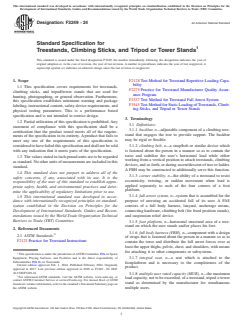
This international standard was developed in accordance with internationally recognized principles on standardization established in the Decision on Principles for the
Development of International Standards, Guides and Recommendations issued by the World Trade Organization Technical Barriers to Trade (TBT) Committee.
Designation: F3249 − 24 An American National Standard
Standard Specification for
Treestands, Climbing Sticks, and Tripod or Tower Stands
This standard is issued under the fixed designation F3249; the number immediately following the designation indicates the year of
original adoption or, in the case of revision, the year of last revision. A number in parentheses indicates the year of last reapproval. A
superscript epsilon (´) indicates an editorial change since the last revision or reapproval.
1. Scope F2128 Test Method for Treestand Repetitive Loading Capa-
bility
1.1 This specification covers requirements for treestands,
F2275 Practice for Treestand Manufacturer Quality Assur-
climbing sticks, and tripod/tower stands that are used for
ance Program
hunting, photographing, or general observation. Furthermore,
F2337 Test Method for Treestand Fall Arrest System
this specification establishes minimum warning and package
F3545 Test Method for Static Loading of Treestands, Climb-
labeling, instructional content, safety device requirements, and
ing Sticks, and Tripod or Tower Stands
physical testing parameters. This is a performance based
specification and is not intended to restrict design.
3. Terminology
1.2 Partial utilization of this specification is prohibited. Any
3.1 Definitions:
statement of compliance with this specification shall be a
3.1.1 backbar, n—adjustable component of a climbing tree-
certification that the product tested meets all of the require-
stand that engages the tree to provide support. The backbar
ments of the specification in its entirety. A product that fails to
may be rigid or flexible.
meet any one of the requirements of this specification is
considered to have failed this specification and shall not be sold 3.1.2 climbing belt, n—a strap/belt or similar device which
with any indication that it meets parts of the specification. is fastened about the person in a manner so as to contain the
torso and stabilize the user’s horizontal load while either
1.3 The values stated in inch-pound units are to be regarded
working from a vertical position to attach treestands, climbing
as standard. No other units of measurement are included in this
devices, and so forth, or during ascent/descent of tree or ladder.
standard.
A FBH may be constructed to additionally serve this function.
1.4 This standard does not purport to address all of the
3.1.3 corner stability, n—the ability of a treestand to resist
safety concerns, if any, associated with its use. It is the
eccentricity, twisting, or sudden movement when load is
responsibility of the user of this standard to establish appro-
applied separately to each of the four corners of a foot
priate safety, health, and environmental practices and deter-
platform.
mine the applicability of regulatory limitations prior to use.
3.1.4 fall arrest system, n—system that is assembled for the
1.5 This international standard was developed in accor-
dance with internationally recognized principles on standard- purpose of arresting an accidental fall of its user. A FAS
consists of a full body harness, lanyard, anchorage means,
ization established in the Decision on Principles for the
Development of International Standards, Guides and Recom- connecting hardware, climbing belt (for fixed position stands),
and suspension relief device.
mendations issued by the World Trade Organization Technical
Barriers to Trade (TBT) Committee.
3.1.5 foot platform, n—horizontal structural area of a tree-
stand on which the user stands and/or places his feet.
2. Referenced Documents
3.1.6 full body harness (FBH), n—component with a design
2.1 ASTM Standards:
of straps that is fastened about the person in a manner so as to
F2123 Practice for Treestand Instructions
contain the torso and distribute the fall arrest forces over at
least the upper thighs, pelvis, chest, and shoulders, with means
for attaching it to other components or subsystems.
This specification is under the jurisdiction of ASTM Committee F08 on Sports
Equipment, Playing Surfaces, and Facilities and is the direct responsibility of 3.1.7 integral seat, n—a seat which is attached to the
Subcommittee F08.18 on Treestands.
footplatform and is necessary to the completeness of the
Current edition approved Feb. 1, 2024. Published February 2024. Originally
product.
approved in 2017. Last previous edition approved in 2020 as F3249 – 20. DOI:
10.1520/F3249-24.
3.1.8 multiple user rated capacity (MUR), n—the maximum
For referenced ASTM standards, visit the ASTM website, www.astm.org, or
load capacity, not to be exceeded, of a treestand, tripod o tower
contact ASTM Customer Service at service@astm.org. For Annual Book of ASTM
stand as determined by the manufacturer for simultaneous
Standards volume information, refer to the standard’s Document Summary page on
the ASTM website. multiple users.
Copyright © ASTM International, 100 Barr Harbor Drive, PO Box C700, West Conshohocken, PA 19428-2959. United States
F3249 − 24
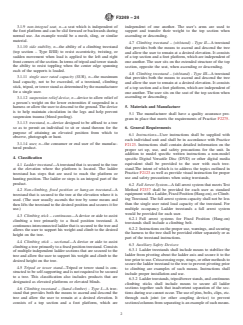
3.1.9 non-integral seat, n—a seat which is independent of independent of one another. The user’s arms are used to
the foot platform and can be slid forward or backwards during support and transfer their weight to the top section when
normal use. An example would be a mesh, sling, or similar ascending or descending.
material.
4.7 Climbing treestand – (sit/stand) - Type II—A treestand
3.1.10 side stability, n—the ability of a climbing treestand
that provides both the means to ascend and descend the tree
(top section – Type II/III) to resist eccentricity, twisting, or
and allow the user to remain at a desired elevation. It consists
sudden movement when load is applied to the left and right
of a top section and a foot platform, which are independent of
front corners of the section. In terms of tripod and tower stands
one another. The user sits on the extended structure of the top
the ability to resist toppling when the center edge spanning
section, opposite the seat, when ascending or descending.
each of the supports is loaded.
4.8 Climbing treestand – (sit/stand) - Type III—A treestand
3.1.11 single user rated capacity (SUR), n—the maximum
that provides both the means to ascend and descend the tree
load capacity, not to be exceeded, of a treestand, climbing
and allow the user to remain at a desired elevation. It consists
stick, tripod, or tower stand as determined by the manufacturer
of a top section and a foot platform, which are independent of
for a single user.
one another. The user sits on the seat of the top section when
ascending or descending.
3.1.12 suspension relief device, n—device to allow relief of
a person’s weight on the lower extremities if suspended in a
harness or allow the user to descend to the ground. The device 5. Materials and Manufacture
is to help maintain circulation in the legs and help prevent
5.1 The manufacturer shall have a quality assurance pro-
suspension trauma (blood pooling).
gram in place that meets the requirements of Practice F2275.
3.1.13 treestand, n—device designed to be affixed to a tree
so as to permit an individual to sit or stand thereon for the
6. General Requirements
purpose of attaining an elevated position from which to
6.1 Instructions—User instructions shall be supplied with
observe, photograph or hunt.
each individual unit and shall be in accordance with Practice
3.1.14 user, n—the consumer or end user of the manufac-
F2123. Instructions shall contain detailed information on the
tured product.
proper set up, use, and safety precautions for the unit. In
addition to model specific written instructions a non-model
4. Classification
specific Digital Versatile Disc (DVD) or other digital media
equivalent shall be provided to the user with each tree-
4.1 Ladder treestand—A treestand that is secured to the tree
stand.The intent of which is to address the topics outlined in
at the elevation where the platform is located. The ladder
Practice F2123 as well as provide visual instruction for proper
treestand has steps that are
...
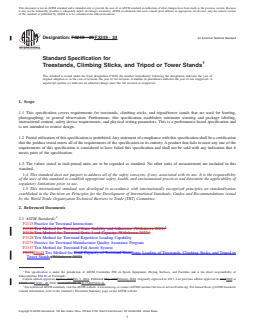
This document is not an ASTM standard and is intended only to provide the user of an ASTM standard an indication of what changes have been made to the previous version. Because
it may not be technically possible to adequately depict all changes accurately, ASTM recommends that users consult prior editions as appropriate. In all cases only the current version
of the standard as published by ASTM is to be considered the official document.
Designation: F3249 − 20 F3249 − 24 An American National Standard
Standard Specification for
Treestands, Climbing Sticks, and Tripod or Tower Stands
This standard is issued under the fixed designation F3249; the number immediately following the designation indicates the year of
original adoption or, in the case of revision, the year of last revision. A number in parentheses indicates the year of last reapproval. A
superscript epsilon (´) indicates an editorial change since the last revision or reapproval.
1. Scope
1.1 This specification covers requirements for treestands, climbing sticks, and tripod/tower stands that are used for hunting,
photographing, or general observation. Furthermore, this specification establishes minimum warning and package labeling,
instructional content, safety device requirements, and physical testing parameters. This is a performance based specification and
is not intended to restrict design.
1.2 Partial utilization of this specification is prohibited. Any statement of compliance with this specification shall be a certification
that the product tested meets all of the requirements of the specification in its entirety. A product that fails to meet any one of the
requirements of this specification is considered to have failed this specification and shall not be sold with any indication that it
meets parts of the specification.
1.3 The values stated in inch-pound units are to be regarded as standard. No other units of measurement are included in this
standard.
1.4 This standard does not purport to address all of the safety concerns, if any, associated with its use. It is the responsibility
of the user of this standard to establish appropriate safety, health, and environmental practices and determine the applicability of
regulatory limitations prior to use.
1.5 This international standard was developed in accordance with internationally recognized principles on standardization
established in the Decision on Principles for the Development of International Standards, Guides and Recommendations issued
by the World Trade Organization Technical Barriers to Trade (TBT) Committee.
2. Referenced Documents
2.1 ASTM Standards:
F2123 Practice for Treestand Instructions
F2125 Test Method for Treestand Static Stability and Adherence (Withdrawn 2022)
F2126 Test Method for Treestand Static Load Capacity (Withdrawn 2022)
F2128 Test Method for Treestand Repetitive Loading Capability
F2275 Practice for Treestand Manufacturer Quality Assurance Program
F2337 Test Method for Treestand Fall Arrest System
F2531F3545 Test Method for Load Capacity of Treestand SeatsStatic Loading of Treestands, Climbing Sticks, and Tripod or
Tower Stands (Withdrawn 2022)
This specification is under the jurisdiction of ASTM Committee F08 on Sports Equipment, Playing Surfaces, and Facilities and is the direct responsibility of
Subcommittee F08.18 on Treestands.
Current edition approved April 1, 2020Feb. 1, 2024. Published May 2020February 2024. Originally approved in 2017. Last previous edition approved in 20172020 as
F3249 – 17.F3249 – 20. DOI: 10.1520/F3249-20.10.1520/F3249-24.
For referenced ASTM standards, visit the ASTM website, www.astm.org, or contact ASTM Customer Service at service@astm.org. For Annual Book of ASTM Standards
volume information, refer to the standard’s Document Summary page on the ASTM website.
Copyright © ASTM International, 100 Barr Harbor Drive, PO Box C700, West Conshohocken, PA 19428-2959. United States
F3249 − 24
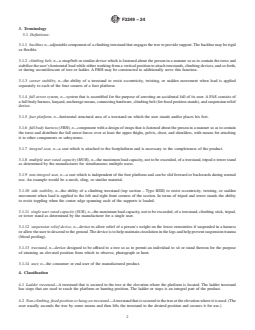
3. Terminology
3.1 Definitions:
3.1.1 backbar, n—adjustable component of a climbing treestand that engages the tree to provide support. The backbar may be rigid
or flexible.
3.1.2 climbing belt, n—a strap/belt or similar device which is fastened about the person in a manner so as to contain the torso and
stabilize the user’s horizontal load while either working from a vertical position to attach treestands, climbing devices, and so forth,
or during ascent/descent of tree or ladder. A FBH may be constructed to additionally serve this function.
3.1.3 corner stability, n—the ability of a treestand to resist eccentricity, twisting, or sudden movement when load is applied
separately to each of the four corners of a foot platform.
3.1.4 fall arrest system, n—system that is assembled for the purpose of arresting an accidental fall of its user. A FAS consists of
a full body harness, lanyard, anchorage means, connecting hardware, climbing belt (for fixed position stands), and suspension relief
device.
3.1.5 foot platform, n—horizontal structural area of a treestand on which the user stands and/or places his feet.
3.1.6 full body harness (FBH), n—component with a design of straps that is fastened about the person in a manner so as to contain
the torso and distribute the fall arrest forces over at least the upper thighs, pelvis, chest, and shoulders, with means for attaching
it to other components or subsystems.
3.1.7 integral seat, n—a seat which is attached to the footplatform and is necessary to the completeness of the product.
3.1.8 multiple user rated capacity (MUR), n—the maximum load capacity, not to be exceeded, of a treestand, tripod o tower stand
as determined by the manufacturer for simultaneous multiple users.
3.1.9 non-integral seat, n—a seat which is independent of the foot platform and can be slid forward or backwards during normal
use. An example would be a mesh, sling, or similar material.
3.1.10 side stability, n—the ability of a climbing treestand (top section – Type II/III) to resist eccentricity, twisting, or sudden
movement when load is applied to the left and right front corners of the section. In terms of tripod and tower stands the ability
to resist toppling when the center edge spanning each of the supports is loaded.
3.1.11 single user rated capacity (SUR), n—the maximum load capacity, not to be exceeded, of a treestand, climbing stick, tripod,
or tower stand as determined by the manufacturer for a single user.
3.1.12 suspension relief device, n—device to allow relief of a person’s weight on the lower extremities if suspended in a harness
or allow the user to descend to the ground. The device is to help maintain circulation in the legs and help prevent suspension trauma
(blood pooling).
3.1.13 treestand, n—device designed to be affixed to a tree so as to permit an individual to sit or stand thereon for the purpose
of attaining an elevated position from which to observe, photograph or hunt.
3.1.14 user, n—the consumer or end user of the manufactured product.
4. Classification
4.1 Ladder treestand—A treestand that is secured to the tree at the elevation where the platform is located. The ladder treestand
has steps that are used to reach the platform or hunting position. The ladder or steps is an integral part of the product.
4.2 Non-climbing, fixed position or hang-on treestand—A treestand that is secured to the tree at the elevation where it is used. (The
user usually ascends the tree by some means and then lifts the treestand to the desired position and secures it for use.)
F3249 − 24
4.3 Climbing stick – continuous—A device or aide to assist climbing a tree primarily to a fixed position treestand. A continuous
interconnected ladder that is secured to the tree and allows the user to support his weight and climb to the desired height on the
tree.
4.4 Climbing stick – sectional—A device or aide to assist climbing a tree primarily to a fixed position treestand. Consists of
multiple independent ladder sections that are secured to the tree and allow the user to support his weight and climb to the desired
height on the tree.
4.5 Tripod or tower stand—Tripod or tower stand is constructed to be self-supporting and is not required to be secured to a tree.
This classification also includes products that are designated as elevated platforms or elevated blinds.
4.6 Climbing treestand – (hand climber) - Type I—A treestand that provides both the means to ascend and descend the tree and
allow the user to remain at a desired elevation. It consists of a top section and a foot platform, which are independent of one
another. The user’s arms are used to support and transfer their weight to the top section when ascending or descending.
4.7 Climbing treestand – (sit/stand) - Type II—A treestand that provides both the means to ascend and descend the tree and allow
the user to remain at a desired elevation. It consists of a top section and a foot platform, which are independent of one another.
The user sits on the extended structure of the top section, opposite the seat, when ascending or descending.
4.8 Climbing treestand – (sit/stand) - Type III—A treestand that provides both the means to ascend and descend the tree and allow
the user to remain at a desired elevation. It consists of a top section and a foot platform, which are independent of one another.
The user sits on the seat of the top section when ascending or descending.
5. Materials and Manufacture
5.1 The manufacturer shall have a quality assurance program in place that meets the requirements of Practice F2275.
6. General Requirements
6.1 Instructions—User instructions shall be supplied with each individual unit and shall be in accordance with Practice F2123.
Instructions shall contain detailed information on the proper set up, use, and safety precautions for the unit. In addition to model
specific written instructions a non-model specific Digital Versatile Disc (DVD) or other digital media equivalent shall be prov
...
Questions, Comments and Discussion
Ask us and Technical Secretary will try to provide an answer. You can facilitate discussion about the standard in here.
Loading comments...