

ASTM E308-22
(Practice)Standard Practice for Computing the Colors of Objects by Using the CIE System
General Information
- Abstract
SIGNIFICANCE AND USE
5.1 The CIE colorimetric systems provide numerical specifications that are meant to indicate whether or not pairs of color stimuli match when viewed by a CIE standard observer. The CIE color systems are not intended to provide visually uniform scales of color difference or to describe visually perceived color appearances.
5.2 This practice provides for the calculation of tristimulus values X, Y, Z and chromaticity coordinates x, y that can be used directly for psychophysical color stimulus specification or that can be transformed to nearly visually uniform color scales, such as CIELAB and CIELUV. Uniform color scales are preferred for research, production control, color-difference calculation, color specification, and setting color tolerances. The appearance of a material or an object is not completely specified by the numerical evaluation of its psychophysical color, because appearance can be influenced by other properties such as gloss or texture.
SCOPE
1.1 This practice provides the values and practical computation procedures needed to obtain CIE tristimulus values from spectral reflectance, transmittance, or radiance data for object-color specimens.
1.2 Procedures and tables of standard values are given for computing from spectral measurements the CIE tristimulus values X, Y, Z, and chromaticity coordinates x, y for the CIE 1931 standard observer and X10, Y10, Z10 and x10. y10 for the CIE 1964 supplementary standard observer.
1.3 Standard values are included for the spectral power of six CIE standard illuminants and three CIE recommended fluorescent illuminants. Weight sets are included for tristimulus integration of nine standard or recommended CIE LED illuminants combined with the two standard CIE observers.
1.4 Procedures are included for cases in which data are available only in more limited wavelength ranges than those recommended, or for a measurement interval wider than that recommended by the CIE. This practice is applicable to spectral data obtained in accordance with Practice E1164 with 1-, 5-, 10-, or 20-nm measurement interval.
1.5 This practice includes procedures for conversion of results to color spaces that are part of the CIE system, such as CIELAB and CIELUV (3). Equations for calculating color differences in these and other systems are given in Practice D2244.
1.6 The values stated in SI units are to be regarded as standard. No other units of measurement are included in this standard.
1.7 This standard does not purport to address all of the safety concerns, if any, associated with its use. It is the responsibility of the user of this standard to establish appropriate safety, health, and environmental practices and determine the applicability of regulatory limitations prior to use.
1.8 This international standard was developed in accordance with internationally recognized principles on standardization established in the Decision on Principles for the Development of International Standards, Guides and Recommendations issued by the World Trade Organization Technical Barriers to Trade (TBT) Committee.
- Status
- Published
- Publication Date
- 31-Jul-2022
- Technical Committee
- E12 - Color and Appearance
- Drafting Committee
- E12.04 - Color and Appearance Analysis
Overview
ASTM E308-22, “Standard Practice for Computing the Colors of Objects by Using the CIE System,” is a critical international standard developed by ASTM International. It provides consistent procedures for calculating object color using the CIE colorimetric systems, ensuring reliable and repeatable color specification across a wide range of industries. This standard defines methods for computing the CIE tristimulus values (X, Y, Z) and chromaticity coordinates (x, y) from spectral data, using standard CIE observers and illuminants. While the CIE colorimetric systems help determine whether color stimuli match under specified conditions, they are not intended to represent visually uniform color differences or perceived color appearances.
Key Topics
- CIE Colorimetric Systems: Outlines the use of the CIE 1931 (2°) and CIE 1964 (10°) standard observers for color calculations.
- Spectral Measurements: Provides procedures for obtaining tristimulus values from spectral reflectance, transmittance, or radiance data, and supports measurement intervals of 1, 5, 10, or 20 nm.
- Illuminants and Weighting Factors: Covers standard values for six CIE standard illuminants, three fluorescent illuminants, and weighting sets for LED illuminants.
- Tristimulus Calculation: Details stepwise computation, including normalization and integration, to ensure consistent results.
- Transformation to Uniform Color Spaces: Supports conversion to more visually uniform scales such as CIELAB and CIELUV, which are widely used for research, production control, and color tolerance definition.
- Measurement Corrections: Includes guidance for data with limited wavelength ranges or wider measurement intervals, and procedures for bandpass correction as required by industry practice.
- Compliance and Safety: Emphasizes adhering to SI units and establishes the need for user awareness regarding safety, health, and environmental practices.
Applications
ASTM E308-22 is utilized extensively across industries requiring precise, reproducible color measurements and standardization:
- Quality Control in Manufacturing: Ensures products meet color specifications and tolerance requirements, supporting consistent brand identity and product appearance.
- Textiles and Plastics: Provides objective color computations for matching and quality assurance, critical in materials with tightly controlled visual properties.
- Paints, Coatings, and Inks: Enables accurate calculation of color attributes under defined illumination and observer conditions, supporting color matching and formulation.
- Research and Development: Facilitates conversion to uniform color spaces (e.g., CIELAB, CIELUV) for advanced color science studies, such as color difference evaluations.
- Digital Imaging and Printing: Applies to calibration and device profiling, helping manage color consistency in print and display technologies.
- Lighting and Illumination Design: References standard illuminants for simulation and product evaluation under typical viewing conditions.
Related Standards
Several standards complement ASTM E308-22 for a comprehensive color measurement and assessment workflow:
- ASTM D2244: Practice for Calculation of Color Tolerances and Color Differences from Instrumentally Measured Color Coordinates
- ASTM E1164: Practice for Obtaining Spectrometric Data for Object-Color Evaluation
- ASTM E313: Practice for Calculating Yellowness and Whiteness Indices
- ASTM E2022: Practice for Calculation of Weighting Factors for Tristimulus Integration
- ASTM E2729: Practice for Rectification of Spectrophotometric Bandpass Differences
- CIE S 014-1/E | ISO 11664-1: Standard Colorimetric Observers
- CIE S 014-2/E | ISO 11664-2: Colorimetric Illuminants
For reliable and standardized color computation, ASTM E308-22 remains a cornerstone practice, ensuring that color data are comparable, reproducible, and meaningful across the global value chain. Incorporating this standard in quality systems helps organizations maintain industry best practices in color measurement, essential for product development, manufacturing, and market acceptance.
Relations
- Refers
ASTM E1164-23 - Standard Practice for Obtaining Spectrometric Data for Object-Color Evaluation - Effective Date
- 01-Nov-2023
- Effective Date
- 01-Aug-2015
- Refers
ASTM E2729-09(2015) - Standard Practice for Rectification of Spectrophotometric Bandpass Differences - Effective Date
- 01-Apr-2015
- Effective Date
- 01-Jan-2015
- Effective Date
- 01-Jan-2015
- Effective Date
- 01-Jan-2015
- Effective Date
- 01-May-2014
- Effective Date
- 01-Nov-2013
- Effective Date
- 01-Jun-2013
- Effective Date
- 01-Jan-2013
- Refers
ASTM E1164-12e1 - Standard Practice for Obtaining Spectrometric Data for Object-Color Evaluation - Effective Date
- 01-Jul-2012
- Refers
ASTM E1164-12 - Standard Practice for Obtaining Spectrometric Data for Object-Color Evaluation - Effective Date
- 01-Jul-2012
- Effective Date
- 01-Jul-2012
- Effective Date
- 01-Jun-2011
- Refers
ASTM E2022-11 - Standard Practice for Calculation of Weighting Factors for Tristimulus Integration - Effective Date
- 01-Jun-2011
Get Certified
Connect with accredited certification bodies for this standard

BSMI (Bureau of Standards, Metrology and Inspection)
Taiwan's standards and inspection authority.
Sponsored listings
Frequently Asked Questions
ASTM E308-22 is a standard published by ASTM International. Its full title is "Standard Practice for Computing the Colors of Objects by Using the CIE System". This standard covers: SIGNIFICANCE AND USE 5.1 The CIE colorimetric systems provide numerical specifications that are meant to indicate whether or not pairs of color stimuli match when viewed by a CIE standard observer. The CIE color systems are not intended to provide visually uniform scales of color difference or to describe visually perceived color appearances. 5.2 This practice provides for the calculation of tristimulus values X, Y, Z and chromaticity coordinates x, y that can be used directly for psychophysical color stimulus specification or that can be transformed to nearly visually uniform color scales, such as CIELAB and CIELUV. Uniform color scales are preferred for research, production control, color-difference calculation, color specification, and setting color tolerances. The appearance of a material or an object is not completely specified by the numerical evaluation of its psychophysical color, because appearance can be influenced by other properties such as gloss or texture. SCOPE 1.1 This practice provides the values and practical computation procedures needed to obtain CIE tristimulus values from spectral reflectance, transmittance, or radiance data for object-color specimens. 1.2 Procedures and tables of standard values are given for computing from spectral measurements the CIE tristimulus values X, Y, Z, and chromaticity coordinates x, y for the CIE 1931 standard observer and X10, Y10, Z10 and x10. y10 for the CIE 1964 supplementary standard observer. 1.3 Standard values are included for the spectral power of six CIE standard illuminants and three CIE recommended fluorescent illuminants. Weight sets are included for tristimulus integration of nine standard or recommended CIE LED illuminants combined with the two standard CIE observers. 1.4 Procedures are included for cases in which data are available only in more limited wavelength ranges than those recommended, or for a measurement interval wider than that recommended by the CIE. This practice is applicable to spectral data obtained in accordance with Practice E1164 with 1-, 5-, 10-, or 20-nm measurement interval. 1.5 This practice includes procedures for conversion of results to color spaces that are part of the CIE system, such as CIELAB and CIELUV (3). Equations for calculating color differences in these and other systems are given in Practice D2244. 1.6 The values stated in SI units are to be regarded as standard. No other units of measurement are included in this standard. 1.7 This standard does not purport to address all of the safety concerns, if any, associated with its use. It is the responsibility of the user of this standard to establish appropriate safety, health, and environmental practices and determine the applicability of regulatory limitations prior to use. 1.8 This international standard was developed in accordance with internationally recognized principles on standardization established in the Decision on Principles for the Development of International Standards, Guides and Recommendations issued by the World Trade Organization Technical Barriers to Trade (TBT) Committee.
SIGNIFICANCE AND USE 5.1 The CIE colorimetric systems provide numerical specifications that are meant to indicate whether or not pairs of color stimuli match when viewed by a CIE standard observer. The CIE color systems are not intended to provide visually uniform scales of color difference or to describe visually perceived color appearances. 5.2 This practice provides for the calculation of tristimulus values X, Y, Z and chromaticity coordinates x, y that can be used directly for psychophysical color stimulus specification or that can be transformed to nearly visually uniform color scales, such as CIELAB and CIELUV. Uniform color scales are preferred for research, production control, color-difference calculation, color specification, and setting color tolerances. The appearance of a material or an object is not completely specified by the numerical evaluation of its psychophysical color, because appearance can be influenced by other properties such as gloss or texture. SCOPE 1.1 This practice provides the values and practical computation procedures needed to obtain CIE tristimulus values from spectral reflectance, transmittance, or radiance data for object-color specimens. 1.2 Procedures and tables of standard values are given for computing from spectral measurements the CIE tristimulus values X, Y, Z, and chromaticity coordinates x, y for the CIE 1931 standard observer and X10, Y10, Z10 and x10. y10 for the CIE 1964 supplementary standard observer. 1.3 Standard values are included for the spectral power of six CIE standard illuminants and three CIE recommended fluorescent illuminants. Weight sets are included for tristimulus integration of nine standard or recommended CIE LED illuminants combined with the two standard CIE observers. 1.4 Procedures are included for cases in which data are available only in more limited wavelength ranges than those recommended, or for a measurement interval wider than that recommended by the CIE. This practice is applicable to spectral data obtained in accordance with Practice E1164 with 1-, 5-, 10-, or 20-nm measurement interval. 1.5 This practice includes procedures for conversion of results to color spaces that are part of the CIE system, such as CIELAB and CIELUV (3). Equations for calculating color differences in these and other systems are given in Practice D2244. 1.6 The values stated in SI units are to be regarded as standard. No other units of measurement are included in this standard. 1.7 This standard does not purport to address all of the safety concerns, if any, associated with its use. It is the responsibility of the user of this standard to establish appropriate safety, health, and environmental practices and determine the applicability of regulatory limitations prior to use. 1.8 This international standard was developed in accordance with internationally recognized principles on standardization established in the Decision on Principles for the Development of International Standards, Guides and Recommendations issued by the World Trade Organization Technical Barriers to Trade (TBT) Committee.
ASTM E308-22 is classified under the following ICS (International Classification for Standards) categories: 17.180.20 - Colours and measurement of light. The ICS classification helps identify the subject area and facilitates finding related standards.
ASTM E308-22 has the following relationships with other standards: It is inter standard links to ASTM E1164-23, ASTM D2244-15a, ASTM E2729-09(2015), ASTM D2244-15, ASTM D2244-15e1, ASTM E313-15, ASTM D2244-14, ASTM E284-13b, ASTM E284-13a, ASTM E284-13, ASTM E1164-12e1, ASTM E1164-12, ASTM E284-12, ASTM D2244-11, ASTM E2022-11. Understanding these relationships helps ensure you are using the most current and applicable version of the standard.
ASTM E308-22 is available in PDF format for immediate download after purchase. The document can be added to your cart and obtained through the secure checkout process. Digital delivery ensures instant access to the complete standard document.
Standards Content (Sample)
This international standard was developed in accordance with internationally recognized principles on standardization established in the Decision on Principles for the
Development of International Standards, Guides and Recommendations issued by the World Trade Organization Technical Barriers to Trade (TBT) Committee.
Designation: E308 − 22
Standard Practice for
Computing the Colors of Objects by Using the CIE System
This standard is issued under the fixed designation E308; the number immediately following the designation indicates the year of
original adoption or, in the case of revision, the year of last revision. A number in parentheses indicates the year of last reapproval. A
superscript epsilon (´) indicates an editorial change since the last revision or reapproval.
This standard has been approved for use by agencies of the U.S. Department of Defense.
INTRODUCTION
Standardtables(Tables1–4)ofcolormatchingfunctionsandilluminantspectralpowerdistributions
have since 1931 been defined by the CIE, but the CIE has eschewed the role of preparing tables of
tristimulus weighting factors for the convenient calculation of tristimulus values. There have
subsequently appeared numerous compilations of tristimulus weighting factors in the literature with
disparity of data resulting from, for example, different selections of wavelength intervals and methods
of truncating abbreviated wavelength ranges. In 1970, Foster et al. (1) proposed conventions to
standardize these two features, and Stearns (2) published a more complete set of tables. Stearns’ work
andlaterpublicationssuchasthe1985revisionofE308havegreatlyreducedthesubstantialvariations
in methods for tristimulus computation that existed several decades ago.
The disparities among earlier tables were largely caused by the introduction of computations based
on 20-nm wavelength intervals. With the increasing precision of modern instruments, there is a
likelihood of a need for tables for narrower wavelength intervals. Stearns’ tables, based on a 10-nm
interval, did not allow the derivation of consistent tables with wavelength intervals less than 10 nm.
The 1-nm table must be designated the basic table if others with greater wavelength intervals are to
have the same white point, and this was the reason for the 1985 revision of E308, resulting in tables
that are included in the present revision as Tables 5.
1. Scope 1.4 Procedures are included for cases in which data are
available only in more limited wavelength ranges than those
1.1 This practice provides the values and practical compu-
recommended, or for a measurement interval wider than that
tation procedures needed to obtain CIE tristimulus values from
recommended by the CIE. This practice is applicable to
spectral reflectance, transmittance, or radiance data for object-
spectral data obtained in accordance with Practice E1164 with
color specimens.
1-, 5-, 10-, or 20-nm measurement interval.
1.2 Procedures and tables of standard values are given for
computing from spectral measurements the CIE tristimulus 1.5 This practice includes procedures for conversion of
values X, Y, Z, and chromaticity coordinates x, y for the CIE results to color spaces that are part of the CIE system, such as
1931 standard observer and X ,Y ,Z and x .y for the CIELAB and CIELUV (3). Equations for calculating color
10 10 10 10 10
CIE 1964 supplementary standard observer. differences in these and other systems are given in Practice
D2244.
1.3 Standard values are included for the spectral power of
six CIE standard illuminants and three CIE recommended
1.6 The values stated in SI units are to be regarded as
fluorescentilluminants.Weightsetsareincludedfortristimulus
standard. No other units of measurement are included in this
integration of nine standard or recommended CIE LED illu-
standard.
minants combined with the two standard CIE observers.
1.7 This standard does not purport to address all of the
safety concerns, if any, associated with its use. It is the
This practice is under the jurisdiction of ASTM Committee E12 on Color and
responsibility of the user of this standard to establish appro-
Appearance and is the direct responsibility of Subcommittee E12.04 on Color and
priate safety, health, and environmental practices and deter-
Appearance Analysis.
mine the applicability of regulatory limitations prior to use.
Current edition approved Aug. 1, 2022. Published August 2022. Originally
approved in 1966. Last previous edition approved in 2018 as E308 – 18. DOI:
1.8 This international standard was developed in accor-
10.1520/E0308-22.
2 dance with internationally recognized principles on standard-
The boldface numbers in parentheses refer to the list of references at the end of
this practice. ization established in the Decision on Principles for the
Copyright © ASTM International, 100 Barr Harbor Drive, PO Box C700, West Conshohocken, PA 19428-2959. United States
E308 − 22
Development of International Standards, Guides and Recom- 3.2.3 chromaticity, n—the color quality of a color stimulus
mendations issued by the World Trade Organization Technical definable by its chromaticity coordinates. E284
Barriers to Trade (TBT) Committee.
3.2.4 chromaticity coordinates, n—the ratio of each of the
tristimulus values of a psychophysical color to the sum of the
2. Referenced Documents
tristimulus values. E284
2.1 ASTM Standards:
3.2.4.1 Discussion—In the CIE 1931 standard colorimetric
D2244 Practice for Calculation of Color Tolerances and
system, the chromaticity coordinates are: x5X⁄~X 1 Y 1 Z!,y
Color Differences from Instrumentally Measured Color
5Y⁄ X 1 Y 1 Z ,z5Z⁄ X 1 Y 1 Z ; in the CIE 1964 colorimet-
~ ! ~ !
Coordinates
ric system, the same equations apply with all symbols having
E284 Terminology of Appearance
the subscript 10 (see 3.2.10).
E313 Practice for Calculating Yellowness and Whiteness
3.2.5 CIE, n—the abbreviation for the French title of the
Indices from Instrumentally Measured Color Coordinates
International Commission on Illumination, Commission Inter-
E1164 PracticeforObtainingSpectrometricDataforObject-
nationale de l’Éclairage. E284
Color Evaluation
E2022 Practice for Calculation of Weighting Factors for
3.2.6 CIE 1931 (x, y) chromaticity diagram,
Tristimulus Integration
n—chromaticity diagram for the CIE 1931 standard observer,
E2729 Practice for Rectification of Spectrophotometric
in which the CIE 1931 chromaticity coordinates are plotted,
Bandpass Differences
with x as abscissa and y as ordinate. E284
2.2 ANSI Standard:
3.2.7 CIE 1931 standard colorimetric system, n—a system
PH2.23 Lighting Conditions for Viewing Photographic
for determining the tristimulus values of any spectral power
Color Prints and Transparencies
distribution using the set of reference color stimuli, X, Y, Z and
2.3 CIE/ISO Standards:
the three CIE color-matching functions x¯(λ), y¯(λ), z¯(λ) adopted
ISO Standard 11664-1:2007(E)/CIE S 014-1/E:2006 Stan- by the CIE in 1931. E284
4,5
dard Colorimetric Observers
3.2.8 CIE 1931 standard observer, n—ideal colorimetric
ISO Standard 11664-2:2007(E)/CIE S 014-2/E:2006 Colori-
observer with color-matching functions x¯(λ), y¯(λ), z¯(λ) corre-
4,5
metric Illuminants
sponding to a field of view subtending a 2° angle on the retina;
CIE Standard D 001 Colorimetric Illuminants and Observers
commonly called the “2° standard observer.” E284
(Disk)
3.2.9 CIE 1964 (x ,y ) chromaticity diagram,
10 10
2.4 ASTM Adjuncts:
n—chromaticity diagram for the CIE 1964 standard observer,
Electronic file containing Tables 5
in which the CIE 1964 chromaticity coordinates are plotted,
with x as abscissa and y as ordinate. E284
10 10
3. Terminology
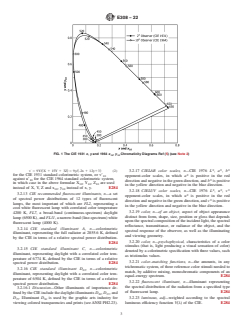
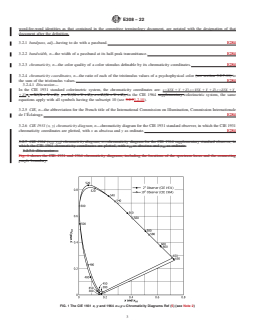
3.2.9.1 Discussion—Fig. 1 shows the CIE 1931 and 1964
3.1 Definitions of terms inTerminology E284 are applicable
chromaticity diagrams, including the locations of the spectrum
to this practice (see also Ref (4)).
locus and the connecting purple boundary.
3.2 Definitions—Definitions are listed in dictionary alpha-
3.2.10 CIE 1964 standard colorimetric system, n—a system
betical order which makes no distinction between capital and
for determining the tristimulus values of any spectral power
lower-case ordering of the letters of the alphabet, and disre-
distribution using the set of reference color stimuli X , Y ,
10 10
gards spaces between multiple-word definiens. Otherwise,
Z and the three CIE color-matching functions x¯ (λ), y¯ (λ),
10 10 10
order is determined by the UTF-8 value of the letter or symbol
z¯ (λ) adopted by the CIE in 1964 (see Note 1). E284
involved. Definitions that have the same meaning, but are not
necessarily word-for-word identities as that contained in the
NOTE 1—Users should be aware that the CIE 1964 (10°) system and
committee terminology document, are notated with the desig- standard observer assume no contribution or constant contribution of rods
tovision.Undersomecircumstances,suchasinviewinghighlymetameric
nation of that document after the definition.
pairs in very low light levels (where the rods are unsaturated), the amount
3.2.1 bandpass, adj—having to do with a passband. E284
of rod participation can vary between the members of the pair. This is not
3.2.2 bandwidth, n—the width of a passband at its half-peak
accounted for by any trichromatic system of colorimetry. The 10° system
and observer should be used with caution in such circumstances.
transmittance. E284
3.2.11 CIE 1964 standard observer, n—ideal colorimetric
observer with color-matching functions x¯ (λ), y¯ (λ), z¯ (λ)
10 10 10
For referenced ASTM standards, visit the ASTM website, www.astm.org, or
corresponding to a field of view subtending a 10° angle on the
contact ASTM Customer Service at service@astm.org. For Annual Book of ASTM
retina; commonly called the “10° standard observer” (see Note
Standards volume information, refer to the standard’s Document Summary page on
1). E284
the ASTM website.
Available from American National Standards Institute (ANSI), 25 W. 43rd St.,
3.2.12 CIE 1976 (u’, v’) or (u’ ,v’ ) chromaticity
10 10
4th Floor, New York, NY 10036, http://www.ansi.org.
diagram, n—the uniform-chromaticity-scale diagram produced
Available from CIE (International Commission on Illumination), http://
www.cie.co.at or http://www.techstreet.com. by plotting in rectangular coordinates v’ against u’, quantities
Electronically readable tables of tristimulus weight sets are available from
defined as follows:
ASTM Headquarters. Request Adjunct No. ADJE0308-EA. Originally approved in
'
2022. u 54X/ X 1 15Y 1 3Z 54x/ -2x 1 12y 1 3 (1)
~ ! ~ !
E308 − 22
FIG. 1 The CIE 1931 x, y and 1964 x ,y Chromaticity Diagrams Ref (5) (see Note 2)
10 10
'
v 59Y/ X 1 15Y 1 3Z 59y/ -2x 1 12y13 (2) 3.2.17 CIELAB color scales, n—CIE 1976 L*, a*, b*
~ ! ~ !
for the CIE 1931 standard colorimetric system, or v’
10 opponent-color scales, in which a* is positive in the red
against u’ for the CIE 1964 standard colorimetric system,
direction and negative in the green direction, and b* is positive
in which case in the above formulae X ,Y ,Z are used
10 10 10
in the yellow direction and negative in the blue direction.
instead of X, Y, Z and x ,y instead of x, y. E284
10 10
3.2.18 CIELUV color scales, n—CIE 1976 L*, u*, v*
3.2.13 CIE recommended fluorescent illuminants, n—a set
opponent-color scales, in which u* is positive in the red
of spectral power distributions of 12 types of fluorescent
direction and negative in the green direction, and v* is positive
lamps, the most important of which are FL2, representing a
in the yellow direction and negative in the blue direction.
cool white fluorescent lamp with correlated color temperature
3.2.19 color, n—of an object, aspect of object appearance
4200 K, FL7, a broad-band (continuous-spectrum) daylight
distinct from form, shape, size, position or gloss that depends
lamp(6500K),and FL11,anarrow-band(line-spectrum)white
upon the spectral composition of the incident light, the spectral
fluorescent lamp (4000 K).
reflectance, transmittance, or radiance of the object, and the
3.2.14 CIE standard illuminant A, n—colorimetric
spectral response of the observer, as well as the illuminating
illuminant, representing the full radiator at 2855.6 K, defined
and viewing geometry.
by the CIE in terms of a relative spectral power distribution.
3.2.20 color, n—psychophysical, characteristics of a color
E284
stimulus (that is, light producing a visual sensation of color)
3.2.15 CIE standard illuminant C, n—colorimetric
denoted by a colorimetric specification with three values, such
illuminant, representing daylight with a correlated color tem-
as tristimulus values.
perature of 6774 K, defined by the CIE in terms of a relative
3.2.21 color–matching functions, n—the amounts, in any
spectral power distribution. E284
trichromatic system, of three reference color stimuli needed to
3.2.16 CIE standard illuminant D ,n—colorimetric
match, by additive mixing, monochromatic components of an
illuminant, representing daylight with a correlated color tem-
equal–energy spectrum. E284
perature of 6504 K, defined by the CIE in terms of a relative
3.2.22 fluorescent illuminant, n—illuminant representing
spectral power distribution. E284
the spectral distribution of the radiation from a specified type
3.2.16.1 Discussion—Other illuminants of importance de-
of fluorescent lamp. E284
fined by the CIE include the daylight illuminants D , D , and
50 55
D . Illuminant D is used by the graphic arts industry for 3.2.23 luminous, adj—weighted according to the spectral
75 50
viewing colored transparencies and prints (see ANSI PH2.23). luminous efficiency function V(λ) of the CIE. E284
E308 − 22
3.2.24 opponent-color scales, n—scales that denote one 4.5 Calculations—CIE tristimulus values X, Y, Z or X , Y ,
10 10
color by positive scale values, the neutral axis by zero value, Z are calculated by numerical summation of the products of
and an approximately complementary color by negative scale tristimulus weighting factors for selected illuminants and
values, common examples being scales that are positive in the observers with the reflectance factors (or transmittance or
red direction and negative in the green direction, and those that radiance factors) making up the spectral data.
are positive in the yellow direction and negative in the blue
4.6 The tristimulus values so calculated may be further
direction. E284
converted to coordinates in a more nearly uniform color space
3.2.25 passband, n—a contiguous band of wavelengths in
such as CIELAB or CIELUV.
which at least a fraction of the incident light is selectively
5. Significance and Use
transmitted by a light-modulating device or medium. E284
3.2.26 spectral, adj—for radiometric quantities, pertaining
5.1 The CIE colorimetric systems provide numerical speci-
to monochromatic radiation at a specified wavelength or, by ficationsthataremeanttoindicatewhetherornotpairsofcolor
extension, to radiation within a narrow wavelength band about
stimuli match when viewed by a CIE standard observer. The
a specified wavelength. E284
CIE color systems are not intended to provide visually uniform
scales of color difference or to describe visually perceived
3.2.27 standard illuminant, n—a luminous flux, specified by
color appearances.
its spectral distribution, meeting specifications adopted by a
standardizing organization. E284
5.2 This practice provides for the calculation of tristimulus
values X, Y, Z and chromaticity coordinates x, y that can be
3.2.28 tristimulus values, n—of a color stimulus, three
used directly for psychophysical color stimulus specification or
amounts of the primary color stimuli required to make an
that can be transformed to nearly visually uniform color scales,
additive match to the color stimulus under consideration. E284
such as CIELAB and CIELUV. Uniform color scales are
3.2.29 tristimulus weighting factors, Sx¯, Sy¯, Sz¯, n—factors
preferred for research, production control, color-difference
obtainedfromproductsofthespectralpowerSofanilluminant
calculation, color specification, and setting color tolerances.
and the spectral color-matching functions x¯, y¯, z¯ (or x¯ ,y¯ ,
10 10
The appearance of a material or an object is not completely
z¯ )ofanobserver,usuallytabulatedatwavelengthintervalsof
specified by the numerical evaluation of its psychophysical
10 nm, used to compute tristimulus values by multiplication by
color, because appearance can be influenced by other proper-
the spectral reflectance, transmittance, or radiance (or the
ties such as gloss or texture.
corresponding factors) and summation. E284
3.2.29.1 Discussion—Proper account should be taken of the 6. Procedure
spectral bandpass of the measuring instrument. See Practice
6.1 Selecting Standard Observer—When colorimetric re-
E2729.
sults are required that will be compared with previous results
obtained for the CIE 1931 standard observer, use the values in
4. Summary of Practice
Table 1 for that observer. When new results are being
4.1 Selection of Parameters—The user of this practice must
computed, consider using the values in Table 2 for the CIE
select values of the following parameters:
1964 standard observer, but see Note 1.
4.1.1 Observer—Select either the CIE 1931 standard colo-
6.1.1 Whenever correlation with visual observations using
rimetric observer (2° observer) or the CIE 1964 supplementary
fields of angular subtense between about 1° and about 4° at the
standard observer (10° observer), tabulated in this practice,
eye of the observer is desired, select the CIE 1931 standard
CIE Standard S 013 or D 001, or Ref (3) (see Note 1).
colorimetric observer.
4.1.2 Illuminant—Select one of the CIE standard or recom-
6.1.2 Whenever correlation with visual observations using
mended illuminants tabulated in this practice, CIE Standard
fields of angular subtense greater than 4° at the eye of the
S 014 or D 001, or Ref (3) (see 3.2.22).
observer is desired, select the CIE 1964 supplementary stan-
4.1.3 Measurement Interval—Select the measurement inter-
dard colorimetric observer (but see Note 1).
val of the available spectral data. This practice provides for 1-,
6.2 Selecting Standard or Recommended Illuminants—
5-, 10-, or 20-nm measurement intervals. For best practice the
Select illuminants according to the type of light(s) under which
measurement interval should be selected to be as nearly as
objects will be viewed or for which their colors will be
possible equal to the instrument bandpass.
specified or evaluated.
4.2 Procedures—For data obtained at 1- or 5-nm measure-
6.2.1 When incandescent (tungsten) lamplight is involved,
ment intervals, the procedures of 7.2 should be followed.
use values for CIE illuminant A.
4.3 For data obtained at 10- or 20-nm measurement 6.2.2 When daylight is involved, use values for CIE illumi-
intervals, the tables of tristimulus weighting factors contained nant C or D .
in Tables 5 should be used with spectral data that have been 6.2.3 When fluorescent-lamp illumination is involved, use
corrected for bandpass dependence. For standard methods of 4200 K standard cool white (FL2) unless results are desired for
making such a correction see Practice E2729. 6500 K broad-band daylight (FL7) or 4000 K narrow-band
white (FL11) fluorescent illumination.
4.4 Aflow chart to ensure the use of proper combinations of
data and tables is given in Fig. 2. The procedures of the 6.3 Selecting the Measurement Interval—For greater accu-
practice are given in detail in 7.1. racy select the 5-nm measurement interval over the 10-nm
E308 − 22
Figure Note—References to Section 7. Calculations are included.
FIG. 2 Flow Chart for Selecting Methods and Tables for Tristimulus Integration
E308 − 22
TABLE 1 Spectral Tristimulus Values (Color-Matching Functions) x¯, y¯, z¯, of the CIE 1931 Standard (2°) Observer,
at 5 nm Intervals from 380 to 780 nm (See Note 2 and Ref (3))
λ(nm) x¯(λ) y¯(λ) z¯ (λ)
380 0.0014 0.0000 0.0065
385 0.0022 0.0001 0.0105
390 0.0042 0.0001 0.0201
395 0.0076 0.0002 0.0362
400 0.0143 0.0004 0.0679
405 0.0232 0.0006 0.1102
410 0.0435 0.0012 0.2074
415 0.0776 0.0022 0.3713
420 0.1344 0.0040 0.6456
425 0.2148 0.0073 1.0391
430 0.2839 0.0116 1.3856
435 0.3285 0.0168 1.6230
440 0.3483 0.0230 1.7471
445 0.3481 0.0298 1.7826
450 0.3362 0.0380 1.7721
455 0.3187 0.0480 1.7441
460 0.2908 0.0600 1.6692
465 0.2511 0.0739 1.5281
470 0.1954 0.0910 1.2876
475 0.1421 0.1126 1.0419
480 0.0956 0.1390 0.8130
485 0.0580 0.1693 0.6162
490 0.0320 0.2080 0.4652
495 0.0147 0.2586 0.3533
500 0.0049 0.3230 0.2720
505 0.0024 0.4073 0.2123
510 0.0093 0.5030 0.1582
515 0.0291 0.6082 0.1117
520 0.0633 0.7100 0.0782
525 0.1096 0.7932 0.0573
530 0.1655 0.8620 0.0422
535 0.2257 0.9149 0.0298
540 0.2904 0.9540 0.0203
545 0.3597 0.9803 0.0134
550 0.4334 0.9950 0.0087
555 0.5121 1.0000 0.0057
560 0.5945 0.9950 0.0039
565 0.6784 0.9786 0.0027
570 0.7621 0.9520 0.0021
575 0.8425 0.9154 0.0018
580 0.9163 0.8700 0.0017
585 0.9786 0.8163 0.0014
590 1.0263 0.7570 0.0011
595 1.0567 0.6949 0.0010
600 1.0622 0.6310 0.0008
605 1.0456 0.5668 0.0006
610 1.0026 0.5030 0.0003
615 0.9384 0.4412 0.0002
620 0.8544 0.3810 0.0002
625 0.7514 0.3210 0.0001
630 0.6424 0.2650 0.0000
635 0.5419 0.2170 0.0000
640 0.4479 0.1750 0.0000
645 0.3608 0.1382 0.0000
650 0.2835 0.1070 0.0000
655 0.2187 0.0816 0.0000
660 0.1649 0.0610 0.0000
665 0.1212 0.0446 0.0000
670 0.0874 0.0320 0.0000
675 0.0636 0.0232 0.0000
680 0.0468 0.0170 0.0000
685 0.0329 0.0119 0.0000
E308 − 22
TABLE 1 Continued
λ(nm) x¯(λ) y¯(λ) z¯ (λ)
690 0.0227 0.0082 0.0000
695 0.0158 0.0057 0.0000
700 0.0114 0.0041 0.0000
705 0.0081 0.0029 0.0000
710 0.0058 0.0021 0.0000
715 0.0041 0.0015 0.0000
720 0.0029 0.0010 0.0000
725 0.0020 0.0007 0.0000
730 0.0014 0.0005 0.0000
735 0.0010 0.0004 0.0000
740 0.0007 0.0002 0.0000
745 0.0005 0.0002 0.0000
750 0.0003 0.0001 0.0000
755 0.0002 0.0001 0.0000
760 0.0002 0.0001 0.0000
765 0.0001 0.0000 0.0000
770 0.0001 0.0000 0.0000
775 0.0001 0.0000 0.0000
780 0.0000 0.0000 0.0000
Summation at 5 nm intervals:
^x¯ (λ) = 21.3714
^y¯ (λ) = 21.3711
^z¯ (λ) = 21.3715
interval where spectral data are available at 5-nm intervals.
Z 5 k R λ S λ z¯ λ dλ
* ~ ! ~ ! ~ !
Likewise, select the 10-nm measurement interval over the
λ
20-nm interval where spectral data are available at 10-nm
where:
intervals. If the 20-nm interval is selected, users should assure
R(λ) = the reflectance, transmittance, or radiance
themselves that the resulting accuracy is sufficient for the
factor (on a scale of zero to one for the
purpose for which the results are intended.
perfect reflecting diffuser),
6.3.1 If the instrument used has a selectable measurement
S(λ) = the relative spectral power of a CIE stan-
interval, select the interval that most nearly equals the band-
dard illuminant, and
width of the instrument throughout the spectrum. If the
x¯(λ), y¯(λ), z¯(λ) = the color-matching functions of one of the
instrument has an adjustable bandwidth, adjust the bandwidth
CIE standard observers.
to be approximately equal to the measurement interval.
The integration is carried out over the entire wavelength
6.3.2 The measurement interval should be commensurate
region in which the color-matching functions are defined, 360
with the bandwidth. A much greater interval would under-
to 830 nm. The normalizing factor k is defined as
sample the spectrum, and a much smaller interval would not
improve the accuracy of the computation.
k 5 100/ S λ y¯ λ dλ (4)
* ~ ! ~ !
λ
6.4 Other Miscellaneous Conditions—While the above se-
lections cover the majority of industrial practices, the possibil-
The CIE notes that in all practical calculations of tristimulus
ity exists that other conditions could be encountered.
values the integration is approximated by a summation, giving
Therefore, other procedures than those included in this practice
the equations as follows:
may be used provided that the results are consistent with those
obtained by use of the procedures in the practice.
X 5 k R~λ! S~λ! x¯~λ! ∆λ (5)
(
λ
7. Calculations
Y 5 k R~λ! S~λ! y¯~λ! ∆λ
7.1 General Procedures—The general procedures for com- (
λ
puting CIE tristimulus values are summarized as follows:
7.1.1 Procedures as Specified by the CIE—The CIE proce-
Z 5 k R λ S λ z¯ λ ∆λ
~ ! ~ ! ~ !
(
dures are specified in Ref (3) and summarized in Refs (5-9).
λ
The fundamental definition is in terms of integrals,
with:
X 5 k R λ S λ x¯ λ dλ (3)
* ~ ! ~ ! ~ !
k 5 100/ S~λ!y¯~λ! ∆λ (6)
(
λ
λ
7.1.2 Procedure Using Tristimulus Weighting Factors—It is
Y 5 k R~λ! S~λ! y¯~λ! dλ
*
λ common industrial practice to carry out the summation to
E308 − 22
TABLE 2 Spectral Tristimulus Values (Color-Matching Functions) x¯ ,y¯ ,z¯ , of the CIE 1964 Supplementary Standard (10°) Observer,
10 10 10
At 5 nm Intervals from 380 to 780 nm (See Note 2 and Ref (3))
λ(nm) x¯ (λ) y¯ (λ) z¯ (λ)
10 10 10
380 0.0002 0.0000 0.0007
385 0.0007 0.0001 0.0029
390 0.0024 0.0003 0.0105
395 0.0072 0.0008 0.0323
400 0.0191 0.0020 0.0860
405 0.0434 0.0045 0.1971
410 0.0847 0.0088 0.3894
415 0.1406 0.0145 0.6568
420 0.2045 0.0214 0.9725
425 0.2647 0.0295 1.2825
430 0.3147 0.0387 1.5535
435 0.3577 0.0496 1.7985
440 0.3837 0.0621 1.9673
445 0.3867 0.0747 2.0273
450 0.3707 0.0895 1.9948
455 0.3430 0.1063 1.9007
460 0.3023 0.1282 1.7454
465 0.2541 0.1528 1.5549
470 0.1956 0.1852 1.3176
475 0.1323 0.2199 1.0302
480 0.0805 0.2536 0.7721
485 0.0411 0.2977 0.5701
490 0.0162 0.3391 0.4153
495 0.0051 0.3954 0.3024
500 0.0038 0.4608 0.2185
505 0.0154 0.5314 0.1592
510 0.0375 0.6067 0.1120
515 0.0714 0.6857 0.0822
520 0.1177 0.7618 0.0607
525 0.1730 0.8233 0.0431
530 0.2365 0.8752 0.0305
535 0.3042 0.9238 0.0206
540 0.3768 0.9620 0.0137
545 0.4516 0.9822 0.0079
550 0.5298 0.9918 0.0040
555 0.6161 0.9991 0.0011
560 0.7052 0.9973 0.0000
565 0.7938 0.9824 0.0000
570 0.8787 0.9556 0.0000
575 0.9512 0.9152 0.0000
580 1.0142 0.8689 0.0000
585 1.0743 0.8256 0.0000
590 1.1185 0.7774 0.0000
595 1.1343 0.7204 0.0000
600 1.1240 0.6583 0.0000
605 1.0891 0.5939 0.0000
610 1.0305 0.5280 0.0000
615 0.9507 0.4618 0.0000
620 0.8563 0.3981 0.0000
625 0.7549 0.3396 0.0000
630 0.6475 0.2835 0.0000
635 0.5351 0.2283 0.0000
640 0.4316 0.1798 0.0000
645 0.3437 0.1402 0.0000
650 0.2683 0.1076 0.0000
655 0.2043 0.0812 0.0000
660 0.1526 0.0603 0.0000
665 0.1122 0.0441 0.0000
670 0.0813 0.0318 0.0000
675 0.0579 0.0226 0.0000
680 0.0409 0.0159 0.0000
685 0.0286 0.0111 0.0000
E308 − 22
TABLE 2 Continued
λ(nm) x¯ (λ) y¯ (λ) z¯ (λ)
10 10 10
690 0.0199 0.0077 0.0000
695 0.0138 0.0054 0.0000
700 0.0096 0.0037 0.0000
705 0.0066 0.0026 0.0000
710 0.0046 0.0018 0.0000
715 0.0031 0.0012 0.0000
720 0.0022 0.0008 0.0000
725 0.0015 0.0006 0.0000
730 0.0010 0.0004 0.0000
735 0.0007 0.0003 0.0000
740 0.0005 0.0002 0.0000
745 0.0004 0.0001 0.0000
750 0.0003 0.0001 0.0000
755 0.0002 0.0001 0.0000
760 0.0001 0.0000 0.0000
765 0.0001 0.0000 0.0000
770 0.0001 0.0000 0.0000
775 0.0000 0.0000 0.0000
780 0.0000 0.0000 0.0000
Summation at 5 nm intervals:
^x¯ (λ) = 23.3294
^y¯ (λ) = 23.3324
^z¯ (λ) = 23.3343
tristimulus values in two steps. In the first of these, a set of 7.2 Summary of Calculations (see Note 2)—A general
normalized tristimulus weighting factors W,W,W is calcu- outline of the procedure is given in Fig. 2 in the form of a flow
x y z
lated as follows: chart.
W ~λ! 5kS~λ! x¯~λ!∆λ (7)
x NOTE 3—For reflecting materials, calculate tristimulus values from
spectral data obtained relative to the perfect reflecting diffuser. For
W λ 5 kS λ y¯ λ ∆λ
~ ! ~ ! ~ !
transmitting materials, calculate by use of the incident light as the
y
reference.
W λ 5 kS λ z¯ λ ∆λ
~ ! ~ ! ~ !
z
7.2.1 Procedure for 1-nm Measurement Interval—Use the
for λ = 360, . 780 nm, (see Note 2), and
1-nm spectral data in CIE S 014 and S 013 (or on CIE D 001
where:
Disk) and (Eq 6) and (Eq 7).
7.2.2 Procedures for Spectral Data:
k 5 100/ S λ y¯ λ ∆λ (8)
~ ! ~ !
(
7.
...
This document is not an ASTM standard and is intended only to provide the user of an ASTM standard an indication of what changes have been made to the previous version. Because
it may not be technically possible to adequately depict all changes accurately, ASTM recommends that users consult prior editions as appropriate. In all cases only the current version
of the standard as published by ASTM is to be considered the official document.
Designation: E308 − 18 E308 − 22
Standard Practice for
Computing the Colors of Objects by Using the CIE System
This standard is issued under the fixed designation E308; the number immediately following the designation indicates the year of
original adoption or, in the case of revision, the year of last revision. A number in parentheses indicates the year of last reapproval. A
superscript epsilon (´) indicates an editorial change since the last revision or reapproval.
This standard has been approved for use by agencies of the U.S. Department of Defense.
INTRODUCTION
Standard tables (Tables 1–4) of color matching functions and illuminant spectral power distributions
have since 1931 been defined by the CIE, but the CIE has eschewed the role of preparing tables of
tristimulus weighting factors for the convenient calculation of tristimulus values. There have
subsequently appeared numerous compilations of tristimulus weighting factors in the literature with
disparity of data resulting from, for example, different selections of wavelength intervals and methods
of truncating abbreviated wavelength ranges. In 1970, Foster et al. (1) proposed conventions to
standardize these two features, and Stearns (2) published a more complete set of tables. Stearns’ work
and later publications such as the 1985 revision of E308 have greatly reduced the substantial variations
in methods for tristimulus computation that existed several decades ago.
The disparities among earlier tables were largely caused by the introduction of computations based
on 20-nm wavelength intervals. With the increasing precision of modern instruments, there is a
likelihood of a need for tables for narrower wavelength intervals. Stearns’ tables, based on a 10-nm
interval, did not allow the derivation of consistent tables with wavelength intervals less than 10 nm.
The 1-nm table must be designated the basic table if others with greater wavelength intervals are to
have the same white point, and this was the reason for the 1985 revision of E308, resulting in tables
that are included in the present revision as Tables 5.
The 1994 revision was made in order to introduce to the user a method of reducing the dependence
of the computed tristimulus values on the bandpass of the measuring instrument, using methods that
are detailed in this practice.
1. Scope
1.1 This practice provides the values and practical computation procedures needed to obtain CIE tristimulus values from spectral
reflectance, transmittance, or radiance data for object-color specimens.
1.2 Procedures and tables of standard values are given for computing from spectral measurements the CIE tristimulus values X,
Y, Z, and chromaticity coordinates x, y for the CIE 1931 standard observer and X , Y , Z and x . y for the CIE 1964
10 10 10 10 10
supplementary standard observer.
This practice is under the jurisdiction of ASTM Committee E12 on Color and Appearance and is the direct responsibility of Subcommittee E12.04 on Color and
Appearance Analysis.
Current edition approved June 1, 2018Aug. 1, 2022. Published September 2018August 2022. Originally approved in 1966. Last previous edition approved in 20172018
as E308 – 17.E308 – 18. DOI: 10.1520/E0308-18.10.1520/E0308-22.
The boldface numbers in parentheses refer to the list of references at the end of this practice.
Copyright © ASTM International, 100 Barr Harbor Drive, PO Box C700, West Conshohocken, PA 19428-2959. United States
E308 − 22
1.3 Standard values are included for the spectral power of six CIE standard illuminants and three CIE recommended fluorescent
illuminants. Weight sets are included for tristimulus integration of nine standard or recommended CIE LED illuminants combined
with the two standard CIE observers.
1.4 Procedures are included for cases in which data are available only in more limited wavelength ranges than those
recommended, or for a measurement interval wider than that recommended by the CIE. This practice is applicable to spectral data
obtained in accordance with Practice E1164 with 1-, 5-, 10-, or 20-nm measurement interval.
1.5 Procedures are included for cases in which the spectral data are, and those in which they are not, corrected for bandpass
dependence. For the uncorrected cases, it is assumed that the spectral bandpass of the instrument used to obtain the data was
approximately equal to the measurement interval and was triangular in shape. These choices are believed to correspond to the most
widely used industrial practice.
1.5 This practice includes procedures for conversion of results to color spaces that are part of the CIE system, such as CIELAB
and CIELUV (3). Equations for calculating color differences in these and other systems are given in Practice D2244.
1.6 The values stated in SI units are to be regarded as standard. No other units of measurement are included in this standard.
1.7 This standard does not purport to address all of the safety concerns, if any, associated with its use. It is the responsibility
of the user of this standard to establish appropriate safety, health, and environmental practices and determine the applicability of
regulatory limitations prior to use.
1.8 This international standard was developed in accordance with internationally recognized principles on standardization
established in the Decision on Principles for the Development of International Standards, Guides and Recommendations issued
by the World Trade Organization Technical Barriers to Trade (TBT) Committee.
2. Referenced Documents
2.1 ASTM Standards:
D2244 Practice for Calculation of Color Tolerances and Color Differences from Instrumentally Measured Color Coordinates
E284 Terminology of Appearance
E313 Practice for Calculating Yellowness and Whiteness Indices from Instrumentally Measured Color Coordinates
E1164 Practice for Obtaining Spectrometric Data for Object-Color Evaluation
E2022 Practice for Calculation of Weighting Factors for Tristimulus Integration
E2729 Practice for Rectification of Spectrophotometric Bandpass Differences
2.2 ANSI Standard:
PH2.23 Lighting Conditions for Viewing Photographic Color Prints and Transparencies
2.3 CIE/ISO Standards:
4,5
ISO Standard 11664-1:2007(E)/CIE S 014-1/E:2006 Standard Colorimetric Observers
4,5
ISO Standard 11664-2:2007(E)/CIE S 014-2/E:2006 Colorimetric Illuminants
CIE Standard D 001 Colorimetric Illuminants and Observers (Disk)
2.4 ASTM Adjuncts:
Computer diskElectronic file containing Tables 5
3. Terminology
3.1 Definitions of terms in Terminology E284 are applicable to this practice (see also Ref (4)).
3.2 Definitions:Definitions—Definitions are listed in dictionary alphabetical order which makes no distinction between capital
and lower-case ordering of the letters of the alphabet, and disregards spaces between multiple-word definiens. Otherwise, order
is determined by the UTF-8 value of the letter or symbol involved. Definitions that have the same meaning, but are not necessarily
For referenced ASTM standards, visit the ASTM website, www.astm.org, or contact ASTM Customer Service at service@astm.org. For Annual Book of ASTM Standards
volume information, refer to the standard’s Document Summary page on the ASTM website.
Available from American National Standards Institute (ANSI), 25 W. 43rd St., 4th Floor, New York, NY 10036, http://www.ansi.org.
Available from CIE (International Commission on Illumination), http://www.cie.co.at or http://www.techstreet.com.
Computer disk of tables is Electronically readable tables of tristimulus weight sets are available from ASTM Headquarters. Request Adjunct No. ADJE0308AADJE0308-
EA. Originally approved in 1994. Revised in 2017.2022.
E308 − 22
word-for-word identities as that contained in the committee terminology document, are notated with the designation of that
document after the definition.
3.2.1 bandpass, adj—having to do with a passband. E284
3.2.2 bandwidth, n—the width of a passband at its half-peak transmittance. E284
3.2.3 chromaticity, n—the color quality of a color stimulus definable by its chromaticity coordinates. E284
3.2.4 chromaticity coordinates, n—the ratio of each of the tristimulus values of a psychophysical color (see section 3.2.7.11) to
the sum of the tristimulus values. E284
3.2.4.1 Discussion—
In the CIE 1931 standard colorimetric system, the chromaticity coordinates are: x5X⁄ X 1 Y 1 Z ,y5Y⁄ X 1 Y 1 Z ,z5Z⁄ X 1 Y
~ ! ~ ! ~
1 Z!x; = X/(X + Y + Z), y = Y/(X + Y + Z), z = Z/(X + Y + Z); in the CIE 1964 supplementary colorimetric system, the same
equations apply with all symbols having the subscript 10 (see 3.2.73.2.10).
3.2.5 CIE, n—the abbreviation for the French title of the International Commission on Illumination, Commission Internationale
de l’Éclairage. E284
3.2.6 CIE 1931 (x, y) chromaticity diagram, n—chromaticity diagram for the CIE 1931 standard observer, in which the CIE 1931
chromaticity coordinates are plotted, with x as abscissa and y as ordinate. E284
3.2.7 CIE 1964 (x , y ) chromaticity diagram, n—chromaticity diagram for the CIE 1964 supplementary standard observer, in
10 10
which the CIE 1964 chromaticity coordinates are plotted, with x as abscissa and y as ordinate.
10 10
3.2.7.1 Discussion—
Fig. 1 shows the CIE 1931 and 1964 chromaticity diagrams, including the locations of the spectrum locus and the connecting
purple boundary.
FIG. 1 The CIE 1931 x, y and 1964 x ,y Chromaticity Diagrams Ref (5) (see Note 2)
10 10
E308 − 22
3.2.8 CIE 1976 (u', v') or (u' , v' ) chromaticity diagram, n—chromaticity diagram in which the CIE 1976 L* u* v* (CIELUV)
10 10
chromaticity coordinates are plotted, with u' (or u' ) as abscissa and v' (or v' ) as ordinate.
10 10
3.2.7 CIE 1931 standard colorimetric system, n—a system for determining the tristimulus values of any spectral power distribution
using the set of reference color stimuli, X, Y, Z and the three CIE color–matchingcolor-matching functions x¯(λ), y¯(λ), z¯(λ)
adopted by the CIE in 1931. E284
3.2.8 CIE 1931 standard observer, n—ideal colorimetric observer with color-matching functions x¯(λ), y¯(λ), z¯(λ) corresponding
to a field of view subtending a 2° angle on the retina; commonly called the “2° standard observer.” E284
3.2.9 CIE 1964 (x , y ) chromaticity diagram, n—chromaticity diagram for the CIE 1964 standard observer, in which the CIE
10 10
1964 chromaticity coordinates are plotted, with x as abscissa and y as ordinate. E284
10 10
3.2.9.1 Discussion—
Fig. 1 shows the CIE 1931 and 1964 chromaticity diagrams, including the locations of the spectrum locus and the connecting
purple boundary.
3.2.10 CIE 1964 supplementary standard colorimetric system, n—a system for determining the tristimulus values of any spectral
power distribution using the set of reference color stimuli X ,Y ,ZZ and the three CIE color-matching functions x¯ (λ), y¯ (λ),
10 10 10 10 10
z¯ (λ) adopted by the CIE in 1964 (see Note 1). E284
NOTE 1—Users should be aware that the CIE 1964 (10°) supplementary system and standard observer assume no contribution or constant contribution
of rods to vision. Under some circumstances, such as in viewing highly metameric pairs in very low light levels (where the rods are unsaturated), the
amount of rod participation can vary between the members of the pair. This is not accounted for by any trichromatic system of colorimetry. The 10° system
and observer should be used with caution in such circumstances.
3.2.11 CIE 1964 standard observer, n—ideal colorimetric observer with color-matching functions x¯ (λ), y¯ (λ), z¯ (λ)
10 10 10
corresponding to a field of view subtending a 10° angle on the retina; commonly called the “10° standard observer” (see Note 1).
E284
3.2.12 CIE 1976 (u’, v’) or (u’ , v’ ) chromaticity diagram, n—the uniform-chromaticity-scale diagram produced by plotting in
10 10
rectangular coordinates v’ against u’, quantities defined as follows:
'
u 5 4X/ X 1 15Y 1 3Z 5 4x/ -2x 1 12y 1 3 (1)
~ ! ~ !
'
v 5 9Y/ X 1 15Y 1 3Z 5 9y/ -2x 1 12y13 (2)
~ ! ~ !
for the CIE 1931 standard colorimetric system, or v’ against u’ for the CIE 1964 standard colorimetric system, in which
10 10
case in the above formulae X , Y , Z are used instead of X, Y, Z and x , y instead of x, y. E284
10 10 10 10 10
3.2.13 CIE recommended fluorescent illuminants, n—a set of spectral power distributions of 12 types of fluorescent lamps, the
most important of which are FL2, representing a cool white fluorescent lamp with correlated color temperature 4200 K, FL7, a
broad-band (continuous-spectrum) daylight lamp (6500 K), and FL11, a narrow-band (line-spectrum) white fluorescent lamp (4000
K).
3.2.14 CIE standard illuminant A, n—colorimetric illuminant, representing the full radiator at 2855.6 K, defined by the CIE in
terms of a relative spectral power distribution. E284
3.2.15 CIE standard illuminant C, n—colorimetric illuminant, representing daylight with a correlated color temperature of 6774
K, defined by the CIE in terms of a relative spectral power distribution. E284
3.2.16 CIE standard illuminant D , n—colorimetric illuminant, representing daylight with a correlated color temperature of 6504
K, defined by the CIE in terms of a relative spectral power distribution. E284
3.2.16.1 Discussion—
Other illuminants of importance defined by the CIE include the daylight illuminants D ,D , and D . Illuminant D is used by
50 55 75 50
the graphic arts industry for viewing colored transparencies and prints (see ANSI PH2.23).
E308 − 22
3.2.17 CIELAB color scales, n—CIE 1976 L*,a*,b* opponent-color scales, in which a* is positive in the red direction and negative
in the green direction, and b* is positive in the yellow direction and negative in the blue direction.
3.2.18 CIELUV color scales, n—CIE 1976 L*,u*,v* opponent-color scales, in which u* is positive in the red direction and
negative in the green direction, and v* is positive in the yellow direction and negative in the blue direction.
3.2.19 color, n—of an object, aspect of object appearance distinct from form, shape, size, position or gloss that depends upon the
spectral composition of the incident light, the spectral reflectance, transmittance, or radiance of the object, and the spectral response
of the observer, as well as the illuminating and viewing geometry.
3.2.20 color, n—psychophysical, characteristics of a color stimulus (that is, light producing a visual sensation of color) denoted
by a colorimetric specification with three values, such as tristimulus values.
3.2.21 color–matching functions, n—the amounts, in any trichromatic system, of three reference color stimuli needed to match,
by additive mixing, monochromatic components of an equal–energy spectrum. E284
3.2.22 fluorescent illuminant, n—illuminant representing the spectral distribution of the radiation from a specified type of
fluorescent lamp. E284
3.2.15 CIE recommended fluorescent illuminants, n—a set of spectral power distributions of 12 types of fluorescent lamps, the
most important of which are FL2, representing a cool white fluorescent lamp with correlated color temperature 4200 K, FL7, a
broad-band (continuous-spectrum) daylight lamp (6500 K), and FL11, a narrow-band (line-spectrum) white fluorescent lamp (4000
K).
3.2.23 luminous, adj—weighted according to the spectral luminous efficiency function V(λ) of the CIE. E284
3.2.24 opponent-color scales, n—scales that denote one color by positive scale values, the neutral axis by zero value, and an
approximately complementary color by negative scale values, common examples being scales that are positive in the red direction
and negative in the green direction, and those that are positive in the yellow direction and negative in the blue direction. E284
3.2.18 CIELAB color scales, n—CIE 1976 L*, a*, b* opponent-color scales, in which a* is positive in the red direction and
negative in the green direction, and b* is positive in the yellow direction and negative in the blue direction.
3.2.19 CIELUV color scales, n—CIE 1976 L*, u*, v* opponent-color scales, in which u* is positive in the red direction and
negative in the green direction, and v* is positive in the yellow direction and negative in the blue direction.
3.2.25 passband, n—a contiguous band of wavelengths in which at least a fraction of the incident light is selectively transmitted
by a light-modulating device or medium. E284
3.2.26 spectral, adj—for radiometric quantities, pertaining to monochromatic radiation at a specified wavelength or, by extension,
to radiation within a narrow wavelength band about a specified wavelength. E284
3.2.27 standard illuminant, n—a luminous flux, specified by its spectral distribution, meeting specifications adopted by a
standardizing organization. E284
3.2.23 CIE standard illuminant A, n—colorimetric illuminant, representing the full radiator at 2855.6 K, defined by the CIE in
terms of a relative spectral power distribution.
3.2.24 CIE standard illuminant C, n—colorimetric illuminant, representing daylight with a correlated color temperature of 6774
K, defined by the CIE in terms of a relative spectral power distribution.
3.2.25 CIE standard illuminant D , n—colorimetric illuminant, representing daylight with a correlated color temperature of 6504
K, defined by the CIE in terms of a relative spectral power distribution.
E308 − 22
3.2.25.1 Discussion—
Other illuminants of importance defined by the CIE include the daylight illuminants D , D , and D . Illuminant D is used by
50 55 75 50
the graphic arts industry for viewing colored transparencies and prints (see ANSI PH2.23).
3.2.26 standard observer, n—an ideal observer having visual response described by the CIE color-matching functions (see CIE
S 013 and Ref (3)).
3.2.27 CIE 1931 standard observer, n—ideal colorimetric observer with color-matching functions x¯(λ), y¯(λ), z¯(λ) corresponding
to a field of view subtending a 2° angle on the retina; commonly called the “2° standard observer.”
3.2.28 CIE 1964 supplementary standard observer, n—ideal colorimetric observer with color-matching functions x¯ (λ), y¯ (λ),
10 10
z¯ (λ) corresponding to a field of view subtending a 10° angle on the retina; commonly called the “10° standard observer” (see
Note 1).
3.2.28 tristimulus values, n—of a color stimulus, three amounts of the primary color stimuli required to make an additive match
to the color stimulus under consideration. E284
3.2.29 tristimulus weighting factors, Sx¯, Sy¯, Sz¯, n—factors obtained from products of the spectral power S of an illuminant and
the spectral color-matching functions x¯, y¯, z¯ (or x¯ , y¯ , z¯ ) of an observer, usually tabulated at wavelength intervals of 10
10 10 10
or 20 nm, 10 nm, used to compute tristimulus values by multiplication by the spectral reflectance, transmittance, or radiance (or
the corresponding factors) and summation.
3.2.30.1 Discussion—
Proper account should be taken of the spectral bandpass of the measuring instrument. E284
3.2.29.1 Discussion—
Proper account should be taken of the spectral bandpass of the measuring instrument. See Practice E2729.
4. Summary of Practice
4.1 Selection of Parameters—The user of this practice must select values of the following parameters:
4.1.1 Observer—Select either the CIE 1931 standard colorimetric observer (2° observer) or the CIE 1964 supplementary standard
observer (10° observer), tabulated in this practice, CIE Standard S 013 or D 001, or Ref (3) (see 3.2.26 and Note 1).
4.1.2 Illuminant—Select one of the CIE standard or recommended illuminants tabulated in this practice, CIE Standard S 014 or
D 001, or Ref (3) (see 3.2.22).
4.1.3 Measurement Interval—Select the measurement interval of the available spectral data. This practice provides for 1-, 5-, 10-,
or 20-nm measurement intervals. For best practice the measurement interval should be selected to be as nearly as possible equal
to the instrument bandpass.
4.2 Procedures—For data obtained at 1- or 5-nm measurement intervals, the procedures of 7.2 should be followed.
4.3 Procedures—The user should ascertain whether or not the spectral data For data obtained at 10- or 20-nm measurement
intervals, the tables of tristimulus weighting factors contained in Tables 5 should be used with spectral data that have been
corrected for bandpass dependence. The accuracy of tristimulus values is significantly improved by incorporating a correction for
bandpassFor standard methods of making such a correction see Practice E2729dependence into either the spectral data or the tables
of tristimulus weighting factors (see .7.2). The procedures used depend on this and on the measurement interval.
4.2.1 For data obtained at 1- or 5-nm measurement interval, the procedures of 7.2 should be followed.
4.2.2 For data obtained at 10- or 20-nm measurement interval, the tables of tristimulus weighting factors contained in Tables 5
should be used with spectral data that have been corrected for bandpass dependence. For standard methods of making such a
correction see Practice E2729.
4.2.3 A flow chart to ensure the use of proper combinations of data and tables is given in Fig. 2. The procedures of the practice
are given in detail in 7.1.
E308 − 22
4.4 A flow chart to ensure the use of proper combinations of data and tables is given in Fig. 2. The procedures of the practice are
given in detail in 7.1.
4.5 Calculations—CIE tristimulus values X, Y, Z or X , Y , Z are calculated by numerical summation of the products of
10 10 10
tristimulus weighting factors for selected illuminants and observers with the reflectance factors (or transmittance or radiance
factors) making up the spectral data.
4.6 The tristimulus values so calculated may be further converted to coordinates in a more nearly uniform color space such as
CIELAB or CIELUV.
5. Significance and Use
5.1 The CIE colorimetric systems provide numerical specifications that are meant to indicate whether or not pairs of color stimuli
match when viewed by a CIE standard observer. The CIE color systems are not intended to provide visually uniform scales of color
difference or to describe visually perceived color appearances.
5.2 This practice provides for the calculation of tristimulus values X, Y, Z and chromaticity coordinates x, y that can be used
directly for psychophysical color stimulus specification or that can be transformed to nearly visually uniform color scales, such
as CIELAB and CIELUV. Uniform color scales are preferred for research, production control, color-difference calculation, color
specification, and setting color tolerances. The appearance of a material or an object is not completely specified by the numerical
evaluation of its psychophysical color, because appearance can be influenced by other properties such as gloss or texture.
6. Procedure
6.1 Selecting Standard Observer—When colorimetric results are required that will be compared with previous results obtained for
the CIE 1931 standard observer, use the values in Table 1 for that observer. When new results are being computed, consider using
the values in Table 2 for the CIE 1964 supplementary standard observer, but see Note 1.
6.1.1 Whenever correlation with visual observations using fields of angular subtense between about 1° and about 4° at the eye of
the observer is desired, select the CIE 1931 standard colorimetric observer.
6.1.2 Whenever correlation with visual observations using fields of angular subtense greater than 4° at the eye of the observer is
desired, select the CIE 1964 supplementary standard colorimetric observer (but see Note 1).
6.2 Selecting Standard or Recommended Illuminants—Select illuminants according to the type of light(s) under which objects will
be viewed or for which their colors will be specified or evaluated.
6.2.1 When incandescent (tungsten) lamplight is involved, use values for CIE illuminant A.
6.2.2 When daylight is involved, use values for CIE illuminant C or D .
6.2.3 When fluorescent-lamp illumination is involved, use 4200 K standard cool white (FL2) unless results are desired for 6500
K broad-band daylight (FL7) or 4000 K narrow-band white (FL11) fluorescent illumination.
6.3 Selecting the Measurement Interval—For greater accuracy select the 5-nm measurement interval over the 10-nm interval
where spectral data are available at 5-nm intervals. Likewise, select the 10-nm measurement interval over the 20-nm interval where
spectral data are available at 10-nm intervals. If the 20-nm interval is selected, users should ensureassure themselves that the
resulting accuracy is sufficient for the purpose for which the results are intended. For many industrial applications use of the 20-nm
interval may be satisfactory.
6.3.1 If the instrument used has a selectable measurement interval, select the interval that most nearly equals the bandwidth of the
instrument throughout the spectrum. If the instrument has an adjustable bandwidth, adjust the bandwidth to be approximately equal
to the measurement interval.
6.3.2 The measurement interval should be commensurate with the bandwidth. A much greater interval would undersample the
spectrum, and a much smaller interval would not improve the accuracy of the computation.
E308 − 22
NOTE 1—References to Section 7. Calculations are included.
Figure Note—References to Section 7. Calculations are included.
FIG. 2 Flow Chart for Selecting Methods and Tables for Tristimulus Integration
E308 − 22
TABLE 1 Spectral Tristimulus Values (Color-Matching Functions) x¯, y¯, z¯, of the CIE 1931 Standard (2°) Observer,
at 5 nm Intervals from 380 to 780 nm (See Note 2 and Ref (3))
λ(nm) x¯(λ) y¯(λ) z¯ (λ)
380 0.0014 0.0000 0.0065
385 0.0022 0.0001 0.0105
390 0.0042 0.0001 0.0201
395 0.0076 0.0002 0.0362
400 0.0143 0.0004 0.0679
405 0.0232 0.0006 0.1102
410 0.0435 0.0012 0.2074
415 0.0776 0.0022 0.3713
420 0.1344 0.0040 0.6456
425 0.2148 0.0073 1.0391
430 0.2839 0.0116 1.3856
435 0.3285 0.0168 1.6230
440 0.3483 0.0230 1.7471
445 0.3481 0.0298 1.7826
450 0.3362 0.0380 1.7721
455 0.3187 0.0480 1.7441
460 0.2908 0.0600 1.6692
465 0.2511 0.0739 1.5281
470 0.1954 0.0910 1.2876
475 0.1421 0.1126 1.0419
480 0.0956 0.1390 0.8130
485 0.0580 0.1693 0.6162
490 0.0320 0.2080 0.4652
495 0.0147 0.2586 0.3533
500 0.0049 0.3230 0.2720
505 0.0024 0.4073 0.2123
510 0.0093 0.5030 0.1582
515 0.0291 0.6082 0.1117
520 0.0633 0.7100 0.0782
525 0.1096 0.7932 0.0573
530 0.1655 0.8620 0.0422
535 0.2257 0.9149 0.0298
540 0.2904 0.9540 0.0203
545 0.3597 0.9803 0.0134
550 0.4334 0.9950 0.0087
555 0.5121 1.0000 0.0057
560 0.5945 0.9950 0.0039
565 0.6784 0.9786 0.0027
570 0.7621 0.9520 0.0021
575 0.8425 0.9154 0.0018
580 0.9163 0.8700 0.0017
585 0.9786 0.8163 0.0014
590 1.0263 0.7570 0.0011
595 1.0567 0.6949 0.0010
600 1.0622 0.6310 0.0008
605 1.0456 0.5668 0.0006
610 1.0026 0.5030 0.0003
615 0.9384 0.4412 0.0002
620 0.8544 0.3810 0.0002
625 0.7514 0.3210 0.0001
630 0.6424 0.2650 0.0000
635 0.5419 0.2170 0.0000
640 0.4479 0.1750 0.0000
645 0.3608 0.1382 0.0000
650 0.2835 0.1070 0.0000
655 0.2187 0.0816 0.0000
660 0.1649 0.0610 0.0000
665 0.1212 0.0446 0.0000
670 0.0874 0.0320 0.0000
675 0.0636 0.0232 0.0000
680 0.0468 0.0170 0.0000
685 0.0329 0.0119 0.0000
E308 − 22
TABLE 1 Continued
λ(nm) x¯(λ) y¯(λ) z¯ (λ)
690 0.0227 0.0082 0.0000
695 0.0158 0.0057 0.0000
700 0.0114 0.0041 0.0000
705 0.0081 0.0029 0.0000
710 0.0058 0.0021 0.0000
715 0.0041 0.0015 0.0000
720 0.0029 0.0010 0.0000
725 0.0020 0.0007 0.0000
730 0.0014 0.0005 0.0000
735 0.0010 0.0004 0.0000
740 0.0007 0.0002 0.0000
745 0.0005 0.0002 0.0000
750 0.0003 0.0001 0.0000
755 0.0002 0.0001 0.0000
760 0.0002 0.0001 0.0000
765 0.0001 0.0000 0.0000
770 0.0001 0.0000 0.0000
775 0.0001 0.0000 0.0000
780 0.0000 0.0000 0.0000
Summation at 5 nm intervals:
^x¯ (λ) = 21.3714
^y¯ (λ) = 21.3711
^z¯ (λ) = 21.3715
6.4 Other Miscellaneous Conditions—While the above selections cover the majority of industrial practices, the possibility exists
that other conditions could be encountered. Therefore, other procedures than those included in this practice may be used provided
that the results are consistent with those obtained by use of the procedures in the practice.
7. Calculations
7.1 General Procedures—The general procedures for computing CIE tristimulus values are summarized as follows:
7.1.1 Procedures as Specified by the CIE—The CIE procedures are specified in Ref (3) and summarized in Refs (5-9). The
fundamental definition is in terms of integrals,
X 5 k R λ S λ x¯ λ dλ (3)
* ~ ! ~ ! ~ !
λ
Y 5 k R~λ!S~λ!y¯ ~λ!dλ
*
λ
Z 5 k R λ S λ z¯ λ dλ
* ~ ! ~ ! ~ !
λ
where:
R(λ) = the reflectance, transmittance, or radiance factor (on a scale of zero to one for the perfect reflecting diffuser),
S(λ) = the relative spectral power of a CIE standard illuminant, and
x¯(λ), y¯(λ), = the color-matching functions of one of the CIE standard observers.
z¯(λ)
The integration is carried out over the entire wavelength region in which the color-matching functions are defined, 360 to 830
nm. The normalizing factor k is defined as
k 5 100/ S λ y¯ λ dλ (4)
* ~ ! ~ !
λ
The CIE notes that in all practical calculations of tristimulus values the integration is approximated by a summation, giving the
equations as follows:
E308 − 22
TABLE 2 Spectral Tristimulus Values (Color-Matching Functions) x¯ , y¯ , z¯ , of the CIE 1964 Supplementary Standard (10°) Observer,
10 10 10
At 5 nm Intervals from 380 to 780 nm (See Note 2 and Ref (3))
λ(nm) x¯ (λ) y¯ (λ) z¯ (λ)
10 10 10
380 0.0002 0.0000 0.0007
385 0.0007 0.0001 0.0029
390 0.0024 0.0003 0.0105
395 0.0072 0.0008 0.0323
400 0.0191 0.0020 0.0860
405 0.0434 0.0045 0.1971
410 0.0847 0.0088 0.3894
415 0.1406 0.0145 0.6568
420 0.2045 0.0214 0.9725
425 0.2647 0.0295 1.2825
430 0.3147 0.0387 1.5535
435 0.3577 0.0496 1.7985
440 0.3837 0.0621 1.9673
445 0.3867 0.0747 2.0273
450 0.3707 0.0895 1.9948
455 0.3430 0.1063 1.9007
460 0.3023 0.1282 1.7454
465 0.2541 0.1528 1.5549
470 0.1956 0.1852 1.3176
475 0.1323 0.2199 1.0302
480 0.0805 0.2536 0.7721
485 0.0411 0.2977 0.5701
490 0.0162 0.3391 0.4153
495 0.0051 0.3954 0.3024
500 0.0038 0.4608 0.2185
505 0.0154 0.5314 0.1592
510 0.0375 0.6067 0.1120
515 0.0714 0.6857 0.0822
520 0.1177 0.7618 0.0607
525 0.1730 0.8233 0.0431
530 0.2365 0.8752 0.0305
535 0.3042 0.9238 0.0206
540 0.3768 0.9620 0.0137
545 0.4516 0.9822 0.0079
550 0.5298 0.9918 0.0040
555 0.6161 0.9991 0.0011
560 0.7052 0.9973 0.0000
565 0.7938 0.9824 0.0000
570 0.8787 0.9556 0.0000
575 0.9512 0.9152 0.0000
580 1.0142 0.8689 0.0000
585 1.0743 0.8256 0.0000
590 1.1185 0.7774 0.0000
595 1.1343 0.7204 0.0000
600 1.1240 0.6583 0.0000
605 1.0891 0.5939 0.0000
610 1.0305 0.5280 0.0000
615 0.9507 0.4618 0.0000
620 0.8563 0.3981 0.0000
625 0.7549 0.3396 0.0000
630 0.6475 0.2835 0.0000
635 0.5351 0.2283 0.0000
640 0.4316 0.1798 0.0000
645 0.3437 0.1402 0.0000
650 0.2683 0.1076 0.0000
655 0.2043 0.0812 0.0000
660 0.1526 0.0603 0.0000
665 0.1122 0.0441 0.0000
670 0.0813 0.0318 0.0000
675 0.0579 0.0226 0.0000
680 0.0409 0.0159 0.0000
685 0.0286 0.0111 0.0000
E308 − 22
TABLE 2 Continued
λ(nm) x¯ (λ) y¯ (λ) z¯ (λ)
10 10 10
690 0.0199 0.0077 0.0000
695 0.0138 0.0054 0.0000
700 0.0096 0.0037 0.0000
705 0.0066 0.0026 0.0000
710 0.0046 0.0018 0.0000
715 0.0031 0.0012 0.0000
720 0.0022 0.0008 0.0000
725 0.0015 0.0006 0.0000
730 0.0010 0.0004 0.0000
735 0.0007 0.0003 0.0000
740 0.0005 0.0002 0.0000
745 0.0004 0.0001 0.0000
750 0.0003 0.0001 0.0000
755 0.0002 0.0001 0.0000
760 0.0001 0.0000 0.0000
765 0.0001 0.0000 0.0000
770 0.0001 0.0000 0.0000
775 0.0000 0.0000 0.0000
780 0.0000 0.0000 0.0000
Summation at 5 nm intervals:
^x¯ (λ) = 23.3294
^y¯ (λ) = 23.3324
^z¯ (λ) = 23.3343
X 5 k R~λ!S~λ!x¯ ~λ!Δλ (5)
(
λ
Y 5 k R~λ!S~λ!y¯ ~λ!Δλ
(
λ
Z 5 k R λ S λ z¯ λ Δλ
~ ! ~ ! ~ !
(
λ
with:
k 5 100/ S λ y¯ λ Δλ (6)
~ ! ~ !
(
λ
7.1.2 Procedure Using Tristimulus Weighting Factors—It is common industrial practice to ca
...