

ASTM C872-10(2021)
(Test Method)Standard Test Method for Lead and Cadmium Release from Porcelain Enamel Surfaces
General Information
- Abstract
SIGNIFICANCE AND USE
4.1 The determination of lead and cadmium release from porcelain enamel surfaces was formerly of interest only to manufacturers of porcelain enamel cookware and similar food service products. Food contact surfaces of these container-type products have been evaluated using a test procedure similar to Test Method C738. Recently, however, there has been a need to measure lead and cadmium release from flat or curved porcelain enamel surfaces that are not capable of being evaluated by a test similar to Test Method C738.
SCOPE
1.1 This test method covers the precise determination of lead and cadmium extracted by acetic acid from porcelain enamel surfaces.
1.2 Values stated in SI units are to be regarded as the standard. Inch-pound units are given for information only.
1.3 This standard does not purport to address all of the safety concerns, if any, associated with its use. It is the responsibility of the user of this standard to establish appropriate safety, health, and environmental practices and determine the applicability of regulatory limitations prior to use.
1.4 This international standard was developed in accordance with internationally recognized principles on standardization established in the Decision on Principles for the Development of International Standards, Guides and Recommendations issued by the World Trade Organization Technical Barriers to Trade (TBT) Committee.
- Status
- Published
- Publication Date
- 31-Mar-2021
- Technical Committee
- B08 - Metallic and Inorganic Coatings
- Drafting Committee
- B08.12 - Materials for Porcelain Enamel and Ceramic-Metal Systems

Overview
ASTM C872-10(2021), Standard Test Method for Lead and Cadmium Release from Porcelain Enamel Surfaces, provides an internationally recognized procedure for determining the amounts of lead and cadmium extracted from porcelain enamel surfaces using acetic acid. Originally developed for manufacturers of enamel cookware and food service products, this standard now addresses the need to measure lead and cadmium release from flat or curved porcelain enamel surfaces not suitable for assessment by earlier test methods.
This test method ensures product safety, supports regulatory compliance, and enables manufacturers to evaluate the health risks associated with the use of porcelain enamel in consumer and industrial products that may come into contact with food or beverages. The procedure involves leaching the surface with acetic acid and quantifying lead and cadmium content using atomic absorption spectrophotometry.
Key Topics
- Precise Measurement of Heavy Metal Release: The method enables accurate detection of lead and cadmium released from porcelain enamel when exposed to acetic acid, simulating real-world food contact scenarios.
- Applicability to Various Surface Types: Unlike previous standards focused on container-type products, ASTM C872-10(2021) is suitable for both flat and curved enamel surfaces.
- International Standardization: Developed in compliance with World Trade Organization Technical Barriers to Trade (TBT) Committee guidelines, promoting global acceptance and regulatory alignment.
- Health and Environmental Considerations: The standard addresses potential risks from heavy metals in food contact materials, helping users comply with stringent safety and environmental regulations.
- Testing Guidance: Recommends best practices in laboratory setup, sample preparation, and safety to ensure reliable, repeatable results.
Applications
ASTM C872-10(2021) is essential for:
- Manufacturers of Porcelain Enamel Products: Assesses heavy metal leaching from food contact surfaces in cookware, bakeware, and serving ware.
- Quality Assurance and Compliance Professionals: Ensures products meet legal and regulatory requirements regarding heavy metal content.
- Product Safety and Research Laboratories: Offers a standardized approach for testing and reporting lead and cadmium release, supporting product investigations and comparative studies.
- Regulatory Agencies and Inspectors: Provides a recognized benchmark for evaluating manufacturer claims and enforcing product safety standards.
- Product Development Teams: Guides material selection and formulation to minimize the risk of lead and cadmium release during manufacturing or end use.
Related Standards
- ASTM C738: Test Method for Lead and Cadmium Extracted from Glazed Ceramic Surfaces - Used for container-type products.
- ASTM D1193: Specification for Reagent Water - Ensures the purity of water used in analytical procedures.
- International Guidelines: Aligned with WTO TBT Committee principles, promoting harmonization with other international safety and performance standards in materials testing.
Keywords: ASTM C872-10(2021), lead release, cadmium release, porcelain enamel, food contact materials, heavy metal leaching, product safety, regulatory compliance, atomic absorption spectrophotometry, international standard, cookware testing.
Relations
- Effective Date
- 01-Mar-2011
- Effective Date
- 01-Mar-2006
- Effective Date
- 15-Feb-2006
- Effective Date
- 10-Apr-1999
- Effective Date
- 10-Feb-1999
- Effective Date
- 10-Feb-1999
Frequently Asked Questions
ASTM C872-10(2021) is a standard published by ASTM International. Its full title is "Standard Test Method for Lead and Cadmium Release from Porcelain Enamel Surfaces". This standard covers: SIGNIFICANCE AND USE 4.1 The determination of lead and cadmium release from porcelain enamel surfaces was formerly of interest only to manufacturers of porcelain enamel cookware and similar food service products. Food contact surfaces of these container-type products have been evaluated using a test procedure similar to Test Method C738. Recently, however, there has been a need to measure lead and cadmium release from flat or curved porcelain enamel surfaces that are not capable of being evaluated by a test similar to Test Method C738. SCOPE 1.1 This test method covers the precise determination of lead and cadmium extracted by acetic acid from porcelain enamel surfaces. 1.2 Values stated in SI units are to be regarded as the standard. Inch-pound units are given for information only. 1.3 This standard does not purport to address all of the safety concerns, if any, associated with its use. It is the responsibility of the user of this standard to establish appropriate safety, health, and environmental practices and determine the applicability of regulatory limitations prior to use. 1.4 This international standard was developed in accordance with internationally recognized principles on standardization established in the Decision on Principles for the Development of International Standards, Guides and Recommendations issued by the World Trade Organization Technical Barriers to Trade (TBT) Committee.
SIGNIFICANCE AND USE 4.1 The determination of lead and cadmium release from porcelain enamel surfaces was formerly of interest only to manufacturers of porcelain enamel cookware and similar food service products. Food contact surfaces of these container-type products have been evaluated using a test procedure similar to Test Method C738. Recently, however, there has been a need to measure lead and cadmium release from flat or curved porcelain enamel surfaces that are not capable of being evaluated by a test similar to Test Method C738. SCOPE 1.1 This test method covers the precise determination of lead and cadmium extracted by acetic acid from porcelain enamel surfaces. 1.2 Values stated in SI units are to be regarded as the standard. Inch-pound units are given for information only. 1.3 This standard does not purport to address all of the safety concerns, if any, associated with its use. It is the responsibility of the user of this standard to establish appropriate safety, health, and environmental practices and determine the applicability of regulatory limitations prior to use. 1.4 This international standard was developed in accordance with internationally recognized principles on standardization established in the Decision on Principles for the Development of International Standards, Guides and Recommendations issued by the World Trade Organization Technical Barriers to Trade (TBT) Committee.
ASTM C872-10(2021) is classified under the following ICS (International Classification for Standards) categories: 81.060.20 - Ceramic products. The ICS classification helps identify the subject area and facilitates finding related standards.
ASTM C872-10(2021) has the following relationships with other standards: It is inter standard links to ASTM C738-94(2011), ASTM D1193-06, ASTM C738-94(2006), ASTM C738-94(1999), ASTM D1193-99e1, ASTM D1193-99. Understanding these relationships helps ensure you are using the most current and applicable version of the standard.
ASTM C872-10(2021) is available in PDF format for immediate download after purchase. The document can be added to your cart and obtained through the secure checkout process. Digital delivery ensures instant access to the complete standard document.
Standards Content (Sample)
This international standard was developed in accordance with internationally recognized principles on standardization established in the Decision on Principles for the
Development of International Standards, Guides and Recommendations issued by the World Trade Organization Technical Barriers to Trade (TBT) Committee.
Designation: C872 − 10 (Reapproved 2021)
Standard Test Method for
Lead and Cadmium Release from Porcelain Enamel
Surfaces
This standard is issued under the fixed designation C872; the number immediately following the designation indicates the year of
original adoption or, in the case of revision, the year of last revision. A number in parentheses indicates the year of last reapproval. A
superscript epsilon (´) indicates an editorial change since the last revision or reapproval.
INTRODUCTION
This test method covers the precise determination of lead or cadmium extracted by acetic acid from
porcelain enamel surfaces. The procedure of extraction may be expected to accelerate the release of
lead or cadmium and to serve, therefore, as a severe test that is unlikely to be matched under actual
conditions of usage.
1. Scope 3. Summary of Test Method
3.1 The lead and cadmium extracted from the article under
1.1 This test method covers the precise determination of
test by acetic acid at 20 to 24 °C (68 to 75 °F) after 24 h of
lead and cadmium extracted by acetic acid from porcelain
leachingaremeasuredbyatomicabsorptionspectrophotometry
enamel surfaces.
using a specific hollow cathode lamp for lead and cadmium
1.2 Values stated in SI units are to be regarded as the
respectively.
standard. Inch-pound units are given for information only.
4. Significance and Use
1.3 This standard does not purport to address all of the
safety concerns, if any, associated with its use. It is the 4.1 The determination of lead and cadmium release from
responsibility of the user of this standard to establish appro- porcelain enamel surfaces was formerly of interest only to
manufacturers of porcelain enamel cookware and similar food
priate safety, health, and environmental practices and deter-
mine the applicability of regulatory limitations prior to use. service products. Food contact surfaces of these container-type
products have been evaluated using a test procedure similar to
1.4 This international standard was developed in accor-
TestMethodC738.Recently,however,therehasbeenaneedto
dance with internationally recognized principles on standard-
measure lead and cadmium release from flat or curved porce-
ization established in the Decision on Principles for the
lain enamel surfaces that are not capable of being evaluated by
Development of International Standards, Guides and Recom-
a test similar to Test Method C738.
mendations issued by the World Trade Organization Technical
Barriers to Trade (TBT) Committee.
5. Interferences
5.1 Since a specific hollow cathode lamp for lead and
2. Referenced Documents
cadmium is used, there are no interferences.
2.1 ASTM Standards:
C738 Test Method for Lead and Cadmium Extracted from
6. Apparatus
Glazed Ceramic Surfaces
6.1 Atomic Absorption Spectrophotometer , equipped with a
D1193 Specification for Reagent Water
102-mm (4-in.) single slot or Boling burner head and digital
concentration readout attachment (DCR) if available. This
instrument should have a sensitivity of about 0.5 mg/L of lead
ThistestmethodisunderthejurisdictionofASTMCommitteeB08onMetallic
for 1 % absorption and a sensitivity of about 0.03 mg/L of
and Inorganic Coatings and is the direct responsibility of Subcommittee B08.12 on
cadmium for 1 % absorption. The operating conditions as
Materials for Porcelain Enamel and Ceramic-Metal Systems.
specified in the instrument manufacturer’s analytical methods
Current edition approved April 1, 2021. Published May 2021. Originally
approvedin1977.Lastpreviouseditionapprovedin2015asC872 – 10(2015).DOI:
manual shall be used.
10.1520/C0872-10R21.
For referenced ASTM standards, visit the ASTM website, www.astm.org, or
contact ASTM Customer Service at service@astm.org. For Annual Book of ASTM
Standards volume information, refer to the standard’s Document Summary page on Perkin-Elmer model 303 and Jarrell-Ash model 82-546 have been found
the ASTM website. suitable for this determination.
Copyright © ASTM International, 100 Barr Harbor Drive, PO Box C700, West Conshohocken, PA 19428-2959. United States
C872 − 10 (2021)
Metric Equivalents for Apparatus
Dimensions (Fig. 1)
in. mm
⁄8 3.2
⁄4 6.4
⁄8 9.5
1 ⁄4 31.8
1 ⁄32 45.2
2 ⁄4 57.2
2.31 58.7
2.5 63.5
4 101.6
4 ⁄16 103.2
4 ⁄8 104.8
5 ⁄2 139.7
FIG. 1 Suitable Test Cell
NOTE 1—ppm, mg/L, and µg/mL are equivalent units.
all reagents shall conform to the specifications of the Commit-
tee onAnalytical Reagents of theAmerican Chemical Society,
6.2 Hollow Cathode Lead Lamp, with wavelength set at
where such specifications are available. Other grades may be
283.3 or 217.0 nm.
used provided it is first ascertained that the reagent is of
6.3 Hollow Cathode Cadmium Lamp, with wavelength set
sufficiently high purity to permit its use without lessening the
at 228.8 nm.
accuracy of the determination.
6.4 Glassware of chemically resistant borosilicate glass, to
7.2 Purity of Water—Unless otherwise indicated, references
make reagents and solutions.
to water shall be understood to mean distilled water (see
6.5 Test Cell, suitable for the containment of the leaching
Specification D1193).
solution on a flat porcelain enamel surface. A cell that has
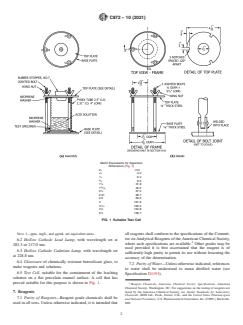
proved suitable for this purpose is shown in Fig. 1. 4
Reagent Chemicals, American Chemical Society Specifications, American
Chemical Society, Washington, DC. For suggestions on the testing of reagents not
7. Reagents listed by the American Chemical Society, see Analar Standards for Laboratory
Chemicals, BDH Ltd., Poole, Dorset, U.K., and the United States Pharmacopeia
7.1 Purity of Reagents—Reagent grade chemicals shall be
and National Formulary, U.S. Pharmaceutical Convention, Inc. (USPC), Rockville,
used in all tests. Unless otherwise indicated, it is intended that MD.
C872 − 10 (2021)
7.3 Acetic Acid (4 % by volume)
...