


ASTM C1167-11(2017)
(Specification)Standard Specification for Clay Roof Tiles
Standard Specification for Clay Roof Tiles
ABSTRACT
This specification covers clay roof tiles with such durability and appearance that can provide a weather-resistant surface of a specified design. Each tile should be manufactured from clay, shale, or similar naturally occurring earthy substances and subjected to high-temperature firing. The heat treatment should develop a fired bond between material particles that provides the required strength and durability. The tiles should be shaped by molding, pressing, or extrusion during manufacture. Generally, the tiles are planar or undulating rectangular and are classified into three grades according to the degree of resistance to weathering. Materials are also grouped into three types according to profile and rise-to-width ratio. Colors and textures produced by application of inorganic coatings are allowed except when the coloring is done by flashing or the texturing by sanding where the sand does not form a continuous coating. Each tile should conform to the specified values of durability, freezing and thawing, transverse breaking strength, efflorescence, reactive particulates, and permeability.
SCOPE
1.1 This specification covers clay tiles intended for use as roof covering where durability and appearance are required to provide a weather-resistant surface of specified design.
1.2 Tiles are manufactured from clay, shale, or similar naturally occurring earthy substances and subjected to heat treatment at elevated temperatures (firing). The heat treatment must develop a fired bond between the particulate constituents to provide the strength and durability requirements of this specification (see firing and fired bond in Terminology C1232).
1.3 Tiles are shaped during manufacture by molding, pressing, or extrusion and it is permitted to use the shaping method to describe the tiles.
1.4 Tiles are generally planar or undulating rectangular shapes available in a variety of cross-sectional profiles, shapes, sizes, surface textures, and colors.
1.5 Three grades of tile having various degrees of resistance to weathering are covered in this specification. Three types of tile are defined to cover the features that influence appearance.
1.6 The values stated in inch-pound units are to be regarded as standard. The values given in parentheses are mathematical conversions to SI units that are provided for information only and are not considered standard.
1.7 This standard does not purport to address all of the safety concerns, if any, associated with its use. It is the responsibility of the user of this standard to establish appropriate safety, health, and environmental practices and determine the applicability of regulatory limitations prior to use.
1.8 This international standard was developed in accordance with internationally recognized principles on standardization established in the Decision on Principles for the Development of International Standards, Guides and Recommendations issued by the World Trade Organization Technical Barriers to Trade (TBT) Committee.
General Information
Buy Standard
Standards Content (Sample)
NOTICE: This standard has either been superseded and replaced by a new version or withdrawn.
Contact ASTM International (www.astm.org) for the latest information
Designation:C1167 −11 (Reapproved 2017)
Standard Specification for
Clay Roof Tiles
This standard is issued under the fixed designation C1167; the number immediately following the designation indicates the year of
original adoption or, in the case of revision, the year of last revision.Anumber in parentheses indicates the year of last reapproval.A
superscript epsilon (´) indicates an editorial change since the last revision or reapproval.
1. Scope 2. Referenced Documents
1.1 This specification covers clay tiles intended for use as 2.1 ASTM Standards:
C1232Terminology for Masonry
roof covering where durability and appearance are required to
C67Test Methods for Sampling and Testing Brick and
provide a weather-resistant surface of specified design.
Structural Clay Tile
1.2 Tiles are manufactured from clay, shale, or similar
C297/C297MTest Method for Flatwise Tensile Strength of
naturally occurring earthy substances and subjected to heat
Sandwich Constructions
treatment at elevated temperatures (firing). The heat treatment
C554Test Method for Crazing Resistance of Fired Glazed
must develop a fired bond between the particulate constituents
Ceramic Whitewares by a Thermal Shock Method
to provide the strength and durability requirements of this
specification(see firingand fired bondinTerminologyC1232).
3. Terminology
1.3 Tiles are shaped during manufacture by molding,
3.1 Definitions—For definitions of terms relating to struc-
pressing, or extrusion and it is permitted to use the shaping
turalclayproducts,andclayrooftiles,seeTerminologyC1232.
method to describe the tiles.
4. Classification
1.4 Tiles are generally planar or undulating rectangular
shapesavailableinavarietyofcross-sectionalprofiles,shapes, 4.1 Clay roof tiles covered by this specification are classi-
sizes, surface textures, and colors. fiedbygradefordurabilityandtypeforappearanceasfollows:
4.1.1 Grades:
1.5 Threegradesoftilehavingvariousdegreesofresistance
4.1.1.1 Grade 1—Providing resistance to severe frost ac-
to weathering are covered in this specification. Three types of
tion.
tile are defined to cover the features that influence appearance.
4.1.1.2 Grade 2—Providing resistance to moderate frost
1.6 The values stated in inch-pound units are to be regarded
action.
as standard. The values given in parentheses are mathematical
4.1.1.3 Grade 3—Providing negligible resistance to any
conversions to SI units that are provided for information only
frost action.
and are not considered standard.
4.1.1.4 Grades relate to exposure to weather as defined in
Table 1.
1.7 This standard does not purport to address all of the
safety concerns, if any, associated with its use. It is the
4.2 Types:
responsibility of the user of this standard to establish appro-
4.2.1 Type I—High-profile tiles—tiles having a rise-to-
priate safety, health, and environmental practices and deter-
width ratio greater than 1:5.
mine the applicability of regulatory limitations prior to use.
4.2.2 Type II—Low-profile tiles—tiles having a rise-to-
1.8 This international standard was developed in accor- width ratio equal to, or less than 1:5.
dance with internationally recognized principles on standard-
4.2.3 Type III—All other tiles, including flat.
ization established in the Decision on Principles for the
5. Material and Finish
Development of International Standards, Guides and Recom-
mendations issued by the World Trade Organization Technical
5.1 Colors and textures produced by application of inor-
Barriers to Trade (TBT) Committee.
ganic coatings to the faces of the tiles are not prohibited
provided that evidence satisfactory to the purchaser is fur-
nished regarding the durability of the coatings. Tiles that are
This specification is under the jurisdiction of ASTM Committee C15 on
Manufactured Masonry Units and is the direct responsibility of Subcommittee
C15.06 on Roofing Tile. For referenced ASTM standards, visit the ASTM website, www.astm.org, or
Current edition approved Dec. 1, 2017. Published January 2018. Originally contact ASTM Customer Service at service@astm.org. For Annual Book of ASTM
approved in 1990. Last previous edition approved in 2011 as C1167–11. DOI: Standards volume information, refer to the standard’s Document Summary page on
10.1520/C1167-11R17. the ASTM website.
Copyright © ASTM International, 100 Barr Harbor Drive, PO Box C700, West Conshohocken, PA 19428-2959. United States
C1167−11 (2017)
TABLE 1 Grade Classification for Clay Roof Tiles TABLE 2 Physical Requirements
Grade Absorption Requirements
Weathering Index (see Annex A1)
(All Types)
Cold Water Absorption Maximum Saturation
A
1 500 and greater Maximum Percent Coefficient
Grade
2 50to500
Average of Individual Average of Individual
3 less than 50
Five Tiles Tile Five Tiles Tile
1 6 8 0.74 0.76
2 11 13 0.80 0.82
3 13 15 0.84 0.86
coloredbyflashingortexturedbysanding,wherethesanddoes
A
The saturation coefficient is the ratio of absorption by 24-h submersion in water
not form a continuous coating, are not considered as surface-
at a temperature of 75 ± 10°F (24 ± 6°C) to that after 5 h submersion in boiling
colored tiles for the purpose of this specification.
water.
NOTE 1—When surface colored tiles (other than sanded or flashed) are
specified, data satisfactory to the purchaser shall be submitted showing
that after 50 cycles of freezing-thawing (5.2) there is no observable
NOTE 2—Frost is of profound importance in mechanical weathering
difference in the applied finish when viewed from a distance of 40 ft (12
where its effectiveness is dependent on the frequency of temperature
m)underanilluminationofnotlessthan50fc(538lm/m )byanobserver
fluctuation across the freezing point in the presence of water. The ability
with normal vision. It is not prohibited to present service records of the
ofatiletoresistfailureinawetandfreezingenvironmentis,therefore,of
performance of the particular coated tiles in appropriate locations in place
paramount importance. If a tile fails in such an environment, its use will
of the freezing and thawing test, with the consent of the purchaser.
resultinanunacceptabledeteriorationofappearanceormorelikely,atotal
failure to function (that is, protect the underlying structure from rain), or
5.2 The tiles shall be free of defects, deficiencies, or
both. Such a tile is completely unacceptable for use regardless of its other
bloating,thatwouldinterferewiththeproperlayingofthetiles,
properties such as strength.
the performance of the roof, or the requirements of this
NOTE 3—The resistance of clay roof tiles to weathering cannot be
specification.
predicted with complete assurance using any of the physical tests
5.2.1 Tiles that, when broken, have a dark area that has a prescribed. However, practical experience has demonstrated satisfactory
performance of clay roof tiles, some for hundreds of years, and this
steely appearance and is sharply delineated from the surround-
experience forms the basis of the prescriptive requirements of Table 2.
ing normal color of tile are not prohibited. This dark area is
Thereisgenerallyexcellentcorrelationbetweenfieldperformanceandthe
knownasblackheartorblackcore.Blackheartisgenerallythe
requirements. However, it is possible that some tiles that meet this
result of the reduction of iron minerals during the firing
specification are not suitable for severe climates. Furthermore, it is also
process. Its presence, regardless of the size in the tile that possible for other tiles that do not meet this specification to show
acceptable serviceability in the most severe climates. The best indication
otherwisemeetsthephysicalperformanceofthisspecification,
of clay roof tile durability is the service record of experience with the
shall not be cause for rejection.
specified product in the environment of its intended use.
5.3 The exposed tile surface shall be free of chippage or
6.1.1 Measure the water absorption, and calculate the satu-
other imperfections detracting from the appearance of the
ration coefficient, in accordance with Test Methods C67. The
designated sample when viewed from a distance 40 ft (12 m)
test sample shall consist of five whole tiles.
under an illumination of not less than 50 fc (538 lm/m)byan
6.1.2 ThephysicalrequirementsinTable2shallbeachieved
observer with normal vision.
asaresultofthefiringprocessandassociatedthermalreactions
5.4 Unless otherwise agreed upon between the purchaser
within the tile body (and glaze, if present) which include
and the seller, a delivery of tiles shall contain not less than
development of the fired bond, increase in density, increase in
95% whole tiles. In this specification, the term whole tiles
strength, and reduction in water absorption. Tiles shall not
shall be understood to mean tiles meeting the appearance
comply with this specification if other processes, for example,
requirements of this specification.
immersion in solutions of organic materials to effect impreg-
nation or surface sealing, are used to change the physical
5.5 After tiles are placed in usage, the manufacturer or his
properties which result from the firing process. It is not
agent shall not be held responsible for compliance of tiles with
prohibited to test tiles in accordance with this Specification
the requirements of this specification for dimensional
after the impregnation and sealing materials are removed as
tolerances, finish, texture, or color.
prescribed in Test Methods C67.
6. Performance Requirements
6.2 Freezing and Thawing—The requirements specified in
6.1 Durability—The tiles shall conform to the physical 6.1forwaterabsorption(5-hboiling)andsaturationcoefficient
requirements for the Grade specified as prescribed in Table 2. shall not apply for all Grades provided that a sample of five
Unless otherwise specified by the purchaser, tiles of a higher tiles, meeting all of the other requirements, experiences no
Grade (greater weathering index) shall be accepted instead of breakage, no crack development that exceeds the minimum
a lower Grade. The saturation coefficient requirement does not dimension of the specimen, and not greater than 0.5% loss in
apply when the average cold water absorption of a random dry weight when subjected to 50 cycles of the freezing-and-
sample of five tiles does not exceed 6%, no more than one tile thawingtestofTestMethodsC67,modifiedinaccordancewith
of the sample exceeds 6% and its cold water absorption is less 6.2.1.
than 8%. When Grade 3 tiles are used in regions where the 6.2.1 Modify Test Methods C67, Section 8, as follows: The
weathering index is less than 50 (see Annex A1), unless test sample shall consist of five whole tiles. The freezing trays
otherwise specified, the requirements for water absorption and and containers shall be of sufficient size and depth to allow the
for saturation coefficient shall not apply. tiles to be completely submerged in water when placed
C1167−11 (2017)
and saturation coefficient, or to the restrictive absorption requirements in
horizontally. The tiles shall be completely submerged in water
6.1.
when the trays are placed in the freezing chamber. It is not
prohibited to test individual tile or to stack tile on top of each 6.3 Strength—The transverse breaking strength of tiles shall
other in the tray, provided that spacers at least ⁄4 in. (6 mm) be determined as described for the Flexure Test in Test
thick are used between adjacent tiles and that the total stack is Methods C67 except as modified in 6.3.1 to 6.3.7.
completely submerged. 6.3.1 Five tiles shall be tested wet after a 24-h submersion
inwateratatemperatureof75 610°F(24 66°C)orfivetiles
NOTE 4—Alarge capacity freezer is generally necessary to accomplish
shall be tested dry after heating in a ventilated oven for 24 h at
freezing in the manner specified inTest Methods C67 for trays containing
more than one tile. It is not prohibited to use custom trays to enclose the a temperature of 230 to 239°F (110 to 115°C).
tile(s)andminimizethevolumeofwaterrequiredtocompletelysubmerge
6.3.1.1 Tile shall be considered to comply with this speci-
the tile(s).
ficationwhentheypasstherequirementofeitherthewetorthe
6.2.2 Alot of tiles shall be given the Grade 1 rating without dry transverse strength test. The choice of method, wet or dry,
repeating a freezing and thawing test provided that a previous
shall be mutually agreed upon between specifier and supplier.
lot made by the supplier from similar materials, by the same 6.3.2 The span chosen for the test shall be 12 in. (30.5 cm)
process, at the same production plant, and within the previous
65%or ⁄3 of the length of the tile, whichever is greater. The
12months,hadpassedthetest,andprovidedalsothatasample
span is measured between the centers of the lower support
of five tiles selected from the lot has an average and individual
members (6.3.3 and Fig. 1).
minimum transverse strength not less than the previously
6.3.2.1 It is not prohibited to use a shorter span than
gradedsampleandhasaverageandindividualmaximumwater
required by 6.3.2 when the length of the tile to be tested is not
absorption and saturation coefficient not greater than those of
sufficient to allow a 12 in. (30.5 cm) span to be used. In that
the previously graded sample.
case,ashorterspan,notlessthantwo-thirdsofthelengthofthe
tile, shall be used and the required minimum values in Table 3
NOTE 5—Unless specifically requested by the purchaser, the 50-cycle
shallbeincreasedproportionatelytothereductioninspan,that
freezing and thawing test is used only as an alternative when tiles do not
conform to either Table 2 requirements for maximum water absorption is, multiplied by:
NOTE 1—See text for dimensions.
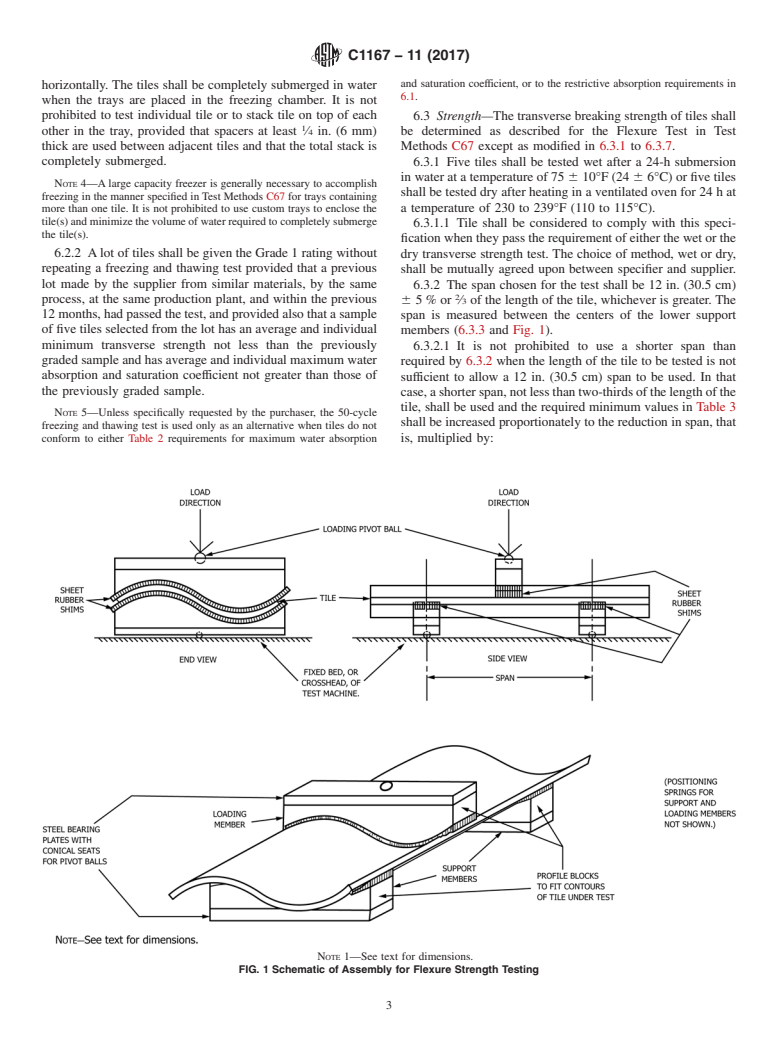
FIG. 1Schematic of Assembly for Flexure Strength Testing
C1167−11 (2017)
TABLE 3 Transverse Breaking Strength Requirements
6.3.6 Both of the support members and the loading member
Wet Transverse Strength, Dry Transverse Strength, shall be free to rotate in the longitudinal and transverse
min, lbf (N) min, lbf (N)
directionsofthetestspecimenandbeadjustedsothattheywill
Type (All Grades)
Average of Individual Average of Individual
exert no force in these directions. It is not prohibited to
Five Tiles Tile Five Tiles Tile
accomplish this by using spherically seated steel balls with
Type I—High Profile 300 (1334) 260 (1157) 400 (1779) 350 (1556)
appropriate supporting springs.
Type II—Low Profile 225 (1001) 200 (890) 300 (1334) 250 (1112)
Type III—Other Tiles 225 (1001) 200 (890) 300 (1334) 250 (1112)
6.3.7 The tile shall be loaded uniformly and continuously,
without shock, at a rate not to exceed 1000 lbf (4550 N)/min
until fracture.
6.3.8 Record the load in pounds (kilograms) at fracture of
eachofthefivetilesandreporttheaverageofthefivetestsand
the mini
...
This document is not an ASTM standard and is intended only to provide the user of an ASTM standard an indication of what changes have been made to the previous version. Because
it may not be technically possible to adequately depict all changes accurately, ASTM recommends that users consult prior editions as appropriate. In all cases only the current version
of the standard as published by ASTM is to be considered the official document.
Designation: C1167 − 11 C1167 − 11 (Reapproved 2017)
Standard Specification for
Clay Roof Tiles
This standard is issued under the fixed designation C1167; the number immediately following the designation indicates the year of
original adoption or, in the case of revision, the year of last revision. A number in parentheses indicates the year of last reapproval. A
superscript epsilon (´) indicates an editorial change since the last revision or reapproval.
1. Scope
1.1 This specification covers clay tiles intended for use as roof covering where durability and appearance are required to provide
a weather-resistant surface of specified design.
1.2 Tiles are manufactured from clay, shale, or similar naturally occurring earthy substances and subjected to heat treatment at
elevated temperatures (firing). The heat treatment must develop a fired bond between the particulate constituents to provide the
strength and durability requirements of this specification (see firing and fired bond in Terminology C1232).
1.3 Tiles are shaped during manufacture by molding, pressing, or extrusion and it is permitted to use the shaping method to
describe the tiles.
1.4 Tiles are generally planar or undulating rectangular shapes available in a variety of cross-sectional profiles, shapes, sizes,
surface textures, and colors.
1.5 Three grades of tile having various degrees of resistance to weathering are covered in this specification. Three types of tile
are defined to cover the features that influence appearance.
1.6 The values stated in inch-pound units are to be regarded as standard. The values given in parentheses are mathematical
conversions to SI units that are provided for information only and are not considered standard.
1.7 This standard does not purport to address all of the safety concerns, if any, associated with its use. It is the responsibility
of the user of this standard to establish appropriate safety safety, health, and healthenvironmental practices and determine the
applicability of regulatory limitations prior to use.
1.8 This international standard was developed in accordance with internationally recognized principles on standardization
established in the Decision on Principles for the Development of International Standards, Guides and Recommendations issued
by the World Trade Organization Technical Barriers to Trade (TBT) Committee.
2. Referenced Documents
2.1 ASTM Standards:
C1232 Terminology for Masonry
C67 Test Methods for Sampling and Testing Brick and Structural Clay Tile
C297/C297M Test Method for Flatwise Tensile Strength of Sandwich Constructions
C554 Test Method for Crazing Resistance of Fired Glazed Ceramic Whitewares by a Thermal Shock Method
3. Terminology
3.1 Definitions—For definitions of terms relating to structural clay products, and clay roof tiles, see Terminology C1232.
4. Classification
4.1 Clay roof tiles covered by this specification are classified by grade for durability and type for appearance as follows:
4.1.1 Grades:
4.1.1.1 Grade 1—Providing resistance to severe frost action.
4.1.1.2 Grade 2—Providing resistance to moderate frost action.
This specification is under the jurisdiction of ASTM Committee C15 on Manufactured Masonry Units and is the direct responsibility of Subcommittee C15.06 on Roofing
Tile.
Current edition approved June 1, 2011Dec. 1, 2017. Published June 2011January 2018. Originally approved in 1990. Last previous edition approved in 20092011 as
C1167 – 03C1167 – 11. (2009). DOI: 10.1520/C1167-11.10.1520/C1167-11R17.
For referenced ASTM standards, visit the ASTM website, www.astm.org, or contact ASTM Customer Service at service@astm.org. For Annual Book of ASTM Standards
volume information, refer to the standard’s Document Summary page on the ASTM website.
Copyright © ASTM International, 100 Barr Harbor Drive, PO Box C700, West Conshohocken, PA 19428-2959. United States
C1167 − 11 (2017)
4.1.1.3 Grade 3—Providing negligible resistance to any frost action.
4.1.1.4 Grades relate to exposure to weather as defined in Table 1.
4.2 Types:
4.2.1 Type I—High-profile tiles—tiles having a rise-to-width ratio greater than 1:5.
4.2.2 Type II—Low-profile tiles—tiles having a rise-to-width ratio equal to, or less than 1:5.
4.2.3 Type III—All other tiles, including flat.
5. Material and Finish
5.1 Colors and textures produced by application of inorganic coatings to the faces of the tiles are not prohibited provided that
evidence satisfactory to the purchaser is furnished regarding the durability of the coatings. Tiles that are colored by flashing or
textured by sanding, where the sand does not form a continuous coating, are not considered as surface-colored tiles for the purpose
of this specification.
NOTE 1—When surface colored tiles (other than sanded or flashed) are specified, data satisfactory to the purchaser shall be submitted showing that after
50 cycles of freezing-thawing (5.2) there is no observable difference in the applied finish when viewed from a distance of 40 ft (12 m) under an
illumination of not less than 50 fc (538 lm/m ) by an observer with normal vision. It is not prohibited to present service records of the performance of
the particular coated tiles in appropriate locations in place of the freezing and thawing test, with the consent of the purchaser.
5.2 The tiles shall be free of defects, deficiencies, or bloating, that would interfere with the proper laying of the tiles, the
performance of the roof, or the requirements of this specification.
5.2.1 Tiles that, when broken, have a dark area that has a steely appearance and is sharply delineated from the surrounding
normal color of tile are not prohibited. This dark area is known as black heart or black core. Black heart is generally the result
of the reduction of iron minerals during the firing process. Its presence, regardless of the size in the tile that otherwise meets the
physical performance of this specification, shall not be cause for rejection.
5.3 The exposed tile surface shall be free of chippage or other imperfections detracting from the appearance of the designated
sample when viewed from a distance 40 ft (12 m) under an illumination of not less than 50 fc (538 lm/m ) by an observer with
normal vision.
5.4 Unless otherwise agreed upon between the purchaser and the seller, a delivery of tiles shall contain not less than 95 % whole
tiles. In this specification, the term whole tiles shall be understood to mean tiles meeting the appearance requirements of this
specification.
5.5 After tiles are placed in usage, the manufacturer or his agent shall not be held responsible for compliance of tiles with the
requirements of this specification for dimensional tolerances, finish, texture, or color.
6. Performance Requirements
6.1 Durability—The tiles shall conform to the physical requirements for the Grade specified as prescribed in Table 2. Unless
otherwise specified by the purchaser, tiles of a higher Grade (greater weathering index) shall be accepted instead of a lower Grade.
The saturation coefficient requirement does not apply when the average cold water absorption of a random sample of five tiles does
not exceed 6 %, no more than one tile of the sample exceeds 6 % and its cold water absorption is less than 8 %. When Grade 3
tiles are used in regions where the weathering index is less than 50 (see Annex A1), unless otherwise specified, the requirements
for water absorption and for saturation coefficient shall not apply.
NOTE 2—Frost is of profound importance in mechanical weathering where its effectiveness is dependent on the frequency of temperature fluctuation
across the freezing point in the presence of water. The ability of a tile to resist failure in a wet and freezing environment is, therefore, of paramount
importance. If a tile fails in such an environment, its use will result in an unacceptable deterioration of appearance or more likely, a total failure to function
(that is, protect the underlying structure from rain), or both. Such a tile is completely unacceptable for use regardless of its other properties such as
strength.
NOTE 3—The resistance of clay roof tiles to weathering cannot be predicted with complete assurance using any of the physical tests prescribed.
However, practical experience has demonstrated satisfactory performance of clay roof tiles, some for hundreds of years, and this experience forms the
basis of the prescriptive requirements of Table 2. There is generally excellent correlation between field performance and the requirements. However, it
is possible that some tiles that meet this specification are not suitable for severe climates. Furthermore, it is also possible for other tiles that do not meet
this specification to show acceptable serviceability in the most severe climates. The best indication of clay roof tile durability is the service record of
experience with the specified product in the environment of its intended use.
6.1.1 Measure the water absorption, and calculate the saturation coefficient, in accordance with Test Methods C67. The test
sample shall consist of five whole tiles.
TABLE 1 Grade Classification for Clay Roof Tiles
Grade
Weathering Index (see Annex A1)
(All Types)
1 500 and greater
2 50 to 500
3 less than 50
C1167 − 11 (2017)
TABLE 2 Physical Requirements
Absorption Requirements
Cold Water Absorption Maximum Saturation
A
Maximum Percent Coefficient
Grade
Average of Individual Average of Individual
Five Tiles Tile Five Tiles Tile
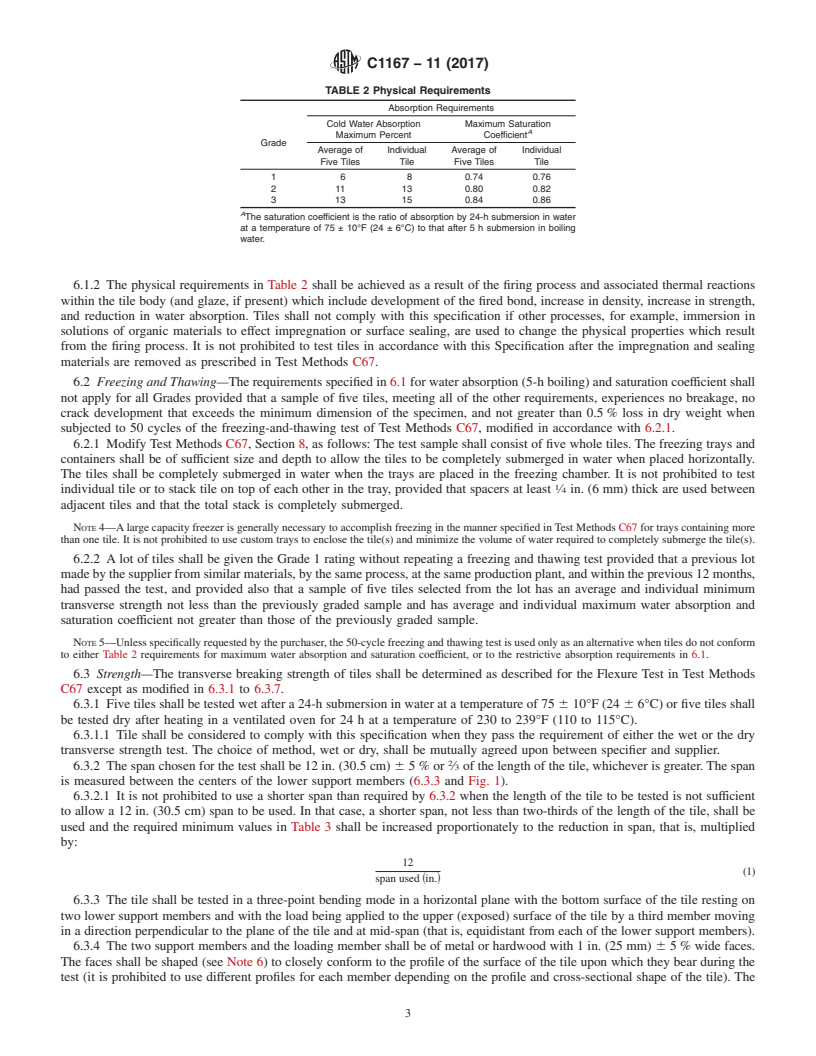
1 6 8 0.74 0.76
2 11 13 0.80 0.82
3 13 15 0.84 0.86
A
The saturation coefficient is the ratio of absorption by 24-h submersion in water
at a temperature of 75 ± 10°F (24 ± 6°C) to that after 5 h submersion in boiling
water.
6.1.2 The physical requirements in Table 2 shall be achieved as a result of the firing process and associated thermal reactions
within the tile body (and glaze, if present) which include development of the fired bond, increase in density, increase in strength,
and reduction in water absorption. Tiles shall not comply with this specification if other processes, for example, immersion in
solutions of organic materials to effect impregnation or surface sealing, are used to change the physical properties which result
from the firing process. It is not prohibited to test tiles in accordance with this Specification after the impregnation and sealing
materials are removed as prescribed in Test Methods C67.
6.2 Freezing and Thawing—The requirements specified in 6.1 for water absorption (5-h boiling) and saturation coefficient shall
not apply for all Grades provided that a sample of five tiles, meeting all of the other requirements, experiences no breakage, no
crack development that exceeds the minimum dimension of the specimen, and not greater than 0.5 % loss in dry weight when
subjected to 50 cycles of the freezing-and-thawing test of Test Methods C67, modified in accordance with 6.2.1.
6.2.1 Modify Test Methods C67, Section 8, as follows: The test sample shall consist of five whole tiles. The freezing trays and
containers shall be of sufficient size and depth to allow the tiles to be completely submerged in water when placed horizontally.
The tiles shall be completely submerged in water when the trays are placed in the freezing chamber. It is not prohibited to test
individual tile or to stack tile on top of each other in the tray, provided that spacers at least ⁄4 in. (6 mm) thick are used between
adjacent tiles and that the total stack is completely submerged.
NOTE 4—A large capacity freezer is generally necessary to accomplish freezing in the manner specified in Test Methods C67 for trays containing more
than one tile. It is not prohibited to use custom trays to enclose the tile(s) and minimize the volume of water required to completely submerge the tile(s).
6.2.2 A lot of tiles shall be given the Grade 1 rating without repeating a freezing and thawing test provided that a previous lot
made by the supplier from similar materials, by the same process, at the same production plant, and within the previous 12 months,
had passed the test, and provided also that a sample of five tiles selected from the lot has an average and individual minimum
transverse strength not less than the previously graded sample and has average and individual maximum water absorption and
saturation coefficient not greater than those of the previously graded sample.
NOTE 5—Unless specifically requested by the purchaser, the 50-cycle freezing and thawing test is used only as an alternative when tiles do not conform
to either Table 2 requirements for maximum water absorption and saturation coefficient, or to the restrictive absorption requirements in 6.1.
6.3 Strength—The transverse breaking strength of tiles shall be determined as described for the Flexure Test in Test Methods
C67 except as modified in 6.3.1 to 6.3.7.
6.3.1 Five tiles shall be tested wet after a 24-h submersion in water at a temperature of 75 6 10°F (24 6 6°C) or five tiles shall
be tested dry after heating in a ventilated oven for 24 h at a temperature of 230 to 239°F (110 to 115°C).
6.3.1.1 Tile shall be considered to comply with this specification when they pass the requirement of either the wet or the dry
transverse strength test. The choice of method, wet or dry, shall be mutually agreed upon between specifier and supplier.
6.3.2 The span chosen for the test shall be 12 in. (30.5 cm) 6 5 % or ⁄3 of the length of the tile, whichever is greater. The span
is measured between the centers of the lower support members (6.3.3 and Fig. 1).
6.3.2.1 It is not prohibited to use a shorter span than required by 6.3.2 when the length of the tile to be tested is not sufficient
to allow a 12 in. (30.5 cm) span to be used. In that case, a shorter span, not less than two-thirds of the length of the tile, shall be
used and the required minimum values in Table 3 shall be increased proportionately to the reduction in span, that is, multiplied
by:
(1)
span used ~in.!
6.3.3 The tile shall be tested in a three-point bending mode in a horizontal plane with the bottom surface of the tile resting on
two lower support members and with the load being applied to the upper (exposed) surface of the tile by a third member moving
in a direction perpendicular to the plane of the tile and at mid-span (that is, equidistant from each of the lower support members).
6.3.4 The two support members and the loading member shall be of metal or hardwood with 1 in. (25 mm) 6 5 % wide faces.
The faces shall be shaped (se
...
Questions, Comments and Discussion
Ask us and Technical Secretary will try to provide an answer. You can facilitate discussion about the standard in here.