

ASTM D1833-87(2017)
(Test Method)Standard Test Method for Odor of Petroleum Wax
General Information
- Abstract
SIGNIFICANCE AND USE
4.1 In some uses of petroleum wax, such as food packaging, odor intensity of the wax is an important property. For example, some description of limits on wax odor often appears in specifications for petroleum wax. The method given here provides a basis for agreement between laboratories on the odor intensity of wax using a numerical scale rather than descriptive terms. While the method is primarily intended for rating odor intensity, results can be influenced by odor type.
SCOPE
1.1 This test method covers a procedure for rating the odor intensity of waxes derived from petroleum.
1.2 This standard does not purport to address all of the safety concerns, if any, associated with its use. It is the responsibility of the user of this standard to establish appropriate safety and health practices and determine the applicability of regulatory limitations prior to use.
1.3 This international standard was developed in accordance with internationally recognized principles on standardization established in the Decision on Principles for the Development of International Standards, Guides and Recommendations issued by the World Trade Organization Technical Barriers to Trade (TBT) Committee.
- Status
- Published
- Publication Date
- 31-May-2017
- Technical Committee
- D02 - Petroleum Products, Liquid Fuels, and Lubricants


Overview
ASTM D1833-87(2017), Standard Test Method for Odor of Petroleum Wax, establishes a uniform procedure for evaluating and rating the odor intensity of petroleum-derived waxes. Odor assessment is a critical quality parameter, particularly when petroleum wax is used in sensitive applications such as food packaging. By adopting a standardized numerical scale for odor intensity, this ASTM standard ensures clear, objective, and reproducible results that support specification compliance and inter-laboratory consistency.
Key Topics
Scope and Purpose:
- Focuses on rating odor intensity in petroleum waxes using a panel approach and a numeric scale.
- Addresses only the odor intensity, though results may also be affected by the type of odor.
- Applicable to all types of waxes derived from petroleum.
Test Method Overview:
- Wax samples are prepared as thin shavings and evaluated by a panel of at least five members.
- Each evaluator assigns a numerical rating based on a specified scale:
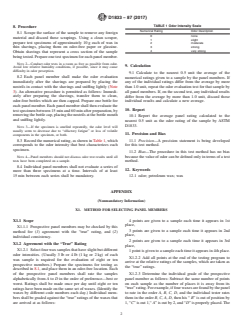
- 0: None
- 1: Slight
- 2: Moderate
- 3: Strong
- 4: Very Strong
- The average panel score determines the final odor rating.
Panel Composition and Consistency:
- Panel members are selected for both accuracy in “true” rating and individual consistency.
- Detailed methods are provided for checking and evaluating panelist performance.
- Best practice guidelines recommend omitting panelists with impaired sensitivity (e.g., respiratory infections).
Reporting and Objectivity:
- Results are reported as the average panel score to the nearest 0.5 unit.
- Strict test protocols minimize subjective bias and facilitate reproducibility.
Health and Safety:
- Users are responsible for maintaining safe practices and complying with regulatory limitations.
Applications
Quality Control:
- Essential for manufacturers and processors of petroleum wax to ensure product odor meets specification limits, especially for consumer products and food packaging.
Specifications and Procurement:
- Facilitates communication and agreement between buyers and suppliers by providing a numerical yardstick for odor acceptability.
Product Development:
- Enables formulators to benchmark samples and optimize processing methods to minimize unwanted odors in end-use applications.
Inter-Laboratory Comparisons:
- Standardized test protocol enhances the reliability of odor ratings across different laboratories and organizations globally.
Regulatory Compliance:
- Supports compliance with industry and regulatory standards that specify odor limits for products containing petroleum wax.
Related Standards
- ASTM D87 – Standard Test Method for Melting Point of Petroleum Wax (Cooling Curve)
- ASTM D127 – Standard Test Method for Drop Melting Point of Petroleum Wax
- ASTM D721 – Standard Test Method for Oil Content of Petroleum Waxes
- ISO 9001 – Quality Management Systems (for general quality control)
- Other ASTM and ISO test methods for evaluating physical and chemical properties of petroleum wax
Summary
ASTM D1833-87(2017) is an essential international standard for any organization involved in the production, testing, or application of petroleum wax. By providing a reliable method for the rating of odor intensity, it enables clear communication among manufacturers, buyers, regulators, and quality assurance professionals. Its application reduces variability in odor assessment, helping the industry deliver higher quality, more consistent wax products that meet stringent specification and safety requirements. This standard complements other petroleum wax testing standards, forming a baseline for comprehensive quality control and assurance in the global wax industry.
Get Certified
Connect with accredited certification bodies for this standard

Element Materials Technology
Materials testing and product certification.

ABS Group Brazil
ABS Group certification services in Brazil.

ABS Quality Evaluations Inc.
American Bureau of Shipping quality certification.
Sponsored listings
Frequently Asked Questions
ASTM D1833-87(2017) is a standard published by ASTM International. Its full title is "Standard Test Method for Odor of Petroleum Wax". This standard covers: SIGNIFICANCE AND USE 4.1 In some uses of petroleum wax, such as food packaging, odor intensity of the wax is an important property. For example, some description of limits on wax odor often appears in specifications for petroleum wax. The method given here provides a basis for agreement between laboratories on the odor intensity of wax using a numerical scale rather than descriptive terms. While the method is primarily intended for rating odor intensity, results can be influenced by odor type. SCOPE 1.1 This test method covers a procedure for rating the odor intensity of waxes derived from petroleum. 1.2 This standard does not purport to address all of the safety concerns, if any, associated with its use. It is the responsibility of the user of this standard to establish appropriate safety and health practices and determine the applicability of regulatory limitations prior to use. 1.3 This international standard was developed in accordance with internationally recognized principles on standardization established in the Decision on Principles for the Development of International Standards, Guides and Recommendations issued by the World Trade Organization Technical Barriers to Trade (TBT) Committee.
SIGNIFICANCE AND USE 4.1 In some uses of petroleum wax, such as food packaging, odor intensity of the wax is an important property. For example, some description of limits on wax odor often appears in specifications for petroleum wax. The method given here provides a basis for agreement between laboratories on the odor intensity of wax using a numerical scale rather than descriptive terms. While the method is primarily intended for rating odor intensity, results can be influenced by odor type. SCOPE 1.1 This test method covers a procedure for rating the odor intensity of waxes derived from petroleum. 1.2 This standard does not purport to address all of the safety concerns, if any, associated with its use. It is the responsibility of the user of this standard to establish appropriate safety and health practices and determine the applicability of regulatory limitations prior to use. 1.3 This international standard was developed in accordance with internationally recognized principles on standardization established in the Decision on Principles for the Development of International Standards, Guides and Recommendations issued by the World Trade Organization Technical Barriers to Trade (TBT) Committee.
ASTM D1833-87(2017) is classified under the following ICS (International Classification for Standards) categories: 75.140 - Waxes, bituminous materials and other petroleum products. The ICS classification helps identify the subject area and facilitates finding related standards.
ASTM D1833-87(2017) is available in PDF format for immediate download after purchase. The document can be added to your cart and obtained through the secure checkout process. Digital delivery ensures instant access to the complete standard document.
Standards Content (Sample)
This international standard was developed in accordance with internationally recognized principles on standardization established in the Decision on Principles for the
Development of International Standards, Guides and Recommendations issued by the World Trade Organization Technical Barriers to Trade (TBT) Committee.
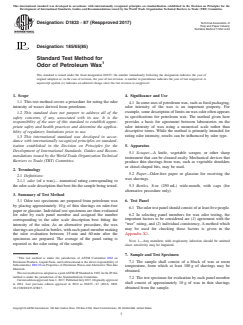
Designation: D1833 − 87 (Reapproved 2017) Technical Association of
Pulp and Paper Industry
Tentative Method T 654 ts-64
Designation: 185/65(85)
Standard Test Method for
Odor of Petroleum Wax
This standard is issued under the fixed designation D1833; the number immediately following the designation indicates the year of
original adoption or, in the case of revision, the year of last revision. A number in parentheses indicates the year of last reapproval. A
superscript epsilon (´) indicates an editorial change since the last revision or reapproval.
1. Scope 4. Significance and Use
1.1 This test method covers a procedure for rating the odor
4.1 In some uses of petroleum wax, such as food packaging,
intensity of waxes derived from petroleum.
odor intensity of the wax is an important property. For
example, some description of limits on wax odor often appears
1.2 This standard does not purport to address all of the
in specifications for petroleum wax. The method given here
safety concerns, if any, associated with its use. It is the
provides a basis for agreement between laboratories on the
responsibility of the user of this standard to establish appro-
odor intensity of wax using a numerical scale rather than
priate safety and health practices and determine the applica-
descriptive terms. While the method is primarily intended for
bility of regulatory limitations prior to use.
rating odor intensity, results can be influenced by odor type.
1.3 This international standard was developed in accor-
dance with internationally recognized principles on standard-
5. Apparatus
ization established in the Decision on Principles for the
Development of International Standards, Guides and Recom-
5.1 Scraper—A knife, vegetable scraper, or other sharp
mendations issued by the World Trade Organization Technical
instrument that can be cleaned easily. Mechanical devices that
Barriers to Trade (TBT) Committee.
produce thin shavings from wax, such as vegetable shredders
or chisel-shaped bits, may be used.
2. Terminology
5.2 Paper—Odor-free paper or glassine for receiving the
2.1 Definitions:
wax shavings.
2.1.1 odor (of a wax)— numerical rating corresponding to
the odor scale description that best fits the sample being tested.
5.3 Bottles, 8 oz (250 mL) wide-mouth, with caps (for
alternative procedure only).
3. Summary of Test Method
6. Test Panel
3.1 Odor test specimens are prepared from petroleum wax
by placing approximately 10 g of thin shavings on odor-free
6.1 The odor test panel should consist of at least five people.
paper or glassine. Individual test specimens are then evaluated
6.2 In selecting panel members for wax odor testing, the
for odor by each panel member and assigned the number
important factors to be considered are (1) agreement with the
corresponding to the odor scale description best fitting the
“true” rating, and (2) individual consistency. A method which
intensity of the odor. As an alternative procedure, the wax
may be used for checking these factors is given in the
shavings are placed in bottles, with each panel member making
Appendix X1.
the odor evaluation between 15 min and 60 min after the
specimens are prepared. The average of the panel rating is
NOTE 1—Any members with respiratory infection should be omitted
reported as the odor rating of the sample.
since sensitivity may be impaired.
7. Sample and Test Specimen
This test method is under the jurisdiction of ASTM Committee D02 on
Petroleum Products, Liquid Fuels, and Lubricantsand is the direct responsibility of 7.1 The sample shall consist of a block of wax at room
Subcommittee D02.10 on Properties of Petroleum Waxes and Alternative Wax-like
temperature, from which at least 100 g of shavings may be
Materials.
obtained.
This test method was adopted as a joint ASTM-IP Standard in 1965. In the IP, this
method is under the jurisdiction of the Standardization Committee.
7.2 The test specimen for evaluation by each panel member
Current edition approved June 1, 2017. Published July 2017. Originally approved
shall consist of approximately 10 g of wax in thin shavings
in 1961. Last previous edition approved in 2012 as D1833 – 87 (2012). DOI:
10.1520/D1833-87R17. obtained from the sample.
Copyright © ASTM International, 100 Barr Harbor Drive, PO Box C700, West Conshohocken, PA 19428-2959. United States
D1833 − 87 (2017)
TABLE 1 Odor Intensity Scale
8. Procedure
Numerical Rating Odor Description
8.1 Scrape the surface of the sample to remove any foreign
0 none
material and discard those scrapings. Using a clean scraper,
1 slight
prepare test specimens of approximately 10 g each of wax in
2 moderate
3 strong
thin shavings, placing them on odor-free paper or glassine.
4 very strong
Obtain shavings that represent a cross section of the sample
being tested. Prepare one test specimen for each panel member.
NOTE 2—Conduct odor tests in a room as free as possible from odor.
9. Calculation
Avoid low relative humidity conditions, if possible, since it may cause
difficulty in odor perception.
9.1 Calculate to the nearest 0.5 unit the average of the
8.2 Each panel member shall make the odor evaluation
numerical ratings given to a sample by the panel members. If
immediately after the shavings are prepared by placing the
any of the individual ratings differ from the average by more
nostrils in contact with the shavings and sniffing lightly (Note than 1.0 unit, repeat the odor evaluation test for that sample by
3). An alternative procedure is permitted as follows: Immedi-
...