

ASTM D409/D409M-16
(Test Method)Standard Test Method for Grindability of Coal by the Hardgrove-Machine Method
General Information
- Abstract
SIGNIFICANCE AND USE
3.1 This test method develops a measurement of grinding or pulverizing characteristics that can be used to evaluate the yield, or energy input, or both, required in a grinding or pulverizing process, which can impact a wide variety of processes, including combustion, coke-making, liquefaction, and gasification.
SCOPE
1.1 This test method2 covers the determination of the relative grindability or ease of pulverization of coals in comparison with coals chosen as standards. A prepared and sized sample receives a definite amount of grinding energy in a miniature pulverizer, and the size consist of the pulverized product is determined by sieving. The resultant size consist is used to produce an index relative to the ease of grinding [Hardgrove Grindability Index (HGI)].
1.1.1 Some coals, such as some high-volatile bituminous, subbituminous, and lignite coals, can undergo physical change as the natural or seam moisture is released during handling and preparation. This change is often sufficient to alter the grindability characteristics that will be reported when tested in the laboratory and could produce different indices dependent on the conditions of drying and the moisture level of the 1.18 × 0.60 mm (No. 16 × 30) (see Test Method D4749) materials used for the test. Therefore, the repeatability and reproducibility cited in this test method may not apply for these high-volatile bituminous, subbituminous, and lignite coals.
1.2 The values stated in either SI units or inch-pound units are to be regarded separately as standard. The values stated in each system may not be exact equivalents; therefore, each system shall be used independently of the other. Combining values from the two systems may result in non-conformance with the standard.
1.3 This standard does not purport to address all of the safety concerns, if any, associated with its use. It is the responsibility of the user of this standard to establish appropriate safety and health practices and determine the applicability of regulatory limitations prior to use.
- Status
- Published
- Publication Date
- 31-Aug-2016
- Technical Committee
- D05 - Coal and Coke
- Drafting Committee
- D05.07 - Physical Characteristics of Coal
Buy Documents
ASTM D409/D409M-16 - Standard Test Method for Grindability of Coal by the Hardgrove-Machine Method
REDLINE ASTM D409/D409M-16 - Standard Test Method for Grindability of Coal by the Hardgrove-Machine Method
Overview
ASTM D409/D409M-16, Standard Test Method for Grindability of Coal by the Hardgrove-Machine Method, is a key standard developed by ASTM International. It provides a widely recognized method for assessing the grindability or ease of pulverization of coal. Determining the relative grindability is critical in industries such as power generation, coke-making, gasification, and liquefaction, where coal properties directly impact operational efficiency and energy usage. The test uses the Hardgrove Grindability Index (HGI) as the quantifiable parameter, which allows for benchmarking and comparison among coals and supports decision-making in coal processing and utilization.
Key Topics
- Purpose: Establishes a uniform process for comparing the grinding or pulverizing characteristics of various coal samples using the Hardgrove-Machine Method.
- Test Principle: A specially prepared, sized coal sample is subjected to a fixed, controlled grinding process in a miniature pulverizer. The grindability is measured by sieving the final product and determining the proportion of finer particles.
- Measurement Output: The size distribution of the ground coal is used to calculate the Hardgrove Grindability Index (HGI), which rates the ease of grinding relative to standard coal samples.
- Sample Handling: Special consideration must be given to coals with high moisture content (such as subbituminous and lignite coals), as moisture changes can affect test reproducibility.
- Units of Measurement: The standard provides guidance for using both SI and inch-pound units independently-combining results from both systems is not permitted.
- Safety and Compliance: Users are responsible for establishing proper safety practices and ensuring regulatory compliance during testing.
Applications
The ASTM D409/D409M-16 standard is essential for numerous coal-related industries and applications:
- Power Generation: Supports the selection and preparation of coal for optimal combustion in power plants. Understanding HGI helps optimize mill operation, improve energy efficiency, and reduce operational costs.
- Coal Trading and Procurement: Enables suppliers and buyers to specify and verify coal grindability, ensuring suitability for intended applications.
- Coke Production: Assesses coal suitability for coke ovens by indicating how coal will behave during grinding and blending.
- Gasification and Liquefaction: Influences equipment selection and process parameters by providing reliable data on the input energy required for coal pulverization.
- Quality Control: Used routinely in laboratory testing, blending decisions, equipment calibration, and aggregate reporting for operational consistency.
Related Standards
Several other ASTM and international standards are frequently referenced alongside ASTM D409/D409M-16 to support comprehensive coal analysis and ensure consistency. These include:
- ASTM D2013: Practice for Preparing Coal Samples for Analysis
- ASTM D2234/D2234M: Practice for Collection of a Gross Sample of Coal
- ASTM D3302: Test Method for Total Moisture in Coal
- ASTM D4749: Test Method for Performing the Sieve Analysis of Coal and Designating Coal Size
- ASTM D6609: Guide for Part-Stream Sampling of Coal
- ASTM D6708: Practice for Statistical Assessment and Improvement of Expected Agreement Between Two Test Methods
- ASTM D6883: Practice for Manual Sampling of Stationary Coal
- ASTM D7430: Practice for Mechanical Sampling of Coal
- ASTM E11: Specification for Woven Wire Test Sieve Cloth and Test Sieves
- ISO 13909 & ISO 18283: Mechanical and Manual Sampling for Hard Coal and Coke
Summary
ASTM D409/D409M-16 plays a vital role in coal characterization and quality assurance throughout the supply chain. Its application enhances the efficiency, safety, and reliability of coal utilization, helping industries maintain consistent product quality and optimize operational performance. This standard is fundamental for laboratories, utilities, and all stakeholders involved in coal procurement, processing, and utilization.
Relations
- Effective Date
- 01-Mar-2024
- Effective Date
- 01-Dec-2019
- Effective Date
- 01-May-2019
- Effective Date
- 15-Apr-2018
- Effective Date
- 01-Apr-2018
- Effective Date
- 01-Mar-2018
- Effective Date
- 01-Nov-2017
- Effective Date
- 15-Oct-2017
- Effective Date
- 15-Oct-2017
- Effective Date
- 15-Oct-2017
- Effective Date
- 15-Sep-2016
- Effective Date
- 15-Sep-2016
- Effective Date
- 15-Jun-2016
- Effective Date
- 01-Jun-2016
- Effective Date
- 01-Apr-2016
Buy Documents
ASTM D409/D409M-16 - Standard Test Method for Grindability of Coal by the Hardgrove-Machine Method
REDLINE ASTM D409/D409M-16 - Standard Test Method for Grindability of Coal by the Hardgrove-Machine Method
Get Certified
Connect with accredited certification bodies for this standard

Bureau Veritas Chile
Bureau Veritas certification services in Chile.
Bureau Veritas Peru
Bureau Veritas certification services in Peru.
BVQI Peru
Bureau Veritas certification in Peru.
Sponsored listings
Frequently Asked Questions
ASTM D409/D409M-16 is a standard published by ASTM International. Its full title is "Standard Test Method for Grindability of Coal by the Hardgrove-Machine Method". This standard covers: SIGNIFICANCE AND USE 3.1 This test method develops a measurement of grinding or pulverizing characteristics that can be used to evaluate the yield, or energy input, or both, required in a grinding or pulverizing process, which can impact a wide variety of processes, including combustion, coke-making, liquefaction, and gasification. SCOPE 1.1 This test method2 covers the determination of the relative grindability or ease of pulverization of coals in comparison with coals chosen as standards. A prepared and sized sample receives a definite amount of grinding energy in a miniature pulverizer, and the size consist of the pulverized product is determined by sieving. The resultant size consist is used to produce an index relative to the ease of grinding [Hardgrove Grindability Index (HGI)]. 1.1.1 Some coals, such as some high-volatile bituminous, subbituminous, and lignite coals, can undergo physical change as the natural or seam moisture is released during handling and preparation. This change is often sufficient to alter the grindability characteristics that will be reported when tested in the laboratory and could produce different indices dependent on the conditions of drying and the moisture level of the 1.18 × 0.60 mm (No. 16 × 30) (see Test Method D4749) materials used for the test. Therefore, the repeatability and reproducibility cited in this test method may not apply for these high-volatile bituminous, subbituminous, and lignite coals. 1.2 The values stated in either SI units or inch-pound units are to be regarded separately as standard. The values stated in each system may not be exact equivalents; therefore, each system shall be used independently of the other. Combining values from the two systems may result in non-conformance with the standard. 1.3 This standard does not purport to address all of the safety concerns, if any, associated with its use. It is the responsibility of the user of this standard to establish appropriate safety and health practices and determine the applicability of regulatory limitations prior to use.
SIGNIFICANCE AND USE 3.1 This test method develops a measurement of grinding or pulverizing characteristics that can be used to evaluate the yield, or energy input, or both, required in a grinding or pulverizing process, which can impact a wide variety of processes, including combustion, coke-making, liquefaction, and gasification. SCOPE 1.1 This test method2 covers the determination of the relative grindability or ease of pulverization of coals in comparison with coals chosen as standards. A prepared and sized sample receives a definite amount of grinding energy in a miniature pulverizer, and the size consist of the pulverized product is determined by sieving. The resultant size consist is used to produce an index relative to the ease of grinding [Hardgrove Grindability Index (HGI)]. 1.1.1 Some coals, such as some high-volatile bituminous, subbituminous, and lignite coals, can undergo physical change as the natural or seam moisture is released during handling and preparation. This change is often sufficient to alter the grindability characteristics that will be reported when tested in the laboratory and could produce different indices dependent on the conditions of drying and the moisture level of the 1.18 × 0.60 mm (No. 16 × 30) (see Test Method D4749) materials used for the test. Therefore, the repeatability and reproducibility cited in this test method may not apply for these high-volatile bituminous, subbituminous, and lignite coals. 1.2 The values stated in either SI units or inch-pound units are to be regarded separately as standard. The values stated in each system may not be exact equivalents; therefore, each system shall be used independently of the other. Combining values from the two systems may result in non-conformance with the standard. 1.3 This standard does not purport to address all of the safety concerns, if any, associated with its use. It is the responsibility of the user of this standard to establish appropriate safety and health practices and determine the applicability of regulatory limitations prior to use.
ASTM D409/D409M-16 is classified under the following ICS (International Classification for Standards) categories: 73.040 - Coals. The ICS classification helps identify the subject area and facilitates finding related standards.
ASTM D409/D409M-16 has the following relationships with other standards: It is inter standard links to ASTM D6708-24, ASTM D2234/D2234M-19, ASTM D6708-19, ASTM D7430-18a, ASTM D6708-18, ASTM D7430-18, ASTM D7430-17, ASTM D6883-17, ASTM D2234/D2234M-17, ASTM D6609-17, ASTM D7430-16b, ASTM D7430-16be1, ASTM D7430-16a, ASTM D7430-16, ASTM D6708-16a. Understanding these relationships helps ensure you are using the most current and applicable version of the standard.
ASTM D409/D409M-16 is available in PDF format for immediate download after purchase. The document can be added to your cart and obtained through the secure checkout process. Digital delivery ensures instant access to the complete standard document.
Standards Content (Sample)
This international standard was developed in accordance with internationally recognized principles on standardization established in the Decision on Principles for the
Development of International Standards, Guides and Recommendations issued by the World Trade Organization Technical Barriers to Trade (TBT) Committee.
Designation: D409/D409M − 16
Standard Test Method for
Grindability of Coal by the Hardgrove-Machine Method
This standard is issued under the fixed designation D409/D409M; the number immediately following the designation indicates the year
of original adoption or, in the case of revision, the year of last revision.Anumber in parentheses indicates the year of last reapproval.
A superscript epsilon (´) indicates an editorial change since the last revision or reapproval.
This standard has been approved for use by agencies of the U.S. Department of Defense.
INTRODUCTION
This test method is structured into the following parts:
The body of the test method discusses the scope, referenced documents, significance and use,
apparatus,grosssamples,preparationoftestsamples,procedure,calculationandreport,precisionand
bias, and keywords.
AnnexA1 contains the method to obtain and prepare coal feedstock for potential use as HGI RMs
(reference materials).
AnnexA2 contains the method to divide and containerize the candidate HGI RMs (candidate HGI
RMs) from the feedstock prepared in Annex A1.
AnnexA3containsthemethodforhomogeneitytestingofthecandidateHGIRMscontainerizedin
Annex A2.
Annex A4 contains the method for determining the Hardgrove grindability index (HGI) to be
assigned to each lot of the candidate HGI RMs.
Annex A5 contains the method used to calibrate a Hardgrove grindability machine using the
primary or secondary HGI RMs.
Annex A6 contains the method for determining the moisture content of the 1.18 × 0.60 mm (No.
16 × 30) test sample.
1. Scope used to produce an index relative to the ease of grinding
[Hardgrove Grindability Index (HGI)].
1.1 This test method covers the determination of the
1.1.1 Some coals, such as some high-volatile bituminous,
relative grindability or ease of pulverization of coals in
subbituminous, and lignite coals, can undergo physical change
comparison with coals chosen as standards. A prepared and
asthenaturalorseammoistureisreleasedduringhandlingand
sized sample receives a definite amount of grinding energy in
preparation. This change is often sufficient to alter the grind-
a miniature pulverizer, and the size consist of the pulverized
ability characteristics that will be reported when tested in the
product is determined by sieving. The resultant size consist is
laboratory and could produce different indices dependent on
the conditions of drying and the moisture level of the 1.18 ×
0.60 mm (No. 16×30) (see Test Method D4749) materials
This test method is under the jurisdiction of ASTM Committee D05 on Coal
used for the test. Therefore, the repeatability and reproducibil-
and Coke and is the direct responsibility of D05.07 on Physical Characteristics of
ity cited in this test method may not apply for these high-
Coal.
Current edition approved Sept. 1, 2016. Published September 2016. Originally volatile bituminous, subbituminous, and lignite coals.
ε1
approved in 1951. Last previous edition approved in 2012 as D409–12 . DOI:
1.2 The values stated in either SI units or inch-pound units
10.1520/D0409_D0409M-16.
are to be regarded separately as standard. The values stated in
Forinformationconcerningtheexperimentalworkonwhichthistestmethodis
based, see paper by Hardgrove, R. M., “Grindability of Coal,” Transactions,
each system may not be exact equivalents; therefore, each
American Society of Mechanical Engineers, Vol 54, F.S.P., p. 37, 1932.
system shall be used independently of the other. Combining
D05.07onPhysicalCharacteristicsonCoalisconductingongoinginvestigations
values from the two systems may result in non-conformance
in regard to quality control during preparation, distribution, and use of standard
reference materials and during preparation and testing of actual samples. with the standard.
Copyright © ASTM International, 100 Barr Harbor Drive, PO Box C700, West Conshohocken, PA 19428-2959. United States
D409/D409M − 16
1.3 This standard does not purport to address all of the 4.2 DryingPans[forair-dryingthe1000g,4.75mm(No.4)
safety concerns, if any, associated with its use. It is the sample]—Dryingpansofsufficientsizesothatthesamplemay
responsibility of the user of this standard to establish appro- be spread to a depth of not more than 25 mm [1.0 in.] with
priate safety and health practices and determine the applica- sides not more than 38 mm [1.5 in.] high. The pans shall be
bility of regulatory limitations prior to use. nonreactive with coal and unaffected by the method of air
drying selected.
2. Referenced Documents
4.3 Balance [for weighing the 1000-g sample before and
2.1 ASTM Standards: after air-drying and the sieve fractions formed during stage-
D2013Practice for Preparing Coal Samples for Analysis crushing]—With a sensitivity of at least 0.5 g in 1000 g and
D2234/D2234MPractice for Collection of a Gross Sample sufficient capacity to weigh a sample with a mass of greater
of Coal than or equal to 1000g along with the drying pan.
D3302Test Method for Total Moisture in Coal
4.4 Balance[forweighingthe50-gtestsampleandthesieve
D4749Test Method for Performing the Sieve Analysis of
fractions formed during milling]—With a sensitivity of at least
Coal and Designating Coal Size
10 mg and a minimum capacity of 800 g.
D6609Guide for Part-Stream Sampling of Coal
NOTE 1—A single balance meeting the specifications of 4.3 and 4.4 is
D6708Practice for StatisticalAssessment and Improvement permitted.
of Expected Agreement Between Two Test Methods that
4.5 CalibrationWeights—Thesecalibrationweightsshallbe
Purport to Measure the Same Property of a Material
used periodically to monitor the response of each balance over
D6883Practice for Manual Sampling of Stationary Coal
the working range.
from Railroad Cars, Barges, Trucks, or Stockpiles
4.6 Sample Divider—An enclosed riffle divider with feed
D7430Practice for Mechanical Sampling of Coal
chute as described in Practice D2013 or a rotary sample
E11Specification forWovenWireTest Sieve Cloth andTest
divider, which has been proven to be free of significant bias,
Sieves
may be used.
2.2
4.7 Standard Sieves—A working set of circular, standard
ISO 13909Hard Coal and Coke—Mechanical Sampling
testing sieves, which are 200 mm [8 in.] in diameter and
ISO 18283Hard Coal and Coke—Manual Sampling
conformtoSpecificationE11orISO3310-1,seriesR40/3,are
ISO 3310-1 Test Sieves—Technical Requirements and
required in the following sizes, together with cover and catch
Testing, Part 1: Test Sieves of Metal Wire Cloth
pan (receiver):
ISO 17043ConformityAssessment—General Requirements
TABLE 1 Standard Sieves for HGI Testing
for Proficiency Testing
U.S.A. Standard Sieve Series Des-
E11 Specification
ignation
3. Significance and Use
16.0 mm ⁄8 in.
4.75 mm No. 4
3.1 Thistestmethoddevelopsameasurementofgrindingor
2.36 mm No. 8
pulverizing characteristics that can be used to evaluate the
1.18 mm No. 16
600 µm No. 30
yield, or energy input, or both, required in a grinding or
75 µm No. 200
pulverizing process, which can impact a wide variety of
4.7.1 These working sieves must be periodically inspected
processes, including combustion, coke-making, liquefaction,
for wear or damage.Any excessively worn or damaged sieves
and gasification.
(for example, sieves with holes, tears, cracks; etc.) must be
4. Apparatus replaced immediately, and the HGI calibration procedure must
be repeated after the damaged sieves are replaced (see Annex
4.1 Air-Drying Oven [for air-drying the 1000 g, 4.75 mm
A5). Since the HGI depends upon the sieve analysis and since
(No. 4) sample]—Adevice for passing slightly heated air over
the 75-µm (No. 200) sieve is fragile, it is recommended that at
the sample. The oven shall be capable of maintaining a
leastonesetofworkingsievesbeobtained,identified,andused
temperature of 10 to 15°C [18 to 27°F] above room tempera-
exclusivelyforHGIdeterminationsandthatonlythisexclusive
ture with a maximum oven temperature of 40°C [104°F]
set of sieves be used for determining HGI.
unless ambient temperature is above 40°C, in which case
4.7.1.1 Excessivewearmaybeindicatedbypoorrepeatabil-
ambient temperature shall be used. In the case of easily
ity or by failure of quality control checks (A5.4.1.1) to agree
oxidized coals, the temperature shall not be over 10 °C [18°F]
reasonably with the initial calibration data.
above room temperature unless ambient temperature is above
4.7.2 Normal wear on sieves is compensated by the use of
37°C [100°F] in which case ambient temperature shall be
primary HGI standard reference samples (HGI RMs) and
used. Air changes shall be at the rate of 1 to 4 air volumes of
proper calibration of equipment; excessive wear (such as holes
oven capacity per minute.
or tears in the sieve cloth, and so forth) is not compensated by
HGI RMs. Because excessive wear is unacceptable, inspect
sieves carefully before each test to ensure the absence of
For referenced ASTM standards, visit the ASTM website, www.astm.org, or
excessive wear. For the 75- and 600-µm (No. 200 and 30)
contact ASTM Customer Service at service@astm.org. For Annual Book of ASTM
sieves, use only a soft-bristled brush (such as short-bristled
Standards volume information, refer to the standard’s Document Summary page on
the ASTM website. camel hair) for brushing and cleaning.
D409/D409M − 16
4.7.2.1 It is good practice to keep a separate primary 75-µm polished cast iron, with a circular horizontal track that holds
(No. 200) check sieve to be used only to check the 75-µm (No. eight polished steel balls, each 25.40 6 0.13 mm [1.000 6
200) working sieves described in 4.7.1 whenever the working 0.005 in.] in diameter. The balls are driven by an upper
sieve becomes suspect. This check is done by running a grinding ring which is rotated at 20 6 1 r/min by means of the
comparativeHGItestbetweenthetwo75-µm(No.200)sieves. upperspindleandwhich,inturn,isdrivenbyanelectricmotor
Use of the working sieve for HGIs should be discontinued if throughreductiongearsor,innewermodels,belts.Weightsare
HGI difference between the sieves is greater than 1 HGI unit. added to the driving spindle so that the total vertical force on
theballsasaresultoftheweights,shaft,topgrindingring,and
4.8 Plate Mill Crusher—A laboratory plate mill capable of
gear is equal to 29.0 6 0.2 kg [64 6 0.5 lb]. The machine is
reducing 4.75-mm (No. 4) sieve size coal particles with the
equipped with a counter and automatic device, which can be
production of a minimum of minus 0.60-mm (minus No. 30)
properly adjusted for stopping the machine after 60 6 0.25
sieve size material. The crusher plates shall be serrated and
revolutions.
about 100 mm [4 in.] in diameter. The distance between the
4.10.1 It is good laboratory practice to have the dimensions
plates shall be adjustable, and the relative speed of rotation of
and the tolerances components that are subject to wear verified
the plates shall not exceed 200 r/min.
on a periodic basis.
4.8.1 Evidence from HGI standard reference sample user-
4.10.2 The position of the counter trip mechanism before
response forms (A5.4.4) indicates that the median value of
and after the test must be used to determine the number of
%Yield (8.3) of the 4.75-mm (No. 4) material as 1.18 ×
revolutions completed. With some machines, it may be neces-
0.60mm(No.16×30)material,regardlessoftheHGIlevel,is
sary to position strategically the counter trip mechanism at the
about 55%. Use this median value to gage the effectiveness/
beginning of the test to accomplish the desired number of
efficiency of the stage-crusher and of the stage-crushing
revolutions(thatis,duringaset-upperiod,watchwherethetrip
process, while noting that, in some situations, the %Yield has
mechanism is initially, count the number of revolutions from
been as low as 45%.
the point of origin, determine where the trip mechanism is at
4.8.2 The most frequently used plate mill can be equipped
4 the end of the test, and determine if the specified 60 6 0.25
with “fine” or “coarse” plates. One independent study has
revolutions are obtained. If not, adjust the position of the trip
found evidence of differences in percent recovery resulting
mechanism at the beginning of the test until the specified
from use of different types of plate. In order to obtain the
number of revolutions are obtained). Periodically, verify that
maximum % Yield, only the coarse plate should be used in
the machine is operated to obtain the specified number of
preparation of both HGI calibration standards and unknown
revolutions per test.
samples.
4.9 Mechanical Sieving Machine—The mechanical sieving
5. Gross Samples
machine shall accept an assembly of vertically nested circular
5.1 Collect a gross sample of coal, representative of the
sieves of 200 mm [8 in.] in diameter, together with cover and
material from which it is taken. The sample may be collected,
receiver. The machine shall simulate the motions given testing
in accordance with Practice D2234/D2234M, D6883, D6609,
sieves during hand sieving by imparting a horizontal oscilla-
or D7430; or ISO 13909 or 18283 (or equivalent other
tory motion of approximately 28-mm [1.1-in.] amplitude at a
international or national standard), and prepared in accordance
rate of approximately 300 oscillations or cycles per minute
with Practice D2013; or ISO 13909 or 18283 (or equivalent
(cpm). Simultaneously, the top of the oscillating assembly is
other international or national standard) except that the sample
struck at a rate of approximately 150 blows per minute by a
topsize shall not be reduced beyond the 4.75-mm (No. 4) sieve
mass of 1.9 kg [4.2 lb] moving through a vertical distance of
and the sample shall have a mass of at least 1000 g.
approximately 28 mm [1.1 in.] under the influence of gravity.
4.9.1 Whenever a mechanical sieving machine other than
5.2 If the topsize of the final sample product produced from
the reference machine described above is used, the method mechanical sampling system is smaller than 4.75mm (No. 4),
may be shown to be equivalent by one of two methods (1) side
the sample does not meet the requirements of this test
x side equivalency testing of the alternative machine vs. the procedure.
reference machine (with both calibration and test samples that
cover the working range), using the equivalency testing statis-
6. Preparation of Test Samples
tical technique of D6708 or (2) acceptable performance in an
6.1 Prepare a 1.18×0.60 mm (No. 16×30) test sample for
appropriate proficiency test program that covers the working
establishing the HGI of HGI RMs (AnnexA4), for calibration
range and that is accredited to ISO 17043.
(Annex A5), or for routine determination of HGI.
4.9.1.1 “Acceptable” performance shall be defined by the
6.2 Whennecessary,dividethequantityof4.75-mm(No.4)
proficiency test provider.
sieve size coal to not less than 1000-g lots using an enclosed
4.10 Grindability Machine—The Hardgrove Grindability
riffle or rotary sample divider, and air dry each sample in
Machine such as is shown in Fig. 1 is required for this test.
conformance with Test Method D3302. To calculate the
EssentialtolerancesandspecificationsareshowninFig.2.The
%Yield (8.3), record the mass of the air-dried sample (m ).
grindability machine includes a stationary grinding bowl of
6.3 Sieve the entire amount (1000 g) of air-dried 4.75-mm
(No. 4) sieve size sample in lots of no greater than 250 g for
D05.07 Minutes, J. Gardner, Georgia Power and G. Linton, October 1990. 2min 6 10 s in the mechanical sieving machine. Use a set of
D409/D409M − 16
FIG. 1 Hardgrove Grindability Machine
Item Mass, kg Mass, lb
Lead 25.9 57.0
†
Shaft and Gear 2.0 4.5
Top Ring 1.1 2.5
Total 29.0 ± 0.2 64.0 ± 0.5
†
Editorially corrected in February 2012.
nested sieves consisting of a 1.18-mm (No. 16) sieve on top of crushed material in portions of no greater than 250 g for 2 min
a 0.60-mm (No. 30) sieve. Weigh and record the mass of each 6 10 s in the mechanical sieving machine. Return the oversize
sieve size. to the crusher, after setting the crusher so that only the largest
6.3.1 Include a 4.75-mm (No. 4) and a 2.36-mm (No. 8) particles are crushed. Continue the stage crushing and sieving
sieve in this nest of sieves to ease separation, determine and procedure until all the material passes the 1.18-mm sieve.
recordthe“natural”particlesizedistribution,andtoverifythat Retain the 1.18×0.60 mm (No. 16× 30) material. After all
the topsize of the sample is appropriate for this test. Sieving stage-crushing is completed, to calculate the %Yield (8.3),
morethan250gatatimeonthe200-mm[8-in.]diametersieve record the mass of the 1.18 × 0.60 mm (No. 16 × 30) fraction
maynotalloweachparticleto“see”thesievesurfaceandhave (m ).
an opportunity to pass or to be retained by the sieve.
6.5 Mix well all the 1.18 × 0.60 mm (No. 16 × 30) material
6.4 Combine and stage crush all of the sieve fractions accumulated from the stage crushing and sieving process and
greater than the 1.18-mm (No. 16) sieve with the crusher divide the quantity using an enclosed riffle or rotary sample
adjustedsothatonlythelargestparticlesarecrushed.Sievethe divider to obtain approximately 120 6 10 g.
D409/D409M − 16
grinding element, which contains the balls. Fasten the bowl in
position and make sure the load is fully applied to the driving
spindle.
7.3 Operate the machine for the specified 60.00 6 0.25
revolutions.
7.4 Remove the bowl from the machine, lift out the upper
grinding ring, and carefully brush adhering coal dust from the
bowl and grinding ring onto a 16-mm [ ⁄8-in.] sieve nested on
a 75-µm (No. 200) sieve and a closely fitting receiving pan.
Carefully empty the contents of the bowl onto the 16-mm
[ ⁄8-in.] sieve. Brush off material adhering to the balls and
removetheballsfromthe16-mm[ ⁄8-in.]sieve.Brushmaterial
adhering to the 16-mm [ ⁄8-in.] sieve, including the underside
of the sieve, onto the 75-µm (No. 200) sieve. Replace the
16-mm [ ⁄8-in.] sieve with a close-fitting cover and shake the
nested75-µm(No.200)sieve;coverandpanfor10min 610s
in a mechanical sieving machine. After the 10-min 6 10-s
period, carefully brush coal dust from the underside of the
75-µm (No. 200) sieve into the receiving pan using a soft-
A = 19.05 6 0.13 mm [ 0.750 6 0.0005 in.] radius
bristled brush to avoid damaging the sieve. Repeat the shaking
B = 25.40 6 0.13 mm [1.000 6 0.0005 in.] diameter
of the ball-milled material and the cleaning of the underside of
C = 12.70 mm [0.50 in.]
the 75-µm (No. 200) sieve for two more periods each of 5-min
D = 22.23 mm [0.875 in.]
6 10-s duration.
E = 19.05 mm [0.750 in.]
7.4.1 Before emptying the contents of the lower grinding
F = 1.42 mm [0.078 in.]
G = 60.33 mm [2.375 in.] bowl onto the 16-mm [ ⁄8-in.] sieve, the tops of the grinding
H = 98.43 mm [3.875 in.]
balls may be brushed and then the balls may be removed from
I = 76.20 mm [3.000 in.]
the lower grinding bowl by use of a magnetic extraction tool.
f = smooth machine surface
Each grinding ball is brushed off and set aside; then, the
ff = fine machined surface and polished
pulverized coal is emptied from the bowl onto the 16-mm
[ ⁄8-in.] sieve.
FIG. 2 Grinding Elements of Hardgrove Machine
7.5 Weigh separately to the nearest 0.01 g the coal retained
on the 75-µm (No. 200) sieve (m ) and the coal passing the
75-µm (No. 200) sieve (m ).
6.6 Asthefinalstepinpreparationofthetestsample,dedust
7.5.1 Alternatively, predetermine the tare masses of the
the120 610-gsamplefrom6.5bysievingona0.60mm(No.
75-µm (No. 200) sieve (m ) and the catch pan (m ). After the
5 6
30) sieve for 5 min 6 10 s using the mechanical sieving
sieving of 7.4, weigh the 75-µm (No. 200) sieve and its
machine.
contents (m ). Subtract the tare mass to obtain the mass of the
6.6.1 Determiningthemassofeachsievefractionaftereach
+75-µm (+No. 200) material = m =m –m . Weigh the catch
3 7 5
stage-crushing step will allow the rate of reduction to be
pan and its contents (m ). Subtract the tare mass to obtain the
calculatedandevaluatedasacontributortoachievingadequate
mass of the –75-µm (–No. 200) material = m =m –m .
4 8 6
% Yield.
7.6 If the sum of the +75-µm (+No. 200) (m ) and the
7. Procedure
-75-µm (-No. 200) (m ) sieve fraction masses differs by more
than 0.50 g from the initial mass of 50 6 0.01 g (m , see 7.2),
7.1 Clean the grindability machine thoroughly, place the 9
reject the test and repeat. Use the calculated mass of the coal
machine on a level surface, and space the balls as evenly as
passing the 75-µm (No. 200) sieve (m ), determined by
possible around the grinding bowl. Set the automatic stopping 10
subtracting the mass retained on the 75-µm (No. 200) sieve
device so that the motion of the grindability machine will stop
(m ) from the test specimen mass (m ), in determining the
after 60 6 0.25 revolutions of the upper grinding ring. 3 9
sum-of-least-squares fit (A5.4.3), in preparation of the calibra-
7.1.1 If the grindability machine makes a different number
tion chart (A5.4.3.2) or in calculation of the grindability index
of revolutions other than the specified 60 6 0.25 revolutions,
of the sample (8.1) m =m –m .
the machine must be adjusted to within the tolerance specified. 10 9 3
(This is normally done by strategically placing the counter
8. Calculation and Report
tripper arm at the start of the test. See 4.10.2.)
7.2 Weigh50 60.01gofthe1.18×0.60mm(No.16× 30) 8.1 Calculate the grindability index corresponding to the
sievesizededustedmaterialfrom6.6anddistributeitevenlyin calculated mass of test specimen passing the 75-µm (No. 200)
the grinding bowl, brushing any material that falls on the sieve (7.5) directly from the equation of the line prepared in
elevated section of the lower grinding element into the lower A5.4.3 and report to the nearest whole number.
D409/D409M − 16
FIG. 3 HGI Log Sheet is for Example Only and is Non-Mandatory
D409/D409M − 16
TABLE 2 Repeatability and Reproducibility for HGI of Coal
8.2 For ease of comparison between or among laboratories,
calculate and report the percent residual moisture in the 1.18 × Repeatability Limit Reproducibility Limit
r R
0.60 mm (No. 16 × 30) sample (Annex A6).
8.3 Calculate the %Yield of 1.18 × 0.60 mm (No. 16 × 30)
material generated from the initial 1000 g of 4.75-mm (No. 4)
top-size sample and compare the actual value to a typical
test results of separate and consecutive test determinations,
median value (4.8.1) to gage the effectiveness/efficiency of the
carriedoutondedusted1.18×0.60mm(No.16×30)samples
stage-crusher and of the stage-crushing process.
in the same laboratory by the same operator using the same
m apparatusonsamplestakenatrandomfromasinglequantityof
Y 5 3100 (1)
m
homogeneous 4.75 mm (No. 4) material, may be expected to
occur with a probability of approximately 95%.
where:
9.1.3 For the HGI method, the Reproducibility Limit (R) in
Y = %Yield,
Table 2 is the value which the absolute difference between two
m = mass of air dried sample (6.2), and
test results, carried out in different laboratories on riffled splits
m = mass of 1.18 × 0.60 mm (No. 16 × 30) material (6.4).
of the 4.75 mm (No. 4) analysis sample, may be expected to
8.4 If other than primary HGI RMs are used for calibration
occur with a probability of approximately 95%.
of the test apparatus and method, report the source of the
9.1.3.1 The precision of this test method for the determina-
calibration standards used.
tion of Hardgrove Grindability Index of Coal, whenever
national (secondary) HGI reference materials are used for
8.5 An example of a typical HGI preparation log sheet that
calibration, must be determined and reported by each pertinent
has found application for record keeping during preparation of
ISO national member body (NMB) and/or their national
samples to be used for HGI determination is shown in Fig. 3.
organization responsible for obtaining and preparing national
9. Precision and Bias
(secondary) HGI RMs. The precision limits for this test
method, whenever these national (secondary) RMs are used,
9.1 Precision:
will be as large as or larger than the precision limits stated in
9.1.1 Theprecisionofthistestmethodforthedetermination
Table 2.
of Hardgrove Grindability Index of Coal, whenever primary
HGI reference materials are used for calibration, is shown in
9.2 Bias—Since this test method (using a calibration proce-
Table 2.
dure) is an empirical standard, the degree of absolute bias
9.1.2 For the HGI method, the Repeatability Limit (r) in
cannot be determined.
Table 2 is the value which the absolute difference between two
10. Keywords
5 10.1 grindability; Hardgrove Grindability Index; HGI; pul-
Supporting data have been filed atASTM International Headquarters and may
be obtained by requesting Research Report RR:D05-1040. verization
ANNEXES
(Mandatory Information)
A1. METHOD TO OBTAIN AND PREPARE HGI REFERENCE MATERIAL FEEDSTOCK
(HGI RM Feedstock)
A1.1 Scope A1.2 Apparatus
A1.1.1 This method describes the procedures used to obtain
A1.2.1 Sieves; 4.75 mm (No. 4) and 2.36 mm (No. 8)—
and prepare Hardgrove Grindability Index (HGI) reference
Square mesh sieves meeting the requirements of Test Method
material feedstock (HGI RM feedstock).
D4749, used to verify that the candidate HGI RMs are
A1.1.1.1 Recognition to obtain and prepare HGI RM feed-
4.75-mm (No. 4) topsize.
stockforuseascandidateprimaryHGIRMsisgivenbyASTM
A1.2.2 Sieve Shaker—Meeting the requirements of Test
Committee D05 on Coal and Coke.
Method D4749, used to verify that the candidate HGI RMs are
A1.1.1.2 Authority to obtain and prepare HGI RM feed-
stock for use as candidate secondary HGI RMs is given by the 4.75-mm (No. 4) topsize.
pertinent ISO national member body (NMB), which maintains
oversight responsibility for these activities.
D409/D409M − 16
A1.2.2.1 No specifications are given for the sieve shaker A1.3.6 Eachfeedstockcoalshallbevisuallyinspectedupon
used in the processing of the feedstock; as long as the final itsreceipttoassuretheabsenceofmorethan5%ofundersized
product meets the specification of being 4.75-mm (No. 4) −3.35-mm[- ⁄8in.]orofoversized+63-mm[+2.5in.]particles.
topsize, there is no need to specify production equipment. If undersized −3.35-mm [- ⁄8 in.] or oversized +63-mm [+2.5
in.] material constitutes greater than 5% of the lot, after
A1.2.3 Crusher—Commensurate with the requirement to
air-drying, the entire shipment shall be sieved to remove the
maximizethe1.18×0.60-mm(No.16×30)sizefractionwhile
undersize or oversize prior to further processing.
maintaining a 4.75-mm (No. 4) topsize.
A1.4 Preparation of Each Candidate HGI RM
A1.3 HGI RM Feedstock Requirements
A1.4.1 Each feedstock is prepared according to the instruc-
A1.3.1 Four coals shall be collected and used as the
tions in this section.
feedstock for the HGI RMs. One feedstock shall have an HGI
of approximately 40 (typically between 35 and 45); a second
A1.4.2 Spread the feedstock coal (onto a smooth, flat,
feedsto
...
This document is not an ASTM standard and is intended only to provide the user of an ASTM standard an indication of what changes have been made to the previous version. Because
it may not be technically possible to adequately depict all changes accurately, ASTM recommends that users consult prior editions as appropriate. In all cases only the current version
of the standard as published by ASTM is to be considered the official document.
´1
Designation: D409/D409M − 12 D409/D409M − 16
Standard Test Method for
Grindability of Coal by the Hardgrove-Machine Method
This standard is issued under the fixed designation D409/D409M; the number immediately following the designation indicates the year
of original adoption or, in the case of revision, the year of last revision. A number in parentheses indicates the year of last reapproval.
A superscript epsilon (´) indicates an editorial change since the last revision or reapproval.
ε NOTE—Editorial changes made in June 2016.
This standard has been approved for use by agencies of the U.S. Department of Defense.
INTRODUCTION
This test method is structured into the following parts:
The body of the test method discusses the scope, referenced documents, significance and use,
apparatus, gross samples, preparation of test samples, procedure, calculation and report, precision and
bias, and keywords.
Annex A1 contains the method to obtain and prepare coal feedstock for potential use as HGI RMs
(reference materials).
Annex A2 contains the method to divide and containerize the candidate HGI RMs (candidate HGI
RMs) from the feedstock prepared in Annex A1.
Annex A3 contains the method for homogeneity testing of the candidate HGI RMs containerized in
Annex A2.
Annex A4 contains the method for determining the Hardgrove grindability index (HGI) to be
assigned to each lot of the candidate HGI RMs.
Annex A5 contains the method used to calibrate a Hardgrove grindability machine using the
primary or secondary HGI RMs.
Annex A6 contains the method for determining the moisture content of the 1.18 × 0.60 mm (No.
16 × 30) test sample.
1. Scope
1.1 This test method covers the determination of the relative grindability or ease of pulverization of coals in comparison with
coals chosen as standards. A prepared and sized sample receives a definite amount of grinding energy in a miniature pulverizer,
and the size consist of the pulverized product is determined by sieving. The resultant size consist is used to produce an index
relative to the ease of grinding [Hardgrove Grindability Index (HGI)].
1.1.1 Some coals, such as some high-volatile bituminous, subbituminous, and lignite coals, can undergo physical change as the
natural or seam moisture is released during handling and preparation. This change is often sufficient to alter the grindability
characteristics that will be reported when tested in the laboratory and could produce different indices dependent on the conditions
of drying and the moisture level of the 1.18 × 0.60 mm (No. 16 × 30) (see Test Method D4749) materials used for the test.
Therefore, the repeatability and reproducibility cited in this test method may not apply for these high-volatile bituminous,
subbituminous, and lignite coals.
1.2 The values stated in either SI units or inch-pound units are to be regarded separately as standard. The values stated in each
system may not be exact equivalents; therefore, each system shall be used independently of the other. Combining values from the
two systems may result in non-conformance with the standard.
This test method is under the jurisdiction of ASTM Committee D05 on Coal and Coke and is the direct responsibility of D05.07 on Physical Characteristics of Coal.
Current edition approved Oct. 1, 2012Sept. 1, 2016. Published December 2012September 2016. Originally approved in 1951. Last previous edition approved in 20112012
ε1
as D409 – 11aD409 – 12 . DOI: 10.1520/D0409_D0409M-12.10.1520/D0409_D0409M-16.
For information concerning the experimental work on which this test method is based, see paper by Hardgrove, R. M., “Grindability of Coal,” Transactions, American
Society of Mechanical Engineers, Vol 54, F.S.P., p. 37, 1932.
D05.07 on Physical Characteristics on Coal is conducting ongoing investigations in regard to quality control during preparation, distribution, and use of standard reference
materials and during preparation and testing of actual samples.
Copyright © ASTM International, 100 Barr Harbor Drive, PO Box C700, West Conshohocken, PA 19428-2959. United States
D409/D409M − 16
1.3 This standard does not purport to address all of the safety concerns, if any, associated with its use. It is the responsibility
of the user of this standard to establish appropriate safety and health practices and determine the applicability of regulatory
limitations prior to use.
2. Referenced Documents
2.1 ASTM Standards:
D2013 Practice for Preparing Coal Samples for Analysis
D2234/D2234M Practice for Collection of a Gross Sample of Coal
D3302 Test Method for Total Moisture in Coal
D4749 Test Method for Performing the Sieve Analysis of Coal and Designating Coal Size
D6609 Guide for Part-Stream Sampling of Coal
D6708 Practice for Statistical Assessment and Improvement of Expected Agreement Between Two Test Methods that Purport
to Measure the Same Property of a Material
D6883 Practice for Manual Sampling of Stationary Coal from Railroad Cars, Barges, Trucks, or Stockpiles
D7430 Practice for Mechanical Sampling of Coal
E11 Specification for Woven Wire Test Sieve Cloth and Test Sieves
2.2
ISO 13909 Hard Coal and Coke—Mechanical Sampling
ISO 18283 Hard Coal and Coke—Manual Sampling
ISO 3310-1 Test Sieves—Technical Requirements and Testing, Part 1: Test Sieves of Metal Wire Cloth
ISO 17043 Conformity Assessment—General Requirements for Proficiency Testing
3. Significance and Use
3.1 This test method develops a measurement of grinding or pulverizing characteristics that can be used to evaluate the yield,
or energy input, or both, required in a grinding or pulverizing process, which can impact a wide variety of processes, including
combustion, coke-making, liquefaction, and gasification.
4. Apparatus
4.1 Air-Drying Oven [for air-drying the 1000 g, 4.75 mm (No. 4) sample]—A device for passing slightly heated air over the
sample. The oven shall be capable of maintaining a temperature of 10 to 15 °C [18 to 27 °F] above room temperature with a
maximum oven temperature of 40 °C [104 °F] unless ambient temperature is above 40 °C, in which case ambient temperature shall
be used. In the case of easily oxidized coals, the temperature shall not be over 10 °C [18 °F] above room temperature unless
ambient temperature is above 37 °C [100 °F] in which case ambient temperature shall be used. Air changes shall be at the rate of
1 to 4 air volumes of oven capacity per minute.
4.2 Drying Pans [for air-drying the 1000 g, 4.75 mm (No. 4) sample]—Drying pans of sufficient size so that the sample may
be spread to a depth of not more than 25 mm [1.0 in.] with sides not more than 38 mm [1.5 in.] high. The pans shall be nonreactive
with coal and unaffected by the method of air drying selected.
4.3 Balance [for weighing the 1000-g sample before and after air-drying and the sieve fractions formed during stage-
crushing]—With a sensitivity of at least 0.5 g in 1000 g and sufficient capacity to weigh a sample with a mass of greater than or
equal to 1000g along with the drying pan.
4.4 Balance [for weighing the 50-g test sample and the sieve fractions formed during milling]—With a sensitivity of at least
10 mg and a minimum capacity of 800 g.
NOTE 1—A single balance meeting the specifications of 4.3 and 4.4 is permitted.
4.5 Calibration Weights—These calibration weights shall be used periodically to monitor the response of each balance over the
working range.
4.6 Sample Divider—An enclosed riffle divider with feed chute as described in Practice D2013 or a rotary sample divider, which
has been proven to be free of significant bias, may be used.
4.7 Standard Sieves—A working set of circular, standard testing sieves, which are 203200 mm [8 in.] in diameter and conform
to Specification E11, or ISO 3310-1, series R 40/3, are required in the following sizes, together with cover and catch pan (receiver):
For referenced ASTM standards, visit the ASTM website, www.astm.org, or contact ASTM Customer Service at service@astm.org. For Annual Book of ASTM Standards
volume information, refer to the standard’s Document Summary page on the ASTM website.
D409/D409M − 16
TABLE 1 Standard Sieves for HGI Testing
U.S.A. Standard Sieve Series Des-
E11 Specification
ignation
16.0 mm ⁄8 in.
4.75 mm No. 4
2.36 mm No. 8
1.18 mm No. 16
600 μm No. 30
75 μm No. 200
4.7.1 These working sieves must be periodically inspected for wear or damage. Any excessively worn or damaged sieves (for
example, sieves with holes, tears, cracks; etc.) must be replaced immediately, and the HGI calibration procedure must be repeated
after the damaged sieves are replaced (see Annex A5). Since the HGI depends upon the sieve analysis and since the 75-μm (No.
200) sieve is fragile, it is recommended that at least one set of working sieves be obtained, identified, and used exclusively for HGI
determinations and that only this exclusive set of sieves be used for determining HGI.
4.7.1.1 Excessive wear may be indicated by poor repeatability or by failure of quality control checks (A5.4.1.1) to agree
reasonably with the initial calibration data.
4.7.2 Normal wear on sieves is compensated by the use of primary HGI standard reference samples (HGI RMs) and proper
calibration of equipment; excessive wear (such as holes or tears in the sieve cloth, and so forth) is not compensated by HGI RMs.
Because excessive wear is unacceptable, inspect sieves carefully before each test to ensure the absence of excessive wear. For the
75- and 600-μm (No. 200 and 30) sieves, use only a soft-bristled brush (such as short-bristled camel hair) for brushing and
cleaning.
4.7.2.1 It is good practice to keep a separate primary 75-μm (No. 200) check sieve to be used only to check the 75-μm (No.
200) working sieves described in 4.7.1 whenever the working sieve becomes suspect. This check is done by running a comparative
HGI test between the two 75-μm (No. 200) sieves. Use of the working sieve for HGIs should be discontinued if HGI difference
between the sieves is greater than 1 HGI unit.
4.8 Plate Mill Crusher—A laboratory plate mill capable of reducing 4.75-mm (No. 4) sieve size coal particles with the
production of a minimum of minus 0.60-mm (minus No. 30) sieve size material. The crusher plates shall be serrated and about
100 mm [4 in.] in diameter. The distance between the plates shall be adjustable, and the relative speed of rotation of the plates shall
not exceed 200 r/min.
4.8.1 Evidence from HGI standard reference sample user-response forms (A5.4.4) indicates that the median value of % Yield
(8.3) of the 4.75-mm (No. 4) material as 1.18 × 0.60 mm 0.60 mm (No. 16 × 30) material, regardless of the HGI level, is about
55 %. Use this median value to gage the effectiveness/efficiency of the stage-crusher and of the stage-crushing process, while
noting that, in some situations, the % Yield has been as low as 45%.
4.8.2 The most frequently used plate mill can be equipped with “fine” or “coarse” plates. One independent study has found
evidence of differences in percent recovery resulting from use of different types of plate. In order to obtain the maximum % Yield,
only the coarse plate should be used in preparation of both HGI calibration standards and unknown samples.
4.9 Mechanical Sieving Machine—The mechanical sieving machine shall accept an assembly of vertically nested circular sieves
of 203200 mm [8 in.] in diameter, together with cover and receiver. The machine shall simulate the motions given testing sieves
during hand sieving by imparting a horizontal oscillatory motion of approximately 28-mm [1.1-in.] amplitude at a rate of
approximately 300 oscillations or cycles per minute (cpm). Simultaneously, the top of the oscillating assembly is struck at a rate
of approximately 150 blows per minute by a mass of 1.9 kg [4.2 lb] moving through a vertical distance of approximately 28 mm
[1.1 in.] under the influence of gravity.
4.9.1 Whenever a mechanical sieving machine other than the reference machine described above is used, the method may be
shown to be equivalent by one of two methods (1) side x side equivalency testing of the alternative machine vs. the reference
machine (with both calibration and test samples that cover the working range), using the equivalency testing statistical technique
of D6708 or (2) acceptable performance in an appropriate proficiency test program that covers the working range.range and that
is accredited to ISO 17043.
4.9.1.1 “Acceptable” performance shall be defined by the proficiency test provider.
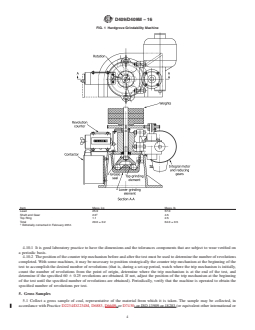
4.10 Grindability Machine—The Hardgrove Grindability Machine such as is shown in Fig. 1 is required for this test. Essential
tolerances and specifications are shown in Fig. 2. The grindability machine includes a stationary grinding bowl of polished cast
iron, with a circular horizontal track that holds eight polished steel balls, each 25.40 6 0.13 mm [1.000 6 0.005 in.] in diameter.
The balls are driven by an upper grinding ring which is rotated at 20 6 1 r/min by means of the upper spindle and which, in turn,
is driven by an electric motor through reduction gears or, in newer models, belts. Weights are added to the driving spindle so that
the total vertical force on the balls as a result of the weights, shaft, top grinding ring, and gear is equal to 29.0 6 0.2 kg [64 6
0.5 lb]. The machine is equipped with a counter and automatic device, which can be properly adjusted for stopping the machine
after 60 6 0.25 revolutions.
D05.07 Minutes, J. Gardner, Georgia Power and G. Linton, October 1990.
D409/D409M − 16
FIG. 1 Hardgrove Grindability Machine
Item Mass, kg Mass, lb
Lead 25.9 57.0
†
Shaft and Gear 2.0 4.5
Top Ring 1.1 2.5
Total 29.0 ± 0.2 64.0 ± 0.5
†
Editorially corrected in February 2012.
4.10.1 It is good laboratory practice to have the dimensions and the tolerances components that are subject to wear verified on
a periodic basis.
4.10.2 The position of the counter trip mechanism before and after the test must be used to determine the number of revolutions
completed. With some machines, it may be necessary to position strategically the counter trip mechanism at the beginning of the
test to accomplish the desired number of revolutions (that is, during a set-up period, watch where the trip mechanism is initially,
count the number of revolutions from the point of origin, determine where the trip mechanism is at the end of the test, and
determine if the specified 60 6 0.25 revolutions are obtained. If not, adjust the position of the trip mechanism at the beginning
of the test until the specified number of revolutions are obtained). Periodically, verify that the machine is operated to obtain the
specified number of revolutions per test.
5. Gross Samples
5.1 Collect a gross sample of coal, representative of the material from which it is taken. The sample may be collected, in
accordance with Practice D2234/D2234M, D6883, D6609, or D7430; or ISO 13909 or 18283 (or equivalent other international or
D409/D409M − 16
national standard), and prepared in accordance with Practice D2013; or ISO 13909 or 18283 (or equivalent other international or
national standard) except that the sample topsize shall not be reduced beyond the 4.75-mm (No. 4) sieve and the sample shall have
a mass of at least 1000 g.
5.2 If the topsize of the final sample product produced from mechanical sampling system is smaller than 4.75mm (No. 4), the
sample does not meet the requirements of this test procedure.
6. Preparation of Test Samples
6.1 Prepare a 1.18 × 0.60 mm (No. 16 × 30) test sample for establishing the HGI of HGI RMs (Annex A4), for calibration
(Annex A5), or for routine determination of HGI.
6.2 When necessary, divide the quantity of 4.75-mm (No. 4) sieve size coal to not less than 1000-g lots using an enclosed riffle
or rotary sample divider, and air dry each sample in conformance with Test Method D3302. To calculate the % Yield (8.3), record
the mass of the air-dried sample (m ).
6.3 Sieve the entire amount (1000 g) of air-dried 4.75-mm (No. 4) sieve size sample in lots of no greater than 250 g for 2 min
2 min 6 10 s in the mechanical sieving machine. Use a set of nested sieves consisting of a 1.18-mm (No. 16) sieve on top of a
0.60-mm (No. 30) sieve. Weigh and record the mass of each sieve size.
6.3.1 Include a 4.75-mm (No. 4) and a 2.36-mm (No. 8) sieve in this nest of sieves to ease separation, determine and record
the “natural” particle size distribution, and to verify that the topsize of the sample is appropriate for this test. Sieving more than
250 g at a time on the 200-mm [8-in.] diameter sieve may not allow each particle to “see” the sieve surface and have an opportunity
to pass or to be retained by the sieve.
6.4 Combine and stage crush all of the sieve fractions greater than the 1.18-mm (No. 16) sieve with the crusher adjusted so that
only the largest particles are crushed. Sieve the crushed material in portions of no greater than 250 g for 2 min 6 10 s in the
mechanical sieving machine. Return the oversize to the crusher, after setting the crusher so that only the largest particles are
crushed. Continue the stage crushing and sieving procedure until all the material passes the 1.18-mm sieve. Retain the 1.18 × 0.60
mm (No. 16 × 30) material. After all stage-crushing is completed, to calculate the % Yield (8.3), record the mass of the 1.18 ×
0.60 mm (No. 16 × 30) fraction (m ).
6.5 Mix well all the 1.18 × 0.60 mm (No. 16 × 30) material accumulated from the stage crushing and sieving process and divide
the quantity using an enclosed riffle or rotary sample divider to obtain approximately 120 6 10 g.
6.6 As the final step in preparation of the test sample, dedust the 120 6 10-g sample from 6.5 by sieving on a 0.60 mm (No.
30) sieve for 5 min 6 10 s using the mechanical sieving machine.
6.6.1 Determining the mass of each sieve fraction after each stage-crushing step will allow the rate of reduction to be calculated
and evaluated as a contributor to achieving adequate % Yield.
7. Procedure
7.1 Clean the grindability machine thoroughly, place the machine on a level surface, and space the balls as evenly as possible
around the grinding bowl. Set the automatic stopping device so that the motion of the grindability machine will stop after 60 6
0.25 revolutions of the upper grinding ring.
D409/D409M − 16
A = 19.05 6 0.13 mm [ 0.750 6 0.0005 in.] radius
B = 25.40 6 0.13 mm [1.000 6 0.0005 in.] diameter
C = 12.70 mm [0.50 in.]
D = 22.23 mm [0.875 in.]
E = 19.05 mm [0.750 in.]
F = 1.42 mm [0.078 in.]
G = 60.33 mm [2.375 in.]
H = 98.43 mm [3.875 in.]
I = 76.20 mm [3.000 in.]
f = smooth machine surface
ff = fine machined surface and polished
7.1.1 If the grindability machine makes a different number of revolutions other than the specified 60 6 0.25 revolutions, the
machine must be adjusted to within the tolerance specified. (This is normally done by strategically placing the counter tripper arm
at the start of the test. See 4.10.2.)
7.2 Weigh 50 6 0.01 g of the 1.18 × 0.60 mm (No. 16 × 30) sieve size dedusted material from 6.6 and distribute it evenly in
the grinding bowl, brushing any material that falls on the elevated section of the lower grinding element into the lower grinding
element, which contains the balls. Fasten the bowl in position and make sure the load is fully applied to the driving spindle.
7.3 Operate the machine for the specified 60.00 6 0.25 revolutions.
7.4 Remove the bowl from the machine, lift out the upper grinding ring, and carefully brush adhering coal dust from the bowl
and grinding ring onto a 16-mm [ ⁄8-in.] sieve nested on a 75-μm (No. 200) sieve and a closely fitting receiving pan. Carefully
empty the contents of the bowl onto the 16-mm [ ⁄8-in.] sieve. Brush off material adhering to the balls and remove the balls from
5 5
the 16-mm [ ⁄8-in.] sieve. Brush material adhering to the 16-mm [ ⁄8-in.] sieve, including the underside of the sieve, onto the 75-μm
(No. 200) sieve. Replace the 16-mm [ ⁄8-in.] sieve with a close-fitting cover and shake the nested 75-μm (No. 200) sieve; cover
and pan for 10 min 6 10 s 10 s in a mechanical sieving machine. After the 10-min 6 10-s period, carefully brush coal dust from
the underside of the 75-μm (No. 200) sieve into the receiving pan using a soft-bristled brush to avoid damaging the sieve. Repeat
the shaking of the ball-milled material and the cleaning of the underside of the 75-μm (No. 200) sieve for two more periods each
of 5-min 6 10-s duration.
7.4.1 Before emptying the contents of the lower grinding bowl onto the 16-mm [ ⁄8-in.] sieve, the tops of the grinding balls may
be brushed and then the balls may be removed from the lower grinding bowl by use of a magnetic extraction tool. Each grinding
ball is brushed off and set aside; then, the pulverized coal is emptied from the bowl onto the 16-mm [ ⁄8-in.] sieve.
7.5 Weigh separately to the nearest 0.01 g the coal retained on the 75-μm (No. 200) sieve (m ) and the coal passing the 75-μm
(No. 200) sieve (m ).
7.5.1 Alternatively, predetermine the tare masses of the 75-μm (No. 200) sieve (m ) and the catch pan (m ). After the sieving
5 6
of 7.4, weigh the 75-μm (No. 200) sieve and its contents (m ). Subtract the tare mass to obtain the mass of the +75-μm (+No. 200)
material = m = m – m . Weigh the catch pan and its contents (m ). Subtract the tare mass to obtain the mass of the –75-μm (–No.
3 7 5 8
200) material = m = m – m .
4 8 6
7.6 If the sum of the +75-μm (+No. 200) (m ) and the -75-μm (-No. 200) (m ) sieve fraction masses differs by more than 0.50
3 4
g from the initial mass of 50 6 0.01 g (m , see 7.2), reject the test and repeat. Use the calculated mass of the coal passing the 75-μm
(No. 200) sieve (m ), determined by subtracting the mass retained on the 75-μm (No. 200) sieve (m ) from the test specimen mass
10 3
(m ), in determining the sum-of-least-squares fit (A5.4.3), in preparation of the calibration chart (A5.4.3.2) or in calculation of the
grindability index of the sample (8.1) m = m – m .
10 9 3
8. Calculation and Report
8.1 Calculate the grindability index corresponding to the calculated mass of test specimen passing the 75-μm (No. 200) sieve
(7.5) directly from the equation of the line prepared in A5.4.3 and report to the nearest whole number.
8.2 For ease of comparison between or among laboratories, calculate and report the percent residual moisture in the 1.18 × 0.60
mm (No. 16 × 30) sample (Annex A6).
8.3 Calculate the % Yield of 1.18 × 0.60 mm (No. 16 × 30) material generated from the initial 1000 g of 4.75-mm (No. 4)
top-size sample and compare the actual value to a typical median value (4.8.1) to gage the effectiveness/efficiency of the
stage-crusher and of the stage-crushing process.
m
Y 5 3100 (1)
m
D409/D409M − 16
FIG. 2 Grinding Elements of Hardgrove Machine
where:
Y = % Yield,
m = mass of air dried sample (6.2), and
m = mass of 1.18 × 0.60 mm (No. 16 × 30) material (6.4).
8.4 If other than primary HGI RMs are used for calibration of the test apparatus and method, report the source of the calibration
standards used.
8.5 An example of a typical HGI preparation log sheet that has found application for record keeping during preparation of
samples to be used for HGI determination is shown in Fig. 3.
9. Precision and Bias
9.1 Precision:
9.1.1 The precision of this test method for the determination of Hardgrove Grindability Index of Coal, whenever primary HGI
reference materials are used for calibration, is shown in Table 2.
9.1.2 For the HGI method, the Repeatability Limit (r) in Table 2 is the value which the absolute difference between two test
results of separate and consecutive test determinations, carried out on dedusted 1.18 × 0.60 mm (No. 16 × 30) samples in the same
laboratory by the same operator using the same apparatus on samples taken at random from a single quantity of homogeneous 4.75
mm (No. 4) material, may be expected to occur with a probability of approximately 95 %.
9.1.3 For the HGI method, the Reproducibility Limit (R) in Table 2 is the value which the absolute difference between two test
results, carried out in different laboratories on riffled splits of the 4.75 mm (No. 4) analysis sample, may be expected to occur with
a probability of approximately 95 %.
9.1.3.1 The precision of this test method for the determination of Hardgrove Grindability Index of Coal, whenever national
(secondary) HGI reference materials are used for calibration, must be determined and reported by each pertinent ISO national
member body (NMB) and/or their national organization responsible for obtaining and preparing national (secondary) HGI RMs.
The precision limits for this test method, whenever these national (secondary) RMs are used, will be as large as or larger than the
precision limits stated in Table 2.
9.2 Bias—Since this test method (using a calibration procedure) is an empirical standard, the degree of absolute bias cannot be
determined.
10. Keywords
10.1 grindability; Hardgrove Grindability Index; HGI; pulverization
Supporting data have been filed at ASTM International Headquarters and may be obtained by requesting Research Report RR:D05-1040.
D409/D409M − 16
FIG. 3 HGI Log Sheet is for Example Only and is Non-Mandatory
D409/D409M − 16
TABLE 2 Repeatability and Reproducibility for HGI of Coal
Repeatability Limit Reproducibility Limit
r R
3 7
ANNEXES
(Mandatory Information)
A1. METHOD TO OBTAIN AND PREPARE HGI REFERENCE MATERIAL FEEDSTOCK
(HGI RM Feedstock)
A1.1 Scope
A1.1.1 This method describes the procedures used to obtain and prepare Hardgrove Grindability Index (HGI) reference material
feedstock (HGI RM feedstock).
A1.1.1.1 Recognition to obtain and prepare HGI RM feedstock for use as candidate primary HGI RMs is given by ASTM
Committee D05 on Coal and Coke.
A1.1.1.2 Authority to obtain and prepare HGI RM feedstock for use as candidate secondary HGI RMs is given by the pertinent
ISO national member body (NMB), which maintains oversight responsibility for these activities.
A1.2 Apparatus
A1.2.1 Sieves; 4.75 mm (No. 4) and 2.36 mm (No. 8)—Square mesh sieves meeting the requirements of Test Method D4749, used
to verify that the candidate HGI RMs are 4.75-mm (No. 4) topsize.
A1.2.2 Sieve Shaker—Meeting the requirements of Test Method D4749, used to verify that the candidate HGI RMs are 4.75-mm
(No. 4) topsize.
A1.2.2.1 No specifications are given for the sieve shaker used in the processing of the feedstock; as long as the final product meets
the specification of being 4.75-mm (No. 4) topsize, there is no need to specify production equipment.
A1.2.3 Crusher—Commensurate with the requirement to maximize the 1.18 × 0.60-mm (No. 16 × 30) size fraction while
maintaining a 4.75-mm (No. 4) topsize.
A1.3 HGI RM Feedstock Requirements
A1.3.1 Four coals shall be collected and used as the feedstock for the HGI RMs. One feedstock shall have an HGI of
approximately 40 (typically between 35 and 45); a second feedstock shall have an HGI of approximately 60 (typically between
55 and 65); a third feedstock shall have an HGI of approximately 80 (typically between 75 and 85); and a fourth feedstock shall
have an HGI of approximately 100 (typically between 90 and 110).
A1.3.2 Each HGI RM feedstock shall have a minimum mass of 80 kg [175 lb]. Where 80 kg [175 lb] is not adequate to produce
the desired number of candidate RMs, an adequate mass to produce the desired number of candidate HGI RMs shall be obtained.
Each candidate RM sample shall have a minimum mass of 1000 g.
A1.3.3 Any feedstock will be accept
...