

ASTM F3505-21
(Test Method)Standard Test Method for Stent and Endovascular Prosthesis Kink Resistance
General Information
- Abstract
SIGNIFICANCE AND USE
5.1 Upon deployment of a stent or endovascular prosthesis, the device is intended to maintain the patency of the vascular vessel. In order to maintain vessel patency, the device must deform within the in-vivo loading environment without a flow-limiting loss in lumen area. Kinking induces a severe, localized loss of lumen area, typified by a slot-like lumen shape. Device resistance to kinking can be evaluated through multiple test methods, with the appropriate selection depending on the device.
5.2 The purpose of this standard is to outline test methods to address the resistance to kinking of stents and endovascular prostheses. In the case where no kinking is observed, the radius at which a predefined narrowing criterion (for example, 50 % diameter reduction) occurs may be considered as the kink radius of the device.
5.3 When kink resistance properties are expected to vary along the length of the stent or endovascular prosthesis, testing should be performed at each of these sections.
5.4 This standard is not intended to evaluate the kink resistance of devices other than stents, endovascular prostheses, and scaffolds, although the specific procedures outlined here may be used if applicable.
SCOPE
1.1 This standard addresses the kink resistance of stents and endovascular prostheses (for example, stent grafts). The standard may also be applicable to scaffolds.
1.2 Test methods presented herein address the kink resistance of stents and endovascular protheses when exposed to bending in a single plane. While concurrent influences (for example, torque) are recognized to influence kinking properties, test methods other than single-plane bending are not addressed.
1.3 Test methods presented herein do not specifically address kink resistance of branched (for example, bifurcated) or multicomponent endovascular prostheses, but some aspects of this standard may be applicable to their application.
1.4 The values stated in SI units are to be regarded as standard. No other units of measurement are included in this standard.
1.5 This standard does not purport to address all of the safety concerns, if any, associated with its use. It is the responsibility of the user of this standard to establish appropriate safety, health, and environmental practices and determine the applicability of regulatory limitations prior to use.
1.6 This international standard was developed in accordance with internationally recognized principles on standardization established in the Decision on Principles for the Development of International Standards, Guides and Recommendations issued by the World Trade Organization Technical Barriers to Trade (TBT) Committee.
- Status
- Published
- Publication Date
- 14-Sep-2021
- Technical Committee
- F04 - Medical and Surgical Materials and Devices
- Drafting Committee
- F04.30 - Cardiovascular Standards
Overview
ASTM F3505-21 is the internationally recognized standard test method for assessing the kink resistance of stents and endovascular prostheses, including stent grafts and certain vascular scaffolds. Developed by ASTM International, this standard provides structured test methods to determine a device's ability to resist kinking during deployment and within physiological environments. Ensuring high kink resistance is essential for vascular devices, as kinking can lead to severe, localized narrowing and compromise vessel patency. The test methods outlined in ASTM F3505-21 help manufacturers, regulatory authorities, and clinical researchers evaluate and report on the mechanical reliability and safety of these critical medical devices.
Key Topics
Kink Resistance Assessment
The main focus of ASTM F3505-21 is to evaluate how stents, stent grafts, and endovascular prostheses perform when subjected to single-plane bending. Devices are tested to identify the smallest radius at which no kinking, or a predefined narrowing (such as a 50% reduction in diameter), is observed.Test Methods
The standard provides three primary test techniques:- Template of Known Radii: Devices are bent to conform to templates with incrementally decreasing radii to determine the kink radius.
- Cylindrical Gauges: The device is bent over cylindrical gauges of varying radii to observe kink behavior.
- Rigid Bend Models: Devices are deployed in translucent rigid models mimicking anatomical bends for direct observation.
Test Conditions
- Tests are performed at clinically relevant temperatures and hydration states, reflecting the intended use environment.
- Proper handling to avoid excess tension or compression is required.
- When relevant, devices can be deployed and tested within mock vessels that simulate vascular conditions.
Reporting Requirements
The standard details comprehensive reporting elements, including:- Test method used and incremental sizes
- Description and identification of the test article
- Use and specifications of mock vessels
- Environmental test conditions
- Defined criteria for narrowing (e.g., 50% diameter reduction)
- Final kink radius results, including images and statistical metrics
Applications
ASTM F3505-21 is invaluable for:
Medical Device Manufacturers:
Ensures the robust, repeatable evaluation of stent and endovascular prosthesis kink resistance during product development and quality verification.Regulatory Compliance:
Facilitates compliance with international requirements for the safety and performance of vascular devices, supporting submissions to regulatory bodies.Clinical Research and Design Optimization:
Assists in identifying design aspects that influence kink resistance, enabling targeted improvements and comparative studies of device performance.Quality Assurance and Lifecycle Testing:
Standardized testing per ASTM F3505-21 helps verify product reliability, minimize the risk of in-vivo complications, and support post-market surveillance.
Related Standards
- ASTM F3172: Guide for device size and sample size selection for endovascular devices, often referenced for rational test article selection.
- Additional relevant ASTM standards may include those addressing cardiovascular implant materials and performance testing.
- Globally, the principles in ASTM F3505-21 align with ISO and regulatory guidance on mechanical testing for vascular implants.
Keywords: stent kink resistance, endovascular prosthesis, mock vessel, stent graft testing, vascular device standards, ASTM F3505-21, device patency, medical device reliability
By adhering to ASTM F3505-21, stakeholders ensure stents and endovascular prostheses are rigorously evaluated for kink resistance, supporting safer and more effective patient outcomes.
Get Certified
Connect with accredited certification bodies for this standard

BSI Group
BSI (British Standards Institution) is the business standards company that helps organizations make excellence a habit.

TÜV Rheinland
TÜV Rheinland is a leading international provider of technical services.

TÜV SÜD
TÜV SÜD is a trusted partner of choice for safety, security and sustainability solutions.
Sponsored listings
Frequently Asked Questions
ASTM F3505-21 is a standard published by ASTM International. Its full title is "Standard Test Method for Stent and Endovascular Prosthesis Kink Resistance". This standard covers: SIGNIFICANCE AND USE 5.1 Upon deployment of a stent or endovascular prosthesis, the device is intended to maintain the patency of the vascular vessel. In order to maintain vessel patency, the device must deform within the in-vivo loading environment without a flow-limiting loss in lumen area. Kinking induces a severe, localized loss of lumen area, typified by a slot-like lumen shape. Device resistance to kinking can be evaluated through multiple test methods, with the appropriate selection depending on the device. 5.2 The purpose of this standard is to outline test methods to address the resistance to kinking of stents and endovascular prostheses. In the case where no kinking is observed, the radius at which a predefined narrowing criterion (for example, 50 % diameter reduction) occurs may be considered as the kink radius of the device. 5.3 When kink resistance properties are expected to vary along the length of the stent or endovascular prosthesis, testing should be performed at each of these sections. 5.4 This standard is not intended to evaluate the kink resistance of devices other than stents, endovascular prostheses, and scaffolds, although the specific procedures outlined here may be used if applicable. SCOPE 1.1 This standard addresses the kink resistance of stents and endovascular prostheses (for example, stent grafts). The standard may also be applicable to scaffolds. 1.2 Test methods presented herein address the kink resistance of stents and endovascular protheses when exposed to bending in a single plane. While concurrent influences (for example, torque) are recognized to influence kinking properties, test methods other than single-plane bending are not addressed. 1.3 Test methods presented herein do not specifically address kink resistance of branched (for example, bifurcated) or multicomponent endovascular prostheses, but some aspects of this standard may be applicable to their application. 1.4 The values stated in SI units are to be regarded as standard. No other units of measurement are included in this standard. 1.5 This standard does not purport to address all of the safety concerns, if any, associated with its use. It is the responsibility of the user of this standard to establish appropriate safety, health, and environmental practices and determine the applicability of regulatory limitations prior to use. 1.6 This international standard was developed in accordance with internationally recognized principles on standardization established in the Decision on Principles for the Development of International Standards, Guides and Recommendations issued by the World Trade Organization Technical Barriers to Trade (TBT) Committee.
SIGNIFICANCE AND USE 5.1 Upon deployment of a stent or endovascular prosthesis, the device is intended to maintain the patency of the vascular vessel. In order to maintain vessel patency, the device must deform within the in-vivo loading environment without a flow-limiting loss in lumen area. Kinking induces a severe, localized loss of lumen area, typified by a slot-like lumen shape. Device resistance to kinking can be evaluated through multiple test methods, with the appropriate selection depending on the device. 5.2 The purpose of this standard is to outline test methods to address the resistance to kinking of stents and endovascular prostheses. In the case where no kinking is observed, the radius at which a predefined narrowing criterion (for example, 50 % diameter reduction) occurs may be considered as the kink radius of the device. 5.3 When kink resistance properties are expected to vary along the length of the stent or endovascular prosthesis, testing should be performed at each of these sections. 5.4 This standard is not intended to evaluate the kink resistance of devices other than stents, endovascular prostheses, and scaffolds, although the specific procedures outlined here may be used if applicable. SCOPE 1.1 This standard addresses the kink resistance of stents and endovascular prostheses (for example, stent grafts). The standard may also be applicable to scaffolds. 1.2 Test methods presented herein address the kink resistance of stents and endovascular protheses when exposed to bending in a single plane. While concurrent influences (for example, torque) are recognized to influence kinking properties, test methods other than single-plane bending are not addressed. 1.3 Test methods presented herein do not specifically address kink resistance of branched (for example, bifurcated) or multicomponent endovascular prostheses, but some aspects of this standard may be applicable to their application. 1.4 The values stated in SI units are to be regarded as standard. No other units of measurement are included in this standard. 1.5 This standard does not purport to address all of the safety concerns, if any, associated with its use. It is the responsibility of the user of this standard to establish appropriate safety, health, and environmental practices and determine the applicability of regulatory limitations prior to use. 1.6 This international standard was developed in accordance with internationally recognized principles on standardization established in the Decision on Principles for the Development of International Standards, Guides and Recommendations issued by the World Trade Organization Technical Barriers to Trade (TBT) Committee.
ASTM F3505-21 is classified under the following ICS (International Classification for Standards) categories: 11.040.40 - Implants for surgery, prosthetics and orthotics. The ICS classification helps identify the subject area and facilitates finding related standards.
ASTM F3505-21 is available in PDF format for immediate download after purchase. The document can be added to your cart and obtained through the secure checkout process. Digital delivery ensures instant access to the complete standard document.
Standards Content (Sample)
This international standard was developed in accordance with internationally recognized principles on standardization established in the Decision on Principles for the
Development of International Standards, Guides and Recommendations issued by the World Trade Organization Technical Barriers to Trade (TBT) Committee.
Designation: F3505 − 21
Standard Test Method for
Stent and Endovascular Prosthesis Kink Resistance
This standard is issued under the fixed designation F3505; the number immediately following the designation indicates the year of
original adoption or, in the case of revision, the year of last revision. A number in parentheses indicates the year of last reapproval. A
superscript epsilon (´) indicates an editorial change since the last revision or reapproval.
1. Scope 3. Terminology
1.1 This standard addresses the kink resistance of stents and 3.1 Definitions:
endovascular prostheses (for example, stent grafts). The stan- 3.1.1 endovascular prosthesis, n—device used to treat dis-
dard may also be applicable to scaffolds. ease by accessing target anatomy through the vasculature.
3.1.2 kink, n—a crease across the conduit where it has
1.2 Test methods presented herein address the kink resis-
folded from excessive bending; the attribute of a stent or
tance of stents and endovascular protheses when exposed to
endovascular prosthesis to buckle in the region of the inner
bending in a single plane. While concurrent influences (for
radius during bending at a particular bending radius or angle.
example, torque) are recognized to influence kinking
properties,testmethodsotherthansingle-planebendingarenot
3.1.3 kink radius, n—the smallest bend radius achieved by
addressed.
the test article upon which a kink did not occur.
1.3 Test methods presented herein do not specifically ad-
3.1.4 mock vessel, n—a simulated vessel typically manufac-
dress kink resistance of branched (for example, bifurcated) or
turedfromanelastomericmaterial.Themockvesselismadeto
multicomponent endovascular prostheses, but some aspects of
approximate the inner diameter and diametric distention of a
this standard may be applicable to their application.
native vessel at physiological pressures or at non-physiological
pressures, and should be translucent to permit visualization of
1.4 The values stated in SI units are to be regarded as
the device during testing.
standard. No other units of measurement are included in this
3.1.5 vascular stent, n—a tubular structure that is perma-
standard.
nently implanted in the native or grafted vasculature and that is
1.5 This standard does not purport to address all of the
intended to provide mechanical radial support to enhance
safety concerns, if any, associated with its use. It is the
vesselpatency.Astentismetallicandnotcoveredbysynthetic,
responsibility of the user of this standard to establish appro-
textile, or tissue graft material.
priate safety, health, and environmental practices and deter-
mine the applicability of regulatory limitations prior to use. 3.1.6 vascular stent graft, n—transluminally placed tubular
1.6 This international standard was developed in accor- vascular prosthesis, with one or more integral stent compo-
dance with internationally recognized principles on standard- nents to provide fixation, radial support, or both, residing
ization established in the Decision on Principles for the partially or completely within a vascular vessel to form an
internal bypass or shunt between sections of the vascular
Development of International Standards, Guides and Recom-
mendations issued by the World Trade Organization Technical system.
Barriers to Trade (TBT) Committee.
4. Summary of Test Method
4.1 Kink resistance of stents and endovascular prostheses
2. Referenced Documents
maybeevaluatedusingthefollowingtestmethods:templateof
2.1 ASTM Standards:
known radii, cylindrical gauges, and rigid bend models.
F3172 Guide for Design Verification Device Size and
Sample Size Selection for Endovascular Devices 5. Significance and Use
5.1 Upon deployment of a stent or endovascular prosthesis,
the device is intended to maintain the patency of the vascular
This test method is under the jurisdiction ofASTM Committee F04 on Medical
vessel. In order to maintain vessel patency, the device must
and Surgical Materials and Devices and is the direct responsibility of Subcommittee
deform within the in-vivo loading environment without a
F04.30 on Cardiovascular Standards.
flow-limiting loss in lumen area. Kinking induces a severe,
Current edition approved Sept. 15, 2021. Published September 2021. DOI:
10.1520/F3505-21.
localized loss of lumen area, typified by a slot-like lumen
For referenced ASTM standards, visit the ASTM website, www.astm.org, or
shape. Device resistance to kinking can be evaluated through
contact ASTM Customer Service at service@astm.org. For Annual Book of ASTM
multipletestmethods,withtheappropriateselectiondepending
Standards volume information, refer to the standard’s Document Summary page on
the ASTM website. on the device.
Copyright © ASTM International, 100 Barr Harbor Drive, PO Box C700, West Conshohocken, PA 19428-2959. United States
F3505 − 21
5.2 Thepurposeofthisstandardistooutlinetestmethodsto 6.1.4 Test article length and diameter should be selected
address the resistance to kinking of stents and endovascular based on the evaluation of the device’s intended use. Rationale
prostheses.Inthecasewherenokinkingisobserved,theradius for test article selection should be provided (see Guide F3172
at which a predefined narrowing criterion (for example, 50 % for more information on sample selection).
diameter reduction) occurs may be considered as the kink 6.1.5 Test article orientation should be considered during
radius of the device. testing, and the worst-case stent design orientation should be
evaluated. That is, given that certain stent and endovascular
5.3 When kink resistance properties are expected to vary
prosthesis designs may have differing properties depending on
along the length of the stent or endovascular prosthesis, testing
circumferential direction, these potential design effects should
should be performed at each of these sections.
be accounted for during testing. Orientation of the test article
5.4 This standard is not intended to evaluate the kink
should remain constant throughout the test, unless justified
resistance of devices other than stents, endovascular
otherwise.
prostheses, and scaffolds, although the specific procedures
6.1.6 Unless otherwise justified, testing should be con-
outlined here may be used if applicable.
ducted without pressurization of the test article lumen. In cases
where lumen pressurization may be justified (for example,
6. Procedure
when testing endovascular prostheses that are only partially
6.1 Overview:
stented), the lumen pressure shall be established and justified
6.1.1 Testing temperature (for example, 37 6 2 °C) should
prior to testing.
be based on the intended clinical use of the device and on the
6.2 Template of Known Radii:
materials of the device. Relevant dimensions such as initial
6.2.1 Summary:
length, diameter, or cell size should be measured at this same
6.2.1.1 This test method is intended to determine the mini-
temperature. When devices that are sensitive to temperature
mum radius that a stent or endovascular prosthesis can accom-
variations between ambient and body temperature (for
modate using a visual template of known radii in appropriate
example, nitinol) are not tested at body temperature, a state-
increments.
ment as to how the differences between ambient and body
6.2.2 Apparatus:
temperature affect the outcomes of the test should be provided.
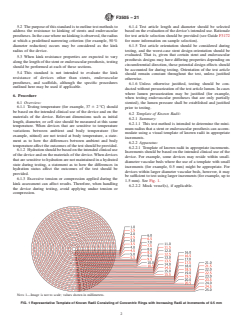
6.2.2.1 Template of known radii in appropriate increments.
6.1.2 Hydrationshouldbebasedontheintendedclinicaluse
Increments should be based on the intended clinical use of the
of the device and on the materials of the device. When devices
device. For example, some devices may reside within small-
that are sensitive to hydration are not maintained in a hydrated
diameter vascular beds where the use of a template with small
state during testing, a statement as to how the differences in
increments (for example, 0.5 mm) might be appropriate. For
hydration status affect the outcomes of the test should be
devices within larger diameter vascular beds, however, it may
provided.
be sufficient to test using larger increments (for example, up to
6.1.3 Excessive tension or compression applied during the
1.5 mm). See Fig. 1.
kink assessment can affect results. Therefore, when handling
6.2.2.2 Mock vessel(s), if applicable.
the device during testing, avoid applying undue tension or
compression.
NOTE 1—Image is not to scale; values shown in millimeters.
FIG. 1 Representative Template of Known Radii Consisting of Concentric Rings with Increasing Radii at Increments of 0.5 mm
F3505 − 21
adding the tubing wall thickness to the ring radius value of the template.
6.2.3 Procedure:
6.2.3.1 Prior to testing, conditioning of the test article may
6.2.3.7 The smallest bend radius achieved by the test article
include loading the device on the delivery catheter, precondi-
uponwhichakinkdidnotoccurshallbeconsideredasthekink
tioning (for example, tracking through a simulated use model
radius.
orintoamockvessel),anddeployment,asappropriate.Theuse
6.2.4 Report:
of a straight or a curved mock vessel may be appropriate for
6.2.4.1 ThetestreportshallbeinaccordancewithSection7.
deployment prior to kink testing; appropriate rationale should
6.3 Cylindrical Gauges:
be provided to justify the selection.
6.3.1 Summary:
6.2.3.2 Position the test article on the appropriate template.
6.3.1.1 This test method is intended to determine the mini-
NOTE 1—The initial template ring selected should represent a radius
mum radius that a stent or endovascular prosthesis can accom-
that is not expected to kink the test article.
modate using cylindrical gauges of known radii in appropriate
6.2.3.3 Using an appropriate, justified gauge length (for
increments.
example,twostentrowsorcells),bendthetestarticlesuchthat
6.3.2 Apparatus:
the gauge length section conforms to the template radius (that
6.3.2.1 Cylindrical gauges of known radii in appropriate
is, ring) up to a maximum of 180°, taking care not to apply
increments. Increments should be based on the intended
undue tension or compression on the test article.
clinical use of the device. For example, some devices may
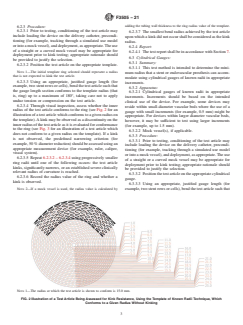
6.2.3.4 Through visual inspection, assess whether the inner
reside within small-diameter vascular beds where the use of a
radius of the test article conforms to the ring (see Fig. 2 for an
gauge with small increments (for example, 0.5 mm) might be
illustrationofatestarticlewhichconformstoagivenradiu
...