


ASTM D7025-09(2015)e1
(Test Method)Standard Test Method for Assessing Clean Flax Fiber Fineness
Standard Test Method for Assessing Clean Flax Fiber Fineness
SIGNIFICANCE AND USE
5.1 This test method for determining fineness of cleaned flax fibers is considered satisfactory for acceptance testing of commercial shipments when the levels are controlled by use of a range of calibration standards.
5.1.1 If there are differences of practical significance between reported test results for two or more laboratories, comparative tests should be performed by those laboratories to determine if there is a statistical bias between them, using competent statistical assistance. As a minimum, use test samples that are as homogenous as possible, are drawn from the material from which the disparate test results were obtained, and are randomly assigned in equal numbers to each laboratory for testing. These test results from the two laboratories should be compared using a statistical test for unpaired data, at a probability level chosen prior to the testing series. If a bias is found, either its cause must be found and corrected, or future test results for that material must be adjusted in consideration of the known bias.
5.2 The resistance that a plug of flax fibers offers to the flow of air is measured as an approximate indication of the average relative fineness of the fibers.
5.2.1 The total surface area of finer fibers has a larger per unit mass and increased resistance to airflow than do coarser fibers.
5.3 Instruments are available to indicate the resistance to air flow using either compressed air or a vacuum; and are constructed (1) to measure airflow under constant pressure drop across the plug, (2) to measure pressure drop when a constant flow of air is maintained, or (3) to indicate resistance to air flow from both a balanced and unbalanced Wheatstone bridge.
5.4 The reliability of the results of any test method depends primarily upon how well the specimens tested represent the original source material. Flax fibers are different from many textile fibers, such as cotton or synthetic ones, in that they are not individual filaments but bu...
SCOPE
1.1 This test method provides two options that cover the determination of the fineness of clean loose flax fibers by: Option 1, measuring the specific surface area by the resistance of a plug of flax fibers to air flow under prescribed conditions, or Option 2, estimating the mass per unit length.
Note 1: For other methods for determining the fineness of fibers refer to Appendix X1.
1.2 The values stated in SI units are to be regarded as standard. No other units of measurement are included in this standard.
1.3 This standard does not purport to address all of the safety concerns, if any, associated with its use. It is the responsibility of the user of this standard to establish appropriate safety and health practices and determine the applicability of regulatory limitations prior to use.
General Information
Buy Standard


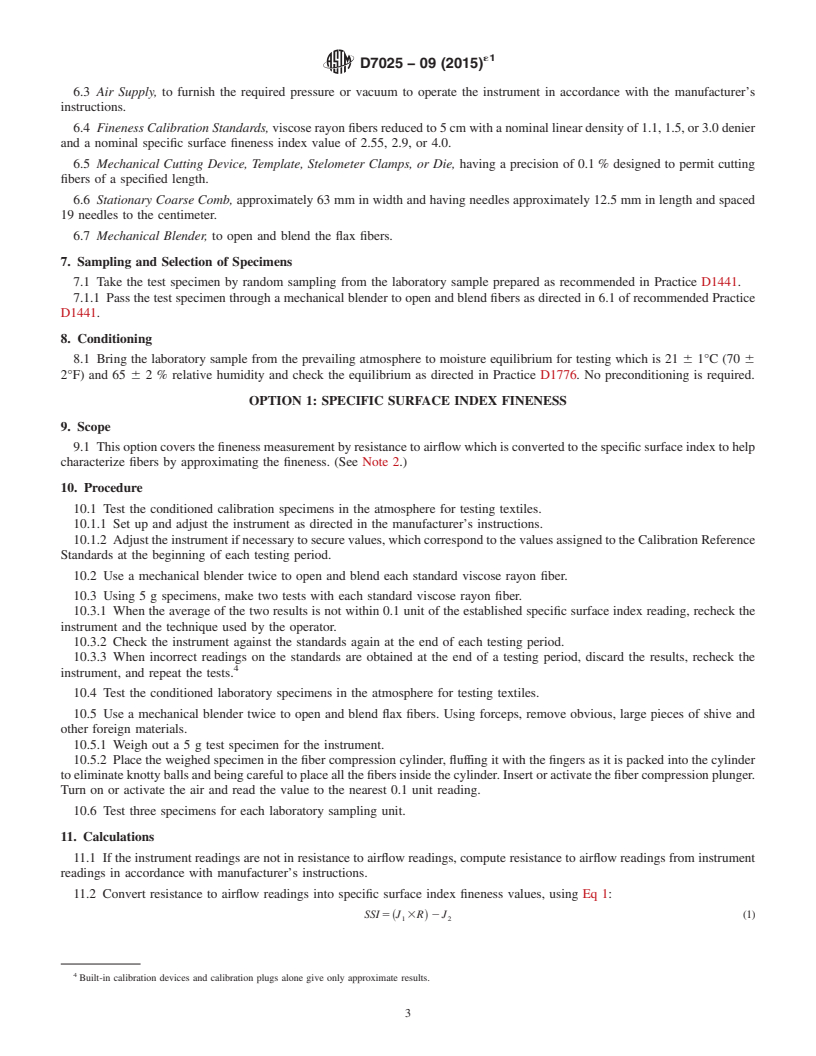
Standards Content (Sample)
NOTICE: This standard has either been superseded and replaced by a new version or withdrawn.
Contact ASTM International (www.astm.org) for the latest information
´1
Designation: D7025 − 09 (Reapproved 2015)
Standard Test Method for
Assessing Clean Flax Fiber Fineness
This standard is issued under the fixed designation D7025; the number immediately following the designation indicates the year of
original adoption or, in the case of revision, the year of last revision.Anumber in parentheses indicates the year of last reapproval.A
superscript epsilon (´) indicates an editorial change since the last revision or reapproval.
ε NOTE—The terminology section was updated in accordance with D13 policy in February 2015.
1. Scope 4. Summary of Test Method
1.1 This test method provides two options that cover the
4.1 Using Option 1, a predetermined mass of clean loose
determination of the fineness of clean loose flax fibers by:
flaxfibersgeneratedbyusingamechanicalblenderisplacedin
Option 1, measuring the specific surface area by the resistance
the specimen holder and compressed to a fixed volume.
of a plug of flax fibers to air flow under prescribed conditions,
4.1.1 The resistance to airflow is measured using a cotton
or Option 2, estimating the mass per unit length.
fiber instrument that provides a reading. This reading is
convertedtoaspecificsurfaceindexwhichisderivedfromthe
NOTE 1—For other methods for determining the fineness of fibers refer
linear density of flax.
to Appendix X1.
1.2 The values stated in SI units are to be regarded as
4.2 Using Option 2, the average linear density of single
standard. No other units of measurement are included in this
fibers in a bundle is calculated from mass and length measure-
standard.
ments on the bundle and the number of single fibers in the
bundle.
1.3 This standard does not purport to address all of the
NOTE 2—There may be no overall correlation between the results
safety concerns, if any, associated with its use. It is the
obtainedwithOptions1and2.Consequently,thesetwooptionscannotbe
responsibility of the user of this standard to establish appro-
used interchangeably. In case of controversy, Option 1 shall prevail.
priate safety and health practices and determine the applica-
bility of regulatory limitations prior to use.
5. Significance and Use
2. Referenced Documents
5.1 This test method for determining fineness of cleaned
flax fibers is considered satisfactory for acceptance testing of
2.1 ASTM Standards:
commercialshipmentswhenthelevelsarecontrolledbyuseof
D123Terminology Relating to Textiles
a range of calibration standards.
D1441Practice for Sampling Cotton Fibers for Testing
5.1.1 If there are differences of practical significance be-
D1577Test Methods for Linear Density of Textile Fibers
tween reported test results for two or more laboratories,
D1776Practice for Conditioning and Testing Textiles
comparativetestsshouldbeperformedbythoselaboratoriesto
D6798Terminology Relating to Flax and Linen
determine if there is a statistical bias between them, using
3. Terminology competent statistical assistance. As a minimum, use test
samples that are as homogenous as possible, are drawn from
3.1 For terminology relating to Flax, see Terminology
the material from which the disparate test results were
D6798.
obtained, and are randomly assigned in equal numbers to each
3.1.1 The following terms are relevant to this standard:
laboratory for testing. These test results from the two labora-
fineness index and specific surface index.
tories should be compared using a statistical test for unpaired
3.2 For definitions of all other textile terms, see Terminol-
data, at a probability level chosen prior to the testing series. If
ogy D123.
abiasisfound,eitheritscausemustbefoundandcorrected,or
future test results for that material must be adjusted in
consideration of the known bias.
ThistestmethodisunderthejurisdictionofASTMCommitteeD13onTextiles
and is the direct responsibility of Subcommittee D13.17 on Bast Fibers and Plants.
5.2 Theresistancethataplugofflaxfibersofferstotheflow
Current edition approved Feb. 1, 2015. Published April 2015. Originally
of air is measured as an approximate indication of the average
approved in 2004. Last previous edition approved in 2004 as D7025–09. DOI:
10.1520/D7025-09R15E01.
relative fineness of the fibers.
For referenced ASTM standards, visit the ASTM website, www.astm.org, or
5.2.1 The total surface area of finer fibers has a larger per
contact ASTM Customer Service at service@astm.org. For Annual Book of ASTM
unit mass and increased resistance to airflow than do coarser
Standards volume information, refer to the standard’s Document Summary page on
the ASTM website. fibers.
Copyright © ASTM International, 100 Barr Harbor Drive, PO Box C700, West Conshohocken, PA 19428-2959. United States
´1
D7025 − 09 (2015)
5.3 Instrumentsareavailabletoindicatetheresistancetoair 6.6 Stationary Coarse Comb, approximately 63 mm in
flow using either compressed air or a vacuum; and are width and having needles approximately 12.5 mm in length
constructed (1) to measure airflow under constant pressure and spaced 19 needles to the centimeter.
drop across the plug, (2) to measure pressure drop when a
6.7 Mechanical Blender, to open and blend the flax fibers.
constant flow of air is maintained, or (3) to indicate resistance
to air flow from both a balanced and unbalanced Wheatstone 7. Sampling and Selection of Specimens
bridge.
7.1 Take the test specimen by random sampling from the
5.4 The reliability of the results of any test method depends laboratory sample prepared as recommended in Practice
primarily upon how well the specimens tested represent the
D1441.
original source material. Flax fibers are different from many 7.1.1 Pass the test specimen through a mechanical blender
textile fibers, such as cotton or synthetic ones, in that they are
to open and blend fibers as directed in 6.1 of recommended
not individual filaments but bundles of fibrous material that Practice D1441.
may or may not be completely separated into individual
8. Conditioning
filamentsandthereforehaveahighdegreeofvariability.While
cleaningandprocessingcanproduceseparationandchangesin
8.1 Bring the laboratory sample from the prevailing atmo-
length, there is no certainty of fibrillation of the fibrous
sphere to moisture equilibrium for testing which is 21 6 1°C
material.
(70 6 2°F) and 65 6 2 % relative humidity and check the
equilibrium as directed in Practice D1776. No preconditioning
NOTE 3—Amodification of this test method can be used in commercial
is required.
trading to select bales that will conform to contract guarantees for
specifiedspecificsurfaceindex.Forthispurpose,theusualpracticetotest
OPTION 1: SPECIFIC SURFACE INDEX FINENESS
only one specimen per sample.
5.4.1 This specific surface index reading is related to the
9. Scope
average linear density of single fibers in a bundle calculated
9.1 This option covers the fineness measurement by resis-
from mass and length measurements on the bundle and the
tancetoairflowwhichisconvertedtothespecificsurfaceindex
number of single fibers in the bundle.
to help characterize fibers by approximating the fineness. (See
5.5 The specific surface index of flax fibers may be a
Note 2.)
function of fineness, degree of retting, cleanliness, variety,
bundle separation, and plant maturity harvest date. This fine-
10. Procedure
ness of flax fibers affects their mill processing and spinning
10.1 Test the conditioned calibration specimens in the
performance as well as contributes significantly to the appear-
atmosphere for testing textiles.
ance and strength of the yarns produced.
10.1.1 Set up and adjust the instrument as directed in the
5.6 The accuracy of weighing can be controlled by the
manufacturer’s instructions.
number of fibers composing the bundle. However, with short
10.1.2 Adjust the instrument if necessary to secure values,
fiber of low linear density the number of fibers to be counted
which correspond to the values assigned to the Calibration
becomes prohibitive unless the bundle mass is kept low.
Reference Standards at the beginning of each testing period.
10.2 Useamechanicalblendertwicetoopenandblendeach
6. Apparatus and Materials
standard viscose rayon fiber.
6.1 Air-Flow Instrument, a device calibrated in micronaire
10.3 Using 5 g specimens, make two tests with each
readings or yielding numerical readings from which specific
standard viscose rayon fiber.
surface index readings can be computed.
10.3.1 Whentheaverageofthetworesultsisnotwithin0.1
6.2 Balances, with one having a capacity suitable for mass
unit of the established specific surface index reading, recheck
of the specific surface index specimen to be used and sensitiv-
the instrument and the technique used by the operator.
ity of at least 0.2% of the mass and another for linear density
10.3.2 Check the instrument against the standards again at
havingacapacityof15mgandsensitivityofatleast0.005mg.
the end of each testing period.
6.3 AirSupply,tofurnishtherequiredpressureorvacuumto
10.3.3 When incorrect readings on the standards are ob-
operate the instrument in accordance with the manufacturer’s tainedattheendofatestingperiod,discardtheresults,recheck
instructions.
the instrument, and repeat the tests.
6.4 Fineness Calibration Standards, viscose rayon fibers 10.4 Testtheconditionedlaboratoryspecimensintheatmo-
reducedto5cmwithanominallineardensityof1.1,1.5,or3.0
sphere for testing textiles.
denier and a nominal specific surface fineness index value of
10.5 Use a mechanical blender twice to open and blend flax
2.55, 2.9, or 4.0.
fibers. Using forceps, remove obvious, large pieces of shive
6.5 Mechanical Cutting Device, Template, Stelometer
and other foreign materials.
Clamps,orDie,havingaprecisionof0.1%designedtopermit
...
This document is not an ASTM standard and is intended only to provide the user of an ASTM standard an indication of what changes have been made to the previous version. Because
it may not be technically possible to adequately depict all changes accurately, ASTM recommends that users consult prior editions as appropriate. In all cases only the current version
of the standard as published by ASTM is to be considered the official document.
´1
Designation: D7025 − 09 D7025 − 09 (Reapproved 2015)
Standard Test Method for
Assessing Clean Flax Fiber Fineness
This standard is issued under the fixed designation D7025; the number immediately following the designation indicates the year of
original adoption or, in the case of revision, the year of last revision. A number in parentheses indicates the year of last reapproval. A
superscript epsilon (´) indicates an editorial change since the last revision or reapproval.
1. Scope
1.1 This test method provides two options that cover the determination of the fineness of clean loose flax fibers by: Option 1,
measuring the specific surface area by the resistance of a plug of flax fibers to air flow under prescribed conditions, or Option 2,
estimating the mass per unit length.
NOTE 1—For other methods for determining the fineness of fibers refer to Appendix X1.
1.2 The values stated in SI units are to be regarded as standard. No other units of measurement are included in this standard.
1.3 This standard does not purport to address all of the safety concerns, if any, associated with its use. It is the responsibility
of the user of this standard to establish appropriate safety and health practices and determine the applicability of regulatory
limitations prior to use.
2. Referenced Documents
2.1 ASTM Standards:
D123 Terminology Relating to Textiles
D1441 Practice for Sampling Cotton Fibers for Testing
D1577 Test Methods for Linear Density of Textile Fibers
D1776 Practice for Conditioning and Testing Textiles
D6798 Terminology Relating to Flax and Linen
3. Terminology
3.1 Definitions:
3.1.1 fineness index, n—the use of a cellulosic fiber to measure air permeability having a specific gravity of 1.5 and a nominal
linear density of 1.1 denier, 1.5 denier, or 3.0 denier.
This test method is under the jurisdiction of ASTM Committee D13 on Textiles and is the direct responsibility of Subcommittee D13.17 on Flax and Linen.
Current edition approved July 1, 2009Feb. 1, 2015. Published August 2009April 2015. Originally approved in 2004. Last previous edition approved in 2004 as
aε
D7025–04–09. 1. DOI: 10.1520/D7025-09.10.1520/D7025-09R15.
For referenced ASTM standards, visit the ASTM website, www.astm.org, or contact ASTM Customer Service at service@astm.org. For Annual Book of ASTM Standards
volume information, refer to the standard’s Document Summary page on the ASTM website.
3.1.1.1 Discussion—
Viscose rayon fiber samples are less variable than natural fibers and manufactured to exacting properties by many fiber distributors.
These fibers are derived from regenerated cellulose to contain a chemically induced crimp (4 to 6 crimps/cm) and a staple length
of approximately 5 cm. Linear density of these fibers can be verified using the bundle weighing Option A of Test Method D1577
to be approximately 0.11, 0.17, and 0.33 mg/m. As detailed in Test Method D1577, fibers were cut with a mechanical cutting device
under sufficient tension to remove fiber crimp. These cellulosic fibers have the same specific gravity as flax and can be used to
determine the specific surface area.
3.1.2 specific surface index, n—relative fineness obtained by measuring the specific surface area by the resistance of airflow
through a known mass of fiber compressed to a fixed volume.
3.1.2.1 Discussion—
Copyright © ASTM International, 100 Barr Harbor Drive, PO Box C700, West Conshohocken, PA 19428-2959. United States
´1
D7025 − 09 (2015)
The specific surface index is influenced by various types of flax whose fiber perimeter, fiber bundles, cross-sectional shape, density,
and trash differ between samples.
3.2 For definitions of textile terms used in this test method, refer to terminology relating to Flax, see Terminology D6798.
3.2.1 The following terms are relevant to this standard: fineness index and specific surface index.
3.3 For definitions of other terms used in this test method, refer to all other textile terms, see Terminology D123.
4. Summary of Test Method
4.1 Using Option 1, a predetermined mass of clean loose flax fibers generated by using a mechanical blender is placed in the
specimen holder and compressed to a fixed volume.
4.1.1 The resistance to airflow is measured using a cotton fiber instrument that provides a reading. This reading is converted
to a specific surface index which is derived from the linear density of flax.
4.2 Using Option 2, the average linear density of single fibers in a bundle is calculated from mass and length measurements on
the bundle and the number of single fibers in the bundle.
NOTE 2—There may be no overall correlation between the results obtained with Options 1 and 2. Consequently, these two options cannot be used
interchangeably. In case of controversy, Option 1 shall prevail.
5. Significance and Use
5.1 This test method for determining fineness of cleaned flax fibers is considered satisfactory for acceptance testing of
commercial shipments when the levels are controlled by use of a range of calibration standards.
5.1.1 If there are differences of practical significance between reported test results for two or more laboratories, comparative
tests should be performed by those laboratories to determine if there is a statistical bias between them, using competent statistical
assistance. As a minimum, use test samples that are as homogenous as possible, are drawn from the material from which the
disparate test results were obtained, and are randomly assigned in equal numbers to each laboratory for testing. These test results
from the two laboratories should be compared using a statistical test for unpaired data, at a probability level chosen prior to the
testing series. If a bias is found, either its cause must be found and corrected, or future test results for that material must be adjusted
in consideration of the known bias.
5.2 The resistance that a plug of flax fibers offers to the flow of air is measured as an approximate indication of the average
relative fineness of the fibers.
5.2.1 The total surface area of finer fibers has a larger per unit mass and increased resistance to airflow than do coarser fibers.
5.3 Instruments are available to indicate the resistance to air flow using either compressed air or a vacuum; and are constructed
(1) to measure airflow under constant pressure drop across the plug, (2) to measure pressure drop when a constant flow of air is
maintained, or (3) to indicate resistance to air flow from both a balanced and unbalanced Wheatstone bridge.
5.4 The reliability of the results of any test method depends primarily upon how well the specimens tested represent the original
source material. Flax fibers are different from many textile fibers, such as cotton or synthetic ones, in that they are not individual
filaments but bundles of fibrous material that may or may not be completely separated into individual filaments and therefore have
a high degree of variability. While cleaning and processing can produce separation and changes in length, there is no certainty of
fibrillation of the fibrous material.
NOTE 3—A modification of this test method can be used in commercial trading to select bales that will conform to contract guarantees for specified
specific surface index. For this purpose, the usual practice to test only one specimen per sample.
5.4.1 This specific surface index reading is related to the average linear density of single fibers in a bundle calculated from mass
and length measurements on the bundle and the number of single fibers in the bundle.
5.5 The specific surface index of flax fibers may be a function of fineness, degree of retting, cleanliness, variety, bundle
separation, and plant maturity harvest date. This fineness of flax fibers affects their mill processing and spinning performance as
well as contributes significantly to the appearance and strength of the yarns produced.
5.6 The accuracy of weighing can be controlled by the number of fibers composing the bundle. However, with short fiber of
low linear density the number of fibers to be counted becomes prohibitive unless the bundle mass is kept low.
6. Apparatus and Materials
6.1 Air-Flow Instrument, a device calibrated in micronaire readings or yielding numerical readings from which specific surface
index readings can be computed.
6.2 Balances, with one having a capacity suitable for mass of the specific surface index specimen to be used and sensitivity of
at least 0.2 % of the mass and another for linear density having a capacity of 15 mg and sensitivity of at least 0.005 mg.
Apparatus and accessories are commercially available.
´1
D7025 − 09 (2015)
6.3 Air Supply, to furnish the required pressure or vacuum to operate the instrument in accordance with the manufacturer’s
instructions.
6.4 Fineness Calibration Standards, viscose rayon fibers reduced to 5 cm with a nominal linear density of 1.1, 1.5, or 3.0 denier
and a nominal specific surface fineness index value of 2.55, 2.9, or 4.0.
6.5 Mechanical Cutting Device, Template, Stelometer Clamps, or Die, having a precision of 0.1 % designed to permit cutting
fibers of a specified length.
6.6 Stationary Coarse Comb, approximately 63 mm in width and having needles approximately 12.5 mm in length and spaced
19 needles to the centimeter.
6.7 Mechanical Blender, to open and blend the flax fibers.
7. Sampling and Selection of Specimens
7.1 Take the test specimen by random sampling from the laboratory sample prepared as recommended in Practice D1441.
7.1.1 Pass the test specimen through a mechanical blender to open and blend fibers as directed in 6.1 of recommended Practice
D1441.
8. Conditioning
8.1 Bring the laboratory sample from the prevailing atmosphere to moisture equilibrium for testing which is 21 6 1°C (70 6
2°F) and 65 6 2 % relative humidity and check the equilibrium as directed in Practice D1776. No preconditioning is required.
OPTION 1: SPECIFIC SURFACE INDEX FINENESS
9. Scope
9.1 This option covers the fineness measurement by resistance to airflow which is converted to the specific surface index to help
characterize fibers by approximating the fineness. (See Note 2.)
10. Procedure
10.1 Test the conditioned calibration specimens in the atmosphere for testing textiles.
10.1.1 Set up and adjust the instrument as directed in the manufacturer’s instructions.
10.1.2 Adjust the instrument if necessary to secure values, which corr
...
Questions, Comments and Discussion
Ask us and Technical Secretary will try to provide an answer. You can facilitate discussion about the standard in here.