

ASTM C240-21
(Test Method)Standard Test Methods for Testing Cellular Glass Insulation Block
General Information
- Abstract
SIGNIFICANCE AND USE
4.1 From a general standpoint, these test methods outline the particular points which have to be taken into account when applying ASTM standard test methods to the case of cellular glass insulating block.
SCOPE
1.1 These test methods cover the testing of cellular glass insulation block for density, water absorption, compressive strength, flexural strength at ambient temperature; preparation for chemical analysis; and thermal conductivity measurements.
1.2 The values stated in inch-pound units are to be regarded as standard. The values given in parentheses are mathematical conversions to SI units that are provided for information only and are not considered standard.
1.3 This standard does not purport to address all of the safety concerns, if any, associated with its use. It is the responsibility of the user of this standard to establish appropriate safety, health, and environmental practices and determine the applicability of regulatory limitations prior to use.
1.4 This international standard was developed in accordance with internationally recognized principles on standardization established in the Decision on Principles for the Development of International Standards, Guides and Recommendations issued by the World Trade Organization Technical Barriers to Trade (TBT) Committee.
- Status
- Published
- Publication Date
- 28-Feb-2021
- Technical Committee
- C16 - Thermal Insulation
- Drafting Committee
- C16.32 - Mechanical Properties

Overview
ASTM C240-21: Standard Test Methods for Testing Cellular Glass Insulation Block defines standardized procedures for evaluating the performance characteristics of cellular glass insulation blocks. Published by ASTM International, this standard specifies test methods for important properties such as density, water absorption, compressive strength, flexural strength, preparation for chemical analysis, and thermal conductivity. These methods ensure that testing of cellular glass blocks is consistent, accurate, and reliable, providing critical data for product quality, compliance, and performance.
Cellular glass insulation is widely valued in the construction, process, and cryogenic industries for its unique properties such as thermal insulation, non-combustibility, and resistance to moisture and chemicals. ASTM C240-21 is essential for manufacturers, testing laboratories, and project specifiers involved in the evaluation and quality control of thermal insulation materials.
Key Topics
The ASTM C240-21 standard addresses key testing areas critical to the performance of cellular glass blocks:
- Density Testing: Determines product density as an indicator of load capacity and other properties, using methods outlined in ASTM C303.
- Water Absorption: Measures the amount of water retained after immersion, crucial for assessing moisture resistance for insulation applications.
- Compressive Strength: Evaluates the ability of the insulation block to withstand loads, following procedures from ASTM C165.
- Flexural Strength: Assesses resistance to bending forces, referencing ASTM C203.
- Thermal Conductivity: Tests the material’s ability to resist heat flow using ASTM C177 or C518, important for thermal insulation efficiency.
- Preparation for Chemical Analysis: Defines specimen preparation for further chemical tests, including analysis of leachable ions.
- Reporting Requirements: Prescribes what data must be reported, ensuring consistency and traceability.
- Sampling and Acceptance: Describes statistical procedures for specimen selection, such as those based on Practice C390 and ISO 3951.
Applications
ASTM C240-21 guides the quality assessment and performance validation of cellular glass insulation blocks, which are widely used in:
- Building Envelope Insulation: Providing thermal resistance, moisture protection, and fire safety for walls, roofs, and foundations.
- Pipe and Equipment Insulation: In industrial settings, cellular glass blocks insulate piping and tanks handling chemicals, cryogenic fluids, or high-temperature media.
- Cryogenic and Cold Storage: Critical for minimizing heat gain or loss in cold storage facilities, LNG terminals, and refrigerated transport.
- Process Industries: Used in oil, gas, chemical, and power plants where non-combustibility and chemical stability are essential.
- Quality Control and Specification Compliance: Manufacturers and inspectors depend on these test methods to validate production batches and guarantee specification compliance.
Related Standards
Several related ASTM and international standards are referenced within ASTM C240-21 to support a comprehensive testing framework:
- ASTM C165: Test Method for Measuring Compressive Properties of Thermal Insulations
- ASTM C168: Terminology Relating to Thermal Insulation
- ASTM C177: Steady-State Heat Flux Measurements and Thermal Transmission Properties by Means of the Guarded-Hot-Plate Apparatus
- ASTM C203: Breaking Load and Flexural Properties of Block-Type Thermal Insulation
- ASTM C303: Dimensions and Density of Preformed Block and Board–Type Thermal Insulation
- ASTM C390: Sampling and Acceptance of Thermal Insulation Lots
- ASTM C518: Steady-State Thermal Transmission Properties by Means of the Heat Flow Meter Apparatus
- ASTM C871: Chemical Analysis of Thermal Insulation Materials for Leachable Ions
- ISO 3951: Sampling Procedures for Inspection by Variables for Percent Nonconforming
- MIL-I-24244: Military specification for insulation materials with special requirements
These references ensure ASTM C240-21 aligns with best practices and internationally recognized testing protocols for thermal insulation materials.
Keywords: ASTM C240-21, cellular glass insulation block, density, water absorption, compressive strength, flexural strength, thermal conductivity, insulation testing, ASTM standards, thermal insulating materials, quality control.
Relations
- Effective Date
- 15-Apr-2024
- Effective Date
- 01-Mar-2024
- Effective Date
- 01-Sep-2019
- Effective Date
- 15-Apr-2018
- Effective Date
- 01-Jun-2017
- Effective Date
- 15-Oct-2016
- Effective Date
- 01-Jan-2016
- Effective Date
- 15-Oct-2015
- Effective Date
- 01-Sep-2015
- Effective Date
- 01-Jun-2015
- Effective Date
- 01-Jan-2015
- Effective Date
- 01-Nov-2013
- Effective Date
- 01-Apr-2013
- Effective Date
- 01-Sep-2012
- Effective Date
- 01-Mar-2012
Get Certified
Connect with accredited certification bodies for this standard

DIBt (Deutsches Institut für Bautechnik)
German Institute for Building Technology.
DIN CERTCO
DIN Group product certification.

Aboma Certification B.V.
Specialized in construction, metal, and transport sectors.
Sponsored listings
Frequently Asked Questions
ASTM C240-21 is a standard published by ASTM International. Its full title is "Standard Test Methods for Testing Cellular Glass Insulation Block". This standard covers: SIGNIFICANCE AND USE 4.1 From a general standpoint, these test methods outline the particular points which have to be taken into account when applying ASTM standard test methods to the case of cellular glass insulating block. SCOPE 1.1 These test methods cover the testing of cellular glass insulation block for density, water absorption, compressive strength, flexural strength at ambient temperature; preparation for chemical analysis; and thermal conductivity measurements. 1.2 The values stated in inch-pound units are to be regarded as standard. The values given in parentheses are mathematical conversions to SI units that are provided for information only and are not considered standard. 1.3 This standard does not purport to address all of the safety concerns, if any, associated with its use. It is the responsibility of the user of this standard to establish appropriate safety, health, and environmental practices and determine the applicability of regulatory limitations prior to use. 1.4 This international standard was developed in accordance with internationally recognized principles on standardization established in the Decision on Principles for the Development of International Standards, Guides and Recommendations issued by the World Trade Organization Technical Barriers to Trade (TBT) Committee.
SIGNIFICANCE AND USE 4.1 From a general standpoint, these test methods outline the particular points which have to be taken into account when applying ASTM standard test methods to the case of cellular glass insulating block. SCOPE 1.1 These test methods cover the testing of cellular glass insulation block for density, water absorption, compressive strength, flexural strength at ambient temperature; preparation for chemical analysis; and thermal conductivity measurements. 1.2 The values stated in inch-pound units are to be regarded as standard. The values given in parentheses are mathematical conversions to SI units that are provided for information only and are not considered standard. 1.3 This standard does not purport to address all of the safety concerns, if any, associated with its use. It is the responsibility of the user of this standard to establish appropriate safety, health, and environmental practices and determine the applicability of regulatory limitations prior to use. 1.4 This international standard was developed in accordance with internationally recognized principles on standardization established in the Decision on Principles for the Development of International Standards, Guides and Recommendations issued by the World Trade Organization Technical Barriers to Trade (TBT) Committee.
ASTM C240-21 is classified under the following ICS (International Classification for Standards) categories: 91.100.60 - Thermal and sound insulating materials. The ICS classification helps identify the subject area and facilitates finding related standards.
ASTM C240-21 has the following relationships with other standards: It is inter standard links to ASTM C168-24, ASTM C390-08(2024), ASTM C390-08(2019), ASTM C168-18, ASTM C168-17, ASTM C303-10(2016), ASTM D4869/D4869M-16, ASTM C168-15a, ASTM C518-15, ASTM C168-15, ASTM D4869/D4869M-15, ASTM C390-08(2013), ASTM C168-13, ASTM C165-07(2012), ASTM C203-05a(2012). Understanding these relationships helps ensure you are using the most current and applicable version of the standard.
ASTM C240-21 is available in PDF format for immediate download after purchase. The document can be added to your cart and obtained through the secure checkout process. Digital delivery ensures instant access to the complete standard document.
Standards Content (Sample)
This international standard was developed in accordance with internationally recognized principles on standardization established in the Decision on Principles for the
Development of International Standards, Guides and Recommendations issued by the World Trade Organization Technical Barriers to Trade (TBT) Committee.
Designation: C240 − 21
Standard Test Methods for
Testing Cellular Glass Insulation Block
This standard is issued under the fixed designation C240; the number immediately following the designation indicates the year of
original adoption or, in the case of revision, the year of last revision.Anumber in parentheses indicates the year of last reapproval.A
superscript epsilon (´) indicates an editorial change since the last revision or reapproval.
1. Scope C390Practice for Sampling and Acceptance of Thermal
Insulation Lots
1.1 These test methods cover the testing of cellular glass
C518Test Method for Steady-State Thermal Transmission
insulation block for density, water absorption, compressive
Properties by Means of the Heat Flow Meter Apparatus
strength, flexural strength at ambient temperature; preparation
C871Test Methods for ChemicalAnalysis of Thermal Insu-
forchemicalanalysis;andthermalconductivitymeasurements.
lationMaterialsforLeachableChloride,Fluoride,Silicate,
1.2 Thevaluesstatedininch-poundunitsaretoberegarded
and Sodium Ions
as standard. The values given in parentheses are mathematical
D226/D226MSpecification for Asphalt-Saturated Organic
conversions to SI units that are provided for information only
Felt Used in Roofing and Waterproofing
and are not considered standard.
D4869/D4869M Specification for Asphalt-Saturated Or-
1.3 This standard does not purport to address all of the
ganic Felt Underlayment Used in Steep Slope Roofing
safety concerns, if any, associated with its use. It is the
2.2 ISO Standard:
responsibility of the user of this standard to establish appro-
ISO 3951Sampling Procedure and Charts for Inspection by
priate safety, health, and environmental practices and deter-
Variables for Percent Nonconforming
mine the applicability of regulatory limitations prior to use.
2.3 Military Standard:
1.4 This international standard was developed in accor-
MIL-I-24244SpecificationInsulationMaterialswithSpecial
dance with internationally recognized principles on standard-
Corrosion, Chloride, and Fluoride Requirements
ization established in the Decision on Principles for the
2.4 Other Standard:
Development of International Standards, Guides and Recom-
NRC 1.36Nonmetallic Thermal Insulation for Austenitic
mendations issued by the World Trade Organization Technical
Stainless Steel
Barriers to Trade (TBT) Committee.
3. Terminology
2. Referenced Documents
3.1 Definitions—Terminology C168 shall be considered as
2.1 ASTM Standards:
applying to the terms considered in these test methods.
C165TestMethodforMeasuringCompressivePropertiesof
Thermal Insulations 4. Significance and Use
C168Terminology Relating to Thermal Insulation
4.1 From a general standpoint, these test methods outline
C177Test Method for Steady-State Heat Flux Measure-
the particular points which have to be taken into account when
ments and Thermal Transmission Properties by Means of
applying ASTM standard test methods to the case of cellular
the Guarded-Hot-Plate Apparatus
glass insulating block.
C203Test Methods for Breaking Load and Flexural Proper-
ties of Block-Type Thermal Insulation
5. Test Methods
C303Test Method for Dimensions and Density of Pre-
5.1 General Sample Preparation—All tests have to be run
formed Block and Board–Type Thermal Insulation
on dry specimens. In case of need, the sample must be
unpacked and stored in a dry place in such a way that all
surfaces are exposed to the ambient air for a minimum of 24
These test methods are under the jurisdiction of ASTM Committee C16 on
hours before testing.
Thermal Insulation and are the direct responsibility of Subcommittee C16.32 on
Mechanical Properties.
Current edition approved March 1, 2021. Published March 2021. Originally
approved in 1950. Last previous edition approved in 2020 as C240–20. DOI: Available fromAmerican National Standards Institute (ANSI), 25 W. 43rd St.,
10.1520/C0240-21. 4th Floor, New York, NY 10036, http://www.ansi.org.
2 4
For referenced ASTM standards, visit the ASTM website, www.astm.org, or Available from DLA Document Services, Building 4/D, 700 Robbins Ave.,
contact ASTM Customer Service at service@astm.org. For Annual Book of ASTM Philadelphia, PA 19111-5094, http://quicksearch.dla.mil.
Standards volume information, refer to the standard’s Document Summary page on Available from Director of Regulatory Standards, US Atomic Energy
the ASTM website. Commission, Washington, DC 20545.
Copyright © ASTM International, 100 Barr Harbor Drive, PO Box C700, West Conshohocken, PA 19428-2959. United States
C240 − 21
5.2 Density—DeterminethedensityinaccordancewithTest results shall be strictly limited to direct comparison of results
Method C303. Preferably, the density shall be measured on a on specimens of identical sizes.
full block, 18 by 24 in. (450 by 600 mm), 18 by 36 in. (450 by 5.3.6 Precision and Bias—The precision as determined in
900 mm), or 24 by 36 in. (600 by 900 mm) by full thickness. inter-laboratory tests is given in Research Report RR:C16-
1007. Therepeatabilityorsingle-laboratoryoperatorprecision
5.2.1 It shall be noted that density is interesting as such for
is 60.00060 g/cm or 60.030 volume% (61S). The repro-
calculation of insulated equipment load and because it has
ducibility or multilaboratory operator precision is 60.00071
influence on the other important properties of cellular glass.
g/cm or 60.035 volume%. Due to a lack of a standard, no
But it shall not be considered in itself as a criterion for
statement is made regarding bias.
acceptance in the case of cellular glass.
5.4 Compressive Strength—Determine the compressive
5.3 Water Absorption:
strength in accordance with Test Method C165 Procedure A,
5.3.1 Scope—This test method covers the determination of
with the following test parameters and specimen preparation
water absorption of cellular glass insulating blocks by measur-
techniques:
ing the amount of water retained as a result of complete
5.4.1 Each of the two parallel bearing surfaces of the
immersion for a prescribed time interval. Surface blotting is
specimens shall be plane. When required, rub them on a
used to correct for the water absorbed on the cut surface cells.
suitable abrasive surface to produce the required flat surface.
5.3.2 Significance and Use—This test method provides a
5.4.2 Standard size test specimens shall be 9 by 12 in. (225
means of measuring the water absorption of cellular glass
by 300 mm) by nominal received thickness, 12 by 18 in. (300
insulating blocks under isothermal conditions as a result of
by 450 mm) by nominal received thickness, or 18 by 24 in.
direct immersion in liquid water. It is intended for use in
(450 by 600 mm) by nominal received thickness. When
product evaluation and quality control.
alternative size specimens are used, the minimum specimen
5.3.3 Equipment and Materials:
size shall be 8 by 8 in. (200 by 200 mm). The report shall
5.3.3.1 Balance, minimum 1500 g capacity and 0.1 g or
include the specimen size.
greater sensitivity.
5.4.3 Capbothbearingsurfacesofthespecimensasfollows:
5.3.3.2 Immersion Tank, equipped with inert specimen sup-
Coat one surface with molten Type III or Type IV asphalt
ports and top surface weights such as stainless steel.
(350,+50,−25°F (preheated to 177,+28,−14°C)), completely
5.3.3.3 Synthetic Sponge, 4 by 7 by 1.5 in. (100 by 180 by
filling the surface cells with a small excess. Such a coating
2 2
40 mm) or larger. Sponges found acceptable to use include
application rate is approximately 0.20 lb/ft (1.0 kg/m ) 6 25
cellulosic sponges and fine-pored absorbent synthetic plastic
%. Immediately press the hot coated block onto a precut piece
sponges.
of felt or paper laying on a flat surface. This is to prevent the
5.3.3.4 Test Room, with temperature of 70 6 5°F (21 6
asphalt surface from sticking to the compression platen during
3°C) and relative humidity of 50 6 10%.
the test. A lightweight kraft paper is suitable, although tradi-
5.3.3.5 Distilled Water. tionally aType 1 roofing felt paper, commonly called a No. 15
asphalt felt, per Specification D226/D226M or D4869/
5.3.4 Procedure:
D4869M has been used.
5.3.4.1 Carefully measure the thickness, width, and length
to the nearest 1 mm of a cellular glass block, preferably 2 by
NOTE 1—A hot asphalt capping is used to simulate field applied
systems, which require a high load bearing insulation product, ranging
12 by 18 in. (50 by 300 by 450 mm) and calculate the volume
from roof applications to cryogenic storage tank base applications.
and exposed surface area.
Uncapped material or different cappings will give different values.
5.3.4.2 Weigh the specimen to the nearest 0.1 g (W ), then
5.4.3.1 Properly capped surfaces shall be approximately
submerge it horizontally under 25 mm (1 in.) of water
plane and parallel. Set the specimens on edge, exposing both
maintained at 70 6 5°F (21 6 3°C). Inert top surface weights
cappedsurfacestoroomtemperatureforaminimumof15min
are required to keep it submerged.After submerging it for 2 h,
to allow the asphalt to harden before testing.
set the specimen on end on a damp cotton bath towel to drain
for 10 min.After the 10 min, remove the excess surface water
NOTE 2—It has been found extremely convenient to employ a partially
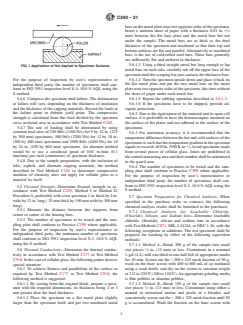
byhandwithadampspongefor1minperlargefaceand1min submerged roll (see Fig. 1) for applying the asphalt.
for the four sides. Wring
...
This document is not an ASTM standard and is intended only to provide the user of an ASTM standard an indication of what changes have been made to the previous version. Because
it may not be technically possible to adequately depict all changes accurately, ASTM recommends that users consult prior editions as appropriate. In all cases only the current version
of the standard as published by ASTM is to be considered the official document.
Designation: C240 − 20 C240 − 21
Standard Test Methods for
Testing Cellular Glass Insulation Block
This standard is issued under the fixed designation C240; the number immediately following the designation indicates the year of
original adoption or, in the case of revision, the year of last revision. A number in parentheses indicates the year of last reapproval. A
superscript epsilon (´) indicates an editorial change since the last revision or reapproval.
1. Scope
1.1 These test methods cover the testing of cellular glass insulation block for density, water absorption, compressive strength,
flexural strength at ambient temperature; preparation for chemical analysis; and thermal conductivity measurements.
1.2 The values stated in inch-pound units are to be regarded as standard. The values given in parentheses are mathematical
conversions to SI units that are provided for information only and are not considered standard.
1.3 This standard does not purport to address all of the safety concerns, if any, associated with its use. It is the responsibility
of the user of this standard to establish appropriate safety, health, and environmental practices and determine the applicability of
regulatory limitations prior to use.
1.4 This international standard was developed in accordance with internationally recognized principles on standardization
established in the Decision on Principles for the Development of International Standards, Guides and Recommendations issued
by the World Trade Organization Technical Barriers to Trade (TBT) Committee.
2. Referenced Documents
2.1 ASTM Standards:
C165 Test Method for Measuring Compressive Properties of Thermal Insulations
C168 Terminology Relating to Thermal Insulation
C177 Test Method for Steady-State Heat Flux Measurements and Thermal Transmission Properties by Means of the
Guarded-Hot-Plate Apparatus
C203 Test Methods for Breaking Load and Flexural Properties of Block-Type Thermal Insulation
C303 Test Method for Dimensions and Density of Preformed Block and Board–Type Thermal Insulation
C390 Practice for Sampling and Acceptance of Thermal Insulation Lots
C518 Test Method for Steady-State Thermal Transmission Properties by Means of the Heat Flow Meter Apparatus
C871 Test Methods for Chemical Analysis of Thermal Insulation Materials for Leachable Chloride, Fluoride, Silicate, and
Sodium Ions
D226/D226M Specification for Asphalt-Saturated Organic Felt Used in Roofing and Waterproofing
D4869/D4869M Specification for Asphalt-Saturated Organic Felt Underlayment Used in Steep Slope Roofing
2.2 ISO Standard:
ISO 3951 Sampling Procedure and Charts for Inspection by Variables for Percent Nonconforming
These test methods are under the jurisdiction of ASTM Committee C16 on Thermal Insulation and are the direct responsibility of Subcommittee C16.32 on Mechanical
Properties.
Current edition approved Sept. 1, 2020March 1, 2021. Published September 2020March 2021. Originally approved in 1950. Last previous edition approved in 20192020
as C240 – 19.C240 – 20. DOI: 10.1520/C0240-20.10.1520/C0240-21.
For referenced ASTM standards, visit the ASTM website, www.astm.org, or contact ASTM Customer Service at service@astm.org. For Annual Book of ASTM Standards
volume information, refer to the standard’s Document Summary page on the ASTM website.
Available from American National Standards Institute (ANSI), 25 W. 43rd St., 4th Floor, New York, NY 10036, http://www.ansi.org.
Copyright © ASTM International, 100 Barr Harbor Drive, PO Box C700, West Conshohocken, PA 19428-2959. United States
C240 − 21
2.3 Military Standard:
MIL-I-24244 Specification Insulation Materials with Special Corrosion, Chloride, and Fluoride Requirements
2.4 Other Standard:
NRC 1.36 Nonmetallic Thermal Insulation for Austenitic Stainless Steel
3. Terminology
3.1 Definitions—Terminology C168 shall be considered as applying to the terms considered in these test methods.
4. Significance and Use
4.1 From a general standpoint, these test methods outline the particular points which have to be taken into account when applying
ASTM standard test methods to the case of cellular glass insulating block.
5. Test Methods
5.1 General Sample Preparation—All tests have to be run on dry specimens. In case of need, the sample must be unpacked and
stored in a dry place in such a way that all surfaces are exposed to the ambient air for a minimum of 24 hours before testing.
5.2 Density—Determine the density in accordance with Test Method C303. Preferably, the density shall be measured on a full
block, 18 by 24 in. (450 by 600 mm), 18 by 36 in. (450 by 900 mm), or 24 by 36 in. (600 by 900 mm) by full thickness.
5.2.1 It shall be noted that density is interesting as such for calculation of insulated equipment load and because it has influence
on the other important properties of cellular glass. But it shall not be considered in itself as a criterion for acceptance in the case
of cellular glass.
5.3 Water Absorption:
5.3.1 Scope—This test method covers the determination of water absorption of cellular glass insulating blocks by measuring the
amount of water retained as a result of complete immersion for a prescribed time interval. Surface blotting is used to correct for
the water absorbed on the cut surface cells.
5.3.2 Significance and Use—This test method provides a means of measuring the water absorption of cellular glass insulating
blocks under isothermal conditions as a result of direct immersion in liquid water. It is intended for use in product evaluation and
quality control.
5.3.3 Equipment and Materials:
5.3.3.1 Balance, minimum 1500 g capacity and 0.1 g or greater sensitivity.
5.3.3.2 Immersion Tank, equipped with inert specimen supports and top surface weights such as stainless steel.
5.3.3.3 Synthetic Sponge, 4 by 7 by 1.5 in. (100 by 180 by 40 mm) or larger. Sponges found acceptable to use include cellulosic
sponges and fine-pored absorbent synthetic plastic sponges.
5.3.3.4 Test Room, with temperature of 70 6 5°F (21 6 3°C) and relative humidity of 50 6 10 %.
5.3.3.5 Distilled Water.
5.3.4 Procedure:
5.3.4.1 Carefully measure the thickness, width, and length to the nearest 1 mm of a cellular glass block, preferably 2 by 12 by
18 in. (50 by 300 by 450 mm) and calculate the volume and exposed surface area.
5.3.4.2 Weigh the specimen to the nearest 0.1 g (W ), then submerge it horizontally under 25 mm (1 in.) of water maintained at
Available from DLA Document Services, Building 4/D, 700 Robbins Ave., Philadelphia, PA 19111-5094, http://quicksearch.dla.mil.
Available from Director of Regulatory Standards, US Atomic Energy Commission, Washington, DC 20545.
C240 − 21
70 6 5°F (21 6 3°C). Inert top surface weights are required to keep it submerged. After submerging it for 2 h, set the specimen
on end on a damp cotton bath towel to drain for 10 min. After the 10 min, remove the excess surface water by hand with a damp
sponge for 1 min per large face and 1 min for the four sides. Wring out the sponge before and once in between for each face and
pass a minimum of two times on each surface. Blot each face of the specimen equally by compressing the sponge by a minimum
of 10 % of its thickness. Weigh the specimen immediately (W ) to the nearest 0.1 g.
5.3.5 Calculation of Results—Calculate the weight of water absorbed (W − W ) and express it as a function of the exterior surface
2 1
of the sample (g/cm ). Water absorption is also be expressed as a function of volume percent, absorbed water volume divided by
specimen volume; or as a function of weight percent, weight of water absorbed (W − W ) divided by the dry specimen weight
2 1
(W ). Such ways of expressing the results shall be strictly limited to direct comparison of results on specimens of identical sizes.
5.3.6 Precision and Bias—The precision as determined in inter-laboratory tests is given in Research Report RR:C16-1007. The
repeatability or single-laboratory operator precision is 60.00060 g/cm or 60.030 volume % (61S). The reproducibility or
multilaboratory operator precision is 60.00071 g/cm or 60.035 volume %. Due to a lack of a standard, no statement is made
regarding bias.
5.4 Compressive Strength—Determine the compressive strength in accordance with Test Method C165 Procedure A, with the
following test parameters and specimen preparation techniques:
5.4.1 Each of the two parallel bearing surfaces of the specimens shall be plane. When required, rub them on a suitable abrasive
surface to produce the required flat surface.
5.4.2 The Standard size test specimens shall be 9 by 12 in. (225 by 300 mm) by nominal received thickness, 12 by 18 in. (300
by 450 mm) by nominal received thickness, or 18 by 24 in. (450 by 600 mm) by nominal received thickness. Quadrant specimens
shall be taken from any one of four equal area quadrants of the preformed block. The minimum acceptable specimen size is When
alternative size specimens are used, the minimum specimen size shall be 8 by 8 in. (200 by 200 mm). The report shall include the
specimen size.
5.4.3 Cap both bearing surfaces of the specimens as follows: Coat one surface with molten Type III or Type IV asphalt
(350, +50, −25°F (preheated to 177, +28, −14°C)), completely filling the surface cells with a small excess. Such a coating
2 2
application rate is approximately 0.20 lb/ft (1.0 kg/m ) 6 25 %. Immediately press the hot coated block onto a precut piece of
felt or paper laying on a flat surface. This is to prevent the asphalt surface from sticking to the compression platen during the test.
A lightweight
...