

ASTM C1676/C1676M-23
(Specification)Standard Specification for Microporous Thermal Insulation
General Information
- Abstract
SCOPE
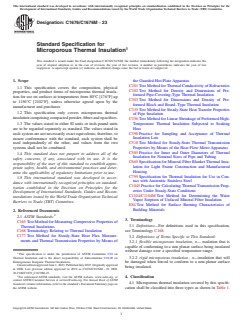
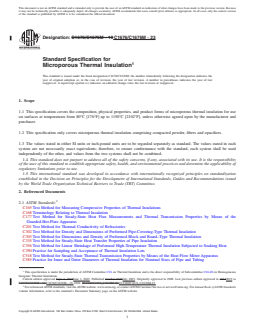
1.1 This specification covers the composition, physical properties, and product forms of microporous thermal insulation for use on surfaces at temperatures from 80°C [176°F] up to 1150°C [2102°F], unless otherwise agreed upon by the manufacturer and purchaser.
1.2 This specification only covers microporous thermal insulation comprising compacted powder, fibers and opacifiers.
1.3 The values stated in either SI units or inch-pound units are to be regarded separately as standard. The values stated in each system are not necessarily exact equivalents; therefore, to ensure conformance with the standard, each system shall be used independently of the other, and values from the two systems shall not be combined.
1.4 This standard does not purport to address all of the safety concerns, if any, associated with its use. It is the responsibility of the user of this standard to establish appropriate safety, health, and environmental practices and determine the applicability of regulatory limitations prior to use.
1.5 This international standard was developed in accordance with internationally recognized principles on standardization established in the Decision on Principles for the Development of International Standards, Guides and Recommendations issued by the World Trade Organization Technical Barriers to Trade (TBT) Committee.
- Status
- Published
- Publication Date
- 31-May-2023
- Technical Committee
- C16 - Thermal Insulation
- Drafting Committee
- C16.20 - Homogeneous Inorganic Thermal Insulations
Buy Documents
ASTM C1676/C1676M-23 - Standard Specification for Microporous Thermal Insulation
REDLINE ASTM C1676/C1676M-23 - Standard Specification for Microporous Thermal Insulation
Overview
ASTM C1676/C1676M-23 is the standard specification for microporous thermal insulation. Developed by ASTM International, this standard defines the composition, physical properties, product forms, and performance characteristics required for microporous insulation used on surfaces at temperatures ranging from 80°C (176°F) up to 1150°C (2102°F). This specification ensures that microporous insulation products - which are made from compacted powder, fibers, and opacifiers - are suitable for a variety of industrial and commercial applications where high thermal performance is critical.
This international standard supports the global harmonization of quality, safety, and reliability requirements for microporous insulation, and is aligned with internationally recognized principles for standardization.
Key Topics
- Composition and Material: Covers microporous insulation made from inorganic metal oxide powders, infra-red opacifiers, and man-made or natural fibers, excluding asbestos.
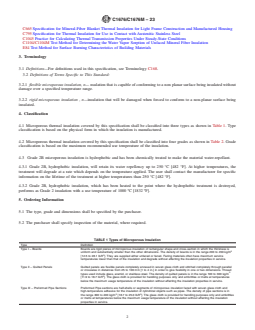
- Product Types: Specifies boards (Type I), quilted panels (Type II), and preformed pipe sections (Type III), each designed for distinct application environments.
- Grades and Temperature Limits:
- Grade 1: up to 900°C (1652°F)
- Grade 2A: up to 1000°C (1832°F)
- Grade 2B (hydrophobic): up to 250°C (482°F), with residual performance up to 1000°C after hydrophobic treatment is lost
- Grade 3: up to 1150°C (2102°F)
- Physical and Mechanical Properties: Encompasses requirements for thermal conductivity, compressive strength, linear shrinkage, water vapor sorption, flame spread, smoke development, and corrosiveness.
- Testing and Qualification: Details test methods for thermal conductivity (e.g., guarded hot plate, heat flow meter), compressive strength, shrinkage, sorption, and surface burning characteristics.
- Ordering and Inspection: Provides guidance on specifying product type, grade, dimensions, inspection, and testing certification.
Applications
The scope and performance characteristics of ASTM C1676/C1676M-23 make it highly valuable for a range of industrial and commercial thermal insulation applications, such as:
- High-Temperature Process Equipment: Used for furnaces, kilns, and reactors where minimizing heat loss and ensuring personnel protection are critical.
- Pipe and Duct Insulation: Preformed pipe sections ensure efficient thermal protection for piping systems transporting hot media.
- Energy Conservation: Reduces heat transmission in energy-intensive industries, supporting sustainability and energy efficiency goals.
- Flexible and Rigid Applications: Quilted panels provide flexible options for fitting around complex shapes, while rigid boards offer robust solutions for flat surfaces.
- Corrosive and Moist Environments: Hydrophobic grades are suitable for applications where resistance to water ingress and retention of insulation performance in moist conditions are needed.
By adhering to this ASTM specification, engineers and specifiers can ensure microporous insulation products meet the stringent requirements for thermal performance, durability, and safety in high-temperature and challenging environments.
Related Standards
Several ASTM standards are referenced within ASTM C1676/C1676M-23 for specific test methods, terminology, and product requirements, including:
- ASTM C165: Test Method for Measuring Compressive Properties of Thermal Insulations
- ASTM C168: Terminology Relating to Thermal Insulation
- ASTM C177: Test Method for Steady-State Heat Flux Measurements and Thermal Transmission
- ASTM C201: Test Method for Thermal Conductivity of Refractories
- ASTM C302 & C303: Test Methods for Density and Dimensions of Thermal Insulation Products
- ASTM C335: Test Method for Steady-State Heat Transfer Properties of Pipe Insulation
- ASTM C356: Test Method for Linear Shrinkage of High-Temperature Insulation
- ASTM C518: Heat Flow Meter Apparatus for Thermal Transmission
- ASTM C665 & C795: Specifications for Mineral-Fiber Blanket Insulation and Use with Stainless Steel
- ASTM E84: Test Method for Surface Burning Characteristics
By referencing ASTM C1676/C1676M-23 and these associated standards, industry professionals can specify, test, and qualify microporous thermal insulation solutions with confidence.
Relations
- Effective Date
- 15-Apr-2024
- Effective Date
- 01-Mar-2024
- Effective Date
- 01-Dec-2023
- Effective Date
- 01-Sep-2023
- Effective Date
- 01-Sep-2019
- Effective Date
- 01-Sep-2019
- Effective Date
- 01-Jul-2019
- Effective Date
- 15-Apr-2019
- Effective Date
- 01-Apr-2019
- Effective Date
- 01-Mar-2019
- Effective Date
- 01-Oct-2018
- Effective Date
- 01-Jul-2018
- Effective Date
- 15-Apr-2018
- Effective Date
- 01-Mar-2018
- Effective Date
- 01-Nov-2017
Buy Documents
ASTM C1676/C1676M-23 - Standard Specification for Microporous Thermal Insulation
REDLINE ASTM C1676/C1676M-23 - Standard Specification for Microporous Thermal Insulation
Get Certified
Connect with accredited certification bodies for this standard

DIBt (Deutsches Institut für Bautechnik)
German Institute for Building Technology.
DIN CERTCO
DIN Group product certification.

Aboma Certification B.V.
Specialized in construction, metal, and transport sectors.
Sponsored listings
Frequently Asked Questions
ASTM C1676/C1676M-23 is a technical specification published by ASTM International. Its full title is "Standard Specification for Microporous Thermal Insulation". This standard covers: SCOPE 1.1 This specification covers the composition, physical properties, and product forms of microporous thermal insulation for use on surfaces at temperatures from 80°C [176°F] up to 1150°C [2102°F], unless otherwise agreed upon by the manufacturer and purchaser. 1.2 This specification only covers microporous thermal insulation comprising compacted powder, fibers and opacifiers. 1.3 The values stated in either SI units or inch-pound units are to be regarded separately as standard. The values stated in each system are not necessarily exact equivalents; therefore, to ensure conformance with the standard, each system shall be used independently of the other, and values from the two systems shall not be combined. 1.4 This standard does not purport to address all of the safety concerns, if any, associated with its use. It is the responsibility of the user of this standard to establish appropriate safety, health, and environmental practices and determine the applicability of regulatory limitations prior to use. 1.5 This international standard was developed in accordance with internationally recognized principles on standardization established in the Decision on Principles for the Development of International Standards, Guides and Recommendations issued by the World Trade Organization Technical Barriers to Trade (TBT) Committee.
SCOPE 1.1 This specification covers the composition, physical properties, and product forms of microporous thermal insulation for use on surfaces at temperatures from 80°C [176°F] up to 1150°C [2102°F], unless otherwise agreed upon by the manufacturer and purchaser. 1.2 This specification only covers microporous thermal insulation comprising compacted powder, fibers and opacifiers. 1.3 The values stated in either SI units or inch-pound units are to be regarded separately as standard. The values stated in each system are not necessarily exact equivalents; therefore, to ensure conformance with the standard, each system shall be used independently of the other, and values from the two systems shall not be combined. 1.4 This standard does not purport to address all of the safety concerns, if any, associated with its use. It is the responsibility of the user of this standard to establish appropriate safety, health, and environmental practices and determine the applicability of regulatory limitations prior to use. 1.5 This international standard was developed in accordance with internationally recognized principles on standardization established in the Decision on Principles for the Development of International Standards, Guides and Recommendations issued by the World Trade Organization Technical Barriers to Trade (TBT) Committee.
ASTM C1676/C1676M-23 is classified under the following ICS (International Classification for Standards) categories: 91.100.60 - Thermal and sound insulating materials. The ICS classification helps identify the subject area and facilitates finding related standards.
ASTM C1676/C1676M-23 has the following relationships with other standards: It is inter standard links to ASTM C168-24, ASTM C390-08(2024), ASTM E84-23d, ASTM E84-23c, ASTM C1104/C1104M-19, ASTM C390-08(2019), ASTM E84-19b, ASTM E84-19a, ASTM C1045-19, ASTM E84-19, ASTM E84-18b, ASTM E84-18a, ASTM C168-18, ASTM E84-18, ASTM E84-17a. Understanding these relationships helps ensure you are using the most current and applicable version of the standard.
ASTM C1676/C1676M-23 is available in PDF format for immediate download after purchase. The document can be added to your cart and obtained through the secure checkout process. Digital delivery ensures instant access to the complete standard document.
Standards Content (Sample)
This international standard was developed in accordance with internationally recognized principles on standardization established in the Decision on Principles for the
Development of International Standards, Guides and Recommendations issued by the World Trade Organization Technical Barriers to Trade (TBT) Committee.
Designation: C1676/C1676M − 23
Standard Specification for
Microporous Thermal Insulation
This standard is issued under the fixed designation C1676/C1676M; the number immediately following the designation indicates the
year of original adoption or, in the case of revision, the year of last revision. A number in parentheses indicates the year of last
reapproval. A superscript epsilon (´) indicates an editorial change since the last revision or reapproval.
1. Scope the Guarded-Hot-Plate Apparatus
C201 Test Method for Thermal Conductivity of Refractories
1.1 This specification covers the composition, physical
C302 Test Method for Density and Dimensions of Pre-
properties, and product forms of microporous thermal insula-
formed Pipe-Covering-Type Thermal Insulation
tion for use on surfaces at temperatures from 80°C [176°F] up
C303 Test Method for Dimensions and Density of Pre-
to 1150°C [2102°F], unless otherwise agreed upon by the
formed Block and Board–Type Thermal Insulation
manufacturer and purchaser.
C335 Test Method for Steady-State Heat Transfer Properties
1.2 This specification only covers microporous thermal
of Pipe Insulation
insulation comprising compacted powder, fibers and opacifiers.
C356 Test Method for Linear Shrinkage of Preformed High-
Temperature Thermal Insulation Subjected to Soaking
1.3 The values stated in either SI units or inch-pound units
are to be regarded separately as standard. The values stated in Heat
C390 Practice for Sampling and Acceptance of Thermal
each system are not necessarily exact equivalents; therefore, to
ensure conformance with the standard, each system shall be Insulation Lots
C518 Test Method for Steady-State Thermal Transmission
used independently of the other, and values from the two
systems shall not be combined. Properties by Means of the Heat Flow Meter Apparatus
C585 Practice for Inner and Outer Diameters of Thermal
1.4 This standard does not purport to address all of the
Insulation for Nominal Sizes of Pipe and Tubing
safety concerns, if any, associated with its use. It is the
C665 Specification for Mineral-Fiber Blanket Thermal Insu-
responsibility of the user of this standard to establish appro-
lation for Light Frame Construction and Manufactured
priate safety, health, and environmental practices and deter-
Housing
mine the applicability of regulatory limitations prior to use.
C795 Specification for Thermal Insulation for Use in Con-
1.5 This international standard was developed in accor-
tact with Austenitic Stainless Steel
dance with internationally recognized principles on standard-
C1045 Practice for Calculating Thermal Transmission Prop-
ization established in the Decision on Principles for the
erties Under Steady-State Conditions
Development of International Standards, Guides and Recom-
C1104/C1104M Test Method for Determining the Water
mendations issued by the World Trade Organization Technical
Vapor Sorption of Unfaced Mineral Fiber Insulation
Barriers to Trade (TBT) Committee.
E84 Test Method for Surface Burning Characteristics of
Building Materials
2. Referenced Documents
2.1 ASTM Standards:
3. Terminology
C165 Test Method for Measuring Compressive Properties of
3.1 Definitions—For definitions used in this specification,
Thermal Insulations
see Terminology C168.
C168 Terminology Relating to Thermal Insulation
C177 Test Method for Steady-State Heat Flux Measure-
3.2 Definitions of Terms Specific to This Standard:
ments and Thermal Transmission Properties by Means of
3.2.1 flexible microporous insulation, n— nsulation that is
capable of conforming to a non planar surface being insulated
without damage over a specified temperature range.
This specification is under the jurisdiction of ASTM Committee C16 on
3.2.2 rigid microporous insulation , n—insulation that will
Thermal Insulation and is the direct responsibility of Subcommittee C16.20 on
Homogeneous Inorganic Thermal Insulations.
be damaged when forced to conform to a non-planar surface
Current edition approved June 1, 2023. Published July 2023. Originally approved
being insulated.
in 2008. Last previous edition approved in 2019 as C1676/C1676M – 19. DOI:
10.1520/C1676_C1676M-23.
For referenced ASTM standards, visit the ASTM website, www.astm.org, or 4. Classification
contact ASTM Customer Service at service@astm.org. For Annual Book of ASTM
4.1 Microporous thermal insulation covered by this specifi-
Standards volume information, refer to the standard’s Document Summary page on
the ASTM website. cation shall be classified into three types as shown in Table 1.
Copyright © ASTM International, 100 Barr Harbor Drive, PO Box C700, West Conshohocken, PA 19428-2959. United States
C1676/C1676M − 23
TABLE 1 Types of Microporous Insulation
Type Definition
Type I – Boards Boards are rigid pieces of microporous insulation of rectangular shape and cross-section in which the thickness is
uniform and substantially smaller than the other dimensions. The density of boards is in the range 200 to 450 kg/m
[12.5 to 28.1 lb/ft ]. They are supplied either unfaced or faced. Facing materials often have maximum service
temperatures lower than that of the insulation and degrade without affecting the insulation properties in service.
Type II – Quilted Panels Quilted panels are flexible panels completely encased in woven glass cloth and stitched completely through parallel
or crosswise in distances from 25 to 100 mm [1 to 4 in.] in order to give flexibility in one or two dimensions. Thread
types used include glass, aramid, or stainless steel. The density of quilted panels is in the range 190 to 300 kg/m
[11.9 to 18.7 lb/ft ]. The glass cloth is provided for handling purposes only and embrittles or melts at temperatures
below the maximum usage temperature of the insulation without affecting the insulation properties in service.
Type III – Preformed Pipe Sections Preformed Pipe sections are half-shells or segments of microporous insulation faced with woven glass cloth and
high-temperature adhesive for the insulation of cylindrical objects such as pipes. The density of pipe sections is in
3 3
the range 300 to 400 kg/m [18.7 to 25.0 lb/ft ]. The glass cloth is provided for handling purposes only and embrittles
or melts at temperatures below the maximum usage temperature of the insulation without affecting the insulation
properties in service.
Type classification is based on the physical form in which the adhesives, and thread is usually lower than the maximum use
insulation is manufactured. temperature of the insulation. The purchaser and supplier shall
agree whether the facings need to maintain their integrity on
4.2 Microporous thermal insulation covered by this specifi-
heating or whether they are sacrificial ).
cation shall be classified into four grades as shown in Table 2.
Grade classification is based on the maximum recommended
6. Materials and Manufacture
use temperature of the insulation.
6.1 Composition—Microporous insulation shall be com-
4.3 Grade 2B microporous insulation is hydrophobic and
prised of compacted inorganic metal oxide powders of surface
has been chemically treated to make the material water-
area greater than 90 m /g [3,052 sq yd/oz], powdered inorganic
repellant.
infra-red opacifiers and man-made or natural fibers or fila-
4.3.1 Grade 2B, hydrophobic insulation, will retain its water
ments. Asbestos shall not be used as an ingredient or compo-
repellency up to 250 °C [482 °F]. At higher temperatures, the
nent of the product.
treatment will degrade at a rate which depends on the tempera-
6.2 Typical facings are as follows:
ture applied. The user shall contact the manufacturer for
6.2.1 Glass cloth, wrapped around or adhered to the surface
specific information on the lifetime of the treatment at higher
of the microporous insulation with an alkali silicate based
temperatures than 250 °C [482 °F].
adhesive;
4.3.2 Grade 2B, hydrophobic insulation, which has been
6.2.2 For other facings, if available, contact the manufac-
heated to the point where the hydrophobic treatment is
turer.
destroyed, performs as Grade 2 insulation with a use tempera-
ture of 1000 ºC [1832 ºF].
7. Physical Properties
7.1 The microporous insulation shall conform to the physi-
5. Ordering Information
cal requirements described in Tables 3-5, other than for
5.1 The type, grade and dimensions shall be specified by the
maximum density which is provided for information only.
purchaser.
Consult the manufacturer for specific design recommendations
5.2 The purchaser shall specify inspection of the material,
for all material types, grades, and classes.
where required.
7.2 The user is advised that some applications require
5.3 When a certification, test report, or both, are required, it
knowledge of the thermal conductivity of the insulation mate-
shall be specified by the purchaser.
rial at mean temperatures above those shown. Consult the
manufacturer for data at mean temperatures exceeding those
5.4 The purchaser and supplier shall agree whether the
listed.
insulation shall be supplied plain or with facings to facilitate
ease of handling, to minimize dust generation, or to resist the
7.3 The physical requirements are based on the properties of
ingress of water. If faced, the purchaser and supplier shall agree
samples dried and conditioned, or both, as specified in the
on the type and requirements. (Warning—The purchaser is
referenced test methods. Microporous insulation, other than
advised that the maximum use temperature of facings,
grade 2 hydrophobic, tends to absorb moisture to varying
degrees depending on exposure conditions. It can absorb up to
TABLE 2 Grades of Microporous Insulation 4 times its dry weight if placed in direct contact with water
through improper storage or application. Proper packaging and
Grade Grade Temperature of use, °C [°F], max
1 900 [1652]
storage is required as defined in 15.1.
2A 1000 [1832]
A
2B 250 [482]
8. Dimensions and Tolerances
3 1150 [2102]
A 8.1 Type I boards are supplied in standard thicknesses from
See 4.3 for a definition o
...
This document is not an ASTM standard and is intended only to provide the user of an ASTM standard an indication of what changes have been made to the previous version. Because
it may not be technically possible to adequately depict all changes accurately, ASTM recommends that users consult prior editions as appropriate. In all cases only the current version
of the standard as published by ASTM is to be considered the official document.
Designation: C1676/C1676M − 19 C1676/C1676M − 23
Standard Specification for
Microporous Thermal Insulation
This standard is issued under the fixed designation C1676/C1676M; the number immediately following the designation indicates the
year of original adoption or, in the case of revision, the year of last revision. A number in parentheses indicates the year of last
reapproval. A superscript epsilon (´) indicates an editorial change since the last revision or reapproval.
1. Scope
1.1 This specification covers the composition, physical properties, and product forms of microporous thermal insulation for use
on surfaces at temperatures from 80°C [176°F] up to 1150°C [2102°F], unless otherwise agreed upon by the manufacturer and
purchaser.
1.2 This specification only covers microporous thermal insulation comprising compacted powder, fibers and opacifiers.
1.3 The values stated in either SI units or inch-pound units are to be regarded separately as standard. The values stated in each
system are not necessarily exact equivalents; therefore, to ensure conformance with the standard, each system shall be used
independently of the other, and values from the two systems shall not be combined.
1.4 This standard does not purport to address all of the safety concerns, if any, associated with its use. It is the responsibility
of the user of this standard to establish appropriate safety, health, and environmental practices and determine the applicability of
regulatory limitations prior to use.
1.5 This international standard was developed in accordance with internationally recognized principles on standardization
established in the Decision on Principles for the Development of International Standards, Guides and Recommendations issued
by the World Trade Organization Technical Barriers to Trade (TBT) Committee.
2. Referenced Documents
2.1 ASTM Standards:
C165 Test Method for Measuring Compressive Properties of Thermal Insulations
C168 Terminology Relating to Thermal Insulation
C177 Test Method for Steady-State Heat Flux Measurements and Thermal Transmission Properties by Means of the
Guarded-Hot-Plate Apparatus
C201 Test Method for Thermal Conductivity of Refractories
C302 Test Method for Density and Dimensions of Preformed Pipe-Covering-Type Thermal Insulation
C303 Test Method for Dimensions and Density of Preformed Block and Board–Type Thermal Insulation
C335 Test Method for Steady-State Heat Transfer Properties of Pipe Insulation
C356 Test Method for Linear Shrinkage of Preformed High-Temperature Thermal Insulation Subjected to Soaking Heat
C390 Practice for Sampling and Acceptance of Thermal Insulation Lots
C518 Test Method for Steady-State Thermal Transmission Properties by Means of the Heat Flow Meter Apparatus
C585 Practice for Inner and Outer Diameters of Thermal Insulation for Nominal Sizes of Pipe and Tubing
This specification is under the jurisdiction of ASTM Committee C16 on Thermal Insulation and is the direct responsibility of Subcommittee C16.20 on Homogeneous
Inorganic Thermal Insulations.
Current edition approved Sept. 1, 2019June 1, 2023. Published October 2019July 2023. Originally approved in 2008. Last previous edition approved in 20142019 as
C1676/C1676M – 14.C1676/C1676M – 19. DOI: 10.1520/C1676_C1676M-19.10.1520/C1676_C1676M-23.
For referenced ASTM standards, visit the ASTM website, www.astm.org, or contact ASTM Customer Service at service@astm.org. For Annual Book of ASTM Standards
volume information, refer to the standard’s Document Summary page on the ASTM website.
Copyright © ASTM International, 100 Barr Harbor Drive, PO Box C700, West Conshohocken, PA 19428-2959. United States
C1676/C1676M − 23
C665 Specification for Mineral-Fiber Blanket Thermal Insulation for Light Frame Construction and Manufactured Housing
C795 Specification for Thermal Insulation for Use in Contact with Austenitic Stainless Steel
C1045 Practice for Calculating Thermal Transmission Properties Under Steady-State Conditions
C1104/C1104M Test Method for Determining the Water Vapor Sorption of Unfaced Mineral Fiber Insulation
E84 Test Method for Surface Burning Characteristics of Building Materials
3. Terminology
3.1 Definitions—For definitions used in this specification, see Terminology C168.
3.2 Definitions of Terms Specific to This Standard:
3.2.1 flexible microporous insulation, n— nsulation that is capable of conforming to a non planar surface being insulated without
damage over a specified temperature range.
3.2.2 rigid microporous insulation , n—insulation that will be damaged when forced to conform to a non-planar surface being
insulated.
4. Classification
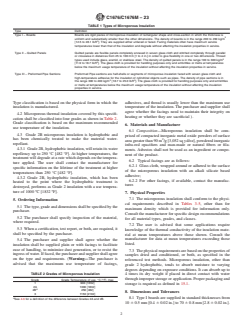
4.1 Microporous thermal insulation covered by this specification shall be classified into three types as shown in Table 1. Type
classification is based on the physical form in which the insulation is manufactured.
4.2 Microporous thermal insulation covered by this specification shall be classified into four grades as shown in Table 2. Grade
classification is based on the maximum recommended use temperature of the insulation.
4.3 Grade 2B microporous insulation is hydrophobic and has been chemically treated to make the material water-repellant.
4.3.1 Grade 2B, hydrophobic insulation, will retain its water repellency up to 250 °C [482 °F]. At higher temperatures, the
treatment will degrade at a rate which depends on the temperature applied. The user shall contact the manufacturer for specific
information on the lifetime of the treatment at higher temperatures than 250 °C [482 °F].
4.3.2 Grade 2B, hydrophobic insulation, which has been heated to the point where the hydrophobic treatment is destroyed,
performs as Grade 2 insulation with a use temperature of 1000 ºC [1832 ºF].
5. Ordering Information
5.1 The type, grade and dimensions shall be specified by the purchaser.
5.2 The purchaser shall specify inspection of the material, where required.
TABLE 1 Types of Microporous Insulation
Type Definition
Type I – Boards Boards are rigid pieces of microporous insulation of rectangular shape and cross-section in which the thickness is
uniform and substantially smaller than the other dimensions. The density of boards is in the range 200 to 450 kg/m
[12.5 to 28.1 lb/ft ]. They are supplied either unfaced or faced. Facing materials often have maximum service
temperatures lower than that of the insulation and degrade without affecting the insulation properties in service.
Type II – Quilted Panels Quilted panels are flexible panels completely encased in woven glass cloth and stitched completely through parallel
or crosswise in distances from 25 to 100 mm [1 to 4 in.] in order to give flexibility in one or two dimensions. Thread
types used include glass, aramid, or stainless steel. The density of quilted panels is in the range 190 to 300 kg/m
[11.9 to 18.7 lb/ft ]. The glass cloth is provided for handling purposes only and embrittles or melts at temperatures
below the maximum usage temperature of the insulation without affecting the insulation properties in service.
Type III – Preformed Pipe Sections Preformed Pipe sections are half-shells or segments of microporous insulation faced with woven glass cloth and
high-temperature adhesive for the insulation of cylindrical objects such as pipes. The density of pipe sections is in
3 3
the range 300 to 400 kg/m [18.7 to 25.0 lb/ft ]. The glass cloth is provided for handling purposes only and embrittles
or melts at temperatures below the maximum usage temperature of the insulation without affecting the insulation
properties in service.
C1676/C1676M − 23
TABLE 2 Grades of Microporous Insulation
Grade Grade Temperature of use, °C [°F], max
1 900 [1652]
2A 1000 [1832]
A
2B 250 [482]
3 1150 [2102]
A
See 4.3 for a definition of the difference between Grades 2A and 2B.
5.3 When a certification, test report, or both, are required, it shall be specified by the purchaser.
5.4 The purchaser and supplier shall agree whether the insulation shall be supplied plain or with facings to facilitate ease of
handling, to minimize dust generation, or to resist the ingress of water. If faced, the purchaser and supplier shall agree on the type
and requirements. (Warning—The purchaser is advised that the maximum use temperature of facings, adhesives, and thread is
usually lower than the maximum use temperature of the insulation. The purchaser and supplier shall agree whether the facings need
to maintain their integrity on heating or whether they are sacrificial ).
6. Materials and Manufacture
6.1 Composition—Microporous insulation shall be comprised of compacted inorganic metal oxide powders of surface area greater
than 90 m /g [3,052 sq yd/oz], powdered inorganic infra-red opacifiers and man-made or natural fibers or filaments. Asbestos shall
not be used as an ingredient or component of the product.
6.2 Typical facings are as follows:
6.2.1 Glass cloth, wrapped around or adhered to the surface of the microporous insulation with an alkali silicate based adhesive;
6.2.2 For other facings, if available, contact the manufacturer.
7. Physical Properties
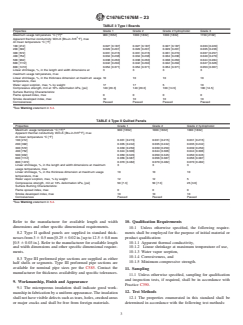
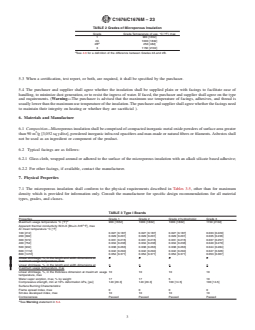
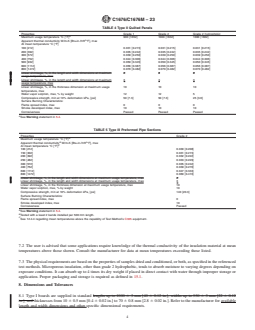
7.1 The microporous insulation shall conform to the physical requirements described in Tables 3-5, other than for maximum
density which is provided for information only. Consult the manufacturer for specific design recommendations for all material
types, grades, and classes.
TABLE 3 Type I Boards
Properties Grade 1 Grade 2 Grade 2 hydrophobic Grade 3
A
Maximum usage temperature °C [°F] 900 [1652] 1000 [1832] 1000 [1832] 1150 [2102]
Apparent thermal conductivity W/m-K [Btu-in./h•ft °F], max
At mean temperature °C [°F]
100 [212] 0.027 [0.187] 0.027 [0.187] 0.027 [0.187] 0.033 [0.229]
200 [392] 0.029 [0.201] 0.029 [0.201] 0.029 [0.201] 0.035 [0.236]
300 [572] 0.031 [0.215] 0.031 [0.215] 0.031 [0.215] 0.037 [0.257]
400 [752] 0.034 [0.236] 0.034 [0.236] 0.034 [0.236] 0.040 [0.270]
500 [932] 0.038 [0.263] 0.038 [0.263] 0.038 [0.263] 0.044 [0.284]
600 [1112] 0.042 [0.294] 0.042 [0.294] 0.042 [0.294] 0.047 [0.326]
800 [1472] 0.054 [0.371] 0.054 [0.371] 0.054 [0.371] 0.053 [0.367]
Linear shrinkage, %, in the length and width dimensions at 2 2 2 2
maximum usage temperature, max
Linear shrinkage, %, in the length and width dimensions at 3 3 3 3
maximu
...