


ASTM D2872-22
(Test Method)Standard Test Method for Effect of Heat and Air on a Moving Film of Asphalt Binder (Rolling Thin-Film Oven Test)
Standard Test Method for Effect of Heat and Air on a Moving Film of Asphalt Binder (Rolling Thin-Film Oven Test)
SIGNIFICANCE AND USE
4.1 This test method indicates approximate change in properties of asphalt during conventional hot-mixing at about 302 °F (150 °C) as indicated by viscosity and other rheological measurements. It yields a residue which approximates the asphalt condition as incorporated in the pavement. If the mixing temperature differs appreciably from the 302 °F (150 °C) level, more or less effect on properties will occur. This test method can also be used to determine mass change, which is a measure of asphalt volatility.
Note 1: The quality of results produced by this standard is dependent on the competence of the personnel performing the procedure and the capability, calibration, and maintenance of the equipment used. Agencies that meet the criteria of Specification D3666 are generally considered capable of competent and objective testing, sampling, inspection, etc. Users of this standard are cautioned that compliance with Specification D3666 alone does not completely ensure reliable results. Reliable results depend on many factors; following the suggestions of Specification D3666 or some similar acceptable guidance provides a means of evaluating and controlling some of those factors.
SCOPE
1.1 This test method is intended to measure the effect of heat and air on a moving film of semi-solid asphaltic materials. The effects of this treatment are determined from measurements of the selected properties of the asphalt before and after the test.
1.2 The values stated in inch-pound units are to be regarded as the standard.
1.3 The text of this standard references notes and footnotes which provide explanatory material. These notes and footnotes (excluding those in tables and figures) shall not be considered as requirements of the standard.
1.4 This standard does not purport to address all of the safety concerns, if any, associated with its use. It is the responsibility of the user of this standard to establish appropriate safety, health, and environmental practices and determine the applicability of regulatory limitations prior to use.
1.5 This international standard was developed in accordance with internationally recognized principles on standardization established in the Decision on Principles for the Development of International Standards, Guides and Recommendations issued by the World Trade Organization Technical Barriers to Trade (TBT) Committee.
General Information
- Status
- Published
- Publication Date
- 30-Apr-2022
- Technical Committee
- D04 - Road and Paving Materials
- Drafting Committee
- D04.46 - Durability and Distillation Tests
Relations
- Effective Date
- 01-Nov-2019
- Effective Date
- 01-May-2019
- Effective Date
- 01-Oct-2016
- Effective Date
- 01-May-2014
- Effective Date
- 01-Dec-2013
- Effective Date
- 01-Nov-2013
- Effective Date
- 01-May-2013
- Effective Date
- 01-Nov-2012
- Effective Date
- 01-Nov-2012
- Effective Date
- 01-Dec-2011
- Effective Date
- 01-May-2011
- Refers
ASTM D2171/D2171M-10 - Standard Test Method for Viscosity of Asphalts by Vacuum Capillary Viscometer - Effective Date
- 01-Jun-2010
- Effective Date
- 01-Dec-2009
- Effective Date
- 01-Nov-2009
- Effective Date
- 01-Nov-2008
Overview
ASTM D2872-22, titled Standard Test Method for Effect of Heat and Air on a Moving Film of Asphalt Binder (Rolling Thin-Film Oven Test), is an internationally recognized standard published by ASTM International. This test method is widely used to evaluate the effects of heat and air on asphalt binder by simulating conditions similar to those encountered during conventional hot-mix asphalt production. By assessing changes in viscosity and other rheological properties, ASTM D2872-22 helps determine the stability and performance of asphalt binders after exposure to high temperatures and air, reflective of paving operations.
Key Topics
- Objective: Measures how heat and air impact semi-solid asphaltic materials through the Rolling Thin-Film Oven Test (RTFOT).
- Test Procedure: A thin film of asphalt is heated in a rotating oven at controlled temperature and airflow, simulating hot-mix conditions.
- Parameters Measured:
- Changes in viscosity and ductility
- Mass change (as a measure of asphalt volatility)
- Residue properties after testing
- Significance:
- Approximates the condition of asphalt as incorporated into pavements
- Assesses binder stability after hot-mixing at around 302 °F (150 °C)
- Provides insight into potential durability and oxidation of asphalt binder
- Precision and Reporting: The test offers guidelines for acceptable reproducibility, and results must be reported including laboratory elevation, conditioning time, and any changes in material mass.
Applications
- Pavement Design: Critical for evaluating asphalt binder stability and predicting pavement performance.
- Material Specification: Used by transportation agencies and contractors to assess the suitability of asphalt for road construction projects.
- Quality Control: Ensures the selected asphalt binder will maintain desired properties after exposure to typical manufacturing conditions.
- Research and Development: Supports the formulation of new asphalt binders with improved resistance to heat and oxidation.
- Compliance Testing: Ensures asphalt suppliers meet national and international requirements for binder performance.
Related Standards
- ASTM D113 - Test Method for Ductility of Asphalt Materials
- ASTM D2171/D2171M - Test Method for Viscosity of Asphalts by Vacuum Capillary Viscometer
- ASTM D3666 - Specification for Agencies Testing and Inspecting Road and Paving Materials
- ASTM E1, E77, E220, E644, E1137/E1137M, E2877 - Thermometer and temperature measurement standards referenced for equipment calibration
- NCHRP Project 20-07 / Task 400 - Guidance on the effect of elevation on rolling thin film oven aging of asphalt binder
Practical Value
Implementing ASTM D2872-22 allows organizations to reliably evaluate the short-term aging of asphalt binders during production. Its use contributes to improved long-term pavement performance, reduced maintenance costs, and greater public safety by ensuring only properly tested asphalts are used. The standardized procedure supports consistency across laboratories, vital for comparing material properties and maintaining construction quality worldwide.
Keywords: asphalt binder, rolling thin-film oven test, RTFOT, ASTM D2872, asphalt volatility, binder aging, pavement durability, viscosity, quality control, construction materials standards
Buy Documents
ASTM D2872-22 - Standard Test Method for Effect of Heat and Air on a Moving Film of Asphalt Binder (Rolling Thin-Film Oven Test)
REDLINE ASTM D2872-22 - Standard Test Method for Effect of Heat and Air on a Moving Film of Asphalt Binder (Rolling Thin-Film Oven Test)
Get Certified
Connect with accredited certification bodies for this standard

ICC Evaluation Service
Building products evaluation and certification.

QAI Laboratories
Building and construction product testing and certification.

Zavod za gradbeništvo Slovenije (ZAG) - Inšpekcija
ZAG inspection body for construction products, structures, and materials.
Sponsored listings
Frequently Asked Questions
ASTM D2872-22 is a standard published by ASTM International. Its full title is "Standard Test Method for Effect of Heat and Air on a Moving Film of Asphalt Binder (Rolling Thin-Film Oven Test)". This standard covers: SIGNIFICANCE AND USE 4.1 This test method indicates approximate change in properties of asphalt during conventional hot-mixing at about 302 °F (150 °C) as indicated by viscosity and other rheological measurements. It yields a residue which approximates the asphalt condition as incorporated in the pavement. If the mixing temperature differs appreciably from the 302 °F (150 °C) level, more or less effect on properties will occur. This test method can also be used to determine mass change, which is a measure of asphalt volatility. Note 1: The quality of results produced by this standard is dependent on the competence of the personnel performing the procedure and the capability, calibration, and maintenance of the equipment used. Agencies that meet the criteria of Specification D3666 are generally considered capable of competent and objective testing, sampling, inspection, etc. Users of this standard are cautioned that compliance with Specification D3666 alone does not completely ensure reliable results. Reliable results depend on many factors; following the suggestions of Specification D3666 or some similar acceptable guidance provides a means of evaluating and controlling some of those factors. SCOPE 1.1 This test method is intended to measure the effect of heat and air on a moving film of semi-solid asphaltic materials. The effects of this treatment are determined from measurements of the selected properties of the asphalt before and after the test. 1.2 The values stated in inch-pound units are to be regarded as the standard. 1.3 The text of this standard references notes and footnotes which provide explanatory material. These notes and footnotes (excluding those in tables and figures) shall not be considered as requirements of the standard. 1.4 This standard does not purport to address all of the safety concerns, if any, associated with its use. It is the responsibility of the user of this standard to establish appropriate safety, health, and environmental practices and determine the applicability of regulatory limitations prior to use. 1.5 This international standard was developed in accordance with internationally recognized principles on standardization established in the Decision on Principles for the Development of International Standards, Guides and Recommendations issued by the World Trade Organization Technical Barriers to Trade (TBT) Committee.
SIGNIFICANCE AND USE 4.1 This test method indicates approximate change in properties of asphalt during conventional hot-mixing at about 302 °F (150 °C) as indicated by viscosity and other rheological measurements. It yields a residue which approximates the asphalt condition as incorporated in the pavement. If the mixing temperature differs appreciably from the 302 °F (150 °C) level, more or less effect on properties will occur. This test method can also be used to determine mass change, which is a measure of asphalt volatility. Note 1: The quality of results produced by this standard is dependent on the competence of the personnel performing the procedure and the capability, calibration, and maintenance of the equipment used. Agencies that meet the criteria of Specification D3666 are generally considered capable of competent and objective testing, sampling, inspection, etc. Users of this standard are cautioned that compliance with Specification D3666 alone does not completely ensure reliable results. Reliable results depend on many factors; following the suggestions of Specification D3666 or some similar acceptable guidance provides a means of evaluating and controlling some of those factors. SCOPE 1.1 This test method is intended to measure the effect of heat and air on a moving film of semi-solid asphaltic materials. The effects of this treatment are determined from measurements of the selected properties of the asphalt before and after the test. 1.2 The values stated in inch-pound units are to be regarded as the standard. 1.3 The text of this standard references notes and footnotes which provide explanatory material. These notes and footnotes (excluding those in tables and figures) shall not be considered as requirements of the standard. 1.4 This standard does not purport to address all of the safety concerns, if any, associated with its use. It is the responsibility of the user of this standard to establish appropriate safety, health, and environmental practices and determine the applicability of regulatory limitations prior to use. 1.5 This international standard was developed in accordance with internationally recognized principles on standardization established in the Decision on Principles for the Development of International Standards, Guides and Recommendations issued by the World Trade Organization Technical Barriers to Trade (TBT) Committee.
ASTM D2872-22 is classified under the following ICS (International Classification for Standards) categories: 91.100.50 - Binders. Sealing materials; 93.080.20 - Road construction materials. The ICS classification helps identify the subject area and facilitates finding related standards.
ASTM D2872-22 has the following relationships with other standards: It is inter standard links to ASTM E644-11(2019), ASTM E2877-12(2019), ASTM D3666-16, ASTM E77-14, ASTM D3666-13, ASTM E220-13, ASTM E1-13, ASTM E2877-12, ASTM E2877-12e1, ASTM D3666-11, ASTM E644-11, ASTM D2171/D2171M-10, ASTM D3666-09a, ASTM E644-09, ASTM E1137/E1137M-08. Understanding these relationships helps ensure you are using the most current and applicable version of the standard.
ASTM D2872-22 is available in PDF format for immediate download after purchase. The document can be added to your cart and obtained through the secure checkout process. Digital delivery ensures instant access to the complete standard document.
Standards Content (Sample)
This international standard was developed in accordance with internationally recognized principles on standardization established in the Decision on Principles for the
Development of International Standards, Guides and Recommendations issued by the World Trade Organization Technical Barriers to Trade (TBT) Committee.
Designation: D2872 − 22
Standard Test Method for
Effect of Heat and Air on a Moving Film of Asphalt Binder
(Rolling Thin-Film Oven Test)
This standard is issued under the fixed designation D2872; the number immediately following the designation indicates the year of
original adoption or, in the case of revision, the year of last revision. A number in parentheses indicates the year of last reapproval. A
superscript epsilon (´) indicates an editorial change since the last revision or reapproval.
1. Scope E77 Test Method for Inspection and Verification of Ther-
mometers
1.1 This test method is intended to measure the effect of
E220 Test Method for Calibration of Thermocouples By
heat and air on a moving film of semi-solid asphaltic materials.
Comparison Techniques
The effects of this treatment are determined from measure-
E644 Test Methods for Testing Industrial Resistance Ther-
ments of the selected properties of the asphalt before and after
mometers
the test.
E1137/E1137M Specification for Industrial Platinum Resis-
1.2 The values stated in inch-pound units are to be regarded
tance Thermometers
as the standard.
E2877 Guide for Digital Contact Thermometers
1.3 The text of this standard references notes and footnotes
2.2 NCHRP Documents:
which provide explanatory material. These notes and footnotes
NCHRP Project 20-07 / Task 400 Effect of Elevation on
(excluding those in tables and figures) shall not be considered
Rolling Thin Film Oven Aging of Asphalt Binder
as requirements of the standard.
3. Summary of Test Method
1.4 This standard does not purport to address all of the
safety concerns, if any, associated with its use. It is the
3.1 Amoving film of asphaltic material is heated in an oven
responsibility of the user of this standard to establish appro-
for 85 min at 325 °F (163 °C). The effects of heat and air are
priate safety, health, and environmental practices and deter-
determined from changes in physical test values as measured
mine the applicability of regulatory limitations prior to use.
before and after the oven treatment. An optional procedure is
1.5 This international standard was developed in accor-
provided for determining the change in sample mass.
dance with internationally recognized principles on standard-
3.2 Precision values for this test method have been devel-
ization established in the Decision on Principles for the
oped for viscosity at 140 °F (60 °C); ductility at 60 °F
Development of International Standards, Guides and Recom-
(15.6 °C); and mass change.
mendations issued by the World Trade Organization Technical
Barriers to Trade (TBT) Committee.
4. Significance and Use
2. Referenced Documents
4.1 This test method indicates approximate change in prop-
2 erties of asphalt during conventional hot-mixing at about
2.1 ASTM Standards:
302 °F (150 °C) as indicated by viscosity and other rheological
D113 Test Method for Ductility of Asphalt Materials
measurements. It yields a residue which approximates the
D2171/D2171M Test Method for Viscosity of Asphalts by
asphalt condition as incorporated in the pavement. If the
Vacuum Capillary Viscometer
mixing temperature differs appreciably from the 302 °F
D3666 Specification for Minimum Requirements for Agen-
(150 °C)level,moreorlesseffectonpropertieswilloccur.This
cies Testing and Inspecting Road and Paving Materials
test method can also be used to determine mass change, which
E1 Specification for ASTM Liquid-in-Glass Thermometers
is a measure of asphalt volatility.
NOTE 1—The quality of results produced by this standard is dependent
This test method is under the jurisdiction of ASTM Committee D04 on Road
on the competence of the personnel performing the procedure and the
and Paving Materials and is the direct responsibility of Subcommittee D04.46 on
capability, calibration, and maintenance of the equipment used. Agencies
Durability and Distillation Tests.
that meet the criteria of Specification D3666 are generally considered
Current edition approved May 1, 2022. Published May 2022. Originally
capable of competent and objective testing, sampling, inspection, etc.
approved in 1970. Last previous edition approved in 2021 as D2872 – 21. DOI:
Users of this standard are cautioned that compliance with Specification
10.1520/D2872-22.
D3666 alone does not completely ensure reliable results. Reliable results
For referenced ASTM standards, visit the ASTM website, www.astm.org, or
dependonmanyfactors;followingthesuggestionsofSpecificationD3666
contact ASTM Customer Service at service@astm.org. For Annual Book of ASTM
Standards volume information, refer to the standard’s Document Summary page on or some similar acceptable guidance provides a means of evaluating and
the ASTM website. controlling some of those factors.
Copyright © ASTM International, 100 Barr Harbor Drive, PO Box C700, West Conshohocken, PA 19428-2959. United States
D2872 − 22
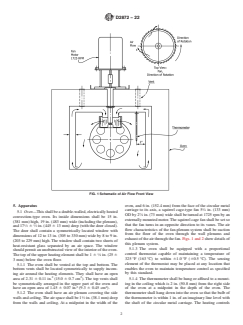
FIG. 1 Schematic of Air Flow Front View
5. Apparatus oven, and 6 in. (152.4 mm) from the face of the circular metal
carriage to its axis, a squirrel cage-type fan 5 ⁄4 in. (133 mm)
5.1 Oven—Thisshallbeadouble-walled,electricallyheated
OD by 2 ⁄8 in. (73 mm) wide shall be turned at 1725 rpm by an
convection-type oven. Its inside dimensions shall be 15 in.
externally mounted motor. The squirrel cage fan shall be set so
(381 mm) high, 19 in. (483 mm) wide (including the plenum),
that the fan turns in an opposite direction to its vanes. The air
1 1
and 17 ⁄2 6 ⁄2 in. (445 6 13 mm) deep (with the door closed).
flow characteristics of the fan-plenum system shall be suction
The door shall contain a symmetrically located window with
from the floor of the oven through the wall plenums and
dimensions of 12 to 13 in. (305 to 330 mm) wide by 8 to 9 in.
exhaust of the air through the fan. Figs. 1 and 2 show details of
(203 to 229 mm) high.The window shall contain two sheets of
this plenum system.
heat-resistant glass separated by an air space. The window
5.1.3 The oven shall be equipped with a proportional
should permit an unobstructed view of the interior of the oven.
1 control thermostat capable of maintaining a temperature of
The top of the upper heating element shall be 1 6 ⁄8 in. (25 6
325 °F (163 °C) to within 61.0 °F (60.5 °C). The sensing
3 mm) below the oven floor.
element of the thermostat may be placed at any location that
5.1.1 The oven shall be vented at the top and bottom. The
enables the oven to maintain temperature control as specified
bottom vents shall be located symmetrically to supply incom-
by this standard.
ing air around the heating elements. They shall have an open
2 2
area of 2.31 6 0.11 in. (15.0 6 0.7 cm ). The top vents shall 5.1.4 The thermometer shall be hung or affixed to a mount-
be symmetrically arranged in the upper part of the oven and ing in the ceiling which is 2 in. (50.8 mm) from the right side
2 2
have an open area of 1.45 6 0.07 in. (9.3 6 0.45 cm ). of the oven at a midpoint in the depth of the oven. The
5.1.2 The oven shall have an air plenum covering the side thermometer shall hang down into the oven so that the bulb of
wallsandceiling.Theairspaceshallbe1 ⁄2in.(38.1mm)deep the thermometer is within 1 in. of an imaginary line level with
from the walls and ceiling. At a midpoint in the width of the the shaft of the circular metal carriage. The heating controls
D2872 − 22
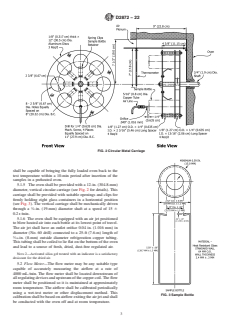
FIG. 2 Circular Metal Carriage
shall be capable of bringing the fully loaded oven back to the
test temperature within a 10-min period after insertion of the
samples in a preheated oven.
5.1.5 The oven shall be provided with a 12-in. (304.8-mm)
diameter, vertical circular carriage (see Fig. 2 for details). This
carriage shall be provided with suitable openings and clips for
firmly holding eight glass containers in a horizontal position
(see Fig. 3). The vertical carriage shall be mechanically driven
through a ⁄4-in. (19-mm) diameter shaft at a speed of 15 6
0.2 r⁄min.
5.1.6 The oven shall be equipped with an air jet positioned
to blow heated air into each bottle at its lowest point of travel.
The air jet shall have an outlet orifice 0.04 in. (1.016 mm) in
diameter (No. 60 drill) connected to a 25-ft (7.6-m) length of
⁄16-in. (8-mm) outside diameter refrigeration copper tubing.
This tubing shall be coiled to lie flat on the bottom of the oven
and lead to a source of fresh, dried, dust-free regulated air.
NOTE 2—Activated silica gel treated with an indicator is a satisfactory
desiccant for the dried air.
5.2 Flow Meter—The flow meter may be any suitable type
capable of accurately measuring the airflow at a rate of
4000 mL⁄min. The flow meter shall be located downstream of
allregulatingdevicesandupstreamofthecoppercoil.Theflow
meter shall be positioned so it is maintained at approximately
room temperature. The airflow shall be calibrated periodically
using a wet-test meter or other displacement method. This
FIG. 3 Sample Bottle
calibrationshallbebasedonairflowexitingtheairjetandshall
be conducted with the oven off and at room temperature.
D2872 − 22
5.3 Thermometric Device for Oven Standardization, with two consecutive readings. The oven preheat time is the time
suitable range, and is one of the following: that it takes to reach thermal equilibrium plus an additional
30 min.
5.3.1 An ASTM Thermometer 13C as prescribed in Speci-
6.1.2 In lieu of completing the steps described in 6.1.1,a
fication E1 and calibrated annually in accordance with Test
minimum preheat time of 4 h may be used.
Method E77.
7. Preparation of Oven
NOTE 3—In order to reduce the risks associated with thermometer
breakage, the thermometer may be fully or partially encapsulated in an
1 1
7.1 Position the air outlet orifice so that it is ⁄4 in. 6 ⁄8 in.
optically transparent polymer sheath having a maximum thickness of
(6 mm 6 3 mm) from the opening of the glass container. The
0.01 in.(0.25mm).Ifasheathisused,itshouldbeinstalledsuchthatthere
is substantial mechanical contact with the thermometer. orificeshallalsobesopositionedthatthejetblowshorizontally
into the central arc of the opening of the circling glass
5.3.2 Athermocouple thermometer with accuracy of 0.5 °C,
container.
conforming to the requirements in Guide E2877. The thermo-
7.2 Position the thermometer specified in 5.3 so that the end
couplethermometershallbecalibratedannuallyasasingleunit
in accordance with Test Method E220. of the bulb of the thermometer is within 1 in. (25.4 mm) of an
imaginary line level with the center of the shaft holding the
5.3.3 A platinum resistance thermometer (PRT) with accu-
revolving carriage.
racyof0.5 °C,conformingtotherequirementsofSpecification
E1137/E1137M. The PRT system (probe and readout) shall be
7.3 Level the oven so that the horizontal axes of the glass
calibrated annually as a single unit in accordance with Test
containers when in position in the carriage are level to within
Methods E644.
61.0°.
5.4 Thermometric Device for Daily Oven Verification—An
7.4 Startthefan.Thefanshallremainonwhenevertheoven
equivalent of the devices listed in 5.3.1 or 5.3.2 may be used, heater is on and the oven door is closed. This standard permits
however, the calibration requirements are not necessary. These (butdoesnotrequire)thefantobestoppedwhentheovendoor
devices shall be standardized annually. is opened. Stopping the fan may be accomplished manually,
with an electronic door interlock, or through other means.
5.4.1 A working thermometric device that is placed in the
oven daily or remains in the oven does not need to be
7.5 Preheat the oven for the preheat time determined in
calibrated. If a calibrated thermometric device is used in this
Section 6 or longer prior to testing with the control thermostat
manner, then it loses its calibration status.
adjusted to the setting that will be used during the test. Select
this setting so that when the oven is fully loaded and the air is
5.5 Container—The container in which the sample is to be
on, the oven will equilibrate at 325 6 1 °F (163 6 0.5 °C), as
tested shall be of clear, transparent, heat-resistant glass con-
indicated by the test thermometer.
forming to the dimensions shown in Fig. 3.
NOTE 4—Because the presence of sample containers affects the tem-
5.6 Cooling Rack—A wire or sheet metal rack, constructed
perature distribution in the oven, containers should be present in the oven
of stainless steel or aluminum, which allows the sample
when the thermostat setting is determined. The use of empty containers is
containers to cool in a horizontal position, with each container
acceptable for this purpose.
in the same horizontal plane. The rack shall be constructed in
8. Procedure
a way that allows air to flow freely around each container with
at least 1 in. (2.5 cm) clearance between containers and at least
8.1 The sample as received shall be free of water. Heat the
1 in. (
...
This document is not an ASTM standard and is intended only to provide the user of an ASTM standard an indication of what changes have been made to the previous version. Because
it may not be technically possible to adequately depict all changes accurately, ASTM recommends that users consult prior editions as appropriate. In all cases only the current version
of the standard as published by ASTM is to be considered the official document.
Designation: D2872 − 21 D2872 − 22
Standard Test Method for
Effect of Heat and Air on a Moving Film of Asphalt Binder
(Rolling Thin-Film Oven Test)
This standard is issued under the fixed designation D2872; the number immediately following the designation indicates the year of
original adoption or, in the case of revision, the year of last revision. A number in parentheses indicates the year of last reapproval. A
superscript epsilon (´) indicates an editorial change since the last revision or reapproval.
1. Scope
1.1 This test method is intended to measure the effect of heat and air on a moving film of semi-solid asphaltic materials. The effects
of this treatment are determined from measurements of the selected properties of the asphalt before and after the test.
1.2 The values stated in inch-pound units are to be regarded as the standard.
1.3 The text of this standard references notes and footnotes which provide explanatory material. These notes and footnotes
(excluding those in tables and figures) shall not be considered as requirements of the standard.
1.4 This standard does not purport to address all of the safety concerns, if any, associated with its use. It is the responsibility
of the user of this standard to establish appropriate safety, health, and environmental practices and determine the applicability of
regulatory limitations prior to use.
1.5 This international standard was developed in accordance with internationally recognized principles on standardization
established in the Decision on Principles for the Development of International Standards, Guides and Recommendations issued
by the World Trade Organization Technical Barriers to Trade (TBT) Committee.
2. Referenced Documents
2.1 ASTM Standards:
D113 Test Method for Ductility of Asphalt Materials
D2171/D2171M Test Method for Viscosity of Asphalts by Vacuum Capillary Viscometer
D3666 Specification for Minimum Requirements for Agencies Testing and Inspecting Road and Paving Materials
E1 Specification for ASTM Liquid-in-Glass Thermometers
E77 Test Method for Inspection and Verification of Thermometers
E220 Test Method for Calibration of Thermocouples By Comparison Techniques
E644 Test Methods for Testing Industrial Resistance Thermometers
E1137/E1137M Specification for Industrial Platinum Resistance Thermometers
E2877 Guide for Digital Contact Thermometers
2.2 NCHRP Documents:
NCHRP Project 20-07 / Task 400 Effect of Elevation on Rolling Thin Film Oven Aging of Asphalt Binder
This test method is under the jurisdiction of ASTM Committee D04 on Road and Paving Materials and is the direct responsibility of Subcommittee D04.46 on Durability
and Distillation Tests.
Current edition approved Nov. 1, 2021May 1, 2022. Published November 2021May 2022. Originally approved in 1970. Last previous edition approved in 20192021 as
D2872 – 19.D2872 – 21. DOI: 10.1520/D2872-21.10.1520/D2872-22.
For referenced ASTM standards, visit the ASTM website, www.astm.org, or contact ASTM Customer Service at service@astm.org. For Annual Book of ASTM Standards
volume information, refer to the standard’s Document Summary page on the ASTM website.
Copyright © ASTM International, 100 Barr Harbor Drive, PO Box C700, West Conshohocken, PA 19428-2959. United States
D2872 − 22
3. Summary of Test Method
3.1 A moving film of asphaltic material is heated in an oven for 85 min at 325 °F (163 °C). The effects of heat and air are
determined from changes in physical test values as measured before and after the oven treatment. An optional procedure is
provided for determining the change in sample mass.
3.2 Precision values for this test method have been developed for viscosity at 140 °F (60 °C); ductility at 60 °F (15.6 °C); and
mass change.
4. Significance and Use
4.1 This test method indicates approximate change in properties of asphalt during conventional hot-mixing at about 302 °F
(150 °C) as indicated by viscosity and other rheological measurements. It yields a residue which approximates the asphalt
condition as incorporated in the pavement. If the mixing temperature differs appreciably from the 302 °F (150 °C) level, more or
less effect on properties will occur. This test method can also be used to determine mass change, which is a measure of asphalt
volatility.
NOTE 1—The quality of results produced by this standard is dependent on the competence of the personnel performing the procedure and the capability,
calibration, and maintenance of the equipment used. Agencies that meet the criteria of Specification D3666 are generally considered capable of competent
and objective testing, sampling, inspection, etc. Users of this standard are cautioned that compliance with Specification D3666 alone does not completely
ensure reliable results. Reliable results depend on many factors; following the suggestions of Specification D3666 or some similar acceptable guidance
provides a means of evaluating and controlling some of those factors.
5. Apparatus
5.1 Oven—This shall be a double-walled, electrically heated convection-type oven. Its inside dimensions shall be 15 in. (381 mm)
1 1
high, 19 in. (483 mm) wide (including the plenum), and 17 ⁄2 6 ⁄2 in. (445 6 13 mm) deep (with the door closed). The door shall
contain a symmetrically located window with dimensions of 12 to 13 in. (305 to 330 mm) wide by 8 to 9 in. (203 to 229 mm)
high. The window shall contain two sheets of heat-resistant glass separated by an air space. The window should permit an
unobstructed view of the interior of the oven. The top of the upper heating element shall be 1 6 ⁄8 in. (25 6 3 mm) below the
oven floor.
5.1.1 The oven shall be vented at the top and bottom. The bottom vents shall be located symmetrically to supply incoming air
2 2
around the heating elements. They shall have an open area of 2.31 6 0.11 in. (15.0 6 0.7 cm ). The top vents shall be
2 2
symmetrically arranged in the upper part of the oven and have an open area of 1.45 6 0.07 in. (9.3 6 0.45 cm ).
5.1.2 The oven shall have an air plenum covering the side walls and ceiling. The air space shall be 1 ⁄2 in. (38.1 mm) deep from
the walls and ceiling. At a midpoint in the width of the oven, and 6 in. (152.4 mm) from the face of the circular metal carriage
1 7
to its axis, a squirrel cage-type fan 5 ⁄4 in. (133 mm) OD by 2 ⁄8 in. (73 mm) wide shall be turned at 1725 rpm by an externally
mounted motor. The squirrel cage fan shall be set so that the fan turns in an opposite direction to its vanes. The air flow
characteristics of the fan-plenum system shall be suction from the floor of the oven through the wall plenums and exhaust of the
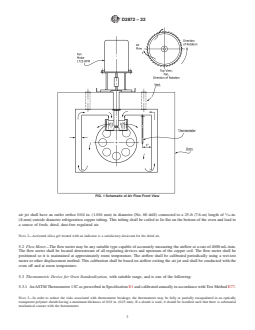
air through the fan. Figs. 1 and 2 show details of this plenum system.
5.1.3 The oven shall be equipped with a proportional control thermostat capable of maintaining a temperature of 325 °F (163 °C)
to within 61.0 °F (60.5 °C). The sensing element of the thermostat may be placed at any location that enables the oven to maintain
temperature control as specified by this standard.
5.1.4 The thermometer shall be hung or affixed to a mounting in the ceiling which is 2 in. (50.8 mm) from the right side of the
oven at a midpoint in the depth of the oven. The thermometer shall hang down into the oven so that the bulb of the thermometer
is within 1 in. of an imaginary line level with the shaft of the circular metal carriage. The heating controls shall be capable of
bringing the fully loaded oven back to the test temperature within a 10-min period after insertion of the samples in a preheated
oven.
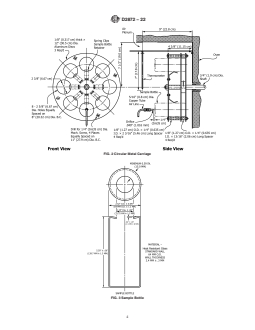
5.1.5 The oven shall be provided with a 12-in. (304.8-mm) diameter, vertical circular carriage (see Fig. 2 for details). This carriage
shall be provided with suitable openings and clips for firmly holding eight glass containers in a horizontal position (see Fig. 3).
The vertical carriage shall be mechanically driven through a ⁄4-in. (19-mm) diameter shaft at a speed of 15 6 0.2 r ⁄min.
5.1.6 The oven shall be equipped with an air jet positioned to blow heated air into each bottle at its lowest point of travel. The
D2872 − 22
FIG. 1 Schematic of Air Flow Front View
air jet shall have an outlet orifice 0.04 in. (1.016 mm) in diameter (No. 60 drill) connected to a 25-ft (7.6-m) length of ⁄16-in.
(8-mm) outside diameter refrigeration copper tubing. This tubing shall be coiled to lie flat on the bottom of the oven and lead to
a source of fresh, dried, dust-free regulated air.
NOTE 2—Activated silica gel treated with an indicator is a satisfactory desiccant for the dried air.
5.2 Flow Meter—The flow meter may be any suitable type capable of accurately measuring the airflow at a rate of 4000 mL ⁄min.
The flow meter shall be located downstream of all regulating devices and upstream of the copper coil. The flow meter shall be
positioned so it is maintained at approximately room temperature. The airflow shall be calibrated periodically using a wet-test
meter or other displacement method. This calibration shall be based on airflow exiting the air jet and shall be conducted with the
oven off and at room temperature.
5.3 Thermometric Device for Oven Standardization, with suitable range, and is one of the following:
5.3.1 An ASTM Thermometer 13C as prescribed in Specification E1 and calibrated annually in accordance with Test Method E77.
NOTE 3—In order to reduce the risks associated with thermometer breakage, the thermometer may be fully or partially encapsulated in an optically
transparent polymer sheath having a maximum thickness of 0.01 in. (0.25 mm). If a sheath is used, it should be installed such that there is substantial
mechanical contact with the thermometer.
D2872 − 22
FIG. 2 Circular Metal Carriage
FIG. 3 Sample Bottle
D2872 − 22
5.3.2 A thermocouple thermometer with accuracy of 0.5 °C, conforming to the requirements in Guide E2877. The thermocouple
thermometer shall be calibrated annually as a single unit in accordance with Test Method E220.
5.3.3 A platinum resistance thermometer (PRT) with accuracy of 0.5 °C, conforming to the requirements of Specification
E1137/E1137M. The PRT system (probe and readout) shall be calibrated annually as a single unit in accordance with Test Methods
E644.
5.4 Thermometric Device for Daily Oven Verification—An equivalent of the devices listed in 5.3.1 or 5.3.2 may be used, however,
the calibration requirements are not necessary. These devices shall be standardized annually.
5.4.1 A working thermometric device that is placed in the oven daily or remains in the oven does not need to be calibrated. If a
calibrated thermometric device is used in this manner, then it loses its calibration status.
5.5 Container—The container in which the sample is to be tested shall be of clear, transparent, heat-resistant glass conforming to
the dimensions shown in Fig. 3.
5.6 Cooling Rack—A wire or sheet metal rack, constructed of stainless steel or aluminum, which allows the sample containers to
cool in a horizontal position, with each container in the same horizontal plane. The rack shall be constructed in a way that allows
air to flow freely around each container with at least 1 in. (2.5 cm) clearance between containers and at least 1 in. (2.5 cm) clearance
between the containers and any solid surface.
6. Determination of Oven Preheat Time
6.1 Determine the preheat time for the oven in accordance with either 6.1.1 or 6.1.2. If 6.1.1 is used, this determination must be
made for each oven, and shall be repeated at least annually or whenever environmental conditions or the test location change. If
6.1.2 is used, no annual determination is necessary.
6.1.1 Adjust the oven control thermostat to the setting that will be used during the test. Select this setting so that when the oven
is fully loaded and the air is on, the oven will equilibrate at 325 6 1 °F (163 6 0.5 °C), as indicated by the test thermometer. Turn
the oven on and simultaneously record the start time to the nearest whole minute. Determine and record the temperature of the oven
at 15-min intervals. Continue this process until the oven reaches thermal equilibrium. Thermal equilibrium is considered to be the
time when the oven temperature does not vary by more than 1 °F (0.5 °C) between two consecutive readings. The oven preheat
time is the time that it takes to reach thermal equilibrium plus an additional 30 min.
6.1.2 In lieu of completing the steps described in 6.1.1, a minimum preheat time of 4 h may be used.
7. Preparation of Oven
1 1
7.1 Position the air outlet orifice so that it is ⁄4 in. 6 ⁄8 in. (6 mm 6 3 mm) from the opening of the glass container. The orifice
shall also be so positioned that the jet blows horizontally into the central arc of the opening of the circling glass container.
7.2 Position the thermometer specified in 5.3 so that the end of the bulb of the thermometer is within 1 in. (25.4 mm) of an
imaginary line level with the center of the shaft holding the revolving carriage.
7.3 Level the oven so that the horizontal axes of the glass containers when in position in the carriage are level to within 61.0°.
7.4 Start the fan. The fan shall remain on whenever the oven heater is on and the oven door is closed. This standard permits (but
does not require) the fan to be stopped when the oven door is opened. Stopping the fan may be accomplished manually, with an
electronic door interlock, or through other means.
7.5 Preheat the oven for the preheat time determined in Section 6 or longer prior to testing with the control thermostat adjusted
to the sett
...
Questions, Comments and Discussion
Ask us and Technical Secretary will try to provide an answer. You can facilitate discussion about the standard in here.
Loading comments...