


ASTM E1558-09(2014)
(Guide)Standard Guide for Electrolytic Polishing of Metallographic Specimens
Standard Guide for Electrolytic Polishing of Metallographic Specimens
SIGNIFICANCE AND USE
4.1 Advantages of Electrolytic Polishing:
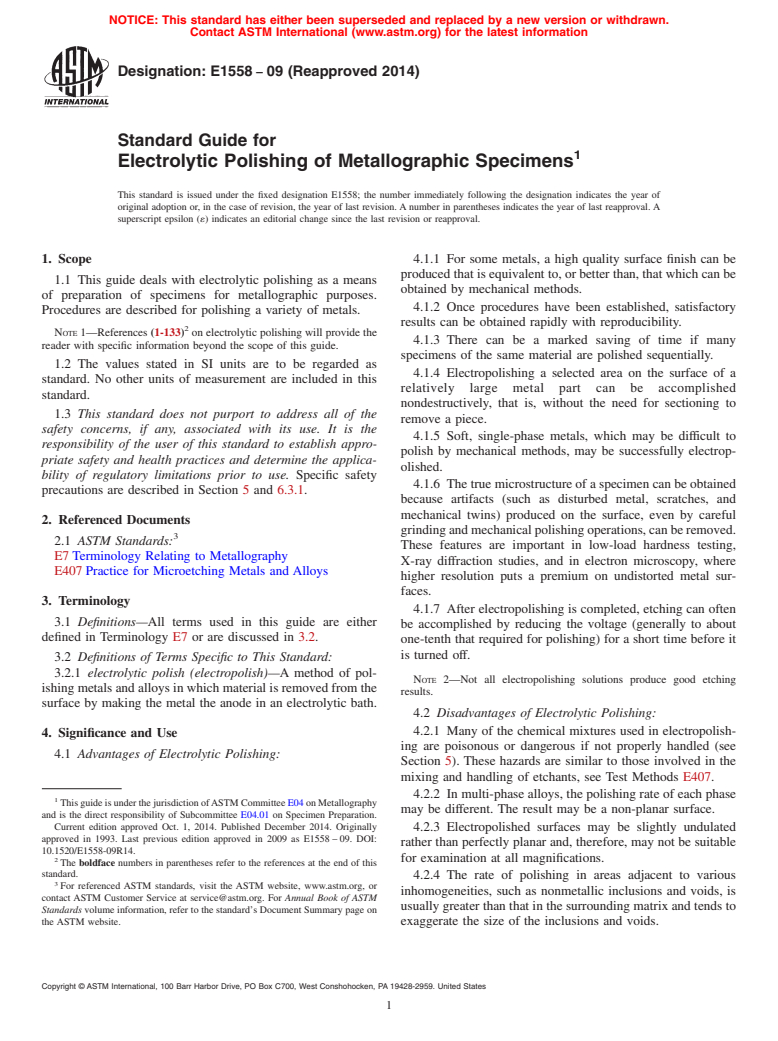
4.1.1 For some metals, a high quality surface finish can be produced that is equivalent to, or better than, that which can be obtained by mechanical methods.
4.1.2 Once procedures have been established, satisfactory results can be obtained rapidly with reproducibility.
4.1.3 There can be a marked saving of time if many specimens of the same material are polished sequentially.
4.1.4 Electropolishing a selected area on the surface of a relatively large metal part can be accomplished nondestructively, that is, without the need for sectioning to remove a piece.
4.1.5 Soft, single-phase metals, which may be difficult to polish by mechanical methods, may be successfully electropolished.
4.1.6 The true microstructure of a specimen can be obtained because artifacts (such as disturbed metal, scratches, and mechanical twins) produced on the surface, even by careful grinding and mechanical polishing operations, can be removed. These features are important in low-load hardness testing, X-ray diffraction studies, and in electron microscopy, where higher resolution puts a premium on undistorted metal surfaces.
4.1.7 After electropolishing is completed, etching can often be accomplished by reducing the voltage (generally to about one-tenth that required for polishing) for a short time before it is turned off.
Note 2: Not all electropolishing solutions produce good etching results.
4.2 Disadvantages of Electrolytic Polishing:
4.2.1 Many of the chemical mixtures used in electropolishing are poisonous or dangerous if not properly handled (see Section 5). These hazards are similar to those involved in the mixing and handling of etchants, see Test Methods E407.
4.2.2 In multi-phase alloys, the polishing rate of each phase may be different. The result may be a non-planar surface.
4.2.3 Electropolished surfaces may be slightly undulated rather than perfectly planar and, therefore, may not be suitable for exami...
SCOPE
1.1 This guide deals with electrolytic polishing as a means of preparation of specimens for metallographic purposes. Procedures are described for polishing a variety of metals.
Note 1: References (1-133)2 on electrolytic polishing will provide the reader with specific information beyond the scope of this guide.
1.2 The values stated in SI units are to be regarded as standard. No other units of measurement are included in this standard.
1.3 This standard does not purport to address all of the safety concerns, if any, associated with its use. It is the responsibility of the user of this standard to establish appropriate safety and health practices and determine the applicability of regulatory limitations prior to use. Specific safety precautions are described in Section 5 and 6.3.1.
General Information
Buy Standard
Standards Content (Sample)
NOTICE: This standard has either been superseded and replaced by a new version or withdrawn.
Contact ASTM International (www.astm.org) for the latest information
Designation: E1558 − 09 (Reapproved 2014)
Standard Guide for
Electrolytic Polishing of Metallographic Specimens
This standard is issued under the fixed designation E1558; the number immediately following the designation indicates the year of
original adoption or, in the case of revision, the year of last revision.Anumber in parentheses indicates the year of last reapproval.A
superscript epsilon (´) indicates an editorial change since the last revision or reapproval.
1. Scope 4.1.1 For some metals, a high quality surface finish can be
producedthatisequivalentto,orbetterthan,thatwhichcanbe
1.1 This guide deals with electrolytic polishing as a means
obtained by mechanical methods.
of preparation of specimens for metallographic purposes.
4.1.2 Once procedures have been established, satisfactory
Procedures are described for polishing a variety of metals.
results can be obtained rapidly with reproducibility.
NOTE 1—References (1-133) on electrolytic polishing will provide the
4.1.3 There can be a marked saving of time if many
reader with specific information beyond the scope of this guide.
specimens of the same material are polished sequentially.
1.2 The values stated in SI units are to be regarded as
4.1.4 Electropolishing a selected area on the surface of a
standard. No other units of measurement are included in this
relatively large metal part can be accomplished
standard.
nondestructively, that is, without the need for sectioning to
1.3 This standard does not purport to address all of the
remove a piece.
safety concerns, if any, associated with its use. It is the
4.1.5 Soft, single-phase metals, which may be difficult to
responsibility of the user of this standard to establish appro-
polish by mechanical methods, may be successfully electrop-
priate safety and health practices and determine the applica-
olished.
bility of regulatory limitations prior to use. Specific safety
4.1.6 Thetruemicrostructureofaspecimencanbeobtained
precautions are described in Section 5 and 6.3.1.
because artifacts (such as disturbed metal, scratches, and
mechanical twins) produced on the surface, even by careful
2. Referenced Documents
grindingandmechanicalpolishingoperations,canberemoved.
2.1 ASTM Standards:
These features are important in low-load hardness testing,
E7Terminology Relating to Metallography
X-ray diffraction studies, and in electron microscopy, where
E407Practice for Microetching Metals and Alloys
higher resolution puts a premium on undistorted metal sur-
faces.
3. Terminology
4.1.7 After electropolishing is completed, etching can often
3.1 Definitions—All terms used in this guide are either
be accomplished by reducing the voltage (generally to about
defined in Terminology E7 or are discussed in 3.2.
one-tenth that required for polishing) for a short time before it
is turned off.
3.2 Definitions of Terms Specific to This Standard:
3.2.1 electrolytic polish (electropolish)—A method of pol-
NOTE 2—Not all electropolishing solutions produce good etching
ishingmetalsandalloysinwhichmaterialisremovedfromthe
results.
surface by making the metal the anode in an electrolytic bath.
4.2 Disadvantages of Electrolytic Polishing:
4.2.1 Many of the chemical mixtures used in electropolish-
4. Significance and Use
ing are poisonous or dangerous if not properly handled (see
4.1 Advantages of Electrolytic Polishing:
Section 5). These hazards are similar to those involved in the
mixing and handling of etchants, see Test Methods E407.
4.2.2 In multi-phase alloys, the polishing rate of each phase
ThisguideisunderthejurisdictionofASTMCommitteeE04onMetallography
may be different. The result may be a non-planar surface.
and is the direct responsibility of Subcommittee E04.01 on Specimen Preparation.
Current edition approved Oct. 1, 2014. Published December 2014. Originally
4.2.3 Electropolished surfaces may be slightly undulated
approved in 1993. Last previous edition approved in 2009 as E1558–09. DOI:
rather than perfectly planar and, therefore, may not be suitable
10.1520/E1558-09R14.
for examination at all magnifications.
The boldface numbers in parentheses refer to the references at the end of this
standard.
4.2.4 The rate of polishing in areas adjacent to various
For referenced ASTM standards, visit the ASTM website, www.astm.org, or
inhomogeneities, such as nonmetallic inclusions and voids, is
contact ASTM Customer Service at service@astm.org. For Annual Book of ASTM
usuallygreaterthanthatinthesurroundingmatrixandtendsto
Standards volume information, refer to the standard’s Document Summary page on
the ASTM website. exaggerate the size of the inclusions and voids.
Copyright © ASTM International, 100 Barr Harbor Drive, PO Box C700, West Conshohocken, PA 19428-2959. United States
E1558 − 09 (2014)
4.2.5 Dimples, pits, and waviness limit applications involv- 5.2.2 When pouring, mixing, or using electrolytes, always
ingsurfacephenomena,coatings,interfaces,andcracks.Edges use the proper protective equipment (eyewear, gloves, apron,
tend to be attacked preferentially, resulting in edge rounding. and so forth).
4.2.6 Artifacts may be produced by electropolishing. 5.2.3 Use proper devices (glass or plastic) for weighing,
4.2.7 Specimen mounting materials may react with the measuring, mixing, containing, and storage of solutions.
electrolyte. 5.2.4 When mixing electrolytes, always add reagents to the
4.2.8 The electropolished surfaces of certain materials may solvent unless specific instructions indicate otherwise.
be passive and difficult to etch. 5.2.5 When using an electrolyte, always avoid direct physi-
cal contact with the electrolyte and the specimen. Use tongs or
4.2.9 Metal removal rates by electropolishing are usually
quite low, typically about 1 µm/min, and all of the prior some other indirect method of handling specimens.
induced damage from cutting and grinding may not be re- 5.2.6 Methanol is a cumulative poison hazard. Where etha-
moved if preparation is stopped after a 600-grit SiC grind and nolormethanolarelistedasalternates,ethanolisthepreferred
electropolishing times are short. solvent. Methanol should be used in a properly designed
4.2.10 A large number of electrolytes may be needed to chemical fume hood.
polish the variety of metals encountered by a given laboratory. 5.2.7 All spills should be cleaned up and disposed of
Considerable time may be required to develop a procedure for properly, no matter how small the spill.
a new alloy. 5.2.8 Properly dispose of all solutions that are not identified
by composition and concentration.
5.2.9 Store, handle, and dispose of chemicals according to
5. General Safety Precautions
the manufacturer’s recommendations. Observe printed cau-
5.1 Beforeusingormixinganychemicals,allproductlabels
tions on reagent containers.
and pertinent Material Safety Data Sheets (MSDS) should be
5.2.10 Information pertaining to the toxicity hazards and
read and understood concerning all of the hazards and safety
working precautions of chemicals, solvents, acids, bases, and
precautions to be observed. Users should be aware of the type
so forth, being used (such as MSDS) should be available for
of hazards involved in the use of all chemicals used, including
rapid consultation.
those hazards that are immediate, long-term, visible, invisible,
and with or without odors. 5.3 Many of the electrolytes in the following listing can be
exceedingly dangerous if carelessly handled. The pertinent
5.1.1 Consult the product labels and MSDS for recommen-
dations concerning proper protective clothing. safety precautions for each class of electrolyte should be read
before any electrolyte is mixed or used.
5.1.2 All chemicals are potentially dangerous. All persons
using any electrolyte should be thoroughly familiar with all of
5.4 Electrolytes containing perchloric acid and acetic anhy-
the chemicals involved and the proper procedure for handling,
dride are very dangerous to mix and may be unpredictable in
mixing, and disposing of each chemical, as well as any
use. Many industrial firms and research laboratories forbid the
combinations of those chemicals.
use of such mixtures. Certain cities also have ordinances
5.1.3 When pouring, mixing, or etching, always use the
prohibiting the use of such potentially explosive mixtures.
properprotectiveequipment(glasses,gloves,apron,etc.)andit
These facts are considered sufficient reason for recommending
is strongly recommended to always work under a certified and
against their use.
testedfumehood.Thisisimperativewithetchantsthatgiveoff
5.5 Mixtures of oxidizable organic compounds and power-
noxious odors or toxic vapors. In particular, note that solutions
ful oxidizing agents are always potentially dangerous. After
containing perchloric acid must be mixed and used in an
some use, any electrolyte will become heavily laden with ions
exclusive hood equipped with a wash down feature to avoid
of the metals polished. These ions may interfere with further
accumulation of explosive perchlorates.
polishing or catalyze the decomposition of the electrolyte.The
5.1.4 Table 1 includes specific safety precautions for the
electrolyte then must be discarded in accordance with appro-
mixing or use of some electrolytes. The user should take care
priate regulations.
to observe each of these specific precautions.
5.6 Most electrolytes (with few exceptions) should be
5.2 Somebasicsuggestionsforthehandlinganddisposalof
mixed and stored in clean glass containers and never be in
electrolytes and their ingredients are as follows:
contact with foreign materials or organic compounds. The
5.2.1 As previously stated, it is good practice to always
exceptions are those electrolytes containing fluorides and
work under a certified fume hood when mixing and utilizing
strong alkaline solutions that should be mixed and stored in
any electrolyte and it is imperative with those electrolytes that
polyethylene or other appropriate material containers. Electro-
give off noxious odors or toxic vapor. Additionally, the
lytes must never be allowed to become concentrated by
electrolytes in Groups I and II must be treated with extra
evaporation.All electrolytes should be discarded appropriately
caution because dried perchlorates can accumulate in hood
as soon as they have exceeded their immediate usefulness.
ductwork and on work surfaces creating the potential for a
powerful accidental explosion. Therefore, these electrolytes 5.7 Specimens mounted in bismuth or bismuth-containing
must only be used in an exclusive hood equipped with a wash metals must not be electropolished in perchloric acid solutions
down feature. To avoid the accumulation of explosive, dry because this mounting medium may react explosively with the
perchlorates, the hood should undergo a wash down cycle electrolyte. Likewise, bismuth or bismuth-containing alloys
following each use. must not be electropolished in solutions containing perchloric
E1558 − 09 (2014)
TABLE 1 Electrolytes for Electropolishing
Class Use Formula Cell Voltage Time Remarks
Group I (Electrolytes Composed of Perchloric Acid and Alcohol With or Without Organic Additions) Use in a washdown/perchloric rated fume hood.
I-1 Al and Al alloys with less than ethanol (95 %) 800 mL 30 to 80 15 to 60 s
2 percent Si distilled water 140 mL
perchloric acid (60 %) 60 mL
steels—carbon, alloy, stainless 35 to 65 15 to 60 s
Pb, Pb-Sn, Pb-Sn-Cd, Pb-Sn-Sb 12 to 35 15 to 60 s
Zn, Zn-Sn-Fe, Zn-Al-Cu 20 to 60 .
Mg and high Mg alloys . . nickel cathode
I-2 stainless steel and aluminum ethanol (95 %) 800 mL 35 to 80 15 to 60 s
perchloric acid (60 %) 200 mL
I-3 stainless steel ethanol (95 %) 940 mL 30 to 45 15 to 60 s
perchloric acid (65 %) 60 mL
I-4 steel, cast iron, Al, Al alloys, Ni, ethanol (95 %) 700 mL 30 to 65 15 to 60 s one of the best formulas for
Sn, Ag, Be, Ti, Zr, U, 2-butoxy ethanol 100 mL universal use
heat-resisting alloys perchloric acid (30 %) 200 mL
I-5 steels—stainless, alloy, ethanol (95 %) 700 mL 15 to 50 15 to 60 s universal electrolyte comparable to
high-speed; Fe, Al, Zr, Pb glycerin 100 mL I-4
perchloric acid (30 %) 200 mL
I-6 Al, Al-Si alloys ethanol (95 %) 760 mL 35 to 60 15 to 60 s particularly good with Al-Si alloys
diethyl ether 190 mL
perchloric acid (30 %) 50 mL
I-7 Mo, Ti, Zr, U-Zr alloy methanol (absolute) 600 mL 60 to 150 5to30s
2-butoxy ethanol 370 mL
perchloric acid (60 %) 30 mL
I-8 Al-Si alloys methanol (absolute) 840 mL 50 to 100 5to60s
glycerin 125 mL
perchloric acid (65 %) 35 mL
I-9 vanadium methanol (absolute) 590 mL 30 3 s three-second cycles repeated at
2-butoxy ethanol 350 mL least seven times to prevent heating
perchloric acid (65 %) 60 mL
germanium 25 to 35 30 to 60 s
titanium 58 to 66 45 s polish only
zirconium 70 to 75 15 s polish and etch simultaneously
I-10 aluminum methanol (absolute) 950 mL 30 to 60 15 to 60 s
nitric acid 15 mL
perchloric acid (60 %) 50 mL
I-11 steels—carbon, alloy, stainless methanol (absolute) 600 mL 30–40 5–60 s good all purpose electropolish
Ti, high-temperature alloys, Pb, butylcellosolve 360 mL
Mo perchloric acid 60 mL
I-12 Al and Al alloys ethanol (95 %) 1000 mL 10 2 min not good for Al-Cu and Al-Si alloys.
perchloric acid 200 mL Black film forms. Peel off after 1–1.5
min and polish 1 min more.
I-13 steel, Al, Ni, Sn, Ti, Be ethanol (95 %) 700 mL 20 20 s Mix ethanol and water, add
stainless steel butylcellosolve 100 mL perchloric acid carefully. Then, add
Al Ni water 137 mL butylcellosolve before use.
perchloric acid 62 mL
I-14 Ni, Ag, or Cu alloys ethanol (95 %) 700 mL 70–80 15 s
Cd butylcellosolve 100 mL
perchloric acid 200 mL
I-15 Mo and Mo alloys methanol (absolute) 600 mL 20 s Mix methanol and water, add
water 13 mL perchloric acid carefully. Add
butylcellosolve 360 mL butylcellosolve before use.
perchloric acid 47 mL
Group II (Electrolytes Composed of Perchloric Acid and Glacial Acetic Acid in Varying Proportions) Use in a washdown/perchloric rated fume hood.
II-1 Cr, Ti, Zr, U, acetic acid (glacial) 940 mL 20 to 60 1 to 5 min good general-purpose electrolyte
Fe, steel—carbon, alloy, stainless perchloric acid (60 %) 60 mL
II-2 Zr, Ti, U, steel—carbon and alloy acetic acid (glacial) 900 mL 12 to 70 0.5 to 2 min
perchloric acid (60 %) 100 mL
II-3 U, Zr, Ti, Al, steel—carbon and acetic acid (glacial) 800 mL 40 to 100 1to15min
alloy perchloric acid (60 %) 200 mL
II-4 Ni, Pb, Pb-Sb alloys acetic acid (glacial) 700 mL 40 to 100 1 to 5 min
perchloric acid (60 %) 300 mL
II-5 3 percent Si-Fe acetic acid (glacial) 650 mL . 5 min 0.06 A/cm
perchloric acid (60 %) 350 mL
II-6 Cr acetic acid (glacial) 1000 mL 30–50 2–3 min can lower voltage to 25 V by adding
perchloric acid 5mL 5–15 % water.
II-7 Hf, steel—carbon and alloy acetic acid (glacial) 1000 mL . . Used to polis
...
This document is not an ASTM standard and is intended only to provide the user of an ASTM standard an indication of what changes have been made to the previous version. Because
it may not be technically possible to adequately depict all changes accurately, ASTM recommends that users consult prior editions as appropriate. In all cases only the current version
of the standard as published by ASTM is to be considered the official document.
Designation: E1558 − 09 E1558 − 09 (Reapproved 2014)
Standard Guide for
Electrolytic Polishing of Metallographic Specimens
This standard is issued under the fixed designation E1558; the number immediately following the designation indicates the year of
original adoption or, in the case of revision, the year of last revision. A number in parentheses indicates the year of last reapproval. A
superscript epsilon (´) indicates an editorial change since the last revision or reapproval.
1. Scope
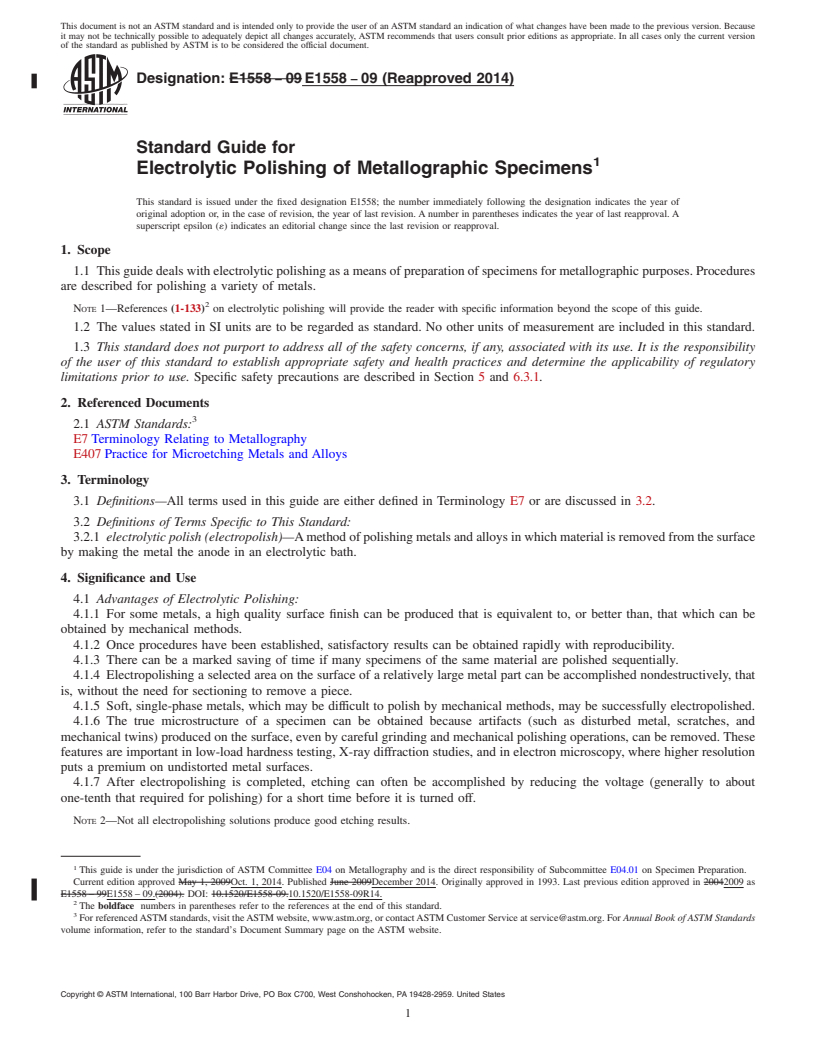
1.1 This guide deals with electrolytic polishing as a means of preparation of specimens for metallographic purposes. Procedures
are described for polishing a variety of metals.
NOTE 1—References (1-133) on electrolytic polishing will provide the reader with specific information beyond the scope of this guide.
1.2 The values stated in SI units are to be regarded as standard. No other units of measurement are included in this standard.
1.3 This standard does not purport to address all of the safety concerns, if any, associated with its use. It is the responsibility
of the user of this standard to establish appropriate safety and health practices and determine the applicability of regulatory
limitations prior to use. Specific safety precautions are described in Section 5 and 6.3.1.
2. Referenced Documents
2.1 ASTM Standards:
E7 Terminology Relating to Metallography
E407 Practice for Microetching Metals and Alloys
3. Terminology
3.1 Definitions—All terms used in this guide are either defined in Terminology E7 or are discussed in 3.2.
3.2 Definitions of Terms Specific to This Standard:
3.2.1 electrolytic polish (electropolish)—A method of polishing metals and alloys in which material is removed from the surface
by making the metal the anode in an electrolytic bath.
4. Significance and Use
4.1 Advantages of Electrolytic Polishing:
4.1.1 For some metals, a high quality surface finish can be produced that is equivalent to, or better than, that which can be
obtained by mechanical methods.
4.1.2 Once procedures have been established, satisfactory results can be obtained rapidly with reproducibility.
4.1.3 There can be a marked saving of time if many specimens of the same material are polished sequentially.
4.1.4 Electropolishing a selected area on the surface of a relatively large metal part can be accomplished nondestructively, that
is, without the need for sectioning to remove a piece.
4.1.5 Soft, single-phase metals, which may be difficult to polish by mechanical methods, may be successfully electropolished.
4.1.6 The true microstructure of a specimen can be obtained because artifacts (such as disturbed metal, scratches, and
mechanical twins) produced on the surface, even by careful grinding and mechanical polishing operations, can be removed. These
features are important in low-load hardness testing, X-ray diffraction studies, and in electron microscopy, where higher resolution
puts a premium on undistorted metal surfaces.
4.1.7 After electropolishing is completed, etching can often be accomplished by reducing the voltage (generally to about
one-tenth that required for polishing) for a short time before it is turned off.
NOTE 2—Not all electropolishing solutions produce good etching results.
This guide is under the jurisdiction of ASTM Committee E04 on Metallography and is the direct responsibility of Subcommittee E04.01 on Specimen Preparation.
Current edition approved May 1, 2009Oct. 1, 2014. Published June 2009December 2014. Originally approved in 1993. Last previous edition approved in 20042009 as
E1558 – 99E1558 – 09.(2004). DOI: 10.1520/E1558-09.10.1520/E1558-09R14.
The boldface numbers in parentheses refer to the references at the end of this standard.
For referenced ASTM standards, visit the ASTM website, www.astm.org, or contact ASTM Customer Service at service@astm.org. For Annual Book of ASTM Standards
volume information, refer to the standard’s Document Summary page on the ASTM website.
Copyright © ASTM International, 100 Barr Harbor Drive, PO Box C700, West Conshohocken, PA 19428-2959. United States
E1558 − 09 (2014)
4.2 Disadvantages of Electrolytic Polishing:
4.2.1 Many of the chemical mixtures used in electropolishing are poisonous or dangerous if not properly handled (see Section
5). These hazards are similar to those involved in the mixing and handling of etchants, see Test Methods E407.
4.2.2 In multi-phase alloys, the polishing rate of each phase may be different. The result may be a non-planar surface.
4.2.3 Electropolished surfaces may be slightly undulated rather than perfectly planar and, therefore, may not be suitable for
examination at all magnifications.
4.2.4 The rate of polishing in areas adjacent to various inhomogeneities, such as nonmetallic inclusions and voids, is usually
greater than that in the surrounding matrix and tends to exaggerate the size of the inclusions and voids.
4.2.5 Dimples, pits, and waviness limit applications involving surface phenomena, coatings, interfaces, and cracks. Edges tend
to be attacked preferentially, resulting in edge rounding.
4.2.6 Artifacts may be produced by electropolishing.
4.2.7 Specimen mounting materials may react with the electrolyte.
4.2.8 The electropolished surfaces of certain materials may be passive and difficult to etch.
4.2.9 Metal removal rates by electropolishing are usually quite low, typically about 1 μm/min, and all of the prior induced
damage from cutting and grinding may not be removed if preparation is stopped after a 600-grit SiC grind and electropolishing
times are short.
4.2.10 A large number of electrolytes may be needed to polish the variety of metals encountered by a given laboratory.
Considerable time may be required to develop a procedure for a new alloy.
5. General Safety Precautions
5.1 Before using or mixing any chemicals, all product labels and pertinent Material Safety Data Sheets (MSDS) should be read
and understood concerning all of the hazards and safety precautions to be observed. Users should be aware of the type of hazards
involved in the use of all chemicals used, including those hazards that are immediate, long-term, visible, invisible, and with or
without odors.
5.1.1 Consult the product labels and MSDS for recommendations concerning proper protective clothing.
5.1.2 All chemicals are potentially dangerous. All persons using any electrolyte should be thoroughly familiar with all of the
chemicals involved and the proper procedure for handling, mixing, and disposing of each chemical, as well as any combinations
of those chemicals.
5.1.3 When pouring, mixing, or etching, always use the proper protective equipment (glasses, gloves, apron, etc.) and it is
strongly recommended to always work under a certified and tested fume hood. This is imperative with etchants that give off
noxious odors or toxic vapors. In particular, note that solutions containing perchloric acid must be mixed and used in an exclusive
hood equipped with a wash down feature to avoid accumulation of explosive perchlorates.
5.1.4 Table 1 includes specific safety precautions for the mixing or use of some electrolytes. The user should take care to
observe each of these specific precautions.
5.2 Some basic suggestions for the handling and disposal of electrolytes and their ingredients are as follows:
5.2.1 As previously stated, it is good practice to always work under a certified fume hood when mixing and utilizing any
electrolyte and it is imperative with those electrolytes that give off noxious odors or toxic vapor. Additionally, the electrolytes in
Groups I and II must be treated with extra caution because dried perchlorates can accumulate in hood ductwork and on work
surfaces creating the potential for a powerful accidental explosion. Therefore, these electrolytes must only be used in an exclusive
hood equipped with a wash down feature. To avoid the accumulation of explosive, dry perchlorates, the hood should undergo a
wash down cycle following each use.
5.2.2 When pouring, mixing, or using electrolytes, always use the proper protective equipment (eyewear, gloves, apron, and so
forth).
5.2.3 Use proper devices (glass or plastic) for weighing, measuring, mixing, containing, and storage of solutions.
5.2.4 When mixing electrolytes, always add reagents to the solvent unless specific instructions indicate otherwise.
5.2.5 When using an electrolyte, always avoid direct physical contact with the electrolyte and the specimen. Use tongs or some
other indirect method of handling specimens.
5.2.6 Methanol is a cumulative poison hazard. Where ethanol or methanol are listed as alternates, ethanol is the preferred
solvent. Methanol should be used in a properly designed chemical fume hood.
5.2.7 All spills should be cleaned up and disposed of properly, no matter how small the spill.
5.2.8 Properly dispose of all solutions that are not identified by composition and concentration.
5.2.9 Store, handle, and dispose of chemicals according to the manufacturer’s recommendations. Observe printed cautions on
reagent containers.
5.2.10 Information pertaining to the toxicity hazards and working precautions of chemicals, solvents, acids, bases, and so forth,
being used (such as MSDS) should be available for rapid consultation.
5.3 Many of the electrolytes in the following listing can be exceedingly dangerous if carelessly handled. The pertinent safety
precautions for each class of electrolyte should be read before any electrolyte is mixed or used.
E1558 − 09 (2014)
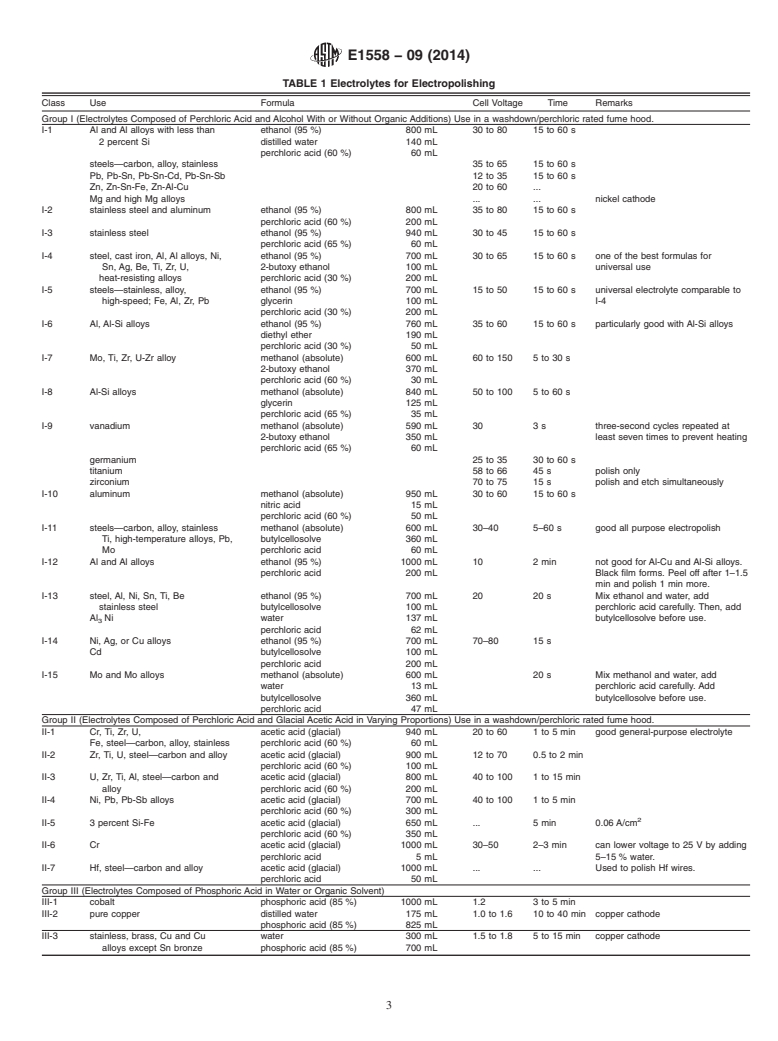
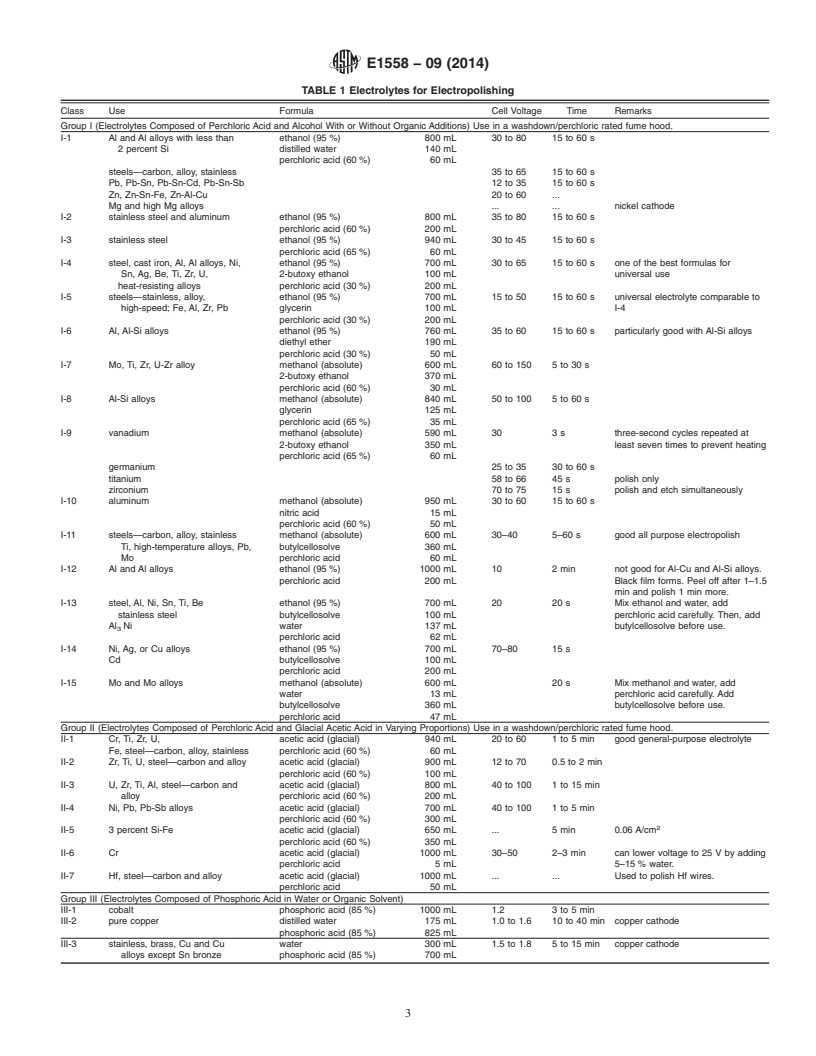
TABLE 1 Electrolytes for Electropolishing
Class Use Formula Cell Voltage Time Remarks
Group I (Electrolytes Composed of Perchloric Acid and Alcohol With or Without Organic Additions) Use in a washdown/perchloric rated fume hood.
I-1 Al and Al alloys with less than ethanol (95 %) 800 mL 30 to 80 15 to 60 s
2 percent Si distilled water 140 mL
perchloric acid (60 %) 60 mL
steels—carbon, alloy, stainless 35 to 65 15 to 60 s
Pb, Pb-Sn, Pb-Sn-Cd, Pb-Sn-Sb 12 to 35 15 to 60 s
Zn, Zn-Sn-Fe, Zn-Al-Cu 20 to 60 .
Mg and high Mg alloys . . nickel cathode
I-2 stainless steel and aluminum ethanol (95 %) 800 mL 35 to 80 15 to 60 s
perchloric acid (60 %) 200 mL
I-3 stainless steel ethanol (95 %) 940 mL 30 to 45 15 to 60 s
perchloric acid (65 %) 60 mL
I-4 steel, cast iron, Al, Al alloys, Ni, ethanol (95 %) 700 mL 30 to 65 15 to 60 s one of the best formulas for
Sn, Ag, Be, Ti, Zr, U, 2-butoxy ethanol 100 mL universal use
heat-resisting alloys perchloric acid (30 %) 200 mL
I-5 steels—stainless, alloy, ethanol (95 %) 700 mL 15 to 50 15 to 60 s universal electrolyte comparable to
high-speed; Fe, Al, Zr, Pb glycerin 100 mL I-4
perchloric acid (30 %) 200 mL
I-6 Al, Al-Si alloys ethanol (95 %) 760 mL 35 to 60 15 to 60 s particularly good with Al-Si alloys
diethyl ether 190 mL
perchloric acid (30 %) 50 mL
I-7 Mo, Ti, Zr, U-Zr alloy methanol (absolute) 600 mL 60 to 150 5 to 30 s
2-butoxy ethanol 370 mL
perchloric acid (60 %) 30 mL
I-8 Al-Si alloys methanol (absolute) 840 mL 50 to 100 5 to 60 s
glycerin 125 mL
perchloric acid (65 %) 35 mL
I-9 vanadium methanol (absolute) 590 mL 30 3 s three-second cycles repeated at
2-butoxy ethanol 350 mL least seven times to prevent heating
perchloric acid (65 %) 60 mL
germanium 25 to 35 30 to 60 s
titanium 58 to 66 45 s polish only
zirconium 70 to 75 15 s polish and etch simultaneously
I-10 aluminum methanol (absolute) 950 mL 30 to 60 15 to 60 s
nitric acid 15 mL
perchloric acid (60 %) 50 mL
I-11 steels—carbon, alloy, stainless methanol (absolute) 600 mL 30–40 5–60 s good all purpose electropolish
Ti, high-temperature alloys, Pb, butylcellosolve 360 mL
Mo perchloric acid 60 mL
I-12 Al and Al alloys ethanol (95 %) 1000 mL 10 2 min not good for Al-Cu and Al-Si alloys.
perchloric acid 200 mL Black film forms. Peel off after 1–1.5
min and polish 1 min more.
I-13 steel, Al, Ni, Sn, Ti, Be ethanol (95 %) 700 mL 20 20 s Mix ethanol and water, add
stainless steel butylcellosolve 100 mL perchloric acid carefully. Then, add
Al Ni water 137 mL butylcellosolve before use.
perchloric acid 62 mL
I-14 Ni, Ag, or Cu alloys ethanol (95 %) 700 mL 70–80 15 s
Cd butylcellosolve 100 mL
perchloric acid 200 mL
I-15 Mo and Mo alloys methanol (absolute) 600 mL 20 s Mix methanol and water, add
water 13 mL perchloric acid carefully. Add
butylcellosolve 360 mL butylcellosolve before use.
perchloric acid 47 mL
Group II (Electrolytes Composed of Perchloric Acid and Glacial Acetic Acid in Varying Proportions) Use in a washdown/perchloric rated fume hood.
II-1 Cr, Ti, Zr, U, acetic acid (glacial) 940 mL 20 to 60 1 to 5 min good general-purpose electrolyte
Fe, steel—carbon, alloy, stainless perchloric acid (60 %) 60 mL
II-2 Zr, Ti, U, steel—carbon and alloy acetic acid (glacial) 900 mL 12 to 70 0.5 to 2 min
perchloric acid (60 %) 100 mL
II-3 U, Zr, Ti, Al, steel—carbon and acetic acid (glacial) 800 mL 40 to 100 1 to 15 min
alloy perchloric acid (60 %) 200 mL
II-4 Ni, Pb, Pb-Sb alloys acetic acid (glacial) 700 mL 40 to 100 1 to 5 min
perchloric acid (60 %) 300 mL
II-5 3 percent Si-Fe acetic acid (glacial) 650 mL . 5 min 0.06 A/cm
perchloric acid (60 %) 350 mL
II-6 Cr acetic acid (glacial) 1000 mL 30–50 2–3 min can lower voltage to 25 V by adding
perchloric acid 5 mL 5–15 % water.
II-7 Hf, steel—carbon and alloy acetic acid (glacial) 1000 mL . . Used to polish Hf wires.
perchloric acid 50 mL
Group III (Electrolytes Composed of Phosphoric Acid in Water or Organic Solvent)
III-1 cobalt phosphoric acid (85 %) 1000 mL 1.2 3 to 5 min
III-2 pure copper distilled water 175 mL 1.0 to 1.6 10 to 40 min copper cathode
phosphoric acid (85 %) 825 mL
III-3 stainless, brass, Cu and Cu water 300 mL 1.5 to 1.8 5 to 15 min copper cathode
alloys except Sn bronze phosphoric acid (85 %) 700 mL
E1558 − 09 (2014)
TABLE 1 Continued
Class Use Formula Cell Voltage Time Remarks
III-4 alpha or alpha plus beta brass, water 600 mL 1 to 2 1 to 15 min copper or stainless steel cathode
Cu-Fe, Cu-Co, Co, Cd phosphoric acid (85 %) 400 mL
III-5 Cu, Cu-Zn water 1000 mL 1 to 2 10 min copper cathode
pyrophosphoric acid 580 g
III-6 steel diethylene glycol monoethyl 500 mL 5 to 20 5 to 15 min 49°C
ether
phosphoric acid (85 %) 500 mL
III-7 Al, Ag, Mg water 200 mL 25 to 30 4 to 6 min aluminum cathode, 38 to 43°C
ethanol (95 %) 380 mL
phosphoric acid (85 %) 400 mL
III-8 uranium ethanol (absolute) 300 mL . .
glycerin (cp) 300 mL
phosphoric acid (85 %) 300 mL
III-9 Mn
...
Questions, Comments and Discussion
Ask us and Technical Secretary will try to provide an answer. You can facilitate discussion about the standard in here.