

ASTM E2452-12(2019)
(Practice)Standard Practice for Equipment Management Process Maturity (EMPM) Model
General Information
- Abstract
SIGNIFICANCE AND USE
5.1 Internal—The EMPM provides assessment results that are easy to understand and communicate. Areas requiring additional resources become apparent, and thus, can be more readily addressed. Improvement can be tracked in meaningful ways. Assessment detail allows attention to be drawn to processes of exceptional maturity and areas in which changes or additional resources, or both, are required to achieve process improvements.
5.2 External—Meaningful comparisons to external requirements are enabled. Comparisons of equipment management between entities in different operational or business environments become meaningful and provide insight previously unavailable.
SCOPE
1.1 This practice covers a process for the assessment and reporting of an entity’s overall equipment management process maturity (EMPM).
1.2 The highest value is placed on continuous improvement as reflected in measured increases in maturity over time.
1.3 The EMPM model is designed to be applicable and appropriate for all equipment-holding entities, however, the EMPM may not be the only acceptable assessment model available.
1.4 It includes all aspects of equipment management.
1.5 In addition to applicability to equipment and equipment management as defined in this practice, this practice may in whole or in part be effectively applied to intangible property, real property, and material.
1.6 There is great variation across organizations regarding the internal departments that accomplish the various aspects of equipment management. Thus, all criteria are not applicable to all entities.
1.7 This standard does not purport to address all of the safety concerns, if any, associated with its use. It is the responsibility of the user of this standard to establish appropriate safety, health, and environmental practices and determine the applicability of regulatory limitations prior to use.
1.8 This international standard was developed in accordance with internationally recognized principles on standardization established in the Decision on Principles for the Development of International Standards, Guides and Recommendations issued by the World Trade Organization Technical Barriers to Trade (TBT) Committee.
- Status
- Published
- Publication Date
- 30-Apr-2019
- Technical Committee
- E53 - Asset Management
- Drafting Committee
- E53.01 - Process Management
Overview
ASTM E2452-12(2019) - Standard Practice for Equipment Management Process Maturity (EMPM) Model provides a comprehensive framework for evaluating and advancing the maturity of equipment management processes within organizations. Developed by ASTM International, this standard applies to any entity managing equipment, including tangible assets, real property, intangible property, and materials. The model focuses on continuous process improvement, effective resource allocation, and meaningful internal and external benchmarking.
This standard is adaptable to the entire organization or specific operational units. It facilitates a lifecycle approach encompassing equipment acquisition, use, and disposition, and offers a consistent methodology for assessment, reporting, and ongoing improvement.
Key Topics
- Equipment Management Process Maturity (EMPM) Model: A scalable framework to assess and improve equipment management practices across different phases of the asset lifecycle.
- Lifecycle Phases: Detailed assessment of equipment acquisition, utilization, and disposition, including criteria for both process management and operational activities.
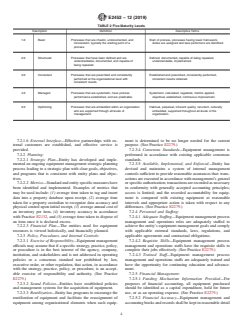
- Maturity Levels: Five defined levels - Basic, Structured, Consistent, Managed, and Optimizing - allowing organizations to benchmark and track progress.
- Internal and External Comparisons: Enables benchmarking against other organizations, industry standards, or stakeholder expectations for transparent performance insights.
- Assessment and Reporting: Process-driven, evidence-based evaluation, with emphasis on documentation, substantiation, and the use of relevant ASTM property management standards.
- Applicability: Suitable for all equipment-holding entities, though criteria can be tailored to fit different organizational structures and asset types.
- Continuous Improvement: Central to the standard is a focus on tracking process maturity over time, identifying strengths and areas requiring additional resources.
Applications
Organizations adopting ASTM E2452-12(2019) realize significant practical benefits, including:
- Strategic Asset Management: Improves acquisition, usage, and disposal of equipment, supporting organizational objectives and regulatory compliance.
- Resource Optimization: Clearly identifies where additional resources are needed to strengthen processes, improving efficiency and reducing costs.
- Benchmarking: Facilitates internal process improvement and external comparisons with peer organizations, providing actionable insights previously unavailable.
- Holistic Lifecycle Management: Supports a unified approach to managing assets from initial acquisition through end-of-life, ensuring performance, accountability, and value.
- Operational Consistency: Promotes repeatable, documented practices that drive consistent results across business units and operational environments.
- Risk and Compliance Management: Assists in managing risk through defined controls, process audits, and alignment with applicable laws, regulations, and international guidelines.
- Scalable Assessments: Can be applied to the overall entity or specific segments, allowing flexibility in approach based on organization needs.
Related Standards
The EMPM model references and aligns with several ASTM property and asset management standards to support a cohesive approach to equipment lifecycle management. Key related standards include:
- ASTM E2131: Practice for Addressing and Reporting Losses of Tangible Property
- ASTM E2132: Practice for Inventory Verification: Electronic and Physical Inventory of Assets
- ASTM E2135: Terminology for Property and Asset Management
- ASTM E2219: Practice for Valuation and Management of Moveable, Durable Property
- ASTM E2220: Practice for Establishing the Full Valuation of the Loss/Overage Population Identified During Inventory
- ASTM E2279: Practice for Establishing the Guiding Principles of Property Asset Management
These standards offer further guidance on specific aspects of asset and equipment management, such as inventory verification, asset valuation, and process management principles.
Keywords: equipment management process maturity, EMPM, ASTM E2452, asset lifecycle, property management, equipment assessment, process maturity model, acquisition, utilization, disposition, equipment benchmarking, continuous improvement, asset management standards
Relations
- Effective Date
- 01-May-2019
- Effective Date
- 01-May-2017
- Effective Date
- 01-Jan-2017
- Effective Date
- 01-Jan-2015
- Effective Date
- 01-Dec-2011
- Effective Date
- 15-Oct-2010
- Effective Date
- 15-Oct-2010
- Effective Date
- 15-Oct-2010
- Effective Date
- 01-Jul-2010
- Effective Date
- 01-Sep-2009
- Refers
ASTM E2279-09 - Standard Practice for Establishing the Guiding Principles of Property Management - Effective Date
- 01-Aug-2009
- Effective Date
- 15-Jun-2007
- Effective Date
- 15-Jun-2007
- Effective Date
- 01-May-2007
- Effective Date
- 15-Feb-2006
Get Certified
Connect with accredited certification bodies for this standard

BSI Group
BSI (British Standards Institution) is the business standards company that helps organizations make excellence a habit.

Bureau Veritas
Bureau Veritas is a world leader in laboratory testing, inspection and certification services.

DNV
DNV is an independent assurance and risk management provider.
Sponsored listings
Frequently Asked Questions
ASTM E2452-12(2019) is a standard published by ASTM International. Its full title is "Standard Practice for Equipment Management Process Maturity (EMPM) Model". This standard covers: SIGNIFICANCE AND USE 5.1 Internal—The EMPM provides assessment results that are easy to understand and communicate. Areas requiring additional resources become apparent, and thus, can be more readily addressed. Improvement can be tracked in meaningful ways. Assessment detail allows attention to be drawn to processes of exceptional maturity and areas in which changes or additional resources, or both, are required to achieve process improvements. 5.2 External—Meaningful comparisons to external requirements are enabled. Comparisons of equipment management between entities in different operational or business environments become meaningful and provide insight previously unavailable. SCOPE 1.1 This practice covers a process for the assessment and reporting of an entity’s overall equipment management process maturity (EMPM). 1.2 The highest value is placed on continuous improvement as reflected in measured increases in maturity over time. 1.3 The EMPM model is designed to be applicable and appropriate for all equipment-holding entities, however, the EMPM may not be the only acceptable assessment model available. 1.4 It includes all aspects of equipment management. 1.5 In addition to applicability to equipment and equipment management as defined in this practice, this practice may in whole or in part be effectively applied to intangible property, real property, and material. 1.6 There is great variation across organizations regarding the internal departments that accomplish the various aspects of equipment management. Thus, all criteria are not applicable to all entities. 1.7 This standard does not purport to address all of the safety concerns, if any, associated with its use. It is the responsibility of the user of this standard to establish appropriate safety, health, and environmental practices and determine the applicability of regulatory limitations prior to use. 1.8 This international standard was developed in accordance with internationally recognized principles on standardization established in the Decision on Principles for the Development of International Standards, Guides and Recommendations issued by the World Trade Organization Technical Barriers to Trade (TBT) Committee.
SIGNIFICANCE AND USE 5.1 Internal—The EMPM provides assessment results that are easy to understand and communicate. Areas requiring additional resources become apparent, and thus, can be more readily addressed. Improvement can be tracked in meaningful ways. Assessment detail allows attention to be drawn to processes of exceptional maturity and areas in which changes or additional resources, or both, are required to achieve process improvements. 5.2 External—Meaningful comparisons to external requirements are enabled. Comparisons of equipment management between entities in different operational or business environments become meaningful and provide insight previously unavailable. SCOPE 1.1 This practice covers a process for the assessment and reporting of an entity’s overall equipment management process maturity (EMPM). 1.2 The highest value is placed on continuous improvement as reflected in measured increases in maturity over time. 1.3 The EMPM model is designed to be applicable and appropriate for all equipment-holding entities, however, the EMPM may not be the only acceptable assessment model available. 1.4 It includes all aspects of equipment management. 1.5 In addition to applicability to equipment and equipment management as defined in this practice, this practice may in whole or in part be effectively applied to intangible property, real property, and material. 1.6 There is great variation across organizations regarding the internal departments that accomplish the various aspects of equipment management. Thus, all criteria are not applicable to all entities. 1.7 This standard does not purport to address all of the safety concerns, if any, associated with its use. It is the responsibility of the user of this standard to establish appropriate safety, health, and environmental practices and determine the applicability of regulatory limitations prior to use. 1.8 This international standard was developed in accordance with internationally recognized principles on standardization established in the Decision on Principles for the Development of International Standards, Guides and Recommendations issued by the World Trade Organization Technical Barriers to Trade (TBT) Committee.
ASTM E2452-12(2019) is classified under the following ICS (International Classification for Standards) categories: 03.100.10 - Purchasing. Procurement. Logistics. The ICS classification helps identify the subject area and facilitates finding related standards.
ASTM E2452-12(2019) has the following relationships with other standards: It is inter standard links to ASTM E2452-12, ASTM E2135-10a(2017), ASTM E2132-17, ASTM E2279-15, ASTM E2132-11, ASTM E2135-10ae2, ASTM E2135-10ae1, ASTM E2135-10a, ASTM E2135-10, ASTM E2131-09, ASTM E2279-09, ASTM E2135-07e1, ASTM E2135-07, ASTM E2132-01(2007), ASTM E2135-06. Understanding these relationships helps ensure you are using the most current and applicable version of the standard.
ASTM E2452-12(2019) is available in PDF format for immediate download after purchase. The document can be added to your cart and obtained through the secure checkout process. Digital delivery ensures instant access to the complete standard document.
Standards Content (Sample)
This international standard was developed in accordance with internationally recognized principles on standardization established in the Decision on Principles for the
Development of International Standards, Guides and Recommendations issued by the World Trade Organization Technical Barriers to Trade (TBT) Committee.
Designation: E2452 − 12 (Reapproved 2019)
Standard Practice for
Equipment Management Process Maturity (EMPM) Model
This standard is issued under the fixed designation E2452; the number immediately following the designation indicates the year of
original adoption or, in the case of revision, the year of last revision. A number in parentheses indicates the year of last reapproval. A
superscript epsilon (´) indicates an editorial change since the last revision or reapproval.
INTRODUCTION
Life-cycle equipment management has a great impact on business operations of almost all entities.
In fact, the success or failure on an entity may hinge on how effectively and efficiently an entity
performs in the equipment management life-cycle. Entities that sustain high maturity levels will
generally be more effective or competitive or both than entities with lower maturity levels in that these
entities will more efficiently and effectively acquire what is needed, use and control equipment better,
and dispose of equipment when no longer sufficiently suitable for operations.
1. Scope ization established in the Decision on Principles for the
Development of International Standards, Guides and Recom-
1.1 This practice covers a process for the assessment and
mendations issued by the World Trade Organization Technical
reporting of an entity’s overall equipment management process
Barriers to Trade (TBT) Committee.
maturity (EMPM).
1.2 The highest value is placed on continuous improvement 2. Referenced Documents
as reflected in measured increases in maturity over time.
2.1 ASTM Standards:
1.3 The EMPM model is designed to be applicable and E2131 Practice for Addressing and Reporting Losses of
Tangible Property
appropriate for all equipment-holding entities, however, the
EMPM may not be the only acceptable assessment model E2132 Practice for Inventory Verification: Electronic and
Physical Inventory of Assets
available.
E2135 Terminology for Property and Asset Management
1.4 It includes all aspects of equipment management.
E2219 Practice forValuation and Management of Moveable,
1.5 In addition to applicability to equipment and equipment
Durable Property (Withdrawn 2009)
management as defined in this practice, this practice may in
E2220 Practice for Establishing the Full Valuation of the
whole or in part be effectively applied to intangible property,
Loss/Overage Population Identified During the Inventory
real property, and material.
of Moveable, Durable Property (Withdrawn 2009)
E2221 Practice for Administrative Control of Property
1.6 There is great variation across organizations regarding
(Withdrawn 2011)
the internal departments that accomplish the various aspects of
E2279 Practice for Establishing the Guiding Principles of
equipment management. Thus, all criteria are not applicable to
Property Asset Management
all entities.
1.7 This standard does not purport to address all of the
3. Terminology
safety concerns, if any, associated with its use. It is the
3.1 Definitions:
responsibility of the user of this standard to establish appro-
3.1.1 entity, n—agency, company, organization, or institu-
priate safety, health, and environmental practices and deter-
tion.
mine the applicability of regulatory limitations prior to use.
3.1.2 equipment, n—non-expendable, tangible, moveable
1.8 This international standard was developed in accor-
property needed for the performance of a task or useful in
dance with internationally recognized principles on standard-
effecting an obligation. E2135
1 2
This practice is under the jurisdiction of ASTM Committee E53 on Asset For referenced ASTM standards, visit the ASTM website, www.astm.org, or
Management and is the direct responsibility of Subcommittee E53.01 on Process contact ASTM Customer Service at service@astm.org. For Annual Book of ASTM
Management. Standards volume information, refer to the standard’s Document Summary page on
Current edition approved May 1, 2019. Published May 2019. Originally the ASTM website.
approved in 2005. Last previous edition approved in 2012 as E2452–12. DOI: The last approved version of this historical standard is referenced on
10.1520/E2452–12R19. www.astm.org.
Copyright © ASTM International, 100 Barr Harbor Drive, PO Box C700, West Conshohocken, PA 19428-2959. United States
E2452 − 12 (2019)
3.1.3 equipment management, n—systematic planning and between entities in different operational or business environ-
control of equipment to optimize its service delivery potential ments become meaningful and provide insight previously
and the management of associated risks and costs throughout unavailable.
its life-cycle in support of organizational objectives. This
6. Applicability
includes the process management and operations of acquisition
or construction of the equipment; its operation, maintenance, 6.1 This practice may be applied to the entirety of the legal
and modification while in use; and its disposal when no longer
entity or a clearly defined, designated constituent part.
required.
6.2 An entity’s equipment holdings may encompass equip-
3.1.4 operations, n—exercise of the tasks that constitute
ment acquired by all legal means:
equipment management.
6.2.1 Company owned equipment,
6.2.2 Leased equipment,
3.1.5 practice, n—a definitive set of instructions for per-
6.2.3 Licenses,
forming one or more specific operations that does not produce
6.2.4 Customer-provided equipment,
a test result. Form and Style
6.2.5 Seized equipment,
3.1.5.1 Discussion—Of the several types of standards listed
6.2.6 Bailed equipment,
in the Form and Style for ASTM Standards guide, this standard
6.2.7 Borrowed equipment, and
is of the type designated as a practice.
6.2.8 Loaned equipment.
3.2 Acronyms:
6.3 This practice may be applied to the entirety of the
3.2.1 CIP—construction in progress
entity’s equipment holdings or a clearly identified subset. This
3.2.2 EMPM—equipment management process maturity
designation constitutes the assessment universe for the desig-
nated entity.
4. Summary of Practice
6.4 To the extent this practice is applied to a limited
4.1 The EMPM model provides insight into the effective-
equipmentuniverseorislimitedtoaportionoftheentity,these
ness of an entity as it acquires, uses, and disposes of the
limitations should be prominently noted when presenting
equipment necessary to the functioning of the entity. It enables
results of the assessment.
a holistic approach and vision for achieving cost-effective,
6.5 This practice should be applied to the designated equip-
responsive equipment acquisition, use, and disposition. It
ment universe regardless of the internal organization acquiring,
clarifies and illuminates functional responsibilities and associ-
using, or disposing the equipment.
ated functional areas.
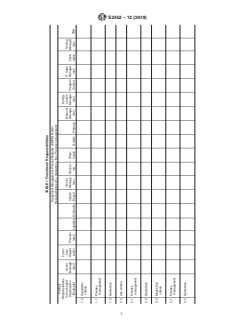
4.2 The functional responsibilities chart in Table 1 presents
7. Levels of Equipment Management Activity
the distribution of duties as a hypothetical entity embarking on
7.1 There are two fundamental levels of equipment man-
an EMPM assessment.
agement activity within the entity: process management and
4.3 The equipment life-cycle as addressed in this practice
operations.
encompasses three fundamental life-cycle phases: acquisition,
7.2 Process management encompasses criteria for the
use, and disposition.
people, processes, and systems involved in equipment manage-
4.4 This practice addresses two fundamental levels of
ment for each life-cycle phase.
equipment management activity within the entity: process
7.2.1 Leadership:
management and operations.
7.2.1.1 Outcome/Process Orientation—Management and
4.5 This practice recognizes five maturity levels (see Table control systems are based on specific desired outcomes or
process-orientedmetricsthatencourageimprovedperformance
2).
and effective management. (See Practice E2279.)
7.2.1.2 Best Value Products—Management systems are de-
5. Significance and Use
signed to deliver on a timely basis the “best value” product to
5.1 Internal—The EMPM provides assessment results that
the organization and its customers, while preserving the
are easy to understand and communicate. Areas requiring
confidence of internal and external stakeholders. (See Practice
additional resources become apparent, and thus, can be more
E2279.)
readily addressed. Improvement can be tracked in meaningful
7.2.1.3 Personal Initiative—Practitioners exercise personal
ways. Assessment detail allows attention to be drawn to
initiative and sound business judgment in providing the “best
processes of exceptional maturity and areas in which changes
value” services to meet the organization’s needs. (See Practice
oradditionalresources,orboth,arerequiredtoachieveprocess
E2279.)
improvements.
7.2.1.4 Lines of Authority/Accountability—Management
5.2 External—Meaningful comparisons to external require-
and control systems have clear, direct lines of authority and
ments are enabled. Comparisons of equipment management
organizational accountability for performance and custodial
care. (See Practice E2279.)
7.2.1.5 Best-in-Class Management—Best-in-class manage-
ment practices and integrated management systems are
From the Form and Style for ASTM Standards guide, available from ASTM
International Headquarters. recognized, identified, and adopted. (See Practice E2279.)
E2452 − 12 (2019)
TABLE 1 Functional Responsibilities
Equipment Management Process Maturity (EMPM) Model
Responsibilities (O = Operations, M = Process management)
Internal
Responsibilities Funct- Config-
in the Subject Asset ional Senior Material uration IT Asset Tooling
Organization Manage- Organi- Procure- Import/ Manage- Receiv- Ware- Manage- Manage- Program Manage- Calib- Manage-
(Example) ment zation ment Logistics Contracts Export men ing house Quality Finance men men Control men ration men TBD
1.0 Acquisition
criteria
1.1 Process
management
1.2 Operations
2.0 Use criteria
2.1 Process
management
2.2 Operations
3.0 Disposition
criteria
3.1 Process
management
3.2 Operations
E2452 − 12 (2019)
TABLE 2 Five Maturity Levels
Description Definition Descriptive Terms
1.0 Basic Processes that are chaotic, undocumented, and Start of process, processes having basic framework,
inconsistent, typically the starting point of a duties are assigned and task performers are identified.
process.
2.0 Structured Processes that have been defined and are Defined, documented, capable of being repeated,
understandable, documented, and capable of understandable, implemented.
being repeated.
3.0 Consistent Processes that are prescribed and consistently Established and prescribed, consistently performed,
performed at the organizational level with consistent results obtained.
consistent results.
4.0 Managed Processes that are systematic, have process Systematic, calculated, regulated, metrics applied,
performance established, and are predicable. objectives established, continuous improvement.
5.0 Optimizing Processes that are embedded within an organization Habitual, perpetual, inherent quality, recurrent, culturally
and are supported through all levels of embedded, supported throughout all levels of the
management. organization.
7.2.1.6 External Interface—Effective partnerships with ex- ment is determined to be no longer needed for the current
ternal customers are established, and effective service is purpose. (See Practice E2279.)
provided. 7.2.3.4 Consensus Standards—Equipment management is
7.2.2 Planning: performed in accordance with existing applicable consensus
7.2.2.1 Strategic Plan—Entity has developed and imple- standards.
mented an ongoing equipment management strategic planning 7.2.3.5 Available, Implemented, and Enforced—Entity has
process leading to a strategic plan with clear goals, objectives, devised and maintains a system of internal management
and programs that is consistent with entity plans and objec- controls sufficient to provide reasonable assurances that: trans-
tives. actions are executed in accordance with management’s general
7.2.2.2 Metrics—Standardandentityspecificmeasureshave orspecificauthorization;transactionsarerecordedasnecessary
been identified and implemented. Examples of metrics that in conformity with generally accepted accounting principles;
may be used include: (1) average time taken to tag and insert access is limited; and the recorded accountability for equip-
data into a property database upon receipt, (2) average time ment is compared with existing equipment at reasonable
taken for a property custodian to recognize data accuracy and intervals and appropriate action is taken with respect to any
physical control upon initial receipt, (3) average annual cost of differences. (See Practice E2279.)
an inventory per item, (4) inventory accuracy in accordance 7.2.4 Personnel and Staffıng:
with Practice E2132, and (5) average time taken to dispose of 7.2.4.1 Adequate Staffıng—Equipment management process
an item once it is declared excess. management and operations roles are adequately staffed to
7.2.2.3 Financial Plan—The entities need for equipment achieve the entity’s equipment management goals and comply
resources is viewed holistically, and financially planned. with applicable external standards, laws, regulations, and
7.2.3 Policy, Procedures, and Internal Controls: applicable agreements and contractual obligations.
7.2.3.1 Exercise of Responsibility—Equipment management 7.2.4.2 Requisite Skills—Equipment management process
officials may assume that if a specific strategy, practice, policy, management and operations staffs have the requisite skills to
or procedure is in the best interest of the agency, company, complete their jobs effectively. (See Practice E2279.)
institution, and stakeholders and is not addressed in operating 7.2.4.3 Trained Staff—Equipment management process
policies or a consensus standard nor prohibited by law, management and operations staffs are adequately trained and
executive order, or other regulation, that action, in accordance have the opportunity for continuing education and advance-
with the strategy, practice, policy, or procedure, is an accept- ment.
able exercise of responsibility and authority. (See Practice 7.2.5 Financial Management:
E2279.) 7.2.5.1 Funding Mechanism Information Provided—For
7.2.3.2 Sound Policies—Entities have established policies purposes of financial accounting, all equipment purchased
and management systems for the acquisition of equipment. should be identified as a capital expenditure, held for future
7.2.3.3 Reutilization—Entity has programs to encourage the use, or as an operating expense. (See Practice E2279.)
reutilization of equipment and facilitate the reassignment of 7.2.5.2 Financial Accuracy—Equipment management and
equipment among organizational elements when such equip- accounting books and records shall be kept in reasonable detail
E2452 − 12 (2019)
that affords reasonable assurance that the system accurately 7.2.7.6 Cross-Functional Integration—Internal customers
reflects the transactions and dispositions of the equipment of are satisfied with specific equipment management products and
the owner. (See Practice E2279.) services.
7.2.7.7 Cost and Performance Data—Trend data used in
7.2.5.3 Balances Costs and Risks—The degree to which
determining cost efficiency for major equipment management
equipment is controlled and the costs of control is commensu-
processes provides feedback on those processes that are the
rate with the practical consequences of a shortage (non-
major cost drivers.
availability of inventory) and the critical nature of an item’s
7.2.8 Quality Management:
loss, all in accordance with Practice E2221. (See Practice
7.2.8.1 Monitoring and Measurement of Processes—The
E2279.)
entity applies suitable methods for monitoring and, where
7.2.5.4 Best Value—Entity seeks the best value in the long
applicable, measurement of the quali
...