

ASTM D6502-10(2022)
(Test Method)Standard Test Method for Measurement of On-line Integrated Samples of Low Level Suspended Solids and Ionic Solids in Process Water by X-Ray Fluorescence (XRF)
General Information
- Abstract
SIGNIFICANCE AND USE
5.1 Corrosion products, in the form of particulate and dissolved metals, in the steam and water circuits of electricity generating plants are of great concern to power plant operators. Aside from indicating the extent of corrosion occurring in the plant, the presence of corrosion products has deleterious effects on plant integrity and efficiency. Deposited corrosion products provide sites at which chemicals, which are innocuous at low levels, may concentrate to corrosive levels and initiate under-deposit corrosion. Also, corrosion products in feedwater enter the steam generating components where deposition on heat transfer surfaces reduces the overall efficiency of the plant.
5.2 Most plants perform some type of corrosion product monitoring. The most common method is to sample for long time periods, up to several days, after which laboratory analysis of the collected sample gives the average corrosion product level over the collection time period. This methodology is referred to as integrated sampling. With the more frequent measurements in the on-line monitor, a time profile of corrosion product transport is obtained. Transient high corrosion product levels can be detected and measured, which cannot be accomplished with integrated sampling techniques. With this newly available data, plant operators may begin to correlate periods of high corrosion product levels with controllable plant operating events. In this way, operators may make more informed operational decisions with respect to corrosion product generation and transport.
SCOPE
1.1 This test method covers the operation, calibration, and data interpretation for an on-line corrosion product (metals) monitoring system. The monitoring system is based on x-ray fluorescence (XRF) analysis of metals contained on membrane filters (for suspended solids) or resin membranes (for ionic solids). Since the XRF detector is sensitive to a range of emission energy, this test method is applicable to simultaneous monitoring of the concentration levels of several metals including titanium, vanadium, chromium, manganese, iron, cobalt, nickel, copper, zinc, mercury, lead, and others in a flowing sample. A detection limit below 1 ppb can be achieved for most metals.
1.2 This test method includes a description of the equipment comprising the on-line metals monitoring system, as well as, operational procedures and system specifications.
1.3 The values stated in SI units are to be regarded as standard. No other units of measurement are included in this standard.
1.4 This standard does not purport to address all of the safety concerns, if any, associated with its use. It is the responsibility of the user of this standard to establish appropriate safety, health, and environmental practices and determine the applicability of regulatory limitations prior to use.
1.5 This international standard was developed in accordance with internationally recognized principles on standardization established in the Decision on Principles for the Development of International Standards, Guides and Recommendations issued by the World Trade Organization Technical Barriers to Trade (TBT) Committee.
- Status
- Published
- Publication Date
- 31-Oct-2022
- Technical Committee
- D19 - Water
Overview
ASTM D6502-10(2022) is a recognized standard test method developed by ASTM International for the measurement of on-line integrated samples of low-level suspended solids and ionic solids in process water using X-Ray Fluorescence (XRF). This method is essential in industries such as electricity generation, where monitoring of corrosion products-both particulate and dissolved metals-in steam and water circuits is critical for plant efficiency, safety, and regulatory compliance. The standard details procedures for on-line, real-time analysis, supporting proactive management of water quality and corrosion control.
Key Topics
- On-line Integrated Sampling: Describes the collection of water samples using membrane filters for suspended solids and resin membranes for ionic solids, accumulating metals over defined periods.
- X-Ray Fluorescence (XRF) Analysis: Utilizes XRF spectroscopy to identify and quantify a wide range of metals (including iron, nickel, copper, zinc, lead, and more) with detection limits below 1 ppb for most elements.
- System Configuration: Covers requirements for the on-line monitoring system, including x-ray probe, flow cell, filter chamber, flow totalizer, valve switching system, and data acquisition.
- Calibration and Quality Control: Outlines procedures to ensure accuracy, including preparation and use of membrane filter standards, calibration curves, and periodic calibration checks.
- Data Interpretation and Reporting: Guides users on converting raw measurements to concentration values (ppb), recording mass, sample volume, and real-time reporting.
- Precision and Sensitivity: Discusses factors affecting detection limit, including accumulation time and flow rate, as well as methods for assessing precision and reliability of results.
Applications
The ASTM D6502-10(2022) standard is primarily applied in:
- Power Generation Facilities: Monitoring and management of corrosion products in steam and water systems-crucial for protecting heat transfer surfaces and maintaining plant efficiency and longevity.
- Water Quality Assurance: On-line continuous monitoring enables rapid detection of spikes in particulate or dissolved metal concentrations, providing timely information to operators.
- Corrosion Studies: Supports detailed analysis and profiling of corrosion product transport, enabling correlation with specific operational events and process optimization strategies.
- Process Control in Industrial Water Streams: Suitable wherever low-level monitoring of metals is necessary, such as in high-purity water processing, chemical manufacturing, and nuclear plant feedwater circuits.
Using on-line XRF monitoring offers practical advantages over traditional integrated sampling, including:
- Early detection of transient events that can lead to under-deposit corrosion.
- Reduction in manual sampling and laboratory analysis turnaround times.
- Improved data-driven decision-making for plant operation and maintenance.
Related Standards
For comprehensive water analysis and process water monitoring, the following ASTM standards are commonly referenced alongside ASTM D6502-10(2022):
- ASTM D1066 - Practice for Sampling Steam
- ASTM D1129 - Terminology Relating to Water
- ASTM D2777 - Practice for Determination of Precision and Bias of Applicable Test Methods of Committee D19 on Water
- ASTM D3370 - Practices for Sampling Water from Flowing Process Streams
- ASTM D3864 - Guide for On-Line Monitoring Systems for Water Analysis
- ASTM D4453 - Practice for Handling of High Purity Water Samples
- ASTM D5540 - Practice for Flow Control and Temperature Control for On-Line Water Sampling and Analysis
- ASTM D6301 - Practice for Collection of On-Line Composite Samples of Suspended Solids and Ionic Solids in Process Water
Keywords: X-ray fluorescence, XRF, online water monitoring, corrosion products, suspended solids, ionic solids, metals analysis, process water quality, ASTM standards, power plant water systems.
By implementing ASTM D6502-10(2022), organizations benefit from improved water quality management, proactive corrosion control, and compliance with international best practices in industrial water systems.
Relations
- Effective Date
- 01-May-2020
- Effective Date
- 01-Aug-2018
- Effective Date
- 01-Aug-2018
- Effective Date
- 01-Feb-2017
- Effective Date
- 15-Feb-2016
- Effective Date
- 15-Jun-2012
- Effective Date
- 15-Jun-2011
- Effective Date
- 01-Feb-2011
- Effective Date
- 01-Dec-2010
- Effective Date
- 01-Mar-2010
- Effective Date
- 01-Oct-2008
- Effective Date
- 01-Oct-2008
- Effective Date
- 01-Oct-2008
- Effective Date
- 15-Jan-2008
- Effective Date
- 01-Dec-2007
Get Certified
Connect with accredited certification bodies for this standard

CIS Institut d.o.o.
Personal Protective Equipment (PPE) certification body. Notified Body NB-2890 for EU Regulation 2016/425 PPE.

Kiwa BDA Testing
Building and construction product certification.
Kmetijski inštitut Slovenije
Agricultural Institute of Slovenia. Soil testing, plant health, agricultural product analysis.
Sponsored listings
Frequently Asked Questions
ASTM D6502-10(2022) is a standard published by ASTM International. Its full title is "Standard Test Method for Measurement of On-line Integrated Samples of Low Level Suspended Solids and Ionic Solids in Process Water by X-Ray Fluorescence (XRF)". This standard covers: SIGNIFICANCE AND USE 5.1 Corrosion products, in the form of particulate and dissolved metals, in the steam and water circuits of electricity generating plants are of great concern to power plant operators. Aside from indicating the extent of corrosion occurring in the plant, the presence of corrosion products has deleterious effects on plant integrity and efficiency. Deposited corrosion products provide sites at which chemicals, which are innocuous at low levels, may concentrate to corrosive levels and initiate under-deposit corrosion. Also, corrosion products in feedwater enter the steam generating components where deposition on heat transfer surfaces reduces the overall efficiency of the plant. 5.2 Most plants perform some type of corrosion product monitoring. The most common method is to sample for long time periods, up to several days, after which laboratory analysis of the collected sample gives the average corrosion product level over the collection time period. This methodology is referred to as integrated sampling. With the more frequent measurements in the on-line monitor, a time profile of corrosion product transport is obtained. Transient high corrosion product levels can be detected and measured, which cannot be accomplished with integrated sampling techniques. With this newly available data, plant operators may begin to correlate periods of high corrosion product levels with controllable plant operating events. In this way, operators may make more informed operational decisions with respect to corrosion product generation and transport. SCOPE 1.1 This test method covers the operation, calibration, and data interpretation for an on-line corrosion product (metals) monitoring system. The monitoring system is based on x-ray fluorescence (XRF) analysis of metals contained on membrane filters (for suspended solids) or resin membranes (for ionic solids). Since the XRF detector is sensitive to a range of emission energy, this test method is applicable to simultaneous monitoring of the concentration levels of several metals including titanium, vanadium, chromium, manganese, iron, cobalt, nickel, copper, zinc, mercury, lead, and others in a flowing sample. A detection limit below 1 ppb can be achieved for most metals. 1.2 This test method includes a description of the equipment comprising the on-line metals monitoring system, as well as, operational procedures and system specifications. 1.3 The values stated in SI units are to be regarded as standard. No other units of measurement are included in this standard. 1.4 This standard does not purport to address all of the safety concerns, if any, associated with its use. It is the responsibility of the user of this standard to establish appropriate safety, health, and environmental practices and determine the applicability of regulatory limitations prior to use. 1.5 This international standard was developed in accordance with internationally recognized principles on standardization established in the Decision on Principles for the Development of International Standards, Guides and Recommendations issued by the World Trade Organization Technical Barriers to Trade (TBT) Committee.
SIGNIFICANCE AND USE 5.1 Corrosion products, in the form of particulate and dissolved metals, in the steam and water circuits of electricity generating plants are of great concern to power plant operators. Aside from indicating the extent of corrosion occurring in the plant, the presence of corrosion products has deleterious effects on plant integrity and efficiency. Deposited corrosion products provide sites at which chemicals, which are innocuous at low levels, may concentrate to corrosive levels and initiate under-deposit corrosion. Also, corrosion products in feedwater enter the steam generating components where deposition on heat transfer surfaces reduces the overall efficiency of the plant. 5.2 Most plants perform some type of corrosion product monitoring. The most common method is to sample for long time periods, up to several days, after which laboratory analysis of the collected sample gives the average corrosion product level over the collection time period. This methodology is referred to as integrated sampling. With the more frequent measurements in the on-line monitor, a time profile of corrosion product transport is obtained. Transient high corrosion product levels can be detected and measured, which cannot be accomplished with integrated sampling techniques. With this newly available data, plant operators may begin to correlate periods of high corrosion product levels with controllable plant operating events. In this way, operators may make more informed operational decisions with respect to corrosion product generation and transport. SCOPE 1.1 This test method covers the operation, calibration, and data interpretation for an on-line corrosion product (metals) monitoring system. The monitoring system is based on x-ray fluorescence (XRF) analysis of metals contained on membrane filters (for suspended solids) or resin membranes (for ionic solids). Since the XRF detector is sensitive to a range of emission energy, this test method is applicable to simultaneous monitoring of the concentration levels of several metals including titanium, vanadium, chromium, manganese, iron, cobalt, nickel, copper, zinc, mercury, lead, and others in a flowing sample. A detection limit below 1 ppb can be achieved for most metals. 1.2 This test method includes a description of the equipment comprising the on-line metals monitoring system, as well as, operational procedures and system specifications. 1.3 The values stated in SI units are to be regarded as standard. No other units of measurement are included in this standard. 1.4 This standard does not purport to address all of the safety concerns, if any, associated with its use. It is the responsibility of the user of this standard to establish appropriate safety, health, and environmental practices and determine the applicability of regulatory limitations prior to use. 1.5 This international standard was developed in accordance with internationally recognized principles on standardization established in the Decision on Principles for the Development of International Standards, Guides and Recommendations issued by the World Trade Organization Technical Barriers to Trade (TBT) Committee.
ASTM D6502-10(2022) is classified under the following ICS (International Classification for Standards) categories: 13.060.50 - Examination of water for chemical substances. The ICS classification helps identify the subject area and facilitates finding related standards.
ASTM D6502-10(2022) has the following relationships with other standards: It is inter standard links to ASTM D1129-13(2020)e2, ASTM D1066-18e1, ASTM D1066-18, ASTM D4453-17, ASTM D4453-16, ASTM D2777-12, ASTM D1066-11, ASTM D4453-11, ASTM D3370-10, ASTM D1129-10, ASTM D5540-08, ASTM D3370-08, ASTM D6301-08, ASTM D2777-08, ASTM D3370-07. Understanding these relationships helps ensure you are using the most current and applicable version of the standard.
ASTM D6502-10(2022) is available in PDF format for immediate download after purchase. The document can be added to your cart and obtained through the secure checkout process. Digital delivery ensures instant access to the complete standard document.
Standards Content (Sample)
This international standard was developed in accordance with internationally recognized principles on standardization established in the Decision on Principles for the
Development of International Standards, Guides and Recommendations issued by the World Trade Organization Technical Barriers to Trade (TBT) Committee.
Designation: D6502 − 10 (Reapproved 2022)
Standard Test Method for
Measurement of On-line Integrated Samples of Low Level
Suspended Solids and Ionic Solids in Process Water by
X-Ray Fluorescence (XRF)
This standard is issued under the fixed designation D6502; the number immediately following the designation indicates the year of
original adoption or, in the case of revision, the year of last revision. A number in parentheses indicates the year of last reapproval. A
superscript epsilon (´) indicates an editorial change since the last revision or reapproval.
1. Scope 2. Referenced Documents
2.1 ASTM Standards:
1.1 This test method covers the operation, calibration, and
D1066 Practice for Sampling Steam
data interpretation for an on-line corrosion product (metals)
D1129 Terminology Relating to Water
monitoring system. The monitoring system is based on x-ray
D2777 Practice for Determination of Precision and Bias of
fluorescence (XRF) analysis of metals contained on membrane
Applicable Test Methods of Committee D19 on Water
filters (for suspended solids) or resin membranes (for ionic
D3370 Practices for Sampling Water from Flowing Process
solids). Since the XRF detector is sensitive to a range of
Streams
emission energy, this test method is applicable to simultaneous
D3864 Guide for On-Line Monitoring Systems for Water
monitoring of the concentration levels of several metals
Analysis
including titanium, vanadium, chromium, manganese, iron,
D4453 Practice for Handling of High Purity Water Samples
cobalt, nickel, copper, zinc, mercury, lead, and others in a
D5540 Practice for Flow Control and Temperature Control
flowing sample.Adetection limit below 1 ppb can be achieved
for On-Line Water Sampling and Analysis
for most metals.
D6301 Practice for Collection of On-Line Composite
Samples of Suspended Solids and Ionic Solids in Process
1.2 Thistestmethodincludesadescriptionoftheequipment
Water
comprising the on-line metals monitoring system, as well as,
operational procedures and system specifications.
3. Terminology
1.3 The values stated in SI units are to be regarded as
3.1 Definitions:
standard. No other units of measurement are included in this
3.1.1 For definitions of other terms used in this standard,
standard.
refer to Terminology D1129 and Guide D3864.
1.4 This standard does not purport to address all of the
3.2 Definitions of Terms Specific to This Standard:
safety concerns, if any, associated with its use. It is the 3.2.1 emission intensity, n—the measure of the amplitude of
responsibility of the user of this standard to establish appro- fluorescence emitted by a sample element.
3.2.1.1 Discussion—This measurement is correlated with a
priate safety, health, and environmental practices and deter-
calibration curve for quantitative analysis. The emission inten-
mine the applicability of regulatory limitations prior to use.
sity generally is given in units of counts per second (c/s).
1.5 This international standard was developed in accor-
3.2.2 excitation source, n—the component of the XRF
dance with internationally recognized principles on standard-
spectrometer, providing the high-energy radiation used to
ization established in the Decision on Principles for the
excite the elemental constituents of a sample, leading to the
Development of International Standards, Guides and Recom-
subsequent measured fluorescence.
mendations issued by the World Trade Organization Technical
3.2.2.1 Discussion—The excitation source may be an elec-
Barriers to Trade (TBT) Committee.
tronicx-raygeneratingtubeoroneofavarietyofradioisotopes
emitting an x-ray line of a suitable energy for the analysis at
hand.
This test method is under the jurisdiction of ASTM Committee D19 on Water
and is the direct responsibility of Subcommittee D19.03 on Sampling Water and
Water-Formed Deposits, Analysis of Water for Power Generation and Process Use,
On-Line Water Analysis, and Surveillance of Water. For referenced ASTM standards, visit the ASTM website, www.astm.org, or
Current edition approved Nov. 1, 2022. Published December 2022. Originally contact ASTM Customer Service at service@astm.org. For Annual Book of ASTM
approved in 1999. Last previous edition approved in 2015 as D6502 – 10 (2015). Standards volume information, refer to the standard’s Document Summary page on
DOI: 10.1520/D6502-10R22. the ASTM website.
Copyright © ASTM International, 100 Barr Harbor Drive, PO Box C700, West Conshohocken, PA 19428-2959. United States
D6502 − 10 (2022)
3.2.3 integrated sample, n—the type of sample collected by design of the flow cell in the on-line monitor is that the sample
concentrating the metal constituents of a water sample using a enters the filter chamber in a way that allows an x-ray probe to
filter or an ion-exchange resin.
be positioned in close proximity to the filter or resin membrane
3.2.3.1 Discussion—These samples typically are collected
surface.
over long time periods (up to several days). The result of
4.3 Since even a small quantity of water covering a sample
analysis of the collection medium yields a single measurement,
significantly attenuates both the excitation and emission
which, when divided by the total sample volume, is interpreted
radiation, a computer controlled valve switching system is
as the average metals concentration during the time of collec-
incorporatedintothemonitor.Inoneposition,thisvalveallows
tion.
sample flow to proceed through the monitoring unit and metals
3.2.4 ionic solids, n—matter that will pass through a
to accumulate on the filter or resin membrane while the flow
0.45 µm filter and may be captured on anion or cation
totalismonitored.Intheotherposition,thevalveintroducesair
ion-exchange membranes, or both.
or other gas to purge the filter chamber of liquid while the
3.2.5 suspended solids, n—matter that is removed by a
sample is diverted to drain. It is during the air purge that the
0.45 µm filter.
x-ray measurement takes place. In this way, the monitor
3.2.6 x-ray fluorescence (XRF) spectroscopy, n—an analyti-
operates by continuously alternating between two modes: a
cal technique in which sample elements are irradiated by a
sample accumulation mode and an analysis mode.Typical time
high-energy source to induce a transition from the ground state
assignments for these modes for sample concentrations in the
to an excited state.
low ppb range are five minutes each; thus, in one cycle, sample
3.2.6.1 Discussion—Theexcitationsourceisinthe5 KeVto
accumulates for five minutes followed by a five minute x-ray
50 KeV x-ray range. The resulting transition elevates an
measurement. With various delays for valve switching
inner-shell electron to one of several outer shells. The excited
operations, computer extraction of x-ray data, and date
state is unstable and those excited elements will spontaneously
manipulation, the measurement cycle in this case lasts approxi-
drop back to their ground state with a concurrent emission of
mately 14 minutes. Sample accumulation and analysis times
fluorescent radiation. The energy (or wavelength) of the
are program variables, which may be adjusted prior to each
fluorescence is unique for each element, so the position of the
monitoringsession.Amonitoringsessiontypicallylastsseveral
emission lines on the energy scale serves to identify the
days for high purity water such as secondary feedwater for
element(s). Then, the intensity of an emission peak may be
nuclear steam generators.
used, with proper calibration methods, to determine the con-
centration of an element in the sample.
5. Significance and Use
3.3 Acronyms:
3.3.1 EDXRF, n—energy-dispersive x-ray fluorescence
5.1 Corrosion products, in the form of particulate and
dissolved metals, in the steam and water circuits of electricity
3.3.2 WDXRF, n—wavelength-dispersive x-ray fluorescence
generatingplantsareofgreatconcerntopowerplantoperators.
4. Summary of Test Method
Aside from indicating the extent of corrosion occurring in the
plant,thepresenceofcorrosionproductshasdeleteriouseffects
4.1 The concentrations of particulate, or dissolved metals,
or both, in water streams are determined through accumulation on plant integrity and efficiency. Deposited corrosion products
on appropriate collection media (filters or ion exchange mate- provide sites at which chemicals, which are innocuous at low
rials) and detection by x-ray fluorescence spectroscopy, pro-
levels, may concentrate to corrosive levels and initiate under-
viding real time determination of iron and other metals found
deposit corrosion. Also, corrosion products in feedwater enter
in water streams. The water sample delivered into the moni-
the steam generating components where deposition on heat
toring system passes through a flow sensor, and then, to a flow
transfer surfaces reduces the overall efficiency of the plant.
cell assembly containing a membrane or resin filter, depending
5.2 Most plants perform some type of corrosion product
on the application of interest. For an application where only
monitoring. The most common method is to sample for long
dissolved metals are to be analyzed, the sample needs to be
time periods, up to several days, after which laboratory
filtered upstream of the sample chamber to prevent particulate
analysis of the collected sample gives the average corrosion
contamination of the resin membrane surface.Asample bypass
valveisusedforflowcontrolthroughthesamplechamber.Two product level over the collection time period. This methodol-
sample chambers in sequence can be used to determine both ogy is referred to as integrated sampling. With the more
particulate and dissolved components of the metal(s) of inter-
frequent measurements in the on-line monitor, a time profile of
est. X-ray fluorescence is used to determine the concentration
corrosion product transport is obtained. Transient high corro-
of the captured material. XRF analysis gives a measure of total
sion product levels can be detected and measured, which
elemental concentration independent of the oxidation state or
cannot be accomplished with integrated sampling techniques.
molecular configuration of the element. Elements with atomic
With this newly available data, plant operators may begin to
numbers 13 through 92 can be detected.
correlate periods of high corrosion product levels with control-
lable plant operating events. In this way, operators may make
4.2 The filter chamber is essentially a variation of the
more informed operational decisions with respect to corrosion
traditional corrosion product sampler used to collect integrated
samples (see Practice D6301). The main difference in the product generation and transport.
D6502 − 10 (2022)
6. Interferences fluorescence. The excitation source may be an electronic x-ray
tube or a suitably chosen radioisotope. For efficient excitation,
6.1 Coincidence of Certain Emission Lines—In XRF, each
the excitation energy should be 1.5 to 2 times the fluorescent
elementemitsfluorescenceatcharacteristicwavelengthswhich
energy of the element(s) being monitored. For example, iron
makes element identification unambiguous; however, certain
which fluoresces at 6.4 keV should be irradiated with a source
pairs of emission lines from different elements occur suffi-
in the range of 10 keV to 13 keV. Many x-ray tubes have
ciently close in energy that the resulting overlap causes
variable power capability so voltage and amperage may be
difficulties in quantitative analysis. An example of this is the
adjustedtooptimizetheanalysisathand.Alternatively,foriron
Kα line of cobalt, which occurs at 6.925 keV (average) and the
analysis, an appropriate choice of radioisotope as an excitation
Kβ line of iron, which occurs at 7.059 keV (average). In the
source is curium-244 (Cm-244), which emits a line at approxi-
case of a small amount of cobalt in the presence of a large
mately 12 keV.
amount of iron, which is a typical case among corrosion
product samples from steam generating plants, the cobalt 7.5 For each measurement cycle, the following information
analysis is hindered by the iron in the sample. Note that iron is is recorded in a continuously updated data file in the control-
lingpersonalcomputer(PC):date,time,massmeasurementfor
not similarly affected by the presence of cobalt since the iron
Kα line may be isolated to extract iron emission intensity. each metal of interest, volume increment, and raw intensity
6.1.1 There are three strategies which may be used to data. The on-line control program, as well as several auxiliary
ameliorate the type of interference described above. First, the programs, operate under the MicrosoftWindows platform.The
ratio of Kα to Kβ emission intensity is constant and known for PC controls all aspects of monitor operation and stores all
each element; thus, from a higher than expected intensity of collected data. Monitoring results appear on the PC screen in
iron Kβ emission, relative to the Kα emission, the presence of real time during a monitoring session, as well as, being stored
cobalt may be inferred and measured. Second, the use of a in continuously updated files in a subdirectory of the user’s
cryogenically cooled, solid-state detector greatly improves the choice.
resolution (by reducing the band width of individual emission
7.6 The data files’ generated during an on-line session
peaks) such that direct measurement of cobalt is possible.
represent a record of cumulative metal mass as a function of
Third, the use of wavelength dispersive XRF (WDXRF)
cumulative sample volume during the course of the session.
instrumentation provides the optimum line separation;
Since the units of these parameters are micrograms and liters
however, WDXRF instrumentation is much more expensive,
respectively, the slope through the data at any point gives the
and less robust for on-line use, than energy dispersive XRF
metal concentration in ppb.Aseparate program, residing in the
(EDXRF) spectrometers.
sameWindowsgroupastheon-linecontrolprogram,automati-
cally converts the raw data to ppb values as a function of time.
7. Apparatus
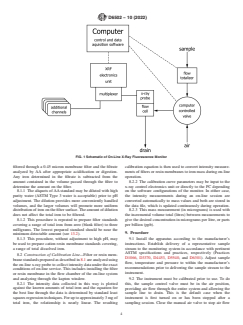
7.7 Aschematic diagram of a typical configuration is shown
7.1 The on-line metals analyzer consists of the following
in Fig.
...