


ASTM D648-18
(Test Method)Standard Test Method for Deflection Temperature of Plastics Under Flexural Load in the Edgewise Position
Standard Test Method for Deflection Temperature of Plastics Under Flexural Load in the Edgewise Position
SIGNIFICANCE AND USE
5.1 This test is particularly suited to control and development work. Data obtained by this test method shall not be used to predict the behavior of plastic materials at elevated temperatures except in applications in which the factors of time, temperature, method of loading, and fiber stress are similar to those specified in this test method. The data are not intended for use in design or predicting endurance at elevated temperatures.
5.2 For many materials, there may be a specification that requires the use of this test method, but with some procedural modifications that take precedence when adhering to the specification. Therefore, it is advisable to refer to that material specification before using this test method. Refer to Table 1 in Classification D4000, which lists the ASTM material standards that currently exist.
SCOPE
1.1 This test method covers the determination of the temperature at which an arbitrary deformation occurs when specimens are subjected to an arbitrary set of testing conditions.
1.2 This test method applies to molded and sheet materials available in thicknesses of 3 mm (1/8 in.) or greater and which are rigid or semirigid at normal temperature.
Note 1: Sheet stock less than 3 mm (0.125 in.) but more than 1 mm (0.040 in.) in thickness may be tested by use of a composite sample having a minimum thickness of 3 mm. The laminae must be of uniform stress distribution. One type of composite specimen has been prepared by cementing the ends of the laminae together and then smoothing the edges with sandpaper. The direction of loading shall be perpendicular to the edges of the individual laminae.
1.3 The values stated in SI units are to be regarded as standard. The values given in parentheses are for information only.
1.4 Some older machines still use mercury-in-glass thermometers. (Warning—Mercury has been designated by many regulatory agencies as a hazardous material that can cause serious medical issues. Mercury, or its vapor, has been demonstrated to be hazardous to health and corrosive to materials. Caution should be taken when handling mercury and mercury containing products. See the applicable product Safety Data Sheet (SDS) for additional information. Users should be aware that selling mercury and/or mercury containing products into your state or country may be prohibited by law.
1.5 This standard does not purport to address all of the safety concerns, if any, associated with its use. It is the responsibility of the user of this standard to establish appropriate safety, health, and environmental practices and determine the applicability of regulatory limitations prior to use.
Note 2: The text of this standard references notes and footnotes that provide explanatory material. These notes and footnotes (excluding those in tables and figures) shall not be considered as requirements of the standard.
Note 3: This standard and ISO 75-1 and ISO 75-2 address the same subject matter, but differ in technical content, and results shall not be compared between the two test methods.
1.6 This international standard was developed in accordance with internationally recognized principles on standardization established in the Decision on Principles for the Development of International Standards, Guides and Recommendations issued by the World Trade Organization Technical Barriers to Trade (TBT) Committee.
General Information
- Status
- Published
- Publication Date
- 31-Mar-2018
- Technical Committee
- D20 - Plastics
- Drafting Committee
- D20.30 - Thermal Properties
Relations
- Effective Date
- 01-Apr-2018
- Effective Date
- 01-Feb-2024
- Effective Date
- 01-Nov-2023
- Effective Date
- 01-Jan-2020
- Effective Date
- 01-Aug-2019
- Effective Date
- 15-Apr-2019
- Effective Date
- 01-Feb-2019
- Effective Date
- 01-Dec-2018
- Effective Date
- 01-Nov-2018
- Effective Date
- 15-Aug-2017
- Effective Date
- 01-May-2014
- Effective Date
- 01-May-2013
- Effective Date
- 01-May-2013
- Effective Date
- 15-Nov-2012
- Effective Date
- 01-May-2012
Overview
ASTM D648-18 is the internationally recognized standard test method for determining the deflection temperature of plastics under flexural load in the edgewise position. Published by ASTM International, this standard outlines procedures for identifying the temperature at which plastic specimens, subjected to a specific flexural load, reach a specified amount of deformation. Widely known as the "deflection temperature under load" or DTUL test, ASTM D648-18 is essential for quality control and product development in the plastics and polymer industries.
This test method is particularly important for evaluating the short-term heat resistance of rigid and semi-rigid plastic materials, which helps manufacturers, laboratories, and end-users make informed decisions about material suitability for elevated temperature applications.
Key Topics
- Purpose and Scope: ASTM D648-18 is intended for molded and sheet plastic materials with a thickness of 3 mm (1/8 in.) or greater that remain rigid or semi-rigid at room temperature. The test determines the temperature at which the material shows a specified deformation when loaded.
- Flexural Load Application: The method subjects a test bar to a defined stress in an edgewise position, while the temperature is gradually increased until a set deflection is observed.
- Test Conditions: The test requires strict control of parameters such as specimen dimensions, load application, rate of temperature rise, and immersion fluid temperature.
- Limitations: Results from ASTM D648-18 should not be used for predicting long-term performance, endurance under sustained loads, or behavior under varying real-life conditions outside those specified in the standard.
- Safety Considerations: Some older equipment may use mercury-in-glass thermometers. Users should be cautious with mercury, as it poses health and environmental hazards, and comply with local regulations regarding its use.
- Reference and Compatibility: ASTM D648-18 is often referenced in plastic material specifications and is aligned with international standardization principles. However, the results should not be directly compared to ISO 75 methods due to technical differences.
Applications
The ASTM D648-18 test method is widely utilized for:
- Quality Control: Ensuring batch-to-batch consistency of plastics by monitoring thermal properties.
- Material Development: Comparing new materials during R&D to established performance benchmarks under flexural load and temperature.
- Specification Compliance: Verifying that products meet customer or regulatory temperature deflection requirements.
- Manufacturing: Selecting plastics for components exposed to elevated temperatures in automotive, electrical, and consumer products.
- Comparative Analysis: Evaluating and selecting thermoplastic materials for end-use environments with known temperature and load conditions.
The test is suitable only for specific cases where the service conditions (load, temperature, time) are consistent with those defined in the standard. It is not intended for the design or prediction of the long-term performance of plastic components at elevated temperatures.
Related Standards
- ASTM D618: Practice for Conditioning Plastics for Testing - outlines specimen conditioning before thermal tests.
- ASTM D883: Terminology Relating to Plastics - provides definitions widely used in the plastics industry.
- ASTM D4000: Classification System for Specifying Plastic Materials - links to material specifications that reference D648.
- ASTM D5947: Test Methods for Physical Dimensions of Solid Plastics Specimens - specifies dimensional measurements.
- ISO 75-1 / ISO 75-2: Internationally recognized standards for determining deflection temperature under load; results are not interchangeable with ASTM D648-18 due to differing methodologies.
Keywords: ASTM D648, deflection temperature, flexural load, plastics testing, DTUL, heat deflection, polymer characterization, quality control, plastics industry standards, thermal performance of plastics.
For optimal results and regulatory compliance, always consult the latest version of ASTM D648-18 and relevant material specifications before testing.
Buy Documents
ASTM D648-18 - Standard Test Method for Deflection Temperature of Plastics Under Flexural Load in the Edgewise Position
REDLINE ASTM D648-18 - Standard Test Method for Deflection Temperature of Plastics Under Flexural Load in the Edgewise Position
Get Certified
Connect with accredited certification bodies for this standard

Smithers Quality Assessments
US management systems and product certification.

DIN CERTCO
DIN Group product certification.
Sponsored listings
Frequently Asked Questions
ASTM D648-18 is a standard published by ASTM International. Its full title is "Standard Test Method for Deflection Temperature of Plastics Under Flexural Load in the Edgewise Position". This standard covers: SIGNIFICANCE AND USE 5.1 This test is particularly suited to control and development work. Data obtained by this test method shall not be used to predict the behavior of plastic materials at elevated temperatures except in applications in which the factors of time, temperature, method of loading, and fiber stress are similar to those specified in this test method. The data are not intended for use in design or predicting endurance at elevated temperatures. 5.2 For many materials, there may be a specification that requires the use of this test method, but with some procedural modifications that take precedence when adhering to the specification. Therefore, it is advisable to refer to that material specification before using this test method. Refer to Table 1 in Classification D4000, which lists the ASTM material standards that currently exist. SCOPE 1.1 This test method covers the determination of the temperature at which an arbitrary deformation occurs when specimens are subjected to an arbitrary set of testing conditions. 1.2 This test method applies to molded and sheet materials available in thicknesses of 3 mm (1/8 in.) or greater and which are rigid or semirigid at normal temperature. Note 1: Sheet stock less than 3 mm (0.125 in.) but more than 1 mm (0.040 in.) in thickness may be tested by use of a composite sample having a minimum thickness of 3 mm. The laminae must be of uniform stress distribution. One type of composite specimen has been prepared by cementing the ends of the laminae together and then smoothing the edges with sandpaper. The direction of loading shall be perpendicular to the edges of the individual laminae. 1.3 The values stated in SI units are to be regarded as standard. The values given in parentheses are for information only. 1.4 Some older machines still use mercury-in-glass thermometers. (Warning—Mercury has been designated by many regulatory agencies as a hazardous material that can cause serious medical issues. Mercury, or its vapor, has been demonstrated to be hazardous to health and corrosive to materials. Caution should be taken when handling mercury and mercury containing products. See the applicable product Safety Data Sheet (SDS) for additional information. Users should be aware that selling mercury and/or mercury containing products into your state or country may be prohibited by law. 1.5 This standard does not purport to address all of the safety concerns, if any, associated with its use. It is the responsibility of the user of this standard to establish appropriate safety, health, and environmental practices and determine the applicability of regulatory limitations prior to use. Note 2: The text of this standard references notes and footnotes that provide explanatory material. These notes and footnotes (excluding those in tables and figures) shall not be considered as requirements of the standard. Note 3: This standard and ISO 75-1 and ISO 75-2 address the same subject matter, but differ in technical content, and results shall not be compared between the two test methods. 1.6 This international standard was developed in accordance with internationally recognized principles on standardization established in the Decision on Principles for the Development of International Standards, Guides and Recommendations issued by the World Trade Organization Technical Barriers to Trade (TBT) Committee.
SIGNIFICANCE AND USE 5.1 This test is particularly suited to control and development work. Data obtained by this test method shall not be used to predict the behavior of plastic materials at elevated temperatures except in applications in which the factors of time, temperature, method of loading, and fiber stress are similar to those specified in this test method. The data are not intended for use in design or predicting endurance at elevated temperatures. 5.2 For many materials, there may be a specification that requires the use of this test method, but with some procedural modifications that take precedence when adhering to the specification. Therefore, it is advisable to refer to that material specification before using this test method. Refer to Table 1 in Classification D4000, which lists the ASTM material standards that currently exist. SCOPE 1.1 This test method covers the determination of the temperature at which an arbitrary deformation occurs when specimens are subjected to an arbitrary set of testing conditions. 1.2 This test method applies to molded and sheet materials available in thicknesses of 3 mm (1/8 in.) or greater and which are rigid or semirigid at normal temperature. Note 1: Sheet stock less than 3 mm (0.125 in.) but more than 1 mm (0.040 in.) in thickness may be tested by use of a composite sample having a minimum thickness of 3 mm. The laminae must be of uniform stress distribution. One type of composite specimen has been prepared by cementing the ends of the laminae together and then smoothing the edges with sandpaper. The direction of loading shall be perpendicular to the edges of the individual laminae. 1.3 The values stated in SI units are to be regarded as standard. The values given in parentheses are for information only. 1.4 Some older machines still use mercury-in-glass thermometers. (Warning—Mercury has been designated by many regulatory agencies as a hazardous material that can cause serious medical issues. Mercury, or its vapor, has been demonstrated to be hazardous to health and corrosive to materials. Caution should be taken when handling mercury and mercury containing products. See the applicable product Safety Data Sheet (SDS) for additional information. Users should be aware that selling mercury and/or mercury containing products into your state or country may be prohibited by law. 1.5 This standard does not purport to address all of the safety concerns, if any, associated with its use. It is the responsibility of the user of this standard to establish appropriate safety, health, and environmental practices and determine the applicability of regulatory limitations prior to use. Note 2: The text of this standard references notes and footnotes that provide explanatory material. These notes and footnotes (excluding those in tables and figures) shall not be considered as requirements of the standard. Note 3: This standard and ISO 75-1 and ISO 75-2 address the same subject matter, but differ in technical content, and results shall not be compared between the two test methods. 1.6 This international standard was developed in accordance with internationally recognized principles on standardization established in the Decision on Principles for the Development of International Standards, Guides and Recommendations issued by the World Trade Organization Technical Barriers to Trade (TBT) Committee.
ASTM D648-18 is classified under the following ICS (International Classification for Standards) categories: 83.080.01 - Plastics in general. The ICS classification helps identify the subject area and facilitates finding related standards.
ASTM D648-18 has the following relationships with other standards: It is inter standard links to ASTM D648-16, ASTM D883-24, ASTM D883-23, ASTM D883-20, ASTM D883-19c, ASTM D883-19a, ASTM D883-19, ASTM D883-18a, ASTM D883-18, ASTM D883-17, ASTM E77-14, ASTM E1-13, ASTM E691-13, ASTM D883-12e1, ASTM D4000-12. Understanding these relationships helps ensure you are using the most current and applicable version of the standard.
ASTM D648-18 is available in PDF format for immediate download after purchase. The document can be added to your cart and obtained through the secure checkout process. Digital delivery ensures instant access to the complete standard document.
Standards Content (Sample)
This international standard was developed in accordance with internationally recognized principles on standardization established in the Decision on Principles for the
Development of International Standards, Guides and Recommendations issued by the World Trade Organization Technical Barriers to Trade (TBT) Committee.
Designation:D648 −18
Standard Test Method for
Deflection Temperature of Plastics Under Flexural Load in
the Edgewise Position
This standard is issued under the fixed designation D648; the number immediately following the designation indicates the year of
original adoption or, in the case of revision, the year of last revision. A number in parentheses indicates the year of last reapproval. A
superscript epsilon (´) indicates an editorial change since the last revision or reapproval.
This standard has been approved for use by agencies of the U.S. Department of Defense.
provide explanatory material. These notes and footnotes (excluding those
1. Scope*
in tables and figures) shall not be considered as requirements of the
1.1 This test method covers the determination of the tem-
standard.
perature at which an arbitrary deformation occurs when speci- NOTE 3—This standard and ISO 75-1 and ISO 75-2 address the same
subject matter, but differ in technical content, and results shall not be
mens are subjected to an arbitrary set of testing conditions.
compared between the two test methods.
1.2 This test method applies to molded and sheet materials
1.6 This international standard was developed in accor-
available in thicknesses of 3 mm ( ⁄8 in.) or greater and which
dance with internationally recognized principles on standard-
are rigid or semirigid at normal temperature.
ization established in the Decision on Principles for the
NOTE 1—Sheet stock less than 3 mm (0.125 in.) but more than 1 mm
Development of International Standards, Guides and Recom-
(0.040in.)inthicknessmaybetestedbyuseofacompositesamplehaving
mendations issued by the World Trade Organization Technical
a minimum thickness of 3 mm. The laminae must be of uniform stress
Barriers to Trade (TBT) Committee.
distribution. One type of composite specimen has been prepared by
cementing the ends of the laminae together and then smoothing the edges
2. Referenced Documents
with sandpaper. The direction of loading shall be perpendicular to the
edges of the individual laminae. 2
2.1 ASTM Standards:
1.3 The values stated in SI units are to be regarded as
D618 Practice for Conditioning Plastics for Testing
standard. The values given in parentheses are for information
D883 Terminology Relating to Plastics
only.
D4000 Classification System for Specifying Plastic Materi-
als
1.4 Some older machines still use mercury-in-glass ther-
D5947 Test Methods for Physical Dimensions of Solid
mometers. (Warning—Mercury has been designated by many
Plastics Specimens
regulatory agencies as a hazardous material that can cause
E1 Specification for ASTM Liquid-in-Glass Thermometers
serious medical issues. Mercury, or its vapor, has been
E77 Test Method for Inspection and Verification of Ther-
demonstrated to be hazardous to health and corrosive to
mometers
materials. Caution should be taken when handling mercury
E608/E608M Specification for Mineral-Insulated, Metal-
and mercury containing products. See the applicable product
Sheathed Base Metal Thermocouples
Safety Data Sheet (SDS) for additional information. Users
E691 Practice for Conducting an Interlaboratory Study to
should be aware that selling mercury and/or mercury contain-
Determine the Precision of a Test Method
ing products into your state or country may be prohibited by
E1137/E1137M Specification for Industrial Platinum Resis-
law.
tance Thermometers
1.5 This standard does not purport to address all of the
E2251 Specification for Liquid-in-Glass ASTM Thermom-
safety concerns, if any, associated with its use. It is the
eters with Low-Hazard Precision Liquids
responsibility of the user of this standard to establish appro-
2.2 ISO Standards:
priate safety, health, and environmental practices and deter-
ISO 75-1 Plastics—Determination of Temperature of De-
mine the applicability of regulatory limitations prior to use.
flection Under Load—Part 1: General Test Method
NOTE 2—The text of this standard references notes and footnotes that
For referenced ASTM standards, visit the ASTM website, www.astm.org, or
This test method is under the jurisdiction ofASTM Committee D20 on Plastics contact ASTM Customer Service at service@astm.org. For Annual Book of ASTM
and is the direct responsibility of Subcommittee D20.30 on Thermal Properties. Standards volume information, refer to the standard’s Document Summary page on
Current edition approved April 1, 2018. Published April 2018. Originally the ASTM website.
approved in 1941. Last previous edition approved in 2016 as D648 - 16. DOI: Available fromAmerican National Standards Institute (ANSI), 25 W. 43rd St.,
10.1520/D0648-18. 4th Floor, New York, NY 10036, http://www.ansi.org.
*A Summary of Changes section appears at the end of this standard
Copyright © ASTM International, 100 Barr Harbor Drive, PO Box C700, West Conshohocken, PA 19428-2959. United States
D648−18
ISO 75-2 Plastics—Determination of Temperature of De- 6.3 The type of mold and the molding process used to
flection Under Load—Part 2: Plastics and Ebonite produce test specimens affects the results obtained in this test.
Molding conditions shall be in accordance with the standard
2.3 NIST Document:
for that material or shall be agreed upon by the cooperating
NBS Special Publication 250-22
laboratories.
3. Terminology
6.4 Results of testing are affected by the design of the test
3.1 General—The definitions of plastics used in this test
equipment. The test span (either 100 mm or 101.6 mm) will
method are in accordance with Terminology D883 unless
influence the resultant measurement. Instrumentation equipped
otherwise indicated.
with metal clips or other types of auxiliary supports designed
to maintain specimens perpendicular to the applied load will
4. Summary of Test Method
affect the test results if the pressure is sufficient to restrict the
4.1 A bar of rectangular cross section is tested in the
downward motion of the specimen at its center.
edgewise position as a simple beam with the load applied at its
7. Apparatus
center to give maximum fiber stresses of 0.455 MPa (66 psi) or
1.82 MPa (264 psi) (Note 4). The specimen is immersed under 7.1 The apparatus shall be constructed essentially as shown
load in a heat-transfer medium provided with a means of
in Fig. 1 and shall consist of the following:
raising the temperature at 2 6 0.2°C/min. The temperature of 7.1.1 Specimen Supports, metal supports, allowing the load
the medium is measured when the test bar has deflected 0.25
to be applied on top of the specimen vertically and midway
mm (0.010 in.). This temperature is recorded as the deflection between the supports, which shall be separated by a distance,
temperature under flexural load of the test specimen.
defined in 7.1.1.1 or 7.1.1.2. The contact edges of the supports
and of the piece by which load is applied shall be rounded to
NOTE4—Aroundrobinhasbeenconductedthatshowedthatthereisno
a radius of 3 6 0.2 mm (0.118 6 0.008 in.).
advantagetousinghigherloadswhenmeasuringdeflectiontemperatureof
present-day plastics with present-day instruments. 7.1.1.1 Method A—101.6 6 0.5 mm (4.0 6 0.02 in.).
7.1.1.2 Method B—100.0 6 0.5 mm (3.937 6 0.020 in.).
5. Significance and Use
7.1.2 Immersion Bath—Choose a suitable liquid heat-
5.1 This test is particularly suited to control and develop- transfer medium (Note 5) in which the specimen shall be
immersed, which will not affect the specimen. It shall be
ment work. Data obtained by this test method shall not be used
to predict the behavior of plastic materials at elevated tempera- well-stirred during the test and shall be provided with a means
of raising the temperature at a uniform rate of 2 6 0.2°C/min.
tures except in applications in which the factors of time,
temperature, method of loading, and fiber stress are similar to This heating rate shall be considered to be met if, over every
5-min interval during the test, the temperature of the bath shall
those specified in this test method. The data are not intended
for use in design or predicting endurance at elevated tempera- rise 10 6 1°C at each specimen location.
tures.
NOTE5—Mineraloilisconsideredsafefromignitionto115°C.Silicone
oils may be heated to about 260°C for short periods of time. For still
5.2 For many materials, there may be a specification that
highertemperatures,specialheat-transfermediashouldbeused.Improved
requires the use of this test method, but with some procedural
performance with longer oil life may be obtained by the use of CO or
modifications that take precedence when adhering to the
other inert gas to isolate the oil surface from the atmosphere.
specification. Therefore, it is advisable to refer to that material
7.1.3 Deflection Measurement Device, suitable for measur-
specification before using this test method. Refer to Table 1 in
ing specimen deflection of at least 0.25 mm (0.010 in.). It shall
Classification D4000, which lists theASTM material standards
be readable to 0.01 mm (0.0005 in.) or better. Dial gauges or
that currently exist.
any other indicating or recording device, including electric
displacement sensing apparatus, are acceptable.
6. Interferences
7.1.4 Weights—Aset of weights of suitable sizes so that the
6.1 The results of the test are dependent on the rate of heat
specimen are loaded to a fiber stress of 0.455 MPa (66 psi) 6
transfer between the fluid and the specimen and the thermal
2.5 % or 1.82 MPa (264 psi) 6 2.5 %.The mass of the rod that
conductivity of the fluid.
applies the testing force shall be determined and included as
6.2 The results of this test are dependent on the measured
part of the total load. If a dial gauge is used, the force exerted
width and depth of the specimen and the final deflection at
by its spring shall be determined and shall be included as part
which the deflection temperature is determined.
of the load (Note 9). Calculate the testing force and the mass
that must be added to achieve the desired stress as follows:
F 5 2Sbd /3L (1)
Mangum, B.W., “Platinum ResistanceThermometer Calibration,” NBS Special
Publication 250-22, 1987. Available from National Institute of Standards and
Technology, Gaithersburg, MD. F 5 F/9.80665
D648−18
FIG. 1Apparatus for Deflection Temperature Test
m 5 F 2 F /9.80665 2 m considerably over the stroke, this force should be measured in that part of
~ !
w s r
the stroke that is to be used. Suggested procedures to determine the total
where:
load required to correct for the force of the dial gauge spring are given in
Appendix X1 and Appendix X2. Other procedures may be used if
F = load, N,
equivalent results are obtained. Appendix X3 provides a method of
F = load, kgf,
determining the spring force, uniformity of the force in the gauge’s test
S = fiber stress in the specimen (0.455 MPa or 1.82 MPa),
measurement range, and whether the gauge is contaminated and sticking.
b = width of specimen, mm,
d = depth of specimen, mm, 7.1.5 Temperature Measurement System
L = distance between supports, (101.6 mm—MethodA, or
7.1.5.1 Digital Indicating System—Consisting of a
100 mm—Method B), see 7.1.1.1 and 7.1.1.2.
thermocouple, resistance thermometer (RTD), and so forth, as
m = added mass, kg,
w
the sensor, together with associated conditioning, conversion,
F = force exerted by any spring-loaded component
s
and readout instrumentation adequate to cover the range being
involved, N; this is a positive value if the thrust of the
tested.Thesensorandrelatedelectronicsshallbeaccuratetoat
spring is towards the test specimen (downwards), or a
least 60.5°C. Thermocouples shall comply with the require-
negative value if the thrust of the spring is opposing
ments of Specification E608/E608M. Resistance thermometers
the descent of the rod, or zero if no such component is
shall comply with the requirements of Specification E1137/
involved, and
E1137M.
m = mass of the rod that applies the testing force to the
r
7.1.5.2 Thermometer—Older systems still in existence use a
specimen, kg.
thermometer for temperature measurement at each individual
NOTE 6—In some designs of this apparatus, the spring force of the dial
gauge is directed upward (opposite the direction of specimen loading), test station. The thermometer shall be one of the following, or
which reduces the net force applied to the specimen. In other designs, the
its equivalent, as prescribed in Specification E1: Thermometer
spring force of the dial gauge acts downward (in the direction of specimen
1C or 2C, having ranges from –20 to 150°C or –5 to 300°C
loading), which increases the net force applies to the specimen. The mass
respectively, whichever temperature range is most suitable.
applied to the loading rod must be adjusted accordingly (increased for
Liquid-in-glass thermometers shall be calibrated for the depth
upward dial force and decreased for downward dial force) to compensate.
Since the force exerted by the spring in certain dial gauges varies of immersion in accordance with Test Method E77.
D648−18
NOTE 7—Consult Specification E2251 for suitable alternatives to
Section 7 of Practice D618 unless specified differently by
mercury-in-glass thermometers.
contract or material specification.
7.2 Micrometers shall meet the requirements of Test Meth-
NOTE 11—Shorter conditioning periods may be used when it is shown
ods D5947 and be calibrated in accordance with that test
that they do not affect the results of this test. Longer conditioning times
method.
may be required for some materials that continue to change with time.
8. Sampling
12. Procedure
8.1 Sample in a statistically acceptable manner. When
12.1 Measure the width and depth of each specimen with a
samples are taken from a production lot or process, the process
suitable micrometer (as described in 7.2) at three points along
shall be in a state of statistical control.
the span. Average these respective readings to obtain the
9. Test Specimen
nominal width and depth value for the specimen. These values
are used to determine the amount of applied force necessary to
9.1 At least two test specimens of the same nominal width
produce the specified fiber stress in each specimen (see 7.1.4).
shallbeusedtotesteachsampleateachfiberstress.Thelength
of the specimen shall at a minimum be the distance between
12.2 Position the test specimens edgewise in the apparatus
supports + 12.7 mm (0.500 in.). The depth of the specimen
and ensure that they are properly aligned on the supports so
must be 12.7 mm 6 0.5 mm (0.500 6 0.020 in.). The width of
that the direction of the testing force is perpendicular to the
the specimen shall be any width from 3 mm to 13 mm (0.118
direction of the molding flow. If the specimen support unit has
in. to 0.512 in.).
metal clips or auxiliary supports on it to hold the specimen
NOTE 8—Tolerances on the depth and width dimensions should be of
perpendicular to the load and to prevent the specimen from
the order of 60.13 mm (0.005 in.) along the length of the specimen to
being displaced by the circulating oil, only one surface of the
minimize variations.
clip or auxiliary support shall touch the specimen at any one
NOTE 9—The test results obtained on specimens approaching 13 mm in
time. The presence of any clip or auxiliary support shall not
width may be 2 to 4°C above those obtained from 4 mm or narrower test
specimens because of poor heat transfer through the specimen. impede the deflection of the specimen or place additional force
on the specimen that will result in more load having to be
9.2 The specimens shall have smooth flat surfaces free from
applied to achieve deflection.
saw cuts, excessive sink marks, or flash.
9.3 Molding conditions shall be in accordance with the
NOTE 12—Holding of the specimens upright on the specimen supports
by the use of clips or auxiliary supports that apply pressure to the
specification for that material or shall be agreed upon by the
specimen have been shown to alter the deflection temperature when
cooperating laboratories. Discrepancies in test results due to
testing at the 0.45 MPa stress level.
variations in molding conditions are often minimized by
annealing the test specimens before the test. Since different
12.3 The sensitive part of the temperature measuring device
materials require different annealing conditions, annealing
shall be positioned as close as possible to the test specimen
procedures shall be employed only if required by the material
(within 10 mm) without touching it. The stirring of the
standard or if agreed upon by the cooperating laboratories.
liquid-heat transfer medium shall be sufficient to ensure that
temperature of the medium is within 1.0°C at any point within
10. Preparation of Apparatus
10 mm of the specimen. If stirring is not sufficient to meet the
10.1 The apparatus shall be arranged so that the deflection
1.0°C requirement, then the temperature measuring device
of the specimen at midspan is measured by the deflection
shall be placed at the same level as the specimen and within 10
measurement device described in 7.1.3. It is acceptable if the
mm of the point at which the specimen is loaded.
apparatus is arranged to shut off the heat automatically and
12.4 Ascertain that the temperature of the bath is suitable.
sound an alarm or record the temperature when the specific
The bath temperature shall be at ambient temperature at the
deflectionhasbeenreached.Sufficientheattransferliquid shall
start of the test unless previous tests have shown that, for the
be used to cover the sensing end of the temperature measuring
particular material under test, no error is introduced by starting
device to the point specified in their calibration.
at a higher temperature.
NOTE 10—It is desirable to have a means to cool the bath in order to
reduce the time required to lower the temperature of the bath after the test
12.5 Carefully apply the loaded rod to the specimen and
has been completed. This may be accomplished by using a cooling coil
lower the assembly into the bath.
installed in the bath, or an external heat transfer system that passes the hot
oil through it. If the rate of temperature rise of the oil is adversely affected
12.6 Adjust the load so that the desired stress of 0.455 MPa
by the presence of residual coolant in the coils, the coolant should be
(66 psi) or 1.82 MPa (264 psi) is obtained.
purged prior to starting the next test.
NOTE 13—Verification of the load should be made on all new
11. Conditioning
equipment, after replacement of dial gauges, or following any other
changethatcouldaffecttheloading.Verificationoftheloadshouldalsobe
11.1 Conditioning—Condition the test specimens in accor-
performed periodically to ensure that the equipment is within calibration
dance with Procedure A of Practice D618 unless otherwise
(see Appendix X1, Appendix X2, and Appendix X3). Depending on the
specified by contract or the relevantASTM material specifica-
type of deflection measurement device used, it may be necessary to adjust
tion. Conditioning time is specified as a minimum. Tempera-
the device such that it records the deflection in the displacement range of
ture and humidity tolerances shall be in accordance with the device where the test is to be made.
D648−18
TABLE 2 Precision, Deflection Temperature
12.7 Five minutes after applying the load, adjust the deflec-
tion measurement device to zero or record its starting position. Units Expressed in °C
A B C D
Material Average S S r R
r R
Heat the liquid heat-transfer medium at a rate of 2.0 6
ABS, 1.8 MPa 81.6 1.15 1.67 3.21 4.68
0.2°C/min.
PP natural, 0.45 MPa 83.8 3.11 4.71 8.70 13.20
PP filled, 0.45 MPa 114.7 2.16 4.62 6.06 12.92
NOTE 14—The 5-min waiting period is provided to compensate
A
S = within-laboratory standard deviation for the indicated material. It is obtained
r
partially for the creep exhibited by some materials at room temperature
by pooling the within-laboratory standard deviations of the test results from all of
when subjected to the specified nominal surface stress. That part of the
the participating laboratories:
creep that occurs in the initial 5 min is usually a significant fraction of that
2 2 2 1/2
which occurs in the first 30 min. S 5 ffsS d 1sS d 1········1sS d g/ng
r 1 2 n
B
S = between-laboratories reproducibility, expressed as standard deviation:
12.8 Record the temperature of the liquid heat-transfer
R
2 2 1/2
medium at which the specimen has deflected the specified
S 5 S 1S , where S 5 standard deviation of laboratory means.
f g
R r L L
amount at the specified fiber stress.
C
r = within-laboratory critical interval between two test results = 2.8 × S
r
D
R = between-laboratories critical interval between two test results = 2.8 × S .
R
NOTE 15—Continuous reading of the deflection versus temperature
even beyond the standard deflection might be useful in special situations.
TABLE 3 Deflection Temperature (Average) Obtained on Test
13. Report
Equipment With Span Values of 100 and 101.6 mm (3.937 and 4.0
13.1 Report the following information:
in.), °C
13.1.1 Full identification of the material tested,
100–mm (3.937–in.)
Material 101.6-mm. (4.0-in.) Span
13.1.2 Method of test specimen preparation, Span
ABS, 1.8 MPa 81.9 81.0
13.1.3 Conditioning procedure,
PP natural, 0.45 MPa 85.2 80.9
13.1.4 Test method, reported as D648 Method A or D648
PP filled, 0.45 MPa 116.6 112.0
Method B,
Nylon, 1.8 MPa 156.1 153.8
13.1.5 The width and depth of the specimen, measured to
0.025 mm,
13.1.6 The standard deflection, the deflection temperature,
and the resultant maximum fiber stress for each specimen,
Table 1. The critical difference limits are the limits beyond
13.1.7 The immersion medium, the temperature at the start
which observed differences are to be considered suspect.
of the test, and the actual heating rate,
13.1.8 Average deflection temperature,
14.2 In 1995 a second round-robin study was conducted.
13.1.9 Any nontypical characteristics of the specimen noted
Table 2 is based on this round robin conducted in accordance
during the test or after removal from the apparatus, (such as
with Practice E691, involving three materials tested by 15
twisting, nonuniform bending, discoloration, swelling), and
laboratories. For each material, all the samples were prepared
13.1.10 Type of apparatus: automated or manual.
at one source, but the individual specimens were prepared at
the laboratories that tested them. Each test result was the
average of two individual determinations. Each laboratory
A
TABLE 1 Statistical Information
obtained four test results for each material. (Warning—The
C
Critical
Critical
following explanation for r and R (14.3 – 14.3.3) are only
B
Standard Difference,
Average Difference,
Polymer
Value Within intended to present a meaningful way of considering the
Deviation Between
Laboratories
Laboratories
approximate precision of this test method. The data in Table 2
Polyethylene, 0.455 85.3 4.8 6.0 9.4
shall not be applied to acceptance or rejection of material, as
MPa
these data apply only to materials tested in the round robin and
Polycarbonate, 0.455 142.0 2.0 2.3 3.9
MPa are unlikely to be rigorously representative of the other lots,
Methyl methacrylate, 97.6 2.9 4.0 5.7
formulations,conditions,material,orlaboratories.Usersofthis
1.82 MPa
testmethodshallapplytheprinciplesoutlinedinPracticeE691
Polysulfone, 1.82 MPa 173.8 2.8 2.3 5.5
to generate data specific to their materials and laboratory (or
A
All values are given in °C.
B
between specific laboratories). The principles of 14.3 – 14.3.3
Average of pairs.
C
Between values of a pair.
would then be valid for such data.)
14.3 Concept of r and R in Table 2—If S and S have been
r R
calculatedfromalargeenoughbodyofdata,andfortestresults
that were averages from testing two specimens for each test
14. Precision and Bias
result, then:
14.1 Precision—An interlaboratory test program was car-
14.3.1 Repeatability—r is the interval representing the criti-
ried out with seven laboratories participating and utilizing both
cal difference between two test results for the same material,
manual and automated instruments. Four polymers were in-
obtainedbythesameoperatorusingthesameequipmentonthe
cludedintheprogram.Statisticalinformationissummarizedin
5 6
Supporting data have been filed at ASTM International Headquarters and may Supporting data have been filed at ASTM International Headquarters and may
be obtained by requesting Research Report RR:D20-1098. be obtained by requesting Research Report RR:D20-1202.
D648−18
same day in the same laboratory. Two test results shall be 14.4 There are no recognized standards by which to esti-
judgednotequivalentiftheydifferbymorethanthe rvaluefor mate bias of this test method.
the material.
NOTE 16—Based on the round-robin test data, a bias may exist
14.3.2 Reproducibility—R is the interval representing the
between data obtained on test equipment with a span between supports of
critical difference between two test results for the same
101.6 mm (4.0 in.) (MethodA) and 100 mm (3.937 in.) (Method B), with
material, obtained by different operators using different equip-
results being of 1.0-4.5°C higher for the equipment with a span width
ment in different laboratories, not necessarily on the same day.
between supports of 100 mm, and the value of the difference is material
Two test results shall be judged not equivalent if they differ by dependent (see Table 3).
more than the R value for that material.
14.3.3 Any judgment in accordance with 14.3.1 or 14.3.2 15. Keywords
would have an approximate 95 % (0.95) probability of being
15.1 deflection temperature; flexural load; flexure
correct.
ANNEXES
(Mandatory Information)
A1. CALIBRATION OF SINGLE-(CENTRALIZED) TEMPERATURE PROBE UNITS
A1.1 If the unit in operation is of the type that has only one readings. Once the calibrated probe indicates the bath is at the
temperature probe in the bath, and this probe is monitored to set point, make adjustments to the centralized probe’s display
record the deflection temperature of the specimen at all the
as necessary.
stations in the unit, then the following calibration and checks
A1.3.2 High-temperature calibration will be accomplished
mustbeundertakentoensurecomparableresultswithunitsthat
by programming the unit to maintain an elevated temperature
have a temperature probe at each station.
near, but not exceeding the highest temperature allowed by the
A1.2 This procedure must be performed annually as a heat transfer media. All covers and stations must be in place
minimum to ensure proper temperature distribution and acc
...
This document is not an ASTM standard and is intended only to provide the user of an ASTM standard an indication of what changes have been made to the previous version. Because
it may not be technically possible to adequately depict all changes accurately, ASTM recommends that users consult prior editions as appropriate. In all cases only the current version
of the standard as published by ASTM is to be considered the official document.
Designation: D648 − 16 D648 − 18
Standard Test Method for
Deflection Temperature of Plastics Under Flexural Load in
the Edgewise Position
This standard is issued under the fixed designation D648; the number immediately following the designation indicates the year of
original adoption or, in the case of revision, the year of last revision. A number in parentheses indicates the year of last reapproval. A
superscript epsilon (´) indicates an editorial change since the last revision or reapproval.
This standard has been approved for use by agencies of the U.S. Department of Defense.
1. Scope*
1.1 This test method covers the determination of the temperature at which an arbitrary deformation occurs when specimens are
subjected to an arbitrary set of testing conditions.
1.2 This test method applies to molded and sheet materials available in thicknesses of 3 mm ( ⁄8 in.) or greater and which are
rigid or semirigid at normal temperature.
NOTE 1—Sheet stock less than 3 mm (0.125 in.) but more than 1 mm (0.040 in.) in thickness may be tested by use of a composite sample having a
minimum thickness of 3 mm. The laminae must be of uniform stress distribution. One type of composite specimen has been prepared by cementing the
ends of the laminae together and then smoothing the edges with sandpaper. The direction of loading shall be perpendicular to the edges of the individual
laminae.
1.3 The values stated in SI units are to be regarded as standard. The values given in parentheses are for information only.
1.4 Some older machines still use mercury-in-glass thermometers. (Warning—Mercury has been designated by many
regulatory agencies as a hazardous material that can cause serious medical issues. Mercury, or its vapor, has been demonstrated
to be hazardous to health and corrosive to materials. Caution should be taken when handling mercury and mercury containing
products. See the applicable product Safety Data Sheet (SDS) for additional information. Users should be aware that selling
mercury and/or mercury containing products into your state or country may be prohibited by law.
1.5 This standard does not purport to address all of the safety concerns, if any, associated with its use. It is the responsibility
of the user of this standard to establish appropriate safety safety, health, and healthenvironmental practices and determine the
applicability of regulatory limitations prior to use.
NOTE 2—The text of this standard references notes and footnotes that provide explanatory material. These notes and footnotes (excluding those in tables
and figures) shall not be considered as requirements of the standard.
NOTE 3—This standard and ISO 75-1 and ISO 75-2 address the same subject matter, but differ in technical content, and results shall not be compared
between the two test methods.
NOTE 2—The text of this standard references notes and footnotes that provide explanatory material. These notes and footnotes (excluding those in tables
and figures) shall not be considered as requirements of the standard.
NOTE 3—This standard and ISO 75-1 and ISO 75-2 address the same subject matter, but differ in technical content, and results shall not be compared
between the two test methods.
1.6 This international standard was developed in accordance with internationally recognized principles on standardization
established in the Decision on Principles for the Development of International Standards, Guides and Recommendations issued
by the World Trade Organization Technical Barriers to Trade (TBT) Committee.
2. Referenced Documents
2.1 ASTM Standards:
D618 Practice for Conditioning Plastics for Testing
D883 Terminology Relating to Plastics
D4000 Classification System for Specifying Plastic Materials
D5947 Test Methods for Physical Dimensions of Solid Plastics Specimens
This test method is under the jurisdiction of ASTM Committee D20 on Plastics and is the direct responsibility of Subcommittee D20.30 on Thermal Properties.
Current edition approved April 1, 2016April 1, 2018. Published April 2016April 2018. Originally approved in 1941. Last previous edition approved in 20072016 as
D648 - 07D648 - 16., which was withdrawn January 2016 and reinstated in April 2016. DOI: 10.1520/D0648-16. DOI: 10.1520/D0648-18.
For referenced ASTM standards, visit the ASTM website, www.astm.org, or contact ASTM Customer Service at service@astm.org. For Annual Book of ASTM Standards
volume information, refer to the standard’s Document Summary page on the ASTM website.
*A Summary of Changes section appears at the end of this standard
Copyright © ASTM International, 100 Barr Harbor Drive, PO Box C700, West Conshohocken, PA 19428-2959. United States
D648 − 18
E1 Specification for ASTM Liquid-in-Glass Thermometers
E77 Test Method for Inspection and Verification of Thermometers
E608/E608M Specification for Mineral-Insulated, Metal-Sheathed Base Metal Thermocouples
E691 Practice for Conducting an Interlaboratory Study to Determine the Precision of a Test Method
E1137/E1137M Specification for Industrial Platinum Resistance Thermometers
E2251 Specification for Liquid-in-Glass ASTM Thermometers with Low-Hazard Precision Liquids
2.2 ISO Standards:
ISO 75-1 Plastics—Determination of Temperature of Deflection Under Load—Part 1: General Test Method
ISO 75-2 Plastics—Determination of Temperature of Deflection Under Load—Part 2: Plastics and Ebonite
2.3 NIST Document:
NBS Special Publication 250-22
3. Terminology
3.1 General—The definitions of plastics used in this test method are in accordance with Terminology D883 unless otherwise
indicated.
4. Summary of Test Method
4.1 A bar of rectangular cross section is tested in the edgewise position as a simple beam with the load applied at its center to
give maximum fiber stresses of 0.455 MPa (66 psi) or 1.82 MPa (264 psi) (Note 4). The specimen is immersed under load in a
heat-transfer medium provided with a means of raising the temperature at 2 6 0.2°C/min. The temperature of the medium is
measured when the test bar has deflected 0.25 mm (0.010 in.). This temperature is recorded as the deflection temperature under
flexural load of the test specimen.
NOTE 4—A round robin has been conducted that showed that there is no advantage to using higher loads when measuring deflection temperature of
present-day plastics with present-day instruments.
5. Significance and Use
5.1 This test is particularly suited to control and development work. Data obtained by this test method shall not be used to
predict the behavior of plastic materials at elevated temperatures except in applications in which the factors of time, temperature,
method of loading, and fiber stress are similar to those specified in this test method. The data are not intended for use in design
or predicting endurance at elevated temperatures.
5.2 For many materials, there may be a specification that requires the use of this test method, but with some procedural
modifications that take precedence when adhering to the specification. Therefore, it is advisable to refer to that material
specification before using this test method. Refer to Table 1 in Classification D4000, which lists the ASTM material standards that
currently exist.
6. Interferences
6.1 The results of the test are dependent on the rate of heat transfer between the fluid and the specimen and the thermal
conductivity of the fluid.
6.2 The results of this test are dependent on the measured width and depth of the specimen and the final deflection at which
the deflection temperature is determined.
6.3 The type of mold and the molding process used to produce test specimens affects the results obtained in this test. Molding
conditions shall be in accordance with the standard for that material or shall be agreed upon by the cooperating laboratories.
6.4 Results of testing are affected by the design of the test equipment. The test span (either 100 mm or 101.6 mm) will influence
the resultant measurement. Instrumentation equipped with metal clips or other types of auxiliary supports designed to maintain
specimens perpendicular to the applied load will affect the test results if the pressure is sufficient to restrict the downward motion
of the specimen at its center.
7. Apparatus
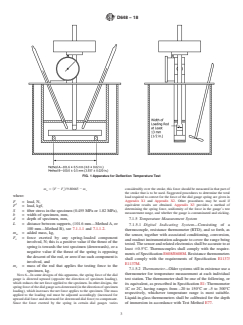
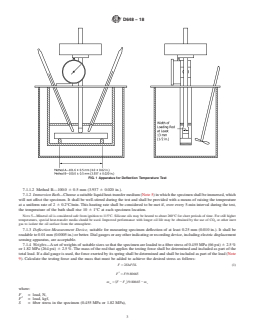
7.1 The apparatus shall be constructed essentially as shown in Fig. 1 and shall consist of the following:
7.1.1 Specimen Supports, metal supports, allowing the load to be applied on top of the specimen vertically and midway between
the supports, which shall be separated by a distance, defined in 7.1.1.1 or 7.1.1.2. The contact edges of the supports and of the piece
by which load is applied shall be rounded to a radius of 3 6 0.2 mm (0.118 6 0.008 in.).
7.1.1.1 Method A—101.6 6 0.5 mm (4.0 6 0.02 in.).
Available from American National Standards Institute (ANSI), 25 W. 43rd St., 4th Floor, New York, NY 10036, http://www.ansi.org.
Mangum, B. W., “Platinum Resistance Thermometer Calibration,” NBS Special Publication 250-22, 1987. Available from National Institute of Standards and Technology,
Gaithersburg, MD.
D648 − 18
FIG. 1 Apparatus for Deflection Temperature Test
7.1.1.2 Method B—100.0 6 0.5 mm (3.937 6 0.020 in.).
7.1.2 Immersion Bath—Choose a suitable liquid heat-transfer medium (Note 5) in which the specimen shall be immersed, which
will not affect the specimen. It shall be well-stirred during the test and shall be provided with a means of raising the temperature
at a uniform rate of 2 6 0.2°C/min. This heating rate shall be considered to be met if, over every 5-min interval during the test,
the temperature of the bath shall rise 10 6 1°C at each specimen location.
NOTE 5—Mineral oil is considered safe from ignition to 115°C. Silicone oils may be heated to about 260°C for short periods of time. For still higher
temperatures, special heat-transfer media should be used. Improved performance with longer oil life may be obtained by the use of CO or other inert
gas to isolate the oil surface from the atmosphere.
7.1.3 Deflection Measurement Device, suitable for measuring specimen deflection of at least 0.25 mm (0.010 in.). It shall be
readable to 0.01 mm (0.0005 in.) or better. Dial gauges or any other indicating or recording device, including electric displacement
sensing apparatus, are acceptable.
7.1.4 Weights—A set of weights of suitable sizes so that the specimen are loaded to a fiber stress of 0.455 MPa (66 psi) 6 2.5 %
or 1.82 MPa (264 psi) 6 2.5 %. The mass of the rod that applies the testing force shall be determined and included as part of the
total load. If a dial gauge is used, the force exerted by its spring shall be determined and shall be included as part of the load (Note
9). Calculate the testing force and the mass that must be added to achieve the desired stress as follows:
F 5 2Sbd /3L (1)
F 5 F/9.80665
m 5 F 2 F /9.80665 2 m
~ !
w s r
where:
F = load, N,
F = load, kgf,
S = fiber stress in the specimen (0.455 MPa or 1.82 MPa),
D648 − 18
b = width of specimen, mm,
d = depth of specimen, mm,
L = distance between supports, (101.6 mm—Method A, or 100 mm—Method B), see 7.1.1.1 and 7.1.1.2.
m = added mass, kg,
w
F = force exerted by any spring-loaded component involved, N; this is a positive value if the thrust of the spring is towards
s
the test specimen (downwards), or a negative value if the thrust of the spring is opposing the descent of the rod, or zero
if no such component is involved, and
m = mass of the rod that applies the testing force to the specimen, kg.
r
NOTE 6—In some designs of this apparatus, the spring force of the dial gauge is directed upward (opposite the direction of specimen loading), which
reduces the net force applied to the specimen. In other designs, the spring force of the dial gauge acts downward (in the direction of specimen loading),
which increases the net force applies to the specimen. The mass applied to the loading rod must be adjusted accordingly (increased for upward dial force
and decreased for downward dial force) to compensate. Since the force exerted by the spring in certain dial gauges varies considerably over the stroke,
this force should be measured in that part of the stroke that is to be used. Suggested procedures to determine the total load required to correct for the
force of the dial gauge spring are given in Appendix X1 and Appendix X2. Other procedures may be used if equivalent results are obtained. Appendix
X3 provides a method of determining the spring force, uniformity of the force in the gauge’s test measurement range, and whether the gauge is
contaminated and sticking.
7.1.5 Temperature Measurement System
7.1.5.1 Digital Indicating System—Consisting of a thermocouple, resistance thermometer (RTD), and so forth, as the sensor,
together with associated conditioning, conversion, and readout instrumentation adequate to cover the range being tested. The
sensor and related electronics shall be accurate to at least 60.5°C. Thermocouples shall comply with the requirements of
Specification E608/E608M. Resistance thermometers shall comply with the requirements of Specification E1137/E1137M.
7.1.5.2 Thermometer—Older systems still in existence use a thermometer for temperature measurement at each individual test
station. The thermometer shall be one of the following, or its equivalent, as prescribed in Specification E1: Thermometer 1C or
2C, having ranges from –20 to 150°C or –5 to 300°C respectively, whichever temperature range is most suitable. Liquid-in-glass
thermometers shall be calibrated for the depth of immersion in accordance with Test Method E77.
NOTE 7—Consult Specification E2251 for suitable alternatives to mercury-in-glass thermometers.
7.2 Micrometers shall meet the requirements of Test Methods D5947 and be calibrated in accordance with that test method.
8. Sampling
8.1 Sample in a statistically acceptable manner. When samples are taken from a production lot or process, the process shall be
in a state of statistical control.
9. Test Specimen
9.1 At least two test specimens of the same nominal width shall be used to test each sample at each fiber stress. The length of
the specimen shall be 127 mm (5 in.) in length, 13 mm (at a minimum be the distance between supports + 12.7 mm (0.500 in.).
The depth of the specimen must be 12.7 mm 6 0.5 ⁄2 in.) in depth by mm (0.500 6 0.020 in.). The width of the specimen shall
1 1
be any width from 3 mm ( ⁄8 in.) to 13 mm ((0.118 ⁄2 in. to 0.512 in.).
NOTE 8—Tolerances on the depth and width dimensions (for highly reproducible work) should be of the order of 60.13 mm (0.005 in.) along the length
of the specimen.specimen to minimize variations.
NOTE 9—The test results obtained on specimens approaching 13 mm in width may be 2 to 4°C above those obtained from 4 mm or narrower test
specimens because of poor heat transfer through the specimen.
9.2 The specimens shall have smooth flat surfaces free from saw cuts, excessive sink marks, or flash.
9.3 Molding conditions shall be in accordance with the specification for that material or shall be agreed upon by the cooperating
laboratories. Discrepancies in test results due to variations in molding conditions are often minimized by annealing the test
specimens before the test. Since different materials require different annealing conditions, annealing procedures shall be employed
only if required by the material standard or if agreed upon by the cooperating laboratories.
10. Preparation of Apparatus
10.1 The apparatus shall be arranged so that the deflection of the specimen at midspan is measured by the deflection
measurement device described in 7.1.3. It is acceptable if the apparatus is arranged to shut off the heat automatically and sound
an alarm or record the temperature when the specific deflection has been reached. Sufficient heat transfer liquid shall be used to
cover the sensing end of the temperature measuring device to the point specified in their calibration.
NOTE 10—It is desirable to have a means to cool the bath in order to reduce the time required to lower the temperature of the bath after the test has
been completed. This may be accomplished by using a cooling coil installed in the bath, or an external heat transfer system that passes the hot oil through
it. If the rate of temperature rise of the oil is adversely affected by the presence of residual coolant in the coils, the coolant should be purged prior to
starting the next test.
D648 − 18
11. Conditioning
11.1 Conditioning—Condition the test specimens in accordance with Procedure A of Practice D618 unless otherwise specified
by contract or the relevant ASTM material specification. Conditioning time is specified as a minimum. Temperature and humidity
tolerances shall be in accordance with Section 7 of Practice D618 unless specified differently by contract or material specification.
NOTE 11—Shorter conditioning periods may be used when it is shown that they do not affect the results of this test. Longer conditioning times may
be required for some materials that continue to change with time.
12. Procedure
12.1 Measure the width and depth of each specimen with a suitable micrometer (as described in 7.2) at three points along the
span. Average these respective readings to obtain the nominal width and depth value for the specimen. These values are used to
determine the amount of applied force necessary to produce the specified fiber stress in each specimen (see 7.1.4).
12.2 Position the test specimens edgewise in the apparatus and ensure that they are properly aligned on the supports so that the
direction of the testing force is perpendicular to the direction of the molding flow. If the specimen support unit has metal clips or
auxiliary supports on it to hold the specimen perpendicular to the load and to prevent the specimen from being displaced by the
circulating oil, only one surface of the clip or auxiliary support shall touch the specimen at any one time. The presence of any clip
or auxiliary support shall not impede the deflection of the specimen or place additional force on the specimen that will result in
more load having to be applied to achieve deflection.
NOTE 12—Holding of the specimens upright on the specimen supports by the use of clips or auxiliary supports that apply pressure to the specimen
have been shown to alter the deflection temperature when testing at the 0.45 MPa stress level.
12.3 The sensitive part of the temperature measuring device shall be positioned as close as possible to the test specimen (within
10 mm) without touching it. The stirring of the liquid-heat transfer medium shall be sufficient to ensure that temperature of the
medium is within 1.0°C at any point within 10 mm of the specimen. If stirring is not sufficient to meet the 1.0°C requirement, then
the temperature measuring device shall be placed at the same level as the specimen and within 10 mm of the point at which the
specimen is loaded.
12.4 Ascertain that the temperature of the bath is suitable. The bath temperature shall be at ambient temperature at the start of
the test unless previous tests have shown that, for the particular material under test, no error is introduced by starting at a higher
temperature.
12.5 Carefully apply the loaded rod to the specimen and lower the assembly into the bath.
12.6 Adjust the load so that the desired stress of 0.455 MPa (66 psi) or 1.82 MPa (264 psi) is obtained.
NOTE 13—Verification of the load should be made on all new equipment, after replacement of dial gauges, or following any other change that could
affect the loading. Verification of the load should also be performed periodically to ensure that the equipment is within calibration (see Appendix X1,
Appendix X2, and Appendix X3). Depending on the type of deflection measurement device used, it may be necessary to adjust the device such that it
records the deflection in the displacement range of the device where the test is to be made.
12.7 Five minutes after applying the load, adjust the deflection measurement device to zero or record its starting position. Heat
the liquid heat-transfer medium at a rate of 2.0 6 0.2°C/min.
NOTE 14—The 5-min waiting period is provided to compensate partially for the creep exhibited by some materials at room temperature when subjected
to the specified nominal surface stress. That part of the creep that occurs in the initial 5 min is usually a significant fraction of that which occurs in the
first 30 min.
12.8 Record the temperature of the liquid heat-transfer medium at which the specimen has deflected the specified amount at the
specified fiber stress.
NOTE 15—Continuous reading of the deflection versus temperature even beyond the standard deflection might be useful in special situations.
13. Report
13.1 Report the following information:
13.1.1 Full identification of the material tested,
13.1.2 Method of test specimen preparation,
13.1.3 Conditioning procedure,
13.1.4 Test method, reported as D648 Method A or D648 Method B,
13.1.5 The width and depth of the specimen, measured to 0.025 mm,
13.1.6 The standard deflection, the deflection temperature, and the resultant maximum fiber stress for each specimen,
13.1.7 The immersion medium, the temperature at the start of the test, and the actual heating rate,
13.1.8 Average deflection temperature,
13.1.9 Any nontypical characteristics of the specimen noted during the test or after removal from the apparatus, (such as
twisting, nonuniform bending, discoloration, swelling), and
13.1.10 Type of apparatus: automated or manual.
D648 − 18
A
TABLE 1 Statistical Information
C Critical
Critical
B
Standard Difference,
Average Difference,
Polymer
Value Deviation Within Between
Laboratories
Laboratories
Polyethylene, 0.455 85.3 4.8 6.0 9.4
MPa
Polycarbonate, 0.455 142.0 2.0 2.3 3.9
MPa
Methyl methacrylate, 97.6 2.9 4.0 5.7
1.82 MPa
Polysulfone, 1.82 MPa 173.8 2.8 2.3 5.5
A
All values are given in °C.
B
Average of pairs.
C
Between values of a pair.
TABLE 2 Precision, Deflection Temperature
Units Expressed in °C
A B C D
Material Average S S r R
r R
ABS, 1.8 MPa 81.6 1.15 1.67 3.21 4.68
PP natural, 0.45 MPa 83.8 3.11 4.71 8.70 13.20
PP filled, 0.45 MPa 114.7 2.16 4.62 6.06 12.92
A
S = within-laboratory standard deviation for the indicated material. It is obtained
r
by pooling the within-laboratory standard deviations of the test results from all of
the participating laboratories:
2 2 2 1/2
S 5 ffsS d 1sS d 1········1sS d g/ng
r 1 2 n
B
S = between-laboratories reproducibility, expressed as standard deviation:
R
2 2 1/2
S 5 S 1S , where S 5standard deviation of laboratory means.
f g
R r L L
C
r = within-laboratory critical interval between two test results = 2.8 × S
r
D
R = between-laboratories critical interval between two test results = 2.8 × S .
R
TABLE 3 Deflection Temperature (Average) Obtained on Test
Equipment With Span Values of 100 and 101.6 mm (3.937 and 4.0
in.), °C
100–mm (3.937–in.)
Material 101.6-mm. (4.0-in.) Span
Span
ABS, 1.8 MPa 81.9 81.0
PP natural, 0.45 MPa 85.2 80.9
PP filled, 0.45 MPa 116.6 112.0
Nylon, 1.8 MPa 156.1 153.8
14. Precision and Bias
14.1 Precision—An interlaboratory test program was carried out with seven laboratories participating and utilizing both
manual and automated instruments. Four polymers were included in the program. Statistical information is summarized in Table
1. The critical difference limits are the limits beyond which observed differences are to be considered suspect.
14.2 In 1995 a second round-robin study was conducted. Table 2 is based on this round robin conducted in accordance with
Practice E691, involving three materials tested by 15 laboratories. For each material, all the samples were prepared at one source,
but the individual specimens were prepared at the laboratories that tested them. Each test result was the average of two individual
determinations. Each laboratory obtained four test results for each material. (Warning—The following explanation for r and R
(14.3 – 14.3.3) are only intended to present a meaningful way of considering the approximate precision of this test method. The
data in Table 2 shall not be applied to acceptance or rejection of material, as these data apply only to materials tested in the round
robin and are unlikely to be rigorously representative of the other lots, formulations, conditions, material, or laboratories. Users
of this test method shall apply the principles outlined in Practice E691 to generate data specific to their materials and laboratory
(or between specific laboratories). The principles of 14.3 – 14.3.3 would then be valid for such data.)
14.3 Concept of r and R in Table 2—If S and S have been calculated from a large enough body of data, and for test results
r R
that were averages from testing two specimens for each test result, then:
Supporting data have been filed at ASTM International Headquarters and may be obtained by requesting Research Report RR:D20-1098.
Supporting data have been filed at ASTM International Headquarters and may be obtained by requesting Research Report RR:D20-1202.
D648 − 18
14.3.1 Repeatability—r is the interval representing the critical difference between two test results for the same material, obtained
by the same operator using the same equipment on the same day in the same laboratory. Two test results shall be judged not
equivalent if they differ by more than the r value for the material.
14.3.2 Reproducibility—R is the interval representing the critical difference between two test results for the same material,
obtained by different operators using different equipment in different laboratories, not necessarily on the same day. Two test results
shall be judged not equivalent if they differ by more than the R value for that material.
14.3.3 Any judgment in accordance with 14.3.1 or 14.3.2 would have an approximate 95 % (0.95) probability of being correct.
14.4 There are no recognized standards by which to estimate bias of this test method.
NOTE 16—Based on the round-robin test data, a bias may exist between data obtained on test equipment with a span between supports of 101.6 mm
(4.0 in.) (Method A) and 100 mm (3.937 in.) (Method B), with results being of 1.0-4.5°C higher for the equipment with a span width between supports
of 100 mm, and the value of the difference is material dependent (see Table 3).
15. Keywords
15.1 deflection temperature; flexural load; flexure
ANNEXES
(Mandatory Information)
A1. CALIBRATION OF SINGLE-(CENTRALIZED) TEMPERATURE PROBE UNITS
A1.1 If the unit in operation is of the type that has only one temperature probe in the bath, and this probe is monitored to record
the deflection temperature of the specimen at all the stations in the unit, then the following calibration and checks must be
undertaken to ensure comparable results with units that have a temperature probe at each station.
A1.2 This procedure must be performed annually as a minimum to ensure proper temperature distribution and accuracy of probe
and display.
A1.3 Calibration will require the use of a calibrated reference temperature meter and probe traceable to NIST, the International
System of Units (SI) through NIST or another National Metrology Institute, with accuracy and display resolution of 0.1°C or better,
a stopwatch, and any tools needed to open and adjust the unit.
A1.3.1 Low-temperature calibration of the unit is accomplished by placing the NIST traceable reference probe within 10 mm of
specimen height, specimen, in the bath at three different points in the bath. The three points will be at the center and left and right
ends of the bath. Start with the station closes
...
Questions, Comments and Discussion
Ask us and Technical Secretary will try to provide an answer. You can facilitate discussion about the standard in here.
Loading comments...