

ASTM G60-01(2018)
(Practice)Standard Practice for Conducting Cyclic Humidity Exposures
General Information
- Abstract
SIGNIFICANCE AND USE
3.1 The procedure described is used to observe the behavior of steels under exposure conditions that retard the formation of a protective type of rust. It is also used to evaluate seal coat on insulation.
3.2 This practice should not be used to rank steels that form a protective type of rust under atmospheric exposure conditions.
SCOPE
1.1 This practice covers procedures for conducting cyclic humidity exposures with a corrosive dip.2 It sets forth the conditions required in cyclic humidity testing.
1.2 This practice does not prescribe the type of exposure specimen or exposure periods nor the interpretation to be given to the results.
1.3 The values stated in SI units are to be regarded as standard. The values given in parentheses are for information only.
1.4 This standard does not purport to address all of the safety concerns, if any, associated with its use. It is the responsibility of the user of this standard to consult and establish appropriate safety, health, and environmental practices and determine the applicability of regulatory limitations prior to use.
1.5 This international standard was developed in accordance with internationally recognized principles on standardization established in the Decision on Principles for the Development of International Standards, Guides and Recommendations issued by the World Trade Organization Technical Barriers to Trade (TBT) Committee.
- Status
- Published
- Publication Date
- 30-Sep-2018
- Technical Committee
- G01 - Corrosion of Metals
- Drafting Committee
- G01.05 - Laboratory Corrosion Tests

Overview
ASTM G60-01(2018) - Standard Practice for Conducting Cyclic Humidity Exposures provides standardized guidance for exposing metals, primarily steels, to repeated cycles of humidity and a corrosive dip. This practice is essential for evaluating material performance under simulated atmospheric conditions that inhibit the development of protective rust layers, as well as for assessing the integrity of seal coatings on insulation materials. The standard outlines key requirements and apparatus for consistent cyclic humidity exposure, ensuring reproducibility in laboratory corrosion tests.
Key Topics
- Cyclic Humidity Exposure: Procedures and conditions for exposing test specimens to alternating humidity levels combined with periodic corrosive dips.
- Test Apparatus: Description of necessary equipment, including a controlled test chamber, humidifying system, drying mechanism, and specimen supports made from inert or corrosion-resistant materials.
- Specimen Guidelines: Recommendations on specimen preparation, placement, support, and insulation to ensure accurate test results without contamination or interference.
- Dip Solution Requirements: Preparation of a specified solution for corrosion cycles, emphasizing the use of high-purity reagents and water.
- Data Recording and Reporting: Guidelines for proper documentation of exposure conditions, evaluation methods, and results, emphasizing the importance of reliable temperature and humidity monitoring.
- Safety Considerations: Reminder that users are responsible for addressing all relevant safety, health, and environmental protocols during test setup and execution.
Applications
ASTM G60-01(2018) supports industries and research organizations in evaluating the corrosion resistance of steel and the performance of protective coatings under cyclic humidity conditions. Practical application areas include:
- Material Qualification: Assessing the durability of steels not intended to form protective rust, guiding material selection for use in harsh, fluctuating humidity environments.
- Protective Coating Evaluation: Determining the efficacy of seal coats on insulation, especially in applications where moisture ingress can degrade performance.
- Comparative Testing: Providing a standard method for laboratories to conduct comparable corrosion tests across different materials and products.
- Product Development: Aiding manufacturers in improving metal finishing technologies, coatings, or materials subject to periodic humidity, helping extend product life cycles.
- Quality Assurance: Used by quality control laboratories for batch approval and performance validation of steels and coating systems.
Related Standards
For comprehensive corrosion testing and specimen handling, consider these related references:
- ASTM D1193: Specification for Reagent Water, setting requirements for water purity in corrosion tests.
- ASTM G1: Practice for Preparing, Cleaning, and Evaluating Corrosion Test Specimens, providing guidance on test specimen management to ensure meaningful results.
Practical Value
Adopting ASTM G60-01(2018) enables reliable, reproducible cyclic corrosion testing that supports informed decisions in material selection, coating validation, and compliance with quality standards. The standard facilitates collaboration and benchmarking across laboratories and industries by providing a clear, recognized protocol for cyclic humidity exposures. Its use helps reduce field failures, improve long-term product performance, and demonstrate due diligence in environmental simulation testing.
Keywords
cyclic humidity exposure, corrosion testing, steel corrosion, protective coatings, laboratory corrosion tests, ASTM G60, cyclic exposure, humidity cycles, seal coat evaluation, material durability standards
Relations
- Effective Date
- 01-Oct-2018
- Effective Date
- 01-Dec-2011
- Effective Date
- 01-Mar-2006
- Refers
ASTM G1-03 - Standard Practice for Preparing, Cleaning, and Evaluating Corrosion Test Specimens - Effective Date
- 01-Oct-2003
- Effective Date
- 10-Feb-1999
- Effective Date
- 10-Feb-1999
- Effective Date
- 01-Jan-1999
- Effective Date
- 01-Oct-2018
- Effective Date
- 01-Oct-2018
Get Certified
Connect with accredited certification bodies for this standard

IMP NDT d.o.o.
Non-destructive testing services. Radiography, ultrasonic, magnetic particle, penetrant, visual inspection.
Inštitut za kovinske materiale in tehnologije
Institute of Metals and Technology. Materials testing, metallurgical analysis, NDT.
Q Techna d.o.o.
NDT and quality assurance specialist. 30+ years experience. NDT personnel certification per ISO 9712, nuclear and thermal power plant inspections, QA/
Sponsored listings
Frequently Asked Questions
ASTM G60-01(2018) is a standard published by ASTM International. Its full title is "Standard Practice for Conducting Cyclic Humidity Exposures". This standard covers: SIGNIFICANCE AND USE 3.1 The procedure described is used to observe the behavior of steels under exposure conditions that retard the formation of a protective type of rust. It is also used to evaluate seal coat on insulation. 3.2 This practice should not be used to rank steels that form a protective type of rust under atmospheric exposure conditions. SCOPE 1.1 This practice covers procedures for conducting cyclic humidity exposures with a corrosive dip.2 It sets forth the conditions required in cyclic humidity testing. 1.2 This practice does not prescribe the type of exposure specimen or exposure periods nor the interpretation to be given to the results. 1.3 The values stated in SI units are to be regarded as standard. The values given in parentheses are for information only. 1.4 This standard does not purport to address all of the safety concerns, if any, associated with its use. It is the responsibility of the user of this standard to consult and establish appropriate safety, health, and environmental practices and determine the applicability of regulatory limitations prior to use. 1.5 This international standard was developed in accordance with internationally recognized principles on standardization established in the Decision on Principles for the Development of International Standards, Guides and Recommendations issued by the World Trade Organization Technical Barriers to Trade (TBT) Committee.
SIGNIFICANCE AND USE 3.1 The procedure described is used to observe the behavior of steels under exposure conditions that retard the formation of a protective type of rust. It is also used to evaluate seal coat on insulation. 3.2 This practice should not be used to rank steels that form a protective type of rust under atmospheric exposure conditions. SCOPE 1.1 This practice covers procedures for conducting cyclic humidity exposures with a corrosive dip.2 It sets forth the conditions required in cyclic humidity testing. 1.2 This practice does not prescribe the type of exposure specimen or exposure periods nor the interpretation to be given to the results. 1.3 The values stated in SI units are to be regarded as standard. The values given in parentheses are for information only. 1.4 This standard does not purport to address all of the safety concerns, if any, associated with its use. It is the responsibility of the user of this standard to consult and establish appropriate safety, health, and environmental practices and determine the applicability of regulatory limitations prior to use. 1.5 This international standard was developed in accordance with internationally recognized principles on standardization established in the Decision on Principles for the Development of International Standards, Guides and Recommendations issued by the World Trade Organization Technical Barriers to Trade (TBT) Committee.
ASTM G60-01(2018) is classified under the following ICS (International Classification for Standards) categories: 19.040 - Environmental testing. The ICS classification helps identify the subject area and facilitates finding related standards.
ASTM G60-01(2018) has the following relationships with other standards: It is inter standard links to ASTM G60-01(2013), ASTM G1-03(2011), ASTM D1193-06, ASTM G1-03, ASTM D1193-99e1, ASTM D1193-99, ASTM G1-90(1999)e1, ASTM D3794-22, ASTM G198-17. Understanding these relationships helps ensure you are using the most current and applicable version of the standard.
ASTM G60-01(2018) is available in PDF format for immediate download after purchase. The document can be added to your cart and obtained through the secure checkout process. Digital delivery ensures instant access to the complete standard document.
Standards Content (Sample)
This international standard was developed in accordance with internationally recognized principles on standardization established in the Decision on Principles for the
Development of International Standards, Guides and Recommendations issued by the World Trade Organization Technical Barriers to Trade (TBT) Committee.
Designation: G60 − 01 (Reapproved 2018)
Standard Practice for
Conducting Cyclic Humidity Exposures
This standard is issued under the fixed designation G60; the number immediately following the designation indicates the year of original
adoption or, in the case of revision, the year of last revision.Anumber in parentheses indicates the year of last reapproval.Asuperscript
epsilon (´) indicates an editorial change since the last revision or reapproval.
1. Scope 3. Significance and Use
1.1 This practice covers procedures for conducting cyclic 3.1 The procedure described is used to observe the behavior
humidity exposures with a corrosive dip. It sets forth the of steels under exposure conditions that retard the formation of
conditions required in cyclic humidity testing. a protective type of rust. It is also used to evaluate seal coat on
insulation.
1.2 This practice does not prescribe the type of exposure
specimen or exposure periods nor the interpretation to be given 3.2 This practice should not be used to rank steels that form
to the results. a protective type of rust under atmospheric exposure condi-
tions.
1.3 The values stated in SI units are to be regarded as
standard. The values given in parentheses are for information
4. Apparatus
only.
4.1 The apparatus required for cyclic humidity exposures
1.4 This standard does not purport to address all of the
consists of a test chamber, provisions for heating the chamber,
safety concerns, if any, associated with its use. It is the
a humidifying tower, a drying train, a dip mechanism, provi-
responsibility of the user of this standard to consult and
sions for introducing and draining the solution, a supply of
establish appropriate safety, health, and environmental prac-
compressed air, specimen supports, and necessary means of
tices and determine the applicability of regulatory limitations
control.
prior to use.
4.2 The size and detailed construction of the apparatus are
1.5 This international standard was developed in accor-
optional, provided the conditions obtained meet the require-
dance with internationally recognized principles on standard-
ments of this practice.
ization established in the Decision on Principles for the
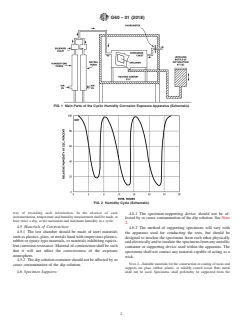
Development of International Standards, Guides and Recom- 4.3 AschematicdiagramoftheapparatusisshowninFig.1.
mendations issued by the World Trade Organization Technical
4.4 The apparatus should be capable of providing an 8-h
Barriers to Trade (TBT) Committee.
humidity cycle three times per day, as shown in Fig. 2, and a
dip cycle once a day.
2. Referenced Documents
4.4.1 The cyclic variation of humidity can be obtained by
2.1 ASTM Standards:
variation of the temperature of the water in the humidifying
D1193 Specification for Reagent Water
tower. The temperature of the water is cycled thermostatically
G1 Practice for Preparing, Cleaning, and Evaluating Corro-
such that the relative humidity of air bubbling through the
sion Test Specimens
water at a minimum rate of 1 L⁄min (0.04 ft /min) will vary
between 100 and 50 % when the temperature of the air in the
test chamber is brought to 52 6 1°C (125 6 2°F).
This practice is under the jurisdiction of ASTM Committee G01 on Corrosion
4.4.2 The range of relative humidity can be extended by
of Metals and is the direct responsibility of Subcommittee G01.05 on Laboratory
adding a drying period to the humidity cycle described above.
Corrosion Tests.
Current edition approved Oct. 1, 2018. Published November 2018. Originally The minimum relative humidity shall be ≤20 % and the
approved in 1979. Last previous edition approved in 2013 as G60 – 01 (2013). DOI:
maximum relative humidity shall be ≥95 % for each cycle.
10.1520/G0060-01R18.
4.4.3 Drops of solution which accumulate on the ceiling or
Opinsky, A. J., Thomson, R. F., and Boegehold, A. L., “A Cyclic Humidity
cover of the chamber shall not be permitted to fall on the
Accelerated Corrosion Test for Sheet Steel,” ASTM Bulletin, January 1953.
For referenced ASTM standards, visit the ASTM website, www.astm.org, or
specimens being exposed.
contact ASTM Customer Service at service@astm.org. For Annual Book of ASTM
NOTE 1—Instruments to continuously record temperature and humidity
Standards volume information, refer to the standard’s Document Summary page on
the ASTM website. are not mandatory, but these provide the most reliable and economical
Copyright © ASTM International, 100 Barr Harbor Drive, PO Box C700, West Conshohocken, PA 19428-2959. United States
G60 − 01 (2018)
FIG. 1 Main Parts of the Cyclic Humidity Corrosion Exposure Apparatus (Schematic)
FIG. 2 Humidity Cycle (Schematic)
way of recording such information. In the absence of such
4.6.1 The specimen-supporting device should not be af-
instrumentation, temperature and humidity measurement shall be made, at
fected by or cause contamination of the dip solution. See Note
least twice a day, at the maximum and minimum humidity in a cycle.
2.
4.5 Materials of Construction:
4.6.2 The method of supporting specimens will vary with
4.5.1 The test chamber should be made of inert materials
the apparatus used for conducting the tests, but should be
suchasplastics,glass,ormetalslinedwithimperviousplastics,
designed to insulate the specimens from each other physically
rubber or epoxy-type materials, or materials exhibiting equiva-
andelectricallyandtoinsulatethespecimensfromanymetallic
lent corrosion resistance. Material of construction shall be such
container or supporting device used within the apparatus. The
that it will not affect the corrosiveness of the exposure
specimens shall not contact any material capable of acting as a
atmosphere.
wick.
4.5.2 Thedipsolutioncontainershouldnotbeaffectedbyor
NOTE 2—Suitable materials for the construction or coating of racks and
cause contamination of the dip solution.
supports are glass, rubber, plastic, or suitably coated wood. Bare metal
4.6 Specimen Supports: shall not be used. Specimens shall preferably be supported from th
...