

ASTM A487/A487M-21
(Specification)Standard Specification for Steel Castings Suitable for Pressure Service
General Information
- Abstract
ABSTRACT
This specification covers low-alloy steel and martensitic stainless steels in the normalized and tempered, or quenched and tempered conditions, suitable for pressure-containing parts. All castings shall receive the specified heat treatment requirement: austenitizing temperature, medium, quenching cool, and tempering temperature. Preliminary heat treatment and multiple tempering are permitted. Recording-type pyrometers shall be used to control the furnace temperature. The steel shall conform to the required chemical composition for carbon, manganese, phosphorus, sulfur, silicon, nickel, chromium, molybdenum, vanadium, boron, and copper. Residual elements include: copper, nickel, chromium, tungsten, molybdenum, and vanadium. Tensile properties of the steel shall conform to the requirements for tensile strength, yield strength, elongation, reduction of area, hardness, and maximum thickness. Product analysis tolerance is specified. Repair by welding may be done.
SCOPE
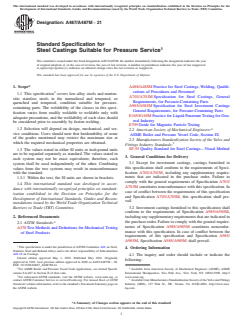
1.1 This specification2 covers low-alloy steels and martensitic stainless steels in the normalized and tempered, or quenched and tempered, condition suitable for pressure-containing parts. The weldability of the classes in this specification varies from readily weldable to weldable only with adequate precautions, and the weldability of each class should be considered prior to assembly by fusion welding.
1.2 Selection will depend on design, mechanical, and service conditions. Users should note that hardenability of some of the grades mentioned may restrict the maximum size at which the required mechanical properties are obtained.
1.3 The values stated in either SI units or inch-pound units are to be regarded separately as standard. The values stated in each system may not be exact equivalents; therefore, each system shall be used independently of the other. Combining values from the two systems may result in nonconformance with the standard.
1.3.1 Within the text, the SI units are shown in brackets.
1.4 This international standard was developed in accordance with internationally recognized principles on standardization established in the Decision on Principles for the Development of International Standards, Guides and Recommendations issued by the World Trade Organization Technical Barriers to Trade (TBT) Committee.
- Status
- Published
- Publication Date
- 30-Apr-2021
- Technical Committee
- A01 - Steel, Stainless Steel and Related Alloys
- Drafting Committee
- A01.18 - Castings
Buy Documents
ASTM A487/A487M-21 - Standard Specification for Steel Castings Suitable for Pressure Service
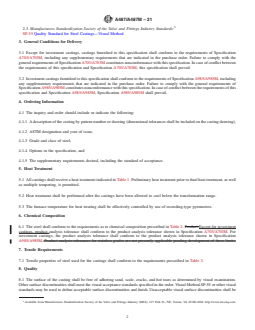
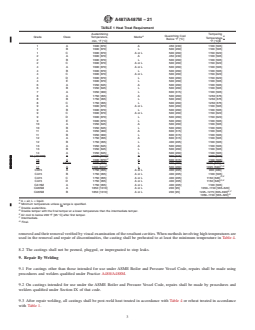
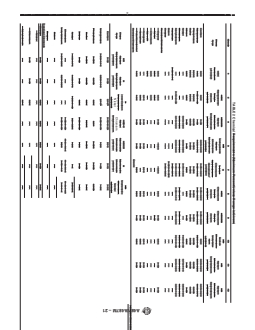
REDLINE ASTM A487/A487M-21 - Standard Specification for Steel Castings Suitable for Pressure Service
Overview
ASTM A487/A487M-21 is a standard specification developed by ASTM International for steel castings suitable for pressure-containing parts, encompassing low-alloy steels and martensitic stainless steels. This standard addresses the requirements for mechanical properties, chemical composition, and heat treatment of cast steel used in critical pressure service applications. Typical applications include components used in boilers, pressure vessels, and industrial piping systems, where strength, durability, and resistance to pressure are essential.
Key Topics
- Material Types: The specification covers low-alloy steel and martensitic stainless steel castings, supplied in normalized and tempered or quenched and tempered conditions.
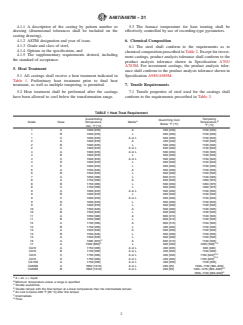
- Heat Treatment: All steel castings must undergo controlled heat treatment, including austenitizing, quenching, and tempering, as specified. Multiple tempering and preliminary heat treatments are permitted.
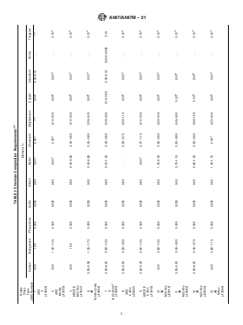
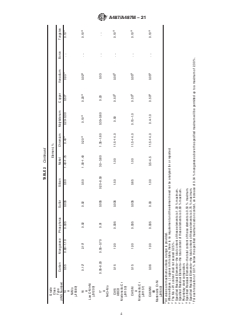
- Chemical Requirements: The steel must meet strict chemical composition limits for elements such as carbon, manganese, phosphorus, sulfur, silicon, nickel, chromium, molybdenum, vanadium, boron, and copper. Residual elements limits are also defined to ensure material integrity.
- Mechanical Properties: The standard prescribes requirements for tensile strength, yield strength, elongation, reduction of area, hardness, and maximum thickness, ensuring reliable performance under pressure.
- Weldability: Welding suitability varies by class and grade, and appropriate precautions or procedures must be observed before and after welding.
- Inspection and Quality: Visual and non-destructive testing methods such as magnetic particle and liquid penetrant inspection are referenced for surface quality control. Weld repairs and their inspection are also outlined for compliance.
- Units of Measurement: Both SI and inch-pound units are recognized, but values from each system are not exact equivalents and shall not be interchanged.
Applications
Steel castings conforming to ASTM A487/A487M-21 are widely used for manufacturing parts that will contain pressure, such as:
- Boilers and Pressure Vessels: High-strength, pressure-resistant castings are vital for safety and integrity.
- Valves and Fittings: Critical components in pipelines and process systems that must withstand pressure, temperature, and corrosion.
- Industrial Piping Systems: For carrying steam, gases, or liquids under pressure, requiring robust and durable materials.
- Power Generation Equipment: Including turbine housings and compressor components where heat and pressure cycling are frequent.
- Petrochemical and Refinery Applications: Where castings face demanding service conditions and strict regulatory compliance.
End users benefit from this standard as it ensures consistency in steel casting performance, facilitates international trade, and supports compliance with global safety regulations.
Related Standards
Several standards and codes are referenced in ASTM A487/A487M-21 to support comprehensive requirements and testing procedures:
- ASTM A370: Methods for mechanical testing of steel products
- ASTM A488/A488M: Practice for welding qualifications of procedures and personnel for steel castings
- ASTM A703/A703M: General requirements for steel castings for pressure-containing parts
- ASTM A985/A985M: Requirements for steel investment castings for pressure service
- ASME Boiler and Pressure Vessel Code, Section IX: Welding procedures for pressure vessels
- SP-55 (MSS): Visual inspection standard for steel castings
- ASTM E165/E165M, E709: Liquid penetrant and magnetic particle nondestructive testing methods
By aligning with ASTM A487/A487M-21, manufacturers, designers, and inspectors ensure high-quality, pressure-capable steel castings that meet international standards for safety, durability, and performance in critical industries.
Relations
- Effective Date
- 01-Mar-2024
- Effective Date
- 01-Mar-2024
- Effective Date
- 01-Jul-2019
- Effective Date
- 01-Mar-2019
- Effective Date
- 01-Sep-2018
- Effective Date
- 01-Sep-2018
- Effective Date
- 01-Jul-2018
- Effective Date
- 01-Jul-2018
- Effective Date
- 15-May-2018
- Effective Date
- 01-May-2018
- Refers
ASTM A370-17a - Standard Test Methods and Definitions for Mechanical Testing of Steel Products - Effective Date
- 15-Nov-2017
- Effective Date
- 01-Nov-2017
- Effective Date
- 01-May-2017
- Effective Date
- 01-May-2017
- Effective Date
- 01-Jan-2017
Buy Documents
ASTM A487/A487M-21 - Standard Specification for Steel Castings Suitable for Pressure Service
REDLINE ASTM A487/A487M-21 - Standard Specification for Steel Castings Suitable for Pressure Service
Get Certified
Connect with accredited certification bodies for this standard

Element Materials Technology
Materials testing and product certification.

Inštitut za kovinske materiale in tehnologije
Institute of Metals and Technology. Materials testing, metallurgical analysis, NDT.
Sponsored listings
Frequently Asked Questions
ASTM A487/A487M-21 is a technical specification published by ASTM International. Its full title is "Standard Specification for Steel Castings Suitable for Pressure Service". This standard covers: ABSTRACT This specification covers low-alloy steel and martensitic stainless steels in the normalized and tempered, or quenched and tempered conditions, suitable for pressure-containing parts. All castings shall receive the specified heat treatment requirement: austenitizing temperature, medium, quenching cool, and tempering temperature. Preliminary heat treatment and multiple tempering are permitted. Recording-type pyrometers shall be used to control the furnace temperature. The steel shall conform to the required chemical composition for carbon, manganese, phosphorus, sulfur, silicon, nickel, chromium, molybdenum, vanadium, boron, and copper. Residual elements include: copper, nickel, chromium, tungsten, molybdenum, and vanadium. Tensile properties of the steel shall conform to the requirements for tensile strength, yield strength, elongation, reduction of area, hardness, and maximum thickness. Product analysis tolerance is specified. Repair by welding may be done. SCOPE 1.1 This specification2 covers low-alloy steels and martensitic stainless steels in the normalized and tempered, or quenched and tempered, condition suitable for pressure-containing parts. The weldability of the classes in this specification varies from readily weldable to weldable only with adequate precautions, and the weldability of each class should be considered prior to assembly by fusion welding. 1.2 Selection will depend on design, mechanical, and service conditions. Users should note that hardenability of some of the grades mentioned may restrict the maximum size at which the required mechanical properties are obtained. 1.3 The values stated in either SI units or inch-pound units are to be regarded separately as standard. The values stated in each system may not be exact equivalents; therefore, each system shall be used independently of the other. Combining values from the two systems may result in nonconformance with the standard. 1.3.1 Within the text, the SI units are shown in brackets. 1.4 This international standard was developed in accordance with internationally recognized principles on standardization established in the Decision on Principles for the Development of International Standards, Guides and Recommendations issued by the World Trade Organization Technical Barriers to Trade (TBT) Committee.
ABSTRACT This specification covers low-alloy steel and martensitic stainless steels in the normalized and tempered, or quenched and tempered conditions, suitable for pressure-containing parts. All castings shall receive the specified heat treatment requirement: austenitizing temperature, medium, quenching cool, and tempering temperature. Preliminary heat treatment and multiple tempering are permitted. Recording-type pyrometers shall be used to control the furnace temperature. The steel shall conform to the required chemical composition for carbon, manganese, phosphorus, sulfur, silicon, nickel, chromium, molybdenum, vanadium, boron, and copper. Residual elements include: copper, nickel, chromium, tungsten, molybdenum, and vanadium. Tensile properties of the steel shall conform to the requirements for tensile strength, yield strength, elongation, reduction of area, hardness, and maximum thickness. Product analysis tolerance is specified. Repair by welding may be done. SCOPE 1.1 This specification2 covers low-alloy steels and martensitic stainless steels in the normalized and tempered, or quenched and tempered, condition suitable for pressure-containing parts. The weldability of the classes in this specification varies from readily weldable to weldable only with adequate precautions, and the weldability of each class should be considered prior to assembly by fusion welding. 1.2 Selection will depend on design, mechanical, and service conditions. Users should note that hardenability of some of the grades mentioned may restrict the maximum size at which the required mechanical properties are obtained. 1.3 The values stated in either SI units or inch-pound units are to be regarded separately as standard. The values stated in each system may not be exact equivalents; therefore, each system shall be used independently of the other. Combining values from the two systems may result in nonconformance with the standard. 1.3.1 Within the text, the SI units are shown in brackets. 1.4 This international standard was developed in accordance with internationally recognized principles on standardization established in the Decision on Principles for the Development of International Standards, Guides and Recommendations issued by the World Trade Organization Technical Barriers to Trade (TBT) Committee.
ASTM A487/A487M-21 is classified under the following ICS (International Classification for Standards) categories: 77.140.80 - Iron and steel castings. The ICS classification helps identify the subject area and facilitates finding related standards.
ASTM A487/A487M-21 has the following relationships with other standards: It is inter standard links to ASTM A370-24, ASTM A488/A488M-24, ASTM A370-19, ASTM A985/A985M-19, ASTM A985/A985M-18a, ASTM A703/A703M-18a, ASTM A488/A488M-18e1, ASTM A488/A488M-18, ASTM A985/A985M-18, ASTM A703/A703M-18, ASTM A370-17a, ASTM A703/A703M-17a, ASTM A488/A488M-17, ASTM A703/A703M-17, ASTM A370-17. Understanding these relationships helps ensure you are using the most current and applicable version of the standard.
ASTM A487/A487M-21 is available in PDF format for immediate download after purchase. The document can be added to your cart and obtained through the secure checkout process. Digital delivery ensures instant access to the complete standard document.
Standards Content (Sample)
This international standard was developed in accordance with internationally recognized principles on standardization established in the Decision on Principles for the
Development of International Standards, Guides and Recommendations issued by the World Trade Organization Technical Barriers to Trade (TBT) Committee.
Designation:A487/A487M −21
Standard Specification for
Steel Castings Suitable for Pressure Service
This standard is issued under the fixed designationA487/A487M; the number immediately following the designation indicates the year
of original adoption or, in the case of revision, the year of last revision.Anumber in parentheses indicates the year of last reapproval.
A superscript epsilon (´) indicates an editorial change since the last revision or reapproval.
This standard has been approved for use by agencies of the U.S. Department of Defense.
1. Scope* A488/A488MPractice for Steel Castings, Welding, Qualifi-
2 cations of Procedures and Personnel
1.1 This specification covers low-alloy steels and marten-
A703/A703M Specification for Steel Castings, General
sitic stainless steels in the normalized and tempered, or
Requirements, for Pressure-Containing Parts
quenched and tempered, condition suitable for pressure-
A985/A985MSpecification for Steel Investment Castings
containing parts. The weldability of the classes in this speci-
General Requirements, for Pressure-Containing Parts
fication varies from readily weldable to weldable only with
E165/E165MPractice for Liquid Penetrant Testing for Gen-
adequate precautions, and the weldability of each class should
eral Industry
be considered prior to assembly by fusion welding.
E709Guide for Magnetic Particle Testing
1.2 Selection will depend on design, mechanical, and ser-
2.2 American Society of Mechanical Engineers:
vice conditions. Users should note that hardenability of some
ASME Boiler and Pressure Vessel Code, Section IX
of the grades mentioned may restrict the maximum size at
2.3 Manufacturers Standardization Society of the Valve and
which the required mechanical properties are obtained.
Fittings Industry Standards:
SP-55Quality Standard for Steel Castings—Visual Method
1.3 The values stated in either SI units or inch-pound units
are to be regarded separately as standard. The values stated in
3. General Conditions for Delivery
each system may not be exact equivalents; therefore, each
3.1 Except for investment castings, castings furnished to
system shall be used independently of the other. Combining
this specification shall conform to the requirements of Speci-
values from the two systems may result in nonconformance
fication A703/A703M, including any supplementary require-
with the standard.
ments that are indicated in the purchase order. Failure to
1.3.1 Within the text, the SI units are shown in brackets.
comply with the general requirements of Specification A703/
1.4 This international standard was developed in accor-
A703M constitutes nonconformance with this specification. In
dance with internationally recognized principles on standard-
case of conflict between the requirements of this specification
ization established in the Decision on Principles for the
and Specification A703/A703M, this specification shall pre-
Development of International Standards, Guides and Recom-
vail.
mendations issued by the World Trade Organization Technical
3.2 Investment castings furnished to this specification shall
Barriers to Trade (TBT) Committee.
conform to the requirements of Specification A985/A985M,
2. Referenced Documents includinganysupplementaryrequirementsthatareindicatedin
the purchase order. Failure to comply with the general require-
2.1 ASTM Standards:
ments of Specification A985/A985M constitutes nonconfor-
A370Test Methods and Definitions for Mechanical Testing
mance with this specification. In case of conflict between the
of Steel Products
requirements of this specification and Specification A985/
A985M, Specification A985/A985M shall prevail.
This specification is under the jurisdiction ofASTM Committee A01 on Steel,
4. Ordering Information
Stainless Steel and RelatedAlloys and is the direct responsibility of Subcommittee
A01.18 on Castings.
4.1 The inquiry and order should include or indicate the
Current edition approved May 1, 2021. Published May 2021. Originally
following:
approved in 1963. Last previous edition approved in 2020 as A487/A487M – 20.
DOI: 10.1520/A0487_A0487M-21.
2 4
For ASME Boiler and Pressure Vessel Code applications, see related Specifi- Available from American Society of Mechanical Engineers (ASME), ASME
cations SA-487 in Section II of that code. International Headquarters, Two Park Ave., New York, NY 10016-5990, http://
For referenced ASTM standards, visit the ASTM website, www.astm.org, or www.asme.org.
contact ASTM Customer Service at service@astm.org. For Annual Book of ASTM AvailablefromManufacturersStandardizationSocietyoftheValveandFittings
Standards volume information, refer to the standard’s Document Summary page on Industry (MSS), 127 Park St., NE, Vienna, VA 22180-4602, http://www.mss-
the ASTM website. hq.com.
*A Summary of Changes section appears at the end of this standard
Copyright © ASTM International, 100 Barr Harbor Drive, PO Box C700, West Conshohocken, PA 19428-2959. United States
A487/A487M−21
4.1.1 A description of the casting by pattern number or 5.3 The furnace temperature for heat treating shall be
drawing (dimensional tolerances shall be included on the effectively controlled by use of recording-type pyrometers.
casting drawing),
6. Chemical Composition
4.1.2 ASTM designation and year of issue,
4.1.3 Grade and class of steel,
6.1 The steel shall conform to the requirements as to
4.1.4 Options in the specification, and
chemicalcompositionprescribedinTable2.Exceptforinvest-
4.1.5 The supplementary requirements desired, including
ment castings, product analysis tolerance shall conform to the
the standard of acceptance.
product analysis tolerance shown in Specification A703/
A703M. For investment castings, the product analysis toler-
5. Heat Treatment
ance shall conform to the product analysis tolerance shown in
5.1 All castings shall receive a heat treatment indicated in
Specification A985/A985M.
Table 1. Preliminary heat treatment prior to final heat
treatment, as well as multiple tempering, is permitted. 7. Tensile Requirements
5.2 Heat treatment shall be performed after the castings 7.1 Tensile properties of steel used for the castings shall
have been allowed to cool below the transformation range. conform to the requirements prescribed in Table 3.
TABLE 1 Heat Treat Requirement
Austenitizing
Tempering
Quenching Cool
A
B
Grade Class Temperature, Media Temperature,
Below °F [°C]
°F [°C]
min, °F [°C]
1 A 1600 [870] A 450 [230] 1100 [595]
1 B 1600 [870] L 500 [260] 1100 [595]
1 C 1600 [870] A or L 500 [260] 1150 [620]
2 A 1600 [870] A 450 [230] 1100 [595]
2 B 1600 [870] L 500 [260] 1100 [595]
2 C 1600 [870] A or L 500 [260] 1150 [620]
4 A 1600 [870] A or L 500 [260] 1100 [595]
4 B 1600 [870] L 500 [260] 1100 [595]
4 C 1600 [870] A or L 500 [260] 1150 [620]
4 D 1600 [870] L 500 [260] 1150 [620]
4 E 1600 [870] L 500 [260] 1100 [595]
6 A 1550 [845] A 500 [260] 1100 [595]
6 B 1550 [845] L 500 [260] 1100 [595]
7 A 1650 [900] L 600 [315] 1100 [595]
8 A 1750 [955] A 500 [260] 1250 [675]
8 B 1750 [955] L 500 [260] 1250 [675]
8 C 1750 [955] L 500 [260] 1250 [675]
9 A 1600 [870] A or L 500 [260] 1100 [595]
9 B 1600 [870] L 500 [260] 1100 [595]
9 C 1600 [870] A or L 500 [260] 1150 [620]
9 D 1600 [870] L 500 [260] 1150 [620]
9 E 1600 [870] L 500 [260] 1100 [595]
10 A 1550 [845] A 500 [260] 1100 [595]
10 B 1550 [845] L 500 [260] 1100 [595]
11 A 1650 [900] A 600 [315] 1100 [595]
11 B 1650 [900] L 600 [315] 1100 [595]
12 A 1750 [955] A 600 [315] 1100 [595]
12 B 1750 [955] L 400 [205] 1100 [595]
13 A 1550 [845] A 500 [260] 1100 [595]
13 B 1550 [845] L 500 [260] 1100 [595]
14 A 1550 [845] L 500 [260] 1100 [595]
C
16 A 1600 [870] A 600 [315] 1100 [595]
C F,G
17 A 1590 [865] L 500 [260] 1095 [590]
CA15 A 1750 [955] A or L 400 [205] 900 [480]
CA15 B 1750 [955] A or L 400 [205] 1100 [595]
D,E
CA15 C 1750 [955] A or L 400 [205] 1150 [620]
D,E
CA15 D 1750 [955] A or L 400 [205] 1150 [620]
CA15M A 1750 [955] A or L 400 [205] 1100 [595]
CA6NM A 1850 [1010] A or L 200 [95] 1050–1150 [565–620]
E,F
CA6NM B 1850 [1010] A or L 200 [95] 1225–1275 [665–690]
G
1050–1150 [565–620]
A
A = air, L = liquid.
B
Minimum temperature unless a range is specified.
C
Double austenitize.
D
Double temper with the final temper at a lower temperature than the intermediate temper.
E
Air cool to below 200 °F [95 °C] after first temper.
F
Intermediate.
G
Final.
A487/A487M−21
A,B
TABLE 2 Chemical Composition Requirements
Grade
Element, %
Class
Type
Carbon Manganese Phosphorus Sulfur Silicon Nickel Chromium Molybdenum Copper Vanadium Boron Tungsten
(UNS Number)
D DC,D D C,D
1 0.30 1.00 0.035 0.035 0.80 0.50 0.35 0.50 0.04–0.12 . . .
ABC
V
(J13002)
D D D D D
2 0.30 1.00–1.40 0.035 0.035 0.80 0.50 0.35 0.10–0.30 0.50 0.03 . . . 0.10
ABC
Mn-Mo
(J13005)
E E E
4 0.30 1.00 0.035 0.035 0.80 0.40–0.80 0.40–0.80 0.15–0.30 0.50 0.03 . . . 0.10
ABCDE
Ni-Cr-Mo
(J13047)
E E E
6 0.05–0.38 1.30–1.70 0.035 0.035 0.80 0.40–0.80 0.40–0.80 0.30–0.40 0.50 0.03 . . . 0.10
AB
Mn-Ni-Cr-Mo
(J13855)
7 0.05–0.20 0.60–1.00 0.035 0.035 0.80 0.70–1.00 0.40–0.80 0.40–0.60 0.15–0.50 0.03–0.10 0.002–0.006 0.10
A
F
Ni-Cr-Mo-V
(J13084)
E E E
8 0.05–0.20 0.50–0.90 0.035 0.035 0.80 . . . 2.00–2.75 0.90–1.10 0.50 0.03 . . . 0.10
ABC
Cr-Mo
(J22091)
D D D D
9 0.05–0.33 0.60–1.00 0.035 0.035 0.80 0.50 0.75–1.10 0.15–0.30 0.50 0.03 . . . 0.10
ABCDE
Cr-Mo
(J13345)
E E E
10 0.30 0.60–1.00 0.035 0.035 0.80 1.40–2.00 0.55–0.90 0.20–0.40 0.50 0.03 . . . 0.10
AB
Ni-Cr-Mo
(J23015)
G G G
11 0.05–0.20 0.50–0.80 0.035 0.035 0.60 0.70–1.10 0.50–0.80 0.45–0.65 0.50 0.03 . . . 0.10
AB
Ni-Cr-Mo
(J12082)
G G G
12 0.05–0.20 0.40–0.70 0.035 0.035 0.60 0.60–1.00 0.50–0.90 0.90–1.20 0.50 0.03 . . . 0.10
AB
Ni-Cr-Mo
(J22000)
H H H H
13 0.30 0.80–1.10 0.035 0.035 0.60 1.40–1.75 0.40 0.20–0.30 0.50 0.03 . . . 0.10
AB
Ni-Mo
(J13080)
A487/A487M−21
TABLE2 Continued
Grade
Element, %
Class
Type
Carbon Manganese Phosphorus Sulfur Silicon Nickel Chromium Molybdenum Copper Vanadium Boron Tungsten
(UNS Number)
H H H H
14 0.55 0.80–1.10 0.035 0.035 0.60 1.40–1.75 0.40 0.20–0.30 0.50 0.03 . . . 0.10
A
Ni-Mo
(J15580)
I I G G G G G
16 0.12 2.10 0.02 0.02 0.50 1.00–1.40 0.20 0.10 0.20 0.02 . . . 0.10
A
Low C-Mn-Ni
(J31200)
17 0.05–0.20 0.55–0.70 0.01 0.005 0.20–0.50 3.0–3.80 1.35–1.60 0.35–0.60 0.20 0.03 . . . . . .
A
Ni-Cr-Mo
G G G
CA15 0.15 1.00 0.035 0.035 1.50 1.00 11.5–14.0 0.50 0.50 0.05 . . . 0.10
ABCD
Martensitic Cr
(J91150)
G G G
CA15M 0.15 1.00 0.035 0.035 0.65 1.00 11.5–14.0 0.15–1.0 0.50 0.05 . . . 0.10
A
Martensitic Cr
(J91151)
G G G
CA6NM 0.06 1.00 0.035 0.03 1.00 3.5–4.5 11.5–14.0 0.4–1.0 0.50 0.05 . . . 0.10
AB
Martensitic Cr-Ni
(J91540)
A
All values are maximums unless a range is provided.
B
Where ellipses ({) appear in this table, there is no requirement and the element need not be analyzed for or reported.
C
The Mo + W content shall not exceed 0.25 %.
D
Specified
...
This document is not an ASTM standard and is intended only to provide the user of an ASTM standard an indication of what changes have been made to the previous version. Because
it may not be technically possible to adequately depict all changes accurately, ASTM recommends that users consult prior editions as appropriate. In all cases only the current version
of the standard as published by ASTM is to be considered the official document.
Designation: A487/A487M − 20 A487/A487M − 21
Standard Specification for
Steel Castings Suitable for Pressure Service
This standard is issued under the fixed designation A487/A487M; the number immediately following the designation indicates the year
of original adoption or, in the case of revision, the year of last revision. A number in parentheses indicates the year of last reapproval.
A superscript epsilon (´) indicates an editorial change since the last revision or reapproval.
This standard has been approved for use by agencies of the U.S. Department of Defense.
1. Scope*
1.1 This specification covers low-alloy steels and martensitic stainless steels in the normalized and tempered, or quenched and
tempered, condition suitable for pressure-containing parts. The weldability of the classes in this specification varies from readily
weldable to weldable only with adequate precautions, and the weldability of each class should be considered prior to assembly by
fusion welding.
1.2 Selection will depend on design, mechanical, and service conditions. Users should note that hardenability of some of the
grades mentioned may restrict the maximum size at which the required mechanical properties are obtained.
1.3 The values stated in either SI units or inch-pound units are to be regarded separately as standard. The values stated in each
system may not be exact equivalents; therefore, each system shall be used independently of the other. Combining values from the
two systems may result in nonconformance with the standard.
1.3.1 Within the text, the SI units are shown in brackets.
1.4 This international standard was developed in accordance with internationally recognized principles on standardization
established in the Decision on Principles for the Development of International Standards, Guides and Recommendations issued
by the World Trade Organization Technical Barriers to Trade (TBT) Committee.
2. Referenced Documents
2.1 ASTM Standards:
A370 Test Methods and Definitions for Mechanical Testing of Steel Products
A488/A488M Practice for Steel Castings, Welding, Qualifications of Procedures and Personnel
A703/A703M Specification for Steel Castings, General Requirements, for Pressure-Containing Parts
A985/A985M Specification for Steel Investment Castings General Requirements, for Pressure-Containing Parts
E165/E165M Practice for Liquid Penetrant Testing for General Industry
E709 Guide for Magnetic Particle Testing
2.2 American Society of Mechanical Engineers:
ASME Boiler and Pressure Vessel Code, Section IX
This specification is under the jurisdiction of ASTM Committee A01 on Steel, Stainless Steel and Related Alloys and is the direct responsibility of Subcommittee A01.18
on Castings.
Current edition approved May 1, 2020May 1, 2021. Published May 2020May 2021. Originally approved in 1963. Last previous edition approved in 20142020 as
A487/A487M – 14.20. DOI: 10.1520/A0487_A0487M-20.10.1520/A0487_A0487M-21.
For ASME Boiler and Pressure Vessel Code applications, see related Specifications SA-487 in Section II of that code.
For referenced ASTM standards, visit the ASTM website, www.astm.org, or contact ASTM Customer Service at service@astm.org. For Annual Book of ASTM Standards
volume information, refer to the standard’s Document Summary page on the ASTM website.
Available from American Society of Mechanical Engineers (ASME), ASME International Headquarters, Two Park Ave., New York, NY 10016-5990, http://
www.asme.org.
*A Summary of Changes section appears at the end of this standard
Copyright © ASTM International, 100 Barr Harbor Drive, PO Box C700, West Conshohocken, PA 19428-2959. United States
A487/A487M − 21
2.3 Manufacturers Standardization Society of the Valve and Fittings Industry Standards:
SP-55 Quality Standard for Steel Castings—Visual Method
3. General Conditions for Delivery
3.1 Except for investment castings, castings furnished to this specification shall conform to the requirements of Specification
A703/A703M, including any supplementary requirements that are indicated in the purchase order. Failure to comply with the
general requirements of Specification A703/A703M constitutes nonconformance with this specification. In case of conflict between
the requirements of this specification and Specification A703/A703M, this specification shall prevail.
3.2 Investment castings furnished to this specification shall conform to the requirements of Specification A985/A985M, including
any supplementary requirements that are indicated in the purchase order. Failure to comply with the general requirements of
Specification A985/A985M constitutes nonconformance with this specification. In case of conflict between the requirements of this
specification and Specification A985/A985M, Specification A985/A985M shall prevail.
4. Ordering Information
4.1 The inquiry and order should include or indicate the following:
4.1.1 A description of the casting by pattern number or drawing (dimensional tolerances shall be included on the casting drawing),
4.1.2 ASTM designation and year of issue,
4.1.3 Grade and class of steel,
4.1.4 Options in the specification, and
4.1.5 The supplementary requirements desired, including the standard of acceptance.
5. Heat Treatment
5.1 All castings shall receive a heat treatment indicated in Table 1. Preliminary heat treatment prior to final heat treatment, as well
as multiple tempering, is permitted.
5.2 Heat treatment shall be performed after the castings have been allowed to cool below the transformation range.
5.3 The furnace temperature for heat treating shall be effectively controlled by use of recording-type pyrometers.
6. Chemical Composition
6.1 The steel shall conform to the requirements as to chemical composition prescribed in Table 2. Product Except for investment
castings, product analysis tolerance shall conform to the product analysis tolerance shown in Specification A703/A703M. For
investment castings, the product analysis tolerance shall conform to the product analysis tolerance shown in Specification
A985/A985M. Product analysis tolerances for stainless grades are not presently applicable pending development of these limits.
7. Tensile Requirements
7.1 Tensile properties of steel used for the castings shall conform to the requirements prescribed in Table 3.
8. Quality
8.1 The surface of the casting shall be free of adhering sand, scale, cracks, and hot tears as determined by visual examination.
Other surface discontinuities shall meet the visual acceptance standards specified in the order. Visual Method SP-55 or other visual
standards may be used to define acceptable surface discontinuities and finish. Unacceptable visual surface discontinuities shall be
Available from Manufacturers Standardization Society of the Valve and Fittings Industry (MSS), 127 Park St., NE, Vienna, VA 22180-4602, http://www.mss-hq.com.
A487/A487M − 21
TABLE 1 Heat Treat Requirement
Austenitizing
Tempering
Quenching Cool
A B
Grade Class Temperature, Media
Temperature,
Below °F [°C] B
°F [°C]
min, °F [°C]
1 A 1600 [870] A 450 [230] 1100 [595]
1 B 1600 [870] L 500 [260] 1100 [595]
1 C 1600 [870] A or L 500 [260] 1150 [620]
2 A 1600 [870] A 450 [230] 1100 [595]
2 B 1600 [870] L 500 [260] 1100 [595]
2 C 1600 [870] A or L 500 [260] 1150 [620]
4 A 1600 [870] A or L 500 [260] 1100 [595]
4 B 1600 [870] L 500 [260] 1100 [595]
4 C 1600 [870] A or L 500 [260] 1150 [620]
4 D 1600 [870] L 500 [260] 1150 [620]
4 E 1600 [870] L 500 [260] 1100 [595]
6 A 1550 [845] A 500 [260] 1100 [595]
6 B 1550 [845] L 500 [260] 1100 [595]
7 A 1650 [900] L 600 [315] 1100 [595]
8 A 1750 [955] A 500 [260] 1250 [675]
8 B 1750 [955] L 500 [260] 1250 [675]
8 C 1750 [955] L 500 [260] 1250 [675]
9 A 1600 [870] A or L 500 [260] 1100 [595]
9 B 1600 [870] L 500 [260] 1100 [595]
9 C 1600 [870] A or L 500 [260] 1150 [620]
9 D 1600 [870] L 500 [260] 1150 [620]
9 E 1600 [870] L 500 [260] 1100 [595]
10 A 1550 [845] A 500 [260] 1100 [595]
10 B 1550 [845] L 500 [260] 1100 [595]
11 A 1650 [900] A 600 [315] 1100 [595]
11 B 1650 [900] L 600 [315] 1100 [595]
12 A 1750 [955] A 600 [315] 1100 [595]
12 B 1750 [955] L 400 [205] 1100 [595]
13 A 1550 [845] A 500 [260] 1100 [595]
13 B 1550 [845] L 500 [260] 1100 [595]
14 A 1550 [845] L 500 [260] 1100 [595]
C
16 (J31200) A 1600 [870] A 600 [315] 1100 [595]
C
16 A 1600 [870] A 600 [315] 1100 [595]
F,G
17 ABCD 1590 [865] L 500 [260] 1095 [590]
C F,G
17 A 1590 [865] L 500 [260] 1095 [590]
CA15 A 1750 [955] A or L 400 [205] 900 [480]
CA15 B 1750 [955] A or L 400 [205] 1100 [595]
D,E
CA15 C 1750 [955] A or L 400 [205] 1150 [620]
D,E
CA15 D 1750 [955] A or L 400 [205] 1150 [620]
CA15M A 1750 [955] A or L 400 [205] 1100 [595]
CA6NM A 1850 [1010] A or L 200 [95] 1050–1150 [565–620]
E,F
CA6NM B 1850 [1010] A or L 200 [95] 1225–1275 [665–690]
G
1050–1150 [565–620]
A
A = air, L = liquid.
B
Minimum temperature unless a range is specified.
C
Double austenitize.
D
Double temper with the final temper at a lower temperature than the intermediate temper.
E
Air cool to below 200 °F [95 °C] after first temper.
F
Intermediate.
G
Final.
removed and their removal verified by visual examination of the resultant cavities. When methods involving high temperatures are
used in the removal and repair of discontinuities, the casting shall be preheated to at least the minimum temperature in Table 4.
8.2 The castings shall not be peened, plugged, or impregnated to stop leaks.
9. Repair By Welding
9.1 For castings other than those intended for use under ASME Boiler and Pressure Vessel Code, repairs shall be made using
procedures and welders qualified under Practice A488/A488M.
9.2 On castings intended for use under the ASME Boiler and Pressure Vessel Code, repairs shall be made by procedures and
welders qualified under Section IX of that code.
9.3 After repair welding, all castings shall be post-weld heat treated in accordance with Table 4 or reheat treated in accordance
with Table 1.
A487/A487M − 21
TABLE 2 Chemical Requirements (Maximum PercentUnless Range is Given)
Grade 1 2 4 6 7 8 9 10 11 12
AB AB
A
ABC ABCDE ABC ABCDE AB AB
Manganese Nickel-
Nickel-
ABC Manganese- Nickel- Chromium- Chromium- Nickel- Nickel-
Class Nickel- Chromium-
Chromium-
Vanadium Molyb- Chromium- Molyb- Molyb- Chromium- Chromium-
Type Chromium- Molybde-
Molybdenum-
(J13002) denum Molybdenum denum denum Molybdenum Molybdenum
A
Molybdenum num
Vanadium
(J13005) (J13047) (J22091) (J13345) (J12082) (J22000)
(J12084)
(J13855) (J23015)
Carbon 0.30 0.30 0.30 0.05–0.38 0.05–0.20 0.05–0.20 0.05–0.33 0.30 0.05–0.20 0.05–0.20
Manganese 1.00 1.00–1.40 1.00 1.30–1.70 0.60–1.00 0.50–0.90 0.60–1.00 0.60–1.00 0.50–0.80 0.40–0.70
Phosphorus 0.035 0.035 0.035 0.035 0.035 0.035 0.035 0.035 0.035 0.035
Sulfur 0.035 0.035 0.035 0.035 0.035 0.035 0.035 0.035 0.035 0.035
Silicon 0.80 0.80 0.80 0.80 0.80 0.80 0.80 0.80 0.60 0.60
Nickel . . . . . . 0.40–0.80 0.40–0.80 0.70–1.00 . . . . . . 1.40–2.00 0.70–1.10 0.60–1.00
Chromium . . . . . . 0.40–0.80 0.40–0.80 0.40–0.80 2.00–2.75 0.75–1.10 0.55–0.90 0.50–0.80 0.50–0.90
Molybdenum . . . 0.10–0.30 0.15–0.30 0.30–0.40 0.40–0.60 0.90–1.10 0.15–0.30 0.20–0.40 0.45–0.65 0.90–1.20
Vanadium 0.04–0.12 . . . . . . . . . 0.03–0.10 . . . . . . . . . . . . . . .
Boron . . . . . . . . . . . . 0.002–0.006 . . . . . . . . . . . . . . .
Copper . . . . . . . . . . . . 0.15–0.50 . . . . . . . . . . . . . . .
Residual Elements:
Copper 0.50 0.50 0.50 0.50 0.50 0.50 0.50 0.50 0.50 0.50
Nickel 0.50 0.50 . . . . . . . . . . . . 0.50 . . . . . . . . .
Chromium 0.35 0.35 . . . . . . . . . . . . . . . . . . . . . . . .
Mo + W 0.25 . . . . . . . . . . . . . . . . . . . . . . . . . . .
Tungsten . . . 0.10 0.10 0.10 0.10 0.10 0.10 0.10 0.10 0.10
Vanadium . . . 0.03 0.03 0.03 . . . 0.03 0.03 0.03 0.03 0.03
Total Content of 1.00 1.00 0.60 0.60 0.60 0.60 1.00 0.60 0.50 0.50
Grade
Residual Elements
13141617CA15CA15M
A AB
AB A ABCD ABCD A
Low Carbon Martensitic
Class Nickel- Nickel- Nickel Martensitic Martensitic
Manganese- Chromium
Type Molybdenum Molybdenum Chromium Chromium Chromium
Nickel Nickel
(J13080) (J15580) Molybdenum (J91150) (J91151)
(J31200) (J91540)
B
Carbon 0.30 0.55 0.12 0.15–0.20 0.15 0.15 0.06
B
Manganese 0.80–1.10 0.80–1.10 2.10 0.55–0.70 1.00 1.00 1.00
Phosphorus 0.035 0.035 0.02 0.01 0.035 0.035 0.035
Sulfur 0.035 0.035 0.02 0.005 0.035 0.035 0.03
Silicon 0.60 0.60 0.50 0.20–0.50 1.50 0.65 1.00
Nickel 1.40–1.75 1.40–1.75 1.00–1.40 3.0–3.80 1.00 1.0 3.5–4.5
Chromium . . . . . . . . . 1.35–1.60 11.5–14.0 11.5–14.0 11.5–14.0
Molybdenum 0.20–0.30 0.20–0.30 . . . 0.35–0.60 0.50 0.15–1.0 0.4–1.0
Boron . . . . . . . . . . . . . . . . . . . . .
Copper . . . . . . . . . . . . . . . . . . . . .
Residual Elements
Copper 0.50 0.50 0.20 0.20 0.50 0.50 0.50
Nickel . . . . . . . . . . . . . . . . . . . . .
Chromium 0.40 0.40 0.20 . . . . . . . . . . . .
Molybdenum . . . . . . 0.10 . . . . . . . . . . . .
A487/A487M − 21
GradeTABLE 2 Continued
13141617CA15CA15M
A AB
AB A ABCD ABCD A
Low Carbon Martensitic
Class Nickel- Nickel- Nickel Martensitic Martensitic
Manganese- Chromium
Type Molybdenum Molybdenum Chromium Chromium Chromium
Nickel Nickel
(J13080) (J15580) Molybdenum (J91150) (J91151)
(J31200) (J91540)
Tungsten 0.10 0.10 0.10 . . . 0.10 0.10 0.10
Vanadium 0.03 0.03 0.02 0.03 0.05 0.05 0.05
Total 0.75 0.75 0.50 0.50 0.50 0.50 0.50
Content
of Residual
Elements
A,B
TABLE 2 Chemical Composition Requirements
Grade
Element, %
Class
Manganese Phosphorus Copper Vanadium Boron
Type
Carbon Sulfur Silicon Nickel Chromium Molybdenum Tungsten
(UNS Number)
D D C,D D C,D
1 0.30 1.00 0.035 0.035 0.80 0.50 0.35 0.50 0.04–0.12 . . .
ABC
V
(J13002)
D D D D D
2 0.30 1.00–1.40 0.035 0.035 0.80 0.50 0.35 0.10–0.30 0.50 0.03 . . . 0.10
ABC
Mn-Mo
(J13005)
E E E
4 0.30 1.00 0.035 0.035 0.80 0.40–0.80 0.40–0.80 0.15–0.30 0.50 0.03 . . . 0.10
ABCDE
Ni-Cr-Mo
(J13047)
E E E
6 0.05–0.38 1.30–1.70 0.035 0.035 0.80 0.40–0.80 0.40–0.80 0.30–0.40 0.50 0.03 . . . 0.10
AB
Mn-Ni-Cr-Mo
(J13855)
7 0.05–0.20 0.60–1.00 0.035 0.035 0.80 0.70–1.00 0.40–0.80 0.40–0.60 0.15–0.50 0.03–0.10 0.002–0.006 0.10
A
F
Ni-Cr-Mo-V
(J13084)
E E E
8 0.05–0.20 0.50–0.90 0.035 0.035 0.80 . . . 2.00–2.75 0.90–1.10 0.50 0.03 . . . 0.10
ABC
Cr-Mo
(J22091)
D D D D
9 0.05–0.33 0.60–1.00 0.035
...