


ASTM G161-00(2018)
(Guide)Standard Guide for Corrosion-Related Failure Analysis
Standard Guide for Corrosion-Related Failure Analysis
SIGNIFICANCE AND USE
3.1 This guide is intended to assist those encountering corrosion or possible corrosion as a causative factor in a failure analysis.
3.2 This guide is not an absolute plan that will identify the cause of corrosion in all failure analyses.
3.3 This guide is intended to help an investigator identify significant sources and types of corrosion information that may be available for failure analysis.
3.4 Appendix X1 contains a checklist that is intended to assist in corrosion-related failure evaluations.
SCOPE
1.1 This guide covers key issues to be considered when examining metallic failures when corrosion is suspected as either a major or minor causative factor.
1.2 Corrosion-related failures could include one or more of the following: change in surface appearance (for example, tarnish, rust, color change), pin hole leak, catastrophic structural failure (for example, collapse, explosive rupture, implosive rupture, cracking), weld failure, loss of electrical continuity, and loss of functionality (for example, seizure, galling, spalling, swelling).
1.3 Issues covered include overall failure site conditions, operating conditions at the time of failure, history of equipment and its operation, corrosion product sampling, environmental sampling, metallurgical and electrochemical factors, morphology (mode) or failure, and by considering the preceding, deducing the cause(s) of corrosion failure.
1.4 This standard does not purport to address all of the safety concerns, if any, associated with its use. It is the responsibility of the user of this standard to establish appropriate safety, health, and environmental practices and determine the applicability of regulatory limitations prior to use.
1.5 This international standard was developed in accordance with internationally recognized principles on standardization established in the Decision on Principles for the Development of International Standards, Guides and Recommendations issued by the World Trade Organization Technical Barriers to Trade (TBT) Committee.
General Information
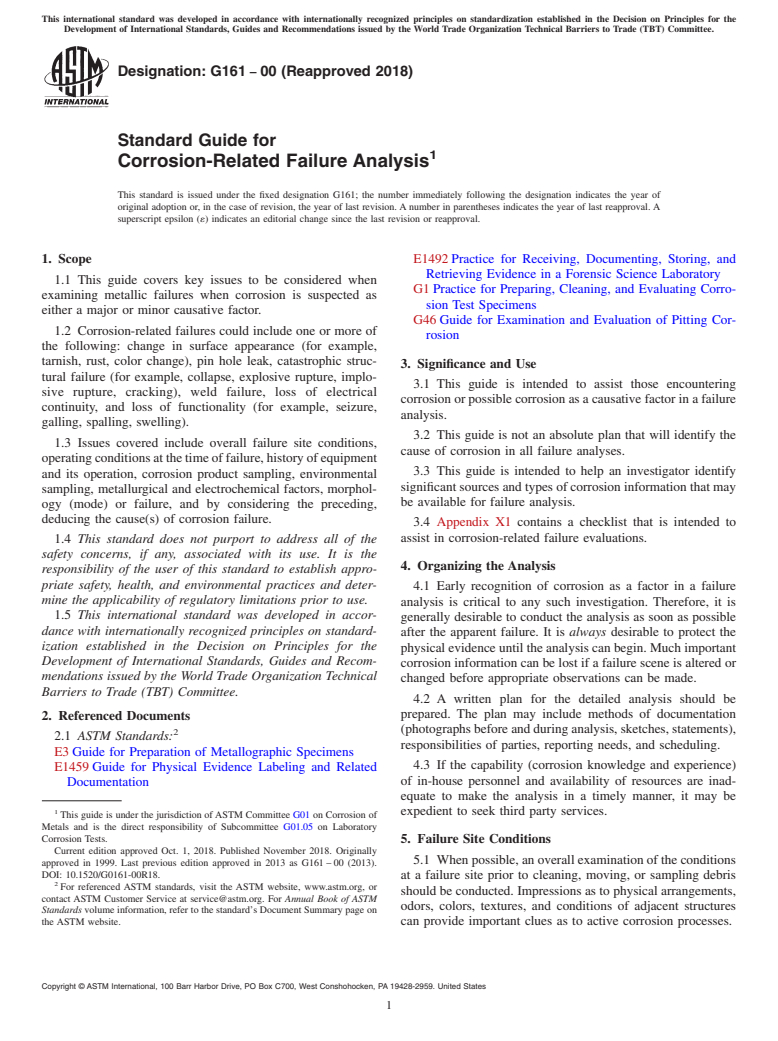
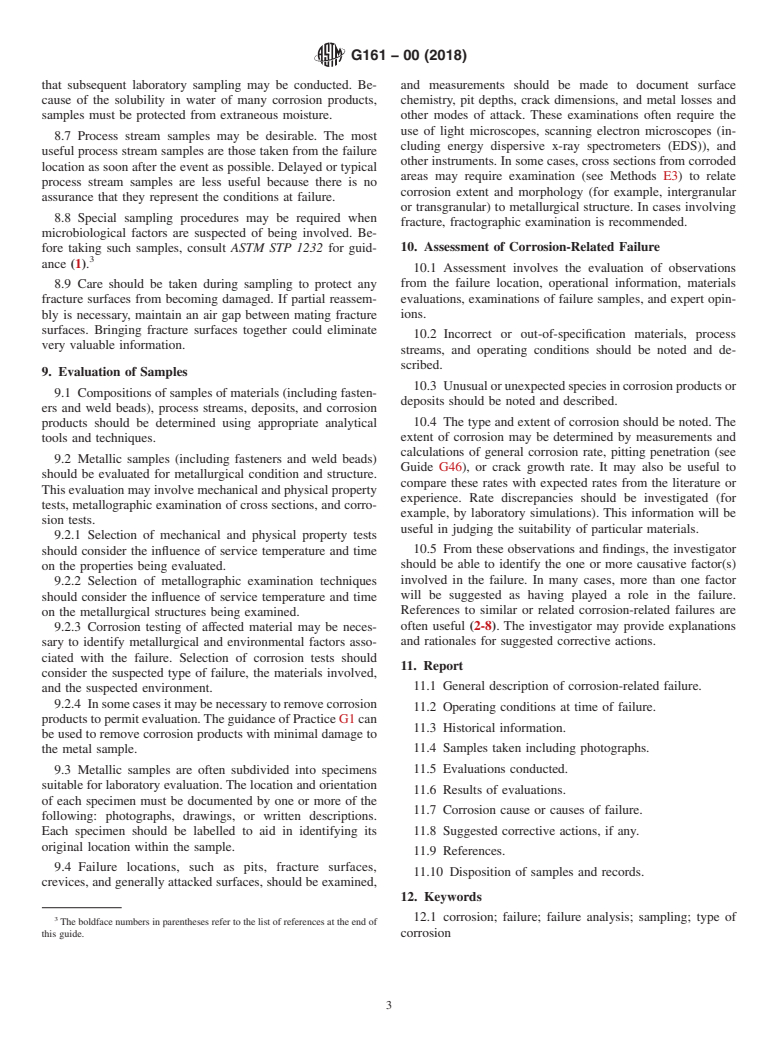
Standards Content (Sample)
This international standard was developed in accordance with internationally recognized principles on standardization established in the Decision on Principles for the
Development of International Standards, Guides and Recommendations issued by the World Trade Organization Technical Barriers to Trade (TBT) Committee.
Designation: G161 − 00 (Reapproved 2018)
Standard Guide for
1
Corrosion-Related Failure Analysis
This standard is issued under the fixed designation G161; the number immediately following the designation indicates the year of
original adoption or, in the case of revision, the year of last revision. A number in parentheses indicates the year of last reapproval. A
superscript epsilon (´) indicates an editorial change since the last revision or reapproval.
1. Scope E1492 Practice for Receiving, Documenting, Storing, and
Retrieving Evidence in a Forensic Science Laboratory
1.1 This guide covers key issues to be considered when
G1 Practice for Preparing, Cleaning, and Evaluating Corro-
examining metallic failures when corrosion is suspected as
sion Test Specimens
either a major or minor causative factor.
G46 Guide for Examination and Evaluation of Pitting Cor-
1.2 Corrosion-related failures could include one or more of
rosion
the following: change in surface appearance (for example,
tarnish, rust, color change), pin hole leak, catastrophic struc-
3. Significance and Use
tural failure (for example, collapse, explosive rupture, implo-
3.1 This guide is intended to assist those encountering
sive rupture, cracking), weld failure, loss of electrical
corrosion or possible corrosion as a causative factor in a failure
continuity, and loss of functionality (for example, seizure,
analysis.
galling, spalling, swelling).
3.2 This guide is not an absolute plan that will identify the
1.3 Issues covered include overall failure site conditions,
cause of corrosion in all failure analyses.
operatingconditionsatthetimeoffailure,historyofequipment
3.3 This guide is intended to help an investigator identify
and its operation, corrosion product sampling, environmental
significant sources and types of corrosion information that may
sampling, metallurgical and electrochemical factors, morphol-
be available for failure analysis.
ogy (mode) or failure, and by considering the preceding,
deducing the cause(s) of corrosion failure.
3.4 Appendix X1 contains a checklist that is intended to
assist in corrosion-related failure evaluations.
1.4 This standard does not purport to address all of the
safety concerns, if any, associated with its use. It is the
4. Organizing the Analysis
responsibility of the user of this standard to establish appro-
priate safety, health, and environmental practices and deter-
4.1 Early recognition of corrosion as a factor in a failure
mine the applicability of regulatory limitations prior to use.
analysis is critical to any such investigation. Therefore, it is
1.5 This international standard was developed in accor-
generally desirable to conduct the analysis as soon as possible
dance with internationally recognized principles on standard-
after the apparent failure. It is always desirable to protect the
ization established in the Decision on Principles for the
physical evidence until the analysis can begin. Much important
Development of International Standards, Guides and Recom-
corrosion information can be lost if a failure scene is altered or
mendations issued by the World Trade Organization Technical
changed before appropriate observations can be made.
Barriers to Trade (TBT) Committee.
4.2 A written plan for the detailed analysis should be
prepared. The plan may include methods of documentation
2. Referenced Documents
(photographsbeforeandduringanalysis,sketches,statements),
2
2.1 ASTM Standards:
responsibilities of parties, reporting needs, and scheduling.
E3 Guide for Preparation of Metallographic Specimens
4.3 If the capability (corrosion knowledge and experience)
E1459 Guide for Physical Evidence Labeling and Related
of in-house personnel and availability of resources are inad-
Documentation
equate to make the analysis in a timely manner, it may be
1
expedient to seek third party services.
This guide is under the jurisdiction ofASTM Committee G01 on Corrosion of
Metals and is the direct responsibility of Subcommittee G01.05 on Laboratory
Corrosion Tests.
5. Failure Site Conditions
Current edition approved Oct. 1, 2018. Published November 2018. Originally
5.1 When possible, an overall examination of the conditions
approved in 1999. Last previous edition approved in 2013 as G161 – 00 (2013).
DOI: 10.1520/G0161-00R18.
at a failure site prior to cleaning, moving, or sampling debris
2
For referenced ASTM standards, visit the ASTM website, www.astm.org, or
should be conducted. Impressions as to physical arrangements,
contact ASTM Customer Service at service@astm.org. For Annual Book of ASTM
odors, colors, textures, and conditions of adjacent structures
Standards volume information, refer to the standard
...
Questions, Comments and Discussion
Ask us and Technical Secretary will try to provide an answer. You can facilitate discussion about the standard in here.