

ASTM F1960-23b
(Specification)Standard Specification for Cold Expansion Fittings with PEX Reinforcing Rings for Use with Cross-linked Polyethylene (PEX) and Polyethylene of Raised Temperature (PE-RT) Tubing
General Information
- Abstract
ABSTRACT
This specification covers cold expansion fittings and cross-linked (PEX) reinforcing rings for use with cross-linked polyethylene (PEX) plastic tubing in specific nominal diameters. These fittings are intended for use in residential and commercial, hot and cold, potable water distribution systems as well as sealed central heating, including under-floor-heating systems. The PEX reinforcing rings shall conform to the required density, degree of cross-linking, and stabilizer migration resistance.
SCOPE
1.1 This specification covers cold expansion fittings and cross-linked (PEX) reinforcing rings for use with cross-linked polyethylene (PEX) plastic tubing in nominal tubing sizes of 3/8 , 1/2 , 5/8 , 3/4 , 1, 11/4 , 11/2 , 2, 21/2 , and 3 in. that meet the requirements of Specification F876 or F3253 and for use with Polyethylene of Raised Temperature (PE-RT) pipe in nominal tubing sizes of 3/8 , 1/2 , 5/8 , 3/4 , 1, 11/4 , 11/2 , 2, 21/2 , and 3 that meet the requirements of Specification F2769. These fittings are intended for use in 100 psi (690 kPa) cold- and hot-water distribution systems operating at temperatures up to and including 180 °F (82 °C). The system is comprised of a PEX reinforcing ring and a cold expansion fitting. Included are the requirements for materials, workmanship, dimensions, and markings to be used on the fitting components. The components covered by this specification are intended for use in residential and commercial, hot and cold, potable water distribution systems as well as building supply lines, sealed central heating, including under-floor-heating systems.
1.2 The values stated in inch-pound units are to be regarded as standard. The values given in parentheses are mathematical conversions to SI units that are provided for information only and are not considered standard.
1.3 This standard does not purport to address all of the safety concerns, if any, associated with its use. It is the responsibility of the user of this standard to establish appropriate safety, health, and environmental practices and determine the applicability of regulatory limitations prior to use.
1.4 This international standard was developed in accordance with internationally recognized principles on standardization established in the Decision on Principles for the Development of International Standards, Guides and Recommendations issued by the World Trade Organization Technical Barriers to Trade (TBT) Committee.
- Status
- Published
- Publication Date
- 31-Aug-2023
- Technical Committee
- F17 - Plastic Piping Systems
- Drafting Committee
- F17.10 - Fittings
Buy Documents
ASTM F1960-23b - Standard Specification for Cold Expansion Fittings with PEX Reinforcing Rings for Use with Cross-linked Polyethylene (PEX) and Polyethylene of Raised Temperature (PE-RT) Tubing
REDLINE ASTM F1960-23b - Standard Specification for Cold Expansion Fittings with PEX Reinforcing Rings for Use with Cross-linked Polyethylene (PEX) and Polyethylene of Raised Temperature (PE-RT) Tubing
Overview
ASTM F1960-23b, Standard Specification for Cold Expansion Fittings with PEX Reinforcing Rings for Use with Cross-linked Polyethylene (PEX) and Polyethylene of Raised Temperature (PE-RT) Tubing, provides comprehensive requirements for cold expansion fittings and PEX reinforcing rings. These components support safe and reliable connections in hot and cold potable water distribution systems, as well as in sealed central heating applications, including under-floor heating.
The standard addresses compatibility with PEX and PE-RT tubing in a broad range of nominal sizes, ensuring pressure performance up to 100 psi at temperatures up to 180°F (82°C). ASTM F1960-23b establishes material, dimensional, marking, and performance requirements, aiming to promote uniformity and safety across plumbing and heating installations in both residential and commercial settings.
Key Topics
- Scope: Covers cold expansion fittings and cross-linked (PEX) reinforcing rings for use with PEX and PE-RT tubing of specific nominal diameters, per ASTM F876, F3253, and F2769.
- Materials: Specifies permissible materials for fittings, including brass, stainless steel, wrought copper, polysulfone, polyphenylene sulfide, and requirements for PEX reinforcing rings.
- Performance requirements: Outlines density, degree of cross-linking, and thermal oxidative resistance for PEX reinforcing rings, including specific testing protocols.
- Dimensions and Tolerances: Provides detailed dimensional and alignment requirements for fittings and reinforcing rings to ensure proper function and compatibility.
- Marking and Identification: Requires manufacturers to apply legible and durable markings to fittings and PEX rings, including product designation, manufacturer's name, and size.
- Assembly and Testing: Describes procedures for assembling fittings with PEX or PE-RT tubing and expansion tools, along with protocols for reinforcing ring testing.
- Safety and Potable Water Compliance: Stipulates that products must comply with ANSI/NSF 61 and relevant health and safety practices if intended for potable water applications.
Applications
ASTM F1960-23b is widely utilized in the construction and plumbing industries for:
- Residential and Commercial Plumbing: Ensures reliable connections in hot and cold potable water distribution systems, supporting both single and multi-family housing projects, as well as commercial buildings.
- Central Heating Systems: Supports use in sealed systems, including hydronic and under-floor heating, providing secure pipe connections capable of handling elevated temperatures and pressures.
- Building Supply Lines: Provides guidelines for fittings and reinforcing rings used in main water supply and distribution within buildings.
- Flexible Plastic Piping Systems: Helps standardize the performance and safety of systems using flexible PEX and PE-RT tubing, a popular alternative to traditional copper or steel piping.
- Regulatory and Quality Assurance: Used by manufacturers, inspectors, and regulatory authorities to verify code compliance and industry best practices for fittings and components installed in potable water and heating systems.
Related Standards
ASTM F1960-23b references and aligns with several other key standards, including:
- ASTM F876: Standard Specification for Crosslinked Polyethylene (PEX) Tubing
- ASTM F3253: Standard Specification for PEX Tubing with Oxygen Barrier
- ASTM F2769: Standard Specification for Polyethylene of Raised Temperature (PE-RT) Tubing
- ASTM F877: Standard Specification for PEX Hot- and Cold-Water Distribution Systems
- ANSI/NSF 14 and 61: Standards for plastic piping components and health effects for drinking water system components
- ASTM Material Specifications: Including standards for brass (B16/B16M, B140/B140M), stainless steel (A351/A351M), copper (B75/B75M), polyphenylene sulfide (D6358), and polysulfone (D6394)
- ISO 9080 and 12162: International standards for thermoplastics pipe materials relating to hydrostatic strength and classification
By incorporating these references, ASTM F1960-23b ensures that products meet a unified set of performance, reliability, and safety criteria required for modern PEX and PE-RT plumbing systems.
Keywords: ASTM F1960-23b, PEX fittings, cold expansion fittings, PEX reinforcing rings, PE-RT tubing, potable water systems, under-floor heating, cross-linked polyethylene, polyethylene of raised temperature, plumbing standards.
Relations
- Effective Date
- 01-Feb-2024
- Effective Date
- 01-Feb-2024
- Effective Date
- 01-Feb-2024
- Effective Date
- 01-Feb-2024
- Effective Date
- 01-Feb-2024
- Effective Date
- 01-Dec-2023
- Effective Date
- 01-Oct-2023
- Effective Date
- 01-Apr-2020
- Effective Date
- 01-Apr-2020
- Effective Date
- 01-Nov-2019
- Effective Date
- 01-Oct-2019
- Refers
ASTM B283/B283M-19a - Standard Specification for Copper and Copper-Alloy Die Forgings (Hot-Pressed) - Effective Date
- 01-Oct-2019
- Effective Date
- 01-Apr-2019
- Effective Date
- 01-Apr-2019
- Refers
ASTM B283/B283M-19 - Standard Specification for Copper and Copper-Alloy Die Forgings (Hot-Pressed) - Effective Date
- 01-Apr-2019
Buy Documents
ASTM F1960-23b - Standard Specification for Cold Expansion Fittings with PEX Reinforcing Rings for Use with Cross-linked Polyethylene (PEX) and Polyethylene of Raised Temperature (PE-RT) Tubing
REDLINE ASTM F1960-23b - Standard Specification for Cold Expansion Fittings with PEX Reinforcing Rings for Use with Cross-linked Polyethylene (PEX) and Polyethylene of Raised Temperature (PE-RT) Tubing
Get Certified
Connect with accredited certification bodies for this standard

Institut za varilstvo d.o.o. (Welding Institute)
Slovenia's leading welding institute since 1952. ISO 3834, EN 1090, pressure equipment certification, NDT personnel, welder qualification. Only IIW Au
Sponsored listings
Frequently Asked Questions
ASTM F1960-23b is a technical specification published by ASTM International. Its full title is "Standard Specification for Cold Expansion Fittings with PEX Reinforcing Rings for Use with Cross-linked Polyethylene (PEX) and Polyethylene of Raised Temperature (PE-RT) Tubing". This standard covers: ABSTRACT This specification covers cold expansion fittings and cross-linked (PEX) reinforcing rings for use with cross-linked polyethylene (PEX) plastic tubing in specific nominal diameters. These fittings are intended for use in residential and commercial, hot and cold, potable water distribution systems as well as sealed central heating, including under-floor-heating systems. The PEX reinforcing rings shall conform to the required density, degree of cross-linking, and stabilizer migration resistance. SCOPE 1.1 This specification covers cold expansion fittings and cross-linked (PEX) reinforcing rings for use with cross-linked polyethylene (PEX) plastic tubing in nominal tubing sizes of 3/8 , 1/2 , 5/8 , 3/4 , 1, 11/4 , 11/2 , 2, 21/2 , and 3 in. that meet the requirements of Specification F876 or F3253 and for use with Polyethylene of Raised Temperature (PE-RT) pipe in nominal tubing sizes of 3/8 , 1/2 , 5/8 , 3/4 , 1, 11/4 , 11/2 , 2, 21/2 , and 3 that meet the requirements of Specification F2769. These fittings are intended for use in 100 psi (690 kPa) cold- and hot-water distribution systems operating at temperatures up to and including 180 °F (82 °C). The system is comprised of a PEX reinforcing ring and a cold expansion fitting. Included are the requirements for materials, workmanship, dimensions, and markings to be used on the fitting components. The components covered by this specification are intended for use in residential and commercial, hot and cold, potable water distribution systems as well as building supply lines, sealed central heating, including under-floor-heating systems. 1.2 The values stated in inch-pound units are to be regarded as standard. The values given in parentheses are mathematical conversions to SI units that are provided for information only and are not considered standard. 1.3 This standard does not purport to address all of the safety concerns, if any, associated with its use. It is the responsibility of the user of this standard to establish appropriate safety, health, and environmental practices and determine the applicability of regulatory limitations prior to use. 1.4 This international standard was developed in accordance with internationally recognized principles on standardization established in the Decision on Principles for the Development of International Standards, Guides and Recommendations issued by the World Trade Organization Technical Barriers to Trade (TBT) Committee.
ABSTRACT This specification covers cold expansion fittings and cross-linked (PEX) reinforcing rings for use with cross-linked polyethylene (PEX) plastic tubing in specific nominal diameters. These fittings are intended for use in residential and commercial, hot and cold, potable water distribution systems as well as sealed central heating, including under-floor-heating systems. The PEX reinforcing rings shall conform to the required density, degree of cross-linking, and stabilizer migration resistance. SCOPE 1.1 This specification covers cold expansion fittings and cross-linked (PEX) reinforcing rings for use with cross-linked polyethylene (PEX) plastic tubing in nominal tubing sizes of 3/8 , 1/2 , 5/8 , 3/4 , 1, 11/4 , 11/2 , 2, 21/2 , and 3 in. that meet the requirements of Specification F876 or F3253 and for use with Polyethylene of Raised Temperature (PE-RT) pipe in nominal tubing sizes of 3/8 , 1/2 , 5/8 , 3/4 , 1, 11/4 , 11/2 , 2, 21/2 , and 3 that meet the requirements of Specification F2769. These fittings are intended for use in 100 psi (690 kPa) cold- and hot-water distribution systems operating at temperatures up to and including 180 °F (82 °C). The system is comprised of a PEX reinforcing ring and a cold expansion fitting. Included are the requirements for materials, workmanship, dimensions, and markings to be used on the fitting components. The components covered by this specification are intended for use in residential and commercial, hot and cold, potable water distribution systems as well as building supply lines, sealed central heating, including under-floor-heating systems. 1.2 The values stated in inch-pound units are to be regarded as standard. The values given in parentheses are mathematical conversions to SI units that are provided for information only and are not considered standard. 1.3 This standard does not purport to address all of the safety concerns, if any, associated with its use. It is the responsibility of the user of this standard to establish appropriate safety, health, and environmental practices and determine the applicability of regulatory limitations prior to use. 1.4 This international standard was developed in accordance with internationally recognized principles on standardization established in the Decision on Principles for the Development of International Standards, Guides and Recommendations issued by the World Trade Organization Technical Barriers to Trade (TBT) Committee.
ASTM F1960-23b is classified under the following ICS (International Classification for Standards) categories: 23.040.45 - Plastics fittings. The ICS classification helps identify the subject area and facilitates finding related standards.
ASTM F1960-23b has the following relationships with other standards: It is inter standard links to ASTM D2765-16(2024), ASTM F876-24, ASTM F3253-24, ASTM F877-24, ASTM F2769-24, ASTM F876-23a, ASTM B927/B927M-23, ASTM B75/B75M-20, ASTM F412-20, ASTM F877-19, ASTM B16/B16M-19, ASTM B283/B283M-19a, ASTM D6358-19, ASTM B75/B75M-19, ASTM B283/B283M-19. Understanding these relationships helps ensure you are using the most current and applicable version of the standard.
ASTM F1960-23b is available in PDF format for immediate download after purchase. The document can be added to your cart and obtained through the secure checkout process. Digital delivery ensures instant access to the complete standard document.
Standards Content (Sample)
This international standard was developed in accordance with internationally recognized principles on standardization established in the Decision on Principles for the
Development of International Standards, Guides and Recommendations issued by the World Trade Organization Technical Barriers to Trade (TBT) Committee.
Designation: F1960 − 23b An American National Standard
Standard Specification for
Cold Expansion Fittings with PEX Reinforcing Rings for Use
with Cross-linked Polyethylene (PEX) and Polyethylene of
Raised Temperature (PE-RT) Tubing
This standard is issued under the fixed designation F1960; the number immediately following the designation indicates the year of
original adoption or, in the case of revision, the year of last revision. A number in parentheses indicates the year of last reapproval. A
superscript epsilon (´) indicates an editorial change since the last revision or reapproval.
1. Scope* 2. Referenced Documents
2.1 ASTM Standards:
1.1 This specification covers cold expansion fittings and
cross-linked (PEX) reinforcing rings for use with cross-linked A351/A351M Specification for Castings, Austenitic, for
Pressure-Containing Parts
polyethylene (PEX) plastic tubing in nominal tubing sizes of
3 1 5 3 1 1 1
⁄8, ⁄2, ⁄8, ⁄4, 1, 1 ⁄4, 1 ⁄2, 2, 2 ⁄2, and 3 in. that meet the B16/B16M Specification for Free-Cutting Brass Rod, Bar
and Shapes for Use in Screw Machines
requirements of Specification F876 or F3253 and for use with
Polyethylene of Raised Temperature (PE-RT) pipe in nominal B62 Specification for Composition Bronze or Ounce Metal
3 1 5 3 1 1 1
Castings
tubing sizes of ⁄8, ⁄2, ⁄8, ⁄4, 1, 1 ⁄4, 1 ⁄2, 2, 2 ⁄2, and 3 that meet
the requirements of Specification F2769. These fittings are B75/B75M Specification for Seamless Copper Tube
B140/B140M Specification for Copper-Zinc-Lead (Red
intended for use in 100 psi (690 kPa) cold- and hot-water
distribution systems operating at temperatures up to and Brass or Hardware Bronze) Rod, Bar, and Shapes
B283/B283M Specification for Copper and Copper-Alloy
including 180 °F (82 °C). The system is comprised of a PEX
reinforcing ring and a cold expansion fitting. Included are the Die Forgings (Hot-Pressed)
B371/B371M Specification for Copper-Zinc-Silicon Alloy
requirements for materials, workmanship, dimensions, and
markings to be used on the fitting components. The compo- Rod
nents covered by this specification are intended for use in B453/B453M Specification for Copper-Zinc-Lead Alloy
residential and commercial, hot and cold, potable water distri- (Leaded-Brass) Rod, Bar, and Shapes
bution systems as well as building supply lines, sealed central B584 Specification for Copper Alloy Sand Castings for
heating, including under-floor-heating systems. General Applications
B927/B927M Specification for Brass Rod, Bar, and Shapes
1.2 The values stated in inch-pound units are to be regarded
B967/B967M Specification for Copper-Zinc-Tin-Bismuth
as standard. The values given in parentheses are mathematical
Alloy Rod, Bar and Wire
conversions to SI units that are provided for information only
D792 Test Methods for Density and Specific Gravity (Rela-
and are not considered standard.
tive Density) of Plastics by Displacement
1.3 This standard does not purport to address all of the
D1505 Test Method for Density of Plastics by the Density-
safety concerns, if any, associated with its use. It is the
Gradient Technique
responsibility of the user of this standard to establish appro-
D1600 Terminology for Abbreviated Terms Relating to Plas-
priate safety, health, and environmental practices and deter-
tics
mine the applicability of regulatory limitations prior to use.
D2122 Test Method for Determining Dimensions of Ther-
1.4 This international standard was developed in accor-
moplastic Pipe and Fittings
dance with internationally recognized principles on standard-
D2765 Test Methods for Determination of Gel Content and
ization established in the Decision on Principles for the
Swell Ratio of Crosslinked Ethylene Plastics
Development of International Standards, Guides and Recom-
D2837 Test Method for Obtaining Hydrostatic Design Basis
mendations issued by the World Trade Organization Technical
for Thermoplastic Pipe Materials or Pressure Design Basis
Barriers to Trade (TBT) Committee.
for Thermoplastic Pipe Products
D6358 Classification System and Basis for Specification for
This specification is under the jurisdiction of ASTM Committee F17 on Plastic
Piping Systems and is the direct responsibility of Subcommittee F17.10 on Fittings For referenced ASTM standards, visit the ASTM website, www.astm.org, or
Current edition approved Sept. 1, 2023. Published September 2023. Originally contact ASTM Customer Service at service@astm.org. For Annual Book of ASTM
approved in 1999. Last previous edition approved in 2023 as F1960 – 23a. DOI: Standards volume information, refer to the standard’s Document Summary page on
10.1520/F1960-23B. the ASTM website.
*A Summary of Changes section appears at the end of this standard
Copyright © ASTM International, 100 Barr Harbor Drive, PO Box C700, West Conshohocken, PA 19428-2959. United States
F1960 − 23b
Poly (Phenylene Sulfide) (PPS) Injection Molding, Extru- tubing that meets the requirements of Specification F876 or
sion and Blow Molding Materials Using ISO Methods F3253 and with PE-RT tubing that meets the requirements of
D6394 Classification System for and Basis for Specification Specification F2769.
for Sulfone Plastics (SP)
5. Materials and Manufacture
F412 Terminology Relating to Plastic Piping Systems
F876 Specification for Crosslinked Polyethylene (PEX) Tub-
5.1 Cold expansion fittings shall be made from one of the
ing
following materials:
F877 Specification for Crosslinked Polyethylene (PEX) Hot-
5.1.1 Brass:
and Cold-Water Distribution Systems
5.1.1.1 Machined Brass—Machined brass fittings shall be
F2769 Specification for Polyethylene of Raised Temperature
made from material meeting the requirements of one of the
(PE-RT) Plastic Hot and Cold-Water Tubing and Distri-
following listed below:
bution Systems
Specification Alloy
F3253 Specification for Crosslinked Polyethylene (PEX)
ASTM B16/B16M UNS C36000
ASTM B140/B140M UNS C31400
Tubing with Oxygen Barrier for Hot- and Cold-Water
ASTM B371/B371M UNS C69300, C69850
Hydronic Distribution Systems
Standard EN 12164 CW614N
ASTM B453/B453M UNS C35300
2.2 ANSI Standard:
3 ASTM B927/B927M UNS C27450, C27451
B1.20 Pipe Threads General Purpose
ASTM B967/B967M UNS C49260, C49340
B16.18 Cast Copper Alloy Solder Joint Pressure Fittings
5.1.1.2 Forged Brass—Forged brass fittings shall be made
B16.22 Wrought Copper and Copper Alloy Solder Joint
from material meeting the requirements of Specification B283/
Pressure Fittings
B283M, Copper Alloy UNS Nos. C27450, C27451, C27453,
2.3 NSF Standards:
C35330, C36500, C37700, C46400, C46500, C48600,
NSF 14 for Plastic Piping Components and Related Materi-
C49260, C49340, C69300, or C69850.
als
5.1.1.3 Cast Copper Alloys—Cast copper alloy fittings shall
NSF 61 for Drinking Water System Components-Health
be made from material meeting the requirements of Specifica-
Effects
tion B584, Copper Alloy UNS Nos. C84400, C83800, C87850
2.4 Manufacturers’ Standardization Society Standards:
or C89844 or C89836 or Specification B62, Copper Alloy UNS
SP-104 Wrought Copper Solder Joint Pressure Fittings No. C83600, or Standard EN 1982, copper alloy EN Symbol
CuSn4Zn6Pb3–C.
2.5 ISO Standards:
5.1.2 Sulfone:
ISO 9080 Plastics piping and ducting systems -- Determina-
5.1.2.1 20 % Glass-Filled Polysulfone—Polysulfone fittings
tion of the long-term hydrostatic strength of thermoplas-
produced using glass reinforcement shall be molded from
tics materials in pipe form by extrapolation
polysulfone materials as specified in Classification D6394. The
ISO 12162 Thermoplastics materials for pipes and fittings
polymers shall consist of polysulfone and glass fiber and meet
for pressure applications –Classification, designation and
the following line call out for additional properties
design coefficient
(SP0110G20A30430).
5.1.2.2 Unreinforced Sulfone Plastic (SP)—Fittings shall be
3. Terminology
molded from sulfone plastic (SP) as specified in Classification
3.1 Definitions:
D6394. The material shall be unreinforced polysulfone (group
3.1.1 Definitions are in accordance with Terminology F412
01, class 1, grade 2), or polyphenylsulfone (group 3, class 1,
and abbreviations are in accordance with Terminology D1600,
grade 2.) or unreinforced polyphenylsulfone/polysulfone
unless otherwise indicated.
blends (group 04, class 1, grade 2) or reworked plastic in
3.1.2 PEX reinforcing rings—cross-linked polyethylene
accordance with 5.1.2.3.
rings used to add contraction force around the cold expansion
5.1.2.3 Clean rework material of the same commercial
fittings.
designation, generated for the manufacturer’s own production
may be used by the same manufacturer, provided the fittings
4. Classification
meet all of the requirements of this specification. Rework
4.1 This specification covers one class of cold expansion
material shall not be introduced at a ratio exceeding 25%.
fittings with PEX reinforcing rings suitable for use with PEX
5.1.3 Polyphenylene sulfide (PPS):
5.1.3.1 Unreinforced Polyphenylene sulfide (PPS)—Fittings
shall be molded from unreinforced Polyphenylene sulfide
Available from American National Standards Institute (ANSI), 25 W. 43rd St.,
(PPS) as specified in Classification D6358. The polymers shall
4th Floor, New York, NY 10036, http://www.ansi.org
consist of PPS and meet the following line call out for
Available from NSF International, P.O. Box 130140, 789 N. Dixboro Rd., Ann
additional properties (PPS0000B32240).
Arbor, MI 48113-0140, http://www.nsf.org.
5.1.3.2 Clean rework material of the same commercial
Available from Manufacturers Standardization Society of the Valve and Fittings
Industry (MSS), 127 Park St., NE, Vienna, VA 22180-4602, http://www.mss-
designation, generated for the manufacturer’s own production
hq.com.
may be used by the same manufacturer, provided the fittings
Available from International Organization for Standardization (ISO), ISO
meet all of the requirements of this specification. Rework
Central Secretariat, BIBC II, Chemin de Blandonnet 8, CP 401, 1214 Vernier,
Geneva, Switzerland, http://www.iso.org. material shall not be introduced at a ratio exceeding 25 %.
F1960 − 23b
NOTE 1—All wetted and pressure carrying polymeric materials used to
joint ends shall be accordance with ANSI B16.18, ANSI
manufacture the fittings should be suitable for the intended applications,
B16.22, or Manufacturers’ Standardization Society SP-104.
that is, hot and cold potable water plumbing systems, in addition to the
performance requirements of this specification. Those qualifying charac-
7. Performance Requirements
teristics include but are not limited to an established hydrostatic design
basis (HDB) in accordance with Test Method D2837 or a minimum
7.1 PEX Reinforcing Rings:
required stress (MRS) in accordance with ISO 9080/ ISO 12162 and a
7.1.1 Density—When determined in accordance with 11.1,
demonstration of resistance to the long-term effects of those chemicals
normally found in water conveyed in these applications (for example,
the PEX reinforcing rings shall have a density in the range
disinfectants such as sodium hypochlorite used in potable water) at the
from 926 to 940 kg/m .
maximum temperature stated in this specification.
7.1.2 Degree of Cross-linking—When tested in accordance
5.2 Reinforcing rings shall be made from PEX material
with 11.2, the degree of cross-linking for PEX reinforcing rings
meeting the performance requirements of 6.1.
shall be within the range from 70 to 89% inclusive.
5.3 Stainless Steel—fittings shall be made from material 7.1.3 Thermal Oxidative Resistance—The material used to
make the PEX rings shall meet the thermal oxidative resistance
meeting the requirements of Specification A351/A351M, stain-
less steel UNS No. J92800 or UNS J92600. requirements as defined in 11.3 of this specification.
5.4 Wrought Copper—Wrought copper fittings shall be
8. Dimensions
made from material meeting the requirements of Specification
B75/B75M for one of the following coppers: copper UNS
8.1 Dimensions and Tolerances—The dimensions and toler-
C10200, C10300, C10800, or C12200. ances of fittings and PEX reinforcing rings shall be as shown
in Figs. 1 and 2, and Fig. 4 when measured in accordance with
6. General Requirements 6.2.
8.1.1 Alignment—The maximum angular variation of any
6.1 General—All performance tests shall be performed on
opening shall not exceed 1° off the true centerline axis.
assemblies of fittings, PEX reinforcing rings and PEX or
8.1.2 Fittings with Solder Joint Ends—Solder joint ends
PE-RT tubing. Fittings and reinforcing rings shall meet the
shall be in accordance with ANSI B16.22, ANSI B16.18 or
material and dimensional requirements of this specification.
MSS SP-104.
PEX tubing shall meet the requirements of Specification F876
8.1.3 Tapered Threaded Ends—Fitting threads shall be
or F3253. PE-RT tubing shall meet the requirements of
Specification F2769. Assembly of test specimens shall be in right-hand conforming to ANSI B1.20.1. They shall be taper
threads (NPT).
accordance with 10.1. Each assembly shall contain at least two
joints. Use separate sets of assemblies for each performance
test requirement. 9. Workmanship, Finish, and Appearance
6.1.1 Fitting manufactured according to this specification
9.1 The fittings shall be made from compounds that are
and intended for use with PEX tubing meeting requirements of
homogeneous throughout. The sealing surfaces of the insert
Specification F876, shall comply with the following perfor-
shall be smooth and free of foreign material. The fitting walls
mance requirements of Specification F877. When a section
shall be free of cracks, holes, blisters, voids, foreign inclusions,
with an identical title appears in this specification, it contains
or other defects that are visible to the naked eye and that affect
additional requirements that supplement those found in Speci-
wall integrity.
fication F877.
6.1.1.1 Requirements,
10. Assembly
6.1.1.2 Test Methods, and
10.1 Cold Expansion Joints—Fittings shall be joined to
6.1.1.3 Retest and Rejection.
PEX or PE-RT tubing by the contraction of the expanded
6.1.2 Fittings, manufactured according to this specification
tubing and reinforcing ring over the insert of the cold expan-
and intended for use with PE-RT tubing meeting the require-
sion fitting. Fitt
...
This document is not an ASTM standard and is intended only to provide the user of an ASTM standard an indication of what changes have been made to the previous version. Because
it may not be technically possible to adequately depict all changes accurately, ASTM recommends that users consult prior editions as appropriate. In all cases only the current version
of the standard as published by ASTM is to be considered the official document.
Designation: F1960 − 23a F1960 − 23b An American National Standard
Standard Specification for
Cold Expansion Fittings with PEX Reinforcing Rings for Use
with Cross-linked Polyethylene (PEX) and Polyethylene of
Raised Temperature (PE-RT) Tubing
This standard is issued under the fixed designation F1960; the number immediately following the designation indicates the year of
original adoption or, in the case of revision, the year of last revision. A number in parentheses indicates the year of last reapproval. A
superscript epsilon (´) indicates an editorial change since the last revision or reapproval.
1. Scope*
1.1 This specification covers cold expansion fittings and cross-linked (PEX) reinforcing rings for use with cross-linked
3 1 5 3 1 1 1
polyethylene (PEX) plastic tubing in nominal tubing sizes of ⁄8, ⁄2, ⁄8, ⁄4, 1, 1 ⁄4, 1 ⁄2, 2, 2 ⁄2, and 3 in. that meet the requirements
of Specification F876 or F3253 and for use with Polyethylene of Raised Temperature (PE-RT) pipe in nominal tubing sizes of ⁄8,
1 5 3 1 1 1
⁄2, ⁄8, ⁄4, 1, 1 ⁄4, 1 ⁄2, 2, 2 ⁄2, and 3 that meet the requirements of Specification F2769. These fittings are intended for use in 100
psi (690 kPa) cold- and hot-water distribution systems operating at temperatures up to and including 180 °F (82 °C). The system
is comprised of a PEX reinforcing ring and a cold expansion fitting. Included are the requirements for materials, workmanship,
dimensions, and markings to be used on the fitting components. The components covered by this specification are intended for use
in residential and commercial, hot and cold, potable water distribution systems as well as building supply lines, sealed central
heating, including under-floor-heating systems.
1.2 The values stated in inch-pound units are to be regarded as standard. The values given in parentheses are mathematical
conversions to SI units that are provided for information only and are not considered standard.
1.3 This standard does not purport to address all of the safety concerns, if any, associated with its use. It is the responsibility
of the user of this standard to establish appropriate safety, health, and environmental practices and determine the applicability of
regulatory limitations prior to use.
1.4 This international standard was developed in accordance with internationally recognized principles on standardization
established in the Decision on Principles for the Development of International Standards, Guides and Recommendations issued
by the World Trade Organization Technical Barriers to Trade (TBT) Committee.
2. Referenced Documents
2.1 ASTM Standards:
A351/A351M Specification for Castings, Austenitic, for Pressure-Containing Parts
B16/B16M Specification for Free-Cutting Brass Rod, Bar and Shapes for Use in Screw Machines
B62 Specification for Composition Bronze or Ounce Metal Castings
B75/B75M Specification for Seamless Copper Tube
B140/B140M Specification for Copper-Zinc-Lead (Red Brass or Hardware Bronze) Rod, Bar, and Shapes
B283/B283M Specification for Copper and Copper-Alloy Die Forgings (Hot-Pressed)
B371/B371M Specification for Copper-Zinc-Silicon Alloy Rod
This specification is under the jurisdiction of ASTM Committee F17 on Plastic Piping Systems and is the direct responsibility of Subcommittee F17.10 on Fittings
Current edition approved April 1, 2023Sept. 1, 2023. Published April 2023September 2023. Originally approved in 1999. Last previous edition approved in 2023 as
F1960 – 23.F1960 – 23a. DOI: 10.1520/F1960-23A.10.1520/F1960-23B.
For referenced ASTM standards, visit the ASTM website, www.astm.org, or contact ASTM Customer Service at service@astm.org. For Annual Book of ASTM Standards
volume information, refer to the standard’s Document Summary page on the ASTM website.
*A Summary of Changes section appears at the end of this standard
Copyright © ASTM International, 100 Barr Harbor Drive, PO Box C700, West Conshohocken, PA 19428-2959. United States
F1960 − 23b
B453/B453M Specification for Copper-Zinc-Lead Alloy (Leaded-Brass) Rod, Bar, and Shapes
B584 Specification for Copper Alloy Sand Castings for General Applications
B927/B927M Specification for Brass Rod, Bar, and Shapes
B967/B967M Specification for Copper-Zinc-Tin-Bismuth Alloy Rod, Bar and Wire
D792 Test Methods for Density and Specific Gravity (Relative Density) of Plastics by Displacement
D1505 Test Method for Density of Plastics by the Density-Gradient Technique
D1600 Terminology for Abbreviated Terms Relating to Plastics
D2122 Test Method for Determining Dimensions of Thermoplastic Pipe and Fittings
D2765 Test Methods for Determination of Gel Content and Swell Ratio of Crosslinked Ethylene Plastics
D2837 Test Method for Obtaining Hydrostatic Design Basis for Thermoplastic Pipe Materials or Pressure Design Basis for
Thermoplastic Pipe Products
D6358 Classification System and Basis for Specification for Poly (Phenylene Sulfide) (PPS) Injection Molding, Extrusion and
Blow Molding Materials Using ISO Methods
D6394 Classification System for and Basis for Specification for Sulfone Plastics (SP)
F412 Terminology Relating to Plastic Piping Systems
F876 Specification for Crosslinked Polyethylene (PEX) Tubing
F877 Specification for Crosslinked Polyethylene (PEX) Hot- and Cold-Water Distribution Systems
F2769 Specification for Polyethylene of Raised Temperature (PE-RT) Plastic Hot and Cold-Water Tubing and Distribution
Systems
F3253 Specification for Crosslinked Polyethylene (PEX) Tubing with Oxygen Barrier for Hot- and Cold-Water Hydronic
Distribution Systems
2.2 ANSI Standard:
B1.20 Pipe Threads General Purpose
B16.18 Cast Copper Alloy Solder Joint Pressure Fittings
B16.22 Wrought Copper and Copper Alloy Solder Joint Pressure Fittings
2.3 NSF Standards:
NSF 14 for Plastic Piping Components and Related Materials
NSF 61 for Drinking Water System Components-Health Effects
2.4 Manufacturers’ Standardization Society Standards:
SP-104 Wrought Copper Solder Joint Pressure Fittings
2.5 ISO Standards:
ISO 9080 Plastics piping and ducting systems -- Determination of the long-term hydrostatic strength of thermoplastics materials
in pipe form by extrapolation
ISO 12162 Thermoplastics materials for pipes and fittings for pressure applications –Classification, designation and design
coefficient
3. Terminology
3.1 Definitions:
3.1.1 Definitions are in accordance with Terminology F412 and abbreviations are in accordance with Terminology D1600, unless
otherwise indicated.
3.1.2 PEX reinforcing rings—cross-linked polyethylene rings used to add contraction force around the cold expansion fittings.
4. Classification
4.1 This specification covers one class of cold expansion fittings with PEX reinforcing rings suitable for use with PEX tubing that
meets the requirements of Specification F876 or F3253 and with PE-RT tubing that meets the requirements of Specification F2769.
5. Materials and Manufacture
5.1 Cold expansion fittings shall be made from one of the following materials:
Available from American National Standards Institute (ANSI), 25 W. 43rd St., 4th Floor, New York, NY 10036, http://www.ansi.org
Available from NSF International, P.O. Box 130140, 789 N. Dixboro Rd., Ann Arbor, MI 48113-0140, http://www.nsf.org.
Available from Manufacturers Standardization Society of the Valve and Fittings Industry (MSS), 127 Park St., NE, Vienna, VA 22180-4602, http://www.mss-hq.com.
Available from International Organization for Standardization (ISO), ISO Central Secretariat, BIBC II, Chemin de Blandonnet 8, CP 401, 1214 Vernier, Geneva,
Switzerland, http://www.iso.org.
F1960 − 23b
5.1.1 Brass:
5.1.1.1 Machined Brass—Machined brass fittings shall be made from material meeting the requirements of one of the following
listed below:
Specification Alloy
ASTM B16/B16M UNS C36000
ASTM B140/B140M UNS C31400
ASTM B371/B371M UNS C69300, C69850
Standard EN 12164 CW614N
ASTM B453/B453M UNS C35300
ASTM B927/B927M UNS C27450, C27451
ASTM B967/B967M UNS C49260, C49340
5.1.1.2 Forged Brass—Forged brass fittings shall be made from material meeting the requirements of Specification B283/B283M,
Copper Alloy UNS Nos. C27450, C27451, C27453, C35330, C36500, C37700, C46400, C46500, C48600, C49260, C49340,
C69300, or C69850.
5.1.1.3 Cast Copper Alloys—Cast copper alloy fittings shall be made from material meeting the requirements of Specification
B584, Copper Alloy UNS Nos. C84400, C83800, C87850 or C89844 or C89836 or Specification B62, Copper Alloy UNS No.
C83600, or Standard EN 1982, copper alloy EN Symbol CuSn4Zn6Pb3–C.
5.1.2 Sulfone:
5.1.2.1 20 % Glass-Filled Polysulfone—Polysulfone fittings produced using glass reinforcement shall be molded from polysulfone
materials as specified in Classification D6394. The polymers shall consist of polysulfone and glass fiber and meet the following
line call out for additional properties (SP0110G20A30430).
5.1.2.2 Unreinforced Sulfone Plastic (SP)—Fittings shall be molded from sulfone plastic (SP) as specified in Classification D6394.
The material shall be unreinforced polysulfone (group 01, class 1, grade 2), or polyphenylsulfone (group 3, class 1, grade 2.) or
unreinforced polyphenylsulfone/polysulfone blends (group 04, class 1, grade 2) or reworked plastic in accordance with 5.1.2.3.
5.1.2.3 Clean rework material of the same commercial designation, generated for the manufacturer’s own production may be used
by the same manufacturer, provided the fittings meet all of the requirements of this specification. Rework material shall not be
introduced at a ratio exceeding 25%.
5.1.3 Polyphenylene sulfide (PPS):
5.1.3.1 Unreinforced Polyphenylene sulfide (PPS)—Fittings shall be molded from unreinforced Polyphenylene sulfide (PPS) as
specified in Classification D6358. The polymers shall consist of PPS and meet the following line call out for additional properties
(PPS0000B32240).
5.1.3.2 Clean rework material of the same commercial designation, generated for the manufacturer’s own production may be used
by the same manufacturer, provided the fittings meet all of the requirements of this specification. Rework material shall not be
introduced at a ratio exceeding 25 %.
NOTE 1—All wetted and pressure carrying polymeric materials used to manufacture the fittings should be suitable for the intended applications, that is,
hot and cold potable water plumbing systems, in addition to the performance requirements of this specification. Those qualifying characteristics include
but are not limited to an established hydrostatic design basis (HDB) in accordance with Test Method D2837 or a minimum required stress (MRS) in
accordance with ISO 9080/ ISO 12162 and a demonstration of resistance to the long-term effects of those chemicals normally found in water conveyed
in these applications (for example, disinfectants such as sodium hypochlorite used in potable water) at the maximum temperature stated in this
specification.
5.2 Reinforcing rings shall be made from PEX material meeting the performance requirements of 6.1.
5.3 Stainless Steel—fittings shall be made from material meeting the requirements of Specification A351/A351M, stainless steel
UNS No. J92800 or UNS J92600.
F1960 − 23b
5.4 Wrought Copper—Wrought copper fittings shall be made from material meeting the requirements of Specification B75/B75M
for one of the following coppers: copper UNS C10200, C10300, C10800, or C12200.
6. General Requirements
6.1 General—All performance tests shall be performed on assemblies of fittings, PEX reinforcing rings and PEX or PE-RT tubing.
Fittings and reinforcing rings shall meet the material and dimensional requirements of this specification. PEX tubing shall meet
the requirements of Specification F876 or F3253. PE-RT tubing shall meet the requirements of Specification F2769. Assembly of
test specimens shall be in accordance with 10.1. Each assembly shall contain at least two joints. Use separate sets of assemblies
for each performance test requirement.
6.1.1 Fitting manufactured according to this specification and intended for use with PEX tubing meeting requirements of
Specification F876, shall comply with the following performance requirements of Specification F877. When a section with an
identical title appears in this specification, it contains additional requirements that supplement those found in Specification F877.
6.1.1.1 Requirements,
6.1.1.2 Test Methods, and
6.1.1.3 Retest and Rejection.
6.1.2 Fittings, manufactured according to this specification and intended for use with PE-RT tubing meeting the requirements of
Specification F2769, shall comply with the following performance requirements of Specification F2769. When a section with an
identical title appears in this Specification, it contains additional requirements that supplement those found in Specification F2769.
6.1.2.1 Requirements,
6.1.2.2 Test Methods, and
6.1.2.3 Retest and Rejection.
6.2 Dimensions—Any randomly selected fitting or fittings and PEX reinforcing rings shall be used to determine dimensions.
Measurements shall be made in accordance with Test Method D2122, except determine diameter by making measurements at four
locations spaced at approximately 45° apart around the circumference. Inspection and gauging of solder joint ends shall be
accordance with ANSI B16.18, ANSI B16.22, or Manufacturers’ Standardization Society SP-104.
7. Performance Requirements
7.1 PEX Reinforcing Rings:
7.1.1 Density—When determined in accordance with 11.1, the PEX reinforcing rings shall have a density in the range from 926
to 940 kg/m .
7.1.2 Degree of Cross-linking—When tested in accordance with 11.2, the degree of cross-linking for PEX reinforcing rings shall
be within the range from 70 to 89% inclusive.
7.1.3 Stabilizer Functionality—Thermal Oxidative Resistance—The material used to make the PEX rings shall meet the stabilizer
functionality thermal oxidative resistance requirements as defined in 11.3 of this specification.
8. Dimensions
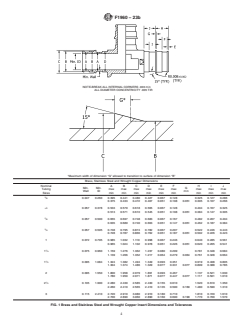
8.1 Dimensions and Tolerances—The dimensions and tolerances of fittings and PEX reinforcing rings shall be as shown in Figs.
1 and 2, and Fig. 4 when measured in accordance with 6.2.
8.1.1 Alignment—The maximum angular variation of any opening shall not exceed 1° off the true centerline axis.
8.1.2 Fittings with Solder Joint Ends—Solder joint ends shall be in accordance with ANSI B16.22, ANSI B16.18 or MSS SP-104.
...