

ASTM D5045-14(2022)
(Test Method)Standard Test Methods for Plane-Strain Fracture Toughness and Strain Energy Release Rate of Plastic Materials
General Information
- Abstract
SIGNIFICANCE AND USE
5.1 The property KIc (GIc) determined by these test methods characterizes the resistance of a material to fracture in a neutral environment in the presence of a sharp crack under severe tensile constraint, such that the state of stress near the crack front approaches plane strain, and the crack-tip plastic (or non-linear viscoelastic) region is small compared with the crack size and specimen dimensions in the constraint direction. A KIc value is believed to represent a lower limiting value of fracture toughness. This value has been used to estimate the relation between failure stress and defect size for a material in service wherein the conditions of high constraint described above would be expected. Background information concerning the basis for development of these test methods in terms of linear elastic fracture mechanics can be found in Refs (1-5).3
5.1.1 The KIc (GIc) value of a given material is a function of testing speed and temperature. Furthermore, cyclic loads have been found to cause crack extension at K values less than KIc (GIc). Crack extension under cyclic or sustained load will be increased by the presence of an aggressive environment. Therefore, application of KIc (GIc) in the design of service components should be made considering differences that may exist between laboratory tests and field conditions.
5.1.2 Plane-strain fracture toughness testing is unusual in that sometimes there is no advance assurance that a valid KIc (GIc) will be determined in a particular test. Therefore it is essential that all of the criteria concerning validity of results be carefully considered as described herein.
5.1.3 Clearly, it will not be possible to determine KIc (GIc) if any dimension of the available stock of a material is insufficient to provide a specimen of the required size.
5.2 Inasmuch as the fracture toughness of plastics is often dependent on specimen process history, that is, injection molded, extruded, compression molded, etc., the spe...
SCOPE
1.1 These test methods are designed to characterize the toughness of plastics in terms of the critical-stress-intensity factor, KIc, and the energy per unit area of crack surface or critical strain energy release rate, GIc, at fracture initiation.
1.2 Two testing geometries are covered by these test methods, single-edge-notch bending (SENB) and compact tension (CT).
1.3 The scheme used assumes linear elastic behavior of the cracked specimen, so certain restrictions on linearity of the load-displacement diagram are imposed.
1.4 A state-of-plane strain at the crack tip is required. Specimen thickness must be sufficient to ensure this stress state.
1.5 The crack must be sufficiently sharp to ensure that a minimum value of toughness is obtained.
1.6 The significance of these test methods and many conditions of testing are identical to those of Test Method E399, and, therefore, in most cases, appear here with many similarities to the metals standard. However, certain conditions and specifications not covered in Test Method E399, but important for plastics, are included.
1.7 This protocol covers the determination of GIc as well, which is of particular importance for plastics.
1.8 These test methods give general information concerning the requirements for KIc and GIc testing. As with Test Method E399, two annexes are provided which give the specific requirements for testing of the SENB and CT geometries.
1.9 Test data obtained by these test methods are relevant and appropriate for use in engineering design.
1.10 This standard does not purport to address all of the safety concerns, if any, associated with its use. It is the responsibility of the user of this standard to establish appropriate safety, health, and environmental practices and determine the applicability of regulatory limitations prior to use.
Note 1: This standard and ISO 13586 address the same subject matter, but differ in technical con...
- Status
- Published
- Publication Date
- 31-Oct-2022
- Technical Committee
- D20 - Plastics
- Drafting Committee
- D20.10 - Mechanical Properties
Overview
ASTM D5045-14(2022): Standard Test Methods for Plane-Strain Fracture Toughness and Strain Energy Release Rate of Plastic Materials is an internationally recognized standard published by ASTM International. This standard outlines test methods to determine two key properties of plastics-plane-strain fracture toughness (KIc) and critical strain energy release rate (GIc). These values are essential for assessing the resistance of plastic materials to crack growth and fracture when subjected to high tensile constraints, especially in environments where cracks may develop due to material flaws or service conditions.
By following ASTM D5045, organizations can obtain reliable fracture toughness data critical to engineering design, safety assessments, and material development, ensuring that plastics can withstand operational stresses and prevent unexpected failures.
Key Topics
- Fracture Toughness (KIc): Represents the resistance of a plastic material to the propagation of a sharp crack under severe tensile constraint, providing a lower limiting value for material toughness.
- Strain Energy Release Rate (GIc): A measure of the energy required to initiate fracture per unit area of crack surface, especially important for viscoelastic and non-linear plastic materials.
- Testing Geometries: Covers two standard specimen types-single-edge-notch bending (SENB) and compact tension (CT)-for consistent, comparable results.
- Linear Elastic Behavior: Assumes test specimens exhibit linear load-displacement up to fracture, with restrictions applied to verify this condition.
- Valid Test Criteria: Outlines strict dimensions and crack conditions required for valid KIc and GIc measurements, including specimen thickness and crack sharpness.
- Environment and Service Considerations: Emphasizes the influence of environment, testing speed, temperature, and specimen process history (e.g., molding methods) on test outcomes.
- Relevance to Engineering Design: Test data are considered directly applicable for design and evaluation of plastic components in practical engineering applications.
Applications
ASTM D5045 plays a vital role in:
- Material Selection and Quality Control: Manufacturers use fracture toughness data to compare plastics, ensure product consistency, and qualify new materials.
- Structural Design: Engineers rely on KIc and GIc values to predict safe operational limits, assess flaw tolerance, and design components that resist cracking under service loads.
- Failure Analysis: Investigators use these standardized methods to determine the cause of crack propagation or catastrophic failure in plastic parts.
- Research and Development: Laboratories use these test methods to develop new plastics or modify processing techniques to improve fracture resistance.
- Regulatory Compliance: Meeting ASTM D5045 requirements demonstrates adherence to recognized best practices, supporting product certification and international trade.
Related Standards
- ASTM E399: Standard Test Method for Linear-Elastic Plane-Strain Fracture Toughness of Metallic Materials, which provides foundational concepts shared with ASTM D5045 but tailored for metals.
- ASTM D638: Test Method for Tensile Properties of Plastics, often used for yielding stress determination in conjunction with fracture toughness testing.
- ISO 13586: Plastics-Determination of fracture toughness (KIc) of linear elastic plastics-Comparable international standard with technical differences.
- ASTM D4000: Classification System for Specifying Plastic Materials, commonly referenced for material specification.
- ASTM E691: Practice for Conducting an Interlaboratory Study to Determine the Precision of a Test Method, relevant for precision evaluation.
Keywords: plane-strain fracture toughness, critical strain energy release rate, KIc, GIc, plastic materials, fracture testing, ASTM D5045, SENB, CT, material design, quality control, crack initiation, failure analysis.
By applying ASTM D5045, industries worldwide ensure the reliability, safety, and compliance of plastic parts across various demanding applications.
Relations
- Effective Date
- 01-May-2013
- Effective Date
- 15-Nov-2012
- Effective Date
- 15-Nov-2012
- Effective Date
- 15-Nov-2012
- Effective Date
- 15-Nov-2012
- Effective Date
- 01-May-2012
- Effective Date
- 01-Nov-2011
- Effective Date
- 01-Apr-2011
- Effective Date
- 01-Jul-2010
- Effective Date
- 15-May-2010
- Effective Date
- 01-May-2010
- Effective Date
- 15-Sep-2009
- Effective Date
- 01-Jul-2009
- Effective Date
- 01-Jul-2009
- Effective Date
- 01-Jan-2009
Get Certified
Connect with accredited certification bodies for this standard

DIN CERTCO
DIN Group product certification.

Smithers Quality Assessments
US management systems and product certification.
Sponsored listings
Frequently Asked Questions
ASTM D5045-14(2022) is a standard published by ASTM International. Its full title is "Standard Test Methods for Plane-Strain Fracture Toughness and Strain Energy Release Rate of Plastic Materials". This standard covers: SIGNIFICANCE AND USE 5.1 The property KIc (GIc) determined by these test methods characterizes the resistance of a material to fracture in a neutral environment in the presence of a sharp crack under severe tensile constraint, such that the state of stress near the crack front approaches plane strain, and the crack-tip plastic (or non-linear viscoelastic) region is small compared with the crack size and specimen dimensions in the constraint direction. A KIc value is believed to represent a lower limiting value of fracture toughness. This value has been used to estimate the relation between failure stress and defect size for a material in service wherein the conditions of high constraint described above would be expected. Background information concerning the basis for development of these test methods in terms of linear elastic fracture mechanics can be found in Refs (1-5).3 5.1.1 The KIc (GIc) value of a given material is a function of testing speed and temperature. Furthermore, cyclic loads have been found to cause crack extension at K values less than KIc (GIc). Crack extension under cyclic or sustained load will be increased by the presence of an aggressive environment. Therefore, application of KIc (GIc) in the design of service components should be made considering differences that may exist between laboratory tests and field conditions. 5.1.2 Plane-strain fracture toughness testing is unusual in that sometimes there is no advance assurance that a valid KIc (GIc) will be determined in a particular test. Therefore it is essential that all of the criteria concerning validity of results be carefully considered as described herein. 5.1.3 Clearly, it will not be possible to determine KIc (GIc) if any dimension of the available stock of a material is insufficient to provide a specimen of the required size. 5.2 Inasmuch as the fracture toughness of plastics is often dependent on specimen process history, that is, injection molded, extruded, compression molded, etc., the spe... SCOPE 1.1 These test methods are designed to characterize the toughness of plastics in terms of the critical-stress-intensity factor, KIc, and the energy per unit area of crack surface or critical strain energy release rate, GIc, at fracture initiation. 1.2 Two testing geometries are covered by these test methods, single-edge-notch bending (SENB) and compact tension (CT). 1.3 The scheme used assumes linear elastic behavior of the cracked specimen, so certain restrictions on linearity of the load-displacement diagram are imposed. 1.4 A state-of-plane strain at the crack tip is required. Specimen thickness must be sufficient to ensure this stress state. 1.5 The crack must be sufficiently sharp to ensure that a minimum value of toughness is obtained. 1.6 The significance of these test methods and many conditions of testing are identical to those of Test Method E399, and, therefore, in most cases, appear here with many similarities to the metals standard. However, certain conditions and specifications not covered in Test Method E399, but important for plastics, are included. 1.7 This protocol covers the determination of GIc as well, which is of particular importance for plastics. 1.8 These test methods give general information concerning the requirements for KIc and GIc testing. As with Test Method E399, two annexes are provided which give the specific requirements for testing of the SENB and CT geometries. 1.9 Test data obtained by these test methods are relevant and appropriate for use in engineering design. 1.10 This standard does not purport to address all of the safety concerns, if any, associated with its use. It is the responsibility of the user of this standard to establish appropriate safety, health, and environmental practices and determine the applicability of regulatory limitations prior to use. Note 1: This standard and ISO 13586 address the same subject matter, but differ in technical con...
SIGNIFICANCE AND USE 5.1 The property KIc (GIc) determined by these test methods characterizes the resistance of a material to fracture in a neutral environment in the presence of a sharp crack under severe tensile constraint, such that the state of stress near the crack front approaches plane strain, and the crack-tip plastic (or non-linear viscoelastic) region is small compared with the crack size and specimen dimensions in the constraint direction. A KIc value is believed to represent a lower limiting value of fracture toughness. This value has been used to estimate the relation between failure stress and defect size for a material in service wherein the conditions of high constraint described above would be expected. Background information concerning the basis for development of these test methods in terms of linear elastic fracture mechanics can be found in Refs (1-5).3 5.1.1 The KIc (GIc) value of a given material is a function of testing speed and temperature. Furthermore, cyclic loads have been found to cause crack extension at K values less than KIc (GIc). Crack extension under cyclic or sustained load will be increased by the presence of an aggressive environment. Therefore, application of KIc (GIc) in the design of service components should be made considering differences that may exist between laboratory tests and field conditions. 5.1.2 Plane-strain fracture toughness testing is unusual in that sometimes there is no advance assurance that a valid KIc (GIc) will be determined in a particular test. Therefore it is essential that all of the criteria concerning validity of results be carefully considered as described herein. 5.1.3 Clearly, it will not be possible to determine KIc (GIc) if any dimension of the available stock of a material is insufficient to provide a specimen of the required size. 5.2 Inasmuch as the fracture toughness of plastics is often dependent on specimen process history, that is, injection molded, extruded, compression molded, etc., the spe... SCOPE 1.1 These test methods are designed to characterize the toughness of plastics in terms of the critical-stress-intensity factor, KIc, and the energy per unit area of crack surface or critical strain energy release rate, GIc, at fracture initiation. 1.2 Two testing geometries are covered by these test methods, single-edge-notch bending (SENB) and compact tension (CT). 1.3 The scheme used assumes linear elastic behavior of the cracked specimen, so certain restrictions on linearity of the load-displacement diagram are imposed. 1.4 A state-of-plane strain at the crack tip is required. Specimen thickness must be sufficient to ensure this stress state. 1.5 The crack must be sufficiently sharp to ensure that a minimum value of toughness is obtained. 1.6 The significance of these test methods and many conditions of testing are identical to those of Test Method E399, and, therefore, in most cases, appear here with many similarities to the metals standard. However, certain conditions and specifications not covered in Test Method E399, but important for plastics, are included. 1.7 This protocol covers the determination of GIc as well, which is of particular importance for plastics. 1.8 These test methods give general information concerning the requirements for KIc and GIc testing. As with Test Method E399, two annexes are provided which give the specific requirements for testing of the SENB and CT geometries. 1.9 Test data obtained by these test methods are relevant and appropriate for use in engineering design. 1.10 This standard does not purport to address all of the safety concerns, if any, associated with its use. It is the responsibility of the user of this standard to establish appropriate safety, health, and environmental practices and determine the applicability of regulatory limitations prior to use. Note 1: This standard and ISO 13586 address the same subject matter, but differ in technical con...
ASTM D5045-14(2022) is classified under the following ICS (International Classification for Standards) categories: 83.080.01 - Plastics in general. The ICS classification helps identify the subject area and facilitates finding related standards.
ASTM D5045-14(2022) has the following relationships with other standards: It is inter standard links to ASTM E691-13, ASTM E399-12e1, ASTM E399-12e2, ASTM E399-12, ASTM E399-12e3, ASTM D4000-12, ASTM E691-11, ASTM D4000-11, ASTM D4000-10a, ASTM D638-10, ASTM D4000-10, ASTM D4000-09b, ASTM E399-09, ASTM E399-09e1, ASTM D4000-09a. Understanding these relationships helps ensure you are using the most current and applicable version of the standard.
ASTM D5045-14(2022) is available in PDF format for immediate download after purchase. The document can be added to your cart and obtained through the secure checkout process. Digital delivery ensures instant access to the complete standard document.
Standards Content (Sample)
This international standard was developed in accordance with internationally recognized principles on standardization established in the Decision on Principles for the
Development of International Standards, Guides and Recommendations issued by the World Trade Organization Technical Barriers to Trade (TBT) Committee.
Designation: D5045 − 14 (Reapproved 2022)
Standard Test Methods for
Plane-Strain Fracture Toughness and Strain Energy Release
Rate of Plastic Materials
This standard is issued under the fixed designation D5045; the number immediately following the designation indicates the year of
original adoption or, in the case of revision, the year of last revision.Anumber in parentheses indicates the year of last reapproval.A
superscript epsilon (´) indicates an editorial change since the last revision or reapproval.
1. Scope priate safety, health, and environmental practices and deter-
mine the applicability of regulatory limitations prior to use.
1.1 These test methods are designed to characterize the
toughness of plastics in terms of the critical-stress-intensity
NOTE1—ThisstandardandISO13586addressthesamesubjectmatter,
but differ in technical content.
factor, K , and the energy per unit area of crack surface or
Ic
critical strain energy release rate, G , at fracture initiation.
1.11 This international standard was developed in accor-
Ic
dance with internationally recognized principles on standard-
1.2 Two testing geometries are covered by these test
ization established in the Decision on Principles for the
methods, single-edge-notch bending (SENB) and compact
Development of International Standards, Guides and Recom-
tension (CT).
mendations issued by the World Trade Organization Technical
1.3 The scheme used assumes linear elastic behavior of the
Barriers to Trade (TBT) Committee.
cracked specimen, so certain restrictions on linearity of the
load-displacement diagram are imposed. 2. Referenced Documents
1.4 A state-of-plane strain at the crack tip is required. 2.1 ASTM Standards:
Specimen thickness must be sufficient to ensure this stress D638Test Method for Tensile Properties of Plastics
state. D4000Classification System for Specifying Plastic Materi-
als
1.5 The crack must be sufficiently sharp to ensure that a
E399Test Method for Linear-Elastic Plane-Strain Fracture
minimum value of toughness is obtained.
Toughness of Metallic Materials
1.6 The significance of these test methods and many con-
E691Practice for Conducting an Interlaboratory Study to
ditions of testing are identical to those of Test Method E399,
Determine the Precision of a Test Method
and, therefore, in most cases, appear here with many similari-
3. Terminology
ties to the metals standard. However, certain conditions and
specifications not covered in Test Method E399, but important
3.1 Definitions:
for plastics, are included.
3.1.1 compact tension, n—specimen geometry consisting of
single-edge notched plate loaded in tension. See 3.1.5 for
1.7 This protocol covers the determination of G as well,
Ic
reference to additional definition.
which is of particular importance for plastics.
3.1.2 critical strain energy release rate, G ,n—toughness
1.8 Thesetestmethodsgivegeneralinformationconcerning Ic
parameter based on energy required to fracture. See 3.1.5 for
the requirements for K and G testing. As with Test Method
Ic Ic
reference to additional definition.
E399, two annexes are provided which give the specific
requirements for testing of the SENB and CT geometries. 3.1.3 plane-strain fracture toughness, K ,n—toughness
Ic
parameter indicative of the resistance of a material to fracture.
1.9 Testdataobtainedbythesetestmethodsarerelevantand
See 3.1.5 for reference to additional definition.
appropriate for use in engineering design.
3.1.4 single-edge notched bend, n—specimen geometry
1.10 This standard does not purport to address all of the
consisting of center-notched beam loaded in three-point bend-
safety concerns, if any, associated with its use. It is the
ing. See 3.1.5 for reference to additional definition.
responsibility of the user of this standard to establish appro-
3.1.5 Reference is made toTest Method E399 for additional
explanation of definitions.
These test methods are under the jurisdiction of ASTM Committee D20 on
Plastics and is the direct responsibility of Subcommittee D20.10 on Mechanical
Properties. For referenced ASTM standards, visit the ASTM website, www.astm.org, or
Current edition approved Nov. 1, 2022. Published November 2022. Originally contact ASTM Customer Service at service@astm.org. For Annual Book of ASTM
approved in 1990. Last previous edition approved in 2014 as D5045-14. DOI: Standards volume information, refer to the standard’s Document Summary page on
10.1520/D5045-14R22. the ASTM website.
*A Summary of Changes section appears at the end of this standard
Copyright © ASTM International, 100 Barr Harbor Drive, PO Box C700, West Conshohocken, PA 19428-2959. United States
D5045 − 14 (2022)
3.2 Definitions of Terms Specific to This Standard: 5.2 Inasmuch as the fracture toughness of plastics is often
3.2.1 yield stress, n—stress at fracture is used. The slope of dependent on specimen process history, that is, injection
the stress-strain curve is not required to be zero. See 7.2 for molded, extruded, compression molded, etc., the specimen
reference to additional definition. crack orientation (parallel or perpendicular) relative to any
processing direction shall be noted on the report form dis-
4. Summary of Test Methods
cussed in 10.1.
4.1 These test methods involve loading a notched specimen
5.3 Before proceeding with this test method, reference
that has been pre-cracked, in either tension or three-point
shouldbemadetothespecificationofthematerialbeingtested.
bending. The load corresponding to a 2.5% apparent incre-
Any test specimen preparation, conditioning, dimensions, or
ment of crack extension is established by a specified deviation
testing parameters, or combination thereof, covered in the
from the linear portion of the record. The K value is
Ic
relevant ASTM materials specification shall take precedence
calculated from this load by equations that have been estab-
over those mentioned in this test method. If there are no
lishedonthebasisofelasticstressanalysisonspecimensofthe
relevantASTM material specifications, then the default condi-
type described in the test methods. The validity of the
tions apply.
determination of the K value by these test methods depends
Ic
6. Apparatus
upon the establishment of a sharp-crack condition at the tip of
the crack, in a specimen of adequate size to give linear elastic
6.1 Testing Machine—A constant displacement-rate device
behavior.
shall be used such as an electromechanical, screw-driven
4.2 Amethod for the determination of G is provided. The machine, or a closed loop, feedback-controlled servohydraulic
Ic
method requires determination of the energy derived from load frame. For SENB, a rig with either stationary or moving
integrationoftheloadversusload-pointdisplacementdiagram, rollers of sufficiently large diameter to avoid excessive plastic
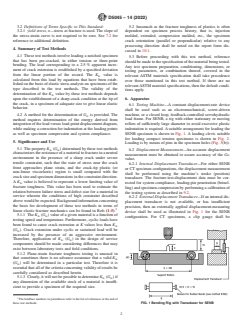
while making a correction for indentation at the loading points indentation is required.Asuitable arrangement for loading the
as well as specimen compression and system compliance. SENB specimen is shown in Fig. 1. A loading clevis suitable
for loading compact tension specimens is shown in Fig. 2.
5. Significance and Use
Loading is by means of pins in the specimen holes (Fig. 3(b)).
5.1 ThepropertyK (G )determinedbythesetestmethods
Ic Ic 6.2 Displacement Measurement—An accurate displacement
characterizestheresistanceofamaterialtofractureinaneutral
measurement must be obtained to assure accuracy of the G
Ic
environment in the presence of a sharp crack under severe
value.
tensile constraint, such that the state of stress near the crack
6.2.1 Internal Displacement Transducer—For either SENB
front approaches plane strain, and the crack-tip plastic (or
orCTspecimenconfigurations,thedisplacementmeasurement
non-linear viscoelastic) region is small compared with the
shall be performed using the machine’s stroke (position)
cracksizeandspecimendimensionsintheconstraintdirection.
transducer. The fracture-test-displacement data must be cor-
A K value is believed to represent a lower limiting value of
Ic rected for system compliance, loading-pin penetration (brinel-
fracture toughness. This value has been used to estimate the
ling)andspecimencompressionbyperformingacalibrationof
relation between failure stress and defect size for a material in
the testing system as described in 9.2.
service wherein the conditions of high constraint described
6.2.2 ExternalDisplacementTransducer—Ifaninternaldis-
abovewouldbeexpected.Backgroundinformationconcerning
placement transducer is not available, or has insufficient
the basis for development of these test methods in terms of
precision, then an externally applied displacement-measuring
linear elastic fracture mechanics can be found in Refs (1-5).
device shall be used as illustrated in Fig. 1 for the SENB
5.1.1 TheK (G )valueofagivenmaterialisafunctionof
Ic Ic
configuration. For CT specimens, a clip gauge shall be
testing speed and temperature. Furthermore, cyclic loads have
been found to cause crack extension at K values less than K
Ic
(G ). Crack extension under cyclic or sustained load will be
Ic
increased by the presence of an aggressive environment.
Therefore, application of K (G ) in the design of service
Ic Ic
components should be made considering differences that may
exist between laboratory tests and field conditions.
5.1.2 Plane-strain fracture toughness testing is unusual in
that sometimes there is no advance assurance that a validK
Ic
(G ) will be determined in a particular test. Therefore it is
Ic
essentialthatallofthecriteriaconcerningvalidityofresultsbe
carefully considered as described herein.
5.1.3 Clearly,itwillnotbepossibletodetermineK (G )if
Ic Ic
any dimension of the available stock of a material is insuffi-
cient to provide a specimen of the required size.
The boldface numbers in parentheses refer to the list of references at the end of
these test methods. FIG. 1 Bending Rig with Transducer for SENB
D5045 − 14 (2022)
maximize this dimension. The specimen width, W,is W=2B.
In both geometries the crack length, a, shall be selected such
that 0.45 < a/W< 0.55.
7.1.2 In order for a result to be considered valid according
to these test methods, the following size criteria must be
satisfied:
B, a, ~W 2 a!.2.5 K /σ (1)
~ !
Q y
where:
K = the conditional or trial K value (see Section 9), and
Q Ic
σ = the yield stress of the material for the temperature and
y
loading rate of the test.
The criteria require that B must be sufficient to ensure plane
strain and that (W−a) be sufficient to avoid excessive plas-
ticity in the ligament. If (W−a) is too small and non-linearity
in loading occurs, then increasing the W/Bratio to a maximum
of 4 is permitted for SENB specimens.
7.2 Yield Stress:
7.2.1 The yield stress, σ , is to be taken from the maximum
y
FIG. 2 Tension Testing Clevis Design for CT
load in a uniaxial tensile test. The yield-stress test can be
performed in a constant stroke-rate uniaxial tensile test where
the loading time to yield is within 620% of the actual loading
time observed in the fracture test.The definition of yield stress
is not identical to that found in Test Method D638 which
requires a zero slope to the stress-strain curve. If it is
established that 2.5 (K /σ ) is substantially less than
Q y
the specimen thickness employed, then a correspondingly
smaller specimen can be used.
7.2.2 Yielding in tensile tests in most polymers can be
achieved by carefully polishing the specimen sides. If yielding
does not occur and brittle fracture is observed, the stress at
fracture shall be used in the criteria to give a conservative size
value.
7.2.3 If a tensile test cannot be performed, then an alterna-
tive method is to use 0.7 times the compressive yield stress.
7.2.4 If the form of the available material is such that it is
not possible to obtain a specimen with both crack length and
thickness greater than 2.5 (K /σ ) , it is not possible to make a
Ic y
valid K (G ) measurement according to these test methods.
Ic Ic
7.2.5 The test method employed for determining yield
stress, as mentioned in 7.2.1 – 7.2.4, must be reported.
7.3 Specimen Configurations:
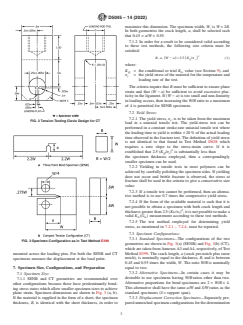
7.3.1 Standard Specimens—The configurations of the two
FIG. 3 Specimen Configuration as in Test Method E399
geometries are shown in Fig. 3(a) (SENB) and Fig. 3(b) (CT),
whicharetakenfromAnnexesA3andA4,respectively,ofTest
Method E399. The crack length, a(crack pre-notch plus razor
mounted across the loading pins. For both the SENB and CT
notch), is nominally equal to the thickness, B, and is between
specimens measure the displacement at the load point.
0.45 and 0.55 times the width, W. The ratio W/Bis nominally
7. Specimen Size, Configurations, and Preparation equal to two.
7.3.2 Alternative Specimens—In certain cases it may be
7.1 Specimen Size:
desirable to use specimens having W/Bratios other than two.
7.1.1 SENB and CT geometries are recommended over
Alternative proportions for bend specimens are 2 < W/B<4.
other configurations because these have predominantly bend-
This alternative shall have the same a/Wand S/Wratios as the
ing stress states which allow smaller specimen sizes to achieve
standard specimens (S=support span).
plane strain. Specimen dimensions are shown in Fig. 3 (a, b).
If the material is supplied in the form of a sheet, the specimen 7.3.3 Displacement Correction Specimens—Separately pre-
thickness, B, is identical with the sheet thickness, in order to paredunnotchedspecimenconfigurationsforthedetermination
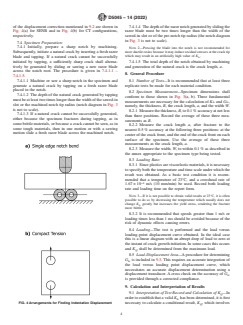
D5045 − 14 (2022)
of the displacement correction mentioned in 9.2 are shown in 7.4.1.4 Thedepthoftherazornotchgeneratedbyslidingthe
Fig. 4(a) for SENB and in Fig. 4(b) for CT configurations, razor blade must be two times longer than the width of the
respectively. sawed-in slot or of the pre-notch tip radius (the notch diagram
in Fig. 3 is not to scale).
7.4 Specimen Preparation:
7.4.1 Initially, prepare a sharp notch by machining.
NOTE 2—Pressing the blade into the notch is not recommended for
moreductileresinsbecauseitmayinduceresidualstressesatthecracktip
Subsequently, initiate a natural crack by inserting a fresh razor
which may result in an artificially high value of K .
Ic
blade and tapping. If a natural crack cannot be successfully
initiated by tapping, a sufficiently sharp crack shall alterna- 7.4.1.5 The total depth of the notch obtained by machining
tively be generated by sliding or sawing a new razor blade and generation of the natural crack is the crack length, a.
across the notch root. The procedure is given in 7.4.1.1 –
8. General Procedure
7.4.1.5.
8.1 Number of Tests—It is recommended that at least three
7.4.1.1 Machine or saw a sharp notch in the specimen and
generate a natural crack by tapping on a fresh razor blade replicate tests be made for each material condition.
placed in the notch.
8.2 Specimen Measurement—Specimen dimensions shall
7.4.1.2 The depth of the natural crack generated by tapping
conform to those shown in Fig. 3(a, b). Three fundamental
mustbeatleasttwotimeslongerthanthewidthofthesawed-in
measurements are necessary for the calculation of K and G ,
Ic Ic
slot or the machined notch tip radius (notch diagram in Fig. 3
namely, the thickness, B, the crack length, a, and the width W.
is not to scale).
8.2.1 Measurethethickness,B,to0.1%accuracyatnotless
7.4.1.3 If a natural crack cannot be successfully generated,
than three positions. Record the average of these three mea-
either because the specimen fractures during tapping, as in
surements as B.
some brittle materials, or because a crack cannot be seen, as in
8.2.2 Measure the crack length a, after fracture to the
some tough materials, then in one motion or with a sawing
nearest 0.5% accuracy at the following three positions: at the
motion slide a fresh razor blade across the machined notch.
centerofthecrackfront,andtheendofthecrackfrontoneach
surface of the specimen. Use the average of these three
measurements as the crack length, a.
8.2.3 Measure the width, W, to within 0.1% as described in
the annex appropriate to the specimen type being tested.
8.3 Loading Rate:
8.3.1 Sinceplasticsareviscoelasticmaterials,itisnecessary
to specify both the temperature and time scale under which the
result was obtained. As a basic test condition it is recom-
mended that a temperature of 23°C, and a crosshead rate of
−4
1.67×10 m/s (10 mm/min) be used. Record both loading
rate and loading time on the report form.
NOTE 3—If it is not possible to obtain valid results at 23°C, it is often
possible to do so by decreasing the temperature which usually does not
change K greatly but increases the yield stress, rendering the fracture
Ic
more brittle.
8.3.2 It is recommended that speeds greater than 1 m/s or
loading times less than 1 ms should be avoided because of the
risk of dynamic effects causing errors.
8.4 Loading—The test is performed and the load versus
loading-point displacement curve obtained. In the ideal case
this is a linear diagram with an abrupt drop of load to zero at
theinstantofcrackgrowthinitiation.Insomecasesthisoccurs
and K shall be determined from the maximum load.
Q
8.5 Load-Displacement Area—Aprocedure for determining
G is included in 9.3. This requires an accurate integration of
Ic
the load versus loading point displacement curve, which
necessitates an accurate displacement determination using a
displacement transducer.Across check on the accuracy of G
Ic
is provided through a corrected compliance.
9. Calculation and Interpretation of Results
9.1 Interpretation of Test Record and Calculation of K —In
Q
ordertoestablishthatavalidK hasbeendetermined,itisfirst
Ic
FIG. 4 Arrangements for Finding Indentation Displacement necessary to calculate a conditional result, K , which involves
Q
D5045 − 14 (2022)
aconstructiononthetestrecord,andtothendeterminewhether the linearity criteria. If the linearity criterion is violated, a
this result is consistent with the size of the specimen in possible option is to increase W for the same a/W and S/W
accordance with 9.1.3.The procedure is given in 9.1.1 – 9.1.5. ratios. Values of W/B of up to 4 are permitted.
9.1.1 Load the specimen and obtain a diagram as shown in
9.1.5 Ifthetestresultfailstomeettherequirementsineither
Fig. 5. Draw a best straight line (AB) to determine the initial
9.1.1 or 9.1.3, or both, it will be necessary to use a larger
compliance, C. C is given by the reciprocal of the slope of line
specimen to determine K . The dimensions of the larger
Q
(AB).Drawasecondline(AB')withacompliance5%greater
specimen can be estimated on the basis of K , but generally
Q
than that of line (AB). If the maximum load that the specimen
mustbeincreasedto1.5timesthoseofthespecimenthatfailed
wasabletosustain,P ,fallswithinlines(AB)and(AB'),use
max to produce a valid K value.
Ic
P to calculate K .If P falls outside line (AB) and line
max Q max
9.2 Displacement Correction for Calculation of G —Make
Q
(AB'),thenusetheintersectionofline(AB')andtheloadcurve
a displacement correction for system compliance, loading-pin
as P . Furthermore, if P /P < 1.1, use P in the calculation
Q max Q Q
penetration, and specimen compression, then calculate G
Ic
of K . However, if P /P > 1.1, the test is invalid.
Q max Q
from the energy derived from integration of the load versus
9.1.2 Calculate K in accordance with the procedure given
Q
load-point displacement curve.
in A1.4 for SENB and A2.5 for CT. For this calculation, a
9.2.1 The procedure for obtaining the corrected
value of a, which is the total crack length after both notching
displacement, u
...