

ASTM D6447-09(2021)
(Test Method)Standard Test Method for Hydroperoxide Number of Aviation Turbine Fuels by Voltammetric Analysis
General Information
- Abstract
SIGNIFICANCE AND USE
4.1 This test method and Test Method D3703 measure the same peroxide species (primarily hydroperoxides) in aviation fuels.
4.2 The magnitude of the hydroperoxide number is an indication of the quantity of oxidizing constituents present. Deterioration of fuel results in the formation of hydroperoxides and other oxygen-carrying compounds. The hydroperoxide number measures those compounds that will oxidize potassium iodide.
4.3 The determination of the hydroperoxide number of fuels is significant because of the adverse effect of hydroperoxides upon certain elastomers in the fuel systems.
SCOPE
1.1 The test method covers the determination of the hydroperoxide content of aviation turbine fuels. The test method may also be applicable to the determination of the hydroperoxide content of any water-insoluble, organic fluid, particularly diesel fuels, gasolines, and kerosines.
1.2 The values stated in SI units are to be regarded as standard. No other units of measurement are included in this standard.
1.3 This standard does not purport to address all the safety concerns, if any, associated with its use. It is the responsibility of the user of this standard to consult and establish appropriate safety, health, and environmental practices and determine the applicability of regulatory limitations prior to use. For specific warning statements, see 6.3 – 6.5, Annex A1, and Annex A2.
1.4 This international standard was developed in accordance with internationally recognized principles on standardization established in the Decision on Principles for the Development of International Standards, Guides and Recommendations issued by the World Trade Organization Technical Barriers to Trade (TBT) Committee.
- Status
- Published
- Publication Date
- 31-Dec-2020
- Technical Committee
- D02 - Petroleum Products, Liquid Fuels, and Lubricants
- Drafting Committee
- D02.05 - Properties of Fuels, Petroleum Coke and Carbon Material
Overview
ASTM D6447-09(2021) - Standard Test Method for Hydroperoxide Number of Aviation Turbine Fuels by Voltammetric Analysis establishes the procedure for determining the hydroperoxide content in aviation turbine fuels. This standard is published by ASTM International and is essential for the quality control and stability assessment of aviation fuels. By measuring the hydroperoxide number, stakeholders can evaluate the presence of oxidizing constituents that may form as fuel deteriorates, safeguarding both operational performance and material compatibility in fuel systems.
Key Topics
Hydroperoxide Number Determination:
The test method quantifies hydroperoxides and similar peroxide species in aviation turbine fuels through voltammetric analysis. Hydroperoxides are critical indicators of fuel oxidation and degradation.Test Method Applicability:
While designed for aviation turbine fuels, this test is also applicable to other water-insoluble, organic fluids including diesel fuels, gasolines, and kerosenes.Measurement Principle:
The methodology involves reacting fuel samples with potassium iodide in the presence of acid. Oxidizing compounds liberate iodine, which is then quantified using voltammetric analysis to determine hydroperoxide content.Significance to Material Compatibility:
Elevated hydroperoxide numbers are associated with adverse effects on certain elastomers within fuel systems. This makes monitoring essential for the longevity and reliability of fuel system components.Quality Assurance:
The standard emphasizes the need for regular calibration of analytical instruments, use of reagent-grade chemicals, and adherence to safety protocols.
Applications
Aviation Industry:
This test ensures the oxidative stability of aviation turbine fuels, helping to minimize risk of fuel system component degradation and maintaining fuel quality for safe flight operations.Fuel Manufacturing and Distribution:
Fuel producers and distributors use this analysis for routine quality control, storage stability assessments, and compliance with regulatory and specification limits for hydroperoxides.Petroleum Testing Laboratories:
Independent laboratories employ ASTM D6447 as part of broader hydrocarbon quality and contamination testing, supporting the certification and troubleshooting of batch fuel stocks.Diesel, Gasoline, and Kerosene Testing:
Although primarily intended for turbine fuels, the test method is valid for other hydrocarbon products, enabling widespread adoption across the fuel industry to monitor oxidation levels.
Related Standards
ASTM D3703 - Test Method for Hydroperoxide Number of Aviation Turbine Fuels, Gasoline, and Diesel Fuels:
Measures the same peroxide species and serves as a complementary or alternative procedure for determining hydroperoxide numbers.ASTM D4057 - Practice for Manual Sampling of Petroleum and Petroleum Products:
Provides guidance on proper fuel sampling methods which are integral to obtaining reliable test results.ASTM D1193 - Specification for Reagent Water:
Specifies requirements for water quality to avoid contaminating test results during analysis.
Practical Value
Following ASTM D6447-09(2021) helps organizations ensure compliance with international aviation fuel standards, protect critical fuel system components against oxidation-related damage, and support regulatory documentation. The voltammetric analysis provides a reliable, repeatable, and precise measurement, making it an essential tool for maintaining fuel integrity and supporting operational safety.
Keywords: hydroperoxide number, aviation fuel, turbine fuel, voltammetric analysis, ASTM D6447, fuel deterioration, oxidation, petroleum testing, fuel quality control, peroxide measurement
Relations
- Effective Date
- 01-Apr-2018
- Effective Date
- 01-Oct-2013
- Effective Date
- 01-Jun-2012
- Refers
ASTM D4057-06(2011) - Standard Practice for Manual Sampling of Petroleum and Petroleum Products - Effective Date
- 01-Jun-2011
- Effective Date
- 01-Dec-2007
- Effective Date
- 01-Dec-2007
- Effective Date
- 01-Mar-2006
- Effective Date
- 01-Nov-2004
- Refers
ASTM D4057-95(2000) - Standard Practice for Manual Sampling of Petroleum and Petroleum Products - Effective Date
- 10-Apr-2000
- Effective Date
- 10-Apr-1999
- Effective Date
- 10-Feb-1999
- Effective Date
- 10-Feb-1999
Get Certified
Connect with accredited certification bodies for this standard

DNV
DNV is an independent assurance and risk management provider.

Lloyd's Register
Lloyd's Register is a global professional services organisation specialising in engineering and technology.
DNV Energy Systems
Energy and renewable energy certification.
Sponsored listings
Frequently Asked Questions
ASTM D6447-09(2021) is a standard published by ASTM International. Its full title is "Standard Test Method for Hydroperoxide Number of Aviation Turbine Fuels by Voltammetric Analysis". This standard covers: SIGNIFICANCE AND USE 4.1 This test method and Test Method D3703 measure the same peroxide species (primarily hydroperoxides) in aviation fuels. 4.2 The magnitude of the hydroperoxide number is an indication of the quantity of oxidizing constituents present. Deterioration of fuel results in the formation of hydroperoxides and other oxygen-carrying compounds. The hydroperoxide number measures those compounds that will oxidize potassium iodide. 4.3 The determination of the hydroperoxide number of fuels is significant because of the adverse effect of hydroperoxides upon certain elastomers in the fuel systems. SCOPE 1.1 The test method covers the determination of the hydroperoxide content of aviation turbine fuels. The test method may also be applicable to the determination of the hydroperoxide content of any water-insoluble, organic fluid, particularly diesel fuels, gasolines, and kerosines. 1.2 The values stated in SI units are to be regarded as standard. No other units of measurement are included in this standard. 1.3 This standard does not purport to address all the safety concerns, if any, associated with its use. It is the responsibility of the user of this standard to consult and establish appropriate safety, health, and environmental practices and determine the applicability of regulatory limitations prior to use. For specific warning statements, see 6.3 – 6.5, Annex A1, and Annex A2. 1.4 This international standard was developed in accordance with internationally recognized principles on standardization established in the Decision on Principles for the Development of International Standards, Guides and Recommendations issued by the World Trade Organization Technical Barriers to Trade (TBT) Committee.
SIGNIFICANCE AND USE 4.1 This test method and Test Method D3703 measure the same peroxide species (primarily hydroperoxides) in aviation fuels. 4.2 The magnitude of the hydroperoxide number is an indication of the quantity of oxidizing constituents present. Deterioration of fuel results in the formation of hydroperoxides and other oxygen-carrying compounds. The hydroperoxide number measures those compounds that will oxidize potassium iodide. 4.3 The determination of the hydroperoxide number of fuels is significant because of the adverse effect of hydroperoxides upon certain elastomers in the fuel systems. SCOPE 1.1 The test method covers the determination of the hydroperoxide content of aviation turbine fuels. The test method may also be applicable to the determination of the hydroperoxide content of any water-insoluble, organic fluid, particularly diesel fuels, gasolines, and kerosines. 1.2 The values stated in SI units are to be regarded as standard. No other units of measurement are included in this standard. 1.3 This standard does not purport to address all the safety concerns, if any, associated with its use. It is the responsibility of the user of this standard to consult and establish appropriate safety, health, and environmental practices and determine the applicability of regulatory limitations prior to use. For specific warning statements, see 6.3 – 6.5, Annex A1, and Annex A2. 1.4 This international standard was developed in accordance with internationally recognized principles on standardization established in the Decision on Principles for the Development of International Standards, Guides and Recommendations issued by the World Trade Organization Technical Barriers to Trade (TBT) Committee.
ASTM D6447-09(2021) is classified under the following ICS (International Classification for Standards) categories: 27.060.10 - Liquid and solid fuel burners. The ICS classification helps identify the subject area and facilitates finding related standards.
ASTM D6447-09(2021) has the following relationships with other standards: It is inter standard links to ASTM D3703-18, ASTM D3703-13, ASTM D3703-07(2012), ASTM D4057-06(2011), ASTM D3703-07, ASTM D3703-07e1, ASTM D1193-06, ASTM D3703-99(2004), ASTM D4057-95(2000), ASTM D3703-99, ASTM D1193-99e1, ASTM D1193-99. Understanding these relationships helps ensure you are using the most current and applicable version of the standard.
ASTM D6447-09(2021) is available in PDF format for immediate download after purchase. The document can be added to your cart and obtained through the secure checkout process. Digital delivery ensures instant access to the complete standard document.
Standards Content (Sample)
This international standard was developed in accordance with internationally recognized principles on standardization established in the Decision on Principles for the
Development of International Standards, Guides and Recommendations issued by the World Trade Organization Technical Barriers to Trade (TBT) Committee.
Designation: D6447 − 09 (Reapproved 2021)
Standard Test Method for
Hydroperoxide Number of Aviation Turbine Fuels by
Voltammetric Analysis
This standard is issued under the fixed designation D6447; the number immediately following the designation indicates the year of
original adoption or, in the case of revision, the year of last revision.Anumber in parentheses indicates the year of last reapproval.A
superscript epsilon (´) indicates an editorial change since the last revision or reapproval.
1. Scope ides present are reduced by the potassium iodide. An equiva-
lent amount of iodine is liberated, which is quantified by
1.1 Thetestmethodcoversthedeterminationofthehydrop-
voltammetric analysis. The results are calculated and reported
eroxide content of aviation turbine fuels. The test method may
as millimoles (mmole) of hydroperoxide per litre of sample.
also be applicable to the determination of the hydroperoxide
content of any water-insoluble, organic fluid, particularly
4. Significance and Use
diesel fuels, gasolines, and kerosines.
4.1 This test method and Test Method D3703 measure the
1.2 The values stated in SI units are to be regarded as
same peroxide species (primarily hydroperoxides) in aviation
standard. No other units of measurement are included in this
fuels.
standard.
4.2 The magnitude of the hydroperoxide number is an
1.3 This standard does not purport to address all the safety
indication of the quantity of oxidizing constituents present.
concerns, if any, associated with its use. It is the responsibility
Deteriorationoffuelresultsintheformationofhydroperoxides
of the user of this standard to consult and establish appropriate
and other oxygen-carrying compounds. The hydroperoxide
safety, health, and environmental practices and determine the
numbermeasuresthosecompoundsthatwilloxidizepotassium
applicability of regulatory limitations prior to use.Forspecific
iodide.
warning statements, see 6.3 – 6.5, Annex A1, and Annex A2.
1.4 This international standard was developed in accor-
4.3 Thedeterminationofthehydroperoxidenumberoffuels
dance with internationally recognized principles on standard-
is significant because of the adverse effect of hydroperoxides
ization established in the Decision on Principles for the
upon certain elastomers in the fuel systems.
Development of International Standards, Guides and Recom-
mendations issued by the World Trade Organization Technical
5. Apparatus
Barriers to Trade (TBT) Committee.
5.1 Voltammetric Analyzer —The instrument used to quan-
2. Referenced Documents
tify the liberated iodine is a voltammetric analyzer equipped
with a three electrode system and a digital or analog output.
2.1 ASTM Standards:
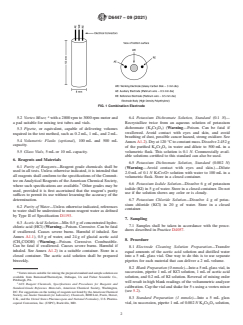
The combination electrode system (see Fig. 1) consists of a
D1193Specification for Reagent Water
glassy carbon disc (3mm diameter) working electrode, a
D3703Test Method for Hydroperoxide Number ofAviation
platinum wire (0.5mm diameter) auxiliary electrode, and a
Turbine Fuels, Gasoline and Diesel Fuels
platinum wire (0.5mm diameter) reference electrode. The
D4057Practice for Manual Sampling of Petroleum and
voltammetric analyzer applies a linear voltage ramp (0V to
Petroleum Products
−1V range with respect to the reference electrode) at a rate of
3. Summary of Test Method
0.1V⁄s to the auxiliary electrode. The current output of the
working electrode is converted to voltage by the voltammetric
3.1 A quantity of sample is contacted with aqueous potas-
analyzer,usingthegainratioof1V⁄20µA.Thepeakheightor
sium iodide solution in the presence of acid. The hydroperox-
peakareaofthevoltammetricresponsetoiodineisoutputtedto
an analog or digital recording device (0V to 1V full scale).
This test method is under the jurisdiction of ASTM Committee D02 on
Petroleum Products, Liquid Fuels, and Lubricantsand is the direct responsibility of
SubcommitteeD02.05onPropertiesofFuels,PetroleumCokeandCarbonMaterial.
Current edition approved Jan. 1, 2021. Published February 2021. Originally
approved in 1999. Last previous edition approved in 2014 as D6447–09 (2014). Voltammetric analyzers specifically designed to perform hydroperoxide value
DOI: 10.1520/D6447-09R21. determinations of aviation turbine fuels are commercially available from The
For referenced ASTM standards, visit the ASTM website, www.astm.org, or University of Dayton Research Institute. Voltammographs, which can be set up to
contactASTM Customer Service at service@astm.org. ForAnnual Book ofASTM perform hydroperoxide value determinations of aviation turbine fuels, are available
Standards volume information, refer to the standard’s Document Summary page on from BAS, West Lafayette, IN and EG&G Princeton Applied Research, Princeton,
theASTM website. NJ.
Copyright © ASTM International, 100 Barr Harbor Drive, PO Box C700, West Conshohocken, PA 19428-2959. United States
D6447 − 09 (2021)
FIG. 1 Combination Electrode
5.2 Vortex Mixer, with a 2800rpm to 3000rpm motor and 6.4 Potassium Dichromate Solution, Standard (0.1 N)—
a pad suitable for mixing test tubes and vials. Recrystallize twice from an aqueous solution of potassium
dichromate (K Cr O)(Warning—Poison. Can be fatal if
2 2 7
5.3 Pipette, or equivalent, capable of delivering volumes
swallowed. Avoid contact with eyes and skin, and avoid
required in the test method, such as 0.2mL, 1mL, and 2mL.
breathing of dust, possible cancer hazard, strong oxidizer. See
5.4 Volumetric Flasks (optional), 100mL and 500 mL
AnnexA1.2).Dryat120°Ctoconstantmass.Dissolve2.452g
capacity.
of the purified K Cr O in water and dilute to 500mL in a
2 2 7
5.5 Glass Vials, 5mL or 10 mL capacity. volumetric flask. This solution is 0.1 N. Commercially avail-
able solutions certified to this standard can also be used.
6. Reagents and Materials
6.5 Potassium Dichromate Solution, Standard (0.002 N)
6.1 Purity of Reagents—Reagent grade chemicals shall be
(Warning—Avoid contact with eyes and skin.)—Dilute
used in all tests. Unless otherwise indicated, it is intended that
2.0mL of 0.1 N K Cr O solution with water to 100mL in a
2 2 7
all reagents shall conform to the specifications of the Commit-
volumetric flask. Store in a closed container.
tee onAnalytical Reagents of theAmerican Chemical Society,
6.6 Potassium Iodide Solution—Dissolve6gof potassium
where such specifications are available. Other grades may be
iodide (KI) in5gof water. Store in a closed container. Do not
used, provided it is first ascertained that the reagent’s purity
use if the solution shows any color or is cloudy.
suffices to permit its use without lessening the accuracy of the
determination. 6.7 Potassium Chloride Solution—Dissolve4gof potas-
sium chloride (KCl) in 20 g of water. Store in a closed
6.2 Purity of Water—Unless otherwise indicated, references
container.
to water shall be understood to mean reagent water as defined
by Type II of Specification D1193.
7. Sampling
6.3 Acetic Acid Solution—Mix 0.5g of concentrated hydro-
7.1 Samples shall be taken in accordance with the proce-
chloric acid (HCl) (Warning—Poison. Corrosive. Can be fatal
dures described in Practice D4057.
if swallowed. Causes severe burns. Harmful if inhaled. See
Annex A1.1), 0.5g of water, and 24g of glacial acetic acid
8. Procedure
(CH COOH) (Warning—Poison. Corrosive. Combustible.
Can be fatal if swallowed. Causes severe burns. Harmful if 8.1 Electrode Cleaning Solution Preparation—Transfer
inhaled. See Annex A1.2) in a suitable container. Store in a
equal amounts of the acetic acid solution and distilled water
closed container. The acetic acid solution shall be prepared
intoa5mL glass vial. One way to do this is to use separate
biweekly.
pipettes for each material that can delivera2mL volume.
8.2 Blank Preparation (0 mmole)—Intoa5mLglassvial,in
succession, pipette 1 mL of KCl solution, 1 mL of acetic acid
Vortexmixerssuitableformixingthepreparedstandardandsamplesolutionare
available from Barnstead/Thermolyne, Dubuque, IA and Fisher Scientific Co.,
solution, and 0.2 mL of KI solution. Reversal of mixing order
Pittsburgh, PA.
will result in high blank readings of the voltammetric analyzer
ACS Reagent Chemicals, Specifications and Procedures for Reagents and
calibration.Capthevialandshakefor5susingavortexmixer
Standard-Grade Reference Materials, American Chemical Society, Washington,
DC. For suggestions on the testing of reagents not listed by theAmerican Chemical (see 5.2).
Society, see Analar Standards for Laboratory Chemicals, BDH Ltd., Poole, Dorset,
8.3 Standard Preparation (1 mmole)—Intoa5mL glass
U.K., and the United States Pharmacopeia and National Formulary, U.S. Pharma-
copeial Convention, Inc. (USPC), Rockville, MD. vial, in succession, pipette 1 mLof 0.002 N K Cr O solution,
2 2 7
D6447 − 09 (2021)
1mLofaceticsolution,and0.2mLofKIsolution.Capthevial the vial, cap the vial, and shake gently by hand for 2 s. Let the
and shake for 5 s using a vortex mixer (see 5.2). vial stand undisturbed for 10 s, allowi
...