

ASTM D6615-22
(Specification)Standard Specification for Jet B Wide-Cut Aviation Turbine Fuel
General Information
- Abstract
ABSTRACT
This specification covers the use of purchasing agencies in formulating specifications for purchases of aviation turbine fuel under contract. This specification defines type Jet B wide-cut aviation turbine fuel intended for use in aircraft that are certified to use such fuel. This fuel has advantages for operations in very low temperature environments compared with other fuels. The aviation turbine fuel shall consist of blends of refined hydrocarbons derived from crude petroleum, natural gasoline, or blends thereof with synthetic hydrocarbons. Additives such as antioxidants, metal deactivator, electrical conductivity additive, leak detection additive, and other additives including biocidal additive and fuel system icing inhibitor, may be added to the aviation turbine fuel in the amount and of the composition specified. The aviation turbine fuel shall conform to the requirements prescribed for the following: aromatics, mercaptan sulfur content, sulfur content, distillation temperature, distillation residue, distillation loss, density, vapor pressure, freezing point, net heat of combustion, smoke point and naphthalene content, copper strip corrosion, thermal stability such as filter pressure drop and tube deposits, existent gum, electrical conductivity, and microseparometer rating. The test methods for determining conformance to these specified requirements are given.
SCOPE
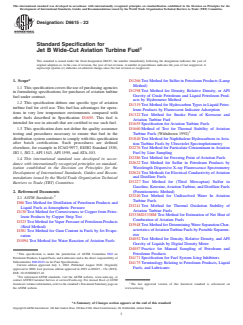
1.1 This specification covers the use of purchasing agencies in formulating specifications for purchases of aviation turbine fuel under contract.
1.2 This specification defines one specific type of aviation turbine fuel for civil use. This fuel has advantages for operations in very low temperature environments compared with other fuels described in Specification D1655. This fuel is intended for use in aircraft that are certified to use such fuel.
1.3 This specification does not define the quality assurance testing and procedures necessary to ensure that fuel in the distribution system continues to comply with this specification after batch certification. Such procedures are defined elsewhere, for example in ICAO 9977, EI/JIG Standard 1530, JIG 1, JIG 2, API 1543, API 1595, and ATA-103.
1.4 This international standard was developed in accordance with internationally recognized principles on standardization established in the Decision on Principles for the Development of International Standards, Guides and Recommendations issued by the World Trade Organization Technical Barriers to Trade (TBT) Committee.
- Status
- Published
- Publication Date
- 30-Jun-2022
- Technical Committee
- D02 - Petroleum Products, Liquid Fuels, and Lubricants
- Drafting Committee
- D02.J0.01 - Jet Fuel Specifications
Buy Documents
ASTM D6615-22 - Standard Specification for Jet B Wide-Cut Aviation Turbine Fuel
REDLINE ASTM D6615-22 - Standard Specification for Jet B Wide-Cut Aviation Turbine Fuel
Overview
ASTM D6615-22: Standard Specification for Jet B Wide-Cut Aviation Turbine Fuel is a comprehensive international standard published by ASTM. It sets forth requirements for Jet B wide-cut aviation turbine fuel, focusing on its composition, properties, performance characteristics, and approved additives. Jet B fuel is intended specifically for civil aviation and is recognized for its suitability in very low temperature environments, making it especially valuable for operations in cold climates where kerosene-type fuels may be less effective. This specification supports agencies and organizations in purchasing and supplying high-quality aviation turbine fuel under contractual agreements.
Key Topics
Fuel Composition and Properties
- Jet B fuel must be a blend of refined hydrocarbons derived from crude petroleum, natural gasoline, or blended with synthetic hydrocarbons.
- The fuel is characterized by a relatively wide boiling range and higher volatility compared to kerosene-based jet fuels.
Performance Requirements
- Critical parameters include: aromatics, sulfur content, distillation temperature and residue, density, vapor pressure, freezing point, net heat of combustion, smoke point, naphthalene content, copper strip corrosion, thermal stability, existent gum, electrical conductivity, and water separation characteristics.
Additive Use
- Allows the use of antioxidants, metal deactivators, electrical conductivity improvers, leak detection additives, biocidal additives, and fuel system icing inhibitors such as diethylene glycol monomethyl ether (DIEGME). Additives must be approved for the specific aircraft and agreed upon between supplier and purchaser.
Testing and Quality Control
- Specifies standard ASTM test methods for each required property to ensure conformance and compatibility in aircraft, including tests for density (D1298, D4052), distillation (D86), vapor pressure (D323, D5191), freezing point (D2386, D5972), and more.
Fuel Cleanliness and Handling
- Requirements for visual appearance (free from water, sediment, and suspended matter) and odor.
- Proper sampling procedures (ASTM D4057) are essential for ensuring fuel quality at the point of delivery.
Applications
- Civil Aviation: Used in aircraft certified for Jet B wide-cut fuel, especially for routes and operations encountering extremely low ambient temperatures.
- Purchasing and Contracting: Assists government and private agencies in specifying and procuring aviation turbine fuel that meets internationally recognized standards, ensuring performance and safety.
- Cold-Weather Operations: Due to its physical properties, Jet B is particularly advantageous for operations in arctic or subarctic regions.
- Fuel Handling and Maintenance: Provides clear guidelines for acceptable additives and handling practices, promoting fuel stability, storage safety, and operational reliability.
Related Standards
Organizations working with ASTM D6615-22 may also reference:
- ASTM D1655 - Specification for Aviation Turbine Fuels (kerosene-type jet fuels)
- ICAO 9977 - Civil Aviation Jet Fuel Supply guidance
- EI/JIG 1530 - Quality Assurance for aviation fuels manufacture, storage, and distribution
- API 1543 & API 1595 - Guidelines for documentation, monitoring, and storage of aviation fuels
- JIG 1 & JIG 2 - Standards for aviation fuel quality control at airports and depots
- ATA-103 - Jet Fuel Quality Control at Airports
- MIL-DTL-5624 - Military specifications for turbine fuel grades
- CAN/CGSB 3.22-97 - Canadian standard for wide-cut aviation turbine fuel
Practical Value
Adhering to ASTM D6615-22 ensures aviation turbine fuels deliver consistent performance, safety, and reliability for aircraft operations. The specification supports fuel producers, suppliers, and operators by defining robust quality benchmarks, detailed test procedures, and approved handling and additive practices. Ultimately, it helps meet regulatory requirements, mitigate operational risks, and support safe, efficient aviation operations worldwide.
Keywords: Jet B fuel, wide-cut aviation turbine fuel, aviation fuel specification, ASTM D6615-22, jet fuel standard, aviation fuel additives, cold weather aviation fuel, fuel quality control.
Relations
- Effective Date
- 15-Mar-2024
- Effective Date
- 01-Mar-2024
- Effective Date
- 01-Mar-2024
- Refers
ASTM D3241-24 - Standard Test Method for Thermal Oxidation Stability of Aviation Turbine Fuels - Effective Date
- 01-Mar-2024
- Effective Date
- 01-Mar-2024
- Refers
ASTM D4175-23a - Standard Terminology Relating to Petroleum Products, Liquid Fuels, and Lubricants - Effective Date
- 15-Dec-2023
- Effective Date
- 01-Dec-2023
- Effective Date
- 01-Dec-2023
- Effective Date
- 01-Dec-2023
- Effective Date
- 01-Nov-2023
- Effective Date
- 01-Nov-2023
- Effective Date
- 01-Oct-2023
- Refers
ASTM D3241-23ae1 - Standard Test Method for Thermal Oxidation Stability of Aviation Turbine Fuels - Effective Date
- 01-Oct-2023
- Refers
ASTM D3241-23a - Standard Test Method for Thermal Oxidation Stability of Aviation Turbine Fuels - Effective Date
- 01-Oct-2023
- Refers
ASTM D4175-23e1 - Standard Terminology Relating to Petroleum Products, Liquid Fuels, and Lubricants - Effective Date
- 01-Jul-2023
Buy Documents
ASTM D6615-22 - Standard Specification for Jet B Wide-Cut Aviation Turbine Fuel
REDLINE ASTM D6615-22 - Standard Specification for Jet B Wide-Cut Aviation Turbine Fuel
Get Certified
Connect with accredited certification bodies for this standard

DNV
DNV is an independent assurance and risk management provider.

Lloyd's Register
Lloyd's Register is a global professional services organisation specialising in engineering and technology.
DNV Energy Systems
Energy and renewable energy certification.
Sponsored listings
Frequently Asked Questions
ASTM D6615-22 is a technical specification published by ASTM International. Its full title is "Standard Specification for Jet B Wide-Cut Aviation Turbine Fuel". This standard covers: ABSTRACT This specification covers the use of purchasing agencies in formulating specifications for purchases of aviation turbine fuel under contract. This specification defines type Jet B wide-cut aviation turbine fuel intended for use in aircraft that are certified to use such fuel. This fuel has advantages for operations in very low temperature environments compared with other fuels. The aviation turbine fuel shall consist of blends of refined hydrocarbons derived from crude petroleum, natural gasoline, or blends thereof with synthetic hydrocarbons. Additives such as antioxidants, metal deactivator, electrical conductivity additive, leak detection additive, and other additives including biocidal additive and fuel system icing inhibitor, may be added to the aviation turbine fuel in the amount and of the composition specified. The aviation turbine fuel shall conform to the requirements prescribed for the following: aromatics, mercaptan sulfur content, sulfur content, distillation temperature, distillation residue, distillation loss, density, vapor pressure, freezing point, net heat of combustion, smoke point and naphthalene content, copper strip corrosion, thermal stability such as filter pressure drop and tube deposits, existent gum, electrical conductivity, and microseparometer rating. The test methods for determining conformance to these specified requirements are given. SCOPE 1.1 This specification covers the use of purchasing agencies in formulating specifications for purchases of aviation turbine fuel under contract. 1.2 This specification defines one specific type of aviation turbine fuel for civil use. This fuel has advantages for operations in very low temperature environments compared with other fuels described in Specification D1655. This fuel is intended for use in aircraft that are certified to use such fuel. 1.3 This specification does not define the quality assurance testing and procedures necessary to ensure that fuel in the distribution system continues to comply with this specification after batch certification. Such procedures are defined elsewhere, for example in ICAO 9977, EI/JIG Standard 1530, JIG 1, JIG 2, API 1543, API 1595, and ATA-103. 1.4 This international standard was developed in accordance with internationally recognized principles on standardization established in the Decision on Principles for the Development of International Standards, Guides and Recommendations issued by the World Trade Organization Technical Barriers to Trade (TBT) Committee.
ABSTRACT This specification covers the use of purchasing agencies in formulating specifications for purchases of aviation turbine fuel under contract. This specification defines type Jet B wide-cut aviation turbine fuel intended for use in aircraft that are certified to use such fuel. This fuel has advantages for operations in very low temperature environments compared with other fuels. The aviation turbine fuel shall consist of blends of refined hydrocarbons derived from crude petroleum, natural gasoline, or blends thereof with synthetic hydrocarbons. Additives such as antioxidants, metal deactivator, electrical conductivity additive, leak detection additive, and other additives including biocidal additive and fuel system icing inhibitor, may be added to the aviation turbine fuel in the amount and of the composition specified. The aviation turbine fuel shall conform to the requirements prescribed for the following: aromatics, mercaptan sulfur content, sulfur content, distillation temperature, distillation residue, distillation loss, density, vapor pressure, freezing point, net heat of combustion, smoke point and naphthalene content, copper strip corrosion, thermal stability such as filter pressure drop and tube deposits, existent gum, electrical conductivity, and microseparometer rating. The test methods for determining conformance to these specified requirements are given. SCOPE 1.1 This specification covers the use of purchasing agencies in formulating specifications for purchases of aviation turbine fuel under contract. 1.2 This specification defines one specific type of aviation turbine fuel for civil use. This fuel has advantages for operations in very low temperature environments compared with other fuels described in Specification D1655. This fuel is intended for use in aircraft that are certified to use such fuel. 1.3 This specification does not define the quality assurance testing and procedures necessary to ensure that fuel in the distribution system continues to comply with this specification after batch certification. Such procedures are defined elsewhere, for example in ICAO 9977, EI/JIG Standard 1530, JIG 1, JIG 2, API 1543, API 1595, and ATA-103. 1.4 This international standard was developed in accordance with internationally recognized principles on standardization established in the Decision on Principles for the Development of International Standards, Guides and Recommendations issued by the World Trade Organization Technical Barriers to Trade (TBT) Committee.
ASTM D6615-22 is classified under the following ICS (International Classification for Standards) categories: 27.060.10 - Liquid and solid fuel burners. The ICS classification helps identify the subject area and facilitates finding related standards.
ASTM D6615-22 has the following relationships with other standards: It is inter standard links to ASTM D1655-24, ASTM D1322-24, ASTM D3227-24, ASTM D3241-24, ASTM D1094-24, ASTM D4175-23a, ASTM D1322-23, ASTM D86-23a, ASTM D86-23ae1, ASTM D5001-23, ASTM D4865-23, ASTM D1655-23a, ASTM D3241-23ae1, ASTM D3241-23a, ASTM D4175-23e1. Understanding these relationships helps ensure you are using the most current and applicable version of the standard.
ASTM D6615-22 is available in PDF format for immediate download after purchase. The document can be added to your cart and obtained through the secure checkout process. Digital delivery ensures instant access to the complete standard document.
Standards Content (Sample)
This international standard was developed in accordance with internationally recognized principles on standardization established in the Decision on Principles for the
Development of International Standards, Guides and Recommendations issued by the World Trade Organization Technical Barriers to Trade (TBT) Committee.
Designation:D6615 −22
Standard Specification for
Jet B Wide-Cut Aviation Turbine Fuel
This standard is issued under the fixed designation D6615; the number immediately following the designation indicates the year of
original adoption or, in the case of revision, the year of last revision. A number in parentheses indicates the year of last reapproval. A
superscript epsilon (´) indicates an editorial change since the last revision or reapproval.
1. Scope* D1266 Test Method for Sulfur in Petroleum Products (Lamp
Method)
1.1 This specification covers the use of purchasing agencies
D1298 Test Method for Density, Relative Density, or API
in formulating specifications for purchases of aviation turbine
Gravity of Crude Petroleum and Liquid Petroleum Prod-
fuel under contract.
ucts by Hydrometer Method
1.2 This specification defines one specific type of aviation
D1319 Test Method for Hydrocarbon Types in Liquid Petro-
turbine fuel for civil use. This fuel has advantages for opera-
leum Products by Fluorescent Indicator Adsorption
tions in very low temperature environments compared with
D1322 Test Method for Smoke Point of Kerosene and
other fuels described in Specification D1655. This fuel is
Aviation Turbine Fuel
intended for use in aircraft that are certified to use such fuel.
D1655 Specification for Aviation Turbine Fuels
1.3 This specification does not define the quality assurance
D1660 Method of Test for Thermal Stability of Aviation
testing and procedures necessary to ensure that fuel in the Turbine Fuels (Withdrawn 1992)
distribution system continues to comply with this specification
D1840 Test Method for Naphthalene Hydrocarbons inAvia-
after batch certification. Such procedures are defined
tion Turbine Fuels by Ultraviolet Spectrophotometry
elsewhere, for example in ICAO 9977, EI/JIG Standard 1530,
D2276 Test Method for Particulate Contaminant inAviation
JIG 1, JIG 2, API 1543, API 1595, and ATA-103.
Fuel by Line Sampling
D2386 Test Method for Freezing Point of Aviation Fuels
1.4 This international standard was developed in accor-
D2622 Test Method for Sulfur in Petroleum Products by
dance with internationally recognized principles on standard-
Wavelength Dispersive X-ray Fluorescence Spectrometry
ization established in the Decision on Principles for the
D2624 Test Methods for Electrical Conductivity ofAviation
Development of International Standards, Guides and Recom-
and Distillate Fuels
mendations issued by the World Trade Organization Technical
D3227 Test Method for (Thiol Mercaptan) Sulfur in
Barriers to Trade (TBT) Committee.
Gasoline, Kerosine,Aviation Turbine, and Distillate Fuels
2. Referenced Documents (Potentiometric Method)
2 D3240 Test Method for Undissolved Water In Aviation
2.1 ASTM Standards:
Turbine Fuels
D86 Test Method for Distillation of Petroleum Products and
D3241 Test Method for Thermal Oxidation Stability of
Liquid Fuels at Atmospheric Pressure
Aviation Turbine Fuels
D130 Test Method for Corrosiveness to Copper from Petro-
D3338/D3338M Test Method for Estimation of Net Heat of
leum Products by Copper Strip Test
Combustion of Aviation Fuels
D323 TestMethodforVaporPressureofPetroleumProducts
D3948 TestMethodforDeterminingWaterSeparationChar-
(Reid Method)
acteristicsofAviationTurbineFuelsbyPortableSeparom-
D381 Test Method for Gum Content in Fuels by Jet Evapo-
eter
ration
D4052 Test Method for Density, Relative Density, and API
D1094 Test Method for Water Reaction of Aviation Fuels
Gravity of Liquids by Digital Density Meter
D4057 Practice for Manual Sampling of Petroleum and
Petroleum Products
This specification is under the jurisdiction of ASTM Committee D02 on
Petroleum Products, Liquid Fuels, and Lubricants and is the direct responsibility of
D4171 Specification for Fuel System Icing Inhibitors
Subcommittee D02.J0.01 on Jet Fuel Specifications.
D4175 Terminology Relating to Petroleum Products, Liquid
Current edition approved July 1, 2022. Published August 2022. Originally
Fuels, and Lubricants
approved in 2000. Last previous edition approved in 2019 as D6615 – 15a (2019).
DOI: 10.1520/D6615-22.
For referenced ASTM standards, visit the ASTM website, www.astm.org, or
contact ASTM Customer Service at service@astm.org. For Annual Book of ASTM
Standards volume information, refer to the standard’s Document Summary page on The last approved version of this historical standard is referenced on
the ASTM website. www.astm.org.
*A Summary of Changes section appears at the end of this standard
Copyright © ASTM International, 100 Barr Harbor Drive, PO Box C700, West Conshohocken, PA 19428-2959. United States
D6615−22
D4176 Test Method for FreeWater and Particulate Contami- 2.5 Military Standard:
nation in Distillate Fuels (Visual Inspection Procedures) MIL-DTL-5624 Turbine Fuel, Aviation, Grades JP-4, JP-5,
D4294 Test Method for Sulfur in Petroleum and Petroleum and JP-5/JP-8 ST
Products by Energy Dispersive X-ray Fluorescence Spec-
2.6 Other Standards and Guidance Material:
trometry
ATA-103 Standard for Jet Fuel Quality Control at Airports
D4306 Practice for Aviation Fuel Sample Containers for
CAN/CGSB 3.22-97 “Aviation Turbine Fuel, Wide Cut
Tests Affected by Trace Contamination
Type” includes grade Jet B and NATO grade F-40 fuel
D4529 Test Method for Estimation of Net Heat of Combus-
ICAO 9977 Manual on Civil Aviation Jet Fuel Supply
tion of Aviation Fuels
D4809 Test Method for Heat of Combustion of Liquid
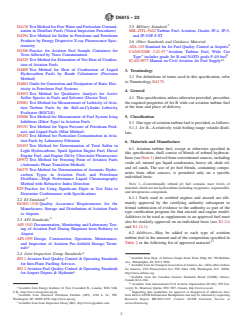
3. Terminology
Hydrocarbon Fuels by Bomb Calorimeter (Precision
3.1 For definitions of terms used in this specification, refer
Method)
to Terminology D4175.
D4865 Guide for Generation and Dissipation of Static Elec-
tricity in Petroleum Fuel Systems
4. General
D4952 Test Method for Qualitative Analysis for Active
Sulfur Species in Fuels and Solvents (Doctor Test) 4.1 Thisspecification,unlessotherwiseprovided,prescribes
the required properties of Jet B wide-cut aviation turbine fuel
D5001 Test Method for Measurement of Lubricity of Avia-
at the time and place of delivery.
tion Turbine Fuels by the Ball-on-Cylinder Lubricity
Evaluator (BOCLE)
5. Classification
D5006 Test Method for Measurement of Fuel System Icing
Inhibitors (Ether Type) in Aviation Fuels
5.1 Onetypeofaviationturbinefuelisprovided,asfollows:
D5191 Test Method for Vapor Pressure of Petroleum Prod-
5.1.1 Jet B—A relatively wide boiling range volatile distil-
ucts and Liquid Fuels (Mini Method)
late.
D5452 Test Method for Particulate Contamination in Avia-
tion Fuels by Laboratory Filtration
6. Materials and Manufacture
D5453 Test Method for Determination of Total Sulfur in
6.1 Aviation turbine fuel, except as otherwise specified in
Light Hydrocarbons, Spark Ignition Engine Fuel, Diesel
this specification, shall consist of blends of refined hydrocar-
Engine Fuel, and Engine Oil by Ultraviolet Fluorescence
bons(seeNote1)derivedfromconventionalsources,including
D5972 Test Method for Freezing Point of Aviation Fuels
crude oil, natural gas liquid condensates, heavy oil, shale oil,
(Automatic Phase Transition Method)
and oil sands. The use of jet fuel blends, containing compo-
D6379 Test Method for Determination of Aromatic Hydro-
nents from other sources, is permitted only on a specific
carbon Types in Aviation Fuels and Petroleum
individual basis.
Distillates—High Performance Liquid Chromatography
Method with Refractive Index Detection NOTE 1—Conventionally refined jet fuel contains trace levels of
materials which are not hydrocarbons including oxygenates, organosulfur,
E29 Practice for Using Significant Digits in Test Data to
and nitrogeneous compounds.
Determine Conformance with Specifications
4 6.1.1 Fuels used in certified engines and aircraft are ulti-
2.2 EI Standard:
mately approved by the certifying authority subsequent to
EI/JIG 1530 Quality Assurance Requirements for the
formal submission of evidence to the authority as part of the
Manufacture, Storage and Distribution of Aviation Fuels
type certification program for that aircraft and engine model.
to Airports
Additives to be used as supplements to an approved fuel must
2.3 API Standards:
also be similarly approved on an individual basis (see X1.2.4
API 1543 Documentation, Monitoring and Laboratory Test-
and X1.12.1).
ing of Aviation Fuel During Shipment from Refinery to
6.2 Additives—May be added to each type of aviation
Airport
turbine fuel in the amount and of the composition specified in
API 1595 Design, Construction, Operation, Maintenance,
Table 2 or the following list of approved material:
and Inspection of Aviation Pre-Airfield Storage Termi-
nals
2.4 Joint Inspection Group Standards:
Available from Dept. of Defense Single Stock Point, Bldg 4D, 700 Robbins
JIG 1 Aviation Fuel Quality Control & Operating Standards
Ave., Philadelphia, PA 19111-5098.
for Into-Plane Fuelling Services
Available fromAirTransportAssociation ofAmerica, Inc. (ATA) d/b/aAirlines
JIG 2 Aviation Fuel Quality Control & Operating Standards
for America, 1301 Pennsylvania Ave. NW, Suite 1100, Washington, D.C. 20004,
http://www.airlines.org.
for Airport Depots & Hydrants
Available from the Canadian General Standards Board (CGSB), Ottawa,
Canada K1A 1G6.
Available from International Civil Aviation Organization (ICAO), 999 Uni-
Available from Energy Institute, 61 New Cavendish St., London, WIG 7AR, versity St., Montreal, Quebec H3C 5H7, Canada, http://www.icao.int.
U.K., http://www.energyinst.org.uk. Supporting data (guidelines for approval or disapproval of additives) have
Available from American Petroleum Institute (API), 1220 L. St., NW, been filed at ASTM International Headquarters and may be obtained by requesting
Washington, DC 20005-4070, http://www.api.org. Research Report RR:D02-1125. Contact ASTM Customer Service at
Available from Joint Inspection Group (JIG), http://www.jigonline.com. service@astm.org.
D6615−22
A
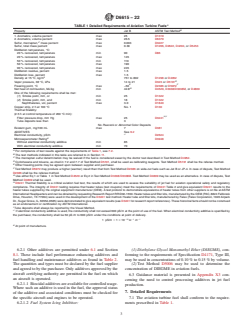
TABLE 1 Detailed Requirements of Aviation Turbine Fuels
B
Property Jet B ASTM Test Method
1. Aromatics, volume percent max 25 D1319
2. Aromatics, volume percent max 26.5 D6379
C
Sulfur, mercaptan, mass percent max 0.003 D3227
Sulfur, total mass percent max 0.30 D1266, D2622, D4294,or D5453
Distillation temperature, °C:
20 % recovered, temperature min 90 D86
20 % recovered, temperature max 145
50 % recovered, temperature min 110
50 % recovered, temperature max 190
90 % recovered, temperature max 245
Distillation residue, percent max 1.5
Distillation loss, percent max 1.5
Density at 15 °C, kg/m 751 to 802 D1298 or D4052
D
Vapor pressure, 38 °C, kPa 14 to 21 D323 or D5191
E F
Freezing point, °C max −50 D2386 or D5972
G
Net heat of combustion, MJ/kg min 42.8 D4529, D3338/D3338M,or D4809
One of the following requirements shall be met:
(1) Smoke point, mm, or min 25 D1322
(2) Smoke point, mm, and min 18 D1322
Naphthalenes, vol, percent max 3.0 D1840
Copper strip, 2 h at 100 °C No. 1 D130
Thermal Stability:
(2.5 h at control temperature of 260 °C min):
H,I
Filter pressure drop, mm Hg max 25 D3241
Tube deposits less than 3
No Peacock or Abnormal Color Deposits
Existent gum, mg/100 mL max 7 D381
ADDITIVES See 6.2
J
Electrical conductivity, pS/m D2624
K
Microseparometer Rating D3948
Without electrical conductivity additive min 85
With electrical conductivity additive min 70
A
For compliance of test results against the requirements of Table 1, see 7.2.
B
The test methods indicated in this table are referred to in Section 11.
C
The mercaptan sulfur determination may be waived if the fuel is considered sweet by the doctor test described in Test Method D4952.
D
Cyclohexane and toluene, as cited in 7.2 and 7.7 of Test Method D5191, shall be used as calibrating reagents. Test Method D5191 shall be the referee method.
E
Other freezing points may be agreed upon between supplier and purchaser.
F
Test Method D5972 may produce a higher (warmer) result than that from Test Method D2386 on wide-cut fuels such as Jet B or JP-4. In case of dispute, Test Method
D2386 shall be the referee method.
G
Use either Eq 1 or Table 1 in Test Method D4529 or Eq 2 in Test Method D3338/D3338M. Test Method D4809 may be used as an alternative. In case of dispute, Test
Method D4809 shall be used.
H
D3241 Thermal Stability is a critical aviation fuel test, the results of which are used to assess the suitability of jet fuel for aviation operational safety and regulatory
compliance. The integrity of D3241 testing requires that heater tubes (test coupons) meet the requirements of D3241 Table 2 and give equivalent D3241 results to the
heater tubes supplied by the original equipment manufacturer (OEM). A test protocol to demonstrate equivalence of heater tubes from other suppliers is on file at ASTM
International Headquarters and can be obtained by requesting Research Report RR:D02-1550. Heater tubes and filter kits, manufactured by the OEM (PAC, 8824 Fallbrook
Drive, Houston, TX 77064) were used in the development of the D3241 test method. Heater tube and filter kits, manufactured by Falex (Falex Corporation, 1020 Airpark
Dr., Sugar Grove, IL, 60554-9585) were demonstrated to give equivalent results (see D3241 for research report references). These historical facts should not be construed
as an endorsement or certification by ASTM International.
I
Tube deposits shall always be reported by the Visual Method.
J
If electrical conductivity additive is used, the conductivity shall not exceed 600 pS/m at the point of use of the fuel. When electrical conductivity additive is specified by
the purchaser, the conductivity shall be 50 pS ⁄m to 600 pS/m under the conditions at point of delivery.
212 21 21
1 pS/m5 13 10 Ω m
K
At point of manufacture.
6.2.1 Other additives are permitted under 6.1 and Section (1) Diethylene Glycol Monomethyl Ether (DIEGME), con-
8.1. These include fuel performance enhancing additives and forming to the requirements of Specification D4171, Type III,
fuel handling and maintenance additives as found in Table 2. may be used in concentrations of 0.10 % to 0.15 % by volume.
The quantities and types must be declared by the fuel supplier (2) Test Method D5006 may be used to determine the
and agreed to by the purchaser. Only additives approved by the concentration of DIEGME in aviation fuels.
aircraft certifying authority are permitted in the fuel on which
6.3 Guidance material is presented in Appendix X3 con-
an aircraft is operated.
cerning the need to control processing additives in jet fuel
6.2.1.1 Biocidaladditivesareavailableforcontrolledusage.
production.
Where such an additive is used in the fuel, the approval status
7. Detailed Requirements
of the additive and associated conditions must be checked for
the specific aircraft and engines to be operated.
7.1 The aviation turbine fuel shall conform to the require-
6.2.1.2 Fuel System Icing Inhibitor: ments prescribed in Table 1.
D6615−22
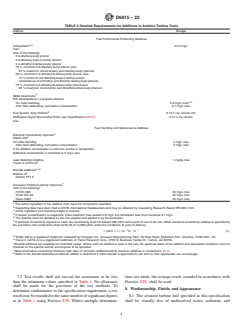
TABLE 2 Detailed Requirements for Additives in Aviation Turbine Fuels
Additive Dosage
Fuel Performance Enhancing Additives
A,B
Antioxidants 24.0 mg/L
C
max
One of the following:
2,6-ditertiary-butyl phenol
2,6-ditertiary-butyl-4-methyl phenol
2,4-dimethyl-6-tertiary-butyl phenol
75 % minimum 2,6-ditertiary-butyl phenol, plus
25 % maximum mixed tertiary and tritertiary-butyl phenols
55 % minimum 2,4-dimethyl-6-tertiary-butyl phenol, plus
15 % minimum 2,6 ditertiary-butyl-4-methyl phenol,
remainder as monomethyl and dimethyl tertiary-butyl phenols
72 % minimum 2,4-dimethyl-6-tertiary-butyl phenol plus
28 % maximum monomethyl and dimethyl-tertiary-butyl phenols
A
Metal Deactivator
N,N-disalicylidene-1,2-propane diamine
C,D
On initial blending 2.0 mg/L max
After field reblending, cumulative concentration 5.7 mg/L max
E
Fuel System Icing Inhibitor 0.10 % by volume min
Diethylene Glycol Monomethyl Ether (see Specification D4171) 0.15 % by volume
max
Fuel Handling and Maintenance Additives
F
Electrical Conductivity Improver
G
Stadis 450
On initial blending 3 mg/L max
After field reblending, cumulative concentration 5 mg/L max
If the additive concentration is unknown at time of retreatment
Additional concentration is restricted to 2 mg/L max
Leak Detection Additive 1 mg/kg max
H
Tracer A (LDTA-A)
E,I,K
Biocidal Additives
Biobore JF
Kathon FP1.5
J
Corrosion Inhibitor/Lubricity Improvers
One of the following:
HiTEC 580 23 mg/L max
Octel DCI-4A 23 mg/L max
Nalco 5403 23 mg/L max
A
The active ingredient of the additive must meet the composition specified.
B
Supporting data have been filed at ASTM International Headquarters and may be obtained by requesting Research Report RR:D02-1125.
C
Active ingredient (not including weight of solvent).
D
If copper contamination is suspected, initial treatment may exceed 2.0 mg/L but cumulative total must be below 5.7 mg/L.
E
The quantity must be declared by the fuel supplier and agreed to by the purchaser.
F
If electrical conductivity improver is used, the conductivity shall not exceed 600 pS/m at the point of use of the fuel. When electrical conductivity additive is specified by
the purchaser, the conductivity shall be 50 pS ⁄m to 600 pS/m under the conditions at point of delivery.
212 21 21
1 pS/m = 13 10 Ω m (1)
G
Stadis 450 is a registered trademark marketed by Innospec Inc., Innospec Manufacturing Park, Oil Sites Road, Ellesmere Port, Cheshire, CH65 4EH, UK.
H
Tracer A (LDTA-A) is a registered trademark of Tracer Research Corp., 3755 N. Business Center Dr., Tucson, AZ 85705.
I
Biocidal additives are available for controlled usage. Where such an additive is used in the fuel, the approval status of the additive and associated conditions must be
checked for the specific aircraft and engines to be operated.
J
More information concerning minimum treat rates of corrosion inhibitor/lubricity improver additives is contained in X1.11.
K
Refer to the Aircraft Maintenance Manual (AMM) to determine if either biocide is approved for use and for their appropriate use and dosage.
7.2 Test results shall not exceed the maximum or be less tions are made, the average result, rounded in accordance with
than the minimum values specified in Table 1. No allowance Practice E29, shall be used.
shall be made for the precision of the test methods. To
8. Workmanship, Finish, and Appearance
determine conformance to the specification requirement, a test
resultmayberoundedtothesamenumberofsignificantfigures 8.1 The aviation turbine fuel specified in this specification
as in Table 1 using Practice E29. Where multiple determina- shall be visually free of undissolved water, sediment, and
D6615−22
suspended matter. The odor of the fuel shall not be nauseating 11. Test Methods
or irritating. No substance of known dangerous toxicity under
11.1 Determine the requirements enumerated in this speci-
usualconditionsofhandlinganduseshallbepresent,exceptas
fication in accordance with the followingASTM test methods.
permitted in this specification.
11.1.1 Density—Test Methods D1298 or D4052.
11.1.2 Distillation—Test Method D86.
9. Sampling
11.1.3 Vapor Pressure—Test Methods D323 or D5191. Test
9.1 Because of the importance of proper sampling proce-
Method D5191 shall be the referee test method.
dures in establishing fuel quality, use the appropriate proce-
11.1.4 Freezing Point—TestMethodsD2386orD5972.Test
dures in Practice D4057 to obtain a representative sample from
Method D2386 shall be the referee test method.
the batch of fuel for specification compliance testing. This
11.1.5 Net Heat of Combustion—Test Methods D4529,
requirement is met by producing fuel as a discrete batch, then
D3338/D3338M,or D4809.
testing it for specification compliance. This requirement is not
11.1.6 Corrosion (Copper Strip)—Test Method D130.
satisfied by averaging online analysis results.
11.1.7 Sulfur—Test Methods D1266, D2622, D4294,or
9.2 A number of jet fuel properties, including thermal D5453.
stability, water separation, electrical conductivity, and others, 11.1.8 Mercaptan Sulfur—Test Method D3227.
11.1.9 Water Reaction—Test Method D1094.
are very sensitive to trace contamination, which can originate
from sample containers. For recommended sample containers, 11.1.10 Existent Gum—Test Method D381.
11.1.11 Thermal Stability—Test Method D3241.
refer to Practice D4306.
11.1.12 Aromatics—Test Methods D1319 or D6379. Test
10. Report
Method D1319 shall be the referee test method.
11.1.13 Smoke Point—Test Method D1322.
10.1 The type and number of reports to ensure conformance
with the requirements of this specification shall be mutually 11.1.14 Naphthalene Content—Test Method D1840.
11.1.15 Electrical Conductivity—Test Method D2624.
agreed upon by the seller and the purchaser of the aviation
turbine fuel.
12. Keywords
10.2 A suggested form for reporting inspection data on
aviation turbine fuels is given inAppendix X4 of Specification 12.1 aviationturbinefuel;avtag;JetB;jetfuel;turbinefuel;
D1655. wide-cut
APPENDIXES
(Nonmandatory Information)
X1. PERFORMANCE CHARACTERISTICS OF AVIATION TURBINE FUELS
X1.1 Introduction X1.2.2 The safe and economical operation of aircraft re-
quires fuel that is essentially clean and dry and free of any
X1.1.1 This appendix describes the performance character-
contamination prior to use. It is possible to measure a number
istics of aviation turbine fuels. A more detailed discussion of
of jet fuel characteristics related to quality.
the individual test methods and their significance is found in
ASTM Manual No. 1. Additional information on aviation
X1.2.3 The significance of standard tests for fuel properties
turbine fuel and its properties is found in ASTM’s MNL 37,
may be summarized for convenience in terms of the technical
Fuels and Lubricants Handbook: Technology, Properties,
relationships with performance characteristics as shown in
Performance, and Testing andthe Handbook of Aviation Fuel
Table X1.1.
Properties.
X1.2.4 The acceptability of additives for use must ulti-
X1.2 Significance and Use
matelybedeterminedbytheengineandaircrafttypecertificate
X1.2.1 Specification D6615 defines one type of jet fuel for
holder and must be approved by his certifying authority. In the
civil use. Limiting values for the two types of fuel covered are
UnitedStatesofAmerica,thecertifyingauthorityistheFederal
placed on fuel properties believed to be related to the perfor-
Aviation Administration.
mance of the aircraft and engines in which they are most
commonly used.
X1.3 Thermal Stability
X1.3.1 Stability to oxidation and polymerization at the
ASTM MNL 1, Manual on Significance of Tests for Petroleum Products,
operating temperatures encountered in certain jet aircraft is an
ASTM International, W. Conshohocken, 1993.
MNL 37, Fuels and Lubricants Handbook: Technology, Properties,
importantperformancerequirement.Thethermalstabilitymea-
Performance, and Testing, Eds., Totten, G. E., Westbrook, S. R., and Shah, R. J.,
surements are related to the amount of deposits formed in the
ASTM International, W. Conshohocken, PA, 2003.
engine fuel system on heating the fuel in a jet aircraft.
Handbook of Aviation Fuel Properties, Fourth Edition (2014), CRC Report
663, Coordinating Research Council, Alpharetta, GA, 30022. Commercial jet fuels should be thermally stable at fuel
D6615−22
TABLE X1.1 Performance Characteristics of Aviation Turbine Fuels
Performance Characteristics Test Method Sections
Engine fuel system deposits and coke Thermal stability X1.3
Combustion properties Smoke point X1.4.2.1
Aromatics X1.4.2.2
Percent naphthalenes X1.4.2.3
Fuel metering and aircraft range Density X1.5.1
Net heat of combustion X1.5.2
Fuel atomization Distillation X1.6.1
Vapor pressure X1.6.2
Fluidity at low temperature Freezing point X1.7.1
Compatibility with elastomer and the metals in the fuel Mercaptan sulfur X1.8.1
system and turbine Sulfur X1.8.2
Copper strip corrosion X1.8.3
Fuel storage stability Existent gum X1.9.1
Fuel cleanliness, handling Water reaction X1.10.1
Water separation characteristics X1.10.2
Free water and particulate contamination X1.10.3
Particulate matter X1.10.4
Membrane color ratings X1.10.5
Undissolved water X1.10.6
Static electricity Conductivity X1.10.7
Fuel lubricating ability (lubricity) Fuel lubricity X1.11
Miscell
...
This document is not an ASTM standard and is intended only to provide the user of an ASTM standard an indication of what changes have been made to the previous version. Because
it may not be technically possible to adequately depict all changes accurately, ASTM recommends that users consult prior editions as appropriate. In all cases only the current version
of the standard as published by ASTM is to be considered the official document.
Designation: D6615 − 15a (Reapproved 2019) D6615 − 22
Standard Specification for
Jet B Wide-Cut Aviation Turbine Fuel
This standard is issued under the fixed designation D6615; the number immediately following the designation indicates the year of
original adoption or, in the case of revision, the year of last revision. A number in parentheses indicates the year of last reapproval. A
superscript epsilon (´) indicates an editorial change since the last revision or reapproval.
1. Scope Scope*
1.1 This specification covers the use of purchasing agencies in formulating specifications for purchases of aviation turbine fuel
under contract.
1.2 This specification defines one specific type of aviation turbine fuel for civil use. This fuel has advantages for operations in very
low temperature environments compared with other fuels described in Specification D1655. This fuel is intended for use in aircraft
that are certified to use such fuel.
1.3 This specification does not define the quality assurance testing and procedures necessary to ensure that fuel in the distribution
system continues to comply with this specification after batch certification. Such procedures are defined elsewhere, for example
in ICAO 9977, EI/JIG Standard 1530, JIG 1, JIG 2, API 1543, API 1595, and ATA-103.
1.4 This international standard was developed in accordance with internationally recognized principles on standardization
established in the Decision on Principles for the Development of International Standards, Guides and Recommendations issued
by the World Trade Organization Technical Barriers to Trade (TBT) Committee.
2. Referenced Documents
2.1 ASTM Standards:
D86 Test Method for Distillation of Petroleum Products and Liquid Fuels at Atmospheric Pressure
D130 Test Method for Corrosiveness to Copper from Petroleum Products by Copper Strip Test
D323 Test Method for Vapor Pressure of Petroleum Products (Reid Method)
D381 Test Method for Gum Content in Fuels by Jet Evaporation
D1094 Test Method for Water Reaction of Aviation Fuels
D1266 Test Method for Sulfur in Petroleum Products (Lamp Method)
D1298 Test Method for Density, Relative Density, or API Gravity of Crude Petroleum and Liquid Petroleum Products by
Hydrometer Method
D1319 Test Method for Hydrocarbon Types in Liquid Petroleum Products by Fluorescent Indicator Adsorption
D1322 Test Method for Smoke Point of Kerosene and Aviation Turbine Fuel
D1655 Specification for Aviation Turbine Fuels
D1660 Method of Test for Thermal Stability of Aviation Turbine Fuels (Withdrawn 1992)
D1840 Test Method for Naphthalene Hydrocarbons in Aviation Turbine Fuels by Ultraviolet Spectrophotometry
This specification is under the jurisdiction of ASTM Committee D02 on Petroleum Products, Liquid Fuels, and Lubricants and is the direct responsibility of Subcommittee
D02.J0.01 on Jet Fuel Specifications.
Current edition approved Nov. 1, 2019July 1, 2022. Published November 2019August 2022. Originally approved in 2000. Last previous edition approved in 20152019
as D6615 – 15a.D6615 – 15a (2019). DOI: 10.1520/D6615-15AR19.10.1520/D6615-22.
For referenced ASTM standards, visit the ASTM website, www.astm.org, or contact ASTM Customer Service at service@astm.org. For Annual Book of ASTM Standards
volume information, refer to the standard’s Document Summary page on the ASTM website.
The last approved version of this historical standard is referenced on www.astm.org.
*A Summary of Changes section appears at the end of this standard
Copyright © ASTM International, 100 Barr Harbor Drive, PO Box C700, West Conshohocken, PA 19428-2959. United States
D6615 − 22
D2276 Test Method for Particulate Contaminant in Aviation Fuel by Line Sampling
D2386 Test Method for Freezing Point of Aviation Fuels
D2622 Test Method for Sulfur in Petroleum Products by Wavelength Dispersive X-ray Fluorescence Spectrometry
D2624 Test Methods for Electrical Conductivity of Aviation and Distillate Fuels
D3227 Test Method for (Thiol Mercaptan) Sulfur in Gasoline, Kerosine, Aviation Turbine, and Distillate Fuels (Potentiometric
Method)
D3240 Test Method for Undissolved Water In Aviation Turbine Fuels
D3241 Test Method for Thermal Oxidation Stability of Aviation Turbine Fuels
D3338/D3338M Test Method for Estimation of Net Heat of Combustion of Aviation Fuels
D3948 Test Method for Determining Water Separation Characteristics of Aviation Turbine Fuels by Portable Separometer
D4052 Test Method for Density, Relative Density, and API Gravity of Liquids by Digital Density Meter
D4057 Practice for Manual Sampling of Petroleum and Petroleum Products
D4171 Specification for Fuel System Icing Inhibitors
D4175 Terminology Relating to Petroleum Products, Liquid Fuels, and Lubricants
D4176 Test Method for Free Water and Particulate Contamination in Distillate Fuels (Visual Inspection Procedures)
D4294 Test Method for Sulfur in Petroleum and Petroleum Products by Energy Dispersive X-ray Fluorescence Spectrometry
D4306 Practice for Aviation Fuel Sample Containers for Tests Affected by Trace Contamination
D4529 Test Method for Estimation of Net Heat of Combustion of Aviation Fuels
D4809 Test Method for Heat of Combustion of Liquid Hydrocarbon Fuels by Bomb Calorimeter (Precision Method)
D4865 Guide for Generation and Dissipation of Static Electricity in Petroleum Fuel Systems
D4952 Test Method for Qualitative Analysis for Active Sulfur Species in Fuels and Solvents (Doctor Test)
D5001 Test Method for Measurement of Lubricity of Aviation Turbine Fuels by the Ball-on-Cylinder Lubricity Evaluator
(BOCLE)
D5006 Test Method for Measurement of Fuel System Icing Inhibitors (Ether Type) in Aviation Fuels
D5191 Test Method for Vapor Pressure of Petroleum Products and Liquid Fuels (Mini Method)
D5452 Test Method for Particulate Contamination in Aviation Fuels by Laboratory Filtration
D5453 Test Method for Determination of Total Sulfur in Light Hydrocarbons, Spark Ignition Engine Fuel, Diesel Engine Fuel,
and Engine Oil by Ultraviolet Fluorescence
D5972 Test Method for Freezing Point of Aviation Fuels (Automatic Phase Transition Method)
D6379 Test Method for Determination of Aromatic Hydrocarbon Types in Aviation Fuels and Petroleum Distillates—High
Performance Liquid Chromatography Method with Refractive Index Detection
E29 Practice for Using Significant Digits in Test Data to Determine Conformance with Specifications
2.2 IPEI Standard:
EI/JIG 1530 Quality Assurance Requirements for the Manufacture, Storage and Distribution of Aviation Fuels to Airports
2.3 API Standards:
API 1543 Documentation, Monitoring and Laboratory Testing of Aviation Fuel During Shipment from Refinery to Airport
API 1595 Design, Construction, Operation, Maintenance, and Inspection of Aviation Pre-Airfield Storage Terminals
2.4 Joint Inspection Group Standards:
JIG 1 Aviation Fuel Quality Control & Operating Standards for Into-Plane Fuelling Services
JIG 2 Aviation Fuel Quality Control & Operating Standards for Airport Depots & Hydrants
2.5 Military Standard:
MIL-DTL-5624 Turbine Fuel, Aviation, Grades JP-4, JP-5, and JP-5/JP-8 ST
2.6 Other Standards and Guidance Material:
ATA-103 Standard for Jet Fuel Quality Control at Airports
CAN/CGSB 3.22-97 “Aviation Turbine Fuel, Wide Cut Type” includes grade Jet B and NATO grade F-40 fuel
ICAO 9977 Manual on Civil Aviation Jet Fuel Supply
3. Terminology
3.1 For definitions of terms used in this specification, refer to Terminology D4175.
Available from Energy Institute, 61 New Cavendish St., London, WIG 7AR, U.K., http://www.energyinst.org.uk.
Available from American Petroleum Institute (API), 1220 L. St., NW, Washington, DC 20005-4070, http://www.api.org.
Available from Joint Inspection Group (JIG), http://www.jigonline.com.
Available from Dept. of Defense Single Stock Point, Bldg 4D, 700 Robbins Ave., Philadelphia, PA 19111-5098.
Available from Air Transport Association of America, Inc. (ATA) d/b/a Airlines for America, 1301 Pennsylvania Ave. NW, Suite 1100, Washington, D.C. 20004,
http://www.airlines.org.
Available from the Canadian General Standards Board (CGSB), Ottawa, Canada K1A 1G6.
Available from International Civil Aviation Organization (ICAO), 999 University St., Montreal, Quebec H3C 5H7, Canada, http://www.icao.int.
D6615 − 22
4. General
4.1 This specification, unless otherwise provided, prescribes the required properties of Jet B wide-cut aviation turbine fuel at the
time and place of delivery.
5. Classification
5.1 One type of aviation turbine fuel is provided, as follows:
5.1.1 Jet B—A relatively wide boiling range volatile distillate.
6. Materials and Manufacture
6.1 Aviation turbine fuel, except as otherwise specified in this specification, shall consist of blends of refined hydrocarbons (see
Note 1) derived from conventional sources, including crude oil, natural gas liquid condensates, heavy oil, shale oil, and oil sands.
The use of jet fuel blends, containing components from other sources, is permitted only on a specific individual basis.
NOTE 1—Conventionally refined jet fuel contains trace levels of materials which are not hydrocarbons including oxygenates, organosulfur, and
nitrogeneous compounds.
6.1.1 Fuels used in certified engines and aircraft are ultimately approved by the certifying authority subsequent to formal
submission of evidence to the authority as part of the type certification program for that aircraft and engine model. Additives to
be used as supplements to an approved fuel must also be similarly approved on an individual basis (see X1.2.4 and X1.12.1).
6.2 Additives—May be added to each type of aviation turbine fuel in the amount and of the composition specified in Table 2 or
the following list of approved material:
6.2.1 Other additives are permitted under 5.16.1 and Section 7.18.1. These include fuel performance enhancing additives and fuel
handling and maintenance additives as found in Table 2. The quantities and types must be declared by the fuel supplier and agreed
to by the purchaser. Only additives approved by the aircraft certifying authority are permitted in the fuel on which an aircraft is
operated.
6.2.1.1 Biocidal additives are available for controlled usage. Where such an additive is used in the fuel, the approval status of the
additive and associated conditions must be checked for the specific aircraft and engines to be operated.
6.2.1.2 Fuel System Icing Inhibitor:
(1) Diethylene Glycol Monomethyl Ether (DIEGME), conforming to the requirements of Specification D4171, Type III, may
be used in concentrations of 0.10 % to 0.15 % by volume.
(2) Test Method D5006 may be used to determine the concentration of DIEGME in aviation fuels.
6.3 Guidance material is presented in Appendix X3 concerning the need to control processing additives in jet fuel production.
7. Detailed Requirements
7.1 The aviation turbine fuel shall conform to the requirements prescribed in Table 1.
7.2 Test results shall not exceed the maximum or be less than the minimum values specified in Table 1. No allowance shall be
made for the precision of the test methods. To determine conformance to the specification requirement, a test result may be rounded
to the same number of significant figures as in Table 1 using Practice E29. Where multiple determinations are made, the average
result, rounded in accordance with Practice E29, shall be used.
8. Workmanship, Finish, and Appearance
8.1 The aviation turbine fuel specified in this specification shall be visually free of undissolved water, sediment, and suspended
Supporting data (guidelines for approval or disapproval of additives) have been filed at ASTM International Headquarters and may be obtained by requesting Research
Report RR:D02-1125. Contact ASTM Customer Service at service@astm.org.
D6615 − 22
A
TABLE 1 Detailed Requirements of Aviation Turbine Fuels
B
Property Jet B ASTM Test Method
1. Aromatics, volume percent max 25 D1319
2. Aromatics, volume percent max 26.5 D6379
C
Sulfur, mercaptan, mass percent max 0.003 D3227
Sulfur, total mass percent max 0.30 D1266, D2622, D4294, or D5453
Distillation temperature, °C:
20 % recovered, temperature min 90 D86
20 % recovered, temperature max 145
50 % recovered, temperature min 110
50 % recovered, temperature max 190
90 % recovered, temperature max 245
Distillation residue, percent max 1.5
Distillation loss, percent max 1.5
Density at 15 °C, kg/m 751 to 802 D1298 or D4052
D
Vapor pressure, 38 °C, kPa 14 to 21 D323 or D5191
E F
Freezing point, °C max −50 D2386 or D5972
G
Net heat of combustion, MJ/kg min 42.8 D4529, D3338/D3338M, or D4809
One of the following requirements shall be met:
(1) Smoke point, mm, or min 25 D1322
(2) Smoke point, mm, and min 18 D1322
Naphthalenes, vol, percent max 3.0 D1840
Copper strip, 2 h at 100 °C No. 1 D130
Thermal Stability:
(2.5 h at control temperature of 260 °C min):
H,I
Filter pressure drop, mm Hg max 25 D3241
Tube deposits less than 3
No Peacock or Abnormal Color Deposits
Existent gum, mg/100 mL max 7 D381
ADDITIVES See 5.2
ADDITIVES See 6.2
J
Electrical conductivity, pS/m D2624
K
Microseparometer Rating D3948
Without electrical conductivity additive min 85
With electrical conductivity additive min 70
A
For compliance of test results against the requirements of Table 1, see 6.27.2.
B
The test methods indicated in this table are referred to in Section 1011.
C
The mercaptan sulfur determination may be waived if the fuel is considered sweet by the doctor test described in Test Method D4952.
D
Cyclohexane and toluene, as cited in 7.2 and 7.7 of Test Method D5191, shall be used as calibrating reagents. Test Method D5191 shall be the referee method.
E
Other freezing points may be agreed upon between supplier and purchaser.
F
Test Method D5972 may produce a higher (warmer) result than that from Test Method D2386 on wide-cut fuels such as Jet B or JP-4. In case of dispute, Test Method
D2386 shall be the referee method.
G
Use either Eq 1 or Table 1 in Test Method D4529 or Eq 2 in Test Method D3338/D3338M. Test Method D4809 may be used as an alternative. In case of dispute, Test
Method D4809 shall be used.
H
D3241 Thermal Stability is a critical aviation fuel test, the results of which are used to assess the suitability of jet fuel for aviation operational safety and regulatory
compliance. The integrity of D3241 testing requires that heater tubes (test coupons) meet the requirements of D3241 Table 2 and give equivalent D3241 results to the
heater tubes supplied by the original equipment manufacturer (OEM). A test protocol to demonstrate equivalence of heater tubes from other suppliers is on file at ASTM
International Headquarters and can be obtained by requesting Research Report RR:D02-1550. Heater tubes and filter kits, manufactured by the OEM (PAC, 8824 Fallbrook
Drive, Houston, TX 77064) were used in the development of the D3241 test method. Heater tube and filter kits, manufactured by Falex (Falex Corporation, 1020 Airpark
Dr., Sugar Grove, IL, 60554-9585) were demonstrated to give equivalent results (see D3241 for research report references). These historical facts should not be construed
as an endorsement or certification by ASTM International.
I
Tube deposits shall always be reported by the Visual Method.
J
If electrical conductivity additive is used, the conductivity shall not exceed 600 pS/m at the point of use of the fuel. When electrical conductivity additive is specified by
the purchaser, the conductivity shall be 50 pS ⁄m to 600 pS/m under the conditions at point of delivery.
212 21 21
1 pS/m51310 Ω m
K
At point of manufacture.
matter. The odor of the fuel shall not be nauseating or irritating. No substance of known dangerous toxicity under usual conditions
of handling and use shall be present, except as permitted in this specification.
9. Sampling
9.1 Because of the importance of proper sampling procedures in establishing fuel quality, use the appropriate procedures in
Practice D4057 to obtain a representative sample from the batch of fuel for specification compliance testing. This requirement is
met by producing fuel as a discrete batch, then testing it for specification compliance. This requirement is not satisfied by averaging
online analysis results.
9.2 A number of jet fuel properties, including thermal stability, water separation, electrical conductivity, and others, are very
sensitive to trace contamination, which can originate from sample containers. For recommended sample containers, refer to
Practice D4306.
D6615 − 22
TABLE 2 Detailed Requirements for Additives in Aviation Turbine Fuels
Additive Dosage
Fuel Performance Enhancing Additives
A,B
Antioxidants 24.0 mg/L
C
max
One of the following:
2,6-ditertiary-butyl phenol
2,6-ditertiary-butyl-4-methyl phenol
2,4-dimethyl-6-tertiary-butyl phenol
75 % minimum 2,6-ditertiary-butyl phenol, plus
25 % maximum mixed tertiary and tritertiary-butyl phenols
55 % minimum 2,4-dimethyl-6-tertiary-butyl phenol, plus
15 % minimum 2,6 ditertiary-butyl-4-methyl phenol,
remainder as monomethyl and dimethyl tertiary-butyl phenols
72 % minimum 2,4-dimethyl-6-tertiary-butyl phenol plus
28 % maximum monomethyl and dimethyl-tertiary-butyl phenols
A
Metal Deactivator
N,N-disalicylidene-1,2-propane diamine
C,D
On initial blending 2.0 mg/L max
After field reblending, cumulative concentration 5.7 mg/L max
E
Fuel System Icing Inhibitor 0.10 % by volume min
Diethylene Glycol Monomethyl Ether (see Specification D4171) 0.15 % by volume
max
Fuel Handling and Maintenance Additives
F
Electrical Conductivity Improver
G
Stadis 450
On initial blending 3 mg/L max
After field reblending, cumulative concentration 5 mg/L max
If the additive concentration is unknown at time of retreatment
Additional concentration is restricted to 2 mg/L max
Leak Detection Additive 1 mg/kg max
H
Tracer A (LDTA-A)
E,I,K
Biocidal Additives
Biobore JF
Kathon FP1.5
J
Corrosion Inhibitor/Lubricity Improvers
One of the following:
HiTEC 580 23 mg/L max
Octel DCI-4A 23 mg/L max
Nalco 5403 23 mg/L max
A
The active ingredient of the additive must meet the composition specified.
B
Supporting data have been filed at ASTM International Headquarters and may be obtained by requesting Research Report RR:D02-1125.
C
Active ingredient (not including weight of solvent).
D
If copper contamination is suspected, initial treatment may exceed 2.0 mg/L but cumulative total must be below 5.7 mg/L.
E
The quantity must be declared by the fuel supplier and agreed to by the purchaser.
F
If electrical conductivity improver is used, the conductivity shall not exceed 600 pS/m at the point of use of the fuel. When electrical conductivity additive is specified by
the purchaser, the conductivity shall be 50 pS ⁄m to 600 pS/m under the conditions at point of delivery.
212 21 21
1 pS/m = 1 310 Ω m (1)
G
Stadis 450 is a registered trademark marketed by Innospec Inc., Innospec Manufacturing Park, Oil Sites Road, Ellesmere Port, Cheshire, CH65 4EH, UK.
H
Tracer A (LDTA-A) is a registered trademark of Tracer Research Corp., 3755 N. Business Center Dr., Tucson, AZ 85705.
I
Biocidal additives are available for controlled usage. Where such an additive is used in the fuel, the approval status of the additive and associated conditions must be
checked for the specific aircraft and engines to be operated.
J
More information concerning minimum treat rates of corrosion inhibitor/lubricity improver additives is contained in X1.11.
K
Refer to the Aircraft Maintenance Manual (AMM) to determine if either biocide is approved for use and for their appropriate use and dosage.
10. Report
10.1 The type and number of reports to ensure conformance with the requirements of this specification shall be mutually agreed
upon by the seller and the purchaser of the aviation turbine fuel.
10.2 A suggested form for reporting inspection data on aviation turbine fuels is given in Appendix X4 of Specification D1655.
D6615 − 22
11. Test Methods
11.1 Determine the requirements enumerated in this specification in accordance with the following ASTM test methods.
11.1.1 Density—Test Methods D1298 or D4052.
11.1.2 Distillation—Test Method D86.
11.1.3 Vapor Pressure—Test Methods D323 or D5191. Test Method D5191 shall be the referee test method.
11.1.4 Freezing Point—Test Methods D2386 or D5972. Test Method D2386 shall be the referee test method.
11.1.5 Net Heat of Combustion—Test Methods D4529, D3338/D3338M, or D4809.
11.1.6 Corrosion (Copper Strip)—Test Method D130.
11.1.7 Sulfur—Test Methods D1266, D2622, D4294, or D5453.
11.1.8 Mercaptan Sulfur—Test Method D3227.
11.1.9 Water Reaction—Test Method D1094.
11.1.10 Existent Gum—Test Method D381.
11.1.11 Thermal Stability—Test Method D3241.
11.1.12 Aromatics—Test Methods D1319 or D6379. Test Method D1319 shall be the referee test method.
11.1.13 Smoke Point—Test Method D1322.
11.1.14 Naphthalene Content—Test Method D1840.
11.1.15 Electrical Conductivity—Test Method D2624.
12. Keywords
12.1 aviation turbine fuel; avtag; Jet B; jet fuel; turbine fuel; wide-cut
APPENDIXES
(Nonmandatory Information)
X1. PERFORMANCE CHARACTERISTICS OF AVIATION TURBINE FUELS
X1.1 Introduction
X1.1.1 This appendix describes the performance characteristics of aviation turbine fuels. A more detailed discussion of the
individual test methods and their significance is found in ASTM Manual No. 1. Additional information on aviation turbine fuel
and its properties is found in ASTM’s MNL 37, Fuels and Lubricants Handbook: Technology, Properties, Performance, and
13 14
Testing and the Handbook of Aviation Fuel Properties.
ASTM MNL 1, Manual on Significance of Tests for Petroleum Products, ASTM International, W. Conshohocken, 1993.
MNL 37, Fuels and Lubricants Handbook: Technology, Properties, Performance, and Testing, Eds., Totten, G. E., Westbrook, S. R., and Shah, R. J., ASTM International,
W. Conshohocken, PA, 2003.
Handbook of Aviation Fuel Properties, Fourth Edition (2014), CRC Report 663, Coordinating Research Council, Alpharetta, GA, 30022.
D6615 − 22
X1.2 Significance and Use
X1.2.1 Specification D6615 defines one type of jet fuel for civil use. Limiting values for the two types of fuel covered are placed
on fuel properties believed to be related to the performance of the aircraft and engines in which they are most commonly used.
X1.2.2 The safe and economical operation of aircraft requires fuel that is essentially clean and dry and free of any contamination
prior to use. It is possible to measure a number of jet fuel characteristics related to quality.
X1.2.3 The significance of standard tests for fuel properties may be summarized for convenience in terms of the technical
relationships with performance characteristics as shown in Table X1.1.
X1.2.4 The acceptability of additives for use must ultimately be determined by the engine and aircraft type certificate holder and
must be approved by his certifying authority. In the United States of America, the certifying authority is the Federal Aviation
Administration.
X1.3 Thermal Stability
X1.3.1 Stability to oxidation and polymerization at the operating temperatures encountered in certain jet aircraft is an important
performance requirement. The thermal stability measurements are related to the amount of deposits formed in the engine fuel
system on heating the fuel in a jet aircraft. Commercial jet fuels should be thermally stable at fuel temperature as high as 163 °C
(325 °F). Such fuels have been demonstrated to have inherent storage stability.
X1.3.2 In 1973, Test Method D3241 replaced Method of Test D1660, known as the ASTM Coker for the determination of
oxidative thermal stability. (See CRC Report 450, dated 1969 and revised in 1972. See also Bert and Painter’s SAE paper
TABLE X1.1 Performance Characteristics of Aviation Turbine Fuels
Performance Characteristics Test Method Sections
Engine fuel system deposits and coke Thermal stability X1.3
Combustion properties Smoke point X1.4.2.1
Aromatics X1.4.2.2
Percent naphthalenes X1.4.2.3
Fuel metering and aircraft range Density X1.5.1
Net heat of combustion X1.5.2
Fuel atomization Distillation X1.6.1
Vapor pressure X1.6.2
Fluidity at low temperature Freezing point X1.7.1
Compatibility with elastomer and the metals in the fuel Mercaptan sulfur X1.8.1
system and turbine Sulfur X1.8.2
Copper strip corrosion X1.8.3
Fuel storage stability Existent gum X1.9.1
Fuel cleanliness, handl
...