

ASTM A352/A352M-21
(Specification)Standard Specification for Steel Castings, Ferritic and Martensitic, for Pressure-Containing Parts, Suitable for Low-Temperature Service
General Information
- Abstract
ABSTRACT
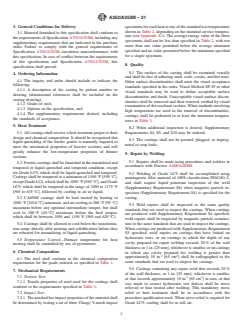
This specification covers steel castings for valves, flanges, fittings, and other pressure-containing parts intended primarily for low-temperature service. Several grades of ferritic steels and one grade of martensitic steel are covered. All castings shall receive a heat treatment proper to their design and chemical composition. It should be recognized that liquid quenching of the ferritic grades is normally required to meet the mechanical properties of heavier sections. The steel shall conform to the requirements as to chemical composition specified. Tensile test and impact test shall be made to conform to the requirements specified.
SCOPE
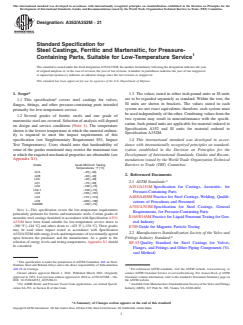
1.1 This specification2 covers steel castings for valves, flanges, fittings, and other pressure-containing parts intended primarily for low-temperature service.
1.2 Several grades of ferritic steels and one grade of martensitic steel are covered. Selection of analysis will depend on design and service conditions (Note 1). The temperature shown is the lowest temperature at which the material ordinarily is required to meet the impact requirements of this specification (see Supplementary Requirement S51, Impact Test Temperatures). Users should note that hardenability of some of the grades mentioned may restrict the maximum size at which the required mechanical properties are obtainable (see Appendix X1).
Grade
Usual Minimum Testing
Temperatures, °F [°C]
LCA
−25 [–32]
LCB
−50 [–46]
LCC
−50 [–46]
LC1
−75 [–59]
LC2
−100 [–73]
LC2-1
−100 [–73]
LC3
−150 [–101]
LC4
−175 [–115]
LC9
−320 [–196]
CA6NM
−100 [−73]
Note 1: This specification covers the low-temperature requirements particularly pertinent for ferritic and martensitic steels. Certain grades of austenitic steel castings furnished in accordance with Specification A351/A351M have been found suitable for low-temperature service down to −300 °F [−184 °C] and others down to −425 °F [−254 °C]. These grades may be used when impact tested in accordance with Specification A352/A352M with energy levels and temperatures of test mutually agreed upon between the purchaser and the manufacturer. As a guide to the selection of energy levels and testing temperatures, Appendix X1 should be consulted.
1.3 The values stated in either inch-pound units or SI units are to be regarded separately as standard. Within the text, the SI units are shown in brackets. The values stated in each system are not exact equivalents; therefore, each system must be used independently of the other. Combining values from the two systems may result in nonconformance with the specification. Inch-pound units are applicable for material ordered to Specification A352 and SI units for material ordered to Specification A352M.
1.4 This international standard was developed in accordance with internationally recognized principles on standardization established in the Decision on Principles for the Development of International Standards, Guides and Recommendations issued by the World Trade Organization Technical Barriers to Trade (TBT) Committee.
- Status
- Published
- Publication Date
- 28-Feb-2021
- Technical Committee
- A01 - Steel, Stainless Steel and Related Alloys
- Drafting Committee
- A01.18 - Castings
Buy Documents
ASTM A352/A352M-21 - Standard Specification for Steel Castings, Ferritic and Martensitic, for Pressure-Containing Parts, Suitable for Low-Temperature Service
REDLINE ASTM A352/A352M-21 - Standard Specification for Steel Castings, Ferritic and Martensitic, for Pressure-Containing Parts, Suitable for Low-Temperature Service
Overview
ASTM A352/A352M-21 is the international standard specification developed by ASTM International for steel castings made from ferritic and martensitic alloys, specifically designed for use in pressure-containing parts operating at low temperatures. This standard applies to castings used in valves, flanges, fittings, and other critical pressure components. The specification outlines multiple steel grades, addresses necessary heat treatments, and includes all requirements for mechanical properties, chemical composition, and necessary testing methods to ensure performance and safety in challenging, low-temperature environments.
Key Topics
Scope and Grades
- Covers several grades of ferritic steels and one grade of martensitic steel.
- Material selection depends on design and service conditions, including minimum required impact temperatures.
Suitable Applications
- Intended for steel castings in valves, flanges, fittings, and other pressure-retaining parts exposed to low-temperature service.
- Grades support minimum testing temperatures ranging from -25°F to -320°F (-32°C to -196°C).
Heat Treatment Requirements
- All ferritic and martensitic steel castings must undergo appropriate heat treatment, such as normalizing, tempering, or liquid quenching.
- Proper heat treatment is essential to achieve the required mechanical properties, especially in thick sections.
Mechanical and Chemical Properties
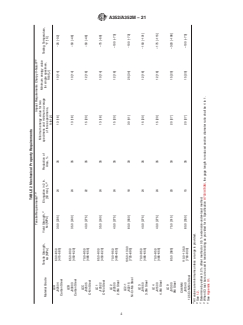
- Defines tensile strength, yield strength, elongation, and Charpy V-notch impact requirements for each grade.
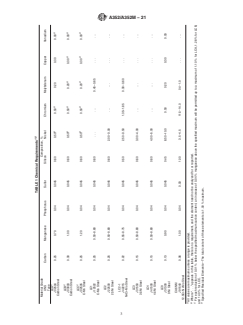
- Steels must meet specified chemical compositions for carbon, manganese, phosphorus, sulfur, and other alloying elements.
Testing and Quality Assurance
- Mandatory tensile and impact tests ensure materials meet mechanical property criteria at designated low temperatures.
- Supplementary tests include magnetic particle inspection, radiographic examination, and liquid penetrant testing.
- Surface quality must conform to established standards, such as MSS SP-55.
Repair and Marking
- Specifies standards for welding repairs, including required inspections and post-weld heat treatments.
- Product markings must indicate heat treatment condition and compliance with test requirements.
Applications
ASTM A352/A352M-21 steel castings are widely used in industries requiring reliable pressure-containing components that maintain toughness and prevent brittle failures at low temperatures. These sectors include:
- Oil and Gas: Cryogenic service valves, pipeline fittings, and flanges for liquefied gas transport and storage.
- Petrochemical Processing: Reactors and pressure vessels in environments prone to sub-zero temperatures.
- Power Generation: Low-temperature steam and gas applications requiring robust pressure-retaining parts.
- Industrial Gas: Equipment for the storage, handling, and transport of compressed or liquefied industrial gases.
By specifying minimum mechanical properties and appropriate testing protocols, the standard ensures that low-temperature steel castings offer superior safety and durability under demanding service conditions.
Related Standards
The following standards are commonly referenced alongside ASTM A352/A352M-21 or provide complementary requirements:
- ASTM A703/A703M: General requirements for steel castings intended for pressure-containing parts.
- ASTM A351/A351M: Standard for austenitic steel castings for similar applications, particularly at even lower temperatures.
- ASTM A488/A488M: Practice for steel castings, welding, and qualification procedures.
- ASTM E165/E165M: Practice for liquid penetrant inspection in general industry.
- ASTM E709: Guide for magnetic particle inspection.
- MSS SP-55: Quality standard for steel castings for visual inspection.
- ASME SA-352: Equivalent specification for use in ASME Boiler and Pressure Vessel Code applications.
Practical Value
Compliance with ASTM A352/A352M-21 ensures high-quality steel castings that support operational safety, reliability, and compliance in critical pressure-containing systems exposed to low temperatures. This standard is essential for manufacturers, designers, engineers, and procurement professionals involved in material selection, equipment fabrication, and maintenance of pressure systems in regulated industries.
Keywords: ASTM A352, low-temperature steel castings, ferritic steel, martensitic steel, pressure-containing parts, valves, flanges, fittings, mechanical properties, impact testing, cryogenic service, petrochemical, oil and gas, quality assurance.
Relations
- Effective Date
- 01-Mar-2024
- Effective Date
- 01-Sep-2018
- Effective Date
- 01-Jul-2018
- Effective Date
- 01-Jul-2018
- Effective Date
- 01-May-2018
- Effective Date
- 01-May-2018
- Effective Date
- 01-Nov-2017
- Effective Date
- 01-May-2017
- Effective Date
- 01-May-2017
- Refers
ASTM A351/A351M-16 - Standard Specification for Castings, Austenitic, for Pressure-Containing Parts - Effective Date
- 01-May-2016
- Effective Date
- 01-Mar-2016
- Refers
ASTM A351/A351M-15 - Standard Specification for Castings, Austenitic, for Pressure-Containing Parts - Effective Date
- 01-Sep-2015
- Effective Date
- 01-Jun-2015
- Effective Date
- 01-Jun-2015
- Refers
ASTM A351/A351M-14 - Standard Specification for Castings, Austenitic, for Pressure-Containing Parts - Effective Date
- 01-May-2014
Buy Documents
ASTM A352/A352M-21 - Standard Specification for Steel Castings, Ferritic and Martensitic, for Pressure-Containing Parts, Suitable for Low-Temperature Service
REDLINE ASTM A352/A352M-21 - Standard Specification for Steel Castings, Ferritic and Martensitic, for Pressure-Containing Parts, Suitable for Low-Temperature Service
Get Certified
Connect with accredited certification bodies for this standard

Element Materials Technology
Materials testing and product certification.

Inštitut za kovinske materiale in tehnologije
Institute of Metals and Technology. Materials testing, metallurgical analysis, NDT.
Sponsored listings
Frequently Asked Questions
ASTM A352/A352M-21 is a technical specification published by ASTM International. Its full title is "Standard Specification for Steel Castings, Ferritic and Martensitic, for Pressure-Containing Parts, Suitable for Low-Temperature Service". This standard covers: ABSTRACT This specification covers steel castings for valves, flanges, fittings, and other pressure-containing parts intended primarily for low-temperature service. Several grades of ferritic steels and one grade of martensitic steel are covered. All castings shall receive a heat treatment proper to their design and chemical composition. It should be recognized that liquid quenching of the ferritic grades is normally required to meet the mechanical properties of heavier sections. The steel shall conform to the requirements as to chemical composition specified. Tensile test and impact test shall be made to conform to the requirements specified. SCOPE 1.1 This specification2 covers steel castings for valves, flanges, fittings, and other pressure-containing parts intended primarily for low-temperature service. 1.2 Several grades of ferritic steels and one grade of martensitic steel are covered. Selection of analysis will depend on design and service conditions (Note 1). The temperature shown is the lowest temperature at which the material ordinarily is required to meet the impact requirements of this specification (see Supplementary Requirement S51, Impact Test Temperatures). Users should note that hardenability of some of the grades mentioned may restrict the maximum size at which the required mechanical properties are obtainable (see Appendix X1). Grade Usual Minimum Testing Temperatures, °F [°C] LCA −25 [–32] LCB −50 [–46] LCC −50 [–46] LC1 −75 [–59] LC2 −100 [–73] LC2-1 −100 [–73] LC3 −150 [–101] LC4 −175 [–115] LC9 −320 [–196] CA6NM −100 [−73] Note 1: This specification covers the low-temperature requirements particularly pertinent for ferritic and martensitic steels. Certain grades of austenitic steel castings furnished in accordance with Specification A351/A351M have been found suitable for low-temperature service down to −300 °F [−184 °C] and others down to −425 °F [−254 °C]. These grades may be used when impact tested in accordance with Specification A352/A352M with energy levels and temperatures of test mutually agreed upon between the purchaser and the manufacturer. As a guide to the selection of energy levels and testing temperatures, Appendix X1 should be consulted. 1.3 The values stated in either inch-pound units or SI units are to be regarded separately as standard. Within the text, the SI units are shown in brackets. The values stated in each system are not exact equivalents; therefore, each system must be used independently of the other. Combining values from the two systems may result in nonconformance with the specification. Inch-pound units are applicable for material ordered to Specification A352 and SI units for material ordered to Specification A352M. 1.4 This international standard was developed in accordance with internationally recognized principles on standardization established in the Decision on Principles for the Development of International Standards, Guides and Recommendations issued by the World Trade Organization Technical Barriers to Trade (TBT) Committee.
ABSTRACT This specification covers steel castings for valves, flanges, fittings, and other pressure-containing parts intended primarily for low-temperature service. Several grades of ferritic steels and one grade of martensitic steel are covered. All castings shall receive a heat treatment proper to their design and chemical composition. It should be recognized that liquid quenching of the ferritic grades is normally required to meet the mechanical properties of heavier sections. The steel shall conform to the requirements as to chemical composition specified. Tensile test and impact test shall be made to conform to the requirements specified. SCOPE 1.1 This specification2 covers steel castings for valves, flanges, fittings, and other pressure-containing parts intended primarily for low-temperature service. 1.2 Several grades of ferritic steels and one grade of martensitic steel are covered. Selection of analysis will depend on design and service conditions (Note 1). The temperature shown is the lowest temperature at which the material ordinarily is required to meet the impact requirements of this specification (see Supplementary Requirement S51, Impact Test Temperatures). Users should note that hardenability of some of the grades mentioned may restrict the maximum size at which the required mechanical properties are obtainable (see Appendix X1). Grade Usual Minimum Testing Temperatures, °F [°C] LCA −25 [–32] LCB −50 [–46] LCC −50 [–46] LC1 −75 [–59] LC2 −100 [–73] LC2-1 −100 [–73] LC3 −150 [–101] LC4 −175 [–115] LC9 −320 [–196] CA6NM −100 [−73] Note 1: This specification covers the low-temperature requirements particularly pertinent for ferritic and martensitic steels. Certain grades of austenitic steel castings furnished in accordance with Specification A351/A351M have been found suitable for low-temperature service down to −300 °F [−184 °C] and others down to −425 °F [−254 °C]. These grades may be used when impact tested in accordance with Specification A352/A352M with energy levels and temperatures of test mutually agreed upon between the purchaser and the manufacturer. As a guide to the selection of energy levels and testing temperatures, Appendix X1 should be consulted. 1.3 The values stated in either inch-pound units or SI units are to be regarded separately as standard. Within the text, the SI units are shown in brackets. The values stated in each system are not exact equivalents; therefore, each system must be used independently of the other. Combining values from the two systems may result in nonconformance with the specification. Inch-pound units are applicable for material ordered to Specification A352 and SI units for material ordered to Specification A352M. 1.4 This international standard was developed in accordance with internationally recognized principles on standardization established in the Decision on Principles for the Development of International Standards, Guides and Recommendations issued by the World Trade Organization Technical Barriers to Trade (TBT) Committee.
ASTM A352/A352M-21 is classified under the following ICS (International Classification for Standards) categories: 77.140.80 - Iron and steel castings. The ICS classification helps identify the subject area and facilitates finding related standards.
ASTM A352/A352M-21 has the following relationships with other standards: It is inter standard links to ASTM A488/A488M-24, ASTM A703/A703M-18a, ASTM A488/A488M-18e1, ASTM A488/A488M-18, ASTM A351/A351M-18e1, ASTM A703/A703M-18, ASTM A703/A703M-17a, ASTM A703/A703M-17, ASTM A488/A488M-17, ASTM A351/A351M-16, ASTM A488/A488M-16, ASTM A351/A351M-15, ASTM A703/A703M-15, ASTM A703/A703M-15e1, ASTM A351/A351M-14. Understanding these relationships helps ensure you are using the most current and applicable version of the standard.
ASTM A352/A352M-21 is available in PDF format for immediate download after purchase. The document can be added to your cart and obtained through the secure checkout process. Digital delivery ensures instant access to the complete standard document.
Standards Content (Sample)
This international standard was developed in accordance with internationally recognized principles on standardization established in the Decision on Principles for the
Development of International Standards, Guides and Recommendations issued by the World Trade Organization Technical Barriers to Trade (TBT) Committee.
Designation: A352/A352M −21
Standard Specification for
Steel Castings, Ferritic and Martensitic, for Pressure-
Containing Parts, Suitable for Low-Temperature Service
This standard is issued under the fixed designationA352/A352M; the number immediately following the designation indicates the year
of original adoption or, in the case of revision, the year of last revision.Anumber in parentheses indicates the year of last reapproval.
A superscript epsilon (´) indicates an editorial change since the last revision or reapproval.
This standard has been approved for use by agencies of the U.S. Department of Defense.
1. Scope* 1.3 The values stated in either inch-pound units or SI units
are to be regarded separately as standard. Within the text, the
1.1 This specification covers steel castings for valves,
SI units are shown in brackets. The values stated in each
flanges, fittings, and other pressure-containing parts intended
system are not exact equivalents; therefore, each system must
primarily for low-temperature service.
beusedindependentlyoftheother.Combiningvaluesfromthe
1.2 Several grades of ferritic steels and one grade of
two systems may result in nonconformance with the specifi-
martensiticsteelarecovered.Selectionofanalysiswilldepend
cation. Inch-pound units are applicable for material ordered to
on design and service conditions (Note 1). The temperature
Specification A352 and SI units for material ordered to
shown is the lowest temperature at which the material ordinar-
Specification A352M.
ily is required to meet the impact requirements of this
specification (see Supplementary Requirement S51, Impact
1.4 This international standard was developed in accor-
Test Temperatures). Users should note that hardenability of
dance with internationally recognized principles on standard-
some of the grades mentioned may restrict the maximum size
ization established in the Decision on Principles for the
atwhichtherequiredmechanicalpropertiesareobtainable(see
Development of International Standards, Guides and Recom-
Appendix X1).
mendations issued by the World Trade Organization Technical
Grade Usual Minimum Testing Barriers to Trade (TBT) Committee.
Temperatures, °F [°C]
LCA −25 [–32]
2. Referenced Documents
LCB −50 [–46]
LCC −50 [–46]
LC1 −75 [–59] 2.1 ASTM Standards:
LC2 −100 [–73]
A351/A351MSpecification for Castings, Austenitic, for
LC2-1 −100 [–73]
Pressure-Containing Parts
LC3 −150 [–101]
LC4 −175 [–115] A488/A488MPractice for Steel Castings, Welding, Qualifi-
LC9 −320 [–196]
cations of Procedures and Personnel
CA6NM −100 [−73]
A703/A703M Specification for Steel Castings, General
NOTE 1—This specification covers the low-temperature requirements
Requirements, for Pressure-Containing Parts
particularly pertinent for ferritic and martensitic steels. Certain grades of
E165/E165MPractice for Liquid Penetrant Testing for Gen-
austenitic steel castings furnished in accordance with Specification A351/
A351M have been found suitable for low-temperature service down to eral Industry
−300°F [−184°C] and others down to −425°F [−254°C]. These grades
E709Guide for Magnetic Particle Testing
may be used when impact tested in accordance with Specification
2.2 Manufacturers Standardization Society of the Valve and
A352/A352Mwithenergylevelsandtemperaturesoftestmutuallyagreed
upon between the purchaser and the manufacturer. As a guide to the
Fittings Industry Standard:
selection of energy levels and testing temperatures, Appendix X1 should
SP-55Quality Standard for Steel Castings for Valves,
be consulted.
Flanges, and Fittings and Other Piping Components (Vi-
sual Method)
This specification is under the jurisdiction ofASTM Committee A01 on Steel,
Stainless Steel and RelatedAlloys and is the direct responsibility of Subcommittee
A01.18 on Castings. For referenced ASTM standards, visit the ASTM website, www.astm.org, or
Current edition approved March 1, 2021. Published March 2021. Originally contact ASTM Customer Service at service@astm.org. For Annual Book of ASTM
approved in 1952. Last previous edition approved in 2018 as A352/A352M–18a. Standards volume information, refer to the standard’s Document Summary page on
DOI: 10.1520/A0352_A0352M-21. the ASTM website.
2 4
For ASME Boiler and Pressure Vessel Code applications, see related Specifi- AvailablefromManufacturersStandardizationSocietyoftheValveandFittings
cation SA-352, in Section II of that Code. Industry (MSS), 127 Park St., NE, Vienna, VA 22180-4602.
*A Summary of Changes section appears at the end of this standard
Copyright © ASTM International, 100 Barr Harbor Drive, PO Box C700, West Conshohocken, PA 19428-2959. United States
A352/A352M − 21
3. General Conditions for Delivery specimensforeachheatatoneofthestandardtesttemperatures
shown in Table 2, depending on the intended service tempera-
3.1 Material furnished to this specification shall conform to
ture (see Appendix X1).The average energy value of the three
the requirements of Specification A703/A703M, including any
specimens shall not be less than specified in Table 2, with not
supplementary requirements that are indicated in the purchase
more than one value permitted below the average minimum
order. Failure to comply with the general requirements of
specified and no value permitted below the minimum specified
Specification A703/A703M constitutes nonconformance with
for a single specimen.
this specification. In case of conflict between the requirements
of this specification and Specification A703/A703M, this
8. Quality
specification shall prevail.
8.1 The surface of the casting shall be examined visually
4. Ordering Information
and shall be free of adhering sand, scale, cracks, and hot tears.
4.1 The inquiry and order should include or indicate the
Other surface discontinuities shall meet the visual acceptance
following:
standards specified in the order. Visual Method SP-55 or other
4.1.1 A description of the casting by pattern number or
visual standards may be used to define acceptable surface
drawing (dimensional tolerances shall be included on the
discontinuities and finish. Unacceptable visual surface discon-
casting drawing),
tinuities shall be removed and their removal verified by visual
4.1.2 Grade of steel,
examination of the resultant cavities.When methods involving
4.1.3 Options in the specification, and
high temperature are used in the removal of discontinuities,
4.1.4 The supplementary requirements desired, including
castings shall be preheated to at least the minimum tempera-
the standards of acceptance.
tures in Table 3.
5. Heat Treatment
8.2 When additional inspection is desired, Supplementary
5.1 Allcastingsshallreceiveaheattreatmentpropertotheir Requirements S4, S5, and S10 may be ordered.
design and chemical composition. It should be recognized that
8.3 The castings shall not be peened, plugged, or impreg-
liquid quenching of the ferritic grades is normally required to
nated to stop leaks.
meet the mechanical properties of heavier sections and will
greatly enhance the low-temperature properties of thinner
9. Repair by Welding
sections.
9.1 Repairs shall be made using procedures and welders in
5.2 Ferriticcastingsshallbefurnishedinthenormalizedand
accordance with Practice A488/A488M.
tempered or liquid quenched and tempered condition, except
for Grade LC9, which shall be liquid quenched and tempered.
9.2 Welding of Grade LC9 shall be accomplished using
Castings shall be tempered at a minimum of 1100°F [590°C],
nonmagnetic filler material of AWS classification ENiCrFe-2,
exceptGradeLC4,whichshallbe1050°F[565°C],andGrade
and shall require liquid penetrant inspection of the weld
LC9, which shall be tempered in the range of 1050 to 1175°F
(Supplementary Requirement S6) when magnetic particle in-
[565 to 635°C], followed by cooling in air or liquid.
spection (Supplementary Requirement S4) is specified for the
casting.
5.3 CA6NM castings shall be heat treated by heating to
1850°F[1010°C]minimum,andaircoolingto200°F[95°C]
9.3 Weld repairs shall be inspected to the same quality
maximum before any optional intermediate temper, but shall
standards that are used to inspect the castings. When castings
cool to 100°F [40°C] maximum before the final temper,
are produced with Supplementary Requirement S4 specified,
which shall be between 1050 and 1150°F [565 and 620°C].
weld repairs shall be inspected by magnetic particle examina-
5.4 Castings shall be allowed to cool below the transforma- tion to the same standards that are used to inspect the castings.
tion range directly after pouring and solidification before they
When castings are produced with Supplementary Requirement
are reheated for normalizing or liquid quenching. S5 specified, weld repairs on castings that have leaked on
hydrostatic tests, or on castings in which the depth of any
5.5 Temperature Control—Furnace temperature for heat
cavity prepared for repair welding exceeds 20% of the wall
treating shall be controlled by use of pyrometers.
thicknessor1in.[25mm],whicheverissmaller,oroncastings
6. Chemical Composition
in which any cavity prepared for welding is greater than
2 2
approximately 10 in. [65 cm ] shall be radiographed to the
6.1 The steel shall conform to the chemical composition
same standards that are used to inspect the castings.
requirements for the grade ordered, as specified in Table 1.
9.4 Castings containing any repair weld that exceeds 20%
7. Mechanical Requirements
of the wall thickness, or 1 in. [25 mm], whichever is smaller,
2 2
7.1 Tension Test:
or that exceeds approximately 10 in. [65 cm ] in area, or that
7.1.1 Tensile properties of steel used for the castings shall
was made to correct hydrostatic test defects shall be stress
conform to the requirements specified in Table 2.
relieved or heat treated after welding. This mandatory stress
7.2 Impact Test: relief or heat treatment shall be in accordance with the
7.2.1 Thenotchedbarimpactpropertiesofthematerialshall procedure qualification used. When stress relief is required for
be determined by testing a set of three Charpy V-notch impact Grade LC9, cooling shall be in still air.
A352/A352M − 21
A,B
TABLE 1 Chemical Requirements
Material Grade Composition, %
UNS Carbon Manganese Phosphorus Sulfur Silicon Nickel Chromium Molybdenum Copper Vanadium
Type
C
LCA
D D D
J02504 0.25 0.70 0.04 0.045 0.60 0.50 0.50 0.20 0.30 0.03
Carbon Steel
C
LCB
D D D D D
J03003 0.30 1.00 0.04 0.045 0.60 0.50 0.50 0.20 0.30 0.03
Carbon Steel
C
LCC
D D D D D
J02505 0.25 1.20 0.04 0.045 0.60 0.50 0.50 0.20 0.30 0.03
C-Mn Steel
LC1
J12522 0.25 0.50–0.80 0.04 0.045 0.60 . . . . . . 0.45–0.65 . . . . . .
C-Mo Steel
LC2
J22500 0.25 0.50–0.80 0.04 0.045 0.60 2.00–3.00 . . . . . . . . . . . .
2.5Ni Steel
LC2-1
J42215 0.22 0.55–0.75 0.04 0.045 0.50 2.50–3.50 1.35–1.85 0.30–0.60 . . . . . .
Ni-Cr-Mo Steel
LC3
J31550 0.15 0.50–0.80 0.04 0.045 0.60 3.00–4.00 . . . . . . . . . . . .
3.5Ni Steel
LC4
J41500 0.15 0.50–0.80 0.04 0.045 0.60 4.00–5.00 . . . . . . . . . . . .
4.5Ni Steel
LC9
J31300 0.13 0.90 0.04 0.045 0.45 8.50–10.0 0.50 0.20 0.30 0.03
9Ni Steel
CA6NM
J91540 0.06 1.00 0.04 0.03 1.00 3.5–4.5 11.5–14.0 0.4–1.0 . . . . . .
12.5Cr-Ni-Mo Steel
A
All values are maximums unless a range is provided.
B
Where “. . .” appears in this table, there is no requirement, and the element need not be analyzed for or reported.
C
For each reduction of 0.01 % below the specified maximum carbon content, an increase of 0.04 % manganese above the specified maximum will be permitted up to a maximum of 1.10 % for LCA, 1.28 % for LCB,
and 1.40 % for LCC.
D
Specified Residual Elements—The total content of these elements is 1.00 % maximum.
A352/A352M − 21
TABLE 2 Mechanical Property Requirements
A,B B,E
Tensile Requirements Impact Requirements Charpy V-Notch
Minimum energy value for two
Minimum energy value
C
Tensile Strength, Elongation in 2 in. Reduction of specimens and minimum average Testing Temperature,
Yield Strength,
Material Grade for single specimen,
D
ksi [MPa]
ksi [MPa] [50 mm], % Area, % of three specimens, °F [°C]
ft·lbf [J]
ft·lbf [J]
LCA
60.0–85.0
J02504 30.0 [205] 24 35 13 [18] 10 [14] –25 [–32]
[415–585]
Carbon Steel
LCB
65.0–90.0
J03003 35.0 [240] 24 35 13 [18] 10 [14] –50 [–46]
[450–620]
Carbon Steel
LCC
70.0–95.0
J02505 40.0 [275] 22 35
...
This document is not an ASTM standard and is intended only to provide the user of an ASTM standard an indication of what changes have been made to the previous version. Because
it may not be technically possible to adequately depict all changes accurately, ASTM recommends that users consult prior editions as appropriate. In all cases only the current version
of the standard as published by ASTM is to be considered the official document.
Designation: A352/A352M − 18a A352/A352M − 21
Standard Specification for
Steel Castings, Ferritic and Martensitic, for Pressure-
Containing Parts, Suitable for Low-Temperature Service
This standard is issued under the fixed designation A352/A352M; the number immediately following the designation indicates the year
of original adoption or, in the case of revision, the year of last revision. A number in parentheses indicates the year of last reapproval.
A superscript epsilon (´) indicates an editorial change since the last revision or reapproval.
This standard has been approved for use by agencies of the U.S. Department of Defense.
1. Scope*
1.1 This specification covers steel castings for valves, flanges, fittings, and other pressure-containing parts intended primarily for
low-temperature service.
1.2 Several grades of ferritic steels and one grade of martensitic steel are covered. Selection of analysis will depend on design and
service conditions (Note 1). The temperature shown is the lowest temperature at which the material ordinarily is required to meet
the impact requirements of this specification (see Supplementary Requirement S51, Impact Test Temperatures). Users should note
that hardenability of some of the grades mentioned may restrict the maximum size at which the required mechanical properties
are obtainable (see Appendix X1).
Grade Usual Minimum Testing
Temperatures, °F [°C]
LCA −25 [–32]
LCB −50 [–46]
LCC −50 [–46]
LC1 −75 [–59]
LC2 −100 [–73]
LC2–1 −100 [–73]
LC2-1 −100 [–73]
LC3 −150 [–101]
LC4 −175 [–115]
LC9 −320 [–196]
CA6NM −100 [−73]
NOTE 1—This specification covers the low-temperature requirements particularly pertinent for ferritic and martensitic steels. Certain grades of austenitic
steel castings furnished in accordance with Specification A351/A351M have been found suitable for low-temperature service down to −300 °F [−184 °C]
and others down to −425 °F [−254 °C]. These grades may be used when impact tested in accordance with Specification A352/A352M with energy levels
and temperatures of test mutually agreed upon between the purchaser and the manufacturer. As a guide to the selection of energy levels and testing
temperatures, Appendix X1 should be consulted.
1.3 The values stated in either inch-pound units or SI units are to be regarded separately as standard. Within the text, the SI units
are shown in brackets. The values stated in each system are not exact equivalents; therefore, each system must be used
This specification is under the jurisdiction of ASTM Committee A01 on Steel, Stainless Steel and Related Alloys and is the direct responsibility of Subcommittee A01.18
on Castings.
Current edition approved Dec. 1, 2018March 1, 2021. Published December 2018March 2021. Originally approved in 1952. Last previous edition approved in 2018 as
A352/A352M – 18.A352/A352M – 18a. DOI: 10.1520/A0352_A0352M-18A.10.1520/A0352_A0352M-21.
For ASME Boiler and Pressure Vessel Code applications, see related Specification SA-352, in Section II of that Code.
*A Summary of Changes section appears at the end of this standard
Copyright © ASTM International, 100 Barr Harbor Drive, PO Box C700, West Conshohocken, PA 19428-2959. United States
A352/A352M − 21
independently of the other. Combining values from the two systems may result in nonconformance with the specification.
Inch-pound units are applicable for material ordered to Specification A352 and SI units for material ordered to Specification
A352M.
1.4 This international standard was developed in accordance with internationally recognized principles on standardization
established in the Decision on Principles for the Development of International Standards, Guides and Recommendations issued
by the World Trade Organization Technical Barriers to Trade (TBT) Committee.
2. Referenced Documents
2.1 ASTM Standards:
A351/A351M Specification for Castings, Austenitic, for Pressure-Containing Parts
A488/A488M Practice for Steel Castings, Welding, Qualifications of Procedures and Personnel
A703/A703M Specification for Steel Castings, General Requirements, for Pressure-Containing Parts
E165/E165M Practice for Liquid Penetrant Testing for General Industry
E709 Guide for Magnetic Particle Testing
2.2 Manufacturers Standardization Society of the Valve and Fittings Industry Standard:
SP-55 Quality Standard for Steel Castings for Valves, Flanges, and Fittings and Other Piping Components (Visual Method)
3. General Conditions for Delivery
3.1 Material furnished to this specification shall conform to the requirements of Specification A703/A703M, including any
supplementary requirements that are indicated in the purchase order. Failure to comply with the general requirements of
Specification A703/A703M constitutes nonconformance with this specification. In case of conflict between the requirements of this
specification and Specification A703/A703M, this specification shall prevail.
4. Ordering Information
4.1 The inquiry and order should include or indicate the following:
4.1.1 A description of the casting by pattern number or drawing (dimensional tolerances shall be included on the casting drawing),
4.1.2 Grade of steel,
4.1.3 Options in the specification, and
4.1.4 The supplementary requirements desired, including the standards of acceptance.
5. Heat Treatment
5.1 All castings shall receive a heat treatment proper to their design and chemical composition. It should be recognized that liquid
quenching of the ferritic grades is normally required to meet the mechanical properties of heavier sections and will greatly enhance
the low-temperature properties of thinner sections.
5.2 Ferritic castings shall be furnished in the normalized and tempered or liquid quenched and tempered condition, except for
Grade LC9, which shall be liquid quenched and tempered. Castings shall be tempered at a minimum of 1100 °F [590 °C], except
Grade LC4, which shall be 1050 °F [565 °C], and Grade LC9, which shall be tempered in the range of 1050 to 1175 °F [565 to
635 °C], followed by cooling in air or liquid.
5.3 CA6NM castings shall be heat treated by heating to 1850 °F [1010 °C] minimum, and air cooling to 200 °F [95 °C] maximum
before any optional intermediate temper, but shall cool to 100 °F [40 °C] maximum before the final temper, which shall be between
1050 and 1150 °F [565 and 620 °C].
5.4 Castings shall be allowed to cool below the transformation range directly after pouring and solidification before they are
reheated for normalizing or liquid quenching.
For referenced ASTM standards, visit the ASTM website, www.astm.org, or contact ASTM Customer Service at service@astm.org. For Annual Book of ASTM Standards
volume information, refer to the standard’s Document Summary page on the ASTM website.
Available from Manufacturers Standardization Society of the Valve and Fittings Industry (MSS), 127 Park St., NE, Vienna, VA 22180-4602.
A352/A352M − 21
5.5 Temperature Control—Furnace temperature for heat treating shall be controlled by use of pyrometers.
6. Chemical Composition
6.1 The steel shall conform to the chemical composition requirements for the grade ordered, as specified in Table 1.
7. Mechanical Requirements
7.1 Tension Test:
7.1.1 Tensile properties of steel used for the castings shall conform to the requirements specified in Table 2.
7.2 Impact Test:
7.2.1 The notched bar impact properties of the material shall be determined by testing a set of three Charpy V-notch impact
specimens for each heat at one of the standard test temperatures shown in Table 2, depending on the intended service temperature
(see Appendix X1). The average energy value of the three specimens shall not be less than specified in Table 2, with not more than
one value permitted below the average minimum specified and no value permitted below the minimum specified for a single
specimen.
8. Quality
8.1 The surface of the casting shall be examined visually and shall be free of adhering sand, scale, cracks, and hot tears. Other
surface discontinuities shall meet the visual acceptance standards specified in the order. Visual Method SP-55 or other visual
standards may be used to define acceptable surface discontinuities and finish. Unacceptable visual surface discontinuities shall be
removed and their removal verified by visual examination of the resultant cavities. When methods involving high temperature are
used in the removal of discontinuities, castings shall be preheated to at least the minimum temperatures in Table 3.
8.2 When additional inspection is desired, Supplementary Requirements S4, S5, and S10 may be ordered.
8.3 The castings shall not be peened, plugged, or impregnated to stop leaks.
9. Repair by Welding
9.1 Repairs shall be made using procedures and welders in accordance with Practice A488/A488M.
9.2 Welding of Grade LC9 shall be accomplished using nonmagnetic filler material of AWS classification ENiCrFe-2, and shall
require liquid penetrant inspection of the weld (Supplementary Requirement S6) when magnetic particle inspection (Supplemen-
tary Requirement S4) is specified for the casting.
9.3 Weld repairs shall be inspected to the same quality standards that are used to inspect the castings. When castings are produced
with Supplementary Requirement S4 specified, weld repairs shall be inspected by magnetic particle examination to the same
standards that are used to inspect the castings. When castings are produced with Supplementary Requirement S5 specified, weld
repairs on castings that have leaked on hydrostatic tests, or on castings in which the depth of any cavity prepared for repair welding
exceeds 20 % of the wall thickness or 1 in. [25 mm], whichever is smaller, or on castings in which any cavity prepared for welding
2 2
is greater than approximately 10 in. [65 cm ] shall be radiographed to the same standards that are used to inspect the castings.
9.4 Castings containing any repair weld that exceeds 20 % of the wall thickness, or 1 in. [25 mm], whichever is smaller, or that
2 2
exceeds approximately 10 in. [65 cm ] in area, or that was made to correct hydrostatic test defects shall be stress relieved or heat
treated after welding. This mandatory stress relief or heat treatment shall be in accordance with the procedure qualification used.
When stress relief is required for Grade LC9, cooling shall be in still air.
10. Product Marking
10.1 All marking shall be on a raised pad using low-stress stamps.
A352/A352M − 21
A,B
TABLE 1 Chemical Requirements
Material Grade Composition, %
UNS Carbon Manganese Phosphorus Sulfur Silicon Nickel Chromium Molybdenum Copper Vanadium
Type
C
LCA
D D D
J02504 0.25 0.70 0.04 0.045 0.60 0.50 0.50 0.20 0.30 0.03
Carbon Steel
C
LCB
D D D D D
J03003 0.30 1.00 0.04 0.045 0.60 0.50 0.50 0.20 0.30 0.03
Carbon Steel
C
LCC
D D D D D
J02505 0.25 1.20 0.04 0.045 0.60 0.50 0.50 0.20 0.30 0.03
C-Mn Steel
LC1
J12522 0.25 0.50 – 0.80 0.04 0.045 0.60 . . . . . . 0.45 – 0.65 . . . . . .
C-Mo Steel
LC1
J12522 0.25 0.50–0.80 0.04 0.045 0.60 . . . . . . 0.45–0.65 . . . . . .
C-Mo Steel
LC2
J22500 0.25 0.50 – 0.80 0.04 0.045 0.60 2.00 – 3.00 . . . . . . . . . . . .
2.5Ni Steel
LC2
J22500 0.25 0.50–0.80 0.04 0.045 0.60 2.00–3.00 . . . . . . . . . . . .
2.5Ni Steel
LC2-1
J42215 0.22 0.55 – 0.75 0.04 0.045 0.50 2.50 – 3.50 1.35 – 1.85 0.30 – 0.60 . . . . . .
Ni-Cr-Mo Steel
LC2-1
J42215 0.22 0.55–0.75 0.04 0.045 0.50 2.50–3.50 1.35–1.85 0.30–0.60 . . . . . .
Ni-Cr-Mo Steel
LC3
J31550 0.15 0.50 – 0.80 0.04 0.045 0.60 3.00 – 4.00 . . . . . . . . . . . .
3.5Ni Steel
LC3
J31550 0.15 0.50–0.80 0.04 0.045 0.60 3.00–4.00 . . . . . . . . . . . .
3.5Ni Steel
LC4
J41500 0.15 0.50 – 0.80 0.04 0.045 0.60 4.00 – 5.00 . . . . . . . . . . . .
4.5Ni Steel
LC4
J41500 0.15 0.50–0.80 0.04 0.045 0.60 4.00–5.00 . . . . . . . . . . . .
4.5Ni Steel
LC9
J31300 0.13 0.90 0.04 0.045 0.45 8.50 – 10.0 0.50 0.20 0.30 0.03
9Ni Steel
LC9
J31300 0.13 0.90 0.04 0.045 0.45 8.50–10.0 0.50 0.20 0.30 0.03
9Ni Steel
CA6NM
J91540 0.06 1.00 0.04 0.03 1.00 3.5 – 4.5 11.5 – 14.0 0.4 – 1.0 . . . . . .
12.5Cr-Ni-Mo Steel
A352/A352M − 21
CA6NM
J91540 0.06 1.00 0.04 0.03 1.00 3.5–4.5 11.5–14.0 0.4–1.0 . . . . . .
12.5Cr-Ni-Mo Steel
A
All values are maximums unless a range is provided.
B
Where “. . .” appears in this table, there is no requirement, and the element need not be analyzed for or reported.
C
For each reduction of 0.01 % below the specified maximum carbon content, an increase of 0.04 % manganese above the specified maximum will be permitted up to a maximum of 1.10 % for LCA, 1.28 % for LCB,
and 1.40 % for LCC.
D
Specified Residual Elements—The total content of these elements is 1.00 % maximum.
A352/A352M − 21
TABLE 2 Mechanical Property Requirements
A,B B,E
Tensile Requirements Impact Requirements Charpy V-Notch
Minimum energy value for two
Minimum energy value
C
Tensile Strength, Elongation in 2 in. Reduction of specimens and minimum average Testing Temperature,
Yield Strength,
Material Grade for single specimen,
D
ksi [MPa]
ksi [MPa] [50 mm], % Area, % of three specimens, °F [°C]
ft·lbf [J]
ft·lbf [J]
LCA
60.0 – 85.0
J02504 30.0 [205] 24 35 13 [18] 10 [14] –25 [–32]
[415 – 585]
Carbon Steel
LCA
60.0–85.0
J02504 30.0 [205] 24 35 13 [18] 10 [14] –25 [–32]
[415–585]
Carbon Steel
LCB
65.0 – 90.0
J03003 35.0 [240] 24 35 13 [18] 10 [14] –50 [–46]
[450 – 620]
Carbon Steel
LCB
65.0–90.0
J03003 35.0 [240] 24 35 13 [18] 10 [14] –50 [–46]
[450–620]
Carbon Steel
LCC
70.0 – 95.0
J02505 40.0 [275] 22 35 15 [20] 12 [16] –50 [–46]
[485 – 655]
C-Mn Steel
LCC
70.0–95.0
J02505 40.0 [275] 22 35 15 [20] 12 [16] –50 [–46]
[485–655]
C-Mn Steel
LC1
65.0 – 90.0
J12522 35.0 [240] 24 35 13 [18] 10 [14] –75 [–59]
[450 – 620]
C-Mo Steel
LC1
65.0–90.0
J12522 35.0 [240] 24 35 13 [18] 10 [14] –75 [–59]
[450–620]
C-Mo Steel
LC2
70.0 – 95.0
J22500 40.0 [275] 24 35 15 [20] 12 [16] –100 [–
...