


ASTM D1078-11(2019)
(Test Method)Standard Test Method for Distillation Range of Volatile Organic Liquids
Standard Test Method for Distillation Range of Volatile Organic Liquids
SIGNIFICANCE AND USE
5.1 This test method provides a method of measurement of distillation range of volatile organic liquids. The relative volatility of organic liquids can be used with other tests for identification and measurement of quality. Therefore, this test method provides a test procedure for assessing compliance with a specification.
5.2 This test method also provides an empirical value of residue, solvent recovery capacity, and loss (or non-recovery) on heating. Organic liquids are used as solvents in many chemical processes. As the relative volatility, residual matter and recovery capability affect the efficiency of these processes, this test method is useful in manufacturing control.
SCOPE
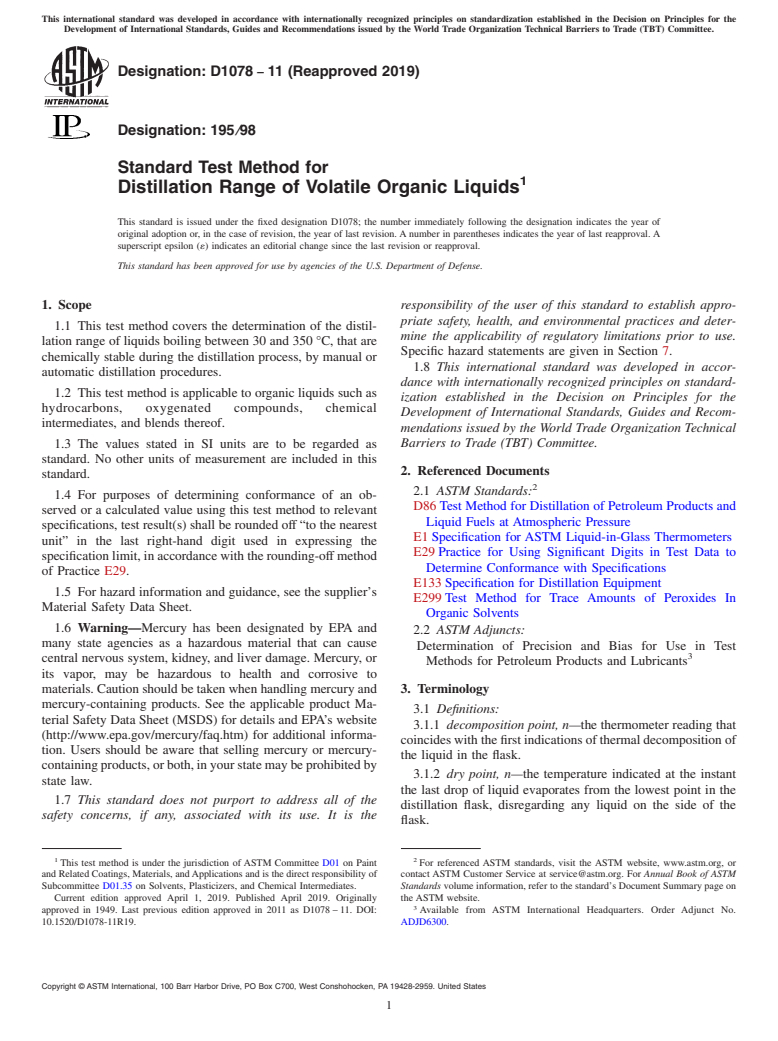
1.1 This test method covers the determination of the distillation range of liquids boiling between 30 and 350 °C, that are chemically stable during the distillation process, by manual or automatic distillation procedures.
1.2 This test method is applicable to organic liquids such as hydrocarbons, oxygenated compounds, chemical intermediates, and blends thereof.
1.3 The values stated in SI units are to be regarded as standard. No other units of measurement are included in this standard.
1.4 For purposes of determining conformance of an observed or a calculated value using this test method to relevant specifications, test result(s) shall be rounded off “to the nearest unit” in the last right-hand digit used in expressing the specification limit, in accordance with the rounding-off method of Practice E29.
1.5 For hazard information and guidance, see the supplier's Material Safety Data Sheet.
1.6 Warning—Mercury has been designated by EPA and many state agencies as a hazardous material that can cause central nervous system, kidney, and liver damage. Mercury, or its vapor, may be hazardous to health and corrosive to materials. Caution should be taken when handling mercury and mercury-containing products. See the applicable product Material Safety Data Sheet (MSDS) for details and EPA’s website (http://www.epa.gov/mercury/faq.htm) for additional information. Users should be aware that selling mercury or mercury-containing products, or both, in your state may be prohibited by state law.
1.7 This standard does not purport to address all of the safety concerns, if any, associated with its use. It is the responsibility of the user of this standard to establish appropriate safety, health, and environmental practices and determine the applicability of regulatory limitations prior to use. Specific hazard statements are given in Section 7.
1.8 This international standard was developed in accordance with internationally recognized principles on standardization established in the Decision on Principles for the Development of International Standards, Guides and Recommendations issued by the World Trade Organization Technical Barriers to Trade (TBT) Committee.
General Information
Relations
Standards Content (Sample)
This international standard was developed in accordance with internationally recognized principles on standardization established in the Decision on Principles for the
Development of International Standards, Guides and Recommendations issued by the World Trade Organization Technical Barriers to Trade (TBT) Committee.
Designation:D1078 −11 (Reapproved 2019)
Designation:195⁄98
Standard Test Method for
1
Distillation Range of Volatile Organic Liquids
This standard is issued under the fixed designation D1078; the number immediately following the designation indicates the year of
original adoption or, in the case of revision, the year of last revision. A number in parentheses indicates the year of last reapproval. A
superscript epsilon (´) indicates an editorial change since the last revision or reapproval.
This standard has been approved for use by agencies of the U.S. Department of Defense.
1. Scope responsibility of the user of this standard to establish appro-
priate safety, health, and environmental practices and deter-
1.1 This test method covers the determination of the distil-
mine the applicability of regulatory limitations prior to use.
lation range of liquids boiling between 30 and 350 °C, that are
Specific hazard statements are given in Section 7.
chemically stable during the distillation process, by manual or
1.8 This international standard was developed in accor-
automatic distillation procedures.
dance with internationally recognized principles on standard-
1.2 This test method is applicable to organic liquids such as
ization established in the Decision on Principles for the
hydrocarbons, oxygenated compounds, chemical
Development of International Standards, Guides and Recom-
intermediates, and blends thereof.
mendations issued by the World Trade Organization Technical
Barriers to Trade (TBT) Committee.
1.3 The values stated in SI units are to be regarded as
standard. No other units of measurement are included in this
2. Referenced Documents
standard.
2
2.1 ASTM Standards:
1.4 For purposes of determining conformance of an ob-
D86 Test Method for Distillation of Petroleum Products and
served or a calculated value using this test method to relevant
Liquid Fuels at Atmospheric Pressure
specifications, test result(s) shall be rounded off “to the nearest
E1 Specification for ASTM Liquid-in-Glass Thermometers
unit” in the last right-hand digit used in expressing the
E29 Practice for Using Significant Digits in Test Data to
specification limit, in accordance with the rounding-off method
Determine Conformance with Specifications
of Practice E29.
E133 Specification for Distillation Equipment
1.5 For hazard information and guidance, see the supplier’s
E299 Test Method for Trace Amounts of Peroxides In
Material Safety Data Sheet.
Organic Solvents
1.6 Warning—Mercury has been designated by EPA and
2.2 ASTM Adjuncts:
many state agencies as a hazardous material that can cause
Determination of Precision and Bias for Use in Test
3
central nervous system, kidney, and liver damage. Mercury, or
Methods for Petroleum Products and Lubricants
its vapor, may be hazardous to health and corrosive to
materials. Caution should be taken when handling mercury and 3. Terminology
mercury-containing products. See the applicable product Ma-
3.1 Definitions:
terial Safety Data Sheet (MSDS) for details and EPA’s website
3.1.1 decomposition point, n—the thermometer reading that
(http://www.epa.gov/mercury/faq.htm) for additional informa-
coincideswiththefirstindicationsofthermaldecompositionof
tion. Users should be aware that selling mercury or mercury-
the liquid in the flask.
containingproducts,orboth,inyourstatemaybeprohibitedby
3.1.2 dry point, n—the temperature indicated at the instant
state law.
the last drop of liquid evaporates from the lowest point in the
1.7 This standard does not purport to address all of the
distillation flask, disregarding any liquid on the side of the
safety concerns, if any, associated with its use. It is the
flask.
1 2
This test method is under the jurisdiction of ASTM Committee D01 on Paint For referenced ASTM standards, visit the ASTM website, www.astm.org, or
and Related Coatings, Materials, andApplications and is the direct responsibility of contact ASTM Customer Service at service@astm.org. For Annual Book of ASTM
Subcommittee D01.35 on Solvents, Plasticizers, and Chemical Intermediates. Standards volume information, refer to the standard’s Document Summary page on
Current edition approved April 1, 2019. Published April 2019. Originally the ASTM website.
3
approved in 1949. Last previous edition approved in 2011 as D1078 – 11. DOI: Available from ASTM International Headquarters. Order Adjunct No.
10.1520/D1078-11R19. ADJD6300.
Copyright © ASTM International, 100 Barr Harbor Drive, PO Box C700, West Conshohocken, PA 19428-2959. United States
1
---------------------- Page: 1 ----------------------
D1078−11 (2019)
water, rinsing with acetone, and drying.
3.1.3 initial boiling point, n—the temperature indic
...
Questions, Comments and Discussion
Ask us and Technical Secretary will try to provide an answer. You can facilitate discussion about the standard in here.